Impossible experiments

Psychology Today have asked a group of leading thinkers to discuss their ‘impossible experiment’, if the impractical, unethical or unattainable was not an obstacle to the ultimate mind and brain study.

Presumably riffing on the BPS Research Digests’ search for the ‘most important psychology experiment that’s never been done’, they’ve gathered proposals that involve everything from brain swapping to behavioural mega-economics.

My favourite is from psychologist Bella DePaulo who has come up with a cunning way of studying the psychological effects of marriage:

I’d like to take couples who are living together and randomly assign half of them to marry and the others to stay unmarried. Then we could really know something about the implications of co-habitation vs. marriage. More outrageously, take people who are not in a serious romantic relationship, and assign half of them, at random, to marry. Single people are randomly assigned to a spouse who is chosen at random, or to a spouse who fits their description of their perfect partner, or to stay single. Who do you think would end up the happiest a decade later? Same for divorce. If married parents are already at each other’s throats, is it better for the children if they divorce, or stay together? Randomly assign half of them to divorce, and half to stay together; then we’ll see. Now take married couples who say they are happy and are not considering divorce. Randomly assign half of them to divorce! Now who will be happier ten years hence?

There’s plenty more blue sky thinking, and a curious video involving a mannequin.

Link to ‘Impossible Experiments’.

What is it like to drill a hole in your head?

Neurophilosophy has secured an interview Heather Perry, a lady who has drilled a hole through her own skull as part of a self-treppaning ritual, and is asking readers to suggest questions.

Treppaning is an ancient art but for obvious reasons, it’s rarely done these days except during brain surgery.

Nevertheless, a dedicated band of devotees argue it has spiritual and psychological benefits.

I have to admit, I’m more than a little sceptical of these benefits, but I’d be fascinated to hear from anyone whose had it done.

So if you’ve got any burning questions, head on over to Neurophilosophy and Mo will select the best ones from the comments to put to Heather.

Link to Neurophilosophy call for trepanning questions.

Connected to the highways of the brain

A fantastic new study which looked at the ‘connectedness’ of the human brain has identified which aspects of the underlying network are the most important routes of communication.

The research was led by neuroscientist Patric Hagmann and combines brain imaging with network mathematics to not only visualise the brain’s network but also to understand which are the most important hubs and connections.

The study used diffusion spectrum imaging or DSI to map out the white matter wiring of the brain in five healthy individuals.

It’s a type of diffusion MRI that identifies water molecules and tracks how they move. In a glass of water, water molecules will move randomly, but when trapped inside nerve fibres, they move along the length of the fibre, allowing maps to be created from the average paths of the moving molecules.

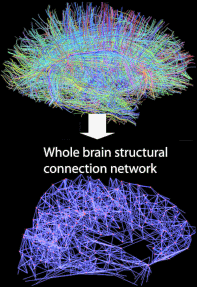
The researchers then took the maps of fibres, as illustrated by the top image, divided the brain up into sections, and created a simplified network map, shown in the bottom image, which allowed them to mathematically test how connected the different areas were.

They used network theory, more typically used in social network analysis, which allows mathematical measures of network properties.

The researchers calculated which areas were the most connected to the rest of the network in terms of connections going directly in and out of the area, but also which areas were the most strategically important ‘hubs’.

This meant the researchers could identify areas of the cortex that are the most highly connected and highly important, forming a structural core of the human brain.

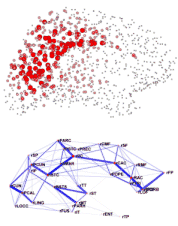
You can see two of the maps on the right. The one in red illustrates which brain areas are the most highly connected. You can see it’s the area at the top and back of the brain. As you can see better on the original image, its very centrally located, like a neural mohawk.

The image in blue on the right shows the network ‘backbone’, the information highways of the brain.

What’s perhaps most interesting it that the most connected brain areas are many of those which are more active when we’re at rest, compared to when we’re engaged in a mental task that requires concentration and effort.

This has been dubbed the ‘default network’ in the scientific literature, and, rather annoyingly, the ‘daydreaming network’ by the popular press.

It’s not entirely clear what the network is for, with some studies directly linked it to ‘stimulus independent thought’ (yes, daydreaming), while others more explicitly define it as internally focused, rather than externally focused thought and cognition.

Unfortunately, most cognitive neuroscience experiments work by measuring the effect of tasks on brain function, so a brain network which seems to be switched off by any sort of task is quite hard to study. A recent study found that even the noise of the brain scanner affects it.

Link to PLoS Biology article on brain connectivity.
Link to write-up from The New York Times.
Link to write-up from Neurophilosophy.
Link to write-up from Science News.

Clutter press

For those wanting an update on the ‘phone network causes suicide’ nonsense that inexplicably made it onto the front page on a national newspaper, Ben Goldacre over at Bad Science contacted the person behind the story who apparently claims to have ‘lost’ the data behind the nonsensical claims.

I contacted Dr Coghill, since his work is now a matter of great public concern, and it is vital his evidence can be properly assessed. He was unable to give me the data. No paper has been published. He himself would not describe the work as a “study”. There are no statistics presented on it, and I cannot see the raw figures. In fact Dr Coghill tells me he has lost the figures. Despite its potentially massive public health importance, Dr Coghill is sadly unable to make his material assessable.

The claims didn’t even make sense as they were reported, and the fact this sort of rubbish managed to get on the front page of a paper is quite shocking.

Bad Science does a great job of picking up on all the bizarre angles of this ‘funny if it wasn’t so influential’ piece of headline scaremongering.

Link to Bad Science on Coghill nonsense.

Intuitions about phenomenal consciousness

Illustrating how this ‘experimental philosophy’ idea has really struck a chord, Scientific American Mind has an article on our intuitions about whether things can have mental states, whether that be animals, humans, machines or corporations.

The piece is by philosopher Joshua Kobe and contains lots of fascinating examples of how we tend to be comfortable attributing mental states likes ‘beliefs’ to corporations, but not emotions.

The same goes for robots, it turns out, but one key factor seems to be not what we think about its thinking ‘machinery’ but how human the body seems.

In one of Huebner’s studies [pdf], for example, subjects were told about a robot who acted exactly like a human being and asked what mental states that robot might be capable of having. Strikingly, the study revealed exactly the same asymmetry we saw above in the case of corporations.

Subjects were willing to say:
• It believes that triangles have three sides.
But they were not willing to say:
• It feels happy when it gets what it wants.

Here again, we see a willingness to ascribe certain kinds of mental states, but not to ascribe states that require phenomenal consciousness. Interestingly enough, this tendency does not seem to be due entirely to the fact that a CPU, instead of an ordinary human brain, controls the robot. Even controlling in the experiment for whether the creature had a CPU or a brain, subjects were more likely to ascribe phenomenal consciousness when the creature had a body that made it look like a human being.

Link to ‘Can a Robot, an Insect or God Be Aware?’
pdf of draft Huebner paper.

Dan Gilbert on the importance of social psychology

Dan Gilbert has a brief interview in this month’s (paywalled) Psychologist magazine. From which the following nugget of wisdom:


Psychologists have a penchant for irrational exuberances, and whenever we discover something new we feel the need to discard everything old. Social psychology is the exception. We kept cognition alive during the behaviourist revolution that denied it, we kept emotion alive during the cognitive revolution that ignored it, and today we are keeping behaviour alive as the neuroscience revolution steams on and threatens
to make it irrelevant. But psychological revolutions inevitably collapse under their own weight and psychologists start hunting for all the babies they tossed out with the bathwater. Social psychology is where they typically go to find them. So the challenge for social psychologists watching yet another revolution that promises to leave them in the dustbin of history is to remember that we’ve outlived every revolutionary who has ever pronounced us obsolete.

Link Gilbert Lab
Link Psychologist Magazine (sorry, subscribers only, but you can browse issues older than six months for free)

Arch of Hysteria

I’ve just bought an excellent book called Invention of Hysteria which is about how the use of photography by the 19th century French neurologist Jean-Martin Charcot helped shape the our concepts of ‘hysteria‘ – a disorder where psychological disturbances manifest themselves as what seem like neurological symptoms.

Such patients would today be diagnosed with ‘conversion disorder’, usually after presenting to a neurology clinic with paralysis, blindness or epilepsy, only for it to be found that there is no damage to any of the areas you might expect or no seizure activity in the brain during a ‘fit’.

Importantly, the patients aren’t ‘faking’, they genuinely experience themselves as paralysed, blind, or otherwise impaired.

What recent research suggests is that there may be a disturbance in higher level brain function which may be suppressing normal actions or sensation.

To use a business analogy, none of the workers are on strike but the management is causing problems so the work can’t be carried out.

Charcot revived interest in this disorder through his weekly, somewhat theatrical, case demonstrations, and, as the book discusses, through some striking and equally theatrical photos and illustrations.

This wonderfully illustrated book examines the history of Charcot’s work at the Salp√™tri√®re, the famous Paris hospital, and how the newly developed technology of photography played a key role in popularising the disorder and shaping our ideas about hysteria.

In the last few decades of the nineteenth century, the Salpêtrière was what it had always been: a kind of feminine inferno, a citta dolorosa confining four thousand incurable or mad women. It was a nightmare in the midst of Paris’s Belle Epoque.

This is where Charcot rediscovered hysteria. I attempt to retrace how he did so, amidst all the various clinical and experimental procedures, through hypnosis and the spectacular presentations of patients having hysterical attacks in the amphitheater where he held his famous Tuesday Lectures. With Charcot we discover the capacity of the hysterical body, which is, in fact, prodigious. It is prodigious; it surpasses the imagination, surpasses “all hopes,” as they say.

Whose imagination? Whose hopes? There’s the rub. What the hysterics of the Salpêtrière could exhibit with their bodies betokens an extraordinary complicity between patients and doctors, a relationship of desires, gazes, and knowledge. This relationship is interrogated here.

What still remains with us is the series of images of the Iconographie photographique de la Salpêtrière. It contains everything: poses, attacks, cries, “attitudes passionnelles,” “crucifixions,” “ecstasy,” and all the postures of delirium. If everything seems to be in these images, it is because photography was in the ideal position to crystallize the link between the fantasy of hysteria and the fantasy of knowledge.

A reciprocity of charm was instituted between physicians, with their insatiable desire for images of Hysteria, and hysterics, who willingly participated and actually raised the stakes through their increasingly theatricalized bodies. In this way, hysteria in the clinic became the spectacle, the invention of hysteria. Indeed, hysteria was covertly identified with something like an art, close to theater or painting.

The book’s website has the first chapter freely available, but sadly none of the photos.

Most of Charcot’s books, containing many of the wonderful illustrations and photos, are listed on Google Books but for some reason I can’t work out, you can’t view the pages.

As they were published in the late 1800s, they should be well out of copyright, so its a bit frustrating we can’t read them.

To give you an idea, however, the illustration on the left is the ‘Grande Hysterie Full Arch’, one of Charcot’s classifications of hysterical epilepsy.

This is one of Charcot’s many illustrations of amazing bodily contortions that was used as inspiration by the famed and somewhat eccentric French sculptor Louise Bourgeois, as you can see in a (possibly NSFW?) article on her work from the Tate magazine.

Link to details of book with sample chapter.

Out of body experiences and grasping the ungraspable

This week’s ABC Radio National’s All in the Mind discusses what happens in the brain during out of body experiences, and why actions can be accurate even when our perceptions are not.

The first interview is with neurologist Olaf Blanke who discusses some of his recent compelling research, including a virtual reality experiment to induce out-of-body touch sensations in healthy participants and one with implanted brain electrodes to trigger full-blown out-of-body experiences in patients undergoing neurosurgery.

The second interview is with psychologist Melvyn Goodale, famous for his work on distinguishing the visual streams in the brain: the dorsal stream and the ventral stream.

Some of the most striking and important results from this work come from patients who have suffered damage to one or the other stream.

In the programme, Goodale talks about brain-injured patient DF, who can correctly and accurately grasp objects she cannot consciously ‘see’. The opposite has been found in other patients, who can accurately see and describe objects they cannot accurately grasp.

This suggests that these two visual pathways, although complimentary, are specialised for different things, one for identifying objects, and the other for working out where they are and how to manipulate them.

The different function of the two pathways can also be demonstrated in healthy people as well.

You may recognise the visual illusion on the left, sometimes called the Titchener or Ebbinghaus illusion. The two circles in the middle are actually the same size, but look different due to their context.

Researchers have created a graspable version of the illusion by putting hoops on a flat surface.

When they’ve measured how people adjust their fingers to pick up the middle circles, they find that we don’t over or underestimate the size. Our fingers are always perfectly adjusted to the actual size.

In other words, it seems that while our perception is fooled by the illusion, our actions aren’t, showing how the specialisation of each visual stream can be seen in everyone.

There’s now a minor cottage industry of research attempting to understand exactly what influences the effect.

UPDATE: “All in the Mind has been honoured with the Grand Award at 2008 New York Radio festivals for best entry across all categories, as well as a Gold World Medal in the Health / Medical category”. – I’m sure it won’t come as a surprise to most Mind Hacks readers but fantastic to have it recognised by the non-initiated!

Link to AITM on out-of-body experiences and other tricks of consciousness.

Trip At The Brain

It’s an age old story. Boy meets girl. Boys loses girl. Boy thinks it might be because he was hypnotised by a crazed scientist who was swinging a brain on a chain. Boy thinks this might explain why the girl was originally a nun but changed into hallucinatory sex vampire.

Yes, it’s the video for mostly nonsensical ‘Trip At The Brain’, produced in 1988 by the skate metal pioneers Suicidal Tendencies.

I suspect it’s what might happen if you were the lead singer of a metal band who hallucinated evil neuroscientists while on a bad trip, or if you were a neuroscientist who hallucinated a metal band while on a bad trip.

Nevertheless, it remains one the finest examples of 20th century neuroscience, heavy metal and hallucinatory sex vampire art.

Link to video of Suicidal Tendencies’ ‘Trip at the Brain’

Average guesses to hit the mark

The Economist has a short but sweet article on a new study that has found that asking the same person to make two guesses and averaging the answer is more accurate than any one guess alone, with more time between guesses improving accuracy.

The study is apparently by psychologists Hal Pashler and Ed Vul and has just been published in Psychological Science, but unfortunately the journal website is down at the moment, but I shall link to the original study when it reappears.

According to The Economist though, here’s the punchline:

The two researchers asked 428 people eight questions drawn from the “CIA World Factbook”: for example, “What percentage of the world’s airports are in the USA?” Half the participants were unexpectedly asked to make a second, different guess immediately after they completed the initial questionnaire. The other half were asked to make a second guess three weeks later.

Dr Vul and Dr Pashler found that in both circumstances the average of the two guesses was better than either guess on its own. They also noticed that the interval between the first and second guesses determined how accurate that average was. Second guesses made immediately improved accuracy by an average of 6.5%; those made after three weeks improved the accuracy by 16%.

Link to Economist article ‘The crowd within’.

Psychotic visitors to the White House

In 1965, The American Journal of Psychiatry published a curious article on delusional people who had visited the White House in Washington DC, wanting to see the President.

The article reviewed the cases of 40 people admitted to the Washington D.C. General Hospital from 1960-1.

It also outlined 10 cases in more detail, this is number 6:

Case 6. A 44-year-old Negro woman “was invited” to see the President many times and prior to her trip wrote that she was finally coming. She hoped the President would stop the “gum chewing” in her head and would stop the police persecution that had caused her ears to flop and her body to go out of shape. She complained of policemen in her ears and riding up and down her nose. The patient was acutely psychotic and her stream of thought disorganized, but she claimed that she had first visited the governor of her home state and the Pentagon before trying to see the President. She refused to discuss previous hospitalization. Diagnosis: schizophrenic reaction, paranoid type.

The paper also contains some interesting speculation: “In 1960, when Mr. Eisenhower was President, only nine patients were admitted, but 32 were hospitalized in 1961, Mr. Kennedy’s inaugural year. This would suggest that some personal characteristic of the President was important.”

The study was actually based on similar research conducted more than 20 years before, on psychotic visitors to government offices in Washington DC.

Link to full text of ‘Psychotic visitors to the White House’.
Link to ‘Psychotic visitors to government offices in the national capital’.

Back from the dead

A scene from a thousand horror movies, retold in the medical literature, with an additional lesson about the correct use of cerebral perfusion and angiography in diagnosing the brain dead patient.

Presumably, learnt shortly after the doctors had stopped screaming.

I love the use of the phrase “the situation became confusing”, just after the dead guy starts moving again.

Unusual movements, “spontaneous” breathing, and unclear cerebral vessels sonography in a brain-dead patient: a case report.

Bohatyrewicz R, Walecka A, Bohatyrewicz A, Zukowski M, Kepiński S, Marzec-Lewenstein E, Sawicki M, Kordowski J.

Transplant Proc. 2007 Nov;39(9):2707-8.

A patient with a brain injury fulfilled all clinical criteria for brainstem death diagnosis. Two standard sets of tests were performed; according to Polish regulations, the patient could be declared brain dead. However, shortly after the completion of the tests and before the final brain death declaration, 6 triggered “assisted” breaths/min were noticed. After careful analysis of the ventilator settings, it was concluded that low trigger sensitivity and airway pressure oscillations during heart contractions were the reasons.

Additionally, a few minutes later, spontaneous jerking movements of lower limbs and clonic movements of neck muscles secondary to painful stimuli were noticed. The situation became confusing; therefore, cerebral Doppler sonography was performed, showing circulatory arrest in both of the internal carotid, middle cerebral, and left vertebral arteries. The basilar artery was not visualized. Forward flow with increased pulsatility was recorded in extracranial and intracranial segments of the right vertebral artery. Cerebral circulatory arrest was still uncertain; therefore, the diagnostic procedures were completed with conventional cerebral angiography, which showed a lack of cerebral blood flow.

Finally, the patient was declared brain dead; kidneys and bones were harvested. Cardiogenic oscillations associated with incorrect low ventilator trigger settings may falsely suggest persistence of breathing efforts in a brain-dead patient. In the case of any unusual events during brain death diagnosis, cerebral perfusion tests should be performed with cerebral angiography as the “gold standard.”

Link to PubMed entry.

Psychobabble worst offenders

PsyBlog has collected the responses to its request for the most annoying psychobabble and you can now vote for your favourite worst offender.

The list reminds me of how many terms, particularly from psychoanalysis, have become part of the language, probably without people realising it.

Being ‘in denial’, being ‘anal’, being ‘defensive’, feeling ‘split’ over a decision, ‘projecting’ your fears, ‘repressing’ a thought, having a big ‘ego’, increasing ‘libido’ and feeling ‘castrated’ were all terms created or popularised by Freud and his followers.

Sadly for jargon haters, today’s psychobabble is tomorrow’s everyday language.

As the late psychologist Julian Jaynes pointed out, the Ancient Greek epic the Iliad makes no reference to a concept of the self or any mental states anywhere in the text.

Much of our everyday language of the mind is a relatively new cultural invention, suggesting that language is just another form of technology.

Hopefully though, some of the more annoying linguistic technologies will fall into disuse fairly soon, although I have to say, I have a fondness for some of the more arcane terms.

‘Enthusiastical’, meaning a form of religiously induced madness, is charmingly Dickensian, and ‘alienist’ – the old word for psychiatrist – has a completely different spin now we tend to think of little green men when we hear the word.

Link to PsyBlog psychobabble vote.

2008-06-27 Spike activity

Quick links from the past week in mind and brain news:

More on experimental philosophy. Scientific America has an excellent piece on the curious new form of conceptual engineering.

The BPS Research Digest looks at new research on ‘non-criminal psychopaths‘.

How to win friends and influence people. Cognitive Daily covers some recent research on popularity at school.

NeuroScene has monthly podcast interviews with mind and brain researchers.

I’m a Blind Climber Who “Sees” With His Tongue. Not only a perfect chat-up line, but also an article for Discover Magazine.

The 1930s Marital Scale is now available as an online test!

The Immanent Frame discusses Pascal Boyer’s cognitive explanation of the evolution of religious thought.

Documentary photographs from institutions for people with learning disabilities from 1960s American, discovered by Neurophilosophy.

If you need an antidote after those somewhat disturbing photos, could I recommend the rocktastic Heavy Load.

How Smart Is the Octopus? asks Carl Zimmer.

The Language Log picks up on some sexual pseudoscience from CNN.

Oxytocin may be a useful treatment for social anxiety, reports The Times.

The Onion radio news reports on a successful case of gay conversion therapy.

NeuroQuantology. Not sure quite what to make of it.

<a href="http://www.nytimes.com/2008/06/24/health/24deme.html?ei=5087&em=&en=66e6d3978799d897&ex=1214452800&adxnnl=1&adxnnlx=1214330421-orjv8mJqWsiyfnOUB4Wt0w&pagewanted=all
“>Antipsychotics dangerous and overprescribed in dementia, reports The New York Times.

The mighty Neuroanthropology has a great piece on cybernetic theory and neuroanthropology hot from a recent conference.

The Times has an article on government-by-cognitive-bias book ‘Nudge‘.

Psychologist Deric Bownds reviews the brain’s default network.

The second social scientist from the US military’s Human Terrain System is killed in the ongoing conflicts, reports Wired.

Sharp Brains has an excellent interview with psychologist Arthur Cramer about, well, sharpening the brain!

Hot Spanish psychologist talks about psicología y los hombres como mero instrumento de placer. Not the sort of Spanish lessons I remember, sadly.

Advances in the History of Psychology picks up on an intriguing new book on the history of ignorance.

Pharma industry spent $168 million, yes that was $168 million, lobbying US lawmakers in 2007, up by a third from 2006, notes Furious Seasons.

Developing Intelligence has an excellent piece on untraining the brain and the use of meditation and hypnosis to decouple automatic attentional processes.

PsychCentral hits Time

PsychCentral, one of the original internet psychology sites, has recently been featured by Time magazine as one of the 50 best websites of 2008.

One of my favourite PsychCentral features is Flashback which says what was featured on the site 1, 5 and 10 years ago.

That’s a fantastic pedigree for an internet site and being featured in Time is surely a testament to the hard work psychologist John Grohol has put into keeping it updated with quality news and information.

Time allows you to rate each site, so if you’re a fan like me, drop by and show your appreciation.

Link to PsychCentral on Time’s 50 Best Websites 2008.

A strange rite of nudity

“In a way, young Dr Highsmith had plenty of warning. He should have known all was not well that day he came home and discovered his wife performing a strange rite of nudity.

But Highsmith was too wrapped up in the psychiatric problems of a lovely model named Barbara to be aware what was happening to his marriage. Though sex was his business, he found it difficult to keep it strictly business – especially with Barbara giving him an increasing role in her haywire love life…”

The description of Henry Lewis Nixon’s 1954 pulp novel Confessions of a Psychiatrist, billed as “a titillating treatise on the love therapy racket, told with daring sophistication and unblushing frankness”.

It looks like it was also published as a double bill with another book, which, unfortunately, was not about psychiatrists and their daring sophistication / unblushing frankness.

Sadly, there are few details about the book on the net, so if you’re dying to find out what the “strange rite of nudity was”, you’re going to have to track down a copy for yourself.

Link to a few more details.