2008-07-11 Spike activity

Some slightly belated links from the past week in mind and brain news:

Ben Goldacre’s Bad Science follows up the piece on the ‘mobile network causes suicide’ nonsense, plus an interesting additional section on the plausibility effect.

Not Quite Rocket Science discusses the ‘Lady Macbeth effect’ and how physical cleanliness moral cleanliness are linked.

The recent study on mapping the brain’s white matter network is discussed in a short video by Scientific American.

The Boston Globe has an article about the recovery of child psychologist Seymour Papert, who suffered a serious brain injury 18 months ago.

My Mind on Books lists some forthcoming cognitive psychology books for 2008.

A career in forensic psychology is discussed by US psychologist Stephen Diamond.

The science of how melody and harmony combine to produce music is covered by Seed Magazine.

The New York Times reviews the debut novel of medic Rivka Galchen which seems to be about the Capgras delusion.

Better golfers see bigger holes according to research covered by PsyBlog.

Neuroanthropology looks at the work of anthropologist Felicitas Goodman on the connection between trance states and body posture which has some interesting parallels between work on hypnotisability and body posture.

Genes implicated in learning may also be linked to autism, reports Scientific American.

The Situationist has a video of Sam Gosling discussing his new book Snoop: What Your Stuff Says About You.

Call-Me-Kenneth prototype the Care-o-Bot is profiled by the AI and Robots blog.

The Neurocritic discovers the newly launched photoshopped ‘Journal of Speed Dating Studies’. No, really. No, not at all it seems!

United States of Analgesia

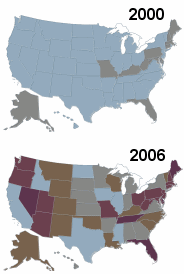
DrugMonkey has alerted to me an interactive map of the USA which displays rates of prescription drug abuse across all 50 states.

You can select the year up the top, the drug of abuse on the left-hand side, and point the mouse at a particular state to get the details.

It’s part of an investigation by the paper into why so many of these drugs are being used illicitly, and why Nevada, the state in which Las Vegas resides, seems to have one of the highest rates of abuse.

All the drugs are opioids and the maps on the right show the rates of consumption for oxycodone, a drug nicknamed ‘hillbilly heroin’.

You can see how the 2000 map clearly shows the highest rates of consumption in the ‘hillbilly’ areas across the Appalachian Mountains, although by 2006 the West Coast has caught up and most of the rest of the country seem to have got into the painkiller habit.

Link to interactive drug map.
Link to Las Vegas Sun series on prescription drug abuse.

Cat psychology (no, really)

I just found this curious empirical study, published last year in the academic journal Psychological Reports, on the personality structure of domestic cats.

The study analysed owner ratings and found four underlying components of cat personality.

Personality in domestic cats.

Psychol Rep. 2007 Feb;100(1):27-9.

Lee CM, Ryan JJ, Kreiner DS.

Personality ratings of 196 cats were made by their owners using a 5-point Likert scale anchored by 1: not at all and 5: a great deal with 12 items: timid, friendly, curious, sociable, obedient, clever, protective, active, independent, aggressive, bad-tempered, and emotional. A principal components analysis with varimax rotation identified three intepretable components. Component I had high loadings by active, clever, curious, and sociable. Component II had high loadings by emotional, friendly, and protective, Component III by aggressive and bad-tempered, and Component IV by timid. Sex was not associated with any component, but age showed a weak negative correlation with Component I. Older animals were rated less social and curious than younger animals.

How long before we start having ‘personality disorder‘ for domestic cats I wonder. Cat psychiatrists, start your engines.

Link to PubMed entry for paper.

Mental illness: in with the intron crowd

Today’s Nature has an excellent feature article on the heated scientific debates over why its so hard to link genes to specific mental illnesses.

Genetics is a complex business, but psychiatric genetics even more so, because it attempts to find links between two completely different levels of description.

Genes are defined on the neurobiological level, while psychiatric diagnoses are defined on the phenomenological level – in other words, verbal descriptions of behaviour, or verbal descriptions of what it is like to have certain mental states.

There is no guarantee, and in many people’s opinion, probably no likelihood, that these ‘what it is like’ descriptions actually clearly demarcate distinct processes at the biological level.

It’s a bit like classifying people as heavy metal fans if they have five or more heavy metal albums.

By definition, there’s a biological difference between people who like heavy metal and those who don’t, but it could be a whole number of distinct differences at the level of brain function which are all just recognised as ‘being a heavy metal fan’ in day-to-day life.

Actually, psychiatric diagnosis has an additional problem, in that for some diagnoses, the same classification can be made when the people don’t share any symptoms. For example, two people could be classified as having schizophrenia / being a heavy metal fan, when they have no symptoms / albums in common.

Some psychiatric geneticists just argue that we don’t have enough data yet, because it seems that when connecting genes to psychology each gene contributes very little and the effect is when the influence of many small effect genes add up and interact.

Others argue that we should look for effects on ‘endophenotypes‘ – the cognitive building blocks of more complex mental life. So instead of trying to connect genes to a collection of ‘what it is like’ experiences, we look at how genes influence neuropsychological processes – such as the mechanisms in the prefrontal cortex that control attention.

Increasingly, some researchers are starting to suggest that the genetic results show that existing psychiatric classifications are invalid, and that we should rethink them as new data comes in.

One thing psychiatry has traditionally been very bad at though, is refining diagnoses on the basis of lab studies.

Definitions are often revised to make them statistically more reliable (i.e. so people can reliably agree what is and what isn’t a particular diagnosis), but this is not the same as having something which is a good basis for scientific enquiry.

Unfortunately, psychiatry is (ironically) a bit too emotionally attached to the traditional diagnostic categories because diagnosis is such a core part of what psychiatrists do.

Anyway, the Nature piece is an excellent guide to the debate on whether we should be attempting to link genes to the neuropsychology of mental disorder.

Link to article ‘Psychiatric genetics: The brains of the family’.

Imagine all the people

The BPS Research Digest covers an intriguing study that found that imagining friends, parents, and romantic partners differently affected how we rate ourselves on personality measures.

The study suggests that being primed with certain sorts of relationship seems to alter either our personality, or how we perceive our personal characteristics.

Dozens of female university students were led to believe they were participating in an investigation into the effect of visualisation on heart rate, with the appropriate medical paraphernalia in place to make the story more convincing.

The students were asked to visualise a range of fairly mundane items or experiences and then at the end they were asked to visualise in detail either one of their parents, a recent romantic partner, or a friend. Afterwards they completed a range of personality and self-esteem tests. Post-experimental debriefing confirmed they hadn’t guessed the true purpose of the study.

Students who visualised a parent subsequently rated themselves as less sensual, adventurous, dominant, extraverted and industrious, than did students asked to visualise a friend or romantic partner, consistent with the idea that people revert to a more submissive “child role” with their parents.

The paper itself doesn’t mention it, but the study has some striking relevance to rather confusingly named ‘object relations theory‘, which could be much more clearly named ‘human relations theory’.

It’s a development of a Freudian idea, but instead of suggesting that sex and aggression are the core drives which shape our psychological landscape, it suggests, rather more sensibly, that relationships are the main factor that influence who we are.

In fact, it suggests that the ‘self’ is malleable and tends to be defined in terms of the people we interact with.

One of the genuinely useful legacies of psychoanalytically-inspired psychology has been the focus on the emotional interaction between people as an important shaping force in how we think and behave.

Most of Freud’s original (lets be polite and say) ‘kookiness’ has been stripped away, which leaves us with an approach that is often both empirically testable and supported by scientific studies.

For example, psychologist Susan Anderson has done a huge amount of experimental research on ‘transference’, where feelings from one relationship affect another because the two people are perceived as similar in some way.

Link to BPSRD article ‘Mind who you think of’.

Interrupting the final curtain

One of the myths of suicide is that if a person wants to kill themselves, they’ll always find a way. While this can occur in some cases, evidence that making methods of self-harm less accessible can reduce the suicide rate suggests that deaths can be prevented with simple safety measures.

The New York Times has a thought-provoking article on exactly this topic looking at how, particularly impulsive suicides, can be prevented.

What makes looking at jumping suicides potentially instructive is that it is a method associated with a very high degree of impulsivity, and its victims often display few of the classic warning signs associated with suicidal behavior. In fact, jumpers have a lower history of prior suicide attempts, diagnosed mental illness (with the exception of schizophrenia) or drug and alcohol abuse than is found among those who die by less lethal methods, like taking pills or poison. Instead, many who choose this method seem to be drawn by a set of environmental cues that, together, offer three crucial ingredients: ease, speed and the certainty of death.

The NYT article focuses on jumping and firearms and how erecting barriers and storing guns in locked boxes are effective preventative measures.

However, if you want a flavour of really how simple the safety measures need to be to make a difference to suicide rate, research has found that putting pills in blister packs reduces lethal overdoses.

It’s amazing if you think about it, simply making it necessary to pop each pill out of its plastic packaging rather than tipping them out of a bottle means less people kill themselves.

The difference is likely a matter of minutes, but it gives time for brief impulsive urges to pass, and every popped pill requires a single deliberate action towards suicide that gives a chance for the distressed person to reconsider. Obviously, many do.

The article merits a read in full, and Liz Spikol has an interesting video commentary on the piece that’s also well-worth checking out.

Link to NYT article ‘The Urge to End It All’.
Link to Liz Spikol on ‘Is Suicide Preventable?’.

Neurowarfare and the modern Rogue Trooper

Wired has picked up on a US military report that warns of the threat posed by neuro-enhanced enemy soldiers, just released by the “Pentagon’s most prestigious scientific advisory panel”.

The full report is available online as a pdf file, and covers how pharmaceuticals and brain-computer interfaces could be used by enemies of the US to create hordes of sleep-resistant super-intelligent neurosoldiers who can kill at the speed of thought.

Obviously, I paraphrase, but it’s interesting that the report is not your usual blue-sky speculation. It actually covers the science in considerable detail.

It also discusses cultural attitudes to cognitive and brain enhancements of various sorts, and how this might affect how and why they might be used.

Non-medical applications of the advances of neuroscience research and medical technology also pose the potential for use by adversaries. In this context, we must consider the possibility that uses that we would consider unacceptable could be developed or applied either by a state-adversary, or by less-easily identified terrorist groups. In the following, we consider first the issues of what types of human performance modification might alter a military balance, and how those issues can be evaluated. We then address two broad areas where there are significant, and highly publicized, advances in human performance modification. These are the areas of brain plasticity (permanently changing the function of an individual’s brain, either by training or by pharmaceuticals), and the area of brain-computer interface (augmenting normal performance via an external device directly linked to the nervous system).

Link to Wired write-up.
pdf of report.

The ambiguous gift of sign names

BBC Ouch! magazine has a completely fascinating article on sign names in the deaf community. They are like mandatory formal nicknames decided by a consensus of your peers that reflect something distinctive about you.

The article describes how assigning and accepting one can be a tricky social negotiation with some having to mount campaigns against unwanted sign names.

Sign names are a weird and wonderful thing, where your average hearing names like Matt, Jack or Jane look positively plain.

But before you get too excited about the possibility of throwing your dull, former identity away, let me point something out: you don’t get to choose your sign name. You don’t even get power of veto on it. It is given to you.

It makes sense. If deaf people could choose their name, you’d get loads of guys wandering around calling themselves Stud, Beer Belly or Jackie Chan’s Lovechild. Women would probably call themselves Lip Gloss, Model or Soft Hair. I’m generalising, and stereotyping, but you get my point.

When a sign name is given to you, it’s special. A bit like losing your deaf virginity. It‚Äôs thought up after an intense period of observation, when people have worked out firstly whether they like you enough to give you one (a sign name, that is), and they’ve taken all your habits and mannerisms into account to find a name that best sums you up.

I have to say, I find watching sign language completely enthralling. It always seems like a wonderful form of cognitive ballet to me.

Obviously, it has its practical uses to, as demonstrated by this video tutorial on how to flirt using sign language.

Link to article on the social complexities of sign names (via MeFi).

Encephalon 49 evolves

The 49th edition of the Encephalon psychology and neuroscience writing carnival has just appeared online, this time hosted by Neuroscientifically Challenged – a blog that’s new to me but looks very good.

A couple of my favourites include a sceptical look at gene therapy in psychiatry and an interesting overview of a theory of how the brain and culture co-evolved.

There’s much more where that came from so check it out for the last fortnight’s highlights.

Link to Encephalon 49.

Lisa Appignanesi on Women and the Mind Doctors

Bookslut has a fantastic interview with writer and historian Lisa Appignanesi who wrote the recently published and well-received history of women and madness Mad, Bad, and Sad.

The book has been praised for being a remarkably balanced account in a field which tends toward the polemical, and for carefully examining the interaction between culture and our experience of mental distress.

…it became quite clear for me that there are rather strict rules about how to behave when you’re crazy in any given epoch, as Ian Hacking has so pithily put it. There are ways in which the cultural understanding of mind and body at any given time plays into the nature of diagnoses, along with historical and sociocultural forces. The way in which we express our discomforts, dissatisfactions, excesses, madnesses is through those particular understandings. So symptoms will feed into diagnoses, diagnoses will feed back on symptoms. Institutional forms, media, and everything else all comes into play, and you end up having a model, or “most-expressed” disease for any given period.

So, for example, towards the late part of the nineteenth century, many explanations had to do with nerves, and you had a disease called neurasthenia, which actually covers a great gamut of problems and disorders. Following on that you have hysteria, that very interesting set of ways of behaving which actually shows women suffering from anesthesia — they can’t feel their skin — and various forms of paralyses and mutisms. In a way, all of these reflect the kinds of things that are wanted of women in that period, and also the kinds of prompts fed to them as they live their condition. And so once a particular kind of liberty for women comes into play, hysteria begins to alter, to change into other things.

Today we have one of the dominant ways for women to express discomfort with who they are is to develop a body illness such as anorexia or bulimia. Many things come into play, but one of them is that we live in an increasingly virtual age, where the body itself is problematic. Body disorders are one way of expressing our misery. So, yes, there’s a cultural expression to symptoms and indeed diagnoses.

The interview is also interesting for a brief outburst of resentment stemming from the current state of UK mental health politics.

The UK government is in the process of spending £300 million on making psychological therapies widely available on the National Health Service. Not unsurprisingly, it has focused its money on therapies which have been proven to be effective through randomised controlled trials.

As cognitive behavioural therapy has the most evidence for its effectiveness most (although not all) of the money is going to fund CBT. Needless to say, this has caused all sorts of hell from the tribes of mental health.

This month’s British Journal of Psychiatry has an article entitled “Wake-up call for British psychiatry” where some of Britain’s leading psychiatrists argue that this money is being spent to the detriment of medical services.

I think this is a valid point. It’s an argument over which evidence-based treatments the government should spend its money on. However, some of the strongest attacks have come from other schools of therapy, especially those evidence-shy Freudians.

Appignanesi, chair of the trustees of the Freud Museum, manages a wonderfully misinformed put down. Apparently CBT is being touted as:

a cure-all for everything. And of course it’s not. It’s merely a form of self-control over the mind. It obviously helps adolescents to order their lives in some ways, but may not help much more than that, and to think of it as a cure-all is not going to help many people. It may make an intervention in the first instance but it won’t work over the longer term

In fact, it’s being funded to treat conditions in adults for which there is evidence for its effectiveness, and there is good evidence that it has lasting long-term beneficial effects, particularly for depression.

In the same vein, Mick Cooper, a leading existential psychotherapist, recently issued a widely reported statement saying the idea that CBT is more effective is a ‘myth’ because that while there had been more studies on CBT, but that did not necessarily mean it was more effective than other types of therapy.

Unfortunately, it seems he can’t distinguish between ‘more evidence for its effectiveness’ and ‘more effective’, which, of course, are quite different.

To get any particular therapy funded, it just needs research to show its effectiveness. It’s a fairly straightforward ‘put up or shut up’ situation.

Of course, the issue of who funds the research is another matter, but as psychoanalysis largely survives through the private patronage of the upper middle classes and aristocracy in the UK (I kid you not), you would think it shouldn’t be too hard to get someone to fund the studies.

Link to Lisa Appignanesi interview.

The economics of a prisoner of war camp

R.A. Radford was an economist taken prisoner during World War Two who later wrote about the complex cigarette-based economy that thrived in the POW camps in a fascinating 1945 article.

You can also read it online as a pdf if you want to see it in its original type-print glory, which I have to say, does rather add to the atmosphere it so wonderfully evokes.

It’s a vivid insight into the social organisation of the camps, and just the descriptions of the market pressures are quite interesting in themselves.

For example, the standard currency was a cigarette, but heavy air raids meant people would smoke more, presumably owing to stress, thereby altering the value of the currency through scarcity.

The camp residents imposed trade regulations, had trading areas, and some even developed businesses:

Around D-Day, food and cigarettes were plentiful, business was brisk and the camp in an optimistic mood. Consequently the Entertainments Committee felt the moment opportune to launch a restaurant, where food and hot drinks were sold while a band and variety turns performed. Earlier experiments, both public and private, had pointed the way, and the scheme was a great success.

Food was bought at market prices to provide the meals and the small profits were devoted to a reserve fund and used to bribe Germans to provide grease-paints and other necessities for the camp theatre. Originally meals were sold for cigarettes but this meant that the whole scheme was vulnerable to the deflationary waves, and furthermore heavy smokers were unlikely to attend much. The whole success of the scheme depended on an adequate amount of food being offered for sale in the normal manner.

To increase and facilitate trade, and to stimulate supplies and customers therefore and secondarily to avoid the worst effects of deflation when it should come, a paper currency was organised by the Restaurant and the Shop.

It’s completely readable even if you’re not familiar with economics and is a captivating window into POW camp society as seen through the eyes of a monetary expert.

Link to article (via MeFi).
pdf of article.

Our time is up

Writer director Rob Pearlstein created a completely endearing 15 minute short film called Our Time is Up about a therapist who discovers he has six weeks to live. It’s wonderfully produced and even got nominated for an Oscar in 2006.

To be fair, it’s initially a bit reliant on some rather tired clich√©s about patients and therapists, but despite itself, it’s disarmingly warm and funny.

The writing is excellent, wrapping up what could have been a series of short sketches into a gently poignant and thought-provoking story.

Link to ‘Our Time is Up’ on YouTube.
Link to the film’s website.

Selling the ‘battle of the sexes’

Slate has just finished an excellent five-part series on two recent books which have attempted to paint men and women as vastly different in mind, brain and behaviour by exaggerating the science of sex difference.

The books in question are Louann Brizendine’s The Female Brain and Susan Pinker’s The Sexual Paradox.

Both have been influential because the authors write from an explicitly feminist angle, and both claim to be drawing on the latest neuroscience, suggesting that they’re overthrowing the mushy political correctness of “everyone is the same”.

The Slate series pulls no punches though, saying “Ultimately, the evangelists aren’t really daring to be politically incorrect. They’re peddling one-sidedness, sprinkled with scientific hyperbole.”

Of course, there are cognitive differences between men and women, but the punchline of almost all sex difference research is that the extent of the difference between any two individuals, be they male or female, tends to vastly outweigh the average difference between the sexes.

Furthermore, while some of these books suggest the differences are innate many studies have found the differences change markedly over time and are influenced by cultural or social factors.

The series is well-researched, easy to digest and looks at the areas of communication, empathy, maths ability and development during childhood. It’s also accompanied by a three-part video discussion, which tackles similar issues.

Slate have been doing a great job of getting some accessible, level-headed neuroscience out there recently, and this is another great example. Good work science writer Amanda Schaffer.

Link to Slate series on ‘The Sex Difference Evangelists’.

Brain twister

In 1941, brain specialist Russell Brain published an article about the brain in the brain science journal Brain. Owing to Brain’s extensive work on the brain, he later became editor of Brain. His work treating brain disorders and his editorship of Brain were some of the reasons he was made Baron Brain, in 1962.

Last year, Brain published a tribute to Brain’s brain article in Brain, owing to its massive impact on our understanding of the brain.

It was written by Alastair Compston.

2008-07-04 Spike activity

Quick links from the past week in mind and brain news:

Scientific American looks at the neuroscience of dance, and includes one of my favourite studies on ballet dancers and capoeira artists.

War on Drugs bulletin: a World Health Organisation study finds the USA leads the world, by quite a wide margin, in per capita consumption of illegal drugs. Globally, there seems no relation between drug consumption and legal restriction. $500 billion well spent then.

Sharp Brains rounds up some of their recent brain enhancement articles by the SB team and guest scientists.

Separated at birth: celebrity psychologists Linda Papadopoulos and Robi Ludwig. That’s just spooky isn’t it?

A 2005 paper in the American Journal of Clinical Hypnosis reports on a man with phantom limb who finds it involuntarily responds to hypnotic suggestions.

The Neurocritic finds the ‘watermelon works like viagra’ nonsense is, well, nonsense.

The NYT Freakanomics blog has a fascinating piece on why people lie on social welfare applications, in the opposite direction than you’d think.

From deceiving others to a great piece on self-deception, in the International Herald Tribune.

Mixing Memory is doing an excellent in-depth review of Lakoff’s new book ‘The Political Mind’. Just check the blog and look for the past pieces and forthcoming updates.

Cypress Hill vindicated! Cognitive Daily reports on a study finding that high-pitched voices are generally rated as more attractive.

The BPS Research Digest tracks down a fascinating book on the history and philosophy of jokes.

Enhancing your cognitive ability with electricity makes a comeback. Technology Review looks at transcranial direct current stimulation.

Developing Intelligence has another fascinating piece – this time on how the cognitive benefits of meditation are likely to be available to everyone.

The excellent Advances in the History of Psychology finds a interesting paper on a seemingly apocryphal 1868 dust-up between Paul Broca and John Hughlings Jackson.

Push the button: Milgram rides again

The New York Times has a good article on some recent replications of Milgram’s infamous conformity experiment where he ordered participants to give what they thought were potentially lethal shocks to an actor pretending to scream in pain.

They’re not quite replications, because Milgram’s experiment as it was actually run is considered unethical, but they’re pretty close and the results are frighteningly similar.

There’s also an interesting twist in one of the studies, that suggests people who go on to give the more dangerous shocks think about responsibility differently, assuming they are not responsible because they’re being ‘ordered’.

In the other paper, due out in the journal American Psychologist, a professor at Santa Clara University replicates part of the Milgram studies — stopping at 150 volts, the critical juncture at which the subject cries out to stop — to see whether people today would still obey. Ethics committees bar researchers from pushing subjects through to an imaginary 450 volts, as Milgram did.

The answer was yes. Once again, more than half the participants agreed to proceed with the experiment past the 150-volt mark. Jerry M. Burger, the author, interviewed the participants afterward and found that those who stopped generally believed themselves to be responsible for the shocks, whereas those who kept going tended to hold the experimenter accountable. That is, the Milgram work also demonstrated individual differences in perceptions of accountability — of who’s on the hook for what.

I recommend the picture on Jerry Burger’s webpage. I swear he must of practised that movie villain grin especially for the Milgram replications.

Link to NYT article ‘Would I Pull That Switch?’