Why email is addictive (and what to do about it)

Email is addictive

Like lots of people who sit in front of a computer all day, I am addicted to email. This worries me for two reasons. The first is the sheer strength of my compulsion. I must hit the ‘get mail’ button at least a hundred times a day. Sometimes, if I don’t have any new mail, I hit it again immediately, just to check. I interrupt my work to check my mail even when I know that I’m not going to find anything interesting and that I should just concentrate on what I am suppossed to be doing. When I come back to my office it’s the first thing I do. If I’m prevented from checking my mail for more than a few hours I get a little jumpy and remain that way until I have.

This is all rather sad, but the second reason I am worried by my email addiction is that I work in a psychology department and we’re supposed to understand how these things work. Now email isn’t a drug – it doesn’t deliver a chemical into your bloodstream. Yet it is clearly addictive. I’m a normal rational person (which is to say I’m just normally maladjusted) and I know that I don’t need to check my email as often as it do – certainly not immediately after checking it the first time for Goodness’ sake! – but still I am compelled. What’s going on, and can psychological science help me out?

Read more below the fold

Continue reading “Why email is addictive (and what to do about it)”

Cognitive behaviour therapy creator wins Lasker Award

AaronBeck.jpgAaron T. Beck, the creator of cognitive behaviour therapy (CBT), has been awarded the Lasker Award – a prestigious prize that is given to those who are deemed to have made a significant contribution to the understanding and treatment of medical disorders.

Randomised controlled trials have shown cognitive behaviour therapy to be one of the most effective treatments for depression and anxiety (typically as good as, or better than, drug therapy) and has also been shown to be effective in a wide range of other disorders, such as psychosis, eating disorders and chronic pain.

In serious cases, both CBT and drug treatment will be used at the same time, and this often gives the best results.

Instead of focusing on early experience and childhood trauma, CBT tends to focus on the here and now, and works with clients to develop more effective ways of thinking about situations which typically lead to disturbed thoughts and emotions.

This can be achieved by understanding the link between thoughts, emotions and behaviour, by testing out assumptions and ideas, and challenging negative thoughts as they occur in the mind.

Lasker Awards are often thought to be hints as to who might win a future Nobel Prize, as 71 Lasker winners have gone on to win a Nobel.

However, the Nobel Prize committee tends not to give awards for psychological discoveries. The nearest, perhaps, was when Daniel Kahneman won the ‘Nobel Prize for Economics’ for his contributions to understanding rationality in economic reasoning.

The New York Times also has some coverage of the story and looks at some of this year’s other Lasker Award winners.

Link to Lasker Award announcement.
Link to information on CBT from mental health charity Mind.
Link to New York Times on this year’s winners.

Trouble with Spikol mental health video series

LizSpikolVideoFrame.jpgLast August, we interviewed editor of the Philadelphia Weekly and mental health campaigner Liz Spikol. Part of her work as a journalist and campaigner involves her blog The Trouble with Spikol, which includes regular video updates conveying her whimsical view of the world of journalism.

Recently, she’s just begun a video series tackling current issues in mental health, drawing both from her own experience and her knowledge of psychiatric treatment and the mental health system.

The first is both frank and witty (the reference to Touched with Fire, Kay Redfield Jamison’s book on the link between creativity and manic depression made me laugh out loud) and hopefully will be the first of many to come.

Link to Liz Spikol video update.

The DiNET project

marc_jorge.jpgWhile in Seville, I met up with Marcos Cobe√±a and Jorge Cant√≥n, two computational neuroscientists who are involved in a project to develop a model of brain function based on Jeff Hawkins’ Hierarchical Temporal Memory framework.

Their project, based at the University of Seville, is called DiNET and aims to develop free software to implement the simulation using the Mono framework to easily enable distributed processing.

Firstly, I must thank Marcos and Jorge for giving me the chance to have my first neuroscience discussion in Spanish, and secondly, for being patient with my dodgy grammar.

One of the things I noted was their enthusiasm for the project and their intention to get as much biological detail into the model as possible, as much of the time was spent discussing details of neural architecture and pathways.

They’re also looking for people willing to join the project. They have a mailing list to discuss the project (currently only in Spanish, but they tell me that will change shortly) and updates will be appearing on the DiNET website.

I look forward to hearing more about the project as it progresses.

Link to DiNET.
Link to website on Hawkin’s theories.

Synapse #7 and BPS Research Digest

A beautiful-looking edition of The Synapse, the biweekly psychology and neuroscience writing carnival has hit the net, as has another compulsive release of the BPS Research Digest – edited by our very own Christian Jarrett.

Just so you know, Mind Hacks will be the hosting the next edition of The Synapse.

Although I’ve yet to find out how to get hold of the submissions, it looks like you can submit links to your psychology and neuroscience writing here.

Jabberwacky wins Loebner prize again

medal_rollo.jpgBBC News is reporting that AI researcher Rollo Carpenter has won the Loebner Prize for the second year in a row with Joan, a development of his Jabberwacky chatbot.

The Loebner Prize is an annual event where various computer programs are subjected to the Turing Test – a test where judges have to work out if they are in a online chatroom with a human or a computer program.

The Turing Test is supposedly a way of testing for artificial intelligence. No software has ever passed the test except in very limited circumstances, but every year the software that comes closest is awarded the Loebner Prize.

We reported on Carpenter’s success last year, and this year’s success is a tribute to the technology behind Jabberwacky, currently being developed by his company icogno.

You can see video of Carpenter’s previous prize-winning chatbot ‘George’ at another recent BBC News page.

Link to BBC News story ‘AI prize award for British firm’.
Link to BBC News page with video of ‘George’.
Link to Jabberwacky online.

Berkeley’s Cherry

I see this cherry, I feel it, I taste it: and I am sure nothing cannot be seen, or felt, or tasted: it is therefore real. Take away the sensations of softness, moisture, redness, tartness, and you take away the cherry, since it is not a being distinct from sensations. A cherry, I say, is nothing but a congeries of sensible impressions, or ideas perceived by various senses: which ideas are united into one thing (or have one name given them) by the mind, because they are observed to attend each other. Thus, when the palate is affected with such a particular taste, the sight is affected with a red colour, the touch with roundness, softness, &c. Hence, when I see, and feel, and taste, in such sundry certain manners, I am sure the cherry exists, or is real; its reality being in my opinion nothing abstracted from those sensations. But if by the word cherry you mean an unknown nature, distinct from all those sensible qualities, and by its existence something distinct from its being perceived; then, indeed, I own, neither you nor I, nor any one else, can be sure it exists.

George Berkeley Three Dialogues Between Hylas And Philonous

Classic Case Studies in Psychology

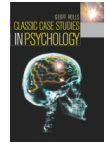
classic_case_studies_psychology.jpgI picked up a copy of Classic Case Studies in Psychology (ISBN 0340886927) yesterday and have been hooked ever since.

It looks at some of the most famous case studies in psychology, including those that have inspired important clinical methods as well as those that have just given us an insight into the more curious corners of human behaviour.

A good sign is that the coverage of the case of Phineas Gage, the railroad worker who had parts of his frontal lobes blown away in 1840, is up to date and avoids many of the myths that have recently been debunked by Macmillan’s brilliant biography An Odd Kind of Fame (ISBN 0262632594).

Also included are the well-known cases of murder victim Kitty Genovese and amnesic patient HM, among many others.

A few of the less well-known are also present, including a case reported by controversial psychologist Hans Eysenck of a man who was sexually aroused by handbags and prams, and the 19th century report on the ‘wild boy’ of Aveyron.

The book is written in a straightforward yet engaging way, so older teenagers will be able to pick it up and read it, but cynical professionals will find much of interest in its pages.

Link to information on Classic Case Studies in Psychology.

An ‘autism mum’

daniel_isnt_talking.jpg

“You’re an autism mum. I see them all the time. I saw you that first day we met, how you agonised over your boy, mute in his pushchair while all the other pre-schoolers made their clever observations about the world; I see how you worry now over his odd way of walking, the animal noises he will sometimes make instead of words. And I see how no amount of pain in the experience of caring for your son will put to death the fire of love you have for him.”

Teacher Andy O’Connor speaking to the mother of an autistic boy in the novel Daniel Isn’t Talking, by Marti Leimbach. This book and four other fiction and non-fiction books on autism were intelligently reviewed by Adam Feinstein in the Guardian a few weeks ago.

Link to Daniel isn’t talking.
Link to Guardian review of five books on autism.

What is synesthesia?

colour_popout.jpgThere’s a useful article in this month’s Scientific American that poses the question ‘what is synesthesia?’ in the ‘ask the experts’ section.

The question is answered by neuroscientists and synaesthesia researchers Thomas Palmeri, Randolph Blake and René Marois, who give a concise description of what its like to have synaesthesia as well as explaining some of the science behind this intriguing condition.

Until 5 years ago, syneasthesia was largely ignored and thought to be a rare and relatively uninteresting oddity.

It is now being investigated after surveys found it far more common than previously thought.

It is thought that researching synaesthesia will also give an insight into the structure and function of perception in the brain, in both those with and those without the condition.

Link to SciAm article ‘What is synesthesia?’.

2006-09-15 Spike activity

Quick links from the past [few weeks] in mind and brain news:

spike.jpg

Michael Crawford discusses The Schizophrenic Symptom of Flat Affect, including insights from his own experience.

Can Freudian ideas help us explain fundamentalism and extremist ideologies? asks the New York Times

Dopamine helps punters spot their ‘best bet’ according to a recent news story in New Scientist.

The NPR Day to Day radio programme discusses the psychology of why people make false confessions to the police.

Difficulties with engaging areas of the prefrontal cortex may explain why teenagers can be more ‘selfish’ suggests new research.

Academic doping: Are kids being given drugs like Ritalin by their parents purely to improve their academic performance?

The Neuroethics and Law Blog tackles the legal and ethical implication of the recent study that suggested a coma-like PVS patient had conscious thought.

Do we all mean the same thing when we talk about colors? asks Cognitive Daily.

A drug used for treating Alzheimer’s drug may also combat brain injury, reports New Scientist.

World Hearing Voices Day today

speakers_cabinet.jpgToday has been designated as World Hearing Voices Day to raise awareness of the experience of hearing voices.

Although the stereotype is that hearing voices is associated with mental illness, the majority of people who hear voices do not have mental illness and are never in need or help or assistance because of their experiences.

There is now a world-wide hearing voices movement that aims to provide an alternative to the medical model (which has traditionally seen ‘voices’ as symptoms) and reframe them as part of the rich tapestry of human existence.

The movement has a curious beginning. Dutch psychiatrist Marius Romme was challenged by one of his patients who had found that her own explanation of her voices gave her far more relief than the psychiatric explanation.

Romme discovered that many other voices hearers had this experience, and, consequently, he and a voice hearer discussed this experience on a Dutch television chat show.

The show was flooded with callers who also heard voices, the majority of whom had never needed medical help.

From this, the Hearing Voices Network was founded in the UK to support voice hearers, and Romme has written a number of books on the subject.

Accepting Voices (ISBN 9781874690139) was co-written with journalist and now psychiatric researcher Sandra Escher and provides advice and information for those who experience voices.

Many voice hearers who do find their voices distressing, will often use both psychiatric help, and the help of non-psychiatric support groups to manage their experiences.

ABC Radio’s All in the Mind recently had a special on the science and culture of hearing voices and the transcript of the show is available online.

Link to Wikipedia article on Hearing Voices Movememt.
Link to transcript of All in the Mind on hearing voices.
Link to recent research on hearing voices (via BB).

Fight to the death with AI robots

NERO_screenshot2_small.jpgNERO is an award-winning futuristic computer game where the player trains squadrons of android soldiers, to be released and pitted against soldiers trained by another player.

Crucially, the android soliders learn using a neural network that adapts via a genetic algorithm.

For the NERO project we are using a specific neuroevolutionary algorithm called NEAT, Neuro-Evolution of Augmenting Topologies. Unlike most neuroevolutionary algorithms, NEAT starts with an artificial neural network of minimal connectivity and adds complexity only when it helps solve a problem. This helps ensure that the algorithm does not produce unnecessarily complex solutions.

In NERO we are introducing a new real-time variant of NEAT, called rtNEAT, in which a small population evolves while you watch. (Most genetic algorithms use generation-based off-line processing, and only provide a result at the end of some pre-specified amount of training.)

The neural network is based on published research and the documentation page contains a raft of information on game play and the science behind the software.

There’s screenshots and video of the game in action, and it’s free to download.

Link to website for NERO.

Heavenly theories of memory

Endel_Tulving.jpg

In particular, must a cognitive theory about memory that would please you be stated in a way that could be tested by brain scientists?

Sure! But an even better idea might be to demand that a cognitive theory be stated in a way that the Almighty himself could pass judgment on.

Legendary memory researcher Endel Tulving setting high standards, from p93 of Conversations in the Cognitive Neurosciences (ISBN 9780262571173).

Epilepsy Action on MySpace

EA_brain_idon.jpgUK epilepsy support charity Epilepsy Action has created a MySpace profile – the first neuro charity I know that has a page on the social networking site.

It’s part of an drive to increase the availability of epilepsy information to young people.

The page has updates on the latest news from the charity, as well as advice so you can educate yourself on what to do if you find someone having a seizure.

On a related note, the BBC has an interview with well-known UK author and speaker Rabbi Lionel Blue on his own epilepsy diagnosis.

Link to Epilepsy Action MySpace profile.
Link to interview with Rabbi Lionel Blue.

1st September BPS Research Digest and Synapse

A couple I missed when I was away… A new BPS Research Digest hit the net on 1st September with articles on job performance, season on birth and intelligence and the expert mind of the burglar among others.

Also edition 6 of The Synapse neuroscience writing carnival arrived, with writing on everything from the detection of musical phrases to the history of the discovery of the neuron.