The Truth About Female Desire available online

Finally, one of the best TV series on the psychology, biology and neuroscience of female sexuality is available online as a torrent.

The Truth About Female Desire was a four part UK television series broadcast in 2005 which was a collaboration between the respected sex research centre The Kinsey Institute, London’s Brunel University and Channel 4.

Eight women volunteered to undergo a number of experiments on sex and sexuality largely taken from the scientific literature, ranging from how suggestion affects attraction, to the physiology of female sexual arousal, to the neuroscience of orgasm, to name just a few.

Researchers are on hand to discuss the results with the women who seem genuinely fascinated about how these results might reflect their own varied experiences of sex, whether straight, gay, stable or single.

While the discussion is frank, if you’re just looking for porn with a bit of science thrown in, you’ll need to go elsewhere.

There’s very little naked flesh on display, and despite this (magazine editors take note!) it’s enormously good fun, quite sexy in places, and utterly fascinating.

There are two torrents available online each of which contains all four 50 minute episodes as one 1.7Gb file.

There is one good torrent available online which contains all four 50 minute episodes as one 1.7Gb download.

At the moment, both have a only a few other people currently downloading, so it may be a little slow to start with, but the more people downloading, the quicker it gets.

It’s rare that proper scientific sex research makes the media and even rarer that it is made into compelling TV, so it’s a few hours well-spent if you’re interested in female sexuality, or sex research in general.

If you’re not sure what a torrent is or how to download one there’s a guide here and if you’re having trouble playing the files the free VLC media player should do the trick.

Finally, thanks to zoidberg for letting me know about the series arriving online.

Link to mininova page with torrent of series.
Link to mininova page with alternative torrent for series.

Gathering data for thought experiments

The Idea Lab section of The New York Times has an article on experimental philosophy – a new branch of philosophy where, for example, answers to philosophical thought experiments are tested on members of the public to find the most common answers and possible contradictions in everyday reasoning.

But now a restive contingent of our tribe is convinced that it can shed light on traditional philosophical problems by going out and gathering information about what people actually think and say about our thought experiments. The newborn movement (“x-phi” to its younger practitioners) has come trailing blogs of glory, not to mention Web sites, special journal issues and panels at the annual meeting of the American Philosophical Association. At the University of California at San Diego and the University of Arizona, students and faculty members have set up what they call Experimental Philosophy Laboratories, while Indiana University now specializes with its Experimental Epistemology Laboratory. Neurology has been enlisted, too.

More and more, you hear about philosophy grad students who are teaching themselves how to read f.M.R.I. brain scans in order to try to figure out what’s going on when people contemplate moral quandaries. (Which decisions seem to arise from cool calculation? Which decisions seem to involve amygdala-associated emotion?) The publisher Springer is starting a new journal called Neuroethics, which, pointedly, is about not just what ethics has to say about neurology but also what neurology has to say about ethics. (Have you noticed that neuro- has become the new nano-?) In online discussion groups, grad students confer about which philosophy programs are “experimentally friendly” the way, in the 1970s, they might have conferred about which programs were welcoming toward homosexuals, or Heideggerians. Oh, and earlier this fall, a music video of an “Experimental Philosophy Anthem” was posted on YouTube. It shows an armchair being torched.

Some of the highest profile work uses neuroimaging to look at the brain areas involved in making moral and ethical decisions, but some of my favourite are the most simple.

As we’ve discussed previously philosopher Eric Schwitzgebel’s work on whether being a professional ethicist makes you behave any more ethically is amusing, but also asks questions about the use of moral philosophy if it doesn’t seem to have any personal impact.

He’s recently taken this a step further and has begun to investigate whether political scientists vote more often than other people.

In a way, everything has come full circle. Before the word was invented ‘science’ was called ‘natural philosophy’, because it was the philosophy of how the natural world worked. It was distinguished from the rest of philosophy because it used experiments.

Link to NYT on ‘The New New Philosophy’.
Link to Schwitzgebel on whether political scientists vote more often?

Think gum

Think Gum is a chewing gum that apparently contains a number of ‘brain boosting’ ingredients, although is mainly notable for its high caffeine content.

As well as caffeine, it contains ginkgo biloba and bacopa monnieri, two herbal supplements which some preliminary studies have found increase memory and concentration.

It’s hard to say whether these have any effect in this particular product but the 20mg of caffeine per piece of gum should keep you alert, even if the caffeine come-down will take away as much as the lift will give you in the first place.

I once had a pharmacist explain the lift and come-down of stimulant drugs to me as “there’s no such thing as a free lunch”, which I thought was a little ironic considering how many catered advertising pitches they get taken to by drug companies while under the impression they’re getting a free lunch.

Link to Think Gum.

The tickbox revolution in intensive care

The New Yorker has a completely gripping article on intensive care medicine that while fascinating in its own right, is also interesting as it contains an amazing account of a how a three year old girl was resuscitated and recovered brain function after near drowning, and stresses the importance of behavioural interventions in high-tech medicine.

The article is essentially about an incredibly simple idea that is vastly reducing infection rates and improving survival rates in intensive care – using checklists to make sure that each step of complex procedures are completed.

It’s been championed by physician Dr Peter Pronovost and is simple but effective way of reducing cognitive error in high pressure situations.

It’s interesting that the idea has found a fair amount of resistance among some doctors, who think that it somehow diminishes their expertise if they have to check against a list, despite the fact that common slips affect even the most competent of people.

One illustration of how complex the intensive care process has become is given near the beginning of the article when it describes a case of a three-year-old girl saved from drowning with what has become a hugely complex, multi-expertise, high-tech medical effort.

Consider a case report in The Annals of Thoracic Surgery of a three-year-old girl who fell into an icy fishpond in a small Austrian town in the Alps. She was lost beneath the surface for thirty minutes before her parents found her on the pond bottom and pulled her up. Following instructions from an emergency physician on the phone, they began cardiopulmonary resuscitation. A rescue team arrived eight minutes later. The girl had a body temperature of sixty-six degrees, and no pulse. Her pupils were dilated and did not react to light, indicating that her brain was no longer working.

But the emergency technicians continued CPR anyway. A helicopter took her to a nearby hospital, where she was wheeled directly to an operating room. A surgical team put her on a heart-lung bypass machine. Between the transport time and the time it took to plug the inflow and outflow lines into the femoral vessels of her right leg, she had been lifeless for an hour and a half. By the two-hour mark, however, her body temperature had risen almost ten degrees, and her heart began to beat. It was her first organ to come back.

After six hours, her core temperature reached 98.6 degrees. The team tried to put her on a breathing machine, but the pond water had damaged her lungs too severely for oxygen to reach her blood. So they switched her to an artificial-lung system known as ECMO—extracorporeal membrane oxygenation. The surgeons opened her chest down the middle with a power saw and sewed lines to and from the ECMO unit into her aorta and her beating heart. The team moved the girl into intensive care, with her chest still open and covered with plastic foil. A day later, her lungs had recovered sufficiently for the team to switch her from ECMO to a mechanical ventilator and close her chest. Over the next two days, all her organs recovered except her brain. A CT scan showed global brain swelling, which is a sign of diffuse damage, but no actual dead zones. So the team drilled a hole into the girl’s skull, threaded in a probe to monitor her cerebral pressure, and kept that pressure tightly controlled by constantly adjusting her fluids and medications. For more than a week, she lay comatose. Then, slowly, she came back to life.

First, her pupils started to react to light. Next, she began to breathe on her own. And, one day, she simply awoke. Two weeks after her accident, she went home. Her right leg and left arm were partially paralyzed. Her speech was thick and slurry. But by age five, after extensive outpatient therapy, she had recovered her faculties completely. She was like any little girl again.

It’s a wonderful article that speaks to a number of important issues in medicine, including the self-perception and culture of clinicians, the importance and power of simple changes in behaviour, and why low-tech capital-free solutions are often the hardest to implement.

Link to New Yorker on checklists and intensive care medicine.

2007-12-07 Spike activity

Quick links from the past week in mind and brain news:

Chewing gum and context-dependent memory: The independent roles of chewing gum and mint flavour. A paper currently ‘in press’ for the British Journal of Psychology.

Sharp Brains has an interview with Prof Robert Emmons, a psychologist who studies gratitude.

In light of the recent UK case of a supposedly dead man who turned up claiming he couldn’t remember the last five years of his life (now under arrest for fraud!) the BBC has an article on why men go missing, and neuropsychologist Dr Eli Jaldow discusses whether this type of amnesia is likely, in The Times.

PsyBlog starts a fascinating series on the unconscious.

A fantastic ‘turning tables’ visual illusion is discovered by Living the Scientific Life

Science News reports on a new theory on the neuroscience of the organisation of thinking. Abstract of scientific paper here.

The influence of eye disorders on the development of impressionist art is discussed by Neurophilosophy

How America Lost the War on Drugs: a fantastic Rolling Stone article on how billions were spent in a futile attempt to stop people taking drugs.

Frontal Cortex looks at a possible link between business acumen and dyslexia.

Partial Recall: Why Memory Fades with Age. Scientific American looks at the neuroscience behind memory decline in normal ageing.

Guantanamo detainee attempts suicide by slashing himself with a sharpened fingernail. When will these terrorists acts of asymmetric warfare cease?

Cognitive Daily looks at kids’ misconceptions about numbers – and how they fix them.

Which brain hemisphere falls asleep first?

The abstract of a fascinating 1995 review paper by Maria Casagrande and colleagues which gathered experimental data together to try and work out which of the brain’s cortical hemispheres falls asleep first.

It turns out, it’s the left.

Which hemisphere falls asleep first?

Neuropsychologia, 33(7), 815-22.

Casagrande M, Violani C, De Gennaro L, Braibanti P, Bertini M.

Behavioral tasks (reaction times to acoustic stimuli and finger tapping tasks) performed by normal subjects when sleepy or attempting to fall asleep have been used as indices of hemispheric asymmetries during the sleep onset period. Results show a stronger impairment of the left hemisphere (right hand) both in reacting to external stimuli and in sustaining endogenous motor programs. The left hemisphere seems to fall asleep earlier than the right hemisphere.

Link to abstract of scientific paper.

Almost perfect

The New York Times has a short article on mental health and perfectionism, the tendency to measure success and self-worth by the completion of often unrealistic goals.

Over the last two decades this concept is being increasingly seen as a core component in some types of types of depression, anxiety and obsessive-compulsive and eating disorders.

A recent study identified several key features of perfectionism as, primarily, excessive concern over making mistakes, with other influences including high personal standards, the perception of high expectations and criticism from parents, doubting of the quality of your own actions, and a preference for order and organisation.

One of the key papers [pdf] in the field that really cemented the idea of perfectionism as an important psychological idea, suggested perfectionism could be focused inward (stringently evaluating and censuring your own behaviour), other-oriented perfectionism (having unrealistic standards for other people) and socially prescribed perfectionism (living up to unrealistic standards which the person perceives others are setting).

For people who already have negative ideas about themselves, perfectionism is thought to work like a constant test. If you can prove to yourself you can pass the test, you feel like a good person.

However, if the standards are unrealistic, you’re always going to fail, and ironically, concern and anxiety about achieving these high standards can actually lead to putting things off, or doing the tasks worse.

This can lead to a vicious circle where people feel their emotional well-being is dependent on them reaching impossible goals, but trying to reach the goal makes them feel even worse.

One of the difficult things in psychological treatment, is often trying to persuade people that performing worse is actually a good thing. ‘Good enough’ rather than ‘perfect’.

Link to NYT article on perfectionism.
pdf of key paper ‘Perfectionism in the Self and Social Contexts’.

Fighting over font-change semantics

Philosopher Patricia Churchland wrote a damning review of Steven Pinker’s new book, ‘The Stuff of Thought’, for Nature and it’s caused a bit of a rumble.

One particular highlight was that she described a theory from Pinker’s book, that suggests that language and thought can refer to meaning in a similar way, as:

…about as applicable to real meaning as ‘Dungeons and Dragons’ is to real life. Aptly ridiculed by critics as ‘font-change semantics’, the theory still has its disciples. Including Steven Pinker.

Apart from showing a woeful misunderstanding of Dungeons and Dragons, Churchland also failed to notice that Pinker had never proposed this theory in his book. In fact, his book argues against it.

In this week’s Nature, psychologist Marc Hauser writes in to say Churchland doesn’t seem to have read the book, and Pinker comes back with his own rebuke:

The book apparently stimulated the reviewer to free-associate to her own beliefs that psychological phenomena can be explained at the level of neurons and that human thinking is in the service of motor control. The fact that I (like most cognitive psychologists) have not signed up to these views is the only point of contact between my book and her review.

While definitely being more entertaining than your average book review , it doesn’t even come close to matching the slanging match between Hans Eyesenck and Stephen Jay Gould, where they ending up arguing over the ‘relative exposure of our respective arses’ in The New York Review of Books.

Sleeping and dreaming

London’s newest science museum, the Wellcome Collection, has just kicked off what looks to be a fantastic exhibition on the art and science of sleeping and dreaming.
It runs until March 2008 and aims to illustrate how we’ve understood sleep through the ages, as well as the contemporary science of this still mysterious state.

If you can’t make it in person, there’s an online taster that contains a collection of striking images from the exhibition with some brief commentary.

The exhibition also has free guided expert-led tours, including ones by sleep researcher Dr Mary Morrell on December 19th, and one by sleep doctor Dr Neil Stanley on January 17th.

Other tours are guided by science journalists and some of the exhibited artists.

Link to exhibition details.
Link to online ‘taster’ exhibition.

Full disclosure: I’ve received grant funding from the Wellcome Trust for a science art collaboration and I am an occasional paid reviewer for their Arts Awards. As far as I know though, neither are connected with this exhibition.

Pavlov and Brian Wilson redux

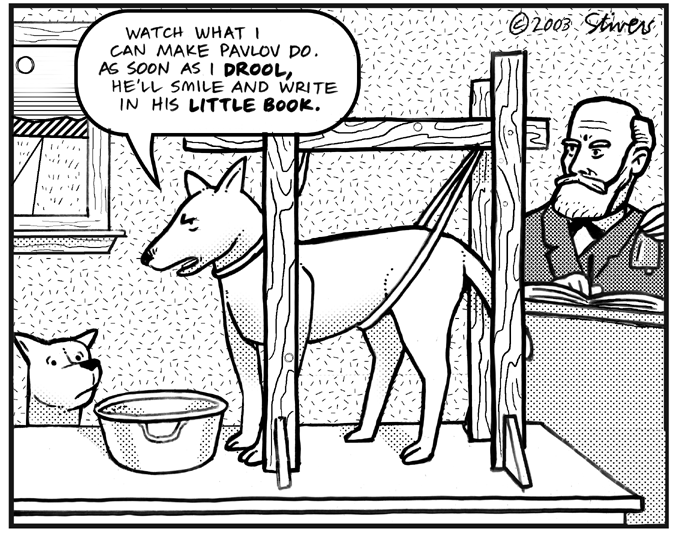
Ivan Pavlov and Brian Wilson – together at last! This rather unlikely combination seemed to spark a bit of interest, so here is a brief collection of your contributions.

Thanks to Lloyd for sending in one of Mark Stivers’ hilarious cartoons that gives an interesting twist on Pavlov’s experiments. Click for the larger version.

Jesse mentioned a clip from The Office that depicts a wonderful demonstration of classical conditioning, as used when trying to annoy your coworkers.

On a Brian Wilson tip, Simon notes that “While insane, Brian Wilson recorded an album called “Sweet Insanity” with [psychologist] Eugene Landy as co-producer, but his label rejected it. WFMU’s blog has a most delightfully terrifying track from said album.”

Brian Wilson rapping. Indeed truly terrifying.

Distinctly less terrifying is Aimee Mann’s recent track, ‘Pavlov’s Bell’, which also references the work of the bearded Russian dog harasser.

Ring a bell and I’ll salivate

A funny clip from That 70s Show where Michael provides a unique interpretation of Pavlov’s work on classical conditioning in an attempt to help Eric with his women problems.

This is not the first time that Pavlov has been invoked as a metaphor in popular culture.

The Barenaked Ladies track, ‘Brian Wilson’, has the following verse:

It’s a matter of instinct, it’s a matter of conditioning,
It’s a matter of fact.
You can call me Pavlov’s dog
Ring a bell and I’ll salivate – how’d you like that?
Dr Landy tell me you’re not just a pedagogue,
cause right now I’m

Lying in bed just like Brian Wilson did…

The Dr Landy referred to in the lyrics was controversial psychologist Eugene Landy, who attempted to ‘treat’ Beach Boys frontman Brian Wilson’s mental difficulties (including a not inconsiderable psychosis) by taking control of his career, musical output and other substantial parts of his life.

Unsurprisingly, legal action was eventually taken against Landy and he gave up his license to practice in California.

Link to That 70s Show clip.
Link to obituary of Eugene Landy.

Harnessing the brain’s power to reorganise after injury

The online Dana magazine Cerebrum has a great article on neurorehabilitation – the art and science of helping someone to recover from brain injury both by harnessing the brain’s natural ability to adapt, and by teaching the injured person new skills and abilities.

The article discuss both rehabilitation medicine, the practice of training patients to adapt and improve, and the neuroscience techniques which are being developed to try and tackle the problem at the cellular level.

One of the key processes which science is trying to understand and optimise is ‘neuroplasticity‘, the process by which the brain makes new connections, reorganises and routes around damage.

The article sets out six key questions for neuroscience that, when answered, should revolutionise who we can treat brain injury:

1. Since so much of what we think we know about regeneration is derived from experiments on immature nerve cells, are the mechanisms of regeneration in the injured mature nervous system the same as those that apply to the developing embryonic nervous system?

2. Since the vast majority of experiments in regeneration of nerve pathways have been done in rats and mice, how predictive are these experiments for results in human patients? Apart from molecular differences, rodents are much smaller than we are. Nerve fibers may have to regenerate much farther in humans in order to achieve the same level of reconnection that underlies functional improvement in smaller animals.

3. Even if sufficient nerve regeneration can be achieved, will the connections made be specific enough to underlie real function?

4. How helpful are stem cells? Can they survive after transplantation into the human spinal cord or will they be rejected? Can they replace damaged neurons or will they serve only as sources of chemical substances that support survival and growth of the brain’s own nerve cells?

5. Will we be able to identify a single approach that is so fundamental that it can yield dramatic improvements in recovery from brain injury, or will we need to develop a cocktail approach, using multiple treatments simultaneously?

6. Will approaches that enhance regeneration in one circumstance, for example spinal cord injury, also work in other situations, such as stroke or traumatic brain injury?

On a related note, Sharp Brains has picked up on the fact that American TV channel PBS will shortly be broadcasting a special on brain fitness and neuroplasticity.

It’ll probably focus on normal ageing and brain fitness rather than brain injury, but hopefully should tackle some of the neuroscience behind brain changes in general.

There’s a trailer available online.

Link to article ‘Harnessing the Brain’s Power to Adapt After Injury’.
Link to Sharp Brains on PBS neuroplasticity programme.

War, social networks and ethical minefields

Wired has an article in its latest edition that discusses why understanding human networks are becoming key to the US Military’s mission in Iraq and Afghanistan. Unfortunately, the article seems to do little more than uncritically echo military enthusiasm for this new approach while telling us little about the actual science behind the techniques.

But the most interesting story is not the strategy itself, which is hardly new, but how it is causing a rift among anthropologists to the point where conference speakers have been heckled and left in tears for their participation.

The debate centres on the US Military’s Human Terrain System, a project that aims to understand the culture, society and social networks in Iraq and Afghanistan, with a view to using this information to further military objectives.

In contrast, the NYT managed to do a brief but considerably more balanced article and video segment on the project last May, noting that the crux of the matter is that the project has employed numerous anthropologists, as anthropology now plays a key role in US military strategy.

Concerns centre over whether co-operating with the military violates the strict codes of ethics that compels anthropologists to ‘do no harm’ to the cultures they are studying, and to ask for informed consent from the people that are observing to make them fully aware of the purpose of the research.

Critics believe that aiding a military occupation is unethical, as it will inevitably lead to deaths prompted by the intelligence they provide, and requires a level of secrecy – violating both of the ‘do no harm’ and ‘informed consent’ principles.

This has caused an angry rift with accusations of ‘mercenary anthropology’ and, in an interesting parallel to the ethical dilemmas faced by the American Psychological Association, the American Anthropological Association has been forced to issue a report and statement on the issue; disapproving of the project while refusing to ban its members from participating.

Last Thursday, at a panel session on the issue at the American Anthropological Association conference, Zenia Helbig, an ex-Human Terrain System researcher, cried when she was heckled by the audience.

Wired describes the scene as ‘ugly’ and quotes Helbig as implying the hecklers were being driven by conspiracy theories, while Inside Higher Education gives a more nuanced account, suggesting audience reactions were mixed.

The overarching issue is that the military has cottoned-on to the fact that its in-house ‘psyops’ services are inadequate for the complexity of new forms of warfare, and are seeking the collaboration of academic disciplines which have been founded on principles of non-coercion.

The debate essentially centres around whether these principles should be universally applied to all people, or whether they are trumped by loyalty to the national interests of a researcher’s country.

Link to NYT article ‘Army Enlists Anthropology in War Zones’.
Link to abstract of Human Terrain System paper.
Link to Inside Higher Ed article on panel discussion.

Encephalon 37 arrives

The 37th edition of the Encephalon psychology and neuroscience writing carnival has just pulled into town and is hosted on A Blog Around the Clock.

A couple of my favourites include a post on whether smiling actually makes you feel better, and one on some of the hidden motivators for our voting behaviour.

There’s much more great mind and brain writing in the mix (including a raft of new student writers), so have a browse and see what catches your eye.

Link to Encephalon 37.

SciAmMind on Smart Kids, Sex Bias and Psychopaths

The latest Scientific American has just hit the shelves and two of the feature articles are available online: one with tips for raising hard-working and motivated children from developmental psychology research, and another on whether neuropsychology helps us understand the gender bias in fields like maths and physics.

However, there is another, stand out article on psychopaths that describes what the term actually means in psychology.

It’s something that’s commonly but wrongly confused with psychosis, largely because they’re both unfortunately shortened to ‘psycho’, despite them being completely different.

This month, the articles in the print edition look particularly good. They cover everything from people who want to be amputees, to the psychology of terrorism, to psychedelic drug therapy, to phantom limbs and more.

Link to article on raising smart kids.
Link to article on gender and scientific achievement.
Link to article on psychopaths.

No eye deer – an amazing brain injury

Retrospectacle has found an amazing case of a five year-old boy who impaled his left frontal lobe on a deer antler after he tripped and fell while carrying it.

The business end of the antler (which was thankfully no longer attached to a deer) went through his eye socket and into his brain.

Luckily, the young lad made a full recovery with no loss of eyesight and no long term brain damage.

Brains of children (particularly those under the age of 8) can make recoveries from injuries that would be much more serious in adults.

This is because young brains are still very ‘plastic’. In other words, they are still growing and re-shaping.

These recoveries can sometimes be quite astonishing. For example, as we’ve reported previously, some young kids can make a full recovery even when they’ve had half their cortex removed.

Interestingly, this child’s injury from the deer antler is similar to an ‘ice pick lobotomy’, detailed in a fantastic Neurophilosophy article.

One difference, however, is while both the ice pick and the deer antler have entered the brain the same way, the ice pick would be moved side to side to cause damage over a much wider area.

Link to Retrospectacle on amazing deer antler injury.