Like a kid in a brain candy store

Photo by Flickr user Max. Click for source.Slate has got a great article that takes on the newly fashionable field of ‘neuromarketing’ and calls it out as an empty promise.

The piece is written by neuroscientist Matt Wall who notes the upsurge in consumer EEG ‘brain wave’ technology has fuelled a boom in neuromarketing companies who claim that measuring the brain is the shining path to selling your product.

Because neuromarketing companies don’t provide the key details of the analysis techniques they use, it’s hard to evaluate them objectively. However, they seem to take a highly automated approach, essentially plugging the raw data into a black box of algorithms that spits out a neatly processed answer at the other end. Such an approach must involve making a large number of assumptions and some fancy-analysis footwork to make something coherent out of the poor-quality data.

In general the same applies to getting information out of a data set as to getting information out of a human: If you torture it long enough, it’ll tell you everything you want to know, but information extracted under torture is highly unreliable.

In addition, marketing-related studies are not well-suited to the kind of repetition that’s required to boost the useful signal and reduce noise; the same product or TV commercial can be presented only a few times before the participant becomes very bored indeed and therefore ceases to have any kind of meaningful reaction.

The article discusses why the current fad of EEG-based neuromarketing is scientifically unsound but despite the technical difficulties and theoretical incoherence of the field, it would all become irrelevant with one simple demonstration: a measure of the brain that could predict buyer preference better than behavioural or psychological measures.

Until now, no-one has shown this. In other words, no-one, nowhere, has shown that a ‘neuromarketing’ approach adds anything to what can be done by a standard marketing approach.

I’m all for neuromarketing research but until you can come up with the goods as a commercial product, you’re selling hot air.

There is one area that neuromarketing companies excel at though – marketing themselves. Considering a complete lack of data for their benefits, they pull in millions of dollars a year from advertising contracts.

Now that is effective marketing.
 

Link to Slate article ‘What Are Neuromarketers Really Selling?’

Great cure but we lost the patient

The Journal of Neuroscience has a surprising case report of a patient who was treated with an implanted brain stimulator to treat severe movement side-effects from an extended period of taking antipsychotic drugs for behavioural problems.

This is the background to the case:

A 27-year-old woman with developmental delay and severe behavioural disturbance was treated with risperidone 6 mg/day from age 14. At age 20, she developed facial twitching, blinks, and truncal extension spasms, which persisted during both sitting and lying supine. By age 21, she was no longer able to walk due to the spasms. She became housebound and was forced to ambulate by crawling, to the extent that she developed post-traumatic cysts over both knees. She was unable to sit in a chair. She was forced to eat from a plate on the floor while kneeling because the extension spasms were too severe in other positions.

The movement problems were due to tardive dystonia – a problem where the brain’s automatic control of muscle tone stops working.

When you move, some muscles need to contract while others need to relax. This happens automatically but turns out to be a complex brain process that is mediated by important dopamine pathways in a deep brain area called the basal ganglia.

Antipsychotic medication was first widely used to treat the delusions and hallucinations of psychosis but is increasingly being used to treat ‘behavioural disturbance’ (normally meaning aggression) as it can be slightly sedating and reduces anxiety.

This medication works by blocking dopamine receptors but in high doses it can lead to temporary and, occasionally, permanent movement problems due to its effects on the dopamine-mediated movement pathways in the brain.

This most typically appears as tic-like movements called tardive dyskinesia, Parkinson’s-disease like stiffness, a form of restlessness called akithisia, or movement problems that affect muscle tone – which is what this patient had.

These severe symptoms were treated in similar way to one option for Parkinson’s disease – a deep brain stimulation device was inserted into the brain to send electrical pulses directly into the basal ganglia to help regulate the movement circuits.

It turns out that many studies have reported the results of putting brain implants in people to treat movement side effects from antipsychotic drugs.

It’s probably true to say that some people have been left with permanent movement problems from the days when large doses of antipsychotics were prescribed and the side-effects were poorly understood.

These days, one of a psychiatrist’s most important jobs is to avoid these unwanted effects.

From one perspective, no matter how the situation arose, patients deserve the best possible treatments, of which deep brain stimulation is certainly one.

But still, you can’t help thinking it’s kind of a bleak situation where brain implants are needed to treat medication side-effects.

When used appropriately, antipsychotics can be a genuinely useful form of treatment but cases like these serve to remind us how far we have to go in developing safer psychiatric medications.
 

Link to locked Journal of Neuroscience case report.

What is it like being nerve gassed?

I’ve just found an interesting article in the Journal of Pharmacy Practice that discusses the medical management of chemical weapons injuries.

It has a particularly attention-grabbing section that describes the effects of being nerve gassed. I’ve pasted it below, but as it was dense with medical jargon, I’ve added explanations in square brackets.

The nerve agents prevent the breakdown of [neurotransmitter] acetylcholine resulting in a cholinergic crisis. Muscarinic effects from nerve agents include miosis [constriction of the pupils of the eyes], bradycardia [slowed heartbeat], diarrhea, nausea and vomiting, diaphoresis [excessive sweating], bronchial secretions [fluid in the lungs], and bronchial constriction [lung tightening]. A dimming of vision occurs with the miosis.

Nicotinic effects include tachycardia [fast heartbeat] and muscle twitching which progresses to muscle paralysis. The toxidrome [poisoning syndrome] depends of the route of absorption. When dermally absorbed [through the skin] muscle twitching occurs first. With inhalation exposure, breathing difficulties are seen first.

The onset of symptoms with inhalation exposure is within 5 minutes. With dermal exposure, it can last up to several hours. The seizures due to nerve agents may be from blocking [neurotransmitter] γ-aminobutyric acid (GABA).

The article also discusses other types of chemical weapons: blister agents, choking agents, incapacitating agents, riot control agents, blood agents, and toxic industrial chemicals. All of which sound very unpleasant.

However, ‘incapacitating agents’ can also mean substances that have psychotropic effects. These can be anything which drug the person to a state where they are less able to resist.

In theory, these could be anything, but the article particularly notes opioid-based gasses (think vaporised synthetic heroin – like the fentanyl derivative used in the 2002 Moscow theatre siege by Russian special forces) or the hallucinogenic drug BZ which has featured in many favourite conspiracy theories.
 

Link to locked article on chemical weapons medicine.

An unrecognised revolution in street drug design

I’ve got an article in The Observer about the ongoing but little recognised revolution in street drug design being pushed forward by the ‘legal high’ market.

Since 2008 we’ve seen the first genuine wave of ‘designer drugs’ that are being produced by science-savvy professional labs that are deliberately producing substances to avoid drug laws.

New substances are appearing at a rate of more than one-a-week and some are completely new to science.

The article looks at how the clandestine labs are creating these new highs and what this almost impossible to regulate situation means for the ‘war on drugs’ approach to recreational drug use.
 

Link to article in The Observer.

Crystal history

Spiegel Online has an excellent article that traces the history of methamphetamine from its early days as synthetic soldier fuel in Nazi Germany to its recent history as street crank.

There is one curious bit though:

Pervitin remained easy to obtain even after the war, on the black market or as a prescription drug from pharmacies. Doctors didn’t hesitate to prescribe it to patients as an appetite suppressant or to improve the mood of those struggling with depression. Students, especially medical students, turned to the stimulant to help them cram through the night and finish their studies faster.

Numerous athletes found Pervitin decreased their sensitivity to pain, while simultaneously increasing performance and endurance. In 1968, boxer Joseph “Jupp” Elze, 28, failed to wake again after a knockout in the ring following some 150 blows to the head. Without methamphetamine, he would have collapsed much sooner and might not have died. Elze became Germany’s first known victim of doping. Yet the drug remained on the market.

This was probably not mainly due to increased pain tolerance. In fact, studies on the pain-killing effects of amphetamine show quite modest effects on reducing discomfort.

Being knocked out is basically where the brain has sustained so much damage that it cannot maintain sufficient arousal to support consciousness.

Amphetamine artificially increases arousal, so you’re likely able to sustain much more brain damage before passing out.

Or to put it another way, after dropping speed, the point at which you sustain enough brain damage to pass out becomes much closer to the point at which you’re likely to die.

There is also a chronic effect of amphetamine raising blood pressure, which increases the chance of stroke, so getting repeatedly punched in the head while on speed is probably not a good idea. I suspect this was the more likely route to the death of boxer Joseph “Jupp” Elze.

If you want a background on the science and history of stimulants, I never miss the opportunity to recommend the brilliant book Speed, Ecstasy, Ritalin: The Science of Amphetamines.

However, if you want a quick primer (no, not that sort) the Spiegel article is a great place to start.
 

Link to Spiegel article ‘The German Granddaddy of Crystal Meth’.

Does brain stimulation make you better at maths?

brainstimulation

The Headlines

Brain stimulation promises “long-lasting” maths boost

Mild electric shocks to brain may help students solve maths problems

Electrical brain boost can make you better at maths

What they actually did

Researchers led by Roi Cohen Kadosh at the University of Oxford trained people on two kinds of maths skills, rote learning simple arithmetic problems and practicing more varied calculations.

During this learning process they applied small and continually varying electrical currents to the scalp, above the temples. A control group wore the electrodes but didn’t receive any current. Compared to the controls, the people who practiced with the current turned on performed faster on the maths problems.

Even more amazing, when a subset of the participants were brought back six months later, those who had received the electrical treatment were still significantly faster, albeit only for the harder, more varied, calculations.

How plausible is it?

The particular technique these researchers used, called Transcranial Random Noise Stimulation (TRNS) is a recent invention, but the use of electrical stimulation to affect brain activity has a long history.

The brain is an electrochemical machine, so there’s every reason to think that electrical stimulation should affect its function. The part of the brain the researchers stimulated – the dorsolateral prefrontal cortex – is known to be involved in complex tasks like learning, decision making and calculation.

What’s amazing is that such a gross intervention as applying a current via electrodes, to such a large part of the brain, could have a specific (and beneficial) effect on mathematical ability.

Tom’s take

This is technically impressive work, done by highly capable researchers at well respected institutions and published in a prestigious journal. Still, there are a few warning signs that make me nervous about how reliable the result is.

  1. The key result showing the long-lasting nature of the effect is based on just six people who received the treatment (out of the 12 originally treated and the 12 controls). Even worse, the statistical test they rely on would have come up as “no effect” if they had done it the conventional way. While the result is based on such small numbers it has to remain as “promising” at best, rather than confirmed.

  2. The researchers recorded percentage correctly on the maths problems, as well as speed of responding, but they only discuss the speed of responding. The graphs of errors make it look like the people who got faster also make more mistakes, which doesn’t count as an improvement in my book. Why no combined analysis of speed and accuracy?

  3. We don’t know which part of the brain this effect is due to. Although they did record brain activity and show that it changes in the area they were interested in, the basic comparison is still “doing something to the brain” vs “doing nothing to the brain” (thanks to Vince Walsh for pointing this out). It is hard to make any solid conclusions on how this technique might be having an effect.

  4. There was no systematic check that participants were truly ignorant of which group they were in, although the researchers believe this to be the case. If participants knew when their brain was being stimulated then the change in performance could have been due to motivation or a desire to please rather than any specific manipulation of brain function.

Putting these worries aside, we’re not going to see this technique used in the classroom any time soon, even if it holds up. Suppose this technique is reliable, and we really can improve people’s basic maths skills with a bit of electrical stimulation we’d still hesitate to deploy it. Does it affect any other skills, perhaps taking resources away from them?

Competition is a basic principle of brain development, it isn’t implausible that there would be a cost to overclocking the brain like this. There might be all sort of minor side effects such as increased fatigue or poorer attention, which would mean that stimulation wasn’t just pure benefit. Or – also plausible – perhaps the more rapid learning of the basics would mean that skills which build on those basics would be harder to learn (sort of like screenburn for memories).

I’m not worried for the participants in this research, but I’d still want a lot more questions answered before I started setting electrical stimulation along with homework.

Read more

The original paper: Snowball, A., Tachtsidis, I., Popescu, T., Thompson, J., Delazer, M., Zamarian, L., Zhu, T., Cohen Kadosh, R. (2013). Long-Term Enhancement of Brain Function and Cognition Using Cognitive Training and Brain Stimulation. Current Biology. doi:10.1016/j.cub.2013.04.045Ed

Ed Yong on the dangers of neuroscience with small data sets.

Dorothy Bishop has collected some reactions to misleading headlines about ‘shocks’).

Tom Stafford does not work for, consult to, own shares in or receive funding from any company or organisation that would benefit from this article, and has no relevant affiliations.

The Conversation

This article was originally published at The Conversation.
Read the original article.

Science behind the billion dollar brain hype

Image by Flickr user Ars Electronica. Click for source.If you want to hear me talk about what the US and Europe’s billion dollar brain projects are trying to achieve, I’m on the latest BBC All in the Mind discussing the science behind the quite considerable hype.

I discuss these latest brain initiatives alongside presenter Claudia Hammond and distinguished neuroscientist Donald Stein – who appeared despite my suggestion of inviting distinguished neuroscientist Shakira.

Either way, a good discussion on an important topic.
 

Link to programme information and streamed audio.
mp3 of podcast.

Amid the borderlands

I’ve got an article in The Observer on how some of the best evidence against the idea that psychiatric diagnoses like ‘schizophrenia’ describe discrete ‘diseases’ comes not from the critics of psychiatry, but from medical genetics.

I found this a fascinating outcome because it puts both sides of the polarised ‘psychiatry divide’ in quite an uncomfortable position.

The “mental illness is a genetic brain disease” folks find that their evidence of choice – molecular genetics – has undermined the validity of individual diagnoses, while the “mental illness is socially constructed” folks find that the best evidence for their claims comes from neurobiology studies.

The evidence that underlies this uncomfortable position comes recent findings that genetic risks that were originally thought to be specific for individual diagnoses turn out to risks for a whole load of later difficulties – from epilepsy, to schizophrenia to learning disability.

In other words, the genetic risk seems to be for neurodevelopmental difficulties but if and how they appear depends on lots of other factors that occur during your life.

The neurobiological evidence has not ‘reduced’ human experience to chemicals, but shown that individual life stories are just as important.
 

Link to Observer article.
Link to brief scientific review article on the topic.

The postmortem portraits of Phineas Gage

A new artform has emerged – the post-mortem neuroportrait. Its finest subject, Phineas Gage.

Gage was a worker extending the tracks of the great railways until he suffered the most spectacular injury. As he was setting a gunpowder charge in a rock with a large tamping iron, the powder was lit by an accidental spark. The iron was launched through his skull.

He became famous in neuroscience because he lived – rare for the time – and had psychological changes as a result of his neurological damage.

His story has been better told elsewhere but the interest has not died – studies on Gage’s injury have continued to the present day.

There is a scientific veneer, of course, but it’s clear that the fascination with the freak Phineas has its own morbid undercurrents.

Image from Wikipedia. Click for source.The image is key.

The first such picture was constructed with nothing more than pen and ink. Gage’s doctor John Harlow sketched his skull which Harlow had acquired after the patient’s death.

This Gage is forever fleshless, the iron stuck mid-flight, the shattered skull frozen as it fragments.

Harlow’s sketch is the original and the originator. The first impression of Gage’s immortal soul.

Gage rested as this rough sketch for over 100 years but he would rise again.

In 1994, a team led by neuroscientist Hannah Damasio used measurements of Gage’s skull to trace the path of the tamping iron and reconstruct its probable effect on the brain.

Gage’s disembodied skull appears as a strobe lit danse macabre, the tamping iron turned into a bolt of pure digital red and Gage’s brain, a deep shadowy grey.

It made Gage a superstar but it sealed his fate.

Every outing needed a more freaky Phineas. Like a low-rent-celebrity, every new exposure demanded something more shocking.

A 2004 study by Peter Ratiu and Ion-Florin Talos depicted Gage alongside his actual cranium – his digital skull screaming as a perfect blue iron pushed through his brain and shattered his face – the disfigurement now a gory new twist to the portrait.

In contrast, his human remains are peaceful – unmoved by the horrors inflicted on their virtual twin.

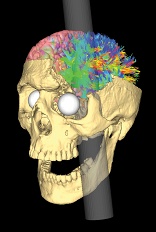
But the most recent Gage is the most otherworldly. A study by John Darrell Van Horn and colleagues examined how the path of the tamping iron would have affected the strands of white matter – the “brain’s wiring” – that connects cortical areas.

From Van Horn et al. (2012) PLoS One. 2012;7(5):e37454A slack-jawed Gage is now pierced by a ghostly iron bar that passes almost silently though his skull.

Gage himself is equally supernatural.

Blank white eyes float lifelessly in his eye sockets – staring into the digital blackness.

His white matter tracts appear within his cranium but are digitally dyed and seem to resemble multi-coloured hair standing on end like the electrified mop of a fairground ghoul.

But as the immortal Gage has become more horrifying over time, living portraits of the railwayman have been discovered. They show an entirely different side to the shattered skull celebrity.

To date, two portraits have been identified. They both show a ruggedly handsome, well-dressed man.

He has gentle flesh. Rather than staring into blackness, he looks at us.

Like a 19th century auto-whaler holding his self-harpoon, he grips the tamping iron, proud and defiant.

I prefer this living Phineas.

He does not become more alien with every new image.

He is at peace with a brutal, chaotic world.

He knows what he has lived through.

Fuck the freak flag, he says.

I’m a survivor.

Happiness rebuilt

I’ve written a piece for SpotOn NYC on the contrast between the effects of brain injury depicted in Oliver Sacks-type books and the typical effects in patients on neurology wards.

These books are not inaccurate but neither do they represent the common outcomes of brain injury.

Sometimes the reality is quite different from what people expect.

It is not that the patients described by Oliver Sacks, or any of the other chroniclers of fragile neurology, are in any way inaccurate. I have met patients who show us something about our brain function in equally stark clarity. But such cases are interesting, scientifically, precisely because they are atypical. In contrast, most brain injury is blurry and scientifically mundane. Some difficulties are concealed by other more pressing problems. It’s hard to mistake your wife for a hat when you’re paralysed. It’s hard to have an awakening when you’re not sure where you are. Their importance lies not in a contribution to an understanding of the brain but to the people concerned. An adjusted life. A refactored family. Tears amid the challenges. Happiness rebuilt.

The piece part of a series of posts written by neuroscience bloggers looking at the difficulties with communicating the subtlety and complexity of brain disorders.

There are some excellent pieces there so do have a browse.
 

Link to ‘The Man Who Mistook His Wife For A Nurse’
Link to communicating brain disorders series.

What will the billion dollar brain projects do?

Two neuroscience projects have been earmarked for billion dollar funding by Europe and the US government but little has been said about what the projects will achieve. Here’s what we know.

The European Commision has just awarded half a billion euros to the Human Brain Project – a development of Henry Markram’s Blue Brain project which has made impressive biologically detailed computational models of cortical columns from the rat brain.

The Human Brain Project sells itself as aiming to “simulate a complete human brain in a supercomputer” but this is clearly bollocks.

It’s interesting that this claim makes the press kit and the flashy video but the actual report (pdf) has much more sober claims about ‘simulating brain dynamics’ and the like.

But it’s important to realise that while their big sell is nonsense, the project is likely to genuinely revolutionise neuroscience in a way that could push the field light years ahead.

What Markram has realised is that the single biggest barrier to progress in neuroscience is the co-ordination, sharing and integration of data.

Essentially, it’s a problem of information architecture but quite frankly, you can’t sell that to politicians and they can’t sell it to the public. Hence the ‘simulating a complete human brain’ fluff.

What the project aims to do is co-ordinate neuroscience teams looking at neurobiology, cognitive neuroscience and computational modelling and give them the tools to easily share data with each other.

One of the big pay-offs will genuinely be the creation of biologically feasible computer simulations of neural networks with the hope that these can be used for practical applications like virtual drug testing and computer-based experiments.

Markram has gained valuable experience of meshing heavy-duty computing with working lab teams and has recruited some of the world’s leading neuroscientists to the project.

Although the spin seems over-the-top scientifically this is an important project that, if successful, could be a scientific landmark.

In terms of the big bucks American counterpart here’s what we know – which, as it turns out, is not very much.

Obama has hinted at spending up to $3 billion on a neuroscience project. He made a vague reference to ‘brain mapping’ and the director of the National Institute of Neurological Disorders and Stroke eventually confirmed he was referring to the Brain Activity Map project – something outlined in a scientific article published in last June’s Neuron.

You can read the piece as a pdf but io9 has some good coverage if you want a summary.

But here’s the thing. The scientific article really just says the project would aim to ‘reconstruct a full record of activity across complete neural circuits’ and turn them into computer models and suggests some technologies that may be useful.

It’s along the same lines as the Human Brain Project but without committing to any details and admits we don’t currently have to the tools to achieve the aims. Even the NINDS director admitted that a ‘concrete plan’ has yet to be finalised.

In fact, considering the vagueness of both the science and the political response I suspect the sudden discussion of the Brain Activity Map project is as much a response to the European cash splash than a well-planned project that has been waiting to be funded.

Although the announcement is probably as much a political as a scientific move the implications are likely to be important.

If we assume that the US has committed to not being left behind by their European colleagues we are likely to see a decade of massive innovation in neuroscience.

We live in exciting times.

Point me to a brain area

I’ve just found an incredibly use brain anatomy atlas that when you point at any part of an MRI scan it tells you which part of the brain you’re looking at in all three planes.

It seems to be part of a very useful website called HeadNeckBrainSpine that is full of handy neuroanatomy tools, tutorials and toys.

If nothing else, do check out the MRI atlas as it will give you a feel for how clearly different brain structures appear on a common type of medical scan.

As some folks on the Twitter arguing service have noted, its only slight drawback is the brain’s biggest structure (the frontal lobes) are not perfectly outlined, but they’re marked adequately and it’s still a massively useful tool that I’ve been referring to ever since I found it.

 
Link to MRI neuroanatomy atlas.
Link to HeadNeckBrainSpine.

Death of a booty chemical

I’ve got a piece in The Observer about why dopamine isn’t a ‘pleasure chemical’ but how this idea is likely to stay because it’s too useful for the media.

It provides a simplified explanation for a whole range of behaviours and sexes-up science stories, regardless of whether it makes sense or not.

If there were a celebrity among brain chemicals, it would be dopamine. Supposedly released whenever we experience something pleasurable, it’s forever linked to salacious stories of sex, drugs and wild partying in the popular press. The Kim Kardashian of neurotransmitters, it gives instant appeal to listless reporting and gives editors an excuse to drop some booty on the science pages.

There are too many bad examples to mention in detail, but I have some favourites. The Sun declared that “cupcakes could be as addictive as cocaine” because they apparently cause “a surge of the reward chemical dopamine to hit the decision-making area of the brain”. The article was topped off with a picture of Katy Perry, apparently a “cupcake fan” and, presumably, dangerously close to spiralling into a life of frosted-sponge addiction.

The piece goes on to mention another particularly bad example of dopamine reporting among many and explains why the ‘pleasure chemical’ cliché just doesn’t fit the science.

Unfortunately, one of my best lines (definition: I laughed at my own joke) got edited out.

The original line was “It was clearly just a smokescreen for the views of gun and, er, cupcake hating liberals” which has just been edited down to “gun hating liberals”.

It’ll make sense when you read it.
 

Link to ‘The unsexy truth about dopamine’ in The Observer.

Owner of Broca’s area identified

A patient who could only say the word ‘tan’ after suffering brain damage became one of the most important cases in the history of neuroscience. But the identity of the famously monosyllabic man has only just been revealed.
Broca’s area was one of the first brain areas identified with a specific function after 19th Century neurologist Paul Broca autopsied a man who had lost the ability to speak.

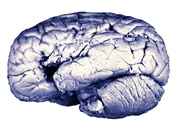
When examining the man’s brain (you can see it on the right), Broca found selective damage to the third convolution of the left frontal lobe and linked this with the fact that the person could understand speech but not produce it.

This type of speech problem after brain injury is now known as Broca’s aphasia but his innovation was not simply naming a new type of neurological problem.

Broca was one of the first people to think of the brain in terms of separate areas supporting specialised functions and studying patterns of difficulty after brain damage as a way of working this out – a science now known as cognitive neuropsychology.

The patient Broca described was nicknamed ‘Tan’ because this was the only syllable he could produce. The scientific report named his as Monsieur Leborgne but no further details existed.

Oddly, personal details were not even recorded in Broca’s unpublished medical notes for the patient.

Because of the mystery, people have speculated for years about the identity of Monsieur Leborgne with theories ranging from the idea that he was a French peasant to a philandering man struck down by syphilis.

But now, historian Cezary Domanski has tracked down the identity of Broca’s famous patient through detective work in record offices in France and published the results in the Journal of the History of the Neurosciences.

According to the Broca’s report, the health problems of Louis Victor Leborgne became apparent during his youth, when he suffered the first fits of epilepsy. Although epileptic, Louis Victor Leborgne was a working person. He lived in Paris, in the third district. His profession is given as “formier” (a common description in the nineteenth century used for craftsmen who produced forms for shoemakers).

Leborgne worked until the age of 30 when the loss of speech occurred. It is not known if the damage to the left side of Leborgne’s brain had anything to do with traumas sustained during fits of epilepsy nor, as reported in some recent publications, does it appear to have been caused by syphilis, as that was not indicated in Broca’s reports. The immediate cause for his hospitalization was his problem with communicating.

Leborgne was admitted to the Bicêtre hospital two or three months after losing his ability to speak. Perhaps at first this might have been perceived as a temporary loss, but the defect proved incurable. Because Leborgne was unmarried, he could not be released to be cared for by close relatives; he therefore spent the rest of his life (21 years total) in the hospital.

Domanski’s article finishes on a poignant note, highlighting that Leborgne became famous through his disease and death and his life history was seemingly thought irrelevant even when he was alive.

“It is time” says Domanski, “for Louis Victor Leborgne to regain his identity”.
 

Link to locked article on the identity of Broca’s patient (via @Neuro_Skeptic)

A brain of warring neurons

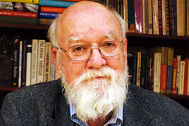
A fascinating talk from philosopher of mind Daniel Dennett where he refutes his earlier claims that neurons can be thought of like transistors in a computational machine that produces the mind.

This section is particularly striking:

The question is, what happens to your ideas about computational architecture when you think of individual neurons not as dutiful slaves or as simple machines but as agents that have to be kept in line and that have to be properly rewarded and that can form coalitions and cabals and organizations and alliances? This vision of the brain as a sort of social arena of politically warring forces seems like sort of an amusing fantasy at first, but is now becoming something that I take more and more seriously, and it’s fed by a lot of different currents.

The complete talk is over at Edge.
 

Link to Dennett talk at Edge.

The search for a genetic killer

Photo by Flickr user Null Value. Click for source.The medical examiner for the Sandy Hook shooting has requested a genetic analysis of killer Adam Lanza. Following this, a powerful editorial in the science magazine Nature has condemned the move suggesting it is “misguided and could lead to dangerous stigmatization.”

But the request to analyse the DNA of Lanza is just the latest in a long line of attempts to account for the behaviour of individual killers in terms of genetics.

Perhaps the first attempt was for a case that bears more than a surface resemblance to the Sandy Hook shooting. In 1998, a 15-year-old high school student called Kip Kinkel killed both of his parents before driving to school and shooting 24 students, one of whom died.

In his trial a child psychiatrist argued that Kinkel had “genetic loading” that made him susceptible to mental illness and violence.

His appeal also relied upon this angle. His lawyer argued that “owing to a genetic predisposition, and therefore through no conscious fault of his own, the defendant suffers a mental illness resulting in committing his crimes.”

Perhaps for the first in decades, an appeal to genetics was used in an attempt to explain the killer’s behaviour.

The genetic arguments became more sophisticated with the trial of serial killer Cary Stayner where a psychiatrist and geneticist presented a genealogy of the his family showing how mental illness and violence ‘ran through the family’.

By the time of the trial of murderer Stephen Mobley, the defence based part of their case on molecular genetics – suggesting that Mobley had a version of the MAOA gene that made him susceptible to violence.

It’s worth noting that none of these appeals to genetics have been successful in the courtroom but it’s interesting that in light of the tragic events in Sandy Hook there has been, yet again, a look towards genetics to try and make sense of the killer – this time presumably based on the yet more advanced technology of whole DNA sequencing.

On this occasion, however, the reasons seems less related to issues of legal responsibility and more for scientific motivations, supposedly to better understand the ‘DNA of a killer’.

As the Nature editorial makes clear, this is foolish:

There is no one-to-one relationship between genetics and mental health or between mental health and violence. Something as simple as a DNA sequence cannot explain anything as complex as behaviour.

However, it shows an interesting shift away from the courtroom genetics of past incidents to a ‘public health’ approach, where, as sociologist Nikolas Rose has noted, the justification is given…

…not in the language of law and rights, but in terms of the priority of protecting “normal people” against risks that threaten their security and contentment. Biological factors are merely one set of factors among others predisposing individuals to antisocial conduct, and “therapeutic interven­tions” are proposed for the good of both the individual and society.

There is a valuable science of understanding how genetics influences violent behaviour but analysis of individual killers will tell us very little about their motivations.

It does, however, reflect a desire to find something different in people who commit appalling crimes. Something that is comprehensible but distinct, alien but identifiable.

This may give us comfort, but it does little to provide answers. In the midst of tragedy, however, the two can easily be confused.
 

Link to Nature editorial.