
Why the truth will out but doesn’t sink in

Bin Laden used a woman as a human shield and fired at the commando team sent to kill him – at least according to the first reports. These have just been corrected to say he was unarmed and standing alone, but the retractions follow a useful pattern – media friendly version first, accurate version later – because the updates make little impact on our beliefs.

In this particular case, I can’t speculate why the corrections came as they did. Maybe it was genuinely the ‘fog of war’ that led to mistaken early reports, but the fact that the media friendly version almost always appears first in accounts of war is likely, at least sometimes, to be a deliberate strategy.

Research shows that even when news reports have been retracted, and we are aware of the retraction, our beliefs are largely based on the initial erroneous version of the story. This is particularly true when we are motivated to approve of the initial account.

Psychologist Stephan Lewandowsky has been studying this effect for several years and not just with abstract test material. Here’s a summary of his study study on retracted reports of the Iraq war:

Media coverage of the 2003 Iraq War frequently contained corrections and retractions of earlier information. For example, claims that Iraqi forces executed coalition prisoners of war after they surrendered were retracted the day after the claims were made. Similarly, tentative initial reports about the discovery of weapons of mass destruction were all later disconfirmed.

We investigated the effects of these retractions and disconfirmations on people’s memory for and beliefs about war-related events in two coalition countries (Australia and the United States) and one country that opposed the war (Germany). Participants were queried about (a) true events, (b) events initially presented as fact but subsequently retracted, and (c) fictional events.

Participants in the United States did not show sensitivity to the correction of misinformation, whereas participants in Australia and Germany discounted corrected misinformation. Our results are consistent with previous findings in that the differences between samples reflect greater suspicion about the motives underlying the war among people in Australia and Germany than among people in the United States.

More recent studies have supported the remarkable power of first strike news. The emotional impact of the first version has little influence on its power to persuade after correction, and the misinformation still has an effect even when it is remembered more poorly than the retraction.

Even explicitly warning people that they might be misled doesn’t dispel the lingering impact of misinformation after it has been retracted.

So while the latest reports say Bin Laden was alone and unarmed, the majority of people are likely to believe he was firing from behind a human shield, even when they can remember the corrections.

And if this isn’t being used as a deliberate strategy to manage public opinion, I shall eat my kevlar hat.
 

Link to Iraq was misinformation study DOI.
pdf of full text.
Link to related 2007 WashPost piece on the persistence of myths.

Ever had the experience of life flashing before your eyes?

Have you ever had the experience of ‘life flashing before your eyes’ when in danger? Perhaps in an accident, combat or a life threatening event?

If so I’d love to hear from you for a book I am writing on hallucinations, altered perceptions and how the brain constructs reality.

If so, feel free to drop me a brief email through this webpage as I’d be keen to hear more.

Parents a risk factor for psychological maladjustment

The Onion has a funny story with the headline ‘Man Raised By Parents Struggling To Adjust To Human Society’.

MINNEAPOLIS—Two years after his discovery by a team of developmental psychologists, David Sullivan, a man raised by a pair of mated parents, is still struggling to adapt to normal human society, sources confirmed Friday.

According to researchers at the University of Minnesota, Sullivan, 25, has made significant progress since moving into his own apartment in 2009, but the decades he spent being reared by parents has made joining civilization a desperately difficult task.

“The chances of David ever becoming socialized to the point where he can function normally among humans is very slim,” said Dr. Lisa Reynolds, a psychologist who has observed Sullivan since he was first introduced into the real world. “The sheltered, isolated environment in which he spent his adolescence has left him completely unequipped to deal with modern life. Tasks that may seem simple to us, such as doing laundry or grocery shopping, completely baffle David.”


Link to ‘Man Raised By Parents Struggling To Adjust To Human Society’.

Media addicted to self-fulfilling porn survey shock

Dr Petra has an excellent breakdown of a recent UK survey that ran with the finding that a quarter of men are worried about their online porn use.

Although the piece looks at the details of this particular headline grabbing story, it really serves as a good critique of almost any media survey about sex, as it examines the process of how such surveys are conducted and subsequently reported by the media.

Porn is a topic that is of increasing interest to the media because it fills a particular niche in the way sex is reported: it allows a sexy headline grabbing topic to presented while framing it with acceptable matronly concern.

If you look at the press coverage of this survey (alongside reflecting on the discussions I had with journalists today) some very definite patterns of how journalists/the media see sex/relationships and porn.

The view from medialand is as follows:

Who looks at porn? Well, it’s men. They are all straight and the porn they are seeking out is also heterosexual. Women are constructed as having problems/concerns about pornography – but only in relation to their (male) partner’s use of it. ‘Pornography’ as a term is used to mean one genre from one format (the internet). Looking at mainstream porn in moderation is okay, but if you do it often then it becomes a problem. Quite often described in the medicalised language of addiction.

Men are naturally sexual and so can’t help liking porn, but if they do look at it they’ll become abusers or change their neurological makeup or sexual behaviour. Women don’t like porn, those who do are presented as being in a minority, probably deluded, or liking romantic/couples-based/equality-based/feminist porn. Porn within relationships is only permissible if it’s to spice things up (or encourage reluctant wives to get in the mood). LGBT folk aren’t even thought about…

If you’re starting from this as your standard position it makes thinking critically about pornography difficult. It means journalists will be tasked (or choose) to find evidence to stack up this world view. It also means it’s risky to find other ways to think about/explore porn for fear of being seen to endorse it.

By the way, the image on the right is a French cartoon from the 1800s satirising concern about the ‘pornography epidemic’.

Plus ça change, plus c’est la même chose.
 

Link to excellent Dr Petra piece on media porn surveys.

Ketamine – biography of a space agent

Ketamine is both a powerful hallucinogenic drug and an effective anaesthetic that can create striking out-of-body experiences.

The history of ‘Taming the Ketamine Tiger’ is recounted by the doctor who has been most involved in researching and understanding the curious compound in an open-access article published in Anesthesiology.

The author is the wonderfully named Edward Domino who was one of the first people to study both the pain killing and mind bending effects of ketamine.

His article recounts the history of the compound from its discovery, to its use in surgery, to its deployment in the Vietnam war and its championing by the consciousness exploring counter-culture.

The paper is written for fellow pharmacologists and so has some fairly technical parts (the section ‘Ketamine Pharmacology’ is probably best skipped if you’re not into the gritty details of how it affects the body and brain) but also has some wonderful personal recollections and anecdotes from the drug’s history.

About 1978, the prominent physician, researcher, and mystic John C. Lilly, M.D. (1915–2001), self-administered ketamine to induce an altered state of consciousness. He summarized his many unique experiences as “a peeping Tom at the keyhole of eternity.” These included sensory deprivation while submerged in a water tank, communication with dolphins, and seduction by repeated ketamine use.

In 1978, Moore and Alltounian reported on their personal ketamine use. Marcia Moore was a celebrated yoga teacher, Howard Alltounian, M.D., a respected clinical anesthesiologist. They reportedly got high on ketamine together and after two ketamine “trips” fell in love and became engaged after 1 week. They felt they were “pioneering a new path to consciousness.” Ms. Moore was called the priestess of the Goddess Ketamine. She took the drug daily and apparently developed tolerance.

For her, ketamine was a seductress, not a goddess. Her husband warned her of its dangers. She slept only a few hours each night. She agreed that she was wrong about a lot of things and was “going to stay with it until it is tamed.” However, Moore was unable to tame the ketamine tiger and in January 1979 disappeared. The assumption was that she injected herself with ketamine and froze to death in a forest.

You can read the full article here although it’s not clear to me that the link is stable enough to be archived, in which case the DOI entry points here although you may need to do some clicking through to find the full text.

Anyway, a fascinating look back at a complex compound from the man at the centre of its science.
 

Link to ‘Taming the Ketamine Tiger’ in Anesthesiology.
Link to DOI entry for same.

The death of the mind

Business Week has an important article on how internet companies are using the massive data sets collected from the minutia of users’ behaviour to influence customer choices.

The article is a useful insight into how tech companies are basing their entire profit model on the ability to model and manipulate human behaviour but the implication for psychology is, perhaps, more profound.

Psychological theories and ideas about how the mind work seem to play a small, if not absent role in these models which are almost entirely based on deriving mathematical models from massive data sets.

Sometimes the objective is simply to turn people on. Zynga, the maker of popular Facebook games such as CityVille and FarmVille, collects 60 billion data points per day—how long people play games, when they play them, what they’re buying, and so forth. The Wants (Zynga’s term is “data ninjas”) troll this information to figure out which people like to visit their friends’ farms and cities, the most popular items people buy, and how often people send notes to their friends.

Discovery: People enjoy the games more if they receive gifts from their friends, such as the virtual wood and nails needed to build a digital barn. As for the poor folks without many friends who aren’t having as much fun, the Wants came up with a solution. “We made it easier for those players to find the parts elsewhere in the game, so they relied less on receiving the items as gifts,” says Ken Rudin, Zynga’s vice-president for analytics.

Although the example given might seem trivial, it is a massive generator of profit and can be applied to any sort of online behaviour.

What’s striking is that the relationships between the context, motivations, evaluation and behaviour of the users is not being described in terms of how the mind or brain understand and respond the situation but purely as a statistical relationship.

It is psychology devoid of psychology. Rather than the wisdom of crowds approach, it’s the behaviour of zombies model. Unsurprisingly, none of the entrepreneurs mentioned are cognitive scientists. They’re all mathematicians.

I am reminded of the Wired article ‘The End of Theory’ which warned that big data crunching computers could solve scientific problems in the same way. The generated mathematical model ‘works’ but the model is uninterpretable and does not help us understand anything about what’s being studied.

Similarly, while the experimental psychologist’s dream for more than a century has been to work with large data sets to have confidence in our conclusions about the mind, the reality, currently being realised, may actually make the mind redundant in the majority of the commercial world.
 

Link to Business Week article (via @ivanoransky).

Sports car advert based on entirely new organ

Car makers Audi have launched a fantastic brain-themed video commercial to promote their new range of money-themed sports cars.
It incorporates the brain as well as lots of neuroanatomy shaped graphics. An approach rarely taken with the usual penis-based marketing campaigns.

It seems the neuroadvert is aimed at academic neuroscientists who would only have to spend their entire year’s salary to buy one.

Despite my snide comments, I have to say, the video rocks.
 

Link to video of Audi commercial (thanks Natasha!)

A neurologist, fighting to the last

The San Francisco Chronicle has a striking article about a neurologist who is dying from the disease he has researched all his professional career. He is writing his last paper as he slowly gives way.

The condition is called amyotrophic lateral sclerosis, also known as ALS or Lou Gehrig’s disease, which slowly destroys neurons in the spinal cord that control the muscles in the body, leading to a gradual loss of control, paralysis and death through breathing problems.

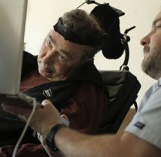
The doctor is Richard Olney an expert in the condition who is writing up his last study on the condition by using a device which lets him type with his eye movements.

Dr. Richard Olney is racing to finish what is almost certain to be his last research paper.

The 63-year-old UCSF neurologist is considered one of the country’s top clinical specialists for amyotrophic lateral sclerosis, or ALS, popularly known as Lou Gehrig’s disease. ALS is also the reason Olney is in a hurry to finish his paper: He was diagnosed with ALS in 2004, and after a long period of relative stability, the disease appears to be rapidly winning out over the doctor.

Olney has almost no muscle function left.

“He’s at the end stages now, certainly,” said Dr. Catherine Lomen-Hoerth, once Olney’s medical trainee, now his doctor. “I’m hopeful he may have at least a few months.”

Olney hopes the disease he is studying will spare him at least long enough to finish his research on it. His son, Nicholas, 33, is assisting with the final write-up.

The piece is tragic yet inspiring and a tribute to a life’s work lived to the full.

God speed good doctor.
 

Link to SF Chronicle article (via @stevesilberman).

Three Christs winner

Many thanks to all who entered our Three Christs competition and what a fantastic response we had.

The entries in the comments stretch from the bizarre to the philosophical to the profound and are enormously good fun to read. However we do have a winner.

In answer to the question “You’re working in a psychiatric hospital and suddenly everyone thinks you’re a patient. How would you convince them you’re really a psychiatrist?” the winning entry was from hat_eater:

Why do I have to convince them I’m a psychiatrist? It says so plain as a day on my admittance form.

Thank you very much and we’ll be in touch to organise your winning copy of The Three Christs of Ypsilanti.

There were many wonderful answers, some of them too long to fit in a blog post so do check them out, but here are a few of the shorter and wittier ones that caught my eye:

natselrox: “Explain to them that according to Godel, it’ll be impossible for me to prove my true identity in a system where subjects can only be either psychiatrists or patients.”

pete: “I would show them my country club membership.”

Kathy: “By not responding to the antipsychotics prescribed for me–’cos the real patients all do get better, don’t they?”

Darrin: “Just tell everyone to speak to my registrar. They will look after things while I’m at an important meeting.”

karen foley: “I would log onto the New York Times as a paying subscriber. While that may be crazy, only doctors can afford the rates!”

Bill: “Have them page you. Only doctors are crazy enough to carry pagers.”

Many thanks to all of you for the fantastic interest in the competition and many thanks to the New York Review of Books Classics for offering a copy for our somewhat odd competition.
 

Link to competition blog post with fantastic entries in the comments.
Link to details of the The Three Christs of Ypsilanti reprint.

A connoisseur’s list of essential psychology

Every month since 2008 The Psychologist magazine has run an interview with a leading psychologist where they ask them to name one book or journal article, either contemporary or historical, that all psychologists should read.

The BPS Research Digest has compiled all the answers into handy and fascinating list.

A few of the answers:

Mistakes Were Made (But Not by Me) by Carol Tavris and Elliot Aronson. “You’ll get to understand why hypocrites never see their own hypocrisy, why couples so often misremember their shared history, why many people persist in courses of action that lead straight into quicksand. It’s lucid and witty, and a delightful read,” said Elizabeth Loftus, Oct 08.

“Muriel Dimen’s Sexuality, Intimacy, Power, which offers one feminist’s journey from dualism to multiplicity, questioning and making more complex all the accounts we have of how you grow up to become a sexed person,” said Lynne Segal, Jan 09.

“B.F. Skinner’s The operational analysis of psychological terms (Psychological Review 52, 270–277, 1945) is rarely read and even less often understood. Contrary to some misrepresentations of his position, Skinner never doubted that we can describe internal states such as thoughts or emotions, but he wondered how we are able to do this. His answer was surprising, relevant to the practice of psychotherapy, and a challenge to all those who (like some unsophisticated therapists) assume that we can know our own feelings by a simple process of self-inspection,” said Richard Bentall, Apr 11.

There are many more where they came from to make for an eye-opening and informative list of recommendations.
 

Link to BPS Research Digest list of essential reads.

The yin and yang of the LSD revolution

Neurotribes has a fantastic interview with the author of a new book on the relationship between Timothy Leary, Allen Ginsberg and their role in the LSD counter-culture that is still echoing through science and culture.

The interview is with Peter Conners, author of White Hand Society, a book that examines the relationship between the two men through their correspondence and looks at how it shaped each as individuals and the place of psychedelics in society.

Despite both men being major figures in the promotion of LSD, they ending up taking very different paths.

Leary, originally a Harvard professor who started out doing respected scientific research into mind altering drugs, ended up being thought of us a bit of a cartoon cut-out by both the establishment and by the counter-culture of the time.

Ginsberg took a less sensationalist route and used the experience as a springboard to spiritual exploration.

Despite the fact that neither ended up boosting serious research in psychedelics both had a massive influence on the scientific study of mind altering drugs.

Silberman: Do you think that if things had unfolded differently for Leary, psychedelics could have been successfully incorporated into mainstream medicine or psychology?

Conners: I actually think they are now more than they’ve ever been. My wife is a clinical psychologist. I recently read an article in The Monitor on tests they’re doing now with psilocybin and MDMA. One potential application is for post-traumatic stress disorder that all these soldiers are coming back with from the Middle East. Another is to help terminal patients prepare for death. The Monitor is a very mainstream venue — it’s the trade journal for psychologists. So after 40 years of a virtual blackout on psychedelic research, you can do it again now, thanks to the efforts of people like Rick Doblin at MAPS, the Multidisciplinary Association for Psychedelic Studies.

Silberman: I think Leary actually helped hasten the blackout, simply by going on and on with his inflammatory and hyperbolic claims about psychedelics. In a Playboy interview in 1966, he said in a properly conducted LSD session, a woman could expect to have hundreds of orgasms. He also insisted that LSD had “cured” Allen Ginsberg of homosexuality. Let’s just say that by the time I met Allen, when he was in his 50s, he must have been having a major relapse!

I have to say, the interview is a little hard on Leary, who, like Ginsberg, had a continuing cultural impact way after he abandoned the championing of LSD, but it is a fascinating look at the relationship between the two men.
 

Link to Neurotribes interview with Peter Connors.

A history of killing

The psychology of murder is the topic of a fantastic edition of ABC Radio’s All in the Mind that looks at the changing motivations behind the most serious of crimes.

You might think that the reasons for committing murder have been relatively constant across time, even if the perceived necessity has been been changed by modern society.

But it turns out that the social psychology of murder has changed radically in the last 500 years.

Honour and shame are no longer considered to be the most important psychological factors in determining social standing and murder is no longer considered an acceptable way of redressing the balance.

Pieter Spierenburg: Basically it means that honour moves away from being based on the body, being tied to the body, being based on preparedness to defend yourself and your dependants, and that you get other sources of honour that for example economic success or that even in a later period what they called sexual purity is a source of honour, being a good husband, a good head of the family, things that people take pride in and that becomes a source of honour— a man can be honourable without being violent…

James Gilligan: The more people have a capacity for feelings of guilt and feelings of remorse after hurting other people, the less likely they are to kill others. I think in the history of Europe what one can see is a gradual increase in moral development from the shame / honour code to the guilt / innocence code.

The programme not only tracks the history of murder and its motivations but looks at this is dealt with in modern day prison systems and violence prevention programmes. A fascinating look at a violent act.
 

Link to All in the Mind on ‘Murder in mind’.

Three Christs return and are waiting to be won

The New York Review of Books has just reprinted the classic book ‘The Three Christs of Ypsilanti’ documenting psychologist Milton Rokeach’s offbeat experiment where he brought three delusional Christs together in the same psychiatric hospital.

I wrote about the astounding but somewhat ethically dubious study in a recent article for Slate if you want some background and I’m pleased to see a new edition being printed, as even the out-of-print second edition was being sold for hundred of dollars.

The publishers have kindly offered a copy of the book as a prize, sent anywhere in the world, so we thought we’d run a quick competition (please note, although I’m quoted on the publishers’ page for the book, I’m not financially involved in any way).

Anyway, the competition is this:

You’re working in a psychiatric hospital and suddenly everyone thinks you’re a patient. How would you convince them you’re really a psychiatrist?

Leave an answer in the comments, I’ll pick the best one by the end of the week and the prize will be sent to you, anywhere in the world.

COMPETITION CLOSED: Thanks for all your wonderful entries. The winner has been announced although you’re welcome to continue to add your own fantastic ideas below if you’d like to join the fun.


Link to publishers page for The Three Christs of Ypsilanti.

Time flies when you’re having fun

The New Yorker has a fantastic profile of neuroscientist David Eagleman that captures both his playful approach to science and his intriguing work on how we perceive time.

Eagleman is one of the most engaging thinkers in neuroscience – equally at home tackling fascinating areas of cognitive science and writing playful books about the afterlife.

The New Yorker article manages to both his wide ranging enthusiasm and the science behind his work into offbeat but essential brain functions.

Time isn’t like the other senses, Eagleman says. Sight, smell, touch, taste, and hearing are relatively easy to isolate in the brain. They have discrete functions that rarely overlap: it’s hard to describe the taste of a sound, the color of a smell, or the scent of a feeling. (Unless, of course, you have synesthesia—another of Eagleman’s obsessions.) But a sense of time is threaded through everything we perceive. It’s there in the length of a song, the persistence of a scent, the flash of a light bulb. “There’s always an impulse toward phrenology in neuroscience—toward saying, ‘Here is the spot where it’s happening,’ ” Eagleman told me. “But the interesting thing about time is that there is no spot. It’s a distributed property. It’s metasensory; it rides on top of all the others.”

An entertaining article that tackles everything from time stretch during life threatening incidents to a study on drummers with Brian Eno. Great fun and throught-provoking.
 

Link to New Yorker profile of David Eagleman.

Arresting suicide by cop

Suicide by cop‘ is a fairly recent concept that has come to light after cases of people who seemingly provoked police shootings in an attempt to end their own lives.

Miller-McCune magazine has an excellent article on how the police are increasingly recognising this as a problem and are working towards diverting these situations to avoid a lethal outcome.

Although some cases are clear-cut, exact figures are hard to come by, not least because it often involves inferring the intentions of someone who has just been killed.

While some say the problem is vastly under-recognised, others are concerned that it could be used as an excuse for questionable shootings by saying the subject was suicidal.

However, the Miller-McCune article takes a comprehensive look at what we know about ‘suicide by cop’ and how innovative new programmes are being put-in-place to try and pick up cases and divert them to mental health services.

Most people who have studied the phenomenon will tell you that, typically, suicide-by-cop scenarios fall into two categories: the “fleeing felon” who tries to escape police and, once cornered, decides he’s going to go out in a blaze of glory; and the “emotionally disturbed person,” who, like Seth, is looking for a way out of the pain of either mental illness or some kind of life failure.

The police encounter “emotionally disturbed persons” so regularly that, in cop lingo, they are called “EDPs.” Whether it’s a domestic call (a man with a history of depression has become violent because his ex won’t take him back), a workplace incident (an employee locks herself in a bathroom with a letter opener after being let go), or a schizophrenic homeless man screaming obscenities at shoppers at the local Dollar Store, police are often the first responders to problems involving our nation’s mentally ill. Situations involving the emotionally disturbed are volatile and can quickly spiral out of control, but most American police officers receive little specialized training on dealing with them.

The author of the piece, crime journalist Julia Dahl, and the mother of a man who tried to kill himself by provoking the police were interviewed recently on NPR Radio’s Here and Now.

Unfortunately, I’m on a low-bandwidth 1990s-style internet connection so can’t listen to it very easily, although it looks like a good complement to the article.
 

Link to Miller-McCune article ‘How to Stop Suicide by Cop’.
Link to ‘suicide by cop’ interview on NPR radio.

The exceptional mourning of twins

I’ve just found an amazing article that looks at how the death of twins is mourned in cultures around the world.

The journal Twin Research and Human Genetics is usually dedicated to the science of twin studies – a key method for understanding the role of genetics and the environment on the development of human traits.

In 2002 they had a special issue that took a very different look at the subject – examining grief and mourning related to twins.

One of the articles is a stunning look at the anthropology of twin death, exploring the diverse and intriguing beliefs and practices concerning twin death.

This is a short excerpt on funeral practices (I’ve removed references removed for ease of reading) although I could have selected almost any part of the fascinating article:

Mythical attributes, such as animal kinship, inevitably influence twin funerary rites. The Ga (west Africa) presume twins have the wild bushcow’s spirit, and living twins rush about like wild cows when a twin dies. The Nootka and Bella Coola (NW North America) believed salmon and twins had close affinity. The Nootka did not bury a dead twin infant, but laid it on swampy ground. A twin who died after infancy was not interred like a singleton, but placed in a box in a riverside tree until the current swept away tree and box together.

Nuer (NE Africa) twin infants’ bodies were placed in trees due to their purported kinship with birds. Both birds and twins were children of God, gaat kwoth, spirits who dwell in air and clouds. A stillborn twin was left in a reed basket in a tree fork and birds of prey supposedly left them intact. Adult Nuer twins weren’t buried, but were laid on a platform with no ceremonies. Twins did not attend others’ funerals.

The Gilyak (Sakhalin Island, Far east) cremated singletons, but burial was mandated for a twin or his parents. Twins, as offspring of the mountain god, were dressed in white and seated Turkish style in a specially built house surrounded with shavings.

The article is completely open-access and, although an academic paper, is quite readable and completely engrossing.
 

Link to article entry (click through for full text PDF)