Shake it baby!

DukeNukem3dScan.jpgBBC News are reporting that Belgian researchers are using a modified version of Duke Nukem 3D in brain imaging studies – unaware that Duke Nukem has been used in brain-scanning experiments since 1998.

The image on the left is from a 1998 paper published in Science by Dr Eleanor Maguire and colleagues. The paper is available as this pdf.

The Maguire study mapped out areas of the brain involved in navigating through space and spatial memory by editing the standard Duke Nukem game to include controlled tasks.

The brain activation can be seen in the hippocampus and caudate nucleus. The location is the LA Meltdown level. Come get some!

A recent study published in PLoS Biology by the same Belgian neuroscientists mentioned by the BBC extended this research by looking at delayed brain activity associated with learning various tasks. This included a spatial navigation task which also used a modified version of the Duke Nukem environment.

After participants had learnt one task, they were asked to wait before completing another. The learning from the first task induced long-term changes in brain activation which could be detected when participants were doing the second unrelated task.

This suggests that learning is an ongoing and evolving brain process, even when you’ve moved on to other things.

Duke Nukem has now featured in a whole raft of brain scanning experiments, often only described as being a ‘virtual environment’.

Link to badly spun BBC News story.
pdf of Maguire and colleagues 1998 paper.
Link to summary of delayed learning paper.
Link to full text of delayed learning paper.

Sleep-retardant properties of my ex-girlfriend

nullhypothesis_2v7cover.jpgThe cover feature in this month’s Null Hypothesis is an empirical investigation into one researcher’s experiences of having a sleep-retardant girlfriend.

The paper is available as a pdf and was written by human computer interaction researcher Ryan Baker in an attempt to fathom why he was sleeping so poorly.

Baker selected the possible causes and put the data into a regression model to determine the effect each had on his sleep duration. The model showed the strongest effect when he slept with his girlfriend, so he presented her with the data.

I concluded by explaining that, due to her sleep-retardant properties, I could not continue to sleep with her, an act she termed “breaking up”. I should mention that Hermina suggested that my data, being from an observational study rather than an experimental study, only shows correlations rather than causation, and that it was quite possible that I had only chosen to sleep at her apartment on nights when I was less tired, or that I had actually chosen to get less sleep on nights when I had come to her apartment.

She proposed that, instead of taking hasty action, we conduct an experimental study where we flip a coin each night to determine whether I would sleep at her apartment or my own, in order to prove a causative effect. Obviously, I rejected this suggestion. Although this study is insufficient to conclusively prove Hermina’s causative role, this strong a correlation, and the importance of getting enough sleep, are sufficient together to suggest that action needs to be taken expeditiously.

Null Hypothesis is an anarchic and consistently funny UK science magazine that often contains gems like this, as well as curious news from the world of science.

pdf of Baker’s paper.
Link to Null Hypothesis website.

Stephen Fry and neuropsychiatric genetics

StephenFry.jpgActor, writer and film director Stephen Fry recently visited the neuropsychiatric genetics unit at Cardiff University – which is not a combination I’d ever thought I’d be writing about.

Fry has bipolar disorder, sometimes called manic depression, which can cause manic highs or deep disabling depressions.

His visit was apparently part of a BBC documentary on bipolar to be shown later this year, and the unit is one of the leading research centres for the genetics of psychopathology.

Link to write-up from Cardiff University.

When does the brain develop maths?

wooden_1-2-3.jpgAn innovative study just published in the open-access science journal PLoS Biology provides intriguing evidence that the brain dedicates a region to understanding maths by as early as four years-old.

The researchers, led by neuroscientist Jessica Cantlon, used fMRI to brain-scan adults and four year-old children while they watched collections of shapes flash up in front of them.

In most conditions, the number of shapes and the type of the shapes stayed the same, so participants mostly saw pictures of 16 circles.

On rare occasions, the circles were replaced by squares or triangles, or alternatively, the number of shapes doubled to 32. This last condition was crucial, because it represented a change in the number of shapes presented on screen.

Most other things that could have caused a brain response were controlled for, so a change of brain activation here should indicate a neural response linked to detecting a change in number.

In this condition, both adults and four-year olds showed activation in an area called the intraparietal sulcus, part of the parietal lobe.

This area is known to be particularly involved in sophisticated number processing in adults using Arabic numerals (what we would normally think of as ‘maths’), which suggests that this ability may be based on a very early mechanism for dealing with counting and numbers.

Interestingly, children showed this activation largely on the right hand side of the brain, whereas adults showed similar activation on both sides.

Cantlon and her team suggest that this is because basic number ability becomes more complex as we learn to do symbolic mathematical operations during and after school, which the pre-school children in the study were unable to do.

Link to summary of study.
Link to full text of scientific paper.

Goths and mental health

Photo by Christine ApplebyThere’s an informed and critical review of the recent coverage about goths, self-harm and success, over at the Anxiety, Addiction and Depression Treatments blog.

One recent study from Glasgow suggested that although goth kids have a higher rates of self-harm, it is more likely that self-harmers are drawn to the goth subculture than vice-versa, as the majority reported that they began harming themselves before becoming goth.

This was reported quite unpredictably in the media, with the goth subculture either being represented as the cause or remedy of these problems.

Another recent study reported that goths are more likely to go into professional jobs and be financially secure later in life, suggesting a good outcome for the majority.

The Anxiety, Addiction and Depression Treatments blog examines the disparity between the recent reporting of these findings and the representation of goth in the mainstream media.

Link to ‘The Rewards of Being Goth’ on AADT blog.

Kitsch movie posters from the planet brain

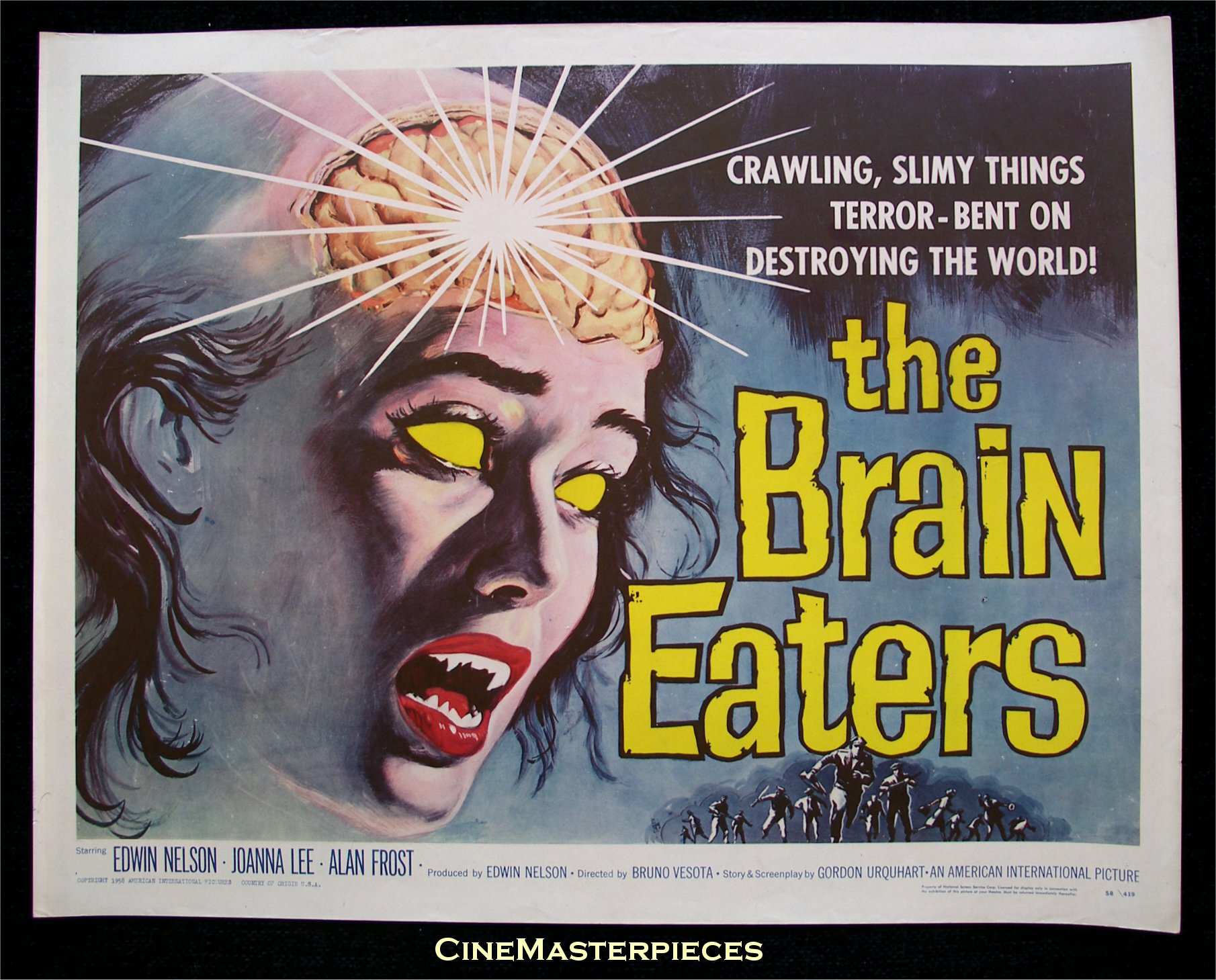
brain_eaters_poster.jpgI’ve just discovered that the search term ‘brain movie poster’ brings up a collection of neuroscience-themed B-movie posters on popular image search engines.

It’s interesting that the majority are from the 50s and 60s, the same time that both mass-produced psychiatric drugs and neuroscience research became widespread.

Maybe this spawned popular concern about the potential ‘brave new world’ about to occur – a worry seized upon by film makers wanting to make a quick buck in the B-movie business. Maybe recent ‘brain movies’ just have dull posters.

Either way, how could you not like a movie called Creature with the Atom Brain where an ex-Nazi mad scientist uses radio-controlled atomic-powered zombies in his quest to help an exiled American gangster return to power?

Link to ‘brain movie poster’ search on Google Images.
Link to ‘brain movie poster’ search on Yahoo! image search.

Australian AITM on the psychology of terrorism

black_white_gunman.jpgRadio National’s excellent All the the Mind focuses on the psychology of terrorism, cutting through some of the common myths about the personalities and motivations of those who commit terrorist acts.

Contrary to the political rhetoric, there is little evidence for terrorists being mentally unbalanced, although many have suffered previous trauma in their lives.

The programme features Dr Anne Speckhard and Dr Jerrold Post both of whom research the psychology of terrorism by working with victims and the perpetrators.

There’s also more information in a previous Mind Hacks post that includes links to further articles and research on the topic.

mp3 and realaudio of programme.
Link to programme transcript.
Link to previous Mind Hacks post on psychology of terrorism.

Thalbourne on the psychology of the paranormal

blue_night_sky.jpgABC Radio National’s In Conversation had a recent discussion about paranormal belief and experience with psychologist Dr Michael Thalbourne.

Thalbourne has conducted a huge amount of experimental research on psychological correlates of belief in the paranormal and what sort of mechanisms might predispose someone to have supernatural experiences.

Although his research and views are occasionally unorthodox, he has had a significant impact on this area of research.

mp3 or realaudio of programme.
Link to programme transcript.

2006-04-14 Spike activity

Quick links from the past week in mind and brain news:

spike.jpg

Study finds more white matter in auditory cortex of people who have a gift for languages.

Male and female brains are differently active, even during rest, reports brain imaging study.

Recent experiment suggests successful community cooperation may rely on a way of punishing noncooperators.

Women have extremely high rates of dissatisfaction with their body image says widely reported but dodgy survey from a magazine.

Clumsy BBC headline of the week – Weak brain links ‘explain autism’ – that actually obscures genuinely interesting research.

Good article in the Boston Globe about research on brain-computer interfaces.

SPET study shows NMDA receptors in left hippocampus of people with schizophrenia may be less efficient.

Futurelab discuss the latest trend in marketing with a neuroscience spin: brain fitness.

Salon feature on “Our crazy mental health system“.

BPS Research Digest reports that people with anxiety disorders suffer less accidents when under 25, but show a higher mortality after.

The Telegraph examines the metaphor of possession in understanding addiction.

As a group, Goths are more likely to self-harm, although probably due to self-harmers being attracted to the group for emotional and peer support reports New Scientist.

NewSci head electricity and ‘myth’ of mood drugs

newsci_20060415.jpgToday’s New Scientist has two articles of interest to mind and brain enthusiasts: a critical analysis of mood stablising drugs, and an account of a new brain intervention that involves passing a small electrical current through the head.

The article on mood stabilisers is largely an edited version of an article by psychiatrist David Healy published in a special issue of PLoS Medicine (mentioned previously on Mind Hacks).

The other feature article is on a technique called transcranial direct current stimulation (tDCS), something I’ve not heard of before but which seems to have some serious research supporting its use.

It sounds like quackery, but it’s not. A growing body of evidence suggests that passing a small electric current through your head can have a profound effect on the way your brain works. Called transcranial direct current stimulation (tDCS), the technique has already been shown to boost verbal and motor skills and to improve learning and memory in healthy people – making fully-functioning brains work even better. It is also showing promise as a therapy to cure migraine and speed recovery after a stroke, and may extract more from the withering brains of people with dementia. Some researchers think the technique will eventually yield a commercial device that healthy people could use to boost their brain function at the flick of a switch.

Unfortunately, the article isn’t available freely online, but you should be able to get the issue from your local newsagent or library.

Link to table of contents for this week’s issue.

Mixing Memory on the ‘hostile media effect’

coffee_newspaper.jpgCognitive science blog Mixing Memory highlights the hostile media effect whereby people assume a report of an event is biased towards an opposing view if it appears in the mass media.

This is despite the fact that when the same report is presented in another format (as an essay, for example) it is assumed to be neutral, or even supportive of the reader’s view.

The effect is particularly apparent when the report concerns some sort of conflict and the viewer is already aligned to one side. Interestingly, it doesn’t matter which side, the bias will be attributed to the opposition regardless. When neutral people view the report, bias is rarely reported.

Serious psychological study of perceived media bias began in the mid-1980s with studies by Vallone, Ross, and Lepper, and by Perloff. In both studies, pro-Israeli and pro-Palestinian participants were presented with television news coverage of Israel’s invasion of Lebanon and subsequent fighting. The pro-Israeli participants believed that the coverage was biased in favor of the Palestinians, and that it would make neutral observers feel less favorable towards their side, while the pro-Palestinians were convinced the coverage was biased in favor of the Israeli side, and that it would hurt their image in the eyes of neutral observers. This is despite the fact that when neutral observers did view the coverage, in Perloff’s study, they failed to perceive any bias, and their opinions of the two sides stayed the same.

As always, there’s more careful analysis and detailed references to the supporting research in the full post on Mixing Memory.

Link to ‘Hostile Media Effects’ on Mixing Memory.

Forced medication for execution

US Judge Wayne Salvant has ordered that Steven Kenneth Staley, a death-row inmate who is so severely mentally ill as to be unable to comprehend his situation, can be forcibly medicated so he can be executed while mentally competent.

A stay of execution was previously granted as he was judged not to understand his situation due to impaired mental functioning.

Staley is not the first prisoner to find himself in this situation. In 2004, Charles Singleton was forcibly medicated and subsequently executed in Arkansas.

His case was considered by an appeals court that decided by 6 votes to 5 that forcible medication for execution was acceptable.

In 1986, the US Supreme Court stated that the execution of the insane was barred by the Eighth Amendment, which prohibits cruel and unusual punishment, although the definition of insanity is left to individual states.

In 2002, the state of Texas executed Monty Delk. His last words were recorded in the state’s execution report:

At his execution, Delk screamed profanities and gibberish. When the warden asked if he had a final statement, Delk shouted. “I am the warden! Get your warden off this gurney and shut up!” At 7:47 p.m., the warden signaled for the lethal injection to begin. After spouting more profanity, Delk blurted out, “You are not in America. This is the island of Barbados. People will see you doing this.” Then, abruptly, he stopped speaking, and his mouth and eyes froze wide open. He was pronounced dead at 7:53 p.m.

Link to article on Staley judgement from The Star-Telegram.
Link to article on Singleton execution from CNN.

SciAmMind on AI and alcoholism

SciAmMindApr2006Cover.jpgThe publishing of Scientific American Mind seems to have settled down into a bimonthly cycle with a new issue on the shelves and two of the articles freely available online.

The first tackles how successfully computer simulations of the mind represent genuine human thought and to what extent they will have to rely on simulating other human abilities and attributes – like perception and distributed neural networks.

The second online article looks at the neurobiology of alcohol and what this tells us about alcoholism and booze-related brain impairment.

Other articles, only available in the paid-for version, include a piece by Nobel prize winner Eric Kandel on future challenges for neuroscientists, and a feature article on one of neuropsychology’s current hot-topics: mirror neurons.

Link to AI article ‘Electric thoughts?’.
Link to neurobiology of alcohol article ‘Staying sober’.

Disease mongering for fun and profit

disease_moungering.jpgOpen-access journal PLoS Medicine has a special on disease mongering – the practice of promoting medical conditions in an effort to boost drug sales.

Drugs are, of course, incredibly useful in treating suffering and disease, but their reality doesn’t always match the marketing of either the compound or the diagnosis.

For example, the definition of many psychiatric conditions is often based on fuzzy criteria on what constitutes a mental disorder and what constitutes normal human suffering or impairment.

The official acceptance of a diagnosis can involve intensely political decisions because if a group of experiences are defined as a mental disorder, the government or insurance companies can be called on to provide care for the affected people.

If a drug company can get their medication licensed as an ‘approved’ part of the care package, they can obviously make a huge amount of money.

This has led to drug companies funding pressure groups both to get a condition recognised with an ‘official’ diagnosis or to raise awareness of certain diagnoses (which has the effect of increasing the rates of diagnoses, and, of course, prescriptions).

This is not to deny that people may genuinely be suffering, but whether that suffering is best treated by a particular drug is another matter.

Here is where science is supposed to settle the matter, except for the fact that drug companies have been known to suppress drug trials that find no effect, and ghost-write scientific papers to which respected scientists add their names (and prestige).

Individual doctors are persuaded to prescribe certain drugs by free gifts, meals, air tickets to visit conferences, and large-scale sponsorship of academic meetings.

It’s all very murky and quite insidious. The PLoS Medicine collection has articles that point out some of the marketing practices that support this process.

Of particular interest to readers here might be the articles on female sexual dysfunction, bipolar disorder and ADHD, although the whole issue is quite thought-provoking.

The issue coincides with a conference currently being held on the same topic in Australia.

Link to PLoS Medicine collection on disease mongering (thanks Petra!)
Link to conference website.
Link to 2002 British Medical Journal special on disease mongering.
Link to coverage from BBC News.

Gladwell on late-bloomers and prodigies in art

Gladwell_pic.jpgMalcolm Gladwell recently gave a lecture on ‘prodigies and late bloomers in art’ which has been audio archived on The New Yorker website.

The lecture is an engaging tour through the lives of some famous late-starting artists and musings on what contributed to their latent talent, including painter Paul Cézanne and legendary rock-and-roll band Fleetwood Mac!

Be warned, however, the site is very fond of annoying pop-up windows.

Link to Gladwell audio lecture.