Missing the big picture in the faces of others

Image from Wikipedia. Click for sourceRadioLab has an interesting discussion between neurologist Oliver Sacks and artist Chuck Close about their experience of having prosopagnosia – the inability to recognise people by their faces.

The condition is often called ‘face blindness’ but the discussion gives a great illustration of why the label is so inaccurate because Chuck Close is famous for his detailed and evocative portraits of people’s faces.

At this point, it’s worth saying that there are various forms of prosopagnosia, an acquired version which people get after brain damage, and an inherited form, which Oliver Sacks and Chuck Close have.

You can see Close’s portraits online but you really need to see them in real life to experience their impact because they are typically huge (2-3 metres high) and incredibly detailed.

This shows that prosopagnosia is clearly not ‘face blindness’ – people with the condition can see faces fine – what they can’t do is distinguish people by their facial features. Faces just seem all the same – in the same way that you or I might have trouble distinguishing sheep by their faces.

We know a significant part of the difficulty is making sense of the structure of faces rather than their details. Statistically, human faces are very similar, and we have developed a way of perceiving faces that includes their overall layout.

You can demonstrate this process in action by simply by turning faces upside-down and showing that our ability to pick out differences is suddenly markedly reduced.

The Thatcher effect is probably the most striking example of this where changes to the eye and mouth seem hideous when the face is the right way up but when inverted we struggle to notice them.

This is because upright faces engage our perception of face structure into which the details are integrated. With upside-down faces we’re left having to do piecemeal feature-by-feature comparisons like a newspaper ‘spot the difference’ competition.

Music is a good analogy. If you heard sequences of disordered musical notes, some of which were identical and some of which had just one note different, you’d probably struggle to say which sequences were the same or different than the ones before.

But if you heard songs, some of which were identical and some of which had a single bum note, you’d easily pick out which were different because our understanding of the structure of melody makes discordant sounds stick out like a sore thumb.

Normal face perception is just picking up on the melody of faces while people with prosopagnosia generally lack this ability (although to different degrees).

In the RadioLab interview, Chuck Close says he paints faces by taking a photo, dividing it up into squares and then painting the canvas detail by detail.

In other words, he’s probably doing something similar to how he perceives faces. In fact, we might guess that Close’s prosopagnosia has given him a focus on detail which facilitates his striking portraits.

By the way, Chuck Close is a generally amazing guy and in 1988 suffered a stroke which left him partially paralysed and without the ability to coordinate his hands to paint such fine detail. Instead, he’s turned to painting portraits which are almost impressionist.

For each section of detail he paints the general pattern of light. Up close the paintings look incredibly abstract but when you step back they merge to form, amazingly, incredibly life-like face portraits.

Link to RadioLab on prosopagnosia.

Rebranding PSYOPS

Photo by Flickr user nukeit1. Click for sourceWired Danger Room reports that the US Military are thinking of changing the name of their Psychological Operations or PSYOPS units to ‘Military Information Support and/to Operations’ that has the forgettable acronym MISO.

Apparently the suggestion has not gone down well with the (dare we say) image conscious PSYOPS troops. Perhaps rather worryingly, one self-identified member is reported as saying “Some of us joined Psychological Operations because it sounded awesome for it‚Äôs name alone.‚Äù

Interestingly, the UK military’s PSYOPS service, 15 (UK) Psychological Operations Group, seems to have pulled a lot of its material from the web. Despite the fact it used to have its own webpage (copy from archive.org) it now seems only to be mentioned on a page on the Royal Navy website.

However, the Wired piece links to the ‘PSYOP Regimental Blog’ which has news about PSYOPS around the world and shop talk from US soldiers in the service.

Link to Wired on possible PSYOPs rebranding.
Link to the PSYOP Regimental Blog.

I feel what you mean

Not Exactly Rocket Science covers a fascinating study on how touching different objects influences how we perceive the world – based on abstract associations between things like weight and seriousness.

Weight is linked to importance, so that people carrying heavy objects deem interview candidates as more serious and social problems as more pressing. Texture is linked to difficulty and harshness. Touching rough sandpaper makes social interactions seem more adversarial, while smooth wood makes them seem friendlier. Finally, hardness is associated with rigidity and stability. When sitting on a hard chair, negotiators take tougher stances but if they sit on a soft one instead, they become more flexible.

The study, led by psychologist Joshua Ackerman, involved a series of innovative experiments that asked people to complete tasks and looked at the effect of simply changing texture or sensation on how the participants’ behaved or perceived the situation. For example:

Ackerman also looked at the influence of an object’s hardness. He asked 49 volunteers to touch either a hard block of word or a soft blanket, under the pretence of examining objects to be used in a magic act. Afterwards, when they read an interaction between a boss and an employee, those who felt the wood thought the employee was stricter and more rigid than those who touched the blanket (but no less positive)

This has obvious practical implications and I suspect attractive shop assistants will find themselves puzzled by sudden influx of the oddly alluring strangers who keep asking for a couple of peaches before asking them out.

Link to write-up from Not Exactly Rocket Science.

2010-06-25 Spike activity

Quick links from the past week in mind and brain news:

Remember the study we covered on how a headache pill can ease the pain of social rejection? The Neurocritic has a skeptical look at the details.

The Atlantic has a fascinating article on witchcraft and the legal system in Central Africa.

The ‘Bloggers Behind the Blogs’ series is in full swing over at the BPS Research Digest. It seems we lack female psychology and neuroscience bloggers.

NPR has an engrossing case taken from the forthcoming Oliver Sacks book about a man who lost the ability to make sense of written words after a stroke. They call it ‘word blindness’ but it is more commonly known as ‘pure alexia’ in the medical literature.

Forensic psychology blog In the News discusses whether new proposals to make the propensity to rape a mental illness is a use or abuse of psychiatric diagnosis.

Scientific American Mind reports on a study finding that people with certain versions of the MAOA genes had 7.8% more credit card debt than those with different versions. Miscued ‘gene for credit card debt’ headlines in 3, 2, 1…

There’s a good analysis of a long overdue rethinking of the ‘disease model’ of addiction over at Addiction Inbox.

Nature News covers the ongoing problems with the US Military’s ‘Human Terrain System’ project that employs battlefield social scientists to understand the, er, human terrain.

There’s a fantastic picture set from Greystone Park, an abandoned state psychiatric hospital in New Jersey, over at the Environmental Graffiti blog.

New Scientist has an interview with the psychologists who created the fantastic ‘gorillas in our midst’ study. Don’t miss the new video in the article.

Seven ways to improve creativity taken from scientific experiments are covered by PsyBlog.

Science News covers news of a new hominid skeleton and what it might mean about human evolution. Needless to say, the debate is ongoing and heated.

Scientists can read your mind… as long as the’re allowed to look at more than one place in your brain and then make a prediction after seeing what you actually did. Excellent analysis of a new ‘neuromarketing’ study over at Applied Statistics.

Mental Nurse have been doing some fantastic investigative journalism on the debates about regulation of psychotherapists in the UK. Their latest piece is a gem.

There’s an excellent article on advances in human speech recognition technology over at The New York Times.

BBC News reports that synthetic street drugs grow in popularity while use of plant extracts cocaine and heroin declines.

An article on autism, the ‘biomed’ movement covers the lure of quack cures at New Scientist.

Discover Magazine has a brief piece on how you construct a brain map – by slicing up brains. With cool brain photo.

Crikey. The Huffington Post has a sensible science article. Neuroscientist Joesph LeDoux on ‘Why the “Right Brain” Idea is Wrong-Headed’. The end times are near.

The New York Times has a piece on neuroscience research to pick up the early signs of Alzheimer’s disease.

There’s an ongoing video interview series on key thinkers and debates in the sociology of health an illness over at Blackwell Publishing. Says they’re podcasts but actually embedded video.

Military brain interfaces for sci-fi warfare

The latest edition of Neurosurgical Focus has an interesting article on the use of brain-computer interfaces in the military.

One part talks about funded US military brain-computer interface projects and it seems someone in the rank and file has seen Avatar one too many times.

Alongside therapeutic interventions, rapid advances in BCI technologies will also create opportunities for neurosurgeons to participate in improving military training and operations, particularly through combat performance modification and optimization. In fact, the use of neuroscientific approaches for achieving these goals is already an evolving area of research.

During the last decade, the Pentagon’s DARPA launched the ‚ÄúAdvanced Speech Encoding Program‚Äù to develop nonacoustic sensors for speech encoding in acoustically hostile environments, such as inside of a military vehicle or an urban environment. The DARPA division is currently involved in a program called ‚ÄúSilent Talk‚Äù that aims to develop user-to-user communication on the battlefield through EEG signals of ‚Äúintended speech,‚Äù thereby eliminating the need for any vocalization or body gestures.

Such capabilities will be of particular benefit in reconnaissance and special operations settings, and successful applications of silent speech interfaces have already been reported.

The whole article is worth a read and luckily for us it seems to have been made open access.

Now, must get me some of those “”high-resolution BCI binoculars that can quickly respond to a subconsciously detected target or a threat”.

Actually, maybe it was Rogue Trooper the military have been overdosing on?

Link to article on neurosurgery and military BCI interfaces.

Coming out of left field

The Health Editor of The Independent has written a baffling article where he seems to confuse transcranial magnetic stimulation, a technique used in cognitive neuroscience to induce current in the brain through the use of large electromagnets, and dodgy ‘magnet therapy’ which involves wearing magnetic pendants that are advertised as curing various ailments.

Transcranial magnetic stimulation or TMS is a technique that takes advantage of the fact that if you move a magnetic field over a conductor, a current is generated.

Your brain, of course, is a conductor of electricity and TMS allows researchers or clinicians to electrically stimulate parts of the brain by applying a magnetic field from outside the skull.

But to generate enough electricity to actually cause neurons to discharge you need very large electromagnets. Typical TMS magnets generate pulses of about 1 telsa (30,000 times greater the the Earth’s magnetic field) for less than a hundred milliseconds.

In fact, this requires so much energy that if you use a TMS machine plugged into standard domestic power supply, the lights dim when you trigger a pulse.

Depending on the arrangement of pulses, TMS can be used to temporarily increase or decrease the activity in parts of the brain near the surface of the skull and there is now an increasing interest in using this to treat psychiatric or neurological disorders.

This new study used the technique to ‘tune down’ the activity of an area of the frontal lobe called the left dorsolateral prefrontal cortex (DLPFC) in patients with Alzheimer’s disease, finding that it improved the understanding of sentences when given over four weeks.

The trial only included 10 patients, 5 in each group but it is an interesting but preliminary pilot study.

Magnet therapy, on the other hand, is a practice from alternative medicine that claims that wearing a magnetic bracelet or drinking ‘magnetised water’ can relieve arthritis or cure minor ailments.

Curious then, that the article in The Independent, despite noting that there is no evidence for ‘magnet therapy’, suggest that results from this new TMS study “are likely to be seized on as further evidence of magnetism’s healing powers”.

In the same way, I presume, that obstetrics could be seized on as further evidence for the effectiveness of rebirthing therapy.

Needless to say, some of the people commenting on the article are less than impressed with the piece.

Link to article ‘Magnets can improve Alzheimer’s symptoms’.
Link to summary of scientific study.

Against narrativity

Photo by Flickr user happysweetmama. Click for source‘We understand ourselves through stories’ is a common, even fashionable, sentiment. Not everybody agrees. Philosopher Galen Strawson‘s 2004 article “Against Narrativity” is a both-barrels attack on this idea. Strawson identifies two theories which he wishes to emphatically reject. The psychological Narrativity thesis is the idea that it is unavoidable human nature to experience their lives as a story. The ethical Narrativity thesis is the idea that conceiving of one’s life as narrative is a good thing, essential to a moral life and true personhood.

It’s just not true that there is only one good way for human beings to experience their being in time. There are deeply non-Narrative people and there are good ways to live that are deeply non-Narrative. I think the [Narrativity theses] hinder human self-understanding, close down important avenues of thought, impoverish our grasp of ethical possibilities, needlessly and wrongly distress those who do not fit their model, and are potentially destructive in psychotherapeutic contexts.

Strawson goes on to identify two personality types, which he calls the diachronic type, the kind of person disposed to conceive of themselves connected to both their past and future selves, and the episodic type, which is the kind of person who does not tend to conceive of their momentary self as part of a chain of selves stretching into the past and future. Obviously the diachronic type, in Strawson’s scheme, will be disposed to narrativity, while the episodic won’t. Strawson suspects that

those who are drawn to write on the subject of ‘narrativity’ tend to have strongly Diachronic and Narrative outlooks or personalities, and generalize from their own case with that special, fabulously misplaced confidence that people feel when, considering elements of their own experience that are existentially fundamental for them, they take it that they must also be fundamental for everyone else.

Although Strawson makes reference to a wide range of western philosophy and literature, it is notable that he doesn’t allude to eastern philosophies such as Zen Buddhism in support of his argument. There is a strong anti-representational sentiment in Zen philosophy, which ties in with the claim that Enlightenment is the experience of reality without the mediation of abstract concepts (and thus also, presumably, unmediated by narratives also).

Link to Strawson’s article, “Against Narrativity
Previously on Mindhacks.com The story of our lives

Holidays through rose tinted sunglasses

Photo by Flickr user entelepentele. Click for sourceThe Boston Globe has a counter-intuitive piece on the psychology of holidays, noting, among other things, that overall enjoyment is not what makes a break likely to feel better and that we often enjoy planning the vacation more than taking it.

The article speculatively (but reasonably) applies findings from the behavioural economics of pleasure but also discusses research that specifically addresses our experience of taking time off.

But research looking at how people actually feel about their vacations suggests that, by and large, they remember them warmly — more warmly, in fact, than they feel while taking them. The psychologists Leigh Thompson, of Northwestern University’s Kellogg School of Management, and Terence Mitchell, of the University of Washington’s Foster School of Business, in 1997 reported the results of a study in which they asked people on three different vacations — a trip to Europe, Thanksgiving break, and a three-week bicycle tour of California — to fill out a series of emotional inventories before the vacation, during it, and then after.

They found that in all three cases, the respondents were least happy about the vacation while they were taking it. Beforehand, they looked forward to it with eager anticipation, and within a few days of returning, they remembered it fondly. But while on it, they found themselves bogged down by the disappointments and logistical headaches of actually going somewhere and doing something, and the pressure they felt to be enjoying themselves.

A recent Dutch study had a more striking finding. Looking not at vacation memories, but measuring general happiness level through a simple three-question questionnaire, the researchers found that going on vacation gave a notable boost to pre-vacation mood but had hardly any effect on post-vacation feelings. Anticipation, it seems, can be a more powerful force than memory.

Link to Globe article ‘The best vacation ever’.

Cycling for the Insane

The delightful conclusion to an 1890 article on ‘Cycling for the Insane’ published in The Journal of Mental Science:

For most of us the exquisite loveliness and delight of a fine summer’s day have a special charm. The very life is luxury. The air is full of sound and sunshine, of the song of birds, and the murmur of insects; the meadows gleam with golden buttercups, we almost fancy we can see the grass grow and the buds open; the bees hum for very joy; there are a thou sand scents, above all, perhaps, that of new-mown hay.

There are doubtless many patients before whom “all the glories of heaven and earth may pass in daily succession without touching their hearts or elevating their minds,” but, in time, it is possible even these would, by means of cycling, have their love of Nature, which had been frozen or crushed out, restored. Thus all Nature, which is full of beauties, would not only be a never-failing source of pleasure and interest, but lift them above the petty troubles and sorrows of their daily life.

Oddly, the article also mentions that both amphibious and aerial bicycles have been invented, with “the cost of each machine not being more than ¬£20”!

Link to sadly pay-walled article.

The scientific method – lego robots edition

At the University of Sheffield we’ve been teaching psychology using lego robots. This isn’t as peculiar as it might sound. You can learn a lot about your theories by trying to build them into a machine or computer programme. But while teaching the course, I discovered that you can also learn a lot about the methods used in experimental psychology by trying them out on robots.

legorobot.jpg

This is one of the lego robots we were using. They are built using a Lego Mindstorms set and inspired by a book by Valentino Braightenberg called ‘Vehicles: Experiments in Synthetic Psychology‘.

The robot has a light sensor on each side and a nose-bumper which tells it when it has hit something. A simple brain connects these sensors with two independently powered wheels. Here’s the robot in action:

The suprising thing, and a crucial point of Braitenberg’s book, is that you can get what looks like complex behaviour (in this case line following) from simple rules. All that governs this robot’s behaviour is a positive connection between each light sensor and the wheel on the same side. This makes the robot turn away from lighter floor patches, so in this environment it traces the edge of the patten. An additional ‘fixed action pattern‘ makes it spin around and start in another direction if it bumps into something.

Many people look at these robots and over-intepret the complexity of their behaviour. You need skepticism and controlled experiments to discover exactly how simple the rules controlling the robot are. However, while I was trying to use the robots to teach this to my class, the robots and the class conspired to teach me something.

In a more advanced class I put a simple learning rule in the robot’s brain so that they could learn to slow down before hitting walls (actually, it is only true that I put the rule in the robot’s brain in the sense that Hitler invaded Poland. In truth I made a grad student programme the rule into the robot. Thanks Stuart!).

The task I set the class was simple, I thought: run an experiment to see the robot learn over successive trials. Because I’d programmed the rule into the robot I thought I’d be able to predict the robot behaviour. The predicted learning curve of the robot looked like this:

predicted.png

The results from the groups looked like this

groups.png

Since each robot was identical – same body, same brain in the way only robots can be – and all the groups were doing the same experiment, I expected to get the same results from each group. No luck there! Some get an increase, but with some the line stays almost flat. Some it goes up smoothly, some get wild swings in performance up and down.

And this got me to thinking. If the results are this variable with experimental subjects which we understand completely – their simple bodies are made of lego for goodness sake! the brains are identical and programmed by us! – how unreliable will results be if you experiment on real people? Noisy humans have bodies and brains which are both vastly more complex than lego robots, and each body and brain is unique. With so many sources of variability between individuals it ios amazing that experimental psychologists ever get any results at all.

The moral is that experimental work is hard, really hard. You’d better be sure your experiment reduces sources of variability as much as possible because there will be enough uncontrollable variability without you adding any more.

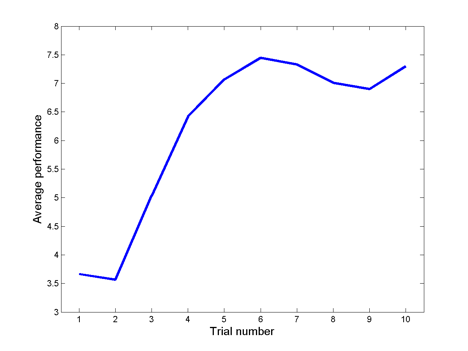
Fortunately there is a light at the end of the tunnel, in the form of statistics. If you average the different noisy group results you get something a bit more like the underlying pattern I knew to be there:

average.png

Trying a simple experiment with the lego robots gave me a new respect for the experimental method, and the difficulty psychologists face when trying to discover the rules underlying the wonderous variety in human behaviour.

Whack on, whack off

Photo by Flickr user Dude With Camera. Click for sourcePsychologist Jesse Bering has written an absolutely remarkable article about the psychology of masturbation for his latest Scientific American ‘Bering in Mind’ column.

I realise it’s now impossible to write anything about the piece without dropping innuendos like a nurse in a Carry On film but it’s worth checking out for the fact it’s both full of surprising findings and is very funny.

The article covers everything from monkey sex to wet dreams (it has ick and wow in equal measure) but this section on the psychology of sexual fantasy particularly caught my eye:

In their excellent 1995 Psychological Bulletin article [pdf] on sexual fantasy, University of Vermont psychologists Harold Leitenberg and Kris Henning summarize a number of interesting differences between the sexes in this area…

One of the more intriguing things that Leitenberg and Henning conclude is that, contrary to common (and Freudian) belief, sexual fantasies are not simply the result of unsatisfied wishes or erotic deprivation:

“Because people who are deprived of food tend to have more frequent daydreams about food, it might be expected that sexual deprivation would have the same effect on sexual thoughts. The little evidence that exists, however, suggests otherwise. Those with the most active sex lives seem to have the most sexual fantasies, and not vice versa. Several studies have shown that frequency of fantasy is positively correlated with masturbation frequency, intercourse frequency, number of lifetime sexual partners, and self-rated sex drive.”

Link to Bering in Mind psychology of masturbation article.
pdf of full text of Leitenberg and Henning sexual fantasy study.

Technology and the brain: the words as they were spoke

I’ve just noticed that the complete transcript of my House of Lords committee debate with Susan Greenfield on ‘What is the potential impact of technology, such as computer gaming, on the brain?’ is now online as a pdf file.

The debate was for the All-Party Parliamentary Group on Scientific Research in Learning and Education and, handily, the transcript has all the slides included next to the relevant text.

As with all direct transcripts it has the fluency of frozen mud: “And we saw a thing from the newspaper there and this was based on a report by Childwise” (clearly hitting one of my rhetorical highs at this point).

You can draw your own conclusions from the debate, however, what stands out for me, and what struck me at the time, is Greenfield’s completely unwillingness to engage with any of the scientific studies on the topic.

There’s also an interesting typo in the transcript. When talking about the research on video game violence during the questions I’m quoted as saying “There is a very good discussion about this in the Binary report”.

What I actually mentioned was the Byron report – a wide-ranging review commissioned by the UK government entitled ‘Safer Children in a Digital World’.

It is probably one of the best scientific reviews on the impact of computers on the well-being and behaviour of children. Interestingly, I met no-one in parliament who had read it and drew blanks whenever I mentioned it. Joined up government in action, I presume.

pdf of ‘impact of technology on the brain’ debate transcript.

Combined animal death delusions

Photo by Flickr user limonada. Click for sourceThe Journal of ECT has a case report of patient who endured the terrifying delusion that her body was rotting away and being replaced by parts of a pig.

The lady concerned was admitted to hospital for surgery but later developed psychosis:

Approximately 4 weeks after the surgery, she started expressing somatic delusions that her entire body was slowly rotting away. She claimed that the bones in her body were replaced by those of a pig and her own body parts were decomposing. She expressed that she deserved the ‘punishment’ by God in this way (decomposing her body) because she did not perform certain religious rituals and did not take a promised pilgrimage. Over the next few days, she also voiced delusions referring to her children‚Äôs body parts being replaced by those with pig‚Äôs body parts.

The disturbing false belief is described as a simultaneous case of both Cotard delusion, where someone believes they are dead or their body is decomposing, and lycanthropy, where someone believes they are transforming or have transformed into an animal.

The patient was apparently successfully treated with electroconvulsive therapy (ECT) although the authors, who like their patient, are based in India, give an interesting cultural interpretation of the delusion:

Interestingly, no reports of metamorphosis into pig/swine have been reported earlier. The metamorphosis into pig in our case can be understood from the Indian culture and mythological importance of the same. According to the Bhagavad Gita, Indra, king of the Hindu gods, was once transformed into a pig for lack of respect to guru Brihaspati. The index case also had strong guilt of not being able to perform certain religious rituals and a promised pilgrimage, which is similar to lack of respect to god and being punished for the same.

However, this is not the first case of a patient with simultaneous Cotard and lycanthropy delusions in the medical literature. In 2005, two Iranian psychiatrists reported on a patient who believed he had died and had also been transformed into a dog.

Link to latest combined Cotard and lycanthropy case report.

A brief glance in Jacques Lacan’s mirror

I’ve just found a very funny YouTube video that attempts to explain everything you need to know about French psychoanalyst and philosopher Jacques Lacan in one minute. It’s not entirely safe for work, which is part of its charm.

Clearly, it’s not intended to be taken too seriously, which I first suspected when it introduced Lacan’s ideas as “like Freud on high grade cocaine mixed with hallucinogens – and we mean that in the most admiring sense”.

The creator of the Lacan video, writer Mark Fullmer, has also just posted another – this time a rap about ‘philosophies of psychoanalyst and theorist Julia Kristeva‘.

In true hip hop style, it also waxes lyrical about how hot she is.

Link to ‘Jacques Lacan in 1 Minute’.
Link to the ‘Hot Kristeva Rap’.

Smells like retail

Photo by Flickr user misteraitch. Click for sourceBusiness Week has a fascinating article on the rise of ‘ambient scenting’ – a type of smell-based marketing used in High Street stores to alter the buying behaviour of shoppers.

There is now a small but determined scientific literature on the effect of scents on consumer behaviour. These studies have found, for example, that a well-chosen perfume can increase people’s liking of products, improve memory for aspects of the product, and when combined with similarly evocative music, can boost sales.

Interestingly, many studies suggest that shop scents seem to work well when they match the theme of the display but have a lesser or absent effect when the smell clashes with the product (and there’s been one study which found no effect at all).

In spite of the relatively small number of studies, the Business Week article charts how ‘scent branding’ has become big business with companies already offering to blend scents specifically for your store or product.

No longer confined to lingerie stores, ambient scenting became standard practice in casinos in the early 2000s and invaded the hospitality sector soon thereafter. Sheraton Hotels & Resorts employs Welcoming Warmth, a mix of fig, jasmine, and freesia. Westin Hotel & Resorts disperses White Tea, which attempts to provide the indefinable “Zen-retreat” experience. (Despite its abstraction, the line was successful enough to inspire Westin’s 2009 line of White Tea candles.) Marriott offers different smells for its airport, suburban, and resort properties. The Mandarin Oriental Miami sprays Meeting Sense in conference rooms in an effort, it claims, to enhance productivity. In the mornings, the scent combines orange blossom and “tangy effervescent zest.” In the afternoon, executives work away while sniffing “an infusion of Mediterranean citrus, fruit, and herbs.”

Scent branding is becoming just as prevalent in retail. Researchers believe that ambient scenting allows consumers to make a deeper brand connection, and data has led many other non-scent-related companies to join the fray. Recently, Gaurin, 41, helped create a fragrance for Samsung’s stores, which has been cited throughout the industry as a milestone in scent as design. He claims the research, which IFF declined to provide on account of contractual agreements, showed that not only did customers under the subtle influence of his creation spend an average of 20 to 30 percent more time mingling among the electronics, but they also identified the scent‚Äîand by extension, the brand‚Äîwith characteristics such as innovation and excellence.

Although this is touted as a relatively new innovation, more obvious applications of the ‘scent sells’ approach have been used on the High Street for some years.

For example, I notice sandwich chain Subway have designed their bread ovens so they vent the smell of freshly baked bread directly to the pavement so passers-by get an olfactory advert as they walk past the front door.

Link to Business Week piece on ‘Scent Branding’.

The sound of seduction

Photo by Flickr user James Jordan. Click for sourceIf you’ve ever wondered whether romantic music will enhance your chances of getting a date with the girl you fancy, wonder no more – science has the answer (and it turns out to be yes).

‘Love is in the air’: Effects of songs with romantic lyrics on compliance with a courtship request

Psychology of Music, Vol. 38, No. 3, 303-307 (2010)

Nicolas Guéguen, Céline Jacob, Lubomir Lamy

Previous research has shown that exposure to various media is correlated to variations in human behaviour. Exposure to aggressive song lyrics increases aggressive action whereas exposure to songs with prosocial lyrics is associated with prosocial behaviour. An experiment was carried out where 18—20-year-old single female participants were exposed to romantic lyrics or to neutral ones while waiting for the experiment to start. Five minutes later, the participant interacted with a young male confederate in a marketing survey. During a break, the male confederate asked the participant for her phone number. It was found that women previously exposed to romantic lyrics complied with the request more readily than women exposed to the neutral ones. The theoretical implication of our results for the General Learning Model is discussed.

There’s a great write-up of the study on Nou Stuff if you want more details.

Link to study abstract and DOI entry (via @danlevitin).
Link to write-up on Nou Stuff.