2010-12-17 Spike activity

Quick links from the past week in mind and brain news:
The Guardian asks whether the internet encourages insidious and bullying behaviour? Well, does it, punk?

We typically don’t remember our early years but it turns out this amnesia develops over time, as a brilliant piece on ‘The shifting boundary of childhood amnesia‘ at Psychology Today recounts.

BBC Radio 4 had a good documentary on the influence of Freud on British culture. Only three more days to listen – annoying, I know.

There’s a brilliant post on consciousness, mental time travel and the brain over at the consistently excellent Neuroskeptic.

BBC News report on the switch to short-acting barbiturate pentobarbital for the death penalty in the US. “a sedative typically used to put down animals” says the BBC, although they don’t mention it’s also used in the acute treatment of epileptic seizures.

Science News covers a new study on the intriguing but not very pleasant hallucinogen salvia divinorum.

Dan Ariely’s blog Irrationally Yours looks at how perception of value relates to worker effort not results.

The woman with no fear (and no amygdalae). Coverage from Not Exactly Rocket Science and Neurophilosophy outdid all the mainstreams.

The New York Times has a Bayesian take on Julian Assange: “…from the standpoint of Bayesian reasoning, to think we can separate out the merits of the charges from their political motivations.”

Footage of Freud and psychoanalysis – from the 1940s. Advances in the History of Psychology finds two archive gems.

The Guardian science blog covers an interesting study that tested whether sleep deprivation can prevent post-traumatic stress disorder.

For the first time, marijuana use is more common in American kids than cigarette smoking. The excellent Addiction Inbox has a great write-up.

Macleans has a great piece on fashionable paranoias. Nothing to fear but wifi and fluoride.

There’s an excellent analysis of how top flight science journals handle studies on language over at Child’s Play. In brief, they don’t.

The New York Times has a long but rewarding piece on ‘embodied cognition‘ by philosopher of mind Andy Clark.

The top 10 psychology studies of 2011 have been selected with excellent taste by Neuronarrative.

You all know the excellent Brain Ethics blog has just been relaunched right? New pieces on how to teach neuromarketing and whether genes make up your mind.

The Journal of the American Academy of Psychiatry and the Law has a thoughtful piece by a psychiatrist reflecting on Foucault, forensic psychiatry, and committing patients to hospital against their will.

We believe we have more free will than other people. Neurotic Physiology feels compelled to cover this fascinating new study.

The Guardian science blog has an eye-opening piece about the discrepancy between which childhood neurological disorders get the funding and which are most common.

The way in which data is collected for a psychology study affects the sort of people who volunteer. The BPS Research Digest covers the subtle effects of research design.

New Scientist has the best books of 2010 as chosen by neuroscience Steven Rose.

Psychologically inclined filmmaker Adam Curtis finds a social history gem on his BBC blog The Medium and the Message: a 1969 British documentary on the office Christmas party.

Seed Magazine looks at the science of interconnectedness and understanding risk in a connected world.

Contrary to lay wisdom, high trusters were significantly better than low trusters were at detecting lies. Barking up the Wrong Tree covers a counter-intuitive study.
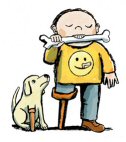
Cannibal cuisine

Cannibalism is a lot more common in human history than you’d guess and an intriguing article in Slate looks at the how a change in living situation might have made the temptations of the flesh all the more appealing.

The piece is by psychologist Jesse Berring who gets his teeth into the scientific debate about whether chowing down on another human may be a genuine biological adaptation, owing to the frequency with with famine-like conditions have appeared in human history.

The bottom line, says Petrinovich, is that when you’re hungry enough, ravenous really, and when all other food sources—including “inedible” things you’d rather not stomach such as shoes, shoelaces, pets, steering wheels, rawhide saddlebags, or frozen donkey brains—have been exhausted and expectations are sufficiently low, even the most recalcitrant moralist among us would shrug off the cannibalism taboo and savor the sweet meat of man … or woman, boy or girl, for that matter. It’s either that or die, and among the two choices, only one is biologically adaptive.

A behavior can be adaptive without being an inherited biological adaptation, of course. But because starvation occurred with such regularity in our ancestral past, and because the starving mind predictably relaxes its cannibalistic proscriptions, and because eating other people restores energy and sustains lives, and because the behavior is universal and proceeds algorithmically (we eat dead strangers first, then dead relatives, then live slaves, then foreigners, and so on down the ladder to kith and kin), there is reason to believe—for Petrinovich, at least—that anthropophagy is an evolved behavior.

The piece isn’t for the feint-hearted, but is certainly a fascinating take on one of the strongest of human taboos.

There is also a link at the bottom to a video discussion between “Robert Wright of BloggingHeads.tv and psychologist Paul Bloom of Yale on what motivates cannibals.”

From the appearance of the screen shot, I think they’ve been practising the look if nothing else.
 

Link to Slate piece ‘Bite Me: An evolutionary case for cannibalism’.

Ecstasy may bring the love by filtering the fear

Ecstasy users often describe the high as feeling ‘loved up’ and MDMA is frequently described as an ’empathogen’ but until now, little was known about how it genuinely affects the recognition of emotions in other people.
A new study just published in Biological Psychiatry has tested the supposed ’empathy boosting’ effects of MDMA and found that it actually makes people worse at picking up on emotions in the face – but only for threatening expressions.

The researchers, led by psychologist Gillinder Bedi, met the volunteers on three occasions, and on each one they were given either MDMA (‘ecstasy’), placebo, or methamphetamine – the latter to be able to distinguish the effect of feeling ‘wired’ from any ecstasy-specific ’empathic’ effects.

Although everyone had agreed to which drugs would be given, the study was done using ‘double-blind’ conditions, meaning neither the researchers nor the participants knew which they were getting on any particular occasion.

An hour after swallowing the pill, the volunteers were asked to rate their mood and emotional state with standardised questionnaires and to take part in experiments to assess their ability to pick up on others’ emotions.

Two tests involved picking up emotion from the face, one from just the eyes, one from whole facial expressions, and another required participants to do the same for voices.

The volunteers reported that they felt significantly more ‘loving’, ‘friendly’ and ‘playful’ on MDMA, although paradoxically on a higher dose of the drug, it also increased feelings of loneliness.

Methamphetamine also boosted some of these feelings, although to a lesser extent, suggesting that part of the ‘loved up’ feeling is probably down to similar amphetamine-like effects in both drugs (MDMA is often described as a ‘substituted amphetamine’ because of its similar molecular structure).

Strikingly, the emotion tests showed no improvement in the ability to pick up on emotion after taking MDMA, and in fact, people were worse – but only at picking up on fearful, threatening emotions in facial expressions.

This suggests that ecstasy might be causing some of the famous feeling of ‘social connectedness’ by tuning out negative signals from other people faces, rather than boosting our ability to pick up on positive emotions.

Although only a first study, it indicates that the ’empathogen’ label is probably misleading because the drug actually makes us worse at reading others’ emotions.

But because we tend to associate ’empathy’ with positive social interactions, the effects of the drug have been linked to being empathic in popular culture.
 

Link to PubMed entry for study.
Link to DOI entry for study.

Air on a G thing

Seed Magazine has an absolutely wonderful article on the neuroscience of musical improvisation that looks at how skilled musicians from the jazz greats to the classical masters take us on unplanned melodic journeys.

It’s a brilliantly written piece, a compelling fusion of music and science journalism, that skilfully captures the emerging scientific interest in musical spontaneity.

Aaron Berkowitz, a cognitive ethnomusicologist, who took on the task of demystifying improvisation as the focus of his dissertation work at Harvard, has a theory. He likens the process of learning to improvise to that of learning a second language. Initially, he says, it’s all about memorizing vocabulary words, useful phrases and verb conjugation tables. Your first day, you might learn to say: How are you? I’m fine. “These are like the baby steps beginning improvisers take. They learn the structure of the blues. They learn basic chords and get the form down,” said Berkowitz. But they’re still very limited in what they can do…

The trajectory of acquiring a language, according to Berkowitz, where you begin with learned phrases, achieve fluency, and are eventually able to create poetry mirrors perfectly the process of learning to improvise. In the same way a language student learns words, phrases and grammatical structure so that later he can recombine them to best communicate his thoughts, a musician collects and commits to memory patterns of notes, chords and progressions, which he can later draw from to express his musical ideas.

After reading the piece I wondered if the brain handles musical improvisation in a similar way to how it manages freestyle rap, as they both require unplanned spontaneity but within the restrictions of ‘what works’.

Sadly, so far, science has completely neglected the neural basis of hip-hop, but we live in hope homey.
 

UPDATE: Mind Hacks posse in full effect. In the comments NT mentioned that neuroscientist Charles Limb has got a freestyle rap study in progress and neuromusic noted that DJ and neuroscientist @djenygma tweeted earlier today he was “Sitting in on #fMRI experiment using local rappers in a freestyle-vs-memorized processing task”.


Link to excellent article on musical improvisation.

Psychologist to the dead

In Havana, even spirits of the dead can have troubled minds.

Although the concept of ‘troubled spirits’ is quite common throughout the world, the Cuban group Sociedad de Estudios Psicológicos Amor y Caridad Universal goes one step further and provides psychologists to treat the conflicted emotions of both the apparition and its possessed human host.

The latest edition of Anthropology and Medicine has a wonderful article that discusses the spiritualist group and their unique take on psychology.

In Havana, the idea that all beings – living and dead – can have psychic and emotional conflicts is common among followers of spiritism (espiritismo), a practice of spirit mediation whose origins are associated with the nineteenth-century mystical teachings of Frenchman Allan Kardec. Spirits too, have lived lives and acquired memories, and often, it seems, accumulated unproductive patterns of thought and behaviour that they are keen to vent on their living counterparts. In the worst of circumstances, believers are expected to seek potent ritual experts to dispatch such beings from the earthly planes of existence they disrupt.

It’s an absolutely fascinating read, as it looks inside the organisation which is at once church, spirit channelling group and clinic. This an amazing part that recounts a session of therapy with a ‘spirit’:

D began suddenly sobbing like a little girl and curling up in his seat like a child. Antonio asked a developed medium next to him to attend to the spirit: ‘investigator, ask her why she is crying, investigate!’ The woman began to talk to the spirit, and attempted to comfort her, but the spirit wouldn’t open up – she only cried incessantly. Antonio asked her directly: ‘what did they do to you? Take this opportunity to get it out of your chest’. ‘They abused me’, the spirit replied immediately.

Antonio turned to the group and explained, in teaching-mode, that this spirit was traumatised, and was reflecting her trauma on the girl (Y). The spirit shook, all shriveled up in her seat. ‘A man abused me’ she managed to say. Antonio kept up his questions, asking increasingly specific ones, and punctuating his investigation with forthright commands of ‘talk, speak!’ He also told the spirit: ‘but all that is over now’, urging it to move on. ‘This is why you took your own life, isn’t it?’ Again out loud to all of us, he remarked: ‘those were the days when virginity was sacred …’

According to the article, the group was founded in the 1950s by Claudio Agramonte who had a complex psychological theory of spirit psychology dictated to him by the spirit of a dead doctor called José de Luz.

Rather appropriately, the article is by a Portuguese academic called, Diana Espirito Santo, which literally translate to Holy Spirit Diana. An interesting case of nominative determinism of which I’m sure the spirits would approve.

The article goes on to discuss how the concepts of the group operate with the social world of Cuba, but is unfortunately locked behind a pay wall, because you’re not old enough to be trusted with anthropology and, anyway, it would probably spoil your dinner.
 

Link to summary on PubMed.
Link to DOI entry.

The brain isn’t going to take it lying down

The brain may manage anger differently depending on whether we’re lying down or sitting up, according to a study published in Psychological Science that may also have worrying implications for how we are trying to understand brain function.

Anger experiments that have measured electrical signals from the brain (using EEG) or that have altered neural activity with magnetic pulses (using TMS) have found that the left frontal lobe is more active than the right, but studies using fMRI functional brain scans have found no differences.

Psychologists Eddie Harmon-Jones and Carly Peterson wondered whether the brain might be working differently in EEG and TMS experiments because the participant is usually sitting upright, while in fMRI, the person is usually lying flat on their back.

If this seems like a trivial distinction as far as emotion is concerned, it actually has some sound theory behind it. A field of study called ‘embodied cognition‘ has found lots of curious interactions between how the mind and brain manage our responses depending on the possibilities for action.

For example, we perceive distances as shorter when we have a tool in our hand and intend to use it, and wearing a heavy backpack causes hills to appear steeper.

Anger is a prime example where we feel motivated to ‘do something’. In the sitting position we’re much more ready to approach whatever’s annoying us than when we’re flat on our backs, and the researchers wondered whether these body positions were interacting with our motivations to change the brain’s response.

So Harmon-Jones and Peterson asked 46 participants to write a short essay before wiring them up to an EEG that measured the electrical activity across the brain.

The participants then put on headphones and listened as someone else read their essay and rated the author on personal characteristics, such as intelligence and competence. Some participants listened while lying down, others while in the sitting position.

What they didn’t know was that the ‘raters’ were actually pre-recorded audio, and while some heard a benign commentary on their work, other participants heard the other ‘person’ slagging-off them off and harshly rating the participant and their personality.

In line with the ‘ready to respond’ theory, when the participants were angry and sitting up, the left frontal lobe was much more active than the right – but when angry and lying down, there was no difference.

First off, the findings provide evidence that body position interacts with how the brain processes emotion, perhaps depending on which actions are immediately possible.

But more importantly, the experiment might also indicate that different neuroscience techniques may be throwing up varying results because of the differing body positions needed to take the tests.

Although this is only an initial study, it could be a major spanner in the works for cognitive science which often assumes that clumping together evidence from a whole range of techniques gives a better idea of what’s going on.
 

pdf of full-text of study.
Link to PubMed entry for study.
Link to DOI entry for study.

Fear of one’s own glance

The Australian and New Zealand Journal of Psychiatry has an intriguing article on a Japanese psychiatric diagnosis that doesn’t seem to have a Western equivalent: ‘fear of one’s own glance’ or jiko-shisen-kyofu.

On the basis of the Japanese diagnostic system, phobia of one’s own glance is characterized by a fear of one’s own glance, which they believe assumes an offensive nature and is uncontrollably directed at persons near them. Individuals with phobia of one’s own glance believe that their glance brings others discomfort, and people with this diagnosis convince themselves of the accuracy of their belief by interpreting the trivial behaviour of others (e.g. coughing, laughing, sniffing, sneezing, head turning, etc.) as evidence for this belief. Such patients feel deeply ashamed, demeaned, and unaccepted, and many eventually avoid social situations. A diagnosis of phobia of one’s own glance is not contingent upon whether or not a patient considers his or her thoughts to be excessive; therefore, neither the presence nor a lack of insight is essential for the diagnosis.

The paper gives several case studies that include people who are concerned that their glance made other people feel uncomfortable, was a nuisance or was socially harmful to others, or made the patient themselves feel uncomfortable.
 

Link to PubMed entry for study.

A visit to San Lázaro

History of Psychology has just published a brief article I wrote about my trip to Hospital San Lázaro in Quito, Ecuador, one of the oldest psychiatric hospitals in Latin America and still a working mental health facility.

In the strong morning light, the whitewashed walls of the Hospital Psiquiátrico San Lázaro come alive with lucid sunshine. The beautiful but commanding building looks out over Quito’s old town, set back from the historic centre, where it retains its ambivalent mixture of the modern and medieval. It’s not a welcoming structure and, externally, seems more castle than care facility. Visitors need to enter large metal gates, before climbing an external ramp, and then must announce themselves to reception in the imposing stone gatehouse. I had come, I explained, to visit the hospital, but so far had no luck getting in touch with anyone to organise an appointment.

I had heard of ‘El Hospicio de Quito’ from colleagues in Colombia who had informed me that it was one of the oldest psychiatric hospitals in Latin America, but yet it merits barely a mention in the English language literature and surprisingly little in the Spanish. Determined to discover more, I visited the hospital and, after arranging to return with a letter officially requesting my visit, I was shown round by one of the staff psychologists.

You can see virtually nothing of the hospital from the gatehouse, but after stepping through the iron doors you find yourself in a courtyard of surprisingly gentle beauty, filled with trees and fountains, and surrounded on all sides by the building’s open internal arches. Although built at the dawn of the Renaissance, the hospital feels more like a medieval fantasy and is made up of a collection of multi-level walkways and clinical areas in cobbled courtyards that seem to have been ‘added on’ rather than designed.

The consulting rooms are sparse with high ceilings, while the patient wards, both male and female, consist of large dormitories and both indoor and outdoor communal areas around which patients meander until therapy, mealtime or visits take priority. But despite the antique façade there was determined modernisation programme in progress, with both the historic chapel being restored and the clinical facilities being renovated.

As I discovered at the time, the hospital itself is not the best place to go to research its history and I have learnt in retrospect that there are much better sources for the serious investigator – albeit ones which necessitate a visit to the city. Nevertheless, I managed to find some background in Luciano Andrade Marín’s (2003) La Lagartija que Abrió la Calle Mejía; Historietas de Quito thanks to the assistance of the staff at the Biblioteca Municipal. The hospital lies on the site of a Jesuit seminary originally founded in 1587 as a place of training and spiritual retreat.

Although damaged in the volcano eruption of 1698 and the earthquake of 1755, the building retains many of its Jesuit features including an impressive baroque entrance arch. The building lay empty for some years after the expulsion of the Jesuits in 1767 although by 1785 the Royal Order of Spain (a plaque in the hospital names them the Mercedarians) had converted the seminary into a hospice for the poor, disabled, mad and leprous. By the time of Ecuador’s independence, the hospice was notorious for the brutal treatment handed out to its mentally disturbed residents.

The hospice was taken over by The Sisters of Charity in 1870 who dedicated the institution to the mentally ill and began altering the building to better accommodate its more singular purpose. Patient care was not so forward thinking, however, and a doctor who visited the hospital in 1903, quoted in Andrade Marín (2003), minced no words in describing the conditions: the patients “were treated like animals… writhing in unclean yards, enclosed in dirt and gloomy dungeons, fed like wild beasts… naked and maltreated”.

Sadly, I found out little about the 20th Century history of the institution, but now considerably more humane and caring, the institution is one of the most important psychiatric hospital in Ecuador. Those wishing to investigate further may want to obtain Mariana Landázuri Camacho’s (2008) book Salir del encierro. Medio siglo del Hospital Psiquiátrico San Lázaro, which apparently contains a more complete history, although seems only available from select shops in Quito. The city libraries I visited could only provided limited help but apparently archives relating to the hospital are held in Quito’s Museo Nacional de Medicina.

The building is not open to the public, but the staff were friendly and welcoming, and, at the very least, the exterior is worth a visit for its architectural beauty and evocative location. There are no histories of this important institution in the English academic literature, and Landázuri Camacho’s book is apparently the only serious attempt at historical scholarship anywhere. Clearly, there is still much to be investigated about the history of this important institution.

 

Link to article entry at History of Psychology.

Going up in smoke

Some amazing graffiti art which has recently appeared in the Colombian city of Medellín near the Hospital metro station.

Medellín has the most amazing street art of any city I’ve ever been too, much of it genuinely beautiful, and often quite socially conscious, in contrast to the gangsta style that pervades many urban landscapes.


The text translates as ‘Tears, pain and desperation are the consequences of dirty money reflected in the harsh mirror of the city. Medellín is decaying through drugs while our lives go up in smoke’.

In Spanish: ‘Lagrimas, dolor y desesperado son las consecuencias del sucio dinero reflejado en el crudo espejo de la urbe. Medellín se nos pudre en drogas mientras nuestras vidas se van con el humo.’

2010-12-10 Spike activity

Quick links from the past week in mind and brain news:

The New York Times has an article on the sociology of the hipster. Sell outs.

Voodoo correlations – two years later. The Neurocritic looks back at the famous paper on problems with fMRI analysis and what, if anything, has changed in neuroscience as a result.

The Guardian has a piece from neuropsychopharmacologist David Nutt on how ‘the government cannot think logically about drugs’. Or education, as it turns out.

How an why do parents lie to their children? The brilliant Evidence Based Mummy covers some fascinating findings – for example – ‘parents who were more punitive in their response to their children lying were actually more likely to lie to their children.’

Time has a brief interview with Antonio Damasio on his new book on consciousness.

Curb those food cravings by imagining yourself eating lots of food. Not Exactly Rocket Science covers a counter-intuitive study on desire and imagination.

The Wall Street Journal has a great Dan Ariely article on the role of guilt in buying gifts. ’tis the season to feel slightly uncomfortable.

There’s an interview with neuropsychologist Suzanne Corkin, long time researcher with amnesic patient HM, over at Neurophilosophy. See the matching article on HM over at Dana.

New Scientist covers a study finding how your social ties can be worked out from coincidences in photos you upload to the internet.

Why is uncertainty so dangerous? The Frontal Cortex has an excellent piece on who fear of uncertainty can affect our decision-making.

Slate analysis the data grabbed from Firefox users to give an insight into our online behaviour.

The mighty Neuroskeptic covers a new study finding mindfulness meditation based therapy is as effective as anti-depressants in prevent relapses of depression for some patients.

Discover Magazine has a piece on the psychology of how not to choke under pressure. And no, it doesn’t mean getting your friend to do it for you.

Why does pot make you puke? Addiction Inbox looks at the neuroscience of cannabis and severe vomiting.

The New York Times looks at the neuroscience of solving ‘light bulb suddenly coming on the head and illuminating the answer’ problems. Otherwise known as insight problems.

There’s level-heading continuing coverage of the flap over the American Anthropological Association dropping “science” from its long-range plan statement over at Neuroanthropology.

All in the Mind from ABC Radio National had a challenging and thought-provoking programme on rethinking suicide by a researcher who has also attempted it.

Six haikus about psychology from Notably Conventional Delivery. Based on blog posts from the mind and brain blogoshere!

Scientific American has a thought-provoking and important article on whether psychedelic therapy exploits the placebo effect.

An originally designed study on paranoid explanations for others’ actions is discussed by the BPS Research Digest.

The Daily Beast has an excellent analysis of the silliness surrounding the so-called ‘slut gene’ and other over-interpreted genetic findings.

The German Admiral’s orgy and the breaking point of British WWII propaganda. PsyWar covers an interesting chapter in the history of PSYOPs.

The Guardian has a brilliant satirical piece on the sinister threat to our language and brains.

Objects in mirror are closer than they appear. I suspect the car manufacturer didn’t count on their statement being analysed by a philosopher of mind who specialises in perception. The Splintered Mind does us proud.

The Herald has a powerful account of the last minutes 2000AD and Judge Dredd comic artist John Hicklenton’s life as he visits the Dignitas assisted suicide service in Switzerland.

Does repetition really makes us believe people more? PsyBlog covers the evidence.

Wired Science covers and study on how being watched by a photograph of staring eyes can be enough to make us behave more responsibly.

The loneliness of the suicide bomber

The Boston Globe has an excellent article on whether suicide bombers are largely motivated by religious fanaticism or whether some might have symptoms of low mood and hopelessness that encourage them to end their lives.

The traditional thinking is that suicide bombing is enabled by concepts of martyrdom and retaliation and has little to do with a wish to escape a painful existence – as happens in ‘psychiatric’ suicides linked to sadness and mental illness.

But more recently, some researchers have begun to question whether some bombers might have been suicidal before being recruited, perhaps making them vulnerable to extremists seeming to offer an ‘honourable’ way out.

The issue is by no means settled but the Globe article does a great job of capturing the state of the research, although somewhat ironically, the debate seems to have become quite polarised.

But despite the accounts from their own published papers, scholar after scholar had dismissed the idea of suicidality among bombers. [Criminologist] Lankford remains incredulous. “This close-mindedness has become a major barrier to scholarly progress,” Lankford said.


Link to Boston Globe on the motivations of suicide bombers.

Feeling cliquey clean

Edge has a fascinating discussion on the social psychology of cleanliness and how our behaviour toward others is influenced by the environment in sometimes quite metaphorical ways.

The interview is with psychologist Simone Schnall and it does tend to be a little meandering although this turns out to be a huge bonus.

Schnall covers a whole raft of eye-opening findings on how our social behaviour is influenced by changes in the environment that seem only symbolically related to our behaviour.

For example, we feel warmer toward strangers when holding a hot drink, we allow our morals to become more flexible when we feel physically cleaner, and we evaluate the whole of our lives less positively during spells of bad weather.

The interview is packed full of these curious meaning-based influences on our lives and is available as a video or a transcript.
 

Link to Edge talk ‘A Sense of Cleanliness’.

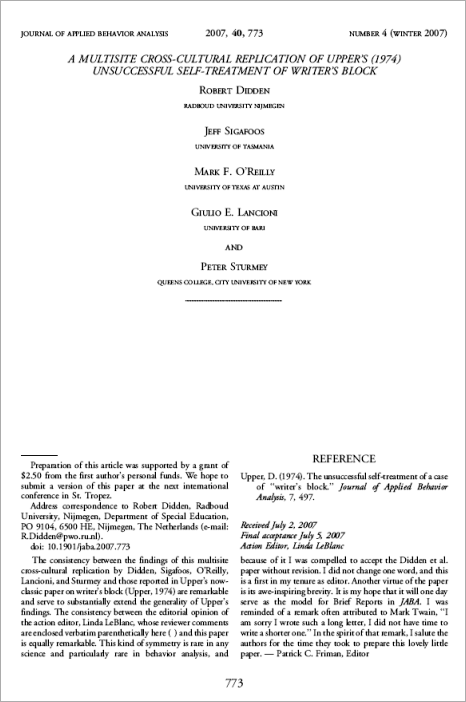
Unsuccessful treatment of writer’s block: a replication

We recently covered an ironic 1974 study entitled ‘The Unsuccessful Self-Treatment of A Case of Writers Block’ and I’m pleased the say the study has been extended and replicated by a team working along similar lines.

The new study took over 30 years to arrive, but duly appeared in the Journal of Applied Behavior Analysis in 2007.


Link to full text of scientific article (via @autismcrisis)

I can smell burnt toast

Pioneering neurosurgeon Wilder Penfield was the subject of one of Canadian television’s ‘Heritage Minutes’ in a melodramatic classic that celebrates his stimulating brain research.

It really does just last one minute and looks like a cross between Hammer Horror and Gone With The Wind with the dramatic stares and hammy acting to match.

Penfield is portrayed as a brilliant neurosurgeon (and “the greatest Canadian alive”!) who operates on women in full make-up to cure them of their epilepsy.

If you ask me, any piece of television that hits a high on a cry of “I can smell burnt toast” has got to be a timeless masterpiece.
 

Link to Wilder Penfield ‘Heritage Minute’ on YouTube.

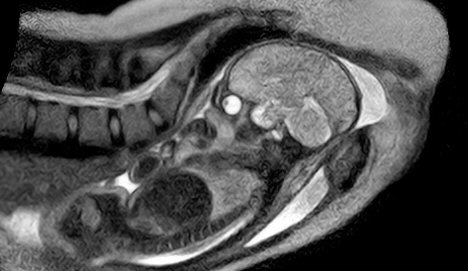
Brain scan of baby during birth

Local.de reports on the first MRI scan of a baby being born, apparently completed by Berlin’s Charité Hospital. The image shows a clear saggital section of the baby’s brain as it is being delivered.


The article reports:

A team comprised of obstetricians, radiologists and engineers have built an “open” MRI scanner that allows a mother-to-be to fit fully into the machine and give birth there, the hospital announced on Tuesday.

The MRI (magnetic resonance imaging) scanner has already taken unique images of the body of a mother and the movement of her baby through the birth canal to the point where its head emerges into the world. The birth that took place in the scanner went smoothly and both mother and baby were in good health, a hospital spokeswoman said.

All I can say is – wow!
 

Link to Local.de story ‘MRI scans live birth’ (via @BoraZ).