Interview with Wade Davis: Part II – culture clashes

This is Part II of our interview with ethnobotanist and explorer Wade Davis where we discuss technology, culture and the slippery concept of human nature.

Davis kindly spoke to myself and science journalist Ana María Jaramillo while visiting Medellín’s excellent science museum Parque Explorer and in Part I we discussed altered states of consciousness and the use of psychedelic plants.

If you’re in Medellín, the science museum is shortly to host an exhibition curated by Davis, of photographs by the founding father of ethnobotany, Richard Evans Shultes.

Schultes travelled through then unexplored parts of the Amazon and studied the native peoples, their rituals and knowledge of the forest and was Davis’ professor and mentor.


Ana María: You wrote “Anthropology has long taught that whether a people’s mental potential goes into technical wizardry or unravelling the complex threads of memory inherent in a myth is merely a matter of cultural choice and orientation.” Do you think Western cultures have lost anything important with a greater focus on technical wizardry?

I’m no scholar of middle Europe but if you think of the moment that we elected to liberate ourselves from the tyranny of absolute faith, and that case, the tyranny of the church, the whole thrust of the Enlightenment was the power of the mind over the body of man. When Descartes said that ‘mind and matter is all that matters’ he thrust out all instincts for myth, mysticism and metaphor and basically, in a single gesture, devitalised Europe.

That idea that only human beings can be animate or the idea that a bird could have animus was ridiculed and dismissed as ridiculous. It was pretty clear that the way that we treat the Earth as simply a raw resource to be consumed at our pleasure comes directly out of that process of devitalising the Earth.

That really goes back to the revelations of genetics where geneticists have shown that we’re all cut from the same genetic cloth, that race is a complete fiction, that the human genetic endowment is a continuum. And the corollary of that is that if we all share the same raw intellectual capacity we all share the same human genes and so how the genes are expressed is a matter of cultural choice.

That’s really my whole work with National Geographic to go around the world looking at cultures that manifest the human genus in different ways. Whether that be a shaman learning to manipulate plants with such dexterity to create a preparation like ayuhuasca or the Polynesian navigator who, through a process of dead reckoning, was able to chart the open oceans centuries before the Europeans dared leave the protection of the coastline, or the Buddhist science of the mind with 2500 years of empirical observation on the nature of mind.

To me these are all just options that human beings have taken. In terms of the relationship to the natural world the classic opposition to our world view is the Aborigines of Australia. What’s fascinating when you look at their entire intellectual devotion is that it is not to improve upon anything. We embrace this cult of improvement which technological wizardry expressed and made this really remarkable world we live in, which I’m not denigrating.

My friend Andy Weil, even though he’ll speak of the value of alternative medicine, says that if you get your arm ripped off in a car accident you don’t want to be taken to a shaman. But the physical impact of our world view on the planet has been demonstrable and what I find interesting is that in these cultures that define the world as being alive – like in Andean Peru where people really do believe that they have a reciprocal obligation to the Earth and the Earth in turn has reciprocal obligations to people. That doesn’t mean that the people of the Andes didn’t cut down the forests – they did – but in general that world has a much more gentle impact on the landscape than modernity has had.

And with the Aborigines it’s fascinating because they didn’t only not embrace the cult of progress but they embraced a world view that denied progress. Their who purpose in life was to not improve on anything – to do the ritual gestures necessary to maintain the world exactly as it was at the time of its origins and that’s a profoundly conservative way of thinking but it had real consequences. As a result – yes they didn’t develop a sophisticated material culture – but they didn’t create climate change either.

I don’t think any of this is about saying who’s right and who’s wrong but it’s just fascinating to recognise that there are different options and these other cultures aren’t failed attempts at being us but they’re unique answers to a fundamental question – what does it mean to be human and alive?

When people answer that question, they do so in 7,000 languages. The problem comes along through cultural myopia, which all cultures tend to have but with our unique power we are causing so many of these world views to be lost.

Vaughan: One of the things that anthropology is constantly doing is defying our expectation of what it is to be human. I’m wondering how much you believe in a common humanity?

Genetics shows that we’re all cut from the same genetic cloth, and, as I said, social anthropology shows that we all have the same adaptive imperatives. That’s what I find so cool about culture. Every culture has to deal with death, every culture deals with procreation, coupling or whatever, but within that communality there’s this amazing set of possibilities and so many unique outcomes.

Rough sleeper

The guy fighting the nurses, in the photo on the right, is asleep. Although usually considered a restful state, sleep, for a minority of people with specific disorders, is a trigger for violence.

Neurology journal Brain has just published a review paper (sadly locked) that discusses how violence can be triggered in the somnolent, noting that there are numerous cases of murders that have been ‘committed’ while unconscious.

The first known case is from the middle ages and apparently “relates to a Silesian woodcutter, who after a few hours of sleep woke up abruptly, aimed his axe at an imaginary intruder and killed his wife instead”.

Other more recent cases include:

Reported image of wild animal rising from floor and attacking child. Tried to defend child from beast, grabbing child instead and smashing him against the wall, killing him.

Vivid image of soldiers attacking daughter. Left house, grabbed axe, entered daughter’s room and ‘defended her’ by hitting twice with axe, killing her.

Dreamed that burglars had entered home and were killing family. Grabbed two guns and fired 10 shots, killing father and brother, injuring mother.

Image of two Japanese soldiers chasing him and wife through jungle. In his dream, he strangled one soldier and kicked another, killing his wife by strangling her instead.

You might be thinking that ‘I did it in my sleep’ is a convenient defence for someone who wants to get away with murder, but there are convincing criteria for deciding whether it was a genuine sleep attack.

The person need to have a confirmed sleep disorder, usually previous violence in sleep confirmed by video recording, as the picture above shows. The brief act typically happens as the person falls asleep or is awoken. The act seems impulsive, senseless and without motivation.

The person reacts with horror when they awake, makes no attempt to escape and can’t remember what happened.

The main risk factor is the presence of a sleep disorder. For example, REM sleep behaviour disorder – where people cannot prevent themselves acting out their dreams, is known to be linked to violence in a minority of those affected. Other conditions know to trigger sleep violence in some include epilepsy, confusional arousal or dissociative disorder.

Although the article in Brain is locked, the same research team published an alternative review paper on sleep violence last year for the medical journal Schweizer Archivs für Neurologie und Psychiatrie.

If you’re not a German reader, don’t be put off by the name because the article is in English and is freely available online as a pdf.
 

Link to summary and DOI entry for Brain article.
pdf of open-access 2009 review article by the same team.

Wading through the killing fields of the mind

BBC Radio 4’s From Our Own Correspondent has a gripping report on a meeting with a Cambodian psychologist who works in a country still trying to come to terms with the collective brutality initiated by the Khmer Rouge regime in the 1970s.

The text of the report is online and makes for powerful reading but I really recommend listening to it, either streamed from page linked above or by downloading the podcast available as an mp3.

The Khmer Rouge are considered to be perhaps the bloodiest regime in history, with over 7 million estimated killed. They began a form of genocide where average citizens were recruited into killing people considered to be subversive from their own community.

Needless to say, many are still living with those who committed the atrocities, or, with the memories of having atrocities committed against them.

The piece is reported an understated but powerfully insightful manner, the psychologist himself reflecting the ambivalence the society still feels towards its past.
 

Link to text of report and streaming audio link.
mp3 of podcast.

Interview with Wade Davis: Part I – altered states

Anthropologist and explorer Wade Davis recently gave a talk at Medellín’s fantastic science museum Parque Explorer and myself and science journalist Ana María Jaramillo managed to grab some of his time to discuss altered states of consciousness and cultural diversity.

If you’re not familiar with Davis’ work, his TED talk on ‘Cultures at the far edge of the world’ is a great place to start.

It was a particular pleasure to talk to Davis in Medellín, because he has had a long connection with the city, previously holding a post at the Botanic Garden, and has extensive experience of Colombia.

His book, One River, discusses his time in Colombia as a student of the legendary botanist and explorer Richard Evans Schultes who was the first to scientifically describe numerous psychoactive plants and substances – including the famous psychedelic of the Amazon peoples – yagé or ayuhuasca.

Our interview is in two parts, and this first part will cover how mind-altering substances integrate with culture and Davis’ own experience with psychedelics. Tomorrow, we’ll discuss diversity of human cultures across the world.


Ana María: I’d like to know how cultural context transforms the effect of a mind-altering substance. For example, is there a difference in experience between someone who takes yagé in a traditional context and someone who takes it outside the ritual, for recreation.

I think it makes a profound difference. Just speaking of psychotropic plants and preparations, everybody who has seriously studied them has always looked at what’s called ‘set and setting’. The ‘set’ is the mental set that you bring to the experience and the setting is the physical ambience in which you experience the explosion of consciousness. Part of the ‘set’ is your own cultural predispositions to the experience

I remember noticing this very much so in Haiti when I studied voodoo. It was just astonishing to witness voodoo acolytes in a state of trance, possessed by the spirit as they saw themselves, handling burning embers with impunity. And when I say that I’m not indulging in some kind of New Age mysticism, I just saw people walking around with burning coals in their mouths, and I can assure you that I would have burnt my tongue terribly whatever the circumstance.

People often ask me, when you were studying voodoo did you become possessed? But the idea was ridiculous to me. If you listened to what I was saying about it, or anyone else was saying about the really unique richness of the cultural experience, it’s just not something you can just try on like a cloak. You can’t just go down to Haiti, put down your money, or put down your soul, and suddenly become a voodooist.

It just has to be something in the very fibre of your being when growing up. Similarly, I think that the set and the setting in which indigenous people in the Amazon experience these substances is probably very unique and it’s also not uniform in any one culture. I remember once when I was with the Cofán and we had taken yagé in a very traditional context and afterwards I turned to the people I had been up all night with and said “I don’t know about you guys but that stuff scares the hell out of me” and they said “scares us too!”

So I think the experiences are idiosyncratic but also culturally specific, that’s my sense of it. But I don’t pretend to be any kind of authority. It’s mainly just based on my own experience, other people might disagree.

It’s interesting how these things change though. I find it fascinating that there is this ayahuasca phenomenon, it’s literally sweeping Europe and sweeping the United States. I meet young people who take ayahuasca and they speak so positively about the experience whereas I remember the whole point of ayahuasca was facing down the jaguar, being ripped away from the tit of jaguar woman. That was sort of what its point was.

I think our reaction to these substances can change over time too, almost as age cohorts move though. I’m someone who’s very happy to say that not only did I used psychedelics and enjoyed them but that they changed my life. I don’t think I would speak the way I speak, write the way I write, synthesise information the way I do, understand those notions of cultural relativism as reflexively as I do, if I hadn’t taken psychedelics.

I often think it’s interesting that if we look at the social changes of the last 30 years – everything from new attitudes towards the environment, new sense of the holistic integration of the Earth, women going from the kitchen to the board room, people of colour from the woodshed to the Whitehouse, gay people from the closet to the alter, that we always leave out of the recipe of social change that millions of people all around the world lay prostrate before the gates of awe after having taken some psychedelic.

We came out of a place with profound alienation of our cultures, experimenting with psychedelics in a very fresh way – there was not a lot of expectation. We rediscovered lots of new drugs and just tried them on ourselves so there were a number of things we could say we were the first to take. Not that I want to dwell on that, but the idea that were trying to find some idea of what it means to be human.

And also cultural relativism and just the idea that other peoples of the world aren’t failed attempts at being you, that comes powerfully from the psychedelic experience. I one point I remember I took some big heroic dose of some drug, I can’t remember exactly, San Pedro I think, and I was stopped by my friend just before I could send a telegram to my professor at Harvard that was going to say ‘Eureka! We’re all ambulatory plants!’ I don’t think that would have really got me too far.

That said, I found that psychedelics were extremely useful to me when I was young, when I was trying to de-construct the world that I had been born into but didn’t necessarily want to live in. And then as I carefully constructed a world, became married, became a father, developed a career, created a world, I found psychedelics profoundly disorienting and not very helpful.

Vaughan: Do you think the kind of disorientation you mentioned also happens on a cultural level? I’m very struck by the fact that many Western cultures are officially hostile to a lot of psychedelic drugs and yet there are many traditional cultures which have used them for thousands of years. I’m interested in that process of integration.

I think that’s a key point. For whatever reason, people in the West define drugs by culturally routed moral and legalistic opinion and therefore the drugs we habitually use we dismiss with euphemisms. So we don’t use caffeine we have a ‘coffee break’, or we’ll have a ‘cocktail party’ or a ‘quick smoke’. The irony is, is that the drugs we do choose to use, by chance turn out to be pharmacologically some of the most powerful and arguably some of the dangerous. Obviously, tobacco being the first to come to mind.

What you see in indigenous cultures by contrast, and lots of people have written about this, is that they seem to recognise that the desire to periodically change consciousness is an acceptable desire and the ethnographic record says it’s so ubiquitous in the human record that you have to see it as a basic human appetite. But they also recognise that the pure effects of these substances can be profoundly disquieting and so they insulate that possibility in a protective cloak of ritual.

Of course, they use their drugs in natural forms – again, I’m not speaking with hippy ethnography – but it’s just a more benign way of taking any drug. And that doesn’t mean that they only use these drugs for ‘culturally useful purposes’ – that was a sort of wonderful puritanical rap laid on us by anthropologists in the 70s who wanted to say it was OK for Indians to take drugs but not us because they don’t really have fun when they use drugs. That’s just not true. The Yanomami love getting high – that’s what they do all day long.

But there obviously seems to be great lessons in that because we remain tormented by drug problems that don’t go away. Andy Wild wrote a long time ago that there’s no such thing as a good or bad drug just good and bad ways of using drugs.

The interesting thing about these substances is not the pharmacological effects but the question of whether they are helpful to you. Do they help you understand something about your life and destiny and your sense of being in the world? I think with psychedelics that they can be profoundly useful but there like a telephone call – once you get the call and get the message you can hang up as Ram Dass famously said.

Clapham Junction and the frustrations of dementia

I’ve just found an amazing Terry Pratchett article published in the Journal of Mental Health earlier this year entitled ‘Diagnosing Clapham Junction syndrome’ where he discusses his experience with dementia.

Pratchett was diagnosed with posterior cortical atrophy, usually considered to be an atypical form of Alzheimer’s disease that is focused on the back of the brain and tends to cause particular disruption to visual abilities.

You can’t battle it, you can’t be a plucky “survivor”. It just steals you from yourself. And I’m 60; that’s supposed to be the new 40. The baby boomers are getting older, and will stay older for longer. And they will run right into the dementia firing range. How will a society cope? Especially a society that can’t so readily rely on those stable family relationships that traditionally provided the backbone of care?

What is needed is will and determination. The first step is to talk openly about dementia because it’s a fact, well enshrined in folklore, that if we are to kill the demon then first we have to say its name. Once we have recognized the demon, without secrecy or shame, we can find its weaknesses. Regrettably one of the best swords for killing demons like this is made of gold – lots of gold. These days we call it funding. I believe the D-day battle on Alzheimer’s will be engaged shortly and a lot of things I’ve heard from experts, not always formally, strengthen that belief. It’s a physical disease, not some mystic curse; therefore it will fall to a physical cure. There’s time to kill the demon before it grows.

I have to say, in one section, Pratchett is probably a little hard on clinicians in terms of how long it takes to diagnose dementia, which is not an easy task.

Dementia is usually defined as a decline in mental abilities that happens faster than would be expected from normal ageing and is associated with degeneration of the brain.

There are many types of dementia, and diagnosis is often broken down into ‘possible’, ‘probable’ and ‘confirmed’ versions.

Rather frustratingly, for those wanting a precise and confident diagnosis of, let’s say, Alzheimer’s disease, a ‘confirmed’ diagnosis can only be officially made on the basis of close examination of the brain tissue after the symptoms are known.

In practice this means that dementia can only be ‘confirmed’ after death. The result is that most people get a diagnosis of ‘possible’ or ‘probable’ dementia.

The former is made when the person has known cognitive problems and estimates that they were much better before, and the latter only when testing has shown that there has been a definite decline over at least six months.

For a diagnosis of Alzheimer’s, this needs to affect at least two areas of mental functioning, so a tried and tested decline in just memory over six months would still leave some doubt. This means a wait of a year can be pretty standard for a ‘probable’ diagnosis.

After finally getting his diagnosis after experiencing difficulties for some time, Pratchett says “you could have used my anger to weld steel”. It’s worth saying that the frustration is shared.

By the way, Pratchett’s article was published in a special open-access edition of the Journal of Mental Health focussing on classification where several people discuss their experience of hearing their diagnosis.

There’s a particularly good piece by Mark Vonnegut, son of science fiction author Kurt Vonnegut who was previously diagnosed with schizophrenia and is now a qualified doctor, working as a primary care pediatrician.
 

Link to Terry Pratchett on ‘Diagnosing Clapham Junction syndrome’.
Link to table of content for open-access edition.

Embrace the Greenfield revolution

Science Oxford Online has an interview with neuroscientist Baroness Susan Greenfield where she argues that too much connection to digital technologies is as much as a threat to humanity as climate change.

How does ‘climate change relate to the concept of ‘mind change’?

Mind change and climate change are both critical scenarios concerning governments and negotiations between countries. There is sometimes an idea that science can save us through climate policy and eco products. An example of how quickly mind change can happen is the way that everyone now recognises the telephone. It may affect boys and girls differently according to the technologies they interact with and influence relations with developing countries. Time spent in virtual environments could lead to behaviour which is individualistic, reclusive, and child like with a high level of greed, impulsivity and disregard for consequences.

Apart from this quite startling claim, for which she cites no actual evidence, I’m just a little struck by how odd the whole interview is.

The interview was done over the phone and I’ve no idea how it’s been edited, but it seems a strange mixture of over-generalisations and, sometimes, answers that don’t even seem relevant to the actual questions.
 

Link to Susan Greenfield interview on ‘mind change’.

2010-12-03 Spike activity

Quick links from the past week in mind and brain news:

The Wall Street Journal has a piece on how neuroscience is apparently being used to design kitchens. No, you haven’t just been slipped some acid – the article is real.

The sleeper effect: how a persuasive message can kick in months after it’s delivered. A great piece on persuasion and propaganda from PsyBlog.

Scientific American has an excellent piece on how Pfizer and Lundbeck published biased data to promote antidepressant reboxetine and how a new analysis of all the data show it doesn’t work and is possibly harmful. A ‘headdesk’ moment in science indeed.

Off-the-wall neuroblog OmniBrain is back. Inflatable brain? Don’t mind if I do.

The Boston Globe has a fantastic on the early history of ‘information overload’ panics. The printing press – oh my god – think of the children!

The problem is, which more intelligent AI should we build? The Nature, Brain, and Culture blog has an excellent critique of techno-utopianism and the ‘singularity’.

NeuroPod from Nature Neuroscience just released a new podcast with a particularly good section on the mix of genes and environment in schizophrenia.

Can psychology help combat pseudoscience? The BPS Research Digest covers a fascinating new study on applied cognitive bias busting.

Der Spiegel investigates what it’s like to be a captain of a cocaine smuggling submarine and talks to a former smuggler.

How to fool a lie detector brain scan. Neuroskeptic covers a study that found one type of scan can be misdirected with a surprisingly easy technique.

The New York Times reports on how Narcissistic Personality Disorder is likely to be removed from the DSM-5.

The American Anthropological Association just eliminated the mention of science from its ‘long-range plan statement’. Neuroanthropology has one of the most sensible takes on the subsequent shit-storm.

Scientific American has an excellent piece on the classic ‘mirror test’ of self-recognition and why ‘failure’ on the test doesn’t necessarily mean the participants have no sense of self.

The Multidisciplinary Association of Psychedelic Studies is shortly to hold a conference and Addiction Inbox covers the intriguing line-up.

The LA Times describes how ‘erasing traumatic memories may soon be possible’ and discusses the ethical implications if the technology because reliable.

A new study reported that family income wasn’t related psychological development in children. Evidence Based Mummy asks ‘if money isn’t directly related to children’s development, what is?’

The Guardian reports on a new ban on the export of UK-manufactured sodium thiopental for use in US executions.

Seizures triggered by strawberry syrup. More tasty goodness from the ever-excellent Neurocritic.

Discover Magazine has an engaging piece on the mathematics of terrorism. Finding patterns amid the chaos.

So, there’s been loads of good stuff on the Advances in the History of Psychology blog recently. Don’t believe me? How about some history of female madness?

Contemporary Psychotherapy is a high-quality, open and online magazine for psychotherapists and new edition has just hit the virtual shelves. Good stuff.

‘Tummy time’ for baby’s brain development

Slate has an amazing article on how the brain development of young babies is linked to the amount of playtime they spend on their tummies.

This in itself is quite a startling fact, but it turns out that the campaign to cut cot death – which involved persuading parents to put babies to sleep on their back – has led to a unintentional but general decline in waking ‘tummy time’ and a slowing in movement and nerve development for some babies.

It turns out that this can have surprisingly long-term effects:

How do we know that the babies who miss out on tummy time are at a lasting as opposed to temporary disadvantage? Looking at data from thousands of people born in 1966 in Northern Finland, a research group led by Charlotte Ridgway at the Institute of Metabolic Sciences, Cambridge, has shown that a one-month delay in infant motor development had the same detrimental effect on how a 14-year-old performs in physical education class as a one-unit increase in the same child’s body-mass index. Using the same Northern Finland cohort, Ridgway and her co-authors also mapped a one-to-one link between the age at which infants stand unaided in their first year—another critical prewalking milestone—and their muscle strength and endurance, as well as cardiovascular fitness, at age 31.

It’s a very well researched piece with all the relevant evidence carefully linked in the article, discussing a surprising but important link between brain development and early movement possibilities.
 

UPDATE: Time has a cautious response to to this article, noting that although the idea is plausible, the data is largely correlational making it difficult to be confident about a lack of tummy time causing developmental delay. Recommended.


Link to ‘Tummy Time: Why babies need more of it than they’re getting’.

I’m not waiting for inspiration, it’s waiting for me

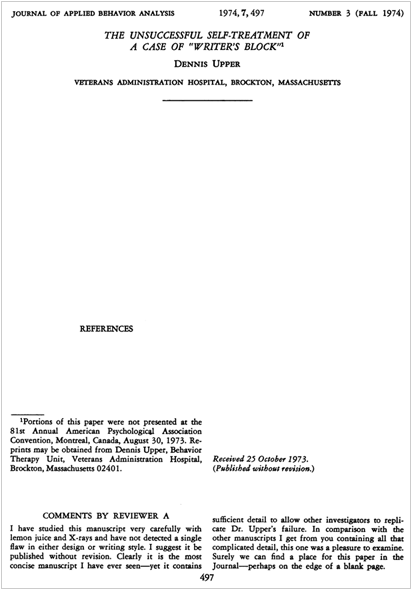
Neuroscience blog Oscillatory Thoughts has a brilliant meditation on the phenomenology of “writer’s block”.

It includes what I originally thought was an hilarious but mocked-up paper from the Journal of Applied Behavior Analysis, only for me to discover that it was genuinely published.


For those wanting verification of these important findings, Oscillatory Thoughts has a replication of this landmark study using more recent technology.
 

Link to Oscillatory Thoughts on “writer’s block”.
Link to the full text of the scientific paper.

Oxytocin is a complex character

Not Exactly Rocket Science elegantly covers a new study that counters the tired ‘love drug’ stereotype associated with the hormone oxytocin.

Although several studies have found that doses of the hormone, usually sprayed into the nose, increase feelings of trust, it is also becoming clear that this just one effect and it may be heavily dependent on situation or the characteristics of the person.

Contrary to the cliché, we reported on a study last year that found that the drug increased feelings of envy and gloating in a trading game.

This new research looked at how a dose of oxytocin altered men’s feeling about their social relationships – including with their mothers – and very different reactions were discovered.

[Psychologist Jennifer Bartz] found that when she averaged out the volunteers’ results, the sniffs of oxytocin hadn’t seemed to colour their memories of their mothers. But things changed when she looked at them individually. Those who felt more anxious about their relationships took a dimmer view of their mother’s parenting styles when they sniffed oxytocin, compared to the placebo. Those who were more secure in their relationships reacted in the opposite way – they remembered mum as being closer and more caring when they took the oxytocin.

These results show that oxytocin is far from being a simple “love hormone”. As Bartz says, it has a “more nuanced role… than previously thought,” and one that varies from person to person. It’s “not an all-purpose attachment panacea.”


Link to NERS on new oxytocin study.

Terminal self-diddling

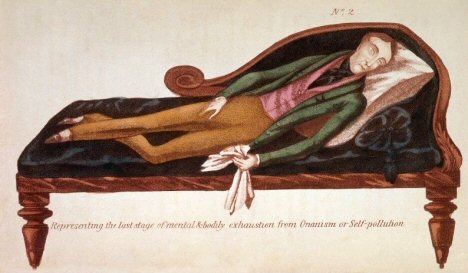
The fantastic Morbid Anatomy blog found this picture from an 1845 medical book depicting ‘the Last Stage of Mental & Bodily Exhaustion from Onanism or Self-pollution’ from the days when self-diddling was widely assumed to be a cause of madness.


Of course, you wouldn’t find anything quite so ridiculous as a mental illness described as ‘the last stage of Onanism or Self-pollution’ in the DSM-5, because stages have been rejected in favour of dimensions.
 

Link to post at Morbid Anatomy.

A new level of chutzpah in psychiatric ghostwriting

The New York Times has a revealing article about how a popular textbook for family doctors on how to treat mental illness, apparently written by two big name psychiatrists, was almost entirely written by a ghostwriting service under the direction of a large drug company.

Two prominent authors of a 1999 book teaching family doctors how to treat psychiatric disorders provided acknowledgment in the preface for an “unrestricted educational grant” from a major pharmaceutical company.

But the drug maker, then known as SmithKline Beecham, actually had much more involvement than the book described, newly disclosed documents show. The grant paid for a writing company to develop the outline and text for the two named authors, the documents show, and then the writing company said it planned to show three drafts directly to the pharmaceutical company for comments and “sign-off” and page proofs for “final approval.”

“That doesn’t sound unrestricted to me,” Dr. Bernard Lo, a medical ethicist and chairman of an Institute of Medicine group…

David A. Kessler, former commissioner of the Food and Drug Administration, is memorably quoted as saying “To ghostwrite an entire textbook is a new level of chutzpah.” “I’ve never heard of that before. It takes your breath away.”

The book is reported to be Recognition and Treatment of Psychiatric Disorders: A Psychopharmacology Handbook for Primary Care by Charles B. Nemeroff and Alan F. Schatzberg.

Nemeroff. Now where have I heard that name before?
 

Link to NYT piece on ghostwritten psychiatry textbook.

Do robots dream of electric reaping?

If, like me, you’re worried about the coming robot war, The New York Times has an article that might make you hyperventilate. It’s about how the military is increasingly arming robots and creating artificial intelligence weapons systems.
The piece explores the rapidly advancing technology of warrior robots and also covers the ethical debate over the use of mechanised killers.

It turns out that some people are so concerned they’ve created a robot arms control lobby group.

For those still a little anxious about the whole affair, several people are quoted who try and put our minds at ease.

“A lot of people fear artificial intelligence,” said John Arquilla, executive director of the Information Operations Center at the Naval Postgraduate School. “I will stand my artificial intelligence against your human any day of the week and tell you that my A.I. will pay more attention to the rules of engagement and create fewer ethical lapses than a human force.”

Dude, you’re not helping.
 

Link to NYT on ‘War Machines: Recruiting Robots for Combat’.

A history of friends in high places

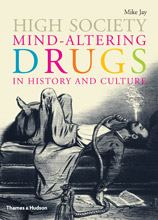
I recently indulged in the outrageous luxury of placing an international order for the book High Society: Mind-Altering Drugs in History and Culture by Mike Jay and I’m very glad I did.

If you want to get a feel for the sort of thing it tackles, the author has a fantastic video where he discusses the history of opium use and how the British in the 1800s were doing exactly the same as the modern day cocaine cartels do now.

It is an incisive and eye-opening history of society and its highs, as well as being wonderfully illustrated on almost every page.

In fact, it’s so beautiful it could almost be one of those expensive coffee table books but it also has the advantage of being shot through with a compelling narrative about how drug use developed in the world’s diverse cultures.

And it really is breathtakingly diverse in its scope – tackling everything from Native Americans and their use of the hallucinogenic cactus peyote, to the black sweet tea enjoyed in the Arabian peninsula, to loved-up urban clubbers popping ecstasy, to the enthusiasm for betel nut in the Far East, to.. well, you get the idea.

The book has been published in conjunction with an exhibition of the same name, currently showing at London’s Wellcome Collection, but it more than holds its own.

It’s a compulsive, colourful journey through one of the world’s favourite pass-times and definitely worth checking out if you’ve ever had an interest in how we tweak and have tweaked the brain’s reality settings.
 

Link to book details on publisher’s website.
Link to excellent 10 minute video on the history of opium.

Photographing the brain, 1894

Legendary Polish neurologist Edward Flatau created one of the first photographic brain atlases way back in 1894. This photo shows how he carefully took 20-minute exposure photos of freshly sliced brains.

The photo is from a recent article published in European Neurology that discusses how Flatau created the atlas and the review it got from a young Sigmund Freud, then early in his career as a neurologist.

To be fair, Freud’s review was 200 words of benign praise and hardly worthy of note, but the article is worth checking out for the discussion and images from the pioneering atlas.

Lucky for us, the article has been made open-access so enjoy it while you can.

Flatau used whole and dissected human brains, unfixed and only rinsed in water. He applied small diaphragms to effect a better depth of field, and took longexposure photographs, with exposure times of 20–30 min for uneven surfaces (ventral, dorsal, lateral and medial facies, plates I, II, V and VII), and up to 10 min for flat sections (horizontal, coronal and sagittal, plates III/ IV, VI and VIII) A schematic color chromolithograph depicted central brain pathways and connections.


Link to article directly.
Link to DOI entry for article in European Neurology.

On the touchstone of consciousness

A wonderful poem simply titled ‘Thought’ by the English writer D. H. Lawrence.

Thought, I love thought.

But not the juggling and twisting of already existent ideas.

I despise that self-important game.

Thought is the welling up of unknown life into consciousness,

Thought is the testing of statements on the touchstone of consciousness,

Thought is gazing onto the face of life, and reading what can be read,

Thought is pondering over experience, and coming to conclusion.

Thought is not a trick, or an exercise, or a set of dodges,

Thought is a man in his wholeness, wholly attending.

Lawrence was hugely controversial in his day, not least due to writing Lady Chatterley’s Lover, but maintained a penetrating interest in the psychology of individuals which his stories so vividly illustrate.
 

Link to Wikipedia page on D.H. Lawrence.