Words about The Scream

January’s British Journal of Psychiatry has another short article in its fantastic ‘100 words’ series, this time on Edvard Munch’s classic painting ‘The Scream‘.

The image is perhaps one of the most iconic artworks of the 20th century and has spurned as many parodies and light-hearted take offs as straight-up tributes.

However, the BJP piece manages to capture the emotional essence of the original:

Edvard Munch is best known for The Scream, 1893, an image endlessly reproduced in the media to depict mental anguish. Explanations of the meaning behind the image abound, mainly focusing on an outpouring of emotion in response to suffering. Munch’s own explanation is revealed in his diaries, which recall the melancholy of a walk along a bridge with friends. Trembling in fear at the fiery sunset, he sensed ‘how an infinite scream was going through the whole of nature’. This dehumanised figure, into which viewers project their own neuroses, is not screaming but blocking out the scream of its existence.


Link to BJP on ‘The Scream – 100 words’.

The war of the manual of mental illness

Wired covers the battle raging over the next version of the ‘manual of mental illness’ – the American Psychiatric Association’s DSM-5.

The piece discusses how the chief editors of two previous version of the manual, Robert Spitzer and Allen Frances – who edited the DSM-III and DSM-IV, have heavily criticised the proposed new manual for lack of transparency in development (non-disclosure agreements are required) and for ever-widening categories.

We’ve covered the (surprisingly personal ) battle on a couple of occasions but the Wired piece does a great job of getting into the nitty gritty of the arguments.

What the battle over DSM-5 should make clear to all of us—professional and layman alike—is that psychiatric diagnosis will probably always be laden with uncertainty, that the labels doctors give us for our suffering will forever be at least as much the product of negotiations around a conference table as investigations at a lab bench. Regier and Scully are more than willing to acknowledge this.

As Scully puts it, “The DSM will always be provisional; that’s the best we can do.” Regier, for his part, says, “The DSM is not biblical. It’s not on stone tablets.” The real problem is that insurers, juries, and (yes) patients aren’t ready to accept this fact. Nor are psychiatrists ready to lose the authority they derive from seeming to possess scientific certainty about the diseases they treat. After all, the DSM didn’t save the profession, and become a best seller in the bargain, by claiming to be only provisional.

My only gripe with the article is it seems a little star-struck by the idea that mental illness could be validated or even wholly defined by reference to neuroscience, which is a huge category error.

How would we know which aspects of neuroscience to investigate? Clearly, the ones associated with distress and impairment – mental and behavioural concepts that can’t be completely substituted by facts about the function of neurons and neurotransmitters.

That’s not to say that neuroscience isn’t important, essential even, but we can’t define disability purely on a biological basis.

It would be like trying to define poverty purely on how much money you had, without reference to quality of life. We need to know what different amounts of money can do for the people in their real-life situations. Earning $5 a day is not the same in New York and Papua New Guinea.

Not even physical medicine pretends to have completely objective diagnoses, as, by definition, a disorder is defined by the impact it has.

An infectious disease is not solely defined by whether we have certain bacteria or not. First, it must be established that those bacteria cause us problems.

The urge to try and define all mental illnesses in terms of neuroscience is, ironically, more an emotional reaction to criticisms about psychiatry’s vagueness than an achievable scientific aim.
 

Link to article ‘Inside the Battle to Define Mental Illness’.

Change of pace

Mind Hacks posts may be a little irregular in the future as I’ve just moved location and job. I’ve left the wonderful city of Medellín and am now living in Colombia’s impressive capital, Bogotá.

I’ve also started working as a psychologist for Médecins sans Frontières (Doctors Without Borders if you’re American) and, as you might expect, the pace of work is a little more intense and unpredictable than usual – not least because I will be spending quite a bit of time ‘on the road’ to work with some of the many MSF projects in the rather more troubled areas of the country.

In fact, I hear that some of areas we work in are so badly affected that they don’t even have Twitter, so blogging is likely to be a bit restricted at times.

However, Tom and I are mulling over some interesting new plans and we’ll still both be posting when in internet enabled zones, but you might see a change of pace.

This also seems a great opportunity to thank the psychologists and psychiatrists I had the pleasure of working with in Medellín, especially from the Department of Psychiatry at the University of Antioquia, from whom I learnt a great deal and with whom I had some incredibly enjoyable times.

Muchas gracias a todos!

Road kill for hot lady drivers

In 1960, the American Journal of Psychiatry reported on “an unusual perversion”, in a case of a man with “the desire to be injured by an automobile operated by a woman.”

The patient, a man in his late twenties, reported a periodic desire to be injured by a woman operating an automobile. This wish, present since adolescence, he had by dint of great ingenuity and effort, gratified hundreds of times without serious injury or detection. Satisfaction could be obtained by inhaling exhaust fumes, having a limb run over on a yielding surface to avoid appreciable damage or by being pressed against a wall by the vehicle.

Gratification was enhanced if the woman were attractive by conventional standards. Injuries inflicted by men operating automobiles or other types of injury inflicted by women had no meaning. He experienced pleasure from the experience, thus establishing the symptom as a perversion rather than a compulsion.

Although psychiatry no longer uses the word perversion (problematic sexual compulsions are now called ‘paraphilias‘) the introduction to the case study says, in a rather understated way, that “some perversions, while representing formidable psychopathology, are also tributes to the complexity of the human mind.”

The article additionally notes that the patient “was ashamed of his symptom but somewhat proud of its unusual nature.”
 

Link to PubMed entry for case study.

Poetic sensitivities

Perceptual psychologists have long been interested in limen – the threshold at which a stimulus becomes detectable. The following limen for the different senses, expressed in everyday terms rather than in terms of physical quantities, have a certain poetry to them. I got this information via email as a scan of an (unknown to me) textbook. I reproduce them here for your enjoyment:

Approximate absolute sensitivities, expressed in everyday terms:

Vision – A candle flame seen at 30 miles on a dark, clear night
Hearing – The tick of a watch under quiet conditions at 20 feet
Taste – One teaspoon of sugar in two gallons of water
Smell – One drop of perfume diffused into the entire volume of a three-room apartment
Touch – The wing of a bee falling on your cheek from a distance of one centimeter

Exact values vary between individuals and even from moment to moment with the same individual. Source: Galanter, E. (1962). Contemporary psychophysics. Holt, Rinehart, Winston.

The dynamic embrace

I’ve just found an enjoyable BBC World Service radio documentary on the relationship between tango and psychoanalysis in the Argentinian city of Buenos Aires.

Buenos Aires is the birthplace of tango and, as we’ve discussed before, has the highest ratio of psychologists to population of any place on earth.

The city has traditionally been one of the world centres for psychoanalysis and it remains a hub for theory and treatment drawn from the work of Sigmund Freud.

The BBC documentary looks at the relationship between the city’s love of therapy and one of the most psychological of dances, talking to both enthusiasts and conscientious objectors.
 

Link to documentary with mp3 and streaming.

The psychology of shoulder-to-shoulder

The consistently sublime RadioLab has a wonderful programme on the psychology of altruism which manages to capture the psychology of supporting others in gripping stories of human interaction.

The standard view of evolution is that living things are shaped by cold-hearted competition. And there is no doubt that today’s plants and animals carry the genetic legacy of ancestors who fought fiercely to survive and reproduce. But in this hour, we wonder whether there might also be a logic behind sharing, niceness, kindness … or even, self-sacrifice.

Is altruism an aberration, or just an elaborate guise for sneaky self-interest? Do we really live in a selfish, dog-eat-dog world? Or has evolution carved out a hidden code that rewards genuine cooperation?

The programme touches on everything from the mathematics of nuclear war to the motivation for heroism and, as always, is really better experienced than described.

But even given the usual exceptional quality of RadioLab, this episode is definitely not one to miss. Fantastic stuff.
 

Link to RadioLab on altruism.

2010-12-24 Spike activity

Quick links from the past week in mind and brain news:

Brain scans as art. The Neurocritic covers a charming paper where a bunch of Serbian radiologists review the history of neuroradiology in famous artworks and then contribute some of their own creative efforts!

Scientific American looks at the evolutionary pressures on religious belief in light of the fact that religious people vastly out-reproduce secular folks.

The first recorded human snog is uncovered by The Intersection. No mention of ancient bike sheds being involved.

The RSA Journal has a thoroughly fascinating interview with behavioural economist Dan Ariely on many curious biases in how we reason about money and finances.

Don’t miss Neuroskeptic on the subtleties of the new studies that seemed to have all but dismissed the link between the XMRV virus and chronic fatigue syndrome. The devil being in the detail.

New Scientist has a positive review of Oliver Sacks’ new book ‘The Mind’s Eye’.

Meet the Denisovans, a potentially new branch on the human tree of life, over at The Loom.

The British Medical Journal has a seasonal paper on phantom vibration syndrome – on the hallucination of an incoming call.

Brain-damaged patients who are paralysed but are unaware of it show unconscious recognition of their difficulties, according to a fascinating new study covered by the BPS Research Digest.

Cerebrum from the Dana Brain Alliance has an excellent piece on ‘the promise and the reality of stem-cell therapies for neurodegenerative diseases.’

20 simple steps to the perfect persuasive message. PsyBlog rounds up its recent series on persuasion and influence.

Discover Magazine asks whether music is for wooing, mothering, bonding, or is it just “auditory cheesecake”? Mmmmm…. cheesecake.

The Man with the Electronic Brain. Great comics find from Boing Boing.

Scientific American has put the stand-out chapter from Carl Zimmer’s Brain Cuttings book online – taking a critical look at the ‘singularity’ and the neuro-immortalists.

Some great coverage of the new study finding that placebos seems to work even when we know they’re placebos from Neurotribes and Not Exactly Rocket Science. Also a more critical take from Respectful Insolence.

Time Magazine asks what methamphetamine has to do with addiction and autism treatments? Turns out, they’re all interesting new findings on the hormone oxytocin.

There’s a lovely look at self-organising principles in the nervous system over at Wiring the Brain.

The Washington Post has a case of very applied ethics. A philosopher calls a vote on whether he should donate a kidney.

Great coverage of a study that used brain activation to try and predict the improvement of teenagers with dyslexia over at BishopBlog.

The Wellcome Collection has the audio of its ‘Describing the Drug Experience’ event online.

The battleground of remembering

I’ve just discovered a engrossing two-part BBC World Service documentary on ‘oral history’ and how the process of getting everyday folk to relay their memories of important event often challenges the authorised memories of official history.

The programme makes an interesting distinction between public memory, the authorised version of events; individual memory, that we each hold inside us; and collective memory, the process by which we collectively negotiate what we believed happened.

Oral history gets individuals to recount their memories of events, but focuses much more on lived experiences and opinions than names and dates, although can be unsettling to official histories when they contradict politically convenient narratives.
 

Link to two-part Memory Wars documentary.

Treating the madness of the hippies

In 1972, Colombian psychiatrist Miguel Echeverry published a book arguing that hippies were not a youth subculture but the expression of a distinct mental illness that should be treated aggressively lest it spread through the population like a contagion.

I found the book, called Psicopatologia y Existencia del Hippie (Psychopathology and Existence of the Hippy), in my local library and it turns out to be one of the most surprising psychiatry books I have ever read.

At some point, I suspect the good Dr Echeverry must have been driven to breaking point by a bunch of long-haired youths strumming poorly tuned guitars outside his window, because he is clearly furious.

This is his definition of a hippy, translated from p83, where he is so angry he forgets to use a full stop.

The true hippy is an individual with a frank disposition to hereditary psychopathology, who has abandoned himself, has totally neglected his hygiene and self-presentation, has let his hair and beard grow, is dressed bizarrely, eccentrically and ridiculously, wears a multitude of rings, necklaces, beads and other extravagances, is opposed to all defined and purposeful social and family structures now and in the future, rejects productive and redeeming work, irresponsibly and cynically promotes the cult of free love, aggressively promotes contempt for moral, social and religious conventions, preaches paradoxically about the abolition of private property, harmfully drugs them self with marijuana, LSD, amphetamines, hypnotics, mescaline, psylocybin, sedatives and heroin etc to rebelliously and insanely avoid the sad realities of life.

The author notes with disdain that the ‘hippy threat’ seems to be a particular problem in Bogotá, probably reflecting more than a little regional distrust of the free-wheeling capital.

The book contains not a single reference to any scientific or clinical study, although is happy to wax lyrical about the subgroups of the hippy mental illness. Apparently, there are five: hippies with defective personal relationships and autistic-like problems, aggressive hippies, hippies with defective behaviour and poor family adjustment, emotionally impaired hippies, and those with abnormal, perverted or inverted instincts.

For those worried that he may be getting a little too psychoanalytic, Dr Echeverry makes it clear that there is both a strong environmental and genetic component to hippy psychopathology. Yes, apparently, you can inherit hippidom.

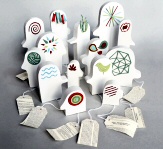
The image on the right is from one of the adverts in the book, all of which advertise the drug Lucidril as a ‘treatment’ for hippies, and it’s no surprise that the book was sponsored by the makers of the medication.

Considering the tone of the book, and the fact that the author concludes that being a hippy as akin to having schizophrenia, it’s interesting that Lucidril is not an antipsychotic, but the trade name for a little known compound called meclofenoxate.

There is weak evidence that the drug boosts memory and is notable largely for its enthusiastic uptake by some sections of the ‘nootropics’ brain hacking crowd.

I suspect the enthusiastic adverts for this oddball drug are largely because the book happened to be sponsored by pharmaceutical company Instituto Bio-Quimico Ltd who were clearly trying to sell the drug as a ‘mental detoxification’ compound for the great unwashed.

But not every bearded girl or guy is a real hippy, says Dr Echeverry, who notes that there are also cases of pseudo-hippies, who are really just weak-minded youths who get swept along with the genuine ‘clinical cases’.

How can you tell the difference you ask? Well, pseudo-hippies are the ones who revert to normality once a psychiatrist pumps them full of approved medication. Simple.

Mind and brain science: an instant overview

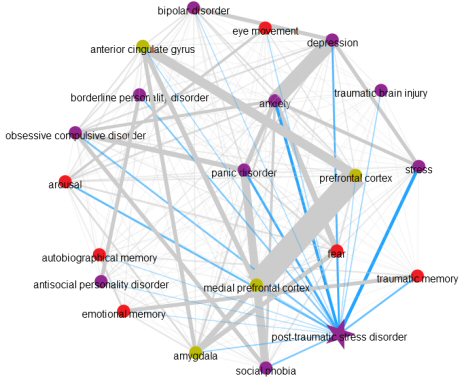
A new online tool called brainSCANr visually summarises the psychology and neuroscience literature to give you a network overview of which are the terms most connected to the target concept in scientific publications.

You can see the example for ‘post-traumatic stress disorder’, otherwise known as PTSD, below. Click here to see it full size on the actual website.
 

The target concept is in the bottom right, marked with a star, and you can immediately see the brain areas, psychological concepts and other disorders most associated with the diagnosis.

The maps are created by looking at how often different words co-occur in the scientific literature, which, as the creators note, is not the same is looking at how concepts are thought of, but it should give a rough approximation.

You can’t just tap any word into it at the moment, as it’s based on a database of concepts, although the searchable list of terms is still quite comprehensive.

However, it’s an inventive new tool which is a fantastic way of getting a quick overview of a field.
 

Link to brainSCANr.

Post-coma nail trauma

Being in coma could play havoc with your nail care routine.


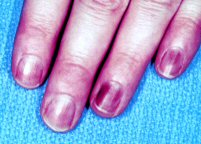
A 1997 report from the Journal of Neurology, Neurosurgery and Psychiatry notes how discoloured fingernails may be a secondary effect of coma owing to the side-effects of a common medical assessment for consciousness.

The test is nothing more high-tech than giving the finger a hard prod with a pencil to see if there is any reaction to pain, which is a common test on unconscious patients.

In fact, it forms part of the universally used Glasgow Coma Scale. You’ll often hear doctors saying “the patient was admitted with a GCS of…” followed by a number up to 15 which rates how conscious and alert the patient is, depending on their reaction to various prods, pokes and verbal requests.

The brief article reported an unintended side-effect of repeated Glasgow Coma Scale assessments after a patient woke up from coma to find her nails all black and blue.

A 30 year old woman was admitted to hospital with a rapidly progressive decline in level of consciousness and seizures. Neuroimaging studies disclosed thrombus in the superior sagittal sinus, bilateral cerebral venous infarctions, and oedema. She was treated with intravenous heparin and propofol for control of agitation and increased intracranial pressure. She made an excellent recovery.

Three weeks after admission she alerted us to a painless brownish discolouration of many of her fingernails. Bilateral subungual haematomas in different stages of resolution were noted. These lesions had been created by frequent nail bed compression with a pencil to monitor motor response, a common practice of applying noxious pain stimuli in comatose patients admitted to neurological intensive care units.

Obviously, if you’re a Goth, Glasgow Coma Scale evaluations are likely to have much less of an impact on your post-coma nail care routine.
 

Link to brief JNNP piece on ‘Coma Nails’.

An informal chat about hard data

Scientific American has an excellent article on the sociology of communicating new discoveries and how the relationship between science and journalism has changed over the years.

It’s a remarkably comprehensive analysis that looks not only at science publication but how it relates to our regular patterns of social communication.

This informal style of communication has been deliberately excluded from science in recent decades through the adoption of peer-review and a uniform impersonal writing style, as a way of imbuing the process with a form of institutional trust.

According to the author, online science pioneer Bora Zivkovic, this model is now being challenged by internet science writing where trust is gained through transparency – showing your working and background through links to original source – rather than having an institutional stamp of approval.

I think he’s a little hard on traditional science journalists, but as an analysis of how trust works in science communication, and how that is being affected by the online science community, it’s an incredibly thought-provoking piece.
 

Link to ‘The line between science and journalism is getting blurry…again’

The plant of human puppets

I’ve made a radio programme with ABC Radio National’s All in the Mind about burundanga, a mysterious street drug used in South America which is widely believed to remove free will.

The name ‘burundanga’ is a popular term and doesn’t refer to a single thing, but its most commonly associated with the brugmansia plants.

They can incapacitate people in high enough doses owing to them being rich in a psychoactive chemical called scopolomine. Criminals spike unsuspecting members of the public and then rob or attack them.

Since living in Colombia, I’ve constantly heard people tell me that the plant removes free will – the affected people just do whatever they’re told. They become, in effect, human puppets.

To me, this always sounded unlikely, and it struck me that, if this was genuinely the case, this might be a hugely important discovery in neuroscience, because free will and agency are two of the most complex and difficult to grasp areas.

But the plant also has hundreds, and probably thousands, of years of history as a psychoactive component of the religious rituals of the indigenous people of the continent, to the point where it holds a central place in some of their founding myths.

Needless to say, the chance to wander round Colombia making a documentary about a psychoactive plant at the intersection of neuroscience, myth and criminal science was too good to miss, so I hope you enjoy the journey.

It sounds wonderful, by the way, but almost entirely due to presenter and producer Natasha Mitchell’s magic at the mixing desk when making sense of my raw materal.

I’ve also written an article about the substance, including the first attempt to use it as a ‘truth drug’ after a gruesome murder, and there’s an image gallery available too.
 

Link to AITM on the plant that steals your free will with mp3 download.
Link to my article on the AITM blog.
Link to image gallery.

Mind and brain bloggers: wanted for your data

If you are a mind and brain blogger, Dr Alice Bell wants to research you. Alice is at the Science Communication Group at Imperial College, London, and is asking us to complete a survey as part of an investigation into the psychology and neuroscience blogosphere.

Are you wondering whether this is you? Here’s who the research project is trying to recruit:

By ‘brain bloggers’ I mean bloggers who write about the stuff that goes in people’s heads, whatever we think this stuff is. Such bloggers might focus on neurology or psychology, or another field entirely. It might be the history, anthropology or commercial applications of these fields. It might come under ‘research blogging’, journalism, ‘public engagement’ or some form of political activism (or several of these at once, or something else entirely). This focus might be exclusively brain-y, or brain-ish issues might be topics they occasionally blog about in the course of other work.

There are more details at the link below, including all the questions.
 

Link to Alice Bell’s mind and brain blogger survey.

The brain scanner’s prayer

The brilliant Neuroskeptic has created a version of The Lord’s Prayer for the fMRI generation. It is at once spiritually uplifting, scientifically edifying and very, very funny.

Our scanner, which art from Siemens,
Hallowed be thy coils.
Thy data come;
Thy scans be done;
In grey matter as it is in white matter.
Give us this day our daily blobs.
And forgive us our trespasses,
As we forgive them that trespass onto our scan slots.
And lead us not into the magnet room carrying a pair of scissors,
But deliver us from volunteers who can’t keep their heads still.
For thine is the magnet,
The gradients,
And the headcoil,
For ever and ever (at least until we can afford a 7T).
Amen.

If you don’t read the Neuroskeptic blog, you’re missing out, as it has some of the best mind and brain coverage on the net and, it seems, the occasional request for divine neurointervention.
 

Link to The Scanner’s Prayer over at Neuroskeptic.
Link to Neuroskeptic blog front page.