A brief history of narcoanalysis

Photo by Flickr user Andres Rueda. Click for source.The judge in the case of ‘Colorado shooter’ James Holmes has made the baffling decision that a ‘narcoanalytic interview’ and ‘polygraph examination’ can be used in an attempt to support an insanity plea.

While polygraph ‘lie detectors’ are known to be seriously flawed, some US states still allow evidence from them to be admitted in court although the fact they’re being considered in such a key case is frankly odd.

But the ‘narcoanalytic interview’ is so left-field as to leave some people scratching their heads as to whether the judge has been at the narcotics himself.

The ‘narcoanalytic interview’ is sometimes described as the application of a ‘truth drug’ but the actual practice is far more interesting.

It has been variously called ‘narcoanalysis’, ‘narcosynthesis’ and the ‘amytal interview’ and involves, as you might expect, interviewing the person under the influence of some sort of narcotic.

It’s roots lie in the very early days of 1890s pre-psychoanalysis where Freud used hypnosis to relax patients to help them discuss emotionally difficult matters.

The idea that being relaxed overcame the mind’s natural resistance to entertaining difficult thoughts and helped get access to the unconscious became the foundation of Freud’s work. Narcoanalysis is still essentially based on this idea.

But, of course, the concept had to wait until the discovery of the first suitable drugs – the barbituates.

Psychiatrist William Bleckwenn found that giving barbital to patients with catatonic schizophrenia led to a “lucid interval” where they seemed to be able to discuss their own mental state in a way previously impossible.

You can see the parallels in the first ever use of ‘narcoanalysis’ to the current case, but through the rest of the century the concept merged with the idea of creating a “truth drug”.

This was born in the 1920s where the gynaecologist Robert House noticed that women who were given scopolamine to ease the birth process seemed to go into a ‘twilight state’ and were more pliant and talkative.

House decided to test this on criminals and went about putting prisoners under the influence of the drug while interviewing them as a way of ‘determining innocence or guilt’. Encouraged by some initial, albeit later recanted, confessions House began to claim that it should be used routinely in police investigations.

This probably would have died a death as a dubious medical curiosity had Time magazine not run an article in their 1923 edition entitled “The Truth-Compeller” about House’s theory – making him and the ‘truth drug’ idea national stars.

These approaches became militarised: firstly as ‘narcoanalysis’ was used to treat traumatised soldiers in the World War Two, and secondly as it was taken up by the CIA in the Cold War as a method for interrogation and became a centrepiece of the secret Project MKUltra.

It has continued to be used in criminal investigations in the US, albeit infrequently, although it has popped up in the legal rulings.

In 1985 the US Supreme Court rejected an appeal by two people convicted of murder that their ‘narcoanalysis police interview’ made their conviction unsafe.

However, the psychiatrist who conducted the interview didn’t convince any of the judges that ‘narcoanalysis’ was actually of benefit:

At one point he testified that it would elicit an accurate statement of subjective memory, but later said that the subject could fabricate memories. He refused to agree that the subject would be more likely to tell the truth under narcoanalysis than if not so treated.

The concept seemed to disappear after that but strong suspicions were raised that ‘narcoanalysis’ was still a CIA favourite when the Bush government’s infamous ‘torture memo‘ justified the use of “mind-altering substances” as part of ‘enhanced interrogation techniques’.

There is no evidence that ‘narcoanalysis’ actually helps in any way, shape or form, and at moderate to high doses, some of the drugs may actually impede memory or make it more likely that the person misremembers.

I suspect that the actual result of the bizarre ruling in the ‘Colorado shooter’ case will just be that psychiatrists will be able to give a potentially psychotic suspect a simple anti-anxiety drug without the resulting evidence being challenged.

This would be no different than giving an anxious or agitated witness the same drug to help them recount what happened.

But the fact that the judge included ‘lie detectors’ and ‘narcoanalysis’ in his ruling as useful legal tools rather than recognising them as flawed investigative techniques is still very concerning and suggests legal thinking mired in the 1950s.
 

pdf of judge’s ruling.
Link to (ironically locked) article on the history of ‘narcoanalysis’

Happiness rebuilt

I’ve written a piece for SpotOn NYC on the contrast between the effects of brain injury depicted in Oliver Sacks-type books and the typical effects in patients on neurology wards.

These books are not inaccurate but neither do they represent the common outcomes of brain injury.

Sometimes the reality is quite different from what people expect.

It is not that the patients described by Oliver Sacks, or any of the other chroniclers of fragile neurology, are in any way inaccurate. I have met patients who show us something about our brain function in equally stark clarity. But such cases are interesting, scientifically, precisely because they are atypical. In contrast, most brain injury is blurry and scientifically mundane. Some difficulties are concealed by other more pressing problems. It’s hard to mistake your wife for a hat when you’re paralysed. It’s hard to have an awakening when you’re not sure where you are. Their importance lies not in a contribution to an understanding of the brain but to the people concerned. An adjusted life. A refactored family. Tears amid the challenges. Happiness rebuilt.

The piece part of a series of posts written by neuroscience bloggers looking at the difficulties with communicating the subtlety and complexity of brain disorders.

There are some excellent pieces there so do have a browse.
 

Link to ‘The Man Who Mistook His Wife For A Nurse’
Link to communicating brain disorders series.

The history of the birth of neuroculture

My recent Observer piece examined how neuroscience has saturated popular culture but the story of how we found ourselves living in a ‘neuroculture’ is itself quite fascinating.

Everyday brain concepts have bubbled up from their scientific roots and integrated themselves into popular consciousness over several decades. Neuroscience itself is actually quite new. Although the brain, behaviour and the nervous system have been studied for millennia the concept of a dedicated ‘neuroscience’ that attempts to understand the link between the brain, mind and behaviour only emerged in the 1960s and the term itself was only coined in 1962. Since then several powerful social currents propelled this nascent science into the collective imagination.

The sixties were a crucial decade for the idea that the brain could be the gateway to the self. Counter-culture devotees, although enthusiastic users of mind-altering drugs, were more interested in explaining the effects in terms of social changes than neurological ones. In contrast, pharmaceutical companies had discovered the first useful psychiatric drugs only a few years before and they began to plough millions both into both divining the neurochemistry of experience and into massive marketing campaigns that linked brain functions to the psyche.

Drug marketing executives targeted two main audiences. Asylum psychiatrists dealt with institutionalised chronic patients and the adverts were largely pitched in terms of management and control, but for office-based psychiatrists, who mainly used psychotherapy to treat their patients, the spin was different. The new medications were sold as having specific psychological effects that could be integrated into a Freudian understanding of the self. According to the marketing, psychoactive chemicals could break down defences, reduce neurotic anxiety and resolve intra-psychic conflict.

In the following years, as neuroscience became prominent and psychoanalysis waned, pharmaceutical companies realised they had to sell theories to make their drugs marketable. The theories couldn’t be the messy ideas of actual science, however, they needed to be straightforward stories of how specific neurotransmitters were tied to simple psychological concepts, not least because psychiatric medication was now largely prescribed by family doctors. Low serotonin leads to depression, too much dopamine causes madness. The fact these theories were wrong was irrelevant, they just needed to be reason enough to prescribe the advertised pill. The Prozac generation was sold and the pharmacology of self became dinner table conversation.

Although not common knowledge at the time, the sixties also saw the rise of neuroscience as a military objective. Rattled by Korean War propaganda coups where American soldiers renounced capitalism and defected to North Korea, the US started the now notorious MKULTRA research programme. It aimed to understand communist ‘brain washing’ in the service of mastering behavioural control for the benefit of the United States.

Many of the leading psychologists and psychiatrists of the time were on the payroll and much of the military top brass was involved. As a result, the idea that specific aspects of the self could be selectively manipulated through the brain became common among the military elite. When the two decade project was revealed amid the pages of The New York Times and later investigated by a 1975 Congressional committee, the research and the thinking behind it made headline news around the world.

Mainstream neuroscience also became a source of fascination due to discoveries that genuinely challenged our understanding of the self and the development of technologies to visualise the brain. As psychologists became interested in studying patients with brain injury it became increasingly clear that the mind seemed to break down in specific patterns depending on how the brain was damaged, suggesting the intriguing possibility of an inherent structure to the mind. The fact that brain damage can cause someone to believe that a body part is not their own, a condition known of somatoparaphrenia, suggests body perception and body ownership are handled separately in the brain. The self was breaking down along fault lines we never knew existed and a new generation of scientist-writers like Oliver Sacks became our guides.

The rise of functional neuroimaging in the eighties and nineties allowed scientists to see a fuzzy outline of brain activity in healthy individuals as they undertook recognisable tasks. The fact that these brightly coloured brain scans were immensely media friendly and seemingly easy to understand (mostly, misleadingly so) made neuroscience appear accessible to anyone. But it wasn’t solely the curiosity of science journalists that propelled these discoveries into the public eye. In 1990 President G.W. Bush launched the Decade of the Brain, a massive project “to enhance public awareness of the benefits to be derived from brain research”. A ten-year programme of events aimed at both the public and scientists followed that sealed the position of neuroscience in popular discourse.

These various cultural threads began weaving a common discourse through the medical, political and popular classes that closely identified the self with brain activity and which suggested that our core humanity could be understood and potentially altered at the neurobiological level.

These cultural forces that underlie our ‘neuroculture’ are being increasingly mapped out by sociologists and historians. One of the best sources is ‘The birth of the neuromolecular gaze’ by Joelle Abi-Rached and Nikolas Rose. Sadly, it’s a locked article although a copy has mysteriously appeared online

However, some excellent work is also being done by Fernando Vidal, who looks at how we understand ourselves through new scientific ‘self’ disciplines, and by Davi Johnson Thornton who studies who neuroscience is being communicated through popular culture.
 

Link to ‘The birth of the neuromolecular gaze’.

2013-03-08 Spike activity

Quick links from the past week in mind and brain news:

Brain freeze from a slurpee was blamed for a five car pile up in Texas according to Jalopnik.

Salon takes a nuanced look at hook-up culture. It’s a culture? I thought it was a hobby.

Housewives, tranquilliser use and the nuclear family in Cold War America. Wellcome History have a fascinating piece on the first fashionable psychiatric drug.

Time reports that enhancing one type of maths ability with brain stimulation impairs another. My own experience is that it helps with spelling but not with grammatical.

What do museums of madness tell us about who we were and who we are? BBC Radio 4 programme Mad Houses is fascinating but no podcast because the BBC love the 20th century.

Futurity reports on a new study finding that the infant brain controls blood flow differently – which could have huge implications for brain scanning technologies like fMRI which rely on blood flow.

The oddly recursive Brain Awareness Day will happen on March 14th.

Retraction Watch covers a case of scientific fraud in studies on the response to reward.

New Neuropod. You know the drill.

Science News reports that heavy drinkers get extra brain fuel from alcohol. Like putting rocket boosters on a one legged donkey.

The essence of intelligence is feedback

Here’s last week’s BBC Future column. The original is here, where it was called “Why our brains love feedback”. I  was inspired to write it by a meeting with artist Tim Lewis, which happened as part of a project I’m involved with : Furnace Park, which is seeing a piece of reclaimed land in an old industrial area of Sheffield transformed into a public space by the University.

A meeting with an artist gets Tom Stafford thinking about the essence of intelligence. Our ability to grasp, process and respond to information about the world allows us follow a purpose. In some ways, it’s what makes us, us.

In Tim Lewis’s world, bizarre kinetic sculptures move, flap wings, draw and even walk around. The British artist creates mechanical animals and animal machines – like Pony, a robotic ostrich with an arm for a neck and a poised hand for a head – that creak into life in a way that can seem unsettling, as if they have a strange, if awkward, life of their own. His latest creations are able to respond to the environment, and it makes me ponder the essence of intelligence – in some ways revealing what makes us, us.
I met Tim on a cold Friday afternoon to talk about his work, and while talking about the cogs and gears he uses to make his artwork move, he made a remark that made me stop in my tracks. The funny thing is, he said, all of the technology existed to make machines like this in the sixteenth century – the thing that stopped them wasn’t the technical know-how, it was because they lacked the right model of the mind.

p015lq0qJetsam 2012, by Tim Lewis (Courtesy: Tim Lewis)
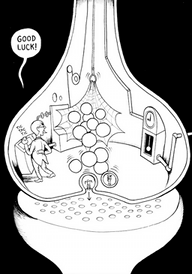
What model of the mind do you need to create a device like Tim’s Jetsam, a large wire mesh Kiwi-like creature that forages around its cage for pieces of a nest to build. The intelligence in this creation isn’t in the precision of the craftwork (although it is precise), or in the faithfulness to the kind of movements seen in nature (although it is faithful). The intelligence is in how it responds to the placing of the sticks. It isn’t programmed in advance, it identifies where each piece is and where it needs to go.

This gives Jetsam the hallmark of intelligence – flexibility. If the environment changes, say when the sticks are re-scattered at random, it can still adapt and find the materials to build its nest. Rather than a brain giving instructions such as “Do this”, feedback allows instructions such as “If this, do that; if that, do the other”. Crucially, feedback allows a machine to follow a purpose – if the goal changes, the machine can adapt.

It’s this quality that the sixteenth century clockwork models lacked, and one that we as humans almost take for granted. We grasp and process information about the world in many forms, including sights, smells or sounds. We may give these information sources different names, but in some sense, these are essentially the same stuff.

Information control

Cybernetics is the name given to the study of feedback, and systems that use feedback, in all their forms. The term comes from the Greek word for “to steer”, and inspiration for some of the early work on cybernetics sprang from automatic guiding systems developed during World War II for guns or radar antennae. Around the middle of the twentieth century cybernetics became an intellectual movement across many different disciplines. It created a common language that allowed engineers to talk with psychologists, or ecologists to talk to mathematicians, about living organisms from the viewpoint of information control systems.

A key message of cybernetics is that you can’t control something unless you have feedback – and that means measurement of the outcomes. You can’t hit a moving target unless you get feedback on changes to its movement, just as you can’t tell if a drug is a cure unless you get feedback on how many more people recover when they are given it. The flip side of this dictum is the promise that with feedback, you can control anything. The human brain seems to be the arch embodiment of this cybernetic principle. With the right feedback, individuals have been known to control things as unlikely as their own heart rate, or learn to shrink and expand their pupils at will. It even seems possible to control the firing of individual brain cells.

But enhanced feedback methods can accelerate learning about more mundane behaviours. For example, if you are learning to take basketball shots, augmented feedback in the form of “You were 3 inches off to the left” can help you learn faster and reach a higher skill level quicker. Perhaps the most powerful example of an augmented feedback loop is the development of writing, which allowed us to take language and experiences, and make them permanent, solidifying it against the ravages of time, space and memory.

Thanks to feedback we can become more than simple programs with simple reflexes, and develop more complex responses to the environment. Feedback allows animals like us to follow a purpose. Tim Lewis’s mechanical bird might seem simple, but in terms of intelligence it has more in common with us than with nearly all other machines that humans have built. Engines or clocks might be incredibly sophisticated, but until they are able to gather their own data about the environment they remain trapped in fixed patterns.

Feedback loops, on the other hand, beginning with the senses but extending out across time and many individuals, allow us to self-construct, letting us travel to places we don’t have the instructions for beforehand, and letting us build on the history of our actions. In this way humanity pulls itself up by its own bootstraps.

2013-03-01 Spike activity

Quick links from the past week in mind and brain news:

Providentia overs the curious history of Japan’s suicide volcano.

Skepticism about ‘social priming’ is driven by a long-history of doubt about subliminal priming of behaviour. Good piece on Daniel Simons’ Blog.

The New York Times has an amazing video about technology to enhance the perception of motion.

The ‘Vaccine Resistance Movement’ has an anti-vaccination conference in Vancouver on March 12th. Bizarrely it is being hosted by Simon Fraser University. If you want to contact them and make your views known you can do so here.

Neurobonkers covers a genuine scientific study on what gains Twitter followers. Note to self: posting pictures of yourself in underwear only works if you’re a glamour model.

We’re all Jonah Lehrer except me. Neuroskeptic on narrative and neuroscience.

The Fix discusses the overuse of ‘addiction’ to describe bad choices.

UK public art and neuroscience events currenty running: Affecting Perception taking place in Oxford and Wonder happening in London.

Slate has a form from 1889 to leave your brain to science. Only brains of “educated and orderly persons rather than those of the ignorant, criminal or insane”!

London neuroscience centre to map ‘connectome‘ of foetal brain reports Wired UK.

A neurobiological graphic novel

The Guardian has a video about the collaboration between neuroscientist Hana Ros and artist Matteo Farinella as they’ve been working on the neurocomic project to create a brain science graphic novel.

The finished project isn’t quite out yet but the artwork is looking amazing.

The film about the collaboration covers how they worked together and how each approach their work.

There’s a lovely bit where Hana Ros describes how she isolates neurons to work on and mentions she gives them all names.

Make sure you also check out the artwork on the project website.
 

Link to video on the collaboration.
Link to the neurocomic website.

A fine art

It’s not often you get to enrage both feminists and misogynists at the same time but a new study, just published in the Archives of Sexual Behavior, may have managed this impressive feat.

It found that men’s preference for larger breasts was associated with having a greater number of oppressive beliefs about women.

Feminists can be enraged about how a natural variation in body shape has become associated with sexist attitudes while misogynists that their breast size preference can be thought of as a problem.

Social scientists, however, may be left relatively unperturbed at the thought of this study. But please, allow me.

So, come on now. What does it really tell us?

You can thank me later.
 

Link to coverage on Feminist Philosophers blog (via @KateClancy)
Link to locked study.

Your future self already exists in the cloud

The Economist has a short but fascinating piece on the work of physicist Chaoming Song who creates mathematical models to predict your future location based on your mobile phone and online activity. His accuracy rarely drops below 80%.

Song Chaoming, for instance, is a researcher at Northeastern University in Boston. He is a physicist, but he moonlights as a social scientist. With that hat on he has devised an algorithm which can look at someone’s mobile-phone records and predict with an average of 93% accuracy where that person is at any moment of any day. Given most people’s regular habits (sleep, commute, work, commute, sleep), this might not seem too hard. What is impressive is that his accuracy was never lower than 80% for any of the 50,000 people he looked at.

If you think this sounds a little far-fetched the findings have already been published – one paper in Nature Physics and the other in Science.

Yes folks, we’re all unique. Just like everyone else.
 

Link to The Economist on Chaoming’s network echo location work.

The Perfect Woman

The heaving busts and melodrama of a Latin American soap opera, a television industry desperate for a ratings hit, and the writer makes a woman with Asperger’s syndrome the love interest for the dashing plastic surgeon in the latest telenovela. It sounds like a recipe for disaster but it turned out to be a triumph.
The Venezuelan telenovela was called La Mujer Perfecta – The Perfect Woman. The name was a play on its plastic surgery theme, a subtle nod to the country’s obsession with surgical tweaks and a knowing satire on the fact that the heroine was unconventionally, well, perfect.

If you’ve never seen a Latin American telenovela most are like a crap version of Knots Landing that exist as the semi-official residence of ex-beauty queens. Occasionally, however, they soar into brilliance.

La Mujer Perfecta was one of those examples and it’s discussed in an English-language article by media researcher Carolina Acosta-Alzuru. Wonderfully, she writes the piece as a letter to the lead character Micaela.

Of these six women, you would be the most peculiar, Micaela. You, who had never gone under the plastic surgery knife and who had never fallen in love, would discover the symptoms of love on meeting Santiago Reverón, a famous plastic surgeon married to a diva with a body and face operated on to the point of perfection. And Santiago would fall in love with you, the strangest woman he had ever met. Among your peculiarities is that you process what you hear literally. You do not understand the nuances of spoken language, nor of body language. As such, you cannot parse metaphors, sarcasm, and jokes.

In addition, you lack social filters when speaking; hence, you never lie or sugar coat your expressions. Brilliant, with an intelligence that is above average and a photographic memory, you can speak extensively about some subjects in which you are particularly learned. At the same time, you have difficulty deciphering emotions — your own and those of others. You are methodical and attached to your routines. They are your safety net. Hence, you suffer if anything alters your habits or environment.

Your body language can confuse people: you have difficulty making eye contact and, in general, you do not like to be touched. At the beginning of La Mujer Perfecta, no one (not even you), knew the reason behind your characteristics: Asperger’s Syndrome, a condition that lies in the spectrum of autism. But Asperger’s would not impede the occurrence of your love story with Santiago. And, as you know, a central love story is the defining characteristic of telenovelas.

Imagine if you had the production values of Dallas but still managed to create a brilliantly subversive, interesting and entertaining TV show that the autism community were really proud of.

Imagine if it topped the ratings without resorting to a librarian moment where the lead character takes off her dorky clothes, flicks her hair and is suddenly ‘cured’.

Most of the series is on YouTube but even if you don’t speak Spanish, it’s worth checking out the scene where Micaela and Santiago have their first kiss. It’s incredibly touching.

Micaela says she doesn’t understand why he says ‘he feels butterflies in his stomach’. Santiago comes out with a passionate but poetic declaration of love that Micaela doesn’t get. He touches her. She asks him not to because it feels uncomfortable. He withdraws his hands.

He says he has been trying to distract himself but he constantly thinks about her and feels completely consumed by her. She asks, concerned, “is this bad?” “No”, he replies, “it’s spectacular”.

She smiles and their lips edge closer. The music surges …you seem the perfect woman for me…. They kiss, a gentle tender kiss. Butterflies are flying around them.

And the adverts come and ruin the moment.

Even the most subversive telenovela of its generation is still, after all, a telenovela.
 

Link to article in academic journal (via @autismcrisis)
Link to pdf of same.

What will the billion dollar brain projects do?

Two neuroscience projects have been earmarked for billion dollar funding by Europe and the US government but little has been said about what the projects will achieve. Here’s what we know.

The European Commision has just awarded half a billion euros to the Human Brain Project – a development of Henry Markram’s Blue Brain project which has made impressive biologically detailed computational models of cortical columns from the rat brain.

The Human Brain Project sells itself as aiming to “simulate a complete human brain in a supercomputer” but this is clearly bollocks.

It’s interesting that this claim makes the press kit and the flashy video but the actual report (pdf) has much more sober claims about ‘simulating brain dynamics’ and the like.

But it’s important to realise that while their big sell is nonsense, the project is likely to genuinely revolutionise neuroscience in a way that could push the field light years ahead.

What Markram has realised is that the single biggest barrier to progress in neuroscience is the co-ordination, sharing and integration of data.

Essentially, it’s a problem of information architecture but quite frankly, you can’t sell that to politicians and they can’t sell it to the public. Hence the ‘simulating a complete human brain’ fluff.

What the project aims to do is co-ordinate neuroscience teams looking at neurobiology, cognitive neuroscience and computational modelling and give them the tools to easily share data with each other.

One of the big pay-offs will genuinely be the creation of biologically feasible computer simulations of neural networks with the hope that these can be used for practical applications like virtual drug testing and computer-based experiments.

Markram has gained valuable experience of meshing heavy-duty computing with working lab teams and has recruited some of the world’s leading neuroscientists to the project.

Although the spin seems over-the-top scientifically this is an important project that, if successful, could be a scientific landmark.

In terms of the big bucks American counterpart here’s what we know – which, as it turns out, is not very much.

Obama has hinted at spending up to $3 billion on a neuroscience project. He made a vague reference to ‘brain mapping’ and the director of the National Institute of Neurological Disorders and Stroke eventually confirmed he was referring to the Brain Activity Map project – something outlined in a scientific article published in last June’s Neuron.

You can read the piece as a pdf but io9 has some good coverage if you want a summary.

But here’s the thing. The scientific article really just says the project would aim to ‘reconstruct a full record of activity across complete neural circuits’ and turn them into computer models and suggests some technologies that may be useful.

It’s along the same lines as the Human Brain Project but without committing to any details and admits we don’t currently have to the tools to achieve the aims. Even the NINDS director admitted that a ‘concrete plan’ has yet to be finalised.

In fact, considering the vagueness of both the science and the political response I suspect the sudden discussion of the Brain Activity Map project is as much a response to the European cash splash than a well-planned project that has been waiting to be funded.

Although the announcement is probably as much a political as a scientific move the implications are likely to be important.

If we assume that the US has committed to not being left behind by their European colleagues we are likely to see a decade of massive innovation in neuroscience.

We live in exciting times.

2013-02-22 Spike activity

Quick links from the past week in mind and brain news:

The Lancet asks how we can help children cope with trauma? The unfortunate answer is we don’t really know.

“If you don’t share my beliefs, it’s because your brain isn’t working properly”. Excellent piece on the ‘defective brain’ fallacy from the Cultural Cognition Project at Yale.

WA Today has an interesting piece on the Australian swim team that gives an insight into how pro-athletes misuse prescription drugs to get high.

What happens to your brain when you get black-out drunk? asks Gizmodo while dropping it’s kebab over your shirt and mumbling about how your mum is really hot for an older woman.

The Guardian has an interesting piece on how psychologists work with weight-loss surgeons to ensure patients can maintain their progress.

What will it be like to live in a robot society? asks iTechPost while jammed against the door, pump-action shotgun in hand, screaming “To The Bunkers!”

Time covers a fascinating neurosurgery study that ‘watched’ how the brain generates speech.

You’re surprisingly good at absorbing caffeine through your skin. Neurotic Physiology heralds a new age of caffeine body patches.

The Institute for Art and Ideas has an interesting discussion on consciousness and a secular interpretation of the soul between Galen Strawson, David Malone and Nicholas Humphrey.

On the Possible Shapes of the Brain. The Loom looks at how brain folding relates to complexity.

Esquire Magazine have a spectacularly shit article on Obama’s billion dollar brain project that they think might “provide the first viable means of remotely controlling the human mind”.

Five examples of how the languages we speak can affect the way we think are discussed on the TED Blog. Mind control! Calm yourselves Esquire.

The Guardian discusses the first UK clinic to treat stalkers.

Cassie Rodenberg’s blog White Noise tracking the lives of addicts on New York’s streets and is both disturbing and compelling.

The Master and His Emissary

I’ve been struggling to understand Iain McGilchrist’s argument about the two hemispheres of the brain, as presented in his book “The Master and His Emissary” [1]. It’s an argument that takes you from neuroanatomy, through behavioural science to cultural studies [2]. The book is crammed with fascinating evidential trees, but I left it without a clear understanding of the overall wood. Watching this RSA Animate helped.

Basically, I think McGilchrist is attempting a neuroscientific rehabilitation of an essentially mystical idea: the map is not the territory, of the important of ends rather than just means [3]. Here’s a tabulation of functions and areas of focus that McGilchrist claims for the two hemispheres:

Left Right
Representation Perception
The Abstract The Concrete
Narrow focus Broad focus
Language Embodiment
Manipulation Experience (?)
Parts Wholes
Machines Life
The Static The Changing
Focus on the known Alertness for the novel
Consistency, familiarity, prediction Contradiction, novelty, surprise
A closed knowledge system An open knowledge system
(Urge after) Consistency (Urge after) Completeness
The Known The Unknown, The ineffable
The explicit The implicit
Generalisation Individuality/uniqueness
Particulars Context

A key idea – which is in the RSA Animate – is the idea of a ‘necessary distance’ from the world. By experiencing yourself as separate (but not totally detached) you are able to empathise with people, manipulate tools, reason on symbols etc. But, of course, there’s always the risk that you end up valuing the tools for their own sake, or believing in the symbol system you have created to understand the world.

From a cognitive neuroscience point of view, this is fair enough, by which I mean that if you are going to look into the (vast) literature on hemispheric specialisation and make some summary claims, as McGilchrist does, then these sort of claims are reasonable. You can enjoy one of the grand-daddies of split brain studies, Michael Gazzaniga, summarise his perspective, which isn’t that discordant, here [4].

From this foundation, McGilchrist goes on to diagnose a historical movement in our culture away from a balanced way of thinking and towards a ‘left brain’ dominated way of thinking. This, to me, also seems fair enough. Modernity does seem characterised by the ascendance of both instrumentalism and bureaucracy, both ‘leftish’ values in the McGilchristian framework.

It is worth noting that dual-systems theories, of which this is one, are perennially popular. McGilchrist is careful and explicit in rejecting the popular Reason vs Emotion distinction that has come to be associated with the two hemispheres. In this RSA report Divided Brain, Divided World, he briefly discusses how his theory relates to the automatic-deliberative distinction, as (for example) set out by Daniel Kahneman in his Thinking Fast and Slow. He says, briefly, that that distinction is orthogonal to the one he’s making; i.e. both hemispheres do automatic and controlled processing.

I was turned on to the book by Helen Mort, who writes a great blog about neuroscience and poetry which you can check out here: poetryonthebrain.blogspot.ca/. If you’re interested in reading more about psychology, divided selves and cultural shifts I recommend Timothy Wilson’s “Strangers to Ourselves” and Walter Ong’s “Orality and Literacy”.

Footnotes

[1] If you buy the paperback they’ve slimmed it down, at least in some editions, by leaving out the reference list at the end. Very frustrating.

[2] Fans of grand theories of hemispheric functioning and the relation to cultural evolution, make sure you check out Julian Jaynes’ The Origin of Consciousness in the Breakdown of the Bicameral Mind . Weirdly McGilchrist hardly references this book (noting merely that he is saying something completely different).

[3] And when I use the term ‘mystical’, that is a good thing, not a denigration.

[4] Gazzaniga, M. (2002). The split brain revisited. Scientific American, Special Editions: The Hidden Mind.

The blossoms are beautiful on their own

Listen. I totally respect your new neuroscience discovery. Really, my balls are jazzed. But quit with the ‘may lead to a cure for epilepsy, autism and schizophrenia’ thing you always put in your press releases.

Your new neuroscience discovery is genuinely cool, but, let’s face it, no more likely to lead to a cure for schizophrenia than my new garden equipment is likely to end world hunger.

My new garden equipment, by the way, is an equally ball-tingling innovation, but you can see how you’d never get away with the world hunger thing when announcing it to the press.

A lot of neuroscience discoveries are similar in a way. They’re the scientific equivalent of inventing a solar powered bird-scarer.

You read that right. A solar-powered bird scarer.

Kinda clicks into place, doesn’t it? You think to yourself ‘that’s cool’ and you silently nod your head to whoever came up with that agricultural gem.

But the UN aren’t busting their onions to integrate it into their agricultural policy. Monsanto aren’t scratching their nuts over how to cash in.

This doesn’t make it less cool. It still makes a genuine contribution and may even make things easier for the bird-troubled farmer. But it’s unlikely to herald the end of famine.

So, neuroscience press release writers of the world – no need to promise me the world.

The blossoms are really quite beautiful on their own.

Point me to a brain area

I’ve just found an incredibly use brain anatomy atlas that when you point at any part of an MRI scan it tells you which part of the brain you’re looking at in all three planes.

It seems to be part of a very useful website called HeadNeckBrainSpine that is full of handy neuroanatomy tools, tutorials and toys.

If nothing else, do check out the MRI atlas as it will give you a feel for how clearly different brain structures appear on a common type of medical scan.

As some folks on the Twitter arguing service have noted, its only slight drawback is the brain’s biggest structure (the frontal lobes) are not perfectly outlined, but they’re marked adequately and it’s still a massively useful tool that I’ve been referring to ever since I found it.

 
Link to MRI neuroanatomy atlas.
Link to HeadNeckBrainSpine.

BBC Column: Why cyclists enrage car drivers

Here is my latest BBC Future column. The original is here. This one proved to be more than usually controversial, not least because of some poorly chosen phrasing from yours truly. This is an updated version which makes what I’m trying to say clearer. If you think that I hate cyclists, or my argument relies on the facts of actual law breaking (by cyclists or drivers), or that I am making a claim about the way the world ought to be (rather than how people see it), then please check out this clarification I published on my personal blog after a few days of feedback from the column. One thing the experience has convinced me of is that cycling is a very emotional issue, and one people often interpret in very moral terms.

It’s not simply because they are annoying, argues Tom Stafford, it’s because they trigger a deep-seated rage within us by breaking the moral order of the road.


Something about cyclists seems to provoke fury in other road users. If you doubt this, try a search for the word “cyclist” on Twitter. As I write this one of the latest tweets is this: “Had enough of cyclists today! Just wanna ram them with my car.” This kind of sentiment would get people locked up if directed against an ethnic minority or religion, but it seems to be fair game, in many people’s minds, when directed against cyclists. Why all the rage?

I’ve got a theory, of course. It’s not because cyclists are annoying. It isn’t even because we have a selective memory for that one stand-out annoying cyclist over the hundreds of boring, non-annoying ones (although that probably is a factor). No, my theory is that motorists hate cyclists because they offend the moral order.

Driving is a very moral activity – there are rules of the road, both legal and informal, and there are good and bad drivers. The whole intricate dance of the rush-hour junction only works because everybody knows the rules and follows them: keeping in lane; indicating properly; first her turn, now mine, now yours. Then along come cyclists, innocently following what they see as the rules of the road, but doing things that drivers aren’t allowed to: overtaking queues of cars, moving at well below the speed limit or undertaking on the inside.

You could argue that driving is like so much of social life, it’s a game of coordination where we have to rely on each other to do the right thing. And like all games, there’s an incentive to cheat. If everyone else is taking their turn, you can jump the queue. If everyone else is paying their taxes you can dodge them, and you’ll still get all the benefits of roads and police.

In economics and evolution this is known as the “free rider problem”; if you create a common benefit  – like taxes or orderly roads – what’s to stop some people reaping the benefit without paying their dues? The free rider problem creates a paradox for those who study evolution, because in a world of selfish genes it appears to make cooperation unlikely. Even if a bunch of selfish individuals (or genes) recognise the benefit of coming together to co-operate with each other, once the collective good has been created it is rational, in a sense, for everyone to start trying to freeload off the collective. This makes any cooperation prone to collapse. In small societies you can rely on cooperating with your friends, or kin, but as a society grows the problem of free-riding looms larger and larger.

Social collapse

Humans seem to have evolved one way of enforcing order onto potentially chaotic social arrangements. This is known as “altruistic punishment”, a term used by Ernst Fehr and Simon Gachter in a landmark paper published in 2002 [4]. An altruistic punishment is a punishment that costs you as an individual, but doesn’t bring any direct benefit. As an example, imagine I’m at a football match and I see someone climb in without buying a ticket. I could sit and enjoy the game (at no cost to myself), or I could try to find security to have the guy thrown out (at the cost of missing some of the game). That would be altruistic punishment.

Altruistic punishment, Fehr and Gachter reasoned, might just be the spark that makes groups of unrelated strangers co-operate. To test this they created a co-operation game played by constantly shifting groups of volunteers, who never meet – they played the game from a computer in a private booth. The volunteers played for real money, which they knew they would take away at the end of the experiment. On each round of the game each player received 20 credits, and could choose to contribute up to this amount to a group project. After everyone had chipped in (or not), everybody (regardless of investment) got 40% of the collective pot.

Under the rules of the game, the best collective outcome would be if everyone put in all their credits, and then each player would get back more than they put in. But the best outcome for each individual was to free ride – to keep their original 20 credits, and also get the 40% of what everybody else put in. Of course, if everybody did this then that would be 40% of nothing.

In this scenario what happened looked like a textbook case of the kind of social collapse the free rider problem warns of. On each successive turn of the game, the average amount contributed by players went down and down. Everybody realised that they could get the benefit of the collective pot without the cost of contributing. Even those who started out contributing a large proportion of their credits soon found out that not everybody else was doing the same. And once you see this it’s easy to stop chipping in yourself – nobody wants to be the sucker.

Rage against the machine

A simple addition to the rules reversed this collapse of co-operation, and that was the introduction of altruistic punishment. Fehr and Gachter allowed players to fine other players credits, at a cost to themselves. This is true altruistic punishment because the groups change after each round, and the players are anonymous. There may have been no direct benefit to fining other players, but players fined often and they fined hard – and, as you’d expect, they chose to fine other players who hadn’t chipped in on that round. The effect on cooperation was electric. With altruistic punishment, the average amount each player contributed rose and rose, instead of declining. The fine system allowed cooperation between groups of strangers who wouldn’t meet again, overcoming the challenge of the free rider problem.

How does this relate to why motorists hate cyclists? The key is in a detail from that classic 2002 paper. Did the players in this game sit there calmly calculating the odds, running game theory scenarios in their heads and reasoning about cost/benefit ratios? No, that wasn’t the immediate reason people fined players. They dished out fines because they were mad as hell. Fehr and Gachter, like the good behavioural experimenters they are, made sure to measure exactly how mad that was, by asking players to rate their anger on a scale of one to seven in reaction to various scenarios. When players were confronted with a free-rider, almost everyone put themselves at the upper end of the anger scale. Fehr and Gachter describe these emotions as a “proximate mechanism”. This means that evolution has built into the human mind a hatred of free-riders and cheaters, which activates anger when we confront people acting like this – and it is this anger which prompts altruistic punishment. In this way, the emotion is evolution’s way of getting us to overcome our short-term self-interest and encourage collective social life.

So now we can see why there is an evolutionary pressure pushing motorists towards hatred of cyclists. Deep within the human psyche, fostered there because it helps us co-ordinate with strangers and so build the global society that is a hallmark of our species, is an anger at people who break the rules, who take the benefits without contributing to the cost. And cyclists trigger this anger when they use the roads but don’t follow the same rules as cars.

Now cyclists reading this might think “but the rules aren’t made for us – we’re more vulnerable, discriminated against, we shouldn’t have to follow the rules.” Perhaps true, but irrelevant when other road-users see you breaking rules they have to keep. Maybe the solution is to educate drivers that cyclists are playing an important role in a wider game of reducing traffic and pollution. Or maybe we should just all take it out on a more important class of free-riders, the tax-dodgers.