2009-01-09 Spike activity

Quick links from the past week in mind and brain news:

A free Critical Neuroscience <a href="http://neuroanthropology.net/2008/11/14/critical-neuroscience-conference-at-ucla/
“>conference is being held in Berkeley UCLA on Jan 30th. Check the link for more information or see this jpg poster.

BPS Research Digest looks at interesting research suggesting that Tetris might work as a ‘cognitive vaccine’ against the development of trauma.

US Government claims futuristic security checkpoints have remarkably terrorist detecting capability on the basis of a Windows desktop shot and an unreleased ‘test’, reports TechFragments.

The Guardian has an extended book review article where neuroscientist Steven Rose discusses the latest theories about the human brain.

The excellent Developing Intelligence finds an interesting <a href="The Science of Mind-Reading: SVMs Extract Intentions from Neural Activity
http://scienceblogs.com/developingintelligence/2009/01/svms_decode_intentions_the_sta.php”>video on ‘brain scan mind reading’.

The New York Times profiles Emily Yudofsky who just set up a fledgling ‘neuromarketing’ company.

Children with developmental language disorder are the topic of a recent Health Report programme from ABC Radio National.

Neuroanimations is a site intended for neurosurgeons that describes various brain pathologies with, unsurprisingly, animations.

The UK is suffering a shortage of people who donate their brains after death for essential research into conditions like Alzheimer’s and Parkinson’s disease, reports BBC News.

RadioLab just broadcast another one of their wonderfully produced shows. This one on <a href="Radiolab diagnosis
http://blogs.wnyc.org/radiolab/2008/12/30/diagnosis/”>diagnosis. Excellent apart from the slightly over-enthusiastic brain scans to diagnose psychiatric disorders bit.

An essay discussing why kindness is seen in such a bad light in modern times is printed in The Guardian, looks to be an extract from a forthcoming book.

Cognitive Daily examines research on the pain killing effects of your favourite music.

BBC Radio 4’s Case Notes has a special on the sense of taste.

Neuroskeptic has an excellent takedown of much of the recent misinformed coverage about ‘why men like computer games‘.

Gregory Petsko discusses the coming neurological epidemic in a talk for TED.

Furious Seasons casts a skeptical eye over a recent American Journal of Psychiatry paper trying to explain why there’s such a large placebo response in antidepressant drugs trials in children.

People overestimate their reactions to racist comments, according to new research covered by Not Exactly Rocket Science.

Bullshit Blue Monday a downer on Wikipedia

Image by stock.xchng user soopahtoe: Click for sourceIs this the most incompetent Wikipedia edit ever? Green Communications, the PR company who promotes the Blue Monday ‘worst day of the year’ bullshit festival, recently tried to ‘anonymously’ delete criticism from the Blue Monday Wikipedia page without realising their IP address was a complete giveaway.

This obviously failed, and they just tried to paste on a whole block of text onto the bottom of the article that started with (and I kid you not):

THE FOLLOWING CONTENT IS ALL FACTUALLY CORRECT. IF YOU DISPUTE IT PLEASE CONTACT THE AUTHOR.

Spank me nanny! Spank me!

Actually, they originally tried to do this from an anonymous IP address that didn’t track back to Green Communications, but then blew their cover by using a registered account to reinsert the text – time under the name ‘Honest Green’ and with the added power caps.

Now, I’m going to assume that the information is ALL FACTUALLY CORRECT so I want to address the last line of their bolt-on Wikipedia press release:

The on-going campaign is run by Wakefield-based public relations company GREEN Communications, on a non-commercial basis as part of its own corporate social responsibility activities.

Let’s make this clear. Green Communications – I applaud your efforts for running non-commercial PR campaigns aimed at promoting mental health. It’s a vastly neglected area that gets scant attention in the press.

However, the reason that the ‘Blue Monday’ / worst day of the year formulae rubbish gets the back up of medical doctors, psychologists and researchers is not just that it’s ridiculous.

It’s that promoting the misunderstanding of science and psychology actually harms people’s ability to make informed choices about their mental health.

It devalues genuine evidence-based work in the area and misleads people as to what they need to consider when trying to manage their own emotions, or, if the need arises, decide on what sort of help or treatment they want when things get too difficult to manage their own.

So, I’d like nothing more than next year, you run a non-commercial PR campaign aimed at empowering and informing people about depression that wasn’t based on misinformation.

You’re an award winning PR company, so I’m sure you can find an equally catchy way of grabbing people’s attention that doesn’t involve obvious drivel.

UPDATE: Just a reminder that you can still enter our Bullshit Blue Monday make up your own nonsense formula competition where you could win a prize!

Link to Bullshit Blue Monday antidote from Ben Goldacre.
Link to Bullshit Blue Monday antidote from Petra Boyton.

Inside the mind of an autistic savant

New Scientist has an interesting interview with Daniel Tammet, a young man with with Asperger’s syndrome, synaesthesia and amazing savant memory skills.

Tammet has also been the subject of scientific investigation, with a 2007 study published in the journal Neurocase examining how activity in his brain is related to his exceptional recall.

Tammet is interesting because savantism is usually associated with people with quite profound autism who are not easily able to communicate their experiences. Owing to the fact that Tammet is highly articulate, he describes how his experiences his mind in wonderful detail.

You also excel at learning languages. How do you pick them up so quickly?

I have synaesthesia, which helps. When there is an overlap between how I visualise a word and its meaning, that helps me remember it. For example, if a word that means “fire” in a new language happens to appear orange to me, that will help me remember it. But more significant is my memory and ability to spot patterns and find relationships between words. Fundamentally, languages are clusters of meaning – that is what grammar is about. This is also why languages interest me so much. My mind is interested in breaking things down and understanding complex relationships.

A documentary about Tammet, called The Boy with the Incredible Brain is available on Google Video and shows him at work as well as talking to neuropsychologists about savant skills.

Link to interview with Tammet at NewSci.
Link to documentary The Boy with the Incredible Brain.

Laughing gas increases imagination, suggestibility

A new study has found that laughing gas, a common anaesthetic used by dentists, increases the vividness of imagination and also increases suggestibility, making people slightly more likely to experience hypnosis-like suggestions.

The study, just published in the medical journal Psychopharmacology, stems from the informal observations of dentists that patients under laughing gas (nitrous oxide) sedation are particularly suggestible and the researchers aimed to test this out in more detail.

The researchers randomised patients at a dental surgery to either receive a nitrous oxide and oxygen mix, or just oxygen, with the patients not knowing which they were receiving. Two weeks later they were invited back and given which ever type of gas mix they hadn’t already had.

While inhaling each gas mix, the participants were asked to complete a measure of imaginative ability, rating the clarity and vividness of their visual imagery, as well as being given various suggestions – without the hypnotic induction – from the Stanford Hypnotic Susceptibility Scale.

This includes suggestions that your hands might move of their own accord, to suggested temporary paralysis, to a suggestion to experience hallucinated sounds – to name but a few.

The researchers found that nitrous oxide boosted imaginative ability considerably, and increased suggestibility modestly but reliably.

The paper discusses the small but interesting literature on which drugs affect suggestibility, and reviews some of the past studies which have tested some quite surprising substances in this way:

Little research has investigated the effects of other drugs upon suggestibility in a controlled manner. Sjoberg and Hollister (1965) administered lysergic acid diethylamide (LSD), mescaline and psilocybin separately and in combination to participants and measured imaginative suggestibility before and after drug administration.

Gibson et al (1977) measured the effect of benzodiazepine administration upon hypnotic suggestibility, and Kelly et al (1978) tested the effect of cannabis intoxication upon the imaginative suggestibility of participants initially scoring low to medium on a standardised scale.

Details of these studies and the resulting changes in suggestibility are given in Table 2 [see further down this page for a web version]. The greatest changes in suggestibility, in order of decreasing size, are evident after administration of nitrous oxide, cannabis, LSD, mescaline, combination of [LSD+mescaline+psilocybin] and diazepam.

So it seems that nitrous oxide may have a particular suggestibility boosting effect.

By the way, the study was led by psychologist Matt Whalley, who also runs the excellent Hypnosis and Suggestion website, undoubtedly the best internet resource for scientific information on hypnosis.

Link to study.
Link to PubMed entry for same.
Link to excellent Hypnosis and Suggestion website.

The attractive face unmasked

Science News has an excellent cover article discussing the psychology of facial attractiveness and rounds-up some of the latest cognitive science research in the area.

It covers research on quite well-worn areas, such as symmetry, masculinity and femininity in faces, but also picks up on some of the new developments that have been tackled only recently.

Other missing elements in evaluating beauty have begun to emerge with the use of new technology. Video techniques have allowed for dynamic rather than static interpretations of beauty.

“Real faces move,” says Edward Morrison of the University of Bristol in England. “If you show someone a moving face, they can recognize it quicker. There is more information.”

And it turns out that how faces move may contribute to how good they look. In a 2007 paper [pdf] in Evolution and Human Behavior, Morrison reported that more of the movements known to be indicators of femininity — blinking, nodding and head tilting — made women’s faces more attractive to male and female volunteers.

“Movement can convey important meanings,” Morrison says. “If that person likes you or doesn’t. If that person is being aggressive. If the person is being flirtatious. The face can start to convey these kinds of things.”

Link to ScienceNews piece ‘It‚Äôs written all over your face’.

The science of ‘voodoo’ brain correlations

The Neurocritic has an excellent post explaining the science of why some of the most widely reported brain scanning studies on social interaction are flawed.

The new analysis has been led by neuroscientist Edward Vul and we reported on this bombshell last week, but this new post clearly explains the problems for those not wanting to plough through the original academic text.

The paper stems from the observation that some of the correlations between brain activity and psychological states in some of these headline studies are remarkably high, one as high as .88

A correlation is a test of how much two measures are related. A correlation of 1 means that the two measures are perfectly in sync, every change in one is mirrored by changed in the other, whereas a correlation of 0 means that there is no syncing at all. Any number in between gives a sliding scale of how much ‘syncing’ there is .

So a correlation of .88 is pretty impressive and suggest near-perfect syncing. Except that it’s higher than would be possible based on how accurate the two measures are.

Imagine that you have a 10cm rule than can only measure to the nearest centimetre. It means that the accuracy of your ruler is only 90% because it fudges any part-centimetre length down the nearest centimetre.

It would be almost impossible to get a perfect correlation using this ruler, because there’s 10% randomness – or 10% out-of-syncness, in every measurement.

And once you know how much randomness there is, you can estimate the maximum correlation you can get because you know the randomness is not going to reliably sync with anything else.

Edward Vul and his team did this with these headline social brain imaging studies and found that some produced correlations higher than would be possible from what we know of how accurate the brain scanning and psychological measures are. So something must be up.

It turns out that some studies deliberately picked out brain areas based on which voxels [micro areas] already had high correlations, while others only reported correlations from a spot in an area that was already the most active.

In other words, they were only selecting the cream of the crop but were reporting it as if it was the general picture.

Neurocritic goes into this in more detail in relation to specific studies, and it’s well worth checking out for the gory details.

Importantly, the researchers of the flawed studies weren’t trying to ‘fake’ results, there were using a common method which Vul has discovered is flawed.

He has called for the researchers to use a more representative form of analysis and correct their findings. We’ll see what happens.

Link to Neurocritic on ‘Voodoo Correlations in Social Neuroscience’.
pdf of Vul’s paper.

Psychiatry and Big Pharma – in 100 words

GFDL image from Wikicommons: Click for sourceThis month’s British Journal of Psychiatry has another one of its regular ‘…in 100 words’ series – this month giving a concise guide to ‘psychiatry and the pharmaceutical industry’.

It’s written by psychiatrist and historian of psychopharmacology David Healy, who’s had more than his fair share of heat from the drug industry.

Psychiatry and the pharmaceutical industry – in 100 words

Little Pharma made profits by making novel compounds; Big Pharma does it by marketing. Doctors say they consume (prescribe) medication according to the evidence, so marketeers design and run trials to increase a drug’s use. They select the trials, data and authors that suit, publish in quality journals, facilitate incorporation in guidelines, then exhort doctors to practise evidence-based medicine. Because ‘they’re worth it’, doctors consume branded high-cost but less effective ‘evidence-based’ derivatives of older compounds making these drugs worth more than their weight in gold. Posted parcels meanwhile are tracked far more accurately than adverse treatment effects on patients.

Link to psychiatry and the pharma industry in 100 words at the BJP.

Deodorants boost sexiness by getting men in the groove

I keep running into fascinating articles that The Economist ran over the Christmas period and this one is no exception – it covers research that suggests that men’s deodorants do increase sexual attractiveness, but by increasing confidence and hence the behaviour of the wearer. The smell alone seems to have little impact on women.

Craig Roberts of the University of Liverpool and his colleagues—working with a team from Unilever’s research laboratory at nearby Port Sunlight—have been investigating the problem. They already knew that appropriate scents can improve the mood of those who wear them. What they discovered, though, as they will describe in a forthcoming edition of the International Journal of Cosmetic Science, is that when a man changes his natural body odour it can alter his self-confidence to such an extent that it also changes how attractive women find him.

Half of Dr Roberts’s volunteers were given an aerosol spray containing a commercial formulation of fragrance and antimicrobial agents. The other half were given a spray identical in appearance but lacking active ingredients. The study was arranged so that the researchers did not know who had received the scent and who the dummy. Each participant obviously knew what he was spraying on himself, since he could smell it. But since no one was told the true purpose of the experiment, those who got the dummy did not realise they were being matched against people with a properly smelly aerosol.

Over the course of several days, Dr Roberts’s team conducted a battery of psychological tests on both groups of volunteers. They found that those who had been given the commercial fragrance showed an increase in self-confidence. Not that surprising, perhaps. What was surprising was that their self-confidence improved to such an extent that women who could watch them but not smell them noticed. The women in question were shown short, silent videos of the volunteers. They deemed the men wearing the deodorant more attractive. They were, however, unable to distinguish between the groups when shown only still photographs of the men, suggesting it was the men’s movement and bearing, rather than their physical appearance, that was making the difference.

The abstract of the actual study (I don’t have access to the full-text unfortunately) also reports that non-verbal attractiveness (presumably, sexiness of ‘body language’) was predicted by the men’s liking of the deodorant, independent of their facial attractiveness.

The researchers conclude by highlighting the remarkable influence of personal odour on self-perception, and how this can even influence how others perceive us, even when they can’t actually smell the scent.

The Economist article also discusses the link between natural scent, genetic and pheromones, and sexual allure. An intriguing article and an excellent study.

Link to Economist article ‘The scent of a man’.
Link to DOI entry for deodorant and sexual attractiveness study.

Self-destruction lite

The New York Times has a thought-provoking article about self-handicapping – the attempt to actually make yourself worse at something. The idea is that if a bad performance is expected, some people actively try and handicap themselves before hand, for example by not practising or by getting drunk, so they have an excuse already lined up and can preserve their self-esteem when they don’t do very well.
I’m sure we’ve all heard about this sort of behaviour discussed anecdotally, but I didn’t realise it’s actually been quite well researched by psychologists since the late 1970s.

Some snippets from the article:

Psychologists have studied this sort of behavior since at least 1978, when Steven Berglas and Edward E. Jones used the phrase ‚Äúself-handicapping‚Äù to describe students in a study who chose to take a drug that they were told would inhibit their performance on an exam (the drug was actually inert)…

Yet given the opportunity, and a good reason, most people will claim some handicap. In a paper [pdf] published last summer, Sean McCrea, a psychologist at the University of Konstanz in Germany, described experiments in which he manipulated participants’ scores on a variety of intelligence tests. In some, the subjects could choose to prepare before taking the test or could join the “no practice” group.

Sure enough, Dr. McCrea found that those told they got bad scores blamed a lack of practice, if they could, and that citing this handicap cushioned the blow to their self-confidence…

As a short-term strategy, self-handicapping is often no more than an exercise in self-delusion. Studies of college students have found that habitual handicappers — who skip a lot of classes; who miss deadlines; who don’t buy the textbook — tend to rate themselves in the top 10 percent of the class, though their grades slouch between C and D.

I wonder how this interacts with the effects of different types of praise and beliefs about intelligence, studied by psychologist Carol Dweck.

She has found that praising a child’s effort on a task (“you’ve worked really hard!”) has a motivating effect, whereas praising the child by attributing their success to a character trait (“you’re really clever”) caused them to become to be more distressed when they encounter failure and lead them to chose easier tasks afterwards.

Her work suggests this is because a belief that intelligence is flexible and effort-related, rather than a fixed character trait, actually makes us more motivated and helps us perform better as we don’t feel we are less intelligent if we fail.

It reflects a likely interaction between performance and self-esteem, mediated by beliefs about competence and I wonder whether self-handicapping is way some people develop to manage this interaction.

Anyway, enough speculation, but I recommend reading the article as it highlights an area that I wasn’t aware of and has many intriguing possibilities.

Link to NYT article on self-handicapping.

Better Living Through Neuroscience

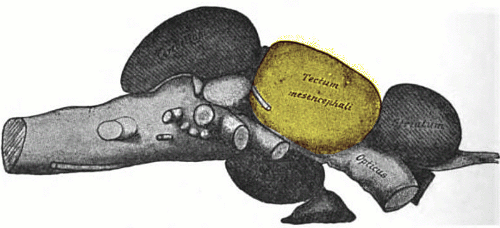
Cod_tectum.pngNew for 2009, mindhacks.com is pleased to announce the development of two lifestyle-enhancing products. These innovations use fundamental features of perception to deliver value to YOU! For pre-ordering details please leave a note in the comments.

Introducing: The Adaptive Stereo

Adaptation is a fundamental feature of perception [see Hack #26, ‘Get Adjusted’, in the book]. Simply viewed it means that your perception adjusts according to what you are experiencing. Adaptation is why you don’t notice the noise of a fan until it turns off, and why everyone shouts at each other when they come out of a club or a loud gig.

Extensive observation by the mindhacks.com team of ethno-psychologists (i.e. me) has led to the theory that adaptation is also behind such perplexing phenomenon as bars where the music is too loud for anyone to talk and people on the bus listening to their headphones so loud that you can hear every note of their music too. Turning the volume up is nice, but once you’ve turned it up you get used to the new level (because of adaptation) and so shortly turn it up again, and so on.

Now the Adaptive Stereo is here to solve this growing problem of noise pollution and associated hearing damage. Psychologists have known for a long time that if you change the magnitude of a stimulus by small amounts it isn’t detectable. The size of the smallest change which you can’t get away with is known in the business as the just noticeable difference (a victory for plain-speak if there ever was one). The Adaptive Stereo takes advantage of this fact, alongside precise calibration according to the human auditory capacity, to continually reduce the volume it plays at, but at a rate below the just noticeable difference. Auditory adaptation ensures that people will adjust to the new volume level, within a reasonable range, so they will be able to hear the music just as well, but simultaneously a) saving their hearing from permanent damage and b) allowing you to continuously turn up the volume on your favourite songs without the music getting any louder on average!

Introducing: The Collicularly-Tuned Bike Light

This innovation solves the urban-cyclist’s annoyance of not being noticed by cars and subsequently being run-over. Although it is easy to think that the purpose of our eyes is to supply information to our conscious, deliberately directed, vision, there is another component of seeing which is unconscious, subcortical and absolutely critical if you are going to notice things on the edge of your vision. A sentinel system, controlled by a subcortical region called the superior colliculus, is responsible for noticing movements and changes in the periphery of your vision and attracting your conscious, cortical, visual attention towards them [See Hack #32 ‘Explore your defense hardware’]. It is this system that lets you find your friends in the theatre when they wave at you. Although your conscious visual system can’t pick them out, when they move their hands rapidly your subcortical sentinel systems alerts your conscious visual system so that you reorientate in their direction and can come to recognise them. Now the colliculus which commands this sentinel is very insensitive to most things – fine detail and colour for example – but it specialises in movement and changes in light levels. And this is why flashing lights are a good idea if you are riding a bike and want to get noticed by drivers who might be focusing their conscious attention on other things (cars, arguing with their passengers, smoking, shaving, etc). The Collicularly-Tuned Bike Light takes advantage of decades of precision sensory neuroscience to flash at the rate which the colliculus is most sensitive too. Drivers will find their attention irresistibly drawn to you as you appear in their peripheral vision (mindhacks.com cannot guarantee that they will then try and avoid you when they notice you). For only an extra ¬£25 an Amygdala-activating extension is available which uses the latest in silhouette technology to project the image of an angry male face directly into the subcortex of unsuspecting drivers.

Blue Monday bullshit competition

Two weeks today will be the annual ‘Blue Monday‘ bullshit festival, where Cliff Arnall and his “formula” are wheeled out in an attempt to make us believe that it tells us about the most depressing day of the year. However, Mind Hacks is running a competition that may prove a useful antedote and you can enter.

To be fair, the day is usually quite depressing, but only because we have to put up with the usual rubbish masquerading as science in the media.

The whole idea is still being pushed by a PR agency, but rather disappointingly, the respected UK charity the Mental Health Foundation have seemingly shelled out hard cash for [see update below] the dubious pleasure of using the opportunity to try and promote mental well-being.

Promoting mental health is, of course, a fantastic idea, but using utter gibberish and pseudoscience to do so is like trying to promote a healthy diet by telling people that apples are particularly bad for us on certain days.

So, to help cheer us all up we want you to come up with a formula that describes what total bullshit these formulas are.

Be creative. As with the original formula, don’t feel you have to be chained by the laws of maths, or even logic.

The most creative entry will win a prize. Sent to you where ever you are in the world.

Be careful not to say nasty things about Mr Arnall himself, rumour has it has he a tendency to threaten legal action against people who say things that could be interpreted as casting aspersions on him directly, although it would be perfectly acceptable to point out that his formula is utter nonsense.

You can either include your entry as a comment to this post, post them to your own blog and send us a link, or email me directly via this web form.

Not only will you be helping the public understanding of science through sarcasm, you could win a prize and get featured on Mind Hacks.

We will print the best entries a few days before the date itself.

The game is afoot!

UPDATE Green Communications commented on a later entry to say that the Mental Health Foundation has not paid for this publicity campaign and that it is being completed on a non-commercial basis.

Acquiring a natural edge

Photo by stock.xchng user tucci. Click for sourceThe Boston Globe has an interesting article on how we interact with urban environments and discusses research suggesting that contact with nature has significant cognitive benefits.

It’s a fascinating article that touches on studies that have found a range of benefits for having contact with a natural environment:

Studies have demonstrated, for instance, that hospital patients recover more quickly when they can see trees from their windows, and that women living in public housing are better able to focus when their apartment overlooks a grassy courtyard…

City life can also lead to loss of emotional control. Kuo and her colleagues found less domestic violence in the apartments with views of greenery. These data build on earlier work that demonstrated how aspects of the urban environment, such as crowding and unpredictable noise, can also lead to increased levels of aggression.

It does, however, contain one misreading that suggests that urban environments blunt our mental sharpness, based on a recent study led by psychologist Marc Berman.

The study actually found that a walk in an urban environment had no significant effect on our mental abilities, although a walk in a natural environment improved them.

Each of these changes was measured relative to an initial assessment conducted indoors and the same pattern emerged when participants just viewed pictures or natural or urban environments.

As far as I know, there is no evidence that urban environments have a negative impact on our cognitive abilities. Comment or get in touch if you know otherwise.

However, we do know that living in an urban environment is one of the most reliable and important environmental risk factors for the development of schizophrenia.

It’s not clear exactly what it is about urban living that raises the risk, although there’s a good commentary by psychiatrist Jim van Os that discusses some of the current explanations.

Link to Boston Globe article on urban impact.
Link to study on the cognitive benefits of interacting with nature.
Link to DOI entry for same.

Mind Bites

Mind Bites is a beautiful photography project by artist Will Lion which combines striking images with quotes from cognitive science research.

You can either view it as a Flickr photo set or as an interactive Flash gallery.

The image on the left is one of the more abstract pictures, but the full range contains everything from portraits, to landscapes, to still life photos – with the research quotes taken from studies on memory to hormonal influence on the earnings of lap dancers.

I can’t help thinking these would make great pictures to have in a psychology department which are usually adorned with faded conference posters and dull oil paintings.

The full set of Will Lion’s ‘Mind Bites’ project is both visually engaging and thought-provoking which is the essence of much great art.

Link to images as Flickr photo set.
Link to Mind Bites as interactive Flash gallery.

Meditation and the neuroscience of inner peace

Picture by alicepopkorn: Click for sourceSharpBrains has an interesting interview with neuroscientist Andrew Newberg who discusses his ongoing research into the brain science of meditation.

As we reported last year, research into meditation is really gathering pace and is suggesting that the practice has some immediate and remarkable benefits for our cognitive abilities that are clearly reflected in changes in brain function.

Most of the lab work has focused on how meditation enhances attention while most of the clinical research work on meditation has focused on its ability to prevent relapse in severe depression.

However, Newberg mentions some ongoing work where they’re attempting to apply some of the lab work to boosting cognitive function in people who presumably have dementia or age-related cognitive difficulties:

Scientists are researching, for example, what elements of meditation may help manage stress and improve memory. How breathing and meditation techniques can contribute to health and wellness. For example, my lab is now conducting a study where 15 older adults with memory problems are practicing Kirtan Kriya meditation during 8 weeks, and we have found very promising preliminary outcomes in terms of the impact on brain function. This work is being funded by the Alzheimer’s Research and Prevention Foundation, but we have submitted a grant request to the National Institute of Health as well.

Also, I just that Time magazine had a special issue on the practice and science of meditation in 2003 which is fully available online, including a funky, if not slightly over-simplified, guide to the neuroanatomy of meditation.

Link to SharpBrains interview with Andrew Newberg.
Link to previous Mind Hacks piece on neuroscience of meditation.
Link to 2003 Time special issue of meditation.

More on secrecy behind the new book of human troubles

Advances in the History of Psychology has just alerted me to a new programme on NPR Radio about the debates over the ‘in revision’ version of the American Psychiatric Association’s diagnostic manual that defines mental illness for significant parts of the world.

It covers some of the most contentious potential diagnoses in the to-be-released DSM V and doesn’t have the most balanced discussion in some cases (e.g. the guy claiming that people against the diagnoses of gender identity disorder – transexualism – just ‘see the stigma’ of the condition).

Most interestingly though, it quotes part of the non-disclosure agreement that members of the DSM committee have had to sign, making a legally binding restriction against discussing:

All work product unpublished manuscripts and draft and other prepublication materials, group discussions, internal correspondence, information about the development process and any other written or unwritten information, in any form, that emanates from, or relates to, my work with the APA task force or work group.

Yes, there is a legal restriction banning members from discussing the development of one of the most important documents in medicine.

The DSM committee vice-chair Darrel Regier says this is a good thing because otherwise “it would just be cacophony and mass confusion” – presumably referring to the annoying tendency of public debate to raise points that you hadn’t thought of before.

Diagnoses decided by an unelected committee in secret sessions that are legally prevented from discussing their work. Science marches on.

Link to NPR Radio on DSM-V development (via AHP).

Sex, orgasm and childbirth: a discomforting mix

Photo by Flickr user Photo Mojo. Click for sourcePetra Boyton has a fantastic piece on the experience of orgasm during birth – the focus of an upcoming documentary and a subject likely to cause discomfort in some.

Petra discusses the relationship between sexual stimulation and labour noting that sexual pleasure has been reported during childbirth in the medical literature.

This is from a 1987 review article on sexuality and childbirth:

Newton (1971 , 1973) argued that women’s three reproductive acts: coitus, parturition, and lactation are psychophysiologically interrelated and trigger caretaking behavior, a necessity for species survival. Features that are evident in both coitus (sexual arousal and orgasm) and in undisturbed childbirth include changes in respiration (hyperpnea and tachypnea), vocalization, strained facial expression, rhythmic uterine contractions, loosening of the cervical mucous plug, frequent supine position with thighs adducted, a tendency to become uninhibited, exceptional muscular strength, an altered state of consciousness with rapid return to alert awareness after orgasm or birth, and a profound feeling of joy or ecstasy following orgasm or delivery. In addition, clitoral engorgement usually associated with sexual arousal has been described in labor in a number of parturients, beginning at 8-9cm cervical dilation (clitoral engorgement has also been described on occasion during stressful situations, without sexual stimulation) (Rossi, 1973). Intense orgasmic sensations have also been described during the second stage of labor (Masters and Johnson, 1966; Sarlin, 1963).

However, there is also evidence that sexual stimulation during labour has been shown to help delivery and ease labour-related pain – such as research on the benefits of breast stimulation during birthing.

However, Petra’s write-up makes clear that systematic research is still lacking, so we’re still not sure about how many women experience orgasm during birth, or how effective all types of active sexual stimulation might be to assist birth.

However, this topic is contentious owing to the psychological discomfort it causes. Perhaps the clash between the stereotypes that birth is innocent and pure while sex is dirty and salacious mean that some people will just find the whole subject too much to handle.

There are many of these areas in medicine. For example, sexual relationships between people with learning disabilities.

The thought of two people with Down syndrome having sex causes great discomfort in many people, despite the fact that it is perfectly possible for some people with Down’s understand and consent to the situation.

If we assume that all people who are able to consent and have found a willing consenting partner should be able to freely participate in a sexual relationship, perhaps it would be useful to develop a test to help evaluate people with learning abilities to make sure they are both able to understand and consenting.

These sorts of tests are common for testing the capacity for other sorts of decisions – such as financial responsibility, or decisions to refuse medical care – but discomfort factor tends to mean that these areas are under-researched.

With reference to the upcoming documentary, the website for the film has quite a curious tone, and I have to say, is slightly sensational.

Buy the DVD or CD!

Share Orgasmic Birth with your friends and family this holiday season with our special 5 pack of DVD’s and CD soundtrack and SAVE. Subtitled in French, Spanish, German, and Portuguese.

I can’t say a 5 pack of the Orgasmic Birth (and soundtrack!) would the first thing that comes to mind when buying Christmas presents, but there you go.

Link to Dr Petra on ‘Is there such a thing as an ‚Äòorgasmic birth‚Äô?’