An unplanned post-mortem

My latest Beyond Boundaries column for The Psychologist explores the space between he we study suicide and the experience of families affected by it:

Suicide is often considered a silencing, but for many it is only the beginning of the conversation. A common approach to understand those who have ended their own lives is the ‘psychological autopsy’ – a method that seeks to reconstruct the mental state of the deceased individual shortly before the final act. The testimony of friends and family is filtered through standardised assessments and psychiatric diagnoses. The narrative is ‘stripped down’ to the essential facts. A life is reduced to risk factors.

Psychologists Christabel Owens and Helen Lambert were struck by the contrast between the goal of the professionals in the interviews and how the friends and family of the deceased used the opportunity to tell their story and to make sense of their loss. ‘The flow of narrative’, they note in their recent study, ‘can often be unstoppable’. The researchers returned to the transcripts of a 2003 psychological autopsy study, but instead of using the interview to construct variables, they looked at how the friends and families portrayed their lost companion.

As suicide is both stigmatised and stigmatising the personal accounts often contained portrayals of events that presupposed possible moral conclusions about the deceased. For example, by tradition, those who have cancer are discussed as heroic fighters, facing down death with courage and resolution. The default stories about people who commit suicide are not nearly so generous, however, and to navigate this treacherous moral territory bereaved friends and family often called on other, more acceptable, social stereotypes to make sense of the situation.

The suicides of women were largely portrayed in medical terms, as being so weakened by negative experiences that they were unable to prevent a decline into mental illness. The suicides of men, on the other hand, were barely ever described in terms of mental disorder. Male suicide was typically described either as the end result of having ‘gone of the rails’, a self-directed descent into antisocial behaviour, or as a ‘heroic’ action, demonstrating a final defiant act against an unjust world.

Deaths were filtered through gender stereotypes of agency and accountability, perhaps to make them more acceptable to an unkind world. Owens and Lambert’s study highlights the stark contrast between how researchers and family members interpret the same tragic events. As professionals, we often do surprisingly little to mesh together the bounded worlds of science and subjectivity, but the study demonstrates the power of the personal narrative. It affects us even after death.

Thanks to Jon Sutton, editor of The Psychologist who has kindly agreed for me to publish my column on Mind Hacks as long as I include the following text:

“The Psychologist is sent free to all members of the British Psychological Society (you can join here), or you can subscribe as a non-member by going here.
 

Link to original behind pay wall.

The bathroom of the mind

The latest issue of The Psychologist has hit the shelves and it has a freely available and suprisingly thought-provoking article about bathroom psychology.

If you’re thinking it’s an excuse for cheap jokes you’d be mistaken as takes a genuine and inquisitive look at why so little psychology, Freud excepted, has been concerned with one of our most important bodily functions.

This part, on the history of theories regarding graffiti found in toilets, is as curious is it is bizarre.

Toilet graffiti, dubbed ‘latrinalia’ by one scholar, has drawn attention from many researchers and theorists over the years. Many of them have focused on gender, using public lavatories as laboratories for studying sex differences in the content and form of these scribblings. Alfred Kinsey was one of the first researchers to enter the field, surveying the walls of more than 300 public toilets in the early 1950s and finding more erotic content in men’s and more romantic content in women’s. Later research has found that men’s graffiti also tend to be more scatological, insulting, prejudiced, and image-based, and less likely to offer advice or otherwise respond to previous remarks.

Theorists have struggled to explain differences such as these. True to his time, Kinsey ascribed them to women’s supposedly greater regard for social conventions and lesser sexual responsiveness. Psychoanalytic writers proposed that graffiti writing was a form of ‘phallic expression’ or that men pursued it out of an unconscious envy of women’s capacity for childbirth. Semioticians argued that men’s toilet graffiti signify and express political dominance, whereas women’s respond to their subordination. Social identity theorists proposed that gender differences in latrinalia reflect the salience of gender in segregated public bathrooms: rather than merely revealing their real, underlying differences, women and men polarise their behaviour in these gender-marked settings so as to exaggerate their femaleness or maleness.

The article looks at many other curious episodes in the bashful psychology of the bathroom.
 

Link to The Psychologit on ‘toilet psychology’

What is the DSM supposed to do?

I’ve written an article for the Discover Magazine’s blog The Crux on what the DSM diagnostic manual is supposed to do.

This is quite an interesting question when you think about it. In other words, it asks – how do we define mental illness – both in theory and in practice?

The article tackles how you decide what a mental illness is in the first place and then how you go about classifying mental states that, by definition, can only be experienced by one person. It turns out, classifying mental illness is a lot like classifying literature.

It also discusses the old and possibly futile quest for ‘biological tests for mental illness’ as if there is a perfect mapping between how we classify mental states and how the brain actually works at the neurobiological level.

So if you want to know the thinking and, indeed, problems behind one of the central and often unquestioned assumptions of psychiatry, this should be a good place to start.
 

Link to ‘What Is the “Bible of Psychiatry” Supposed to Do?’

Sigman and the skewed screen of death

The media is buzzing this morning with the shocking news that children spend ‘more than six hours in front of screens’. The news is shocking, however, because it’s wrong.

The sound bite stems from an upcoming talk on ‘Alcohol and electronic media: units of consumption’ by evidence-ambivalent psychologist Aric Sigman who is doing a guest lecture at a special interest group meeting at the Royal College of Paediatrics and Child Health annual conference.

Sigman has a track record of being economical with evidence for the purpose of promoting his ‘traditional family values’ and this is another classic example.

The ‘six hour a day in front of the screen’ figure comes from a commercial research organisation called Childwise. It was the headline finding that made all the papers, which is quite convenient if you’re selling the report for £1800 a copy.

But why would you rely on a commercial report when you have so many non-commercial scientific studies to choose from?

A 2006 meta-analysis looked at 90, yes 90, studies on media use in young people from Europe and North America and here’s what it found.

Youth watch an average of 1.8–2.8h TV a day. This has not changed for 50 years. Boys and girls spend approx 60 and 23 min day on computer games. Computers account for an additional 30 min day. TV viewing tends to decrease during adolescence.

Now, that’s not to say that there aren’t risks to children if they spend large amounts of their time sat on their arse. Time spent watching television has genuinely been linked to poor health. However, it’s better to inform people of the details rather than the panic inducing headlines.

For example, talking about ‘screen time’ is probably not helpful. For example, TV viewing seems increase the risk of obesity more than video games.

It’s also worth noting that researchers are now making a distinction between ‘passive screen time’ (i.e. being sat on your arse) and ‘active screen time’ (i.e. body movement-based video games) with the latter being found to be a likely intervention for obesity.

The devil is in the details, rather than behind the screen.

Uploaded to the Life network

A fantastic short film about what you might see when your mind is uploaded to an online storage cloud in 2052. It’s subtitled “the Singularity, ruined by lawyers”.

The piece is by futurist Tom Scott who obviously sees the consciousness uploading business far more pessimistically than me.

Personally, I’m going to get uploaded to a linux server. It’s be completely free but won’t support all my mental states.

Yes, I’ll be doing software jokes in the afterlife. No, you won’t have to humour me.
 

Link to fantastic video ‘Welcome to Life’ (via @SebastianSeung)

A history of human sacrifice

A video on the history of human sacrifice is available from Science magazine as part of their special issue on human conflict.

Sadly, all the articles are locked behind a paywall but the video is free to view and has science writer Ann Gibbons discussing how the practice evolved through the ages and how archaeologists have been uncovering the evidence.

If you can’t stump up the cash for what looks like a genuinely fascinating issue there’s more discussion from the latest edition on the podcast where the science of racism and prejudice is explored.
 

Link to locked special issue.
Link to video.
Link to podcast

She’s lost control

An article in Slate claims to have detectected a ‘logic hole’ in how much sympathy we feel for people with mental illness as both psychopathy and autism are ‘biological disorders’ that people ‘can’t help’ but we feel quite differently about people affected by them.

The ‘logic hole’, however, doesn’t exist because it is based on misunderstanding of the role of neuroscience in understanding behaviour and a caricature of what it means to have ‘no control’ over a condition.

Here’s what the article claims:

In the piece [recently published in The New York Times], Kahn compares psychopathy to autism, not because the two disorders are similar in their manifestation, but because psychologists believe they’re both neurological disorders, i.e. based in the brain and really something that the sufferer can’t help.

This caused me to note on Twitter that even though the conditions are similar in this way, autism garners sympathy and psychopathy doesn’t. In fact, most social discourse around psychopathy is still demonizing and utterly unsympathetic to the parents, who are often blamed for the condition. It struck me as an interesting logic hole in our cultural narrative around mental illness, since the usual assumption is that sympathy for mental illness is directly correlated with inability to control your problems.

Clearly the author has good intentions and aims to reduce the stigma associated with mental illness but in terms of behavioural problems, everything is a ‘biological disorder’ because all your behaviour originates in the brain.

The idea that because a disorder is ‘based in the brain’ it therefore follows that ‘really something that the sufferer can’t help’ is a complete fallacy.

Psychopathy, autism, depression, over-eating, persistently losing your keys and constantly getting annoyed at X Factor are all ‘based in the brain’ and this fact has nothing to do with how much control you have over the behaviour.

Putting this misunderstanding aside, however, there is also the unhelpful implication that someone ‘has’ or ‘has not’ control over their thoughts, behaviour, emotions and propensities, especially if they have a psychiatric diagnosis.

Conscious control varies between individuals, is affected by genetics, is amenable to change and training, and depends on the specific task, situation or action.

This does not mean that everyone with autism, psychopathy or any other diagnosis can just decide not to react in a certain way, but it would be equally stigmatising and simply wrong to assume that current difficulties are forever ‘fixed’.

The article finishes “I was just interested in the fact that there’s no relationship between how much we care about those with a mental disorder and how much those with it can help having it.”

In reality, sympathy for people with disorders is a complex phenomenon and the perception of ‘how much control the person has’ over the condition is only one of the factors. The (often equally bogus) moral associations also play a part as does the seriousness of the condition and the medical speciality that treats it.

Nevertheless, we need to get away from the idea that ‘biology means poor control’ because it is both a fallacy, and, ironically, known to be particularly stigmatising in itself.
 

Link to somewhat confused Slate article (via @ejwillingham)

A look inside digital humanity

BBC Radio 4 has just started an excellent series called The Digital Human that looks at how we use technology and how it affects our relationship to the social world.

It’s written and presented by psychologist Aleks Krotoski and the first two episodes are already online.

The first discusses the tendency to capture and display personal media through sites like Flickr and YouTube but, so far, the stand-out episode has been the second which discusses the presentation of self online and how much control we have over it.

I think it’s going to be a six-part series so there should be plenty more great stuff on the way.
 

Link to podcasts of Digital Human series.

Sex survey a let down in bed

A ‘saucy sex survey’ has been doing the rounds in the media that claims to be one of the largest studies on the sex lives of UK citizens. Unfortunately, it seems to be a bit of a let down in bed.

The study has been carried out by an unholy alliance between one of the country’s most respected relationship counselling charities, Relate, and the Ann Summers chain of sex shops but, sadly, it seems the commercial fluff has won out over the genuine insight.

I’m a big fan of Relate. They provide sex and relationship counselling regardless of status, sexuality or income and do an important and often thankless task.

In fact, my mum was a counsellor for them, years ago, when they were still called ‘Marriage Guidance’, and it was one of the things that got me interested in psychology.

The charity also runs a training and research institute for psychologists, psychotherapists and the like, and have built up a reputation for an evidence-based, down-to-earth approach.

Which makes it all the more surprising that they’d get involved with a survey that is clearly designed as a marketing gimmick rather than genuinely useful research.

How do I know it was a marketing gimmick? Because it was discussed in Marketing Week magazine as an example of Ann Summer’s ongoing ‘brand overhaul’ aimed at appealing to ‘a more mature audience’.

“Both parties”, says the article, “hope to make the dual branded survey an annual census”. Lovely.

Now, I’m not necessarily against commercial-academic double teaming, if you’ll excuse the turn of phrase, but you’d better produce something of quality if you want to keep your head held high.

But in this case, the whole thing looks dodgy. The full report, available online as a pdf, is just a bunch of good typesetting, poor graphics and lists of percentages.

What’s more worrying is that Relate won’t release their questions or how they went about asking them. Sex ninja Dr Petra Boynton [not quite her official title] has been trying to get hold of them, in part, because the way questions about a sensitive subject like sex are asked can greatly affect the answers you get.

And of course, which questions you ask is also key. A critical article in today’s Guardian raises some uncomfortable issues about the survey noting that “It sets up a model of the normal libido as frisky and adventurous, looking to try threesomes, bondage and toys – and those things are normal, but so too is not wanting to try them”.

Except, of course, if you’re a massive retailer with an interest in selling people ‘frisky and adventurous’ accessories.
 

Link to article ‘Ann Summers and Relate ought to be unlikely bedfellows’

Testing the foundations of teen tech panics

ABC Radio National’s technology and society programme Future Tense has a good discussion of how much evidence supports popular fears about young people and technology.

It’s got some great comments from the always insightful Danah Boyd about how restrictions on the physical freedom of young people through fears about safety have led to increasing socialisation online.

Interestingly, the inflated fears that stop children from playing in the street have also been projected online, way beyond the actual dangers.

The programme also tackles the myth that ‘digital natives’ grow up with some sort of intimate knowledge of techology when, in reality, their knowledge varies wildly leaving a clear need for education and support.
 

Link to ‘Young people and technology: fear and wellbeing’

In solitary

The new edition of the APA Monitor magazine has an article that discusses the psychological impact of solitary confinement in light of its growing use in American prisons.

One of the most interesting points is that evidence for the effect on solitary confinement on prisoners is actually quite limited due to difficulties studying incarcerated people.

Prisoners in administrative segregation are placed into isolation units for months or years. Corrections officials first turned to this strategy in response to growing gang violence inside prisons, Dvoskin says. Though critics contend that administrative segregation has never been proven to make prisons safer, use of this type of confinement has continued to rise. That’s worrisome to most psychologists who study the issue. Deprived of normal human interaction, many segregated prisoners reportedly suffer from mental health problems including anxiety, panic, insomnia, paranoia, aggression and depression, Haney says (Crime and Delinquency, 2003)…

However, much of the evidence of harm comes from cross-sectional studies or research done on people who are not in prison, such as the isolated elderly. Designing a long-term study to follow prisoners in solitary confinement is challenging. Each correctional system is unique, inmates move in and out of segregation, and many states prohibit or limit psychological studies of incarcerated individuals due to ethical concerns.

Most of our evidence, it turns out, comes from other people deprived of human contact, although the effects have been found to almost universally unpleasant until now.
 

Link to article ‘Alone, in the hole’ (via @ResearchDigest)

The rise and fall of Dark Warrior epilepsy

Of all the names for a neurological disorder in the history of medicine, the most awesome has got to be ‘Dark Warrior epilepsy’.

The condition was reported in a 1982 edition of the British Medical Journal and was so named because the patient had seizures – but only while playing the Dark Warrior video game.

The game was actually a coin-up arcade machine and, despite the dodgy graphics, it is notable for being one of the first machines with an attempt at simulated speech.

The patient was a 17-year-old girl whose father was a video game engineer. He fixed the arcade machines and so she got to play for free.

Curiously, the case report mentions that she had already mastered Space Invaders, Asteroids, and Lunar Rescue.

Old skool video game freaks will be reading this and quietly thinking to themselves, respect, but the more medically inclined might be scratching their heads wondering why a patient’s video-gaming history has been included in their case report.

I mean, I ruled at Elite, but it’s never been mentioned in my medical notes.

The reason, is that only year before, the first ever case of epilepsy triggered by a video game was reported. It was named ‘Space Invader epilepsy’ because it was triggered by the arcade game Astro Fighter and the neurologist clearly didn’t know the difference between the original arcade classic and one of the cheap knock-offs.

The 17-year-old girl from Bristol, however, wasn’t troubled by Space Invaders, nor a host of other video games. She played them all with no problems at all. It was only Dark Warrior that affected her brain and, in fact, it was only a very specific scene in the game that contained a bright multicoloured flashing sequence.

The doctors treating the girl thought it was worth sending the case to a medical journal because video games were still very new in 1982.

But despite using the name ‘Dark Warrior epilepsy’ for this particular case they came up with another name – almost as awesome – for similar seizure disorders: ‘electronic space war video game epilepsy’

They then wrote what can only be described as one of neuroscience’s great paragraphs:

The term Space Invader epilepsy is, in fact, a misnomer, since no cases have been reported with the Space Invader video game itself. We suggest, therefore, that Astro Fighter and Dark Warrior epilepsy be classified under “electronic space war video game epilepsy” and this as a special category of photoconvulsive epilepsy. Video games other than space war games – for example, Super Bug and Munch Man – appear to be less epileptogenic. Electronic space war video game epilepsy has yet to be reported with Defender, Space Fury, Lunar Rescue, or Asteroids war games.

At the time, there was much media panic about ‘video games causing epilepsy’ but the real story is actually far more interesting.

Neurology nowadays doesn’t talk about specific game titles but it still considers the effect of video games on the likelihood of triggering seizures.

Firstly, let’s make it clear that video games don’t cause epilepsy, but the reason people can have seizures while playing is not because of the video game per se, but because of a type of neurological disorder called reflex epilepsy that can be triggered by idiosyncratic features of the environment.

The most well-known and most common is photosensitive epilepsy where certain types of flashing lights can cause a seizure. About 5 in every 100 people who have epilepsy have this type.

But actually, reflex epilepsy is very diverse. Some people will have seizures triggered by certain smells, or certain patterns, or certain emotions, or certain tunes, or even doing certain sort of problem-solving – like mental calculation.

Some of the early cases of computer-triggered epilepsy were caused by certain flash sequences in games, which are now not included by common consent.

Occasionally video-game linked seizures do still appear though, but largely because the game happens to have a characteristic which coincides with the trigger of someone’s pre-existing reflex epilepsy. Maybe a specific sequence of musical notes, or a certain pattern, or even causing a specific feeling of frustration.

But sadly, neither ‘Dark Warrior epilepsy’ nor ‘electronic space war video game epilepsy’ caught on and the medical literature now largely talks about ‘video game-induced seizures’.
 

Link to 1982 case of Dark Warrior epilepsy.

The delightful science of laughter

Neuroscientist Sophie Scott gave a fantastic talk on the science of laughter for a recent TEDx event that you can now watch online.

Talks on the science of humour are famously humourless (usually made all the more dire by the desperate inclusion of some not very funny ‘funny cartoons’) but this discussion of laughter is appropriately delightful.

Scott describes a study her team carried out on the cross cultural recognition of non-verbal vocal sounds (like whoops of triumph) to find that only laughter was universal.

The whole talk is fully of such fascinating snippets, tackling both the social psychology and neuroscience of laughing. Well worth ten minutes of your time.
 

Link to ace talk on the science of laughter.

A new symbol for epilepsy in Chinese

The Chinese character for epilepsy has been changed to avoid the inaccuracies and stigma associated with the previous label which suggested links to madness and, more unusually, animals.

The new name, which looks like this just makes reference to the brain although the story of how the original name got its meaning is quite fascinating in itself.

The following text is from an article in the medical journal Epilepsia which announced the change:

If you’re wondering where the bit about the ‘bizarre movements of goats’ came I suspect it’s from a type of fainting goat that looks like it has seizures and falls over. You can see them ‘in action’ in this YouTube video.

However, the link is mistaken as the goats do not have seizures. The effect is caused by their muscles locking up, independently of their brain, by a condition called myotonia congenita.
 

Link to ‘Announcement of a new Chinese name for epilepsy’ (via @cmaer)

How Ghostwatch haunted psychiatry

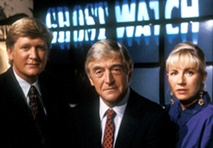
In 1992, the BBC broadcast Ghostwatch, one of the most controversial shows in television history and one that has had a curious and unexpected effect on the course of psychiatry.

The programme was introduced as a live report into a haunted house but in reality, it was fiction. This is now a common plot device, but the broadcast happened in 1992, years before even The Blair Witch Project used the documentary format to tell a fictional story and viewers were used to news-like programmes presenting news-like facts.

But despite some subtle nods to its fictional nature, the fact it was broadcast on Halloween and the ridiculous conclusion (the poltergeist eventually escapes from the house, takes control of the BBC and possesses presenter Michael Parkinson), many people believed the ‘documentary’ was real and that the programme was capturing these astounding events as they happened. You can watch it on YouTube and see how it was introduced.

Consequently, lots of people were genuinely frightened by the programme, including many children who were watching with their families. As a result, the BBC was flooded with calls and letters and were forced to start an investigation into the programme.

As the controversy raged on, an article appeared in the British Medical Journal, written by two doctors from Gulson Hospital in Coventry, reporting post-traumatic stress disorder (PTSD) in two children that was apparently caused by watching Ghostwatch.

Case 1

This boy had been frightened by Ghostwatch and had refused to watch the ending. He subsequently expressed fear of ghosts, witches, and the dark, constantly talking about them and seeking reassurance. He suffered panic attacks, refused to go upstairs alone, and slept with the bedroom light on. He had nightmares and daytime flashbacks and banged his head to remove thoughts of ghosts. He became increasingly clingy and was reluctant to go to school or to allow his mother to go out without him.

Although not without scepticism, several other cases were published as replies to these initial reports producing a small case series of PTSD caused by the TV show.

These minor cases drifted into the history of medicine until people started to debate what event should be considered a sufficiently traumatic event in order to diagnose PTSD.

At the moment, the current DSM-IV-TR diagnosis for PTSD says that “the person experienced, witnessed, or was confronted with an event or events that involved actual or threatened death or serious injury, or a threat to the physical integrity of self or others” and that the person’s response involved “intense fear, helplessness, or horror”.

It’s the “confronted with” part that allows people who have seen distressing things on TV and reacted with “intense fear, helplessness, or horror” to be diagnosed with PTSD.

At the time Ghostwatch was broadcast the criteria required that “the person has experienced an event that is outside the range usual human experience and that would be markedly distressing to almost anyone” which could similarly be interpreted to allow TV programmes to cause the disorder.

The new proposed criteria for the DSM-5 wouldn’t allow television-triggered PTSD. In fact it specifically says that exposure to traumatic events “does not apply to exposure through electronic media, television, movies, or pictures, unless this exposure is work related.”

Ghostwatch has played a part in changing how PTSD will be diagnosed. Although a major motivation was the wave of PTSD diagnoses after watching coverage of 9/11 on TV, the fictional ghost investigation is often cited in the medical literature as an example of how the existing criteria can lead to absurd consequences.

Although the programme is more famous for its effect on the history of media, it remains a minor but significant spectre in psychiatry’s past.
 

Link to GhostWatch entry on Wikipedia.

An antidote to post-natal venom

Today’s Observer has a remarkably vicious article about post-natal depression in fathers that is quite breathtaking in both its ignorance and its venom:

“One notices more talk of postnatal depression in fathers. I use the word “talk” advisedly, scientific proof still being in short supply. Were hormonal levels tested? Was postpartum bruising measured? How about the emergence of a human head in what – in deference to what might be your leisurely Sunday breakfast – I will refer to as the front-bottom area? In fact, was there anything at all to suggest that the subject had, at any point, given birth, thus making sense of adding the term “postnatal” to depression?”

Firstly, journalist Barbara Ellen clearly doesn’t know the difference between postnatal (after a child has been born) and postpartum (after giving birth). It is equally as possible to describe postnatal depression in fathers as it is to describe men, or indeed, women, having a postnatal breakfast.

The statement about “scientific proof still being in short supply” is just odd considering she then goes on to cite a study of 8,431 fathers published in the Lancet on postnatal depresison.

However, this is by no means the only study, as there are plenty more where that came from.

Ellen is also convinced that postnatal depression is “directly related to the physical act of pregnancy and childbirth”.

It is surely the case that the act of being pregnant and giving birth does increase the risk of postpartum depression owing to hormonal changes, but we also know, for example, that disruption to sleep patterns is also a risk factor – something that could equally affect both partners.

This part, though, is just amazingly and needlessly cruel:

I would have been more concerned that the mothers in question were having to put up with such exhausting narcissists as partners – men incapable of hiding their sulky self-absorption, even while being watched by researchers for a period of, wait for it, three minutes. Even serial killer Ted Bundy managed to look “normal” for longer than that.

Sadly, that’s not the only insult thrown in to the mix and just to top it off, the piece finishes on a logical fallacy / insult combo – enter the false dichotomy applied to human suffering:

It was a long, hard road for womankind, getting postnatal depression recognised as a condition, and also to receive medical attention or even routine sympathy. It seems to me that saying men can also get it is just cheapening this achievement.

Mental health is important for all and we don’t cheapen anyone else’s suffering by recognising the pain of others.
 

Link to nasty opinion piece (via @mjrobbins)