Psychosis keeps up with the times

Delusions in conditions like schizophrenia and bipolar disorder have tracked social concerns over the 20th century, according to a wonderful study just published in the International Journal of Social Psychiatry.

Psychologists Brooke Cannon and Lorraine Kramer reviewed the patient records of a state psychiatric hospital in the US looking at each decade of the 20th Century in turn.

They recorded the content of the delusions for every patient with psychosis and while they didn’t find that the level of delusions changed, they did find that they tended to relate to the social concerns of the time.

…more patients after 1950 believe they are being spied upon is consistent with the development of related technology and the advent of the Cold War.

Delusional content tended to reflect the culture at the time, with focus on syphilis in the early 1900s, on Germans during World War II, on Communists during the Cold War, and on technology in recent years.

Indeed, delusions now are being reported relating to computers, the internet and computer games.

An earlier study that looked at hospital records from Slovenia found a similar pattern – with madness also reflecting developing social themes.

The researchers of this study noted that “After the spread of radio in the 1920s and television in the 1950s in Slovenia, there was an obvious increase in delusions of outside influence and control as well as delusions with technical themes.”
 

Link to PubMed entry for study on delusions in 20th Century US.
Link to PubMed entry for study on delusion in in 20th Century Slovenia.

Sonar Voices

Graham March was a drum n’ bass producer who created cutting edge tracks in a teched-up fast-paced version of breakbeat known as neurofunk. He was diagnosed with schizophrenia and sadly took his own life in 2006, but a friend has created a wonderful tribute site that has all of his tunes online.

Often releasing tracks under the moniker Desimal, March was featured on numerous underground labels, but the website has all of his tunes online and freely downloadable, and there is some classic material there.

If you’re not into drum n’ bass you may find it difficult to get a handle on his work, but I was struck by this description of March’s experience of schizophrenia:

I always tried to get Graham to explain to me what it was like inside his head. This is what he told me: “It’s like, 200 hundred channels of Television all on at once and you can’t turn them off, nothing but unwanted noise and thoughts.”

It struck me because March’s sound is like the noise of 200 hundred channel of television focused and filtered into a rich layered stream of precision dance music.

Some of it is pretty dark, as much of the neurofunk genre is, but if you want a track with a more uplifting feel, I have been listening to ‘Neo Indignation’ (mp3) non-stop all morning.
 

Link to Graham March Tribute Site (thanks Ben!)
Link to mp3 downloads of all his tracks.

Regrets, I’ve had a few (but not too few to mention)

The ‘Regrets of the Typical American’ have been analysed in a new study that not only looks at what US citizens regret most, but provides some clues for those wanting to know whether it is better to regret something you haven’t done, or regret something you have.

The research has just been published in the journal Social Psychological and Personality Science and was carried out by psychologists Mike Morrison and Neal Roese who used random dialling to call people and survey them about a troubling regret.

As blues singers have suggested for years, love tops the list (click for larger version):

Previous studies on regret have talked to college students who are probably not ideal for this sort of research as they tend to be quite young and, quite frankly, really haven’t fucked up enough to give a good idea of what the average person laments about their life.

This was the first study to survey a representative sample of all ages, incomes and education levels and although love topped the list, there were some interesting differences in the details.

Women, who tend to value social relationships more than men, have more regrets of love (romance, family) compared to men. Conversely, men were more likely to have work-related (career, education) regrets. Those who lack either higher education or a romantic relationship hold the most regrets in precisely these areas.

Americans with high levels of education had the most career-related regrets. Apparently, the more education obtained, the more acute may be the sensitivity to aspiration and fulfillment. Moreover, the youngest and least-educated people in our sample, who most likely possess the greatest capability of fixing their regrets, were indeed the most likely to provide fixable regrets.

The study also found that regrets about things you haven’t done were equally as common as regrets about things you have, no matter how old the person.

The difference between the two is often a psychological one, because we can frame the same regret either way – as regret about an action: ‘If only I had not dropped out of school’; or as a regret about an inaction: ‘If only I had stayed in school’.

Despite the fact that they are practically equivalent, regrets framed as laments about actions were more common and more intense than regrets about inactions, although inaction regrets tended to be longer lasting.

So the question of whether it is better to regret something you haven’t done than regret something you have, might actually be answerable for some people, but we still don’t know how much choice we have over adopting the different views of regrets or whether this is largely determined by the situation.
 

Link to summary of study ‘Regrets of the Typical American’.
Link to write-up on PhysOrg.

Court in the cross-fire

There are not enough quality forensic psychology blogs in the world, which I suspect is not a thought that passes through the mind of anyone except Mind Hacks readers.

However, if you’re after a punchy fast paced look at the world of criminal and legal psychology you’d do far worse than checking out the website of psyDoctor8.

It dips into everything from the neuroscience of murder to the science of false confessions with an eye on both the media and the academic literature.

And if you do Twitter @PsyDoctor8 is also a great source of links in the same vein.

It makes a wonderful complement to the more in-depth In the News blog, which has consistently been one of the best forensic psychology sources on the net.

And that’s about it. Criminal really.

Yes your honour, I’ll stop with the puns.
 

Link to psyDoctor8 blog.
Link to In the News blog.

The myths of ‘post-disaster counselling’

After almost any large scale disaster, you’ll hear reports that rescue workers, supplies and counsellors are being sent to the area – as if mental health professionals were as vital as food and shelter.

Time has an excellent interview with psychologist Scott Lilienfeld on how our ideas about ‘post-disaster counselling’ are rapidly moving away from the ‘everyone needs to talk’ cliché due to a better understanding of mental health and resilience in the face of tragedy.

Although everyone might be shaken up after a disaster, the vast majority – between about 70% and 80% – will not have mental health problems and will not need the help of psychologists or psychiatrists.

It was initially thought that legions of counsellors were needed to work with everyone affected by the devastation to give sessions of ‘critical incident stress debriefings’ – where people are asked to describe everything that happened to them and vent their emotions – supposedly to help prevent problems developing in the long term.

Instead, studies suggested that this was at best useless and instead probably made mental disorders more likely – probably because it raises or extends the level of stress in already very stressed people.

Perhaps unsurprisingly, most disaster victims are not that interested in exploring their emotions but want to get to a safe place, find out how there friends and family are, and solve immediate practical problems. This in itself tends to make people feel better.

Consequently, new strategies involve only working with people who specifically ask for help and – instead of getting people to ‘vent’ – the focus is on reducing emotional arousal, assuring physical safety and putting people in contact with loved ones.

This strategy is often known as psychological first aid and was specifically designed to avoid the debriefing approach.

Time interviewee Lilienfeld has been key in challenging the idea that ‘everyone needs counselling’ after tragic events and has been a leader in making our disaster response a lot more effective. Highly recommended.
 

Link to Time interview on post-disaster counselling.

Unweaving the weavers

The Guardian has an excellent ongoing series called ‘Untangling the Web’ that examines the social psychology of the internet and how it affects our lives.

Written by social psychologist Aleks Krotoski it’s looked at everything from what effect the internet has had on out sex lives to how it has affected hate campaigns.

Rarely predicable and always informative the series is well worth keeping an eye on, with the latest column on disability being particularly good.
 

Link to ‘Untangling the Web’.

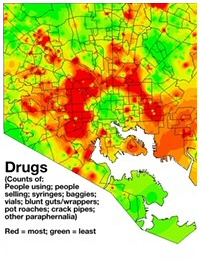
A mental map of city street drugs

Urbanite has a fascinating article on researchers who are attempting to map drug users’ minds onto the city streets.

They are giving addicts GPS-enabled PDAs that ask the participants to rate their psychological state as they move around Baltimore.

By using pre-existing maps of the city that chart things like neighbourhood poverty and local drug availability it’s possible to see how the mental state of users changes as they move through the different physical and social environments of the city.

To make the patterns of movement meaningful, the researchers have to understand the various city “environments” that the drug users move through. This job fell to Craig, the biostatistician and a Baltimore native. To create maps of the urban landscape, Craig started with Census indices, which include race, income, and other socioeconomic metrics. To those he added a system developed by Dr. Debra Furr-Holden at the Johns Hopkins School of Public Health, who sent teams out to score city blocks based on physical characteristics (broken windows, shell casings, street memorials for recent killings) and on people’s behavior (clearly intoxicated adults, unsupervised children, and so on). “Her data are like nothing else I’ve ever seen,” says Epstein.

On these maps, Craig plots the paths of drug users as they move through the city, weaving in the information they’ve plugged into their PDAs. The result is a detailed rendering of how addiction is lived in space and time, opening a new window on the experience of tens of thousands of city residents. “Their work is novel,” says Yale University’s Rajita Sinha, professor of psychiatry and child study and director of the Yale Stress Center. This research “allows us to understand the social context in which drug use takes place and to evaluate that context,” says Sinha, who is internationally known for her pioneering research on the mechanisms linking stress to addiction.

The technique is called ‘ecological momentary assessment’ – although it is similar to a closely related method called ‘experience sampling’ that also involves giving participants an electronic device that requires they record their mental state at various points in their daily life.

These techniques have been around since the early 90s but the new aspect is the incorporation of GPS to map these responses into physical space.

One of the pioneers of this technique has been, not a scientist, but the artist Christian Nold, who has been making emotion maps of cities for many years to beautiful effect.

The Urbanite article covers how a team from the US National Institute on Drug Abuse are attempting perhaps the most ambitious and data-rich version of this approach to date which truly attempts to blend both inner and outer worlds.
 

Link to article ‘On the Trail of Addiction’.

Capturing waves of electricity

BBC Radio 4’s Case Notes has an excellent edition on epilepsy that covers everything from the changes in consciousness during seizures to the use of brain surgery to treat the condition.

It’s a pretty straightforward discussion but you’ll likely not find a better introduction to the neurological disorder, what it does and how it’s treated. Just well explained, no nonsense and comprehensive.

Great stuff.
 

Link to epilepsy edition page with streamed audio.
mp3 of podcast.

Infested by the Wizard of Oz

Jay Traver had begun to notice an uncomfortable crawling sensation under her skin. Scalp spots had bothered her for years but despite her best efforts – she was, after all, a renowned professor of zoology – she couldn’t identify the parasites.

Over the seasons the bugs had spread across her body and eventually invaded her eyes, ears and nostrils, raising her discomfort to fever pitch. Doctors seemed mystified but by the summer of 1950 she had made a breakthrough.

Strong caustic soaps seemed to help control the infestation and she had dug some of the bugs out of her skin with her nails to identify them as dermatophagoides – a mite never previously known to infect humans.

Although lacking a cure she wrote of her discovery and experiences as an article for the scientific journal Proceedings of the Entomological Society of Washington which later appeared in their February 1951 issue.

It is perhaps one of the most remarkable scientific papers ever published, not, as it turns out, because of the startling new discovery, but because the Professor had never been infected by parasites.

The bugs were hallucinated, the infestation a delusion and Travers was suffering from a mental illness.

Known as delusional parasitosis the condition consists of the usually focused delusion that the person is infected by parasites that crawl under the skin and which remain present in the surrounding environment.

Patients often turn up to doctors with small bugs in plastic bags which later turn out to be dust, irrelevant bugs or even just flakes of human skin.

Extensive damage is common as patients apply stronger and stronger solutions to the skin or use sharps objects to dig out what they assume are parasites below the surface of their body.

Professor Traver’s article reports these experiences in detail and even has photos of the supposed ‘dermatophagoides’ mites – which were identified by others as common house dust mites that only live on dry skin that has flaked off the body.

Tellingly, the article described how, after an admission to hospital where no parasites were found, Traver was referred to a neurologist for what was apparently labelled a “psychoneurotic condition”. Dismissing the diagnosis she quickly ducked the appointment.

The scientific paper has become a little-known classic for students of obscure psychiatric conditions. In a recent article on the condition, entomologist Nancy Hinkle hailed it as “one of the most astounding first-person accounts of Ekbom’s syndrome” available but the paper has a more profound point.

Hinkle notes that “her experience illustrates that even highly educated scientists accustomed to dealing with facts and evidence are not immune to delusions”.

We like to think that our convictions are based on reasoned conclusions and that all of our beliefs are subject to the searchlights of self-inquiry, but we are only experts as far as we are allowed by our own minds.

Like a Wizard of Oz that never got found out, we cannot see the man behind the curtains and even knowing he is there doesn’t let us detect him at work.

Professor Jay Traver lived with her delusions for 31 years, right up until her death.
 

pdf of Traver’s 1951 paper.
Link to annoyingly pay-gated Hinkle paper on delusional parasitosis.

Faking tragedy and the pull of online sympathy

The Guardian has a fascinating article about the motivations of people who have faked terminal illnesses as their online companions have offered support and sympathy right until the supposed end.

Several cases have become notorious online where illnesses, and even deaths, have been faked much to the betrayal of community members.

Mandy is one of a growing number of people who pretend to suffer illness and trauma to get sympathy from online support groups. Think of Tyler Durden and Marla Singer in Fight Club, only these support groups are virtual, and the people deceived are real. From cancer forums to anorexia websites, LiveJournal to Mumsnet, trusting communities are falling victim to a new kind of online fraud, one in which people are scammed out of their time and emotion instead of their money. The fakers have nothing to gain from their lies – except attention.

These aren’t just people with a sick sense of humour. Jokers want a quicker payoff than this kind of hoax could ever provide. It requires months of sophisticated research to develop and sustain a convincing story, as well as a team of fictitious personas to back up the web of deceit. Psychiatrists say the lengths to which people like Mandy are prepared to go mean their behaviour is pathological, a disorder rather than simply an act of spite. The irony is these people might actually be classed as ill – just not in the way they claim to be.

This type of behaviour can be diagnosed as facticious disorder in the DSM with the idea that the motivation is to gain the psychological benefits of the ‘sick role’ – i.e. a caring response from other people.

It is considered a mental illness and is sometimes labelled Munchausen syndrome after the German Baron who was famous for his tall tales.

However, faking illness to get material benefits or to avoid responsibilities is classified as malingering is not considered a mental illness, although no justification is usually given for why one is considered an illness and the other just ‘bad behaviour’.

To complicate matters further, it seems some people can experience serious medical problems (e.g. paralysis, blindness) with nothing seeming to be wrong with them – but crucially – they are not doing so consciously.

In other words, they are not ‘faking’ in the normal sense of the word and these conditions are typically diagnosed as conversion disorder.

If they sound exotic, about 10-20% of all neurology examinations turn up no damage that could explain the symptoms.

Considering we have all faked or exaggerated illness to some degree, and the fact that our unconscious mind has a powerful effect on the experience of symptoms – regardless of their physical basis, we can consider terminal illness fakers as one end of a behaviour spectrum on which we all live.

The Guardian article looks at the increasingly recognised online expression of this behaviour (with the inevitable unnecessary suggestion of an online specific diagnosis) and some fascinating individual cases.

 
Link to article ‘Faking illness online’.

Want to come up and see my sketchings?

The Royal Society of Arts has an awesome video that animates one of Steven Pinker’s lectures on ‘Language as a Window into Human Nature’.

It covers how we use certain implicit properties of language to negotiate social relationships – discussing everything from the cult film Fargo to why we try and seduce people with indirect speech rather than coming out and saying “fancy a shag”.

Delightful to watch and definitely 10 minutes well spent.
 

Link to animated ”Language as a Window into Human Nature’.

A place downtown where the freaks all come around

Kellogg Insight has a fantastic article on how nightclub bouncers make instant status judgements to decide whether to let people into exclusive clubs.

It’s a curious insight into perception of social status that both relies on some social stereotypes and turns others completely on their head.

The article is based on the work of sociologist Lauren Rivera who got a job as a “coat-check girl” in a high class club to observe the selection process in action before revealing her true intentions and interviewing the doormen to work out how they made status judgements of hopeful clubbers.

Through conversations and observations, she found that bouncers ran through a hierarchical list of qualities to determine in seconds who would enhance the image of the club and encourage high spending. Social networks mattered more than social class, or anything else for that matter. Celebrities and other recognized elites slipped through the door. And people related to or befriended by this “in crowd” often made the cut, too.

Wealth is considered to be one of the strongest indicators of status, yet bouncers frowned upon bribes even though bribes are obvious displays of money. “New Faces,” as the bouncers called unrecognized club-goers, were selected on the basis of gender, dress, race, and nationality. Sometimes the final call boiled down to details as minor as the type of watch that adorned a man’s wrist.

As we’ve discussed before, Rivera is not the first sociologist to immerse herself in the swing of urban night life for her work.

Sociologist Simon Winlow actually got a job as a bouncer to get, er, hands on experience of the role of violence in the night time economy.
 

Link to Kellog Insight on status judgements in night clubs.
Link to previous Mind Hacks post on work of Simon Winlow.

Five minutes past trauma

A new series of ABC Radio National’s All in the Mind has just kicked off with a thoughtful programme about treating traumatised people just after a tragic event.

If you’re not familiar with the contentious area of disaster response, you may be surprised to hear that there is no firm evidence that psychological treatment of just-traumatised people is any more helpful in the long-term than doing absolutely nothing.

This is in contrast to the widely held belief that all disaster victims ‘need’ to see mental health professionals. In fact, studies on psychological treatment in disaster victims have suggested the worrying result that some treatments may actually make matters worse in the long-term for some people.

This was famously found in studies on single session ‘debriefing’ but also less well known is that there is a similar conclusion with regard to multi-session psychological treatment that is aimed to prevent trauma in disaster victims.

To complicate matters, in the studies where the effects are shown to be harmful in the long-term, patients reported feeling better immediately after the sessions.

If you are a psychologist responding to a disaster, grateful and apparently relieved patients are extremely strong personal evidence that you are being helpful, even if in the long-term you might be causing problems.

This makes it very hard for some to accept that they need to question what they are doing.

But there is one over-arching and important point that trauma psychologist Richard Bryant makes in the programme – that, despite some good hints, the evidence is still not firm enough to say for sure whether we are helping, harming or being irrelevant when working with just-traumatised victims.

It must be stressed that this is in contrast to treating people who are still traumatised a long while after an incident and haven’t recovered on their own, where we know psychological treatment is helpful and important.

This issue of All in the Mind is a fantastic discussion of the potential benefits and drawbacks of ‘trauma debriefing’ and immediate psychological treatment and don’t miss some great additional material on the blog.
 

Link to AITM on ‘The mind in crisis’.
Link to additional material and audio on the AITM Blog.

Let’s hear it for the boy

A fascinating study just published in the Archives of Sexual Behaviour looked at the link between women’s vocalisations during sex and the timing of orgasm during heterosexual encounters, finding that there was little connection with female climax but a strong link with male ejaculation.

The researchers draw the ego-denting conclusion that women’s moans and sighs are not an involuntary reaction to male sexual prowess, but a way of exerting influence over their partner’s sexual response.

In the study, many of the women also explicitly reported what the researchers coyly labelled a ‘tactical use of copulatory vocalizations’ as a specific sexual strategy.

This manoeuvring of male behavior not only ensures the delivery of his ejaculate [be still my beating heart!], but may also serve to end male copulatory effort under circumstances when the female is, for example, suffering discomfort or pain, boredom, fatigue, or simply does not have enough time for the encounter to last longer. Females appear to be fully conscious of the positive effects that their copulatory vocalizations have on male self-esteem and a very high percentage reported using them for this purpose.

Further advantages of the female being able to manipulate the presence/absence/timing of the male orgasm may include the reduction of her risk of incurring physical damage from roughness, abrasion, and ensuing infection. One of the effects of female copulatory vocalizations may be to promote male self-esteem, which may strengthen the pair bond, decreases the risk of emotional infidelity and abandonment, resulting in continued access to resources and protection.

These data were remarkably consistent with findings reported in non-human primates, where, for example, in Barbary macaques (Macaca sylvanus) the likelihood of male ejaculation is related to the intensity and speed of female vocalizations during copulation…

These data were consistent with the proposal that male ejaculation is influenced by female copulatory vocalizations rather than vice versa and points towards the evolutionary origin of human female vocalizations in the context in our polygynandrous “past” rather than our pseudo-monogamous present.

Thankfully the researchers ended the paper with that throwaway evolutionary explanation which gives me a good excuse the ignore the hard data and pretend it never happened.
 

Link to study summary and DOI entry. Sadly locked.
Link to PubMed entry for study.

A liberal dose of controversy

The New York Times covers an important and provocative speech made at a recent big name social psychology conference where the keynote speaker Jonathan Haidt questioned whether social psychologists are blind ‘to the hostile climate they’ve created for non-liberals’.

It’s a brave move and he brings up some important points about the narrow perspective the field has cultivated and its impact on our ways of understanding the world.

“Anywhere in the world that social psychologists see women or minorities underrepresented by a factor of two or three, our minds jump to discrimination as the explanation,” said Dr. Haidt, who called himself a longtime liberal turned centrist. “But when we find out that conservatives are underrepresented among us by a factor of more than 100, suddenly everyone finds it quite easy to generate alternate explanations.”…

Dr. Haidt (pronounced height) told the audience that he had been corresponding with a couple of non-liberal graduate students in social psychology whose experiences reminded him of closeted gay students in the 1980s. He quoted — anonymously — from their e-mails describing how they hid their feelings when colleagues made political small talk and jokes predicated on the assumption that everyone was a liberal.

Haidt highlights an interesting taboo about criticising the victims of discrimination, where even voicing these ideas – regardless of their accuracy – are enough to have someone cast out from the ‘tribal moral community’.

Even if you don’t agree with all his points, the lack of political diversity in social psychology is an important issue that has been glossed (glazed?) over for too long.
 

Link to NYT piece ‘Social Scientist Sees Bias Within’ (via @jonmsutton)

Over-precautionary measures

I’ve just read a wonderfully revealing article from the Journal of Risk Research that compares the assumptions behind planning for modern-day terrorist attacks and the actual reactions of civilians from the intense bombing raids during World War II.

It notes, contrary to popular belief, that both bombing raids and contemporary terrorist attacks rarely cause panic and most situations are dealt with calm amid the chaos. Furthermore, populations generally hold up well even with sustained attacks.

In one section, the article discusses the risks and benefits of how danger is communicated to the people, and how precautionary measures don’t always work as well as they are intended – with this cautionary tale from the Gulf War:

An inherent problem of the precautionary approach is the difficulty of matching the protective measure with the threat. During the 1991 Gulf War, Israeli households were ordered to prepare a room that could be sealed and serve as protection against chemical or biological weapons. Many used these rooms when Tel Aviv and Haifa were targeted by Iraqi Scud missiles.

The dire message that this policy conveyed discouraged some health professionals from leaving their homes during alerts, while some families suffered from burns and carbon monoxide poisoning as a result of poorly designed heat sources.

Of the eight deaths associated with rocket attacks, six resulted from misuse of gas masks. By failing to remove the plug from the filter, individuals were asphyxiated, misattributing anoxia to the effects of poisonous gas. Thus, precautionary measures inadvertently led to greater mortality than Iraqi missiles.

Rather ironically, the journal has locked the article, but some kind soul has made it available online as a pdf if you want to read it in full.
 

Link to DOI entry and summary.
pdf of article.