
A liberal dose of controversy

The New York Times covers an important and provocative speech made at a recent big name social psychology conference where the keynote speaker Jonathan Haidt questioned whether social psychologists are blind ‘to the hostile climate they’ve created for non-liberals’.

It’s a brave move and he brings up some important points about the narrow perspective the field has cultivated and its impact on our ways of understanding the world.

“Anywhere in the world that social psychologists see women or minorities underrepresented by a factor of two or three, our minds jump to discrimination as the explanation,” said Dr. Haidt, who called himself a longtime liberal turned centrist. “But when we find out that conservatives are underrepresented among us by a factor of more than 100, suddenly everyone finds it quite easy to generate alternate explanations.”…

Dr. Haidt (pronounced height) told the audience that he had been corresponding with a couple of non-liberal graduate students in social psychology whose experiences reminded him of closeted gay students in the 1980s. He quoted — anonymously — from their e-mails describing how they hid their feelings when colleagues made political small talk and jokes predicated on the assumption that everyone was a liberal.

Haidt highlights an interesting taboo about criticising the victims of discrimination, where even voicing these ideas – regardless of their accuracy – are enough to have someone cast out from the ‘tribal moral community’.

Even if you don’t agree with all his points, the lack of political diversity in social psychology is an important issue that has been glossed (glazed?) over for too long.
 

Link to NYT piece ‘Social Scientist Sees Bias Within’ (via @jonmsutton)

Over-precautionary measures

I’ve just read a wonderfully revealing article from the Journal of Risk Research that compares the assumptions behind planning for modern-day terrorist attacks and the actual reactions of civilians from the intense bombing raids during World War II.

It notes, contrary to popular belief, that both bombing raids and contemporary terrorist attacks rarely cause panic and most situations are dealt with calm amid the chaos. Furthermore, populations generally hold up well even with sustained attacks.

In one section, the article discusses the risks and benefits of how danger is communicated to the people, and how precautionary measures don’t always work as well as they are intended – with this cautionary tale from the Gulf War:

An inherent problem of the precautionary approach is the difficulty of matching the protective measure with the threat. During the 1991 Gulf War, Israeli households were ordered to prepare a room that could be sealed and serve as protection against chemical or biological weapons. Many used these rooms when Tel Aviv and Haifa were targeted by Iraqi Scud missiles.

The dire message that this policy conveyed discouraged some health professionals from leaving their homes during alerts, while some families suffered from burns and carbon monoxide poisoning as a result of poorly designed heat sources.

Of the eight deaths associated with rocket attacks, six resulted from misuse of gas masks. By failing to remove the plug from the filter, individuals were asphyxiated, misattributing anoxia to the effects of poisonous gas. Thus, precautionary measures inadvertently led to greater mortality than Iraqi missiles.

Rather ironically, the journal has locked the article, but some kind soul has made it available online as a pdf if you want to read it in full.
 

Link to DOI entry and summary.
pdf of article.

No grief for clichés

Time magazine has a fantastic article that tackles common myths about the psychology of grief and the experience of losing a loved one.

We’ve discussed previously how many of the grief clichés (there are specific stages, you have to ‘let it out’ etc) have already been shown to be false but this Time piece goes in greater detail and traces the origin of these myths in the work of Elisabeth Kübler-Ross.

Kübler-Ross was an important pioneer in understanding grief, but she was basing her theories on very little evidence and we now know from more rigorous studies that many of her conclusions were wrong.

Although Kübler-Ross modified her position with regard to the famous ‘stage model’ of grief, where we supposedly pass through distinct stages – saying that they were never intended to be one after the other, later empirical studies have found little evidence for any consistent stages.

One of the reasons that the five stages became so popular is that they make intuitive sense. “Any natural, normal human being, when faced with any kind of loss, will go from shock all the way through acceptance,” Kübler-Ross said in an interview published in 1981.

Two decades later, a group of researchers at Yale decided to test whether the stages do, in fact, reflect the experience of grief. The researchers used newspaper ads and referrals to recruit 233 recently bereaved people, who were assessed for “grief indicators” in an initial interview and then in a follow-up some months later. In the Kübler-Ross model, acceptance, which she defined as recognizing that your loved one is permanently gone, is the final stage.

But the resulting study, published in the Journal of the American Medical Association in 2007, found that most respondents accepted the death of a loved one from the very beginning. On top of that, participants reported feeling more yearning for their loved one than either anger or depression, perhaps the two cornerstone stages in the Kübler-Ross model.

The article tackles many more common beliefs about suffering loss and is a highly recommended look into what is often thought to be ‘common knowledge’.
 

Link to Time on ‘New Ways to Think About Grief’.
Link to previous Mind Hacks post on grief myths.

Suck two of these and call me in the morning

While in Barcelona I discovered a fantastic psychiatry-themed sweet shop called Happy Pills which sells every possible candy you could imagine packaged into mood-lifting pill bottles.

You can also browse their website although if you’re not a Spanish speaker wait for the ‘ingredients’ intro to pass before you can click to see the rest of the website in English if you so wish.

You can order online or track down one of their shops if you’re in Barcelona.
 

Link to Happy Pills website.

The early years of the frontal lobotomy

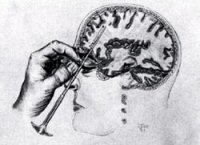
Neurosurgical Focus has an excellent open-access article that takes a critical look at the work of the Portuguese neurologist Egas Moniz – who controversially won the 1949 Nobel prize for inventing the frontal lobotomy.

Although the over-enthusiasm for cutting patients’ frontal lobes to try and ‘cure’ them of mental illness is now looked upon as rather an embarrassing phase in the history of medicine, the article makes clear that criticism of the technique – including Moniz’s sloppy research – has been around for as long as the operation itself.

The article is a comprehensive look at the early history of frontal lobotomy and psychosurgery in general and is a wonderful guide to the long-standing controversies surrounding the procedure.
 

Link to Neurosurgical Focus on the early history of psychosurgery.

The psychology of the 7 deadly sins

The Psychologist has an engrossing article on the psychology behind the ‘7 Deadly Sins’ and how they relate to modern life.

The piece is full of fascinating and counter-intuitive snapshots from the science of social emotions. For example:

Whereas the success and status of others can provoke envy, pride is what we feel when the success and status are our own. Pride, like envy is a human universal, and is another of the sins considered by psychology to be an emotion. Darwin categorised it alongside states such as vanity and suspicion as a ‘complex emotion’. He also anticipated contemporary research showing that the expression of pride – head held high, arms raised – is recognised universally across cultures and by children as young as four.

In 2008 Jessica Tracy at the University of British Columbia and David Matsumoto at San Francisco State University studied congenitally blind Olympic judo competitors and found that they too showed pride in this way, even though they can’t ever have seen a pride display by anyone else.

The BPS Research Digest blog will also be running a ‘sin week’ in the coming week so keep your eye’s peeled for more bad behaviour.
 

Link to The Psychologist on the deadly sins.
 

Full disclosure: I am an unpaid associate editor and columnist for The Psychologist although apart from the occasional lie I live entirely free of sin.

2011-02-04 Spike activity

Quick links from the past week or two in mind and brain news:

The Wall Street Journal has a fascinating piece on child intelligence, genetics and household environment despite the misleading “Why rich parents don’t matter” headline.

Can magnetically stimulating the brain produce Eureka moments? Not Exactly Rocket Science covers an intriguing new study.

The Boston Globe asks what happens when an entire country decriminalises drug use? Portugal did a decade ago, and it seems to have been a success for public health.

‘Packing’ autistic kids. Neuroskeptic covers the latest brand of autism quackery to gain popularity.

Discover Magazine investigates people who cannot recognise faces – a condition called prosopagnosia.

When death is an aphrodisiac. The BPS Research Digest on research finding that thoughts of death lead to greater enthusiasm for one-night-stands. Thank you, science.

Science News covers an awesome study that transferred conscious touch sensations into people’s prosthetic limbs.

I’m sure there’s a small group of level-headed neuromarketing researchers who get as pissed off as the rest of us. The Neurocritic covers another bullshit brain scan marketing scheme.

Nature on a new list of the ten biggest questions in social science research.

Should a legal court pay for a make-up artist to cover up a defendants neo-nazi tattoos to avoid jury bias? In the News covers a fascinating case.

New Scientist covers what we know about the benefits and stresses of long-term relationships.

Arrogant employees are judged poorer at their jobs, even by themselves. The BPS Occupational Digest gets off to a flying start.

Slate discusses whether our ability to read intentions into the behaviour of other people, or, indeed, non-living systems, may have encouraged a belief in God.

Does being social improve your immune system? asks Barking Up The Wrong Tree.

The Guardian explores the effect of the internet on celebrity. You’re keeping tabs on psychologist Aleks Krotoski’s excellent ‘untangling the web’ series right?

The Myth of Joyful Parenthood. The excellent We’re Only Human Blog looks at research on why raising children is hard.

Discover Magazine has an interview with a level-headed fMRI ‘mind reader’ researcher who has no illusions about the challenges and drawbacks of the technique.

Where in the world around you is your mental imagery located? A curious but seemingly common experience explored by The Splintered Mind.

The New York Times has an obituary for psychoanalyst and expert on children’s sexual identity, Eleanor Galenson.

How common are bizarre delusions? Epiphenom covers a new study that looked at the prevalence of unusual beliefs across the population.

How meow meow got its name

New stimulant street drug mephedrone has been nicknamed ‘meow meow’ to the point where the name is appearing in scientific articles on the compound. What is less known, is that the ‘street name’ was largely an invention of journalists.

The drug was originally legal in the UK before it was quickly outlawed after it hit the headlines. Although first known by its chemical name 4-methylmethcathinone, it seems the media needed something more catchy.

The British satirical investigative magazine Private Eye tracked how the M-CAT got its name back in April 2010.

WAY BACK in January 2009 , not long after mephedrone first began to be sold online, members of the web forum attached to the now-defunct “headshop” Champagne Legals discussed what brand name they might attach to the new product, which has the chemical identity dimethylmethcathinone, or MM-CAT.

“What shall we call this drug? It’s called MM-CAT, so why not Miaow?” suggested one. The name did not catch on – unimaginative users tended to call it Meph, or Drone, instead. But on 1st November 2009, someone did add the name “meow” to the wikipedia entry for mephedrone at the head of a list of “street names.”

Three weeks later a 14-year-old girl died after taking the drug (although the cause of her death was later determined to be broncho-pneumonia following a bacterial infection), and The Sun declared the arrival of “a new party favourite called ‘meow meow'” and the world went cat-call crazy.

Among a host of recent headlines the Sunday Times has reported on “the rise of Meow” The Times has heralded “Meow Meow Arrests”, The Sun shrieked about a “Harman Snub for Meow Meow Ban” and The Telegraph took a long hard look at the “Meow Meow Menace in Europe”.

“No one ever called it Meow seriously till the papers picked up on the Wikipedia entry,” one drugs expert tells the Eye. Had hacks checked the site on 17 November, when the entry claimed for the drug claimed it was commonly referred to as as “Mugabe”, or 31 October, when a user claimed “on the street is sometimes referred to as ‘The Chinese'”, we could be seeing some very different headlines indeed.

Clouding over the moon

The mythical connection between phases of the moon, madness and epilepsy are discussed in an engrossing but sadly locked article from the Journal of the History of the Neurosciences.

However, it does have this wonderful section where some of the more whimsical portrayals of ‘lunacy’ are discussed:

In the epic poem by Ludovico Ariosto, “Orlando Furioso” (1532/1992), when the paladin Orlando learns that his lover Angelica is married, he becomes mad and goes through Europe and Africa destroying everything in his path. The English knight Astolfo flies up to moon where all human intellects lost on Earth are collected and finds Orlando’s in a bottle, thus restoring him to sanity (Ariosto, 1532/1992).

In the seventeenth century, the term “lunatic,” especially in its more specific acceptation of “insane” as a result of some mental obsession, began to be substituted by the term “moonstruck.” Reflecting the popular association between the moon and the irrational, primitive, and dark side of the human mind, the adjective “moonstruck” makes its first appearance in John Milton’s Paradise Lost.


Link to summary and DOI entry for ‘lunacy’ article.

2011-01-21 Spike activity

Quick links from the past week in mind and brain news:

Music, expectancy and pleasure in the brain. The Frontal Cortex has an excellent piece on the neuroscience of error prediction and the music appreciating brain.

Science News reports on how a substantial minority of third to sixth graders think they’re best friends with a classmate who actually dislikes them.

Straight Outta Compton, a dainty mother hugger named Nice Cube. Prosocial song lyrics make kids less aggressive, according to a study covered by the BPS Research Digest.

Scientific American explains why you’re probably less popular than your friends. Although in my case, it’s largely because the majority of my friends are cooler than me. Even the imaginary ones.

The widely misreported ‘genetics of friends’ study gets an excellent write-up from Genetic Future.

Wired Science looks at at a secret service study on the psychology of assassins in the US.

A leading journal is under pressure to retract a notorious study on children, depression and antidepressant paroxetine. Neuroskeptic weighs the evidence in this heated case and gives its verdict.

New Scientist covers an intriguing concert for three harmonium players and a synaesthete that recently hit the stage in London.

There’s a fantastic piece on Addiction Inbox on the challenges of personalising addiction medicine when gene variants make anti-craving drugs a hit-or-miss affair.

The Guardian has a piece on the continuing stigmatisation of mental illness in the media.

A psychiatrist and addiction specialist is interviewed about why she finds Twitter useful over at Frontier Psychiatrist.

The Economist charts the rise of the cognitive elite. Sadly, not about a neurally implanted version of the 80’s space trading computer game, as I had first hoped.

Another one of Eric Schwitzgebel and colleagues’ wonderful studies on testing the practical implication of philosophy hits the wires over at The Splintered Mind: do ethics professors respond as well as other philosophers to student email requests?

Medscape covers a new study finding that older surgeons have 1.5 – 3 times the rate of suicidal thinking than the average man in the street.

The over-interpretation of dreams. PsyBlog covers an interesting study on biases that makes us think certain types of dreams are more meaningful than others.

BBC News covers a case of alien hand syndrome and has a video of a patient being attacked by her out of control hand.

Are extraverts better leaders? asks Barking Up the Wrong Tree.

Yahoo! News reports how burglars broke into a home, found white powder, thought it was cocaine, and ended up snorting a deceased man’s ashes. A mistake I think we can all relate to.

A culture shock in brain ethics

Dana has an eye-opening article on the challenges of doing brain research in cultures that don’t share the same assumptions about science and human nature.

There are several sections of the article which turn our research assumptions on their head, owing to the fact that some common principles of ethical research turn out to be based on quite a narrow view of human values.

The idea that donating tissue is simply a matter of individual choice is not a belief held by many communities who believe that all people are interconnected – making individual donations a group decision.

The article touches on an example from the Havasupai people and a similar situation was discussed in an All in the Mind interview with a Maori neuroscientist.

However, I was particularly struck by this part on confidentiality which is often assumed to be the bedrock of human research.

Confidentiality poses another ethical challenge to researchers working with indigenous peoples. Participants in academic studies are invariably anonymous, but in many Native cultures, not identifying oneself, one’s family, and one’s homeland is unacceptable. Anonymity, they believe, undermines the cultural fabric of the community, and is akin to stripping its members of their traditions and beliefs.


Link to ‘Cross-Cultural Neuroethics: Look Both Ways’.

Painful relief for a guilty act

The idea that physical pain can alleviate guilt has a long heritage but a new study just published in Psychological Science has produced evidence that helps confirm this long-held belief.

The experiment, led by psychologist Brock Bastian, asked people to recall a time when they had behaved unacceptably and then rate their current level of guilt as they thought back.

The participants were then asked to do a dexterity task with one hand while either keeping their other hand either in a painful bucket of cold water or in a bucket of lukewarm water.

Participants who wrote about an unethical behavior not only held their hands in ice water longer but also rated the experience as more painful than did participants who wrote about an everyday interaction. Critically, experiencing pain reduced people’s feelings of guilt, and the effect of the painful task on ratings of guilt was greater than the effect of a similar but nonpainful task.

Pain has traditionally been understood as purely physical in nature, but it is more accurate to describe it as the intersection of body, mind, and culture. People give meaning to pain, and we argue that people interpret pain within a judicial model of pain as punishment. Our results suggest that the experience of pain has psychological currency in rebalancing the scales of justice—an interpretation of pain that is analogous to notions of retributive justice. Interpreted in this way, pain has the capacity to resolve guilt.


Link to DOI entry for study.

A wave of neuroscience

The Royal Society has just released a fantastic collection of articles aimed to introduce both the cutting edge of neuroscience and the sometimes fierce debates sparked by its implications.

The collection covers everything from neural interfaces to neuroethics and the articles are written by some of the leading lights in brain research.

This publication is a collection of essays that together provide a primer of current developments in neuroscience and highlight interesting issues and questions for society and policy. The essays, authored by leading experts in neuroscience, bioethics, and science and technology policy, review the state of development of neuroscience and neurotechnology – such as neuroimaging, neuropsychopharmacology, and neural interfaces – and discuss the translation of this knowledge into useful applications. The authors discuss their own views on how developments might impact on society, examining some of the opportunities and risks, as well as the ethical questions and governance issues.

The collection has been dubbed ‘Brain Waves Module 1: Neuroscience, society and policy’ and apparently three other ‘modules’ are on their way.

You can see previews of the other modules from the links at the bottom of the collection’s web page and if they’re as good as this first one, they should make for a fantastic scientific introduction to our current understanding of the brain.
 

Link to Royal Society first Brain Waves collection.

The urban formula

I’ve just caught up with a wonderful New York Times article on the underlying social structure of cities and how seemingly simple mathematical formulas can describe the complexities of urban living.

Geoffrey West is an ex-particle physicist who decided to ‘solve’ cities and set about looking for mathematical laws in the seething mass of statistics generated by city life.

There is something deeply strange about thinking of the metropolis in such abstract terms. We usually describe cities, after all, as local entities defined by geography and history. New Orleans isn’t a generic place of 336,644 people. It’s the bayou and Katrina and Cajun cuisine. New York isn’t just another city. It’s a former Dutch fur-trading settlement, the center of the finance industry and home to the Yankees.

And yet, West insists, those facts are mere details, interesting anecdotes that don’t explain very much. The only way to really understand the city, West says, is to understand its deep structure, its defining patterns, which will show us whether a metropolis will flourish or fall apart. We can’t make our cities work better until we know how they work. And, West says, he knows how they work.

It’s not just about the fundamental of our most complex human societies though – the article reflects on the role of large social groups in human development and their varying forms of durability.

My description doesn’t nearly do the piece justice, however, which remains one of the most intriguing and stimulating articles I’ve ever read on the evolution of urban living.
 

Link to NYT ‘A Physicist Solves the City’.

A slice of the pusher man

New York Magazine has an in-depth article on a low-level drug dealer in the Big Apple who is trying, somewhat half-heartedly, to get out of the game.

It is neither glamorisation nor condemnation, but is a carefully observed slice of life from a business minded, spreadsheet obsessed, upper middle class cocaine dealer.

Lenny sighs, rubs his temples, orders another beer. Sometimes he can’t help but be disgusted by his customers, people living the heedless life he gave up when he “changed from being a consumer in that environment to being a provider for that lifestyle.” But Lenny is a consummate salesman, and to his customers he plays the role of cordial and crooked shrink, supplying all the hollow justifications that once kept his own fears at bay.

When clients invite him to hang out, Lenny understands their motives: They need to convince themselves that he is merely a friend who happens to have drugs on him, not a dealer supporting an unhealthy habit. So Lenny chills, sips a beer. Sometimes customers insist he do a line with them, at which point Lenny, who no longer uses, “accidentally” blows out through the straw so the coke flies everywhere, and then laughs it off.


Link to ‘The One-Man Drug Company’ (via Metafilter).

See Think Mash

Online scallywags The Daily Mash have a funny piece satirising the way neuroscience studies get reported in the media.

To be honest, I think I might keep the first paragraph and use it to improve any dodgy science stories that come my way from now on.

Scientists at the Institute for Studies have finally established that when human eyes see a thing the brain will often generate a thought that is in some way related to the thing that has just been seen.

Professor Henry Brubaker said: “We applied the seeing-thinking forumula to smoking and found that it followed exactly the same pattern.

“We got a bunch of smokers together and showed them a picture of a cigarette. We asked them if this made them think about cigarettes and they all said ‘yes’.”

Similarities to any recently published studies are, of course, purely co-incidental.
 

Link to The Daily Mash story (via @david_colquhoun).