Look before you tweak: a history of amphetamine

I’ve just found a fascinating article in the American Journal of Public Health on ‘America’s First Amphetamine Epidemic’ and how it compares to the current boom in meth and Ritalin use.

The first amphetamine epidemic ran from 1929–1971 and was largely based on easily available over-the-counter speed in the form of ‘pep pills’, widely abused decongestant inhalers and amphetamine-based ‘anti-depressants’.

The idea of giving speed to depressed people seems quite amazing now, especially considering its tendency to cause anxiety, addition and psychosis in the doses prescribed at the time, but it was widely promoted for this purpose.

The following is a 1945 advert for Benzedrine showing a gentleman who has just been treated for depression and is now a proud and dynamic member of society. Thanks pharmaceutical grade crank!

Benzedrine_advert

As an aside, when patients complained about the agitation associated with amphetamine treatment, the drug companies brought out new medications which were speed mixed with barbituates, a class of sedatives.

Not mentioned by the article is the fact that one particular brand of this upper-downer mix called Dexamyl has had a remarkable effect on history – but you’ll have to check the Wikipedia page for the details.

As it happens America is in the midst of another phase of massive stimulant popularity – in the form of street methamphetamine and prescribed Ritalin. In fact, use is at virtually the same levels as when you could buy speed over-the-counter.

By the way, the author of the article also wrote the excellent book On Speed if you want a more in-depth look at the history of the drug.
 

Link to article in American Journal of Public Health (via @medskep)
2013-11-09 Spike activity

Quick links from the past week in mind and brain news:

The worst neurobollocks infographics on the web – found by the neurobollocks blog.

The symptoms of cyberchondria. Only Human covers an interesting study on online hypochondria.

The Chicago Reader has a profile of razor-sharp psychologist and voice-hearer Nev Jones.

The trials and benefits of bringing up a bilingual baby in The Economist.

USA Today has an excellent piece on how elite troops who are hyper-adjusted to combat re-adjust to civilian life.

The excellent Providentia blog has an interesting historical piece on babies born in the then Broadmoor Criminal Lunatic Asylum.

Popping the hood on synaesthesia – what’s going on in there? Interesting piece on the neuroscience of synaesthesia from Wiring the Brain.

The Guardian reports on the luxury-stay addiction rehab industry in Malibu.

BREAKING – Psychologist has opinion: Atheism caused by externalised rage at ‘defective father’ according to new psychoanalytic theory of not believing in Gods reported by Religion News Service.

A multitude of PTSDs

A new paper in Perspectives in Psychological Science looked at all the possible combinations of symptoms that could achieve a DSM-5 diagnosis of posttraumatic stress disorder and found there are now 636,120 ways to have PTSD.

This shows one of the many drawbacks of having a ‘check-list’ approach to classifying mental disorder.

636,120 Ways to Have Posttraumatic Stress Disorder

Perspectives in Psychological Science
November 2013 vol. 8 no. 6 651-662

Isaac R. Galatzer-Levy
Richard A. Bryant

In an attempt to capture the variety of symptoms that emerge following traumatic stress, the revision of posttraumatic stress disorder (PTSD) criteria in the 5th edition of the Diagnostic and Statistical Manual of Mental Disorders (DSM–5) has expanded to include additional symptom presentations. One consequence of this expansion is that it increases the amorphous nature of the classification. Using a binomial equation to elucidate possible symptom combinations, we demonstrate that the DSM–IV criteria listed for PTSD have a high level of symptom profile heterogeneity (79,794 combinations); the changes result in an eightfold expansion in the DSM–5, to 636,120 combinations. In this article, we use the example of PTSD to discuss the limitations of DSM-based diagnostic entities for classification in research by elucidating inherent flaws that are either specific artifacts from the history of the DSM or intrinsic to the underlying logic of the DSM’s method of classification. We discuss new directions in research that can provide better information regarding both clinical and nonclinical behavioral heterogeneity in response to potentially traumatic and common stressful life events. These empirical alternatives to an a priori classification system hold promise for answering questions about why diversity occurs in response to stressors.

Many argue that psychiatric diagnoses are mostly just descriptions of syndromes: groups of signs and symptoms that tend to group together rather than the result of a single underlying disorder.

Sometimes they are better thought of a convenient classifications for testing treatments against.

When diagnoses are developed, however, there is always the temptation to continually tweak the definition to allow the inclusion or exclusion of different experiences as valid targets for treatment.

These changes are usually well-intentioned but can lead to unintended consequences – as this study shows.
 

Link to locked paper from Perspectives in Psychological Science.

Hofstadter’s digital thoughts

The Atlantic has an amazing in-depth article on how Douglas Hofstadter, the Pulitzer Prize-winning author of Gödel, Escher, Bach, has been quietly working in the background of artificial intelligence on the deep problems of the mind.
Hofstadter’s vision of AI – as something that could help us understand the mind rather than just a way of solving difficult problems – has gone through a long period of being deeply unfashionable.

Developments in technology and statistics have allowed surprising numbers of problems to be solved by sifting huge amounts of data through relatively simple algorithms – something called machine learning.

Translation software, for example, long ago stopped trying to model language and instead just generates output from statistical associations. As you probably know from Google Translate, it’s surprisingly effective.

The Atlantic article tackles Hofstadter’s belief that, contrary to the machine learning approach, developing AI programmes can be a way of testing out ideas about the components of thought itself. This idea may be now starting to re-emerge.

The piece is also works as a sweeping look at the history of AI and the only thing I was left wondering was what Hofstadter makes of the deep learning approach which is a cross between machine learning stats and neurocognitively-inspired architecture.

It’s a satisfying thought-provoking read that rewards time and attention.

If you want another excellent, in-depth read on AI, a great complement is another Atlantic article from last year where Noam Chomsky is interviewed on ‘where artificial intelligence went wrong’.

Both will tell you as much about the human mind as they do about AI.
 

Link to ‘The Man Who Would Teach Machines to Think’ on Hofstadter.
Link to ‘Noam Chomsky on Where Artificial Intelligence Went Wrong’.

2013-11-01 Spike activity

Quick links from the past week in mind and brain news:

Alcohol, Sleep, and Why You Might Re-think that Nightcap. Gaines, On Brains on why booze isn’t the best sleep promoter.

The Verge reports on the shocking state of evidence in disaster response psychology.

A neuroscience study on a patient in a coma-like vegetative state indicates he is probably paying attention to sounds – reports BBC News.

The Guardian reports that babies remember melodies heard in the womb according to a new study.

What does it feel like to hold a human brain in your hands? A beautiful piece on Oscillatory Thoughts.

Rethinking the adolescent brain. Neuroscientist Sarah-Jayne Blakemore talks to The Lancet.

BPS Research Digest covers a study on the ‘cheater’s high‘.

A new psychology paper has found that, ethically, we get worn down over the course of a day. Interesting take from Science 2.0.

mind splutter has a brilliant piece: Time Out Of Mind: A linguistic analysis of 50 years of Bob Dylan lyrics.

This week’s edition of Science is a neuroscience special – all locked sadly – but with a free podcast.

My punitive superego is lighting up my brain

This sentence actually appeared in the British Journal of Psychiatry:

Carhart-Harris et al’s finding of activation of Cg25 region of the cingulate gyrus in profound depression is consistent with the idea of an interpersonally isolated and punitive superego desperately trying to prevent overwhelming Pankseppian modalities impulses of panic and rage from reaching consciousness.

Find that in a dead salmon neuroscience haters!

This curious interpretation appeared in a letter in the BJP arguing for how neuroscience supports Freudian psychology.
 

Link to letter in the BJP.

A buried artefact

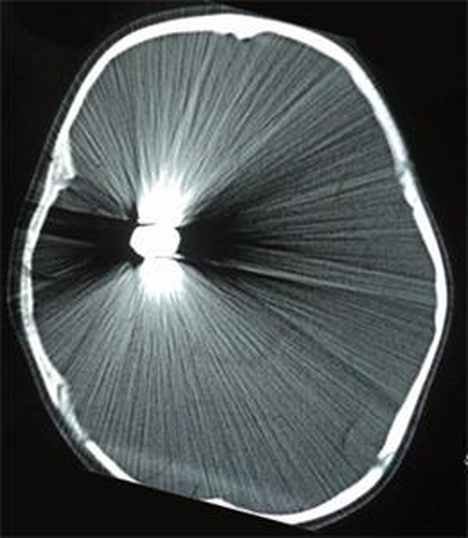
Sometimes there is an accidental beauty in the most macabre of events. Having a bullet lodged in your brain can produce beautiful CT scans due to the scanner’s difficulty with imaging metal objects.

The scan is from an 8-year-old girl who was hit by a bullet that was fired into the air in celebration. She was reportedly fine but this scan is from her hospital admission.

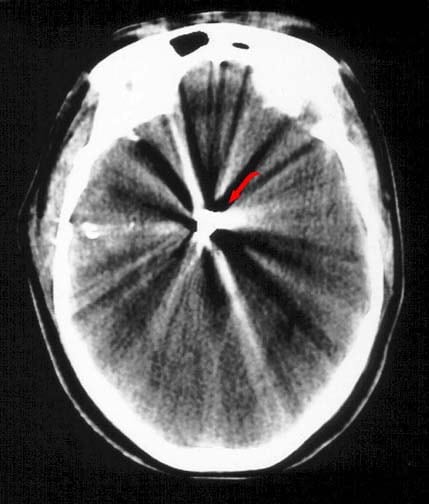
This pattern is an unintended consequence. It’s called a ‘streak’ or ‘star’ artefact and is caused by a combination of the CT scanner beam being over-absorbed by the dense metal object and the image construction software not being able to make sense of the incoming information correctly.

There’s various other images online if you want more unintended brain glitter.

A universal difference

The author of Crazy Like Us, Ethan Watters, has written an excellent article on whether there’s such a thing as ‘human nature’ for the latest edition of Adbusters.

The piece tackles how scientific assumptions about the ‘universals’ of the human mind are having to be revised and discusses research which has shown how people from across the world behave markedly differently in supposedly culturally neutral tasks.

The last generation or two of undergraduates have largely been taught by a cohort of social scientists busily doing penance for the racism and Eurocentrism of their predecessors, albeit in different ways. Many anthropologists took to the navel gazing of postmodernism and swore off attempts at rationality and science, which were disparaged as weapons of cultural imperialism.

Economists and psychologists skirted the issue with the convenient assumption that their job was to study the human mind stripped of culture. The human brain is genetically comparable around the globe, it was agreed, so human hardwiring for much behavior, perception, and cognition should be similarly universal. No need, in that case, to look beyond the convenient population of undergraduates for test subjects…

Henrich’s work with the ultimatum game emerged from a small but growing counter trend in the social sciences, one in which researchers look straight at the question of how deeply culture shapes human cognition.

The article is an engaging look at this new wave of research.
 

Link to Is There Such a Thing as “Human Nature”?

Lou Reed has left the building

Chronicler of the wild side, Lou Reed, has died. Reed was particularly notable for students of human nature for his descriptions of drugs, madness and his own experience of psychiatry.

We’ve touched on his outrageous performance to the New York Society for Clinical Psychiatry before and his songs about or featuring drug use are legendary.

But there was one song that was particularly notable – not least for describing from his own experience of being ‘treated’ for homosexuality with electroshock therapy when he was a teenager.

Kill Your Sons, released in 1974 (audio), is just a straight-out attack on the psychiatrists that treated him:

All your two-bit psychiatrists
are giving you electroshock
They said, they’d let you live at home with mom and dad
instead of mental hospitals
But every time you tried to read a book
you couldn’t get to page 17
‘Cause you forgot where you were
so you couldn’t even read

Here Reed describes the effects on memory that are common just after electroconvulsive therapy. In this case, forgetting what you’ve just read.

The last verse also describes some of his other contacts with psychiatry, mentioning specific psychiatric clinics and medications:

Creedmore treated me very good
but Paine Whitney was even better
And when I flipped out on PHC
I was so sad, I didn’t even get a letter
All of the drugs, that we took
it really was lots of fun
But when they shoot you up with Thorazine on crystal smoke
you choke like a son of a gun

The last line seems to refer to the effect of being given a dopamine-inhibiting antipsychotic when you’re on a dopamine boosting amphetamine – presumably after being taken to a psychiatric clinic while still high. Not a pleasant comedown I would imagine.

I have no idea what ‘PHC’ refers to, though. I’m guessing it’s a psychiatric treatment from the 60s.

It’s interesting that the song was released the year after homosexuality was removed from the DSM in 1973, although it’s never been clear whether this was intentional on Reed’s part or not.
 

Link to YouTube audio of Kill Your Sons.

The grass is always greener

Photo by Flickr user massimo ankor. Click for source.If you’re a neuroscience fan, Marketing magazine has a somewhat depressing report of a Susan Greenfield speech to the travel industry at the ABTA conference in Croatia.

It’s sad for two reasons. Firstly The Baroness is still pursuing the same bizarre and evidence-free line that the internet causes all sorts of brain curdling problems and even doubles down on her odd claim that there’s a link with autism:

“People who are not good at interpersonal skills anyway are on the autistic spectrum disorder, they spend a lot of time in the cyber world. Sadly there are a lot of links between this disorder and compulsive video game use.”

She also says some very strange things about the effects of video games and what gamers are like:

They will have a higher IQ because we know that video game rehearsal repeats all the mental agility that is required of IQ tests. However, being good at mental processing without being able to make connections or understand context doesn’t mean to say that you understand about Syria or the economic problems of the world.

Playing video games means you don’t understand the complex situation in the Middle East? An outrageous claim. Has she never played Call of Duty 4?

However, it’s also a little sad because she’s now doing presumably paid talks to travel conferences to say that while technology damages the brain, travel is good for it.

Greenfield was genuinely one of my scientific heroes and motivated me to get into neuroscience through her talks. And now, it’s all gone a bit Donkey Kong.
 

Link to The Baroness on the cyberapocalypse / holiday cure.

2013-10-25 Spike activity

Quick links from the past week in mind and brain news:

Excellent Nature article on the real impressive science behind the ‘fMRI mind reading’ studies that hit the headlines in unhelpful ways.

The I Have a Therapist campaign aims to destigmatise seeing a therapist.

IEEE Spectrum magazine has a piece on the next world’s strongest fMRI scanner – 11.8 Teslas.

The New York Times has a piece on how the US Military’s DARPA research agency are funding deep brain stimulation research to the tune of $70 million dollars.

A DIY low-cost, open-source kit from BITalino for measuring physiological signals – ECG, EMG, GSR and so on.

Interesting neuromarketing twist in Advertising Age: the same ‘brain truth is the real truth’ illusion but turned round to market the product as having a specific effect on the consumer.

Nautilus has an interesting article on how the mathematics behind codebreaking is being applied to neuroscience.

One family’s search to explain a fatal neurological disorder. American Scientist on the fight against hereditary ataxia.

Discover Magazine’s Crux blog has a piece on five sex research pioneers you’ve probable never heard of.

Scans pinpoint the moment anaesthetic puts the brain under. Report by New Scientist.

The excellent and long-running SciCurious neuroscience blog has moved to a new location.

A man called Dad

An eye-opening 2005 paper estimated the number of children who are not the biological offspring of their presumed father.

Looking at studies from around the world, it concluded that the median number of kids who are not the children of the person they call ‘dad’ is 3.7% with studies typically finding a rate of between two and ten percent.

This is presumably due to children being conceived during clandestine affairs. Whether you think that 3.7% is a low or high figure depends on your view of how human relationships work in real life.

If you want more details there’s an excellent post on Gene Expression which discusses the evidence based and the ethical implications for these findings.

For example, if a child needs genetic testing for medical reasons what should the presenting parents get told about incidental discoveries of ‘paternity discrepancy’?
 

Link to 2005 study on ‘paternity discrepancy’.
Link to excellent Gene Expression post on the same.

The death of the chaotic positivity ratio

A new online publication called Narratively has an excellent story about how a part-time student blew apart a long-standing theory in positive psychology.

The article is the geeky yet compelling tale of how weekend student Nick Brown found something fishy about the ‘critical positivity ratio’ theory that says people flourish when they have between 2.9013 and 11.6346 positive emotions for every negative one.

It’s been a big theory in positive psychology but Brown noticed that it was based on the dodgy application of mathematician Lorenz’s equations from fluid dynamics to human emotions.

He recruited psychology professor Harris Friedman and renowned bunk buster Alan Sokal into the analysis and their critique eventually got the paper partially retracted for being based on very shaky foundations.

It’s a great fun read and also serves as a good backgrounder to positive psychology.

I’ve also noticed that the latest edition of Narratively has loads of great articles on psychology.
 

Link to Narratively on Nick Brown the death of the positivity ratio.
Link to latest edition of Narratively entitled ‘Pieces of Mind’.

Seeing synaesthetic stars during sex

A study in Frontiers in Psychology asked people who have emotional synaesthesia – they see colours when they have certain emotions – about what they experience during sex.

There is a particularly lovely table that illustrates these experiences through the different stages of the sexual response cycle:

Appentance phase
“This phase has an orange character”

Excitement phase
“it’s getting more intensive, starting with a few colours at the beginning and getting more and more intense”

Plateau phase
“The greater the excitement becomes the more thoughts are canalized” “The initial fog transforms into a wall”

Orgasmic phase
“In the moment of orgasm the wall bursts… ringlike structures… in bluish-violet tones”

Resolution phase
“The resolution phase varies between pink and yellow”

It’s worth bearing in mind that emotional synaesthesia isn’t the only thing that can turn sex into a slightly unreal experience.

Some people with epilepsy have seizures triggered by orgasm which can affect both males and females.

All cases reported in the medical literature are people who lose consciousness or have observable movements during the seizure, but this is probably because they are the ones most likely to go to the doctor.

People who have simple partial seizures during orgasm – where they just have unusual experiences but don’t lose consciousness – are probably more common than we think but are less likely to be aware they’re having seizures and so just assume it’s normal for them.
 

Link to study on synaesthesia and sexual experience (via @Neuro_Skeptic)

2013-10-18 Spike activity

Quick links from the past week in mind and brain news:

Is America Less Mentally Healthy Than A Chilean Jail? asks Neuroskeptic.

BPS Research Digest had a special series of articles on people with exceptional abilities such as super calculators, super recognisers and super agers.

Social psychologists say war is not inevitable – according to e! Science News. Tell that to the social priming folks.

CNET has an in-depth article on how IBM is making computers more like your brain both with neuromorphic chips and a liquid power supply.

What your cinema seat says about your personality, according to psychologist Hiromi Mizuki and some crappy PR story from Australia’s Daily Telegraph

CBS Seattle: Psychologist loses license after prostitute steals laptop. Probably after reading that shit PR story on cinemas.

Sleep ‘cleans’ the brain of toxins reports BBC News. I knew it couldn’t be trusted.

New Scientist reports that the “belief that I’m dead” Cotard delusion has been weakly linked to an anti-viral medication although it’s baffling as to why.

The neuroscientists behind Obama’s billion-dollar BRAIN Initiative published a paper in Neuron outlining ideas for the project. Summary: ‘Shit. What do we do now?’

The Guardian publishes an in-depth profile of the head of Europe’s billion dollar brain project, Henry Markram. Summary: ‘Brains? I thought this was an IT project?’

Scraping the bottom of the biscuit barrel

As a wonderful demonstration how media outlets will report the ridiculous as long as ‘neuroscience’ is mentioned, I present the ‘Oreos May Be As Addictive As Cocaine’ nonsense.

According to Google News, it has so far been reported by 209 media outlets, including some of the world’s biggest publications.

That’s not bad for some non-peer reviewed, non-published research described entirely in a single press release from a Connecticut college and done in rats.

The experiment, described in five lines of the press release, is this:

On one side of a maze, they would give hungry rats Oreos and on the other, they would give them a control – in this case, rice cakes. (“Just like humans, rats don’t seem to get much pleasure out of eating them,” Schroeder said.) Then, they would give the rats the option of spending time on either side of the maze and measure how long they would spend on the side where they were typically fed Oreos…

They compared the results of the Oreo and rice cake test with results from rats that were given an injection of cocaine or morphine, known addictive substances, on one side of the maze and a shot of saline on the other. Professor Schroeder is licensed by the U.S. Drug Enforcement Administration to purchase and use controlled substances for research.

The research showed the rats conditioned with Oreos spent as much time on the “drug” side of the maze as the rats conditioned with cocaine or morphine.

Needless to say, South American drug lords are probably not shutting up shop just yet.

But this is how you make headlines around the world and get your press release reported as a ‘health story’ in the international media.

As we’ve noted before, the ‘as addictive as cocaine’ cliché gets wheeled out on a regular basis even for the most unlikely of activities but this really takes the biscuit (“Bad jokes addictive as cocaine” say British scientist’s readers).

However, the alternative conclusion that ‘Cocaine is no more addictive than Oreos’ seems not to have been as popular. Only Reason magazine opted for this one.

The reason that this sort of press release makes headlines is simply because it agrees with the already established tropes that obesity is a form of ‘addiction’ and is ‘explained’ by some vague mention of the brain and dopamine.

The more easily we agree with something, the less critical thinking we apply.
 

Link to a more sensible take from Reason magazine.