How gene therapy could cure brain diseases

Nature’s neurology journal has a freely available article on a technique that interferes with the translation of genetic information into proteins that may help prevent inherited brain diseases.

DNA has two main functions. The ‘template function’ of DNA is to pass on genes through generations and allow different traits to be inherited.

The ‘transcriptional function’ of DNA is to allow these genes to be expressed at appropriate times and places (and not expressed at others) to allow the cell to do its work.

‘Expression’ just means ‘turned into a protein’ and genes are just blueprints for proteins.

The blueprint gets turned into a protein by messenger RNA, which ‘reads off’ the information, then moves away to assemble the protein from a store of amino acid component parts.

As different cells in the body have different functions, and individual cells need to behave differently depending on what’s happening, different proteins need to be created at different times.

Disorders like Huntington’s disease result from genes that cause damaging proteins to be formed. These lead to the malfunction and death of brain areas that, in turn, leads to cognitive problems, movement difficulties, mental illness and eventual death.

Using a technique called RNA interference, researchers have found they can selectively interfere with the process where messenger RNA assembles proteins from the DNA’s genetic information.

Essentially, small chunks of gene-specific RNA are introduced into the cell, these find the messenger RNA and destroy the information before it gets turned into a protein.

In other words, it prevents specific genes from being turned into proteins.

This has caused a great deal of excitement because it could lead to treatments for disorders like Huntingdon’s by simply ‘silencing’ the rogue Huntingdon’s gene.

While you might have a rogue gene, RNA interference could essentially gag it, meaning it would never have a knock-on effect in the brain.

This has been demonstrated in very limited lab tests, and the Nature article examines the prospects for it being developed into a widespread treatment.

There are still some difficulties to overcome, however. One of which is how to get the interfering RNA into the right cells in the brain, a difficulty with many treatments owing to the filtering effect of the blood-brain barrier.

Another is how to make sure that the technique affects only the disease process. Researchers talk about proteins being involved in ‘chemical cascades’, meaning that they are involved in huge and complex mechanisms in the body.

It’s hard to predict exactly what effect silencing a gene will have, and whether your technique for doing so will also interfere with some other processes that use some of the same mechanisms, some of which we probably don’t even know about at the present.

RNA interference is still an experimental process, but it holds great potential for treating inherited brain diseases. The Nature article is a fantastic guide to the cutting edge of the science in this area.

Link to Nature Clinical Practice Neurology article on RNA interference.
Link to plain language guide to its use in Huntington’s.
Link to Wikipedia page on RNA interference.

Shifting eye therapy successfully treats trauma

A recent study has found that EMDR, a once suspect therapy that involves recalling traumatic memories while moving your eyes, is one of the most effective treatments for post-traumatic stress disorder (PTSD).

EMDR stands for Eye Movement Desensitization and Reprocessing. It’s a type of psychotherapy that, among other things, involves thinking about the traumatic event while attending to bodily reactions and moving your eyes left and right, usually following a light or the therapist’s finger.

It sounds bizarre and caused a great deal of suspicion when it first emerged, largely it was pretty much just ‘thought up’ by Dr Francine Shapiro and no-one really knows quite how it works.

However, several studies have found it to be one of the most effective treatments for post-traumatic stress disorder, and this new study, one of best to date, has repeated the finding.

This new study, led by Dutch psychiatrist Dr Bessel van der Kolk, compared EMDR, with SSRI drug fluoxetine (aka Prozac) and a pill placebo in a group of patients diagnosed with PTSD.

After the eight week treatment block, fluoextine and EMDR were equally effective,

However, six months later, 75% who had been traumatised in adulthood and were treated with EMDR reported having no symptoms. For people traumatised during childhood, a third treated by EMDR were symptom free by the same point.

In contrast, none of the people in either group treated with fluoxetine managed to free themselves from symptoms.

Most clinicians looking at the study might suspect that eight weeks of drug treatment wouldn’t be long enough as prescriptions are often recommended for six months to a year after stabilisation.

Nevertheless, it’s an impressive result, not least because of the short 8-week treatment time for EMDR and the strong recovery rate.

One of the criticisms of EMDR is that it’s still not clear what part the eye-movement aspect plays in the therapy and exactly how it works.

What this trial didn’t do is compare EMDR to cognitive behavioural therapy (CBT), a type of recently devised psychotherapy that is known to be one of the most effective treatments for anxiety disorders.

Both of these therapies focus on ‘reprocessing’ the trauma memories – essentially remembering and ‘reliving’ them, which seems to play a major role in preventing the uncontrolled memories and flashbacks that are part of the disorder.

This is also the focus of a recently devised combined drug and ‘reprocessing’ therapy we reported on earlier, which seems to work by dampening down bodily arousal when the memories are recalled due to the action of the drug propranolol.

Link to abstract of clinical trial.

Photographing delusions

Singapore art collective A Dose of Light exhibited some poignant and beautiful photographs by Wu Xiao Kang, a 26 year-old man with schizophrenia who later killed himself.

The show gained international acclaim and only later was it revealed that Kang was fictional, a creation of the collective who had taken the photos themselves.

The project consisted of 36 photos supposedly taken by Kang of an abandoned psychiatric hospital in which he was previously treated.

A Dose of Light designed the whole project as a conceptual artwork to portray the breakdown of reality that sometimes occurs in schizophrenia.

Several galleries and events hosted the exhibition in good faith, and one gallery has now pulled the exhibition in protest.

According to one newspaper report, the group decided to come clean on July 1st when a mental health charity wanted to use the images to promote awareness of mental illness in Singapore.

However, I first saw the photos at Bonkers Fest, an art and music event held in Camberwell, London on June 2nd, that also promotes awareness of mental health issues and is organised by a number of mental health charities.

In this case, there was no admission that the Kang was fictional and the photos were presented as genuine.

One member of the collective, Robert Zhao is a fine art student at Camberwell College of Arts, who were also partly involved in organising the festival.

Link to online ‘Wu Xiao Kang’ exhibition.
Link to Metafilter on the controversy.

Syd Barrett in the American Journal of Psychiatry

From the ‘images in psychiatry’ column from July’s American Journal of Psychiatry, written by Dr Paolo Fusar-Poli:

Roger Keith “Syd” Barrett was both the founding member of one of the most legendary rock bands and probably the most famous rock star to develop psychosis. He formed the band that would become Pink Floyd in 1965, amalgamating the first names of two American bluesmen, Pink Anderson and Floyd Council.

Recorded at Abbey Road Studios, inspired by LSD, and driven by Barrett’s songwriting, singing, and otherworldly guitar solos, the first album, “The Piper at the Gates of Dawn” (1967), alchemized the whimsical bohemian spirit of the “summer of love” and influenced generations of musicians with its sonic inventions and surreal lyrics.

Music journalists have called him “the golden boy of the mind-melting late-60s psychedelic era, its brightest star and ultimately its most tragic victim”. In fact after two haunting solo albums, “The Madcap Laughs” and “Barrett,” which showed the last flickering lights of his genius, his eccentric and creative personality drifted into a psychotic reclusive state, forcing him to withdraw from public view in 1974.

However, Pink Floyd would pay tribute to Barrett and would include madness as an ongoing theme on their best and most successful albums, “Dark Side of the Moon” (1973) and “The Wall” (1979), speaking to Syd directly in the songs “Wish You Were Here” and “Shine on You Crazy Diamond.” Barrett spent the rest of his life in his mother‚Äôs house in Cambridge, painting and gardening.

Link to AJP images in psychiatry column on Syd Barrett.
Link to Wikipedia page on Syd Barrett.

2007-07-13 Spike activity

Quick links from the past week in mind and brain news:

For Certain Tasks, the Cortex Still Beats the CPU. Completely banal title obscures quite an interesting article on ‘human processing‘ in computer tasks.

Research suggests the biggest influence on how responsive we feel our partners are is actually how we respond to our partners.

The Washington Post reports on research linking the decline in criminal activity to a reduction in environmental lead poisoning.

People with autism do <a href="http://sciencenews.org/articles/20070707/fob4.asp
“>far better in certain non-verbal cognitive tests than you might expect from their IQ. Actually, similar findings, showing an advantage for visuospatial tasks, have been reported before.

CNN reports that antidepressants are the most prescribed drugs in U.S.

Dr Jerome Groopman writes in The New York Times about the cognitive biases that can lead to medical errors.

More on the ‘disease model’ of addiction: Dr Nora Volkow talks about the neuroscience of addiction on an NPR radio special.

Can nicotine be modified to make a useful cognitive enhancer? Wired investigates.

Hypnosis redux

alert_eye.jpgThanks to everyone who came along to discuss the neuropsychology of hypnosis last night. For anyone who wants to investigate further, here’s more on the psychology and neuroscience of hypnotic states.

Scientific American has a fantastic article on ‘The Truth and the Hype of Hypnosis’ that tackles some of the myths and covers some of the key scientific research.

Psychologist and hypnosis researcher Dr Peter Naish did a great talk last year on the science of hypnosis for the Dana Centre which is available online as an archived video webcast.

WNYC’s RadioLab had a special on placebo and the power of suggestion, which, to be fair, is light on science and heavy on anecdote, although it does make for an interesting listen.

And finally, Dr Matt Whalley’s site is a great guide to science of hypnosis. I keep mentioning it, because, well, it’s excellent.

Terrorism fails because we don’t see its purpose

In an article for Wired, security guru Bruce Schneier suggests that the reason terrorism fails is because it falls foul of a cognitive bias in how we understand people’s intentions from their actions.

Schneier bases his conclusions on a recent paper [pdf] by Max Abrahms who applies correspondent inference theory to terrorism and the political objectives of terrorist groups.

‘Correspondent inference theory’ suggests that we try and understand people’s intentions and character based on the most salient effect of their actions.

This can often lead us astray, as demonstrated by a regular plot line in soap operas where someone’s good intentions accidentally misfire and the person on the receiving end assumes they’re being deliberately malicious.

As noted by Schneier and Abrahms, this also leads us to misunderstand the goal that motivates terrorist acts:

The theory posited here is that terrorist groups that target civilians are unable to coerce policy change because terrorism has an extremely high correspondence. Countries believe that their civilian populations are attacked not because the terrorist group is protesting unfavorable external conditions such as territorial occupation or poverty. Rather, target countries infer the short-term consequences of terrorism — the deaths of innocent civilians, mass fear, loss of confidence in the government to offer protection, economic contraction, and the inevitable erosion of civil liberties — (are) the objects of the terrorist groups. In short, target countries view the negative consequences of terrorist attacks on their societies and political systems as evidence that the terrorists want them destroyed. Target countries are understandably skeptical that making concessions will placate terrorist groups believed to be motivated by these maximalist objectives.

In his paper, Abrahms examines the political objectives of terrorist groups and looks at how successful terrorism has been in obtaining them. He reckons, with a generous estimate, that only 7% of the stated goals have been achieved.

But he also notes that the stated goals rarely gets through to the people being targeted and that the political rhetoric of the terrorists’ target is littered with misunderstandings of their intentions.

I’m personally interested in how and why terrorists are labelled ‘mad’. It’s in the terrorists’ interest to be seen as sane, as part of the goal is to force concessions.

There’s no point conceding to someone who you think is unbalanced, because an irrational group might not stop the violence once they’ve achieved their aims.

The fact that violent protestors are so often labelled as ‘mad’ suggests, as per correspondent inference theory, that we assume their is no coherent intention behind their actions, contrary to what they are trying to achieve.

Anyway, an interesting look at the motivations and perception of political violence.

Link to ‘The Evolutionary Brain Glitch That Makes Terrorism Fail’.
pdf of Max Abrahms’ paper ‘Why Terrorism Does Not Work’

Magnetic brain stimulation not proven to fight depression

At a recent American Psychiatric Association meeting, commercial companies were showing off custom made magnetic brain stimulators as a treatment for depression. A review article in the latest Nature Reviews Neuroscience looks at the technology and finds there’s still no convincing evidence that it’s an effective treatment.

The technology is based on transcranial magnetic stimulation (TMS), essentially a large electromagnetic which is activated near the scalp.

As you might remember from high school physics, a magnetic field that moves over a conductor causes a current. As your brain is a conductor, a current is formed in the neurons which cause them to briefly activate.

After an area of brain is magnetically activated, there are a few hundred milliseconds of inactive ‘silence’, effectively switching the area off, albeit safely and temporarily.

Depending on how quickly these pulses are applied, over a short period of time (typically a few minutes), the overall level of activity in the targeted brain area can be increased, or decreased. A technique known as repetitive or rTMS.

It has been known for a while that patients with depression have reduced activity in the left frontal lobe.

Researchers thought that TMS could be used to increase activity in this area and treat the depression, and so a long series of controlled trials were started to see how effective it could be.

It turns out, TMS does seem to reliably increase activation in the left frontal lobe, but the evidence on whether it actually improves depression in mixed, so mixed in fact, it’s not clear whether overall, it’s an effective treatment at all.

One of the difficulties is that there are so many variables to test out.

TMS can be applied to anywhere on the cortex, at varying strengths, at varying frequencies, at varying angles, with different wave forms and with different shaped coils, just to name a few of the possibilities that don’t include variation in the patients themselves.

Ridding and Rothwell, authors of the review paper, are not impressed with the results so far, but note some areas are promising but under-researched:

It is a sobering conclusion. A new treatment that might help some patients slightly more than placebo, but for which we do not know the most effective dose nor the best group of patients to target. Yet this is not the most worrying thing about the depression story. The main problem is that none of these trials has advanced our understanding of how rTMS may be having any action at all in depression. Trials currently underway are being conducted with almost the same rationale as the initial trials more than 10 years ago. The only changes are in variables such as the subset of patients being studied, or the intensity of the stimulus with respect to the distance of the patient’s brain from the scalp surface. In effect, the science has stood still.

In retrospect, depression was probably a poor choice of condition in which to begin trials of rTMS. It is phenotypically diverse with difficult diagnostic criteria and a subjective clinical evaluation that makes it highly susceptible to any placebo effects of rTMS. Diagnostically simpler conditions that have been studied more recently, such as auditory hallucinations in schizophrenia and tinnitus may prove more tractable. In both cases, rTMS of areas of the parietal or temporal cortices, respectively, have reduced symptoms, in some cases for several weeks after treatment. However, the number of studies done so far is small, and any firm conclusions about efficacy await much larger controlled trials.

This hasn’t stopped a number of companies producing ‘off-the-shelf’ TMS devices to make the technology more accessible to work-a-day psychiatrists, rather than clinical researchers.

There are currently some large scale trials being conducted to test further whether TMS for depression is a useful treatment, but so far, the evidence just isn’t there.

However, one promising avenue might be using TMS as a treatment for stroke – brain damage caused by bleeds and blockages in blood flow.

A different, but perhaps equally effective approach has been driven by a model in which recovery after stroke is suppressed in some patients by input from an ‘overactive’ non-stroke hemisphere. Reduction of the excitability of this hemisphere by low-frequency rTMS has also been reported to increase function, in this instance in a group of chronic patients whose stroke had occurred at least 1 year previously

It’s still early evidence, but it might be that using TMS to target specific symptoms and selective disorders may be more effective than trying to treat the diverse conditions that make up the common psychiatric diagnoses, such as depression, bipolar and schizophrenia.

Link to abstract of TMS review paper (sadly, not open-access).

Synaesthesia in one language only

New Scientist have recently published a fascinating exchange on synaesthesia which has highlighted that some bilingual people with the condition experience the effect in one language only.

A reader wrote in to suggest that the consistently found associations of certain colours with specific letters of the alphabet may be due to with the way the letters are represented in children’s ‘ABC’ books.

Psychologist Dr Julia Simner replied, noting that research shows this wasn’t the case, but most interestingly, her letter indicates that some bilingual people only experience synaesthesia in one language:

Slessenger’s proposal that synaesthetes’ colours stem simply from childhood ABC books is sensible, but has been tested, and rejected, elsewhere. Anina Rich and colleagues traced 136 ABC books published as far back as 1862 – of which, surprisingly, only 38 used colour in any prominent sense. However, only 1 in 150 of their synaesthetes experienced colours consistent with any alphabet book [pdf].

Additionally, although Slessenger’s account is plausible for the examples he provided (eg, “A is for (red) apple, it’s less tenable when the entirety of alphabetic colours are considered. Indeed if synaesthetes’ colours were indicative solely of ABC learning, this would imply they lived in a world of green elephants (E), red mothers (M), black and blue tigers (T) and yellow cats (C).

Instead, our research indicates a different cause: synaesthetes colour their alphabets with a sophisticated, unconscious rule-system, in which, for example, associations are mapped according to the frequency with which letters and colour terms are encountered in the English language. High-frequency letters such as A are significantly likely to pair with high-frequency colour terms such as “red”.

Finally, Slessenger suggests our synaesthetes should be given symbols from an unknown language to test whether associations are independent of experience. This approach has been investigated and proved unhelpful. Strangely, depth of familiarity is not a strong predictor of synaesthetic colouring since some bilingual people have colour in only one language – and some monolinguals have colour for languages they do not understand.

In original letter was in response to a May article on the condition and some of Simner’s research findings. Unfortunately, the main article is behind a pay wall, but the letters are fascinating in themselves.

Link to original letter.
Link to Dr Simner’s reply.

US psychologists to review gay ‘conversion therapy’

Time magazine reports that the American Psychological Association is conducting a review of their policy on treating gay clients, with a particular focus on reassessing guidelines around controversial therapies aimed at assisting gay clients to ‘go straight’.

The APA already have guidelines for working with gay, lesbian and bisexual clients that make it clear that homosexuality is not to be considered a mental illness.

However, a minority of therapists, usually linked to conservative Christian organisations, practice a type of therapy known as ‘reparative’ or ‘conversion therapy’ to assist gay clients who wish to be straight.

This practice is strongly opposed by gay rights groups, who suggest that it is at best futile and at worst harmful, and feel that it is the distress of discrimination that pushes people into starting such therapies.

Neither the current guidelines, nor the APA policy statement on lesbian and gay issues, makes any mention of this issue – something that the review panel is likely to consider in detail.

Gay rights advocates are hoping that the APA will denounce ‘reparative’ or ‘conversion’ therapies while conservative religious groups have written to the APA to defend their work with consenting clients.

As with many of these policy reviews, the arguments centre as much on who has been selected for the review panel as the debate itself:

Conservatives contend that the review’s outcome is preordained because the task force is dominated by gay-rights supporters. “We’re concerned,” said Carrie Gordon Earll of Focus on the Family. “The APA does not have a good track record of listening to other views.”

Joseph Nicolosi, a leading proponent of reparative therapy, predicted the task force would propose a ban of the practice — and he vowed to resist such a move. Nicolosi, who was rejected as a task force nominee, is president of the National Association for Research and Therapy of Homosexuality.

Clinton Anderson, director of the APA’s Lesbian, Gay and Bisexual Concerns Office, insisted the panel would base its findings on scientific research, not ideology. He defended the decision to reject certain conservative applicants to the task force. “We cannot take into account what are fundamentally negative religious perceptions of homosexuality ‚Äî they don’t fit into our world view,” Anderson said.

Link to Time article ‘Psychologists to Review Stance on Gays’.

The relative exposure of our respective arses

In 1980, the New York Review of Books published a heated exchange between psychologist and IQ researcher Hans Eysenck and biologist and IQ skeptic Stephen Jay Gould.

It remains a classic moment in the IQ debate, not least because of the entertaining mud slinging.

The exchange followed a review of Arthur Jensen’s book Bias in Mental Testing by Stephen Jay Gould in which he slams the concept of IQ and general intelligence – the idea that there is a core resource of psychological ability that most mental tasks draw upon.

In the first exchange, Hans Eysenck, one of the world’s most famous psychologists at the time, wrote to the magazine throwing doubt on pretty much everything Gould had to say.

Gould makes a valiant comeback, dismissing most the arguments as attacking him rather than his claims, but notes that one is “the only meat in a sandwich surrounded by too much very stale (if not moldy) bread”.

You can always tell a scientific argument has got interesting when it wanders off the original point and focuses on who can see whose arse.

Eysenck starts the second exchange with “It is always interesting to note the reactions of a critic who is caught with his pants down, and Stephen Jay Gould’s reply to my letter is no exception”.

Gould, unable to resist carrying the metaphor, replies: “I don’t wish to engage Mr. Eysenck in a protracted debate about the relative exposure of our respective arses; nonetheless, I can’t resist noting that his initial remark surprised me because I thought I had caught him in the same unenviable posture he ascribes to me.”

The debate was heated largely because of Eysenck’s controversial views on intelligence. He suggested that IQ was largely determined by genetics and that small but significant differences could be seen between races as a result.

He was accused of being racist, but he claimed he was simply reporting the data from his studies and noted, in his defence, that he found that Asian people typically came out with the highest IQ – hardly the views of a white supremacist.

Gould was shortly to publish The Mismeasure of Man, a book pouring scorn on the whole concept of IQ and arguing that the tests had serious cultural biases built into them so they were never going to be a fair comparison.

The exchange is worth reading in full both to get a flavour of the debate (essentially the same points are still being made today) and, of course, just for sheer entertainment value.

Link to original book review.
Link to round one.
Link to round two.

Edelman on neural darwinism and consciousness

Biologist Gerald Edelman is interviewed in Discover magazine about his views on the brain’s own internal ‘natural selection’ process and its possible role in the development of consciousness.

Edelman won the Nobel Prize in 1972 for his work on antibodies, but later turned to neuroscience and is keen to crack the problem of consciousness.

He argues that pathways in the brain are created by a process akin to ‘natural selection, where the most useful survive.

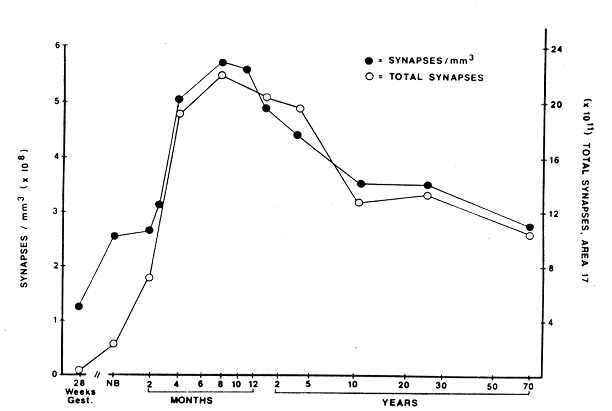
In the first few months of life, the neurons, on average, are more connected with each other than later in life.

If you click here you can see a graph of the number of synapses (inter-neuron connections) present in the human visual cortex by age.

According to the study that this graph is taken from, the peak time for synaptic connections is 6 months old. After that the number rapidly decreases.

This happens because connections that aren’t used disappear on a ‘use it or lose it’ basis, and the ones that are left form the more permanent connections in the brain.

In other words, from all the random variation, the weak connections die out and the strongest survive.

Edelman also argues that this principal applies to larger patterns of activity in the brain – with past and ongoing experience determining what can be considered useful.

Edelman talks about his theory and how he thinks it is crucial in understanding consciousness, and also how his research group is attempting to build robots based on the same principal.

Link to Edelman interview in Discover magazine.

John Nash speaks to American psychiatry

John Nash, Nobel prize winning mathematician and subject of the Oscar winning biopic A Beautiful Mind, delivered a speech to the American Psychiatric Association’s annual conference. In his talk, he suggested that mental illness may be the result of the otherwise healthy evolution of mental diversity.

Applying his specialized understanding of “game theory” to an analysis of mental illness and his own experience with psychosis, the 79-year-old Nobel Laureate suggested that severe mental illness exists in nature as a consequence of the diversification of species, and that it may serve the needs of adaptation by its not infrequent association with genius.

It is a line of thinking that has been followed by such renowned psychiatric researchers as Nancy Andreasen, M.D., and Kay Redfield Jamison, Ph.D.

At the same conference, model and actress Brooke Shields spoke to the conference about her own experience of post-partum depression – the depressive disorder that occurs after giving birth in about 1 out of every 10 women.

Link to Psychiatric News on Nash’s speech (via FuriousSeasons).
Link to Psychiatric News on Shield’s speech.

Neuropsychopharmacology: The Fifth Generation

The American College of Neuropsychopharmacology have made a huge text book freely available online that covers the cutting edge of pretty much everything we know about how drugs affect the mind and brain.

Psychopharmacology is the science of how drugs affect the mind. You can do this without a huge understanding of brain function. You can just see how different drugs affect people’s mental state.

This was pretty much how many of the early drug treatments in psychiatry were discovered.

For example, the first antipsychotic, chlorpromazine, was developed in the 1950s as an antiemetic, a drug to prevent vomiting.

However, the French doctor Henri Laborit noticed that it induced a sort of ‘indifference’ to the world, and wondered whether it might help calm patients with mental illness who were agitated.

It was discovered that this drug was the first effective treatment for psychosis, and for several decades, psychopharmacology research simply tested various derivatives without a good understanding of how they were affecting the brain.

Neuropsychopharmacology adds neuroscience into the mix, and attempts to explain how drugs have their effect by studying how they interact with the biology of the brain.

It’s an incredibly important science, not only for the purpose of developing new treatments, but also for understanding how any drug (be it aspirin, cocaine or caffeine) has its effect.

The online text book, entitled Neuropsychopharmacology: The Fifth Generation reviews a huge, and I mean HUGE, amount of research into this area.

It’s an academic text, so is very in-depth, but is a fantastic resource to have freely available on the net.

Link to Neuropsychopharmacology: The Fifth Generation.