Spinning silhouette illusion

I’ve just found this ‘spinning silhouette‘ visual illusion which took ages to take effect but when it did it was so striking I thought at first it was faked.

The idea is that you keep looking and the woman suddenly ‘flips’ and seems to spin in the opposite direction. It’s very impressive when it happens, but it seemed to happen so randomly that I wondered whether it had been programmed to randomly reverse.

However, I’ve found that if you cover image apart from the shadow of the feet and concentrate on seeing them rotate in the opposite direction, when you uncover the image, it too will seem to be in a reverse spin.

I’m guessing it works because our brain is making the best guess of a 3D shape from a 2D image. The silhouette from a real 3D rotating shape would look identical no matter what way it rotated.

Think about a rotating coin. No matter which way it turns, the silhouette would be the same – it would seem as if a disc was being progressively ‘squashed’ into a line and then back to a disc again.

As with all visual perception, our brain ‘fills in the gaps’ with best guesses, in this case to make it seem like a rotating 3D shape.

However, there’s actually no information about which way its rotating, so it can suddenly ‘flip’ when our perception of the direction becomes unstable and another interpretation takes effect.

It’s like a motion-based necker cube effect.

Link to Spinning Silhouette illusion.

The necessity of the brain: a slight return

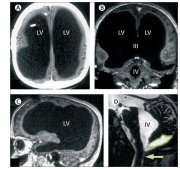
This week’s edition of medical journal The Lancet has a brief case report of a 44-year-old man who was discovered to have a severely distorted brain, due to it being displaced by a build-up of fluid.

The man’s MRI scans are shown on the right and you can clearly see that huge sections of the brain are seemingly absent.

In this case, it was due to hydrocephalus, a condition where the cerebrospinal fluid (CSF) isn’t properly drained.

This fluid bathes and protects the brain. It is produced in the ventricles and circulates around before being removed into the blood supply.

If this draining doesn’t happen properly, the fluid builds up and dangerously increases the pressure inside the skull. This can lead to the brain being malformed, particularly if it occurs in childhood.

The young brain is remarkably good at adapting to obstacles. Children who have had half their brain removed can grow up with few obvious effects.

This seems to also occur in some cases of hydrocephalus. While it is usually associated with quite profound neurological problems, in some cases, it goes undetected because the people seem relatively unaffected.

The late neurologist John Lorber studied case of hydrocephalus and reported one particularly famous case.

A CT scan suggested that the patient had a largely fluid-filled skull with less than a few millimetres of grey matter, but with a IQ of 126 and a first class maths degree. Lorber had many other cases that he said illustrated similar effects.

Lorber provocatively titled his article ‘Is the brain really necessary?’.

His finding was quite astonishing and, despite some criticisms (CT scans probably exaggerate the damage and the patients undoubtedly had some mental difficulties), he highlighted the fact that the brain can adapt to quite severe setbacks in some exceptional cases.

However, the title of his article annoyed quite a few people and it has been cited as one of the origins of the ridiculous but curiously persistent myth that we only use 10% of our brains.

In comparison to Lorber’s case, the Lancet is a man described as having ‘normal social functioning’ and an IQ of 75, on the borderline of having a mild intellectual disability, but nothing so severe you wouldn’t find it as part of normal human variation.

Nevertheless, considering the extent of distortion in the brain, it’s still quite remarkable.

‘Distortion’ is likely to be the key is these cases, as the key brain areas are likely to be ‘smeared’ around the inside of the skull, rather than missing completely.

However, we shouldn’t be too complacent in our explanations of how some people can have such severe brain distortions while functioning really quite well. Our understanding of how this occurs is still quite poor. Plenty of mystery still accompanies these cases.

Link to (closed access) Lancet case report.
Link to write-up from Nature (via Neurophilosopher).
Link to excellent SciCon article on Lorber’s cases and the 10% myth.

Schizophrenia in 15th century Islamic medicine

There’s an interesting exchange in this month’s American Journal of Psychiatry where two researchers note that there is no mention of any condition that resembles schizophrenia in the key 15th century Islamic medical text Cerrahiyyetu‚Äôl-Haniyye (Imperial Surgery).

A reply highlights the fact that it may be because medicine was only practicised on people who volunteered for treatment, which is unlikely to include people who are floridly psychotic.

The exchange contains lots of historical information about how psychosis was understood in centuries past both socially, and by doctors of the time.

Islam has been incredibly important in the history of medicine and Islamic medical texts are rich sources for historians interested in the development of medical care.

Link to AJP letter ‘Absence of Schizophrenia in a 15th-Century Islamic Medical Textbook’.
Link to reply and commentary.

Brain haemorrhage inspires creativity

The Times has an interesting account of a man who experienced a massive surge in creativity after suffering a brain haemorrhage.

Walking into a neat red-brick semi on a housing estate in Birkenhead I am faced with a glittering-eyed tiger. His stare is mercifully benign and his swirling surroundings cover the whole of the inside front door. The room beyond is a cornucopia of shape and colour; every square foot of wall and ceiling a mass of abstract designs, animals and faces. The paintings continue into the kitchen and up the stairs. There are carvings, sculptures, reliefs and smaller pictures propped or hung against larger ones.

This is the home of Tommy McHugh, 57, until six years ago a Liverpool builder, with a rough past as a street fighter, and no apparent artistic inclination. Now he is a man with a passion, full of emotion, driven to create. “My mind is like a volcano exploding with bubbles,” he says in a gentle Scouse accent, “and each bubble contains a million other bubbles, and then another million bubbles of unstoppable creative ideas.” He spends his days ‚Äì and most of his nights ‚Äì painting, sculpting and carving. So what happened six years ago to bring about this transformation? The extraordinary answer is: a brain haemorrhage.

Similar cases have been reported in the medical literature. In one case, the onset of dementia improved the technique of an already established artist and there have been several cases of people who seem to have found previously unused artist talents as their brain disease progresses.

Link to Times article ‘Painting? I can‚Äôt turn it off’.
Link to neurology article on creativity ‘sparked’ by dementia.

2007-07-20 Spike activity

Quick links from the past week in mind and brain news:

NPR has a special radio programme on an Iraqi psychiatrist, now resident in the USA, looking back to his work in the war-torn state.

OmniBrain gathers together a whole list of neuroscience sites for kids. Yay!

New Scientist reports on how a new brain scanning study gives clues to how we suppress traumatic memories.

Neurophilosophy looks at the psychology of Hitchcock’s movies.

New research study suggests there may be two distinct brain networks affected by Parkinson’s disease and a Science News article investigates why smokers are less likely to develop the condition.

Cognitive Daily looks at research on how children perceive motion.

New Scientist investigates how people from different cultures might differ in their ability to take others’ perspective.

I’m not as slim as that girl: The Neurocritic looks at a recent review on the effect of viewing thin models on body image concerns in women.

A Stroke Association survey find that only 33% of people are aware that stroke causes immediate brain damage (in fact, it is immediate brain damage).

Why are people more likely to fight when they’re drunk? Pure Pedantry investigates.

Language Log finds some Chomsky-themed breakfast cereal.

‘Paranoid’ political donation contested in court

A £10 million donation to the UK Conservative party, the biggest in its history, is being contested in the high court because the late donor was allegedly psychotic, believing that Margaret Thatcher would save the world from a conspiracy of demons and satanic forces.

The donor was Branislav Kostic, a Belgrade-born businessman who made millions with Transtrade, a company dealing in pharmaceuticals and metals.

The Times reports that he became concerned about a conspiracy during the Thatcher-era and re-wrote his will to leave his money to the Conservative party, largely disinheriting his family:

The Belgrade-born tycoon was the perfect family man until he became gripped by delusions around 1984. His beliefs in plots to kill him poisoned his relationships with his wife, sister, mother, friends, advisers, bankers and colleagues. He thought that his own solicitors and accountants were part of a conspiracy to destroy the world.

The deluded Mr Kostic believed that he was victim of “a devilish organisation by three monster ladies”. He accused his wife of stealing his passport and money and being a nymphomaniac with numerous male and female lovers. He believed his mother and sister conspired to kill his father and brother-in-law.

In a note to Scotland Yard, he reported a 100-strong international vice ring was attempting to poison him. He told a detective that he had deposited their names in a yellow tennis bag.

Mr Kostic has since died and the court case concerns whether Mr Kostic was of sound mind when making the change to his will.

If Mr Kostic wanted to change his will now, he would likely be given a mental capacity assessment, as part of the UK’s new Mental Capacity Act which recently came into force.

Rather than relying on a blanket judgement that someone who is ‘mentally ill’ lacks capacity to make decisions, the new act requires that each decision be independently evaluated.

The assessment is aimed at understanding whether the person has the mental facilities to weight the evidence and understand both the situation, and the implications of their choice.

If the person is found to have these abilities, they are free to make whatever decision they lack, even if it seems eccentric or not in their best interests.

Link to report from The Times.
Link to report from The Guardian.

LSD assisted psychotherapy study to start in Switzerland

The Royal Society of Chemistry reports that a research project investigating the potential benefits of LSD assisted psychotherapy for people with terminal illnesses has been given the go-ahead by the Swiss authorities.

The Multidisciplanary Association for Psychedelic Studies, part funders of the study, have more about it on their website, including copies of the ethics application and research plan.

MAPS have done huge amounts to make the study of psychedelic drugs both scientifically respectable and acceptable to the regulatory authorities, many of whom are still twitchy from when scientific research into the area was effectively outlawed following the 1960s.

The study is an early exploration, more of a pilot study really, but is being conducted in accordance with the strict standards for clinical trials.

According to the study protocol [pdf], the plan is:

We will conduct this randomized, active-placebo controlled investigation in order to redevelop a treatment method of LSD-assisted therapy for people confronting anxiety relating to advanced-stage illnesses and to gather preliminary evidence on the safety and
efficacy of this treatment in this population using current scientific standards.

Eight of twelve participants will be assigned to the experimental intervention dose condition (called verum (“true”) dose, 200 ¬µg LSD), and four of twelve will be assigned to the low dose condition (called active placebo dose, 20 ¬µg LSD). Participants enrolled in the study will receive two sessions of LSD-assisted psychotherapy separated by a two to four week interval.

These experimental sessions will be embedded within a course of six to eight individual non-drug psychotherapy sessions that will first prepare participants for LSD assisted therapy and then help participants integrate material from the LSD-assisted sessions.

An independent rater will assess anxiety levels, quality of life, and pain throughout the study and until two months after the second experimental session. The use of anxiety and pain medications will be assessed throughout the duration of the study via diaries kept by participants.

The study is similar in design to an already approved study looking at psilocybin assisted psychotherapy for anxiety in cancer patients, and will be the first LSD psychotherapy study for 35 years.

Link to Royal Society of Chemistry news story.
Link to study info from MAPS.

Psychologist wins world poker championships

Jerry Yang, a 29 year-old psychologist and social worker who works for a fostering agency, has won a cool $8.25 million at the World Series of Poker in Las Vegas.

Yang put some of his success down to his training in psychology, but do psychologists make better poker players?

There’s no direct evidence that they do, despite what they might try to tell you at the table, but some research suggests they might have an advantage in a few of the key skills.

A study by Paul Ekman and colleagues [pdf] found that clinical psychologists are among the best professions at detecting deception in others, with academic psychologists coming just slightly behind.

In terms of dealing with the interaction between social influence and risky financial decisions, a study by Dr. Andreas Roider found that psychologists made, on average, three times as much money as economists and physicists in an online trading game because they were less swayed by the ‘herd instinct’

The scientific paper [pdf] contains an interesting snippet:

Maybe it does not come as a surprise that when we look at selected fields of study, physicists perform the best in terms of “rationality” (i.e., performance according to theory) and psychologists the worst. However, since “rational” behavior is profitable only when other subjects behave rationally as well, good performance in terms of “rationality” does not imply good performance in terms of profits. Indeed, the ranking in terms of profits is just the opposite: psychologists are the best and physicists the worst.

In other words, psychologists were better at understanding how people actually behave, as opposed to how they should behave if they were choosing the most mathematically correct strategy.

How much this applies to a game influenced heavily by chance, is, of course, another matter.

Link to Forbes article on Yang’s win.
Link to ScienceDaily on psychologists’ skills in lie detection.
Link to Medical News on psychologists as traders.
Link to Science News article on detecting deception.

Parapsychology, laughter and military neuroscience

BBC Radio 4’s All in the Mind just broadcast a wonderfully eclectic edition with pieces on parapsychology and why people hold paranormal beliefs, the psychology of laughter, and the military applications of neuroscience.

Dr Caroline Watt and Prof Chris French discuss both the current boom in scientific parapsychology research and the psychology of paranormal belief.

Prof Mark Van Vugt talks about the social function of laughter, something we featured the other day.

Finally, Prof Jonathan Moreno, author of the excellent Mind Wars, discusses the military applications of neuroscience, something he also tackled in a 2006 SciAmMind article.

Ghosts, gags and grunts. What a great combination!

Link to edition of BBC AITM with online audio.

An artistic impression of alcoholic delirium

The picture is from this month’s British Journal of Psychiatry and is entitled ‘Memory image of acute alcoholic delirium’.

It was included in a 1919 book of cases studies of people with alcoholic delirium, otherwise known as delirium tremens or the DTs, and was drawn by a patient to communicate their hallucinatory experiences.

Delirium is a mental state where hallucinations and delusions are present, but unlike psychosis, there are also severe impairments in consciousness and cognitive function.

It typically resolves quickly, usually when the physical disturbance that caused it (e.g. fever, intoxication) subsides.

The author of the book, the Danish psychiatrist Einar Brünniche, explains the image:

‘Finally, I should like to present an image, a reproduction of a coloured drawing, in which a patient, an artist, without words, but none the less very effectively and vividly, describes the memory of his past, alcoholic delirium… It shows us the many facets of hallucinations, their animal imagery, their life and mobility and their partial transformation of real objects; it shows us the air brimming with cobwebs, threads and smoke.

However, I should think that the image illustrates a stage at which the delirium has not yet reached its zenith since the patient is still bedridden. True, the hallucinations seem spooky, but they have not yet filled him with uncontrollable dread; he has not yet been stirred to action, he has not yet taken steps to ward off the danger. Besides, the picture speaks for itself’.

There’s more at in this brief ‘psychiatry in pictures’ article at the link below.

Link to British Journal of Psychiatry full image and article.

Remembered spaces

A poignant short essay from The New York Times on locations that only live in our memories.

It has the lovely image of cities that exist only in our minds, after buildings we knew so well have since been replaced.

Sort of nostalgic landscapes that we carry with us, long after the actual places have ceased to exist.

I’d might as well be looking at the people on the street and imagining all the buildings that have passed through them — places we knew almost by intuition until they vanished, leaving behind only the strange sense of knowing our way around a world that can no longer be found.

Link to NYT article ‘Remembered spaces’.

Encephalon 27 dashes by

A somewhat telegraphic 27th edition of the Encephalon psychology and neuroscience writing carnival has just been published on the new clean look Neurocontrarian blog.

A couple of my favourites include a brief investigation into a new skin patch to deliver drugs to patients with Alzheimer’s disease, and an article on punishment, morality and game theory, which sounds quite kinky now I come to think about it.

Needless to say, there’s plenty more kinky-sounding but scientifically respectable articles at the link below.

Link to Encephalon 27.

Hand actions fire mirror neurons in handless people

Science reports that people born without hands show ‘mirror neuron’ activity when they view hand actions, but in the area of the brain that controls the feet.

The ‘mirror neuron‘ system is a brain network that activates both when an action is being carried out, and when it is being observed, and has been hypothesised to be involved in perceiving and comprehending others’ actions.

The mirror neuron system is widely hyped but there’s no doubt it is an important brain function.

The researchers in this study were interested what sort of ‘mirror neuron’ activity would be apparent in people who had never had hands, while they watched hand actions.

The study, led by Dr Valeria Gazzola, recruited two people with arm aplasia, a developmental condition where the arms and hands are missing at birth, and sixteen comparison participants with normally developed hands.

The participants were brain scanned while being shown video of hands manipulating various objects (e.g. grabbing a glass or scooping soup out of a bowl) as well as still images of the hands resting behind the same objects.

Scans were also taken while participants completed actions with their lips, feet, and for the control group, with their hands – to see how this matched up with the ‘mirror neuron’ activity when watching the video.

When watching the hand actions, activity in the brain of two handless participants looked more like they were moving their feet.

As both participants use their feet to manipulate objects on a day-to-day basis, the researchers suggest that they are ‘mirroring’ the same goal, but using the brain systems that match how they would actually get the job done in everyday life.

One difficulty is that the activity from the two aplasic participants is quite variable, meaning the study really needs to be replicated to be sure of the effect.

However, if it bears out, it is a fascinating finding. It suggests that the mirror neuron system is much less action-based than we thought, and is, perhaps, equally as wrapped up with perceiving outcomes as movements.

Link to write-up from Science.
Link to abstract of scientific study.

Unconscious beauty primes positive emotions

We can correctly classify faces as attractive or unattractive, even when they appear so quickly that we’re not conscious of seeing them. This is according to a study that also found that subliminal attractive faces also prime positive emotions.

Profs Ingrid Olson and Christy Marshuetz flashed up photos of faces previously rated as either extremely attractive or extremely unattractive.

Each face stayed on-screen for only 13 milliseconds and was preceded by a picture of a scrambled face and was followed by a picture of a cartoon face.

Showing something just before or just after a briefly presented picture is known as ‘masking’ and helps to ensure that after it appears, the picture doesn’t stay in iconic memory – a very brief ‘after-image’ memory that extends our visual experience after something has gone.

Essentially, masking ensures the image doesn’t register consciously, and when participants were asked to classify the flashes as either attractive or unattractive faces they claimed they were just guessing because they couldn’t ‘see’ any photographs of faces.

But, on average, they managed to correctly classify the faces as attractive or unattractive, suggesting that facial attractiveness is something that is something that we process very quickly, so quick, it can happen before we’re consciously aware of it.

In another experiment, the researchers flashed up pictures of attractive and unattractive faces and houses, shortly followed by a word.

The word could either be linked to positive emotions (such as ‘laughter’) or negative emotions (such as ‘agony’) and participants were asked just to hit a button to classify the words as either good or bad.

The idea was to test whether attractive faces made participants react more quickly to positive words – strong evidence that these concepts had been ‘primed‘.

Priming is where one concept activates related concepts in the brain. So if you’re thinking of ‘football’, semantically related concepts like ‘game’, ‘crowd’ or ‘team’ will be made more available to your thoughts.

Psychologists know this because people will react more quickly to related concepts than to unrelated concepts if asked to identify them.

Olson and Marshuetz found that unconsciously presented attractive faces, but not attractive houses, primed positive emotions.

This suggests that attractive faces may have a particular attention and emotion grabbing effect. The effect seems so strong, it seems to work even when a face hasn’t registered in our conscious mind.

pdf of full-text paper.
Link to write-up from Science Daily.

Laugh and the world laughs with you

Discover magazine has an article that looks at the psychology of laughter and humour, noting that the two aren’t necessarily as linked as we’d normally think.

It seems the social context is as powerful as the content of the humour itself in driving our response, because laughter is a communication in itself.

Previous studies of laughter had assumed that laughing and humor were inextricably linked, but Provine’s early research suggested that the connection was only an occasional one. As his research progressed, Provine began to suspect that laughter was in fact about something else‚Äînot humor or gags or incongruity but our social interactions. He found support for this assumption in a study that had already been conducted, one analyzing people‚Äôs laughing patterns in social and solitary contexts.

“You’re 30 times more likely to laugh when you’re with other people than you are when you’re alone‚Äîif you don’t count simulated social environments like laugh tracks on television,” Provine says. Think how rarely you’ll laugh out loud at a funny passage in a book but how quick you’ll be to give a friendly laugh when greeting an old acquaintance. Laughing is not an instinctive physical response to humor, the way a flinch is a response to pain or a shiver to cold. Humor is crafted to exploit a form of instinctive social bonding.

Link to Discover article on laughter.

Brain toast t-shirt

If you’re a fan of toasting your brains, either literally or metaphorically, there’s now a t-shirt especially designed for you.

Belgian t-shirt label Carbone 14 have created some rather natty versions in red and white.

There’s also a skinny fit version if you like your toasted brains, well, skinny.

If on the other hand, you prefer your brains mashed, fried or baked, you’ll have to advertise your preference some other way, as they’ve yet to design shirts for the rest of the culinary range.

Thanks Laurie!