I’ve got a certificate in armchair psychology

The Guardian’s Lay Scientist blog has an excellent piece on the misguided and intrusive habit of getting psychologists to comment on the mental state of people in the public eye.

Although the media must take some responsibility for encouraging such crass and unhelpful speculation the responsibility lies squarely on the shoulders of the psychologists and pseudo-psychologists who are happy to waffle for their fifteen minutes of fame.

There are two possibilities for a psychologist talking to the media about somebody’s mental health. Either they have treated the subject in a professional capacity, in which case the details should be confidential, or they haven’t, in which case they aren’t qualified to comment….

But forget about my opinions – if you’ll excuse me quoting myself, let’s go back to what the British Psychological Society told me about their guidance last year in the wake of Michael Jackson’s death:

“A guiding principle of the British Psychological Society (BPS), echoed by psychologists I have spoken to, is that professionals should not comment publicly on the mental health of celebrities….”

In spite of guidelines like these, we’re fed a diet of pop psych speculation based on second- or third-hand media reports, dressed up as meaningful analysis through the presence of a media-friendly expert.

It’s true to say that a lot of this opinion parading as professional insight comes from people who are self-appointed ‘body language analysts’ or have simply written a book about ‘relationships’ but it comes surprisingly often from legit psychologists.

But as Dr Petra has noted in the past, the guidelines are rarely enforced by professional associations and the immediate rewards in terms of further media work are a big encouraging factor.
 

Link to The Lay Scientist on celebrity pop psych waffle.

An illusory tribute

Richard Gregory was a much loved and hugely influential perceptual psychologist who passed away earlier this year.

Tom just alerted me to a wonderfully appropriate visual palindrome on his page of remembrance where his name reads perfectly well when either the ‘right way up’ on when ‘turned on its head’.

If you can’t see it or don’t believe it, go to the site and click the corner to see the image rotate.

A small but charming tribute to a man who used visual illusions to demystify perception.
 

Link to Richard Gregory tribute site.

The Ancient Egyptian mummy as a drug

I’ve just found an amazing 1927 article from the Proceedings of the Royal Society of Medicine about the long history of using Egyptian mummies as drugs.

The fact that powdered embalmed corpse from Ancient Egypt has never been shown to have any curative or mind altering properties hasn’t prevented an enthusiasm for the substance which has lasted many thousands of years.

Avicenna (980-1037) describes mumia as useful for a variety of purposes, including abscesses, eruptions, fractures, concussions, paralysis, affections of the throat, lungs and heart, debility of the stomach, disorders of the liver and spleen, and as an antidote for poisons. As a drug, however, he never prescribes it alone, but always mixed with some herb, or in some convenient vehicle, such as wine, milk, butter, or oil.

The demand for mummies as drugs apparently reached such heights that it inspired mass grave robbing and eventually fraud as traders decided it was more profitable to kill slaves, stuff them with bitumen and dry their bodies in the sun. The flesh was fraudulently sold as genuine ancient mummy.

The medicine is mentioned everywhere from apothecary books to Shakespeare and seems to have been thought beneficial well into the 18th century.
 

Link to article ‘Mummy as a Drug’.

Voices amid the static

Dear Mind Hacks readers, I’m wondering if you can help me track down the source of stories I’ve heard about people hearing illusory voices amid the static in the early days of radio.
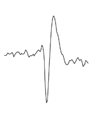

A 2004 BBC Radio 4 documentary on ghostly voices captured on recording equipment called ‘Speak Spirit Speak’ started with a story about Swedish radio operatives during World War II who diligently tracked Nazi radio transmissions – only to discover afterwards that the area they were monitoring never contained any enemy forces.

Despite my attempts to find out more I’ve not been able to discover any other account of this curious incident.

I’ve also heard lots of second-hand stories about people tuning in to what seemed to be feint transmissions in the early days of ham radio only to discover that they were misinterpreting the hiss and whistle of the interference as voices.

However, I’ve not found any other mention of this phenomenon either.

So, do any Mind Hacks readers know where either of these or similar incidents have been documented before?

There have been several similar stories of people hearing what they thought were voices of spirits on electronic equipment (a phenomenon as ‘electronic voice phenomena’ or EVP) and I’m wondering if there have been any documented examples that are less rooted in beliefs about the beyond.

2010-11-12 Spike activity

Quick links from the past week in mind and brain news:

Nature has put all of their schizophrenia special issue articles, features and podcast in one handy accessible page.

There’s an extensive list of psychologists on Twitter over at The BPS Research Digest. Where else do you get to ask psychologists to free associate?

Slate has an excellent piece on why diagnoses of ‘child bipolar disorder’ are skyrocketing in the United States.

A history of cigarettes being edited out of famous photos for modern audiences. Addiction Inbox on tobacco-inspired history editing. Still hungry for, er… less? See the follow-up.

Science News on how minds wander 30 percent of the time during all activities except sex – when we lie back and think of England. God save the Queen.

Missed this last week: ‘What is psychopathology?’ A mini blog carnival hosted by The Thoughtful Animal hits the wires.

The New York Times reports on how the Chinese government are increasingly using psychiatric hospitals to silence dissidents.

The psychology of immersion in video games. An excellent post from the Psychology of Video Games blog covers who games achieve that little touch of the Matrix.

Wired looks back on how the world’s first lobotomy was performed 75 years ago today.

The next step in research showing how a visual-spatial puzzle like Tetris after emotional upset could prevent PTSD-like flashbacks is covered at Not Exactly Rocket Science.

BBC News has video on a robot actress who makes her debut in Japan – who I actually quite fancy until it moves. My eyes! My eyes!

Genes to brains to minds to… murder? The wonderful Neuroskeptic looks at some unusual claims made by a new case study.

BoingBoing has a copy of one of Elvis’s prescriptions. Note to dead Elvis: balanced medical care does not mean uppers and downers in equal proportions.

Want to prove a point about electrical activity in the scalp muscles being confused for brain activity? Why not use an Amazonian neurotoxin to paralyse yourself? Oscillatory Thoughts covers the amazing study.

Discover Magazine has a piece on an interesting theory that a virus may be causing some cases of schizophrenia.

Would you get a tattoo if it was offered free? Perhaps after downing a few beers. Irrationally Yours discusses a curious instant study on a strange promotional offer.

Analysis, the BBC Radio 4 documentary programme, discusses a new UK scheme to rehabilitate offenders funded by bonds. Essentially, you get make money on your investment if re-offending is cut – like betting on social interventions.

A new evidence-based approach to radically re-understanding mental illness from the ground up is covered by an excellent piece at The Neurocritic.

The Chronicle of Higher Education discusses art school and mental health.

Literacy may have stolen brain power from other functions, says Ars Technica. In my case, my sense of style.

All in the Mind, the Aussie one that is, had a brilliant programme on a modular approach to understanding the development of the mind.

Balanced arguments are more persuasive. PsyBlog covers research on how too much rhetorical bias turns us off.

A hazy memory of the happiness disorder

The ex-chief executive of the British Medical Journal has an amusing blog post where he notes how a Phillip Roth novel Sabbath’s Theater brilliantly ‘mimics’ a BMJ Group article on how happiness is a disease, seemingly unaware that his journal genuinely published the article in question.

At one point in the book Mickey is visiting his alcoholic wife in a clinic and after betting on the blood pressure of various patients he encounters a young woman with “a scar on her wrist” who has been in the library of the clinic reading medical journals. She reports “word for word” on what she has read in the Journal of Medical Ethics.

I was stopped short when I read this—because the Journal of Medical Ethics is published by the BMJ Group, and I was responsible for it when I was the chief executive of the group. For a moment I wondered if the piece was really from the Journal of Medical Ethics

Roth mimics well the stilted prose of medical journals with their heavy emphasis on the passive voice. He also mimics the science that leads to problems becoming diseases. The “relevant literature” has been reviewed. This made me think immediately of Stephen Lock, my predecessor as editor of the BMJ, who always struck out “medical literature” and substituted “published reports.” “This stuff is not literature” he used to protest.

In fact, the article was genuinely published in the Journal of Medical Ethics and is titled ‘A proposal to classify happiness as a psychiatric disorder’.

It was written by British psychologist Richard Bentall who, although was clearly having some fun, was also making a serious point about the criteria we use to define mental illness.

Bentall is a long-time psychosis researcher and at the time it was not widely acknowledged that it was possible to have experiences common in diagnoses like schizophrenia, such as hearing voices, without any distress or impairment.

This is why he focuses on the statistical abnormality of the happiness state, its possible neurobiological underpinnings and it cognitive effects, often (over)used to justify why a condition is a ‘real disorder’, and then finishes with “One possible objection to this proposal remains – that happiness is not negatively valued. However, this objection is dismissed as scientifically irrelevant.”

At the time, the satire was widely missed by the British press who ran lots of ‘barmy boffin’ type stories with headlines lines like “Top Doc Talks Through Hat”.

Despite its history of being misunderstood and misremembered, it remains a cutting critique of psychiatric classification and is well worth a read.
 

Link to blog post on Roth’s novel.
Link to full text of article (click PDF link) on happiness as mental disorder.

A psychological rift in the perception of war

BBC Radio 4’s Analysis programme has a fascinating edition on how the public’s psychological perception of war is changing and how this is having an effect on the armed forces.

It’s drawn from a UK perspective and its bookended by a bit of political stuff but the main part is full of interesting observations on how our understanding of acceptable soldiering is changing.

For example, medals for bravery are increasingly given for soldiers who rescue their wounded comrades under fire, rather than for killing the enemy as they used to be, despite the fact that killing the enemy remains a necessary part of a soldier’s job.

The core point of the programme is to explore the how the public and the military view of conflict is diverging and what effect this has on the operations of the armed forces.

Difficulties in adjusting back to civilian life are known to contribute to mental health problems in soldiers and I wondered how much the growing sense of ‘not being understood’ contributes to this but could find no research which directly tackled the issue.
 

Link to Analysis ‘Defence: no stomach for the fight?’
mp3 of podcast of the programme.
Link to text of script.

Scentsuality

I think I may have found the only psychological analysis ever written on the scent of semen. The discussion is from a book called The Smell Culture Reader and it starts with a memorable anecdote about Oscar Wilde whacking off in jail.

I realise none of you are actually reading any more, because you’ve all clicked on the above link and will never get to see the rest of this text.

La la la la la.

Hello?

I’m on the moon!
 

Link to analysis of the ‘Odor of Semen’.

Sliding into psychosis

This week’s edition of Nature is a special issue on schizophrenia and it includes an open-access feature article on the neuroscience of why the disorder only tends to appear in young-adulthood.

One of the themes to come out of the piece is how symptoms of schizophrenia, like delusions and hallucinations, lie on a continuum – the idea being that we all have reality distortions to varying degrees and that these distortions themselves may vary in intensity.

In about a third of people, these will intensify into florid psychosis and a diagnosis of schizophrenia, but for others, the experiences seem self-limiting.

One of the big questions in schizophrenia research is to understand what happens in the mind and brain during this transition and, of course, if possible, to prevent it by early treatment.

This has sparked a great deal of heated debate because up to two thirds of ‘at risk’ people will never develop schizophrenia anyway, and yet might be unnecessarily labeled and medicated.

It’s probably worth noting that the idea of a ‘continuum of psychotic symptoms’ is popular but also still not very well defined, as a locked editorial in the latest issue of Psychological Medicine makes clear.

It’s possible to see a sliding scale in the intensity of experiences, how often they occur, and the emotional impact they have, among many other things, but its not clear how you would go about disproving a continuum in many cases.

The Nature article is a remarkably broad look at the whirlwind of issues surrounding how schizophrenia develops and tackles the issue from the basic neuroscience to the ethics of early treatment.

There’s loads more great stuff on schizophrenia in the same issue, sadly most of it locked out of the internet, but if you want more neuroscience, there is another open-access article on the contentious issue of whether the brain’s glial cells communicate.
 

Link to article ‘Schizophrenia: The making of a troubled mind’.
Link to article ‘Neuroscience: Settling the great glia debate’.
Link to table of contents for this issue.

Best of both worlds

I’ve just read an incredible article on conjoined twins Tatiana and Krista Hogan who have parts of the brain in common and may be sharing thoughts and perceptions.

Adding to the conundrum, of course, are their linked brains, and the mysterious hints of what passes between them. The family regularly sees evidence of it. The way their heads are joined, they have markedly different fields of view. One child will look at a toy or a cup. The other can reach across and grab it, even though her own eyes couldn’t possibly see its location.

“They share thoughts, too,” says Louise. “Nobody will be saying anything,” adds Simms, “and Tati will just pipe up and say, ‘Stop that!’ And she’ll smack her sister.” While their verbal development is delayed, it continues to get better. Their sentences are two or three words at most so far, and their enunciation is at first difficult to understand. Both the family, and researchers, anxiously await the children’s explanation for what they are experiencing.

It’s probably worth noting that while rare, Tatiana and Krista are by no means the only conjoined twins who share a brain.

Perhaps most famous are Lori and George Schappell. If you’re not aware of the Schappells, click the link as they have led amazing lives and would be inspiring individuals even if they were they not conjoined.

This makes me wonder why the issue of shared perceptions has never been tested before.

From a scientific point of view, these studies would be important because parents often swear that their child has ‘special abilities’ which mysteriously seem to vanish when formally tested – as any child psychologist will tell you.

But perhaps it’s simply the case that none of the twins have ever been keen to take part in studies on the effect of having a shared brain.
 

Link to Macleans article ‘A piece of their mind’.

An embedded journalist for neuroscience

I’ve just discovered a new blog called The Brain Detectives by the writer-in-residence at the Montreal Neurological Institute, who has the wonderful job of hanging around and writing-up the most interesting things she hears.

Although the writer, journalist Maria Schamis Turner, has just started, the project looks very promising.

I honestly think that more research institutes should have embedded journalists. Science writing would be greatly improved if the hacks had access to the scientific literature, while the lab rats would get an eloquent interface to the outside world.

If you want a feel for the dispatches coming from the Montreal Neurological Institute, the recent post on homicidal somnambulism (murder while sleepwalking) is great.
 

Link to The Brain Detectives.
Link to piece on homicidal somnambulism.

A poetry of muddlings and loss

Art critic Tom Lubbock developed a brain tumour which estranged him from language in subtle and unpredictable ways. The Guardian has a stunning article where the writer describes how his relationship with language was altered as the tumour encroached upon his brain.

It is one of the most powerfully nuanced accounts of language impairments I have yet read and you can feel the years of art-criticism experience poured into Luddock’s analysis as he charts the effects of the glioblastoma tumour on his temporal lobe.

For a period, suddenly, I cannot speak (or read aloud) any words except the most short, simple, basic. They are fine. And all the rest, the more complex ones, come out as a kind of garbled gobbledygook or jabberwocky. Yet the stress of all the words and sentences – sense or nonsense – is equally and perfectly accurate. I know what I mean to say and to a hearer what I say moves fluently, though in and out of meaningfulness. Simple and comprehensible words punctuate a sequence vocalised out of nonsense.

It is a permanent mystery how we summon up a word. Where are these connections located in the mind? How do we know how we do it and get it right? This mystery only becomes evident when our ability to summon up our words fails.

There are many vivid passages in the piece but I was particularly struck by the most recent October 2010 entry. It is genuinely poetry in the truest sense as it captures the state of the author’s fractured language in both its content and form while subtly communicating the emotional resonance of the changes.
 

Link to Tom Lubbock on when words slip away (thanks @bakadesuyo).

The confusing wisdom of crowds

Bad Science covers an interesting new replication of Asch’s famous conformity experiments – a classic study where participants stated that a line was longer or shorter than it really was simply because others in the room also gave the clearly erroneous answer.

In the original study (there’s some great video here), the other people in the room were stooges, asked by the experimenters to give the wrong answer, but this new study used technology to genuinely show different images to everyone except the conformity target and the results were strikingly different.

Instead of one real subject in a room full of stranger stooges, they used polarising glasses – the same technology used to present a different image to the left and right eye for 3D films – to show participants different images on the same screen, at the same time, in the same room. This meant that friends could disagree, legitimately, and so exert social pressure, but without faking it.

The results were problematic. Overall, sometimes the minority people did conform to peer pressure, giving incorrect answers. But when the results were broken down, women did conform, a third of the time, but men did not. This poses a problem. Why were the results of this study different to the original study?

The point of the piece is to highlight how science actually works, with conflicting results and context dependent changes in outcome, but there’s also a good discussion of possible reasons why the effect wasn’t replicated.
 

Link to Bad Science on conformity and .
Link to DOI and summary of new Asch replication study.
Link to original video from Asch on the conformity experiments.

Grief myths

Myths about grief are so widespread they frequently appear even as guidance for mental health professionals. A new study looked at textbooks given to trainee nurses and found that all had a least one unsupported claim about the grieving process and few had advice drawn from actual research.

Handily, the research paper, authored by nurse and psychologist E. Alison Holman and colleagues, has a fantastic table which lists the common myths about grief and compares them to what we actually know from studies on people who have experienced loss.

General Myths

  1. There are stages or a predictable course of grief that individuals should or typically will experience
  2. There is a specific timeline for when grieving processes will occur

    Emotional experience myths

  3. Negative emotions such as distress, depression, sadness, disorganization, loss of functioning,
    anger, guilt, fear or emotional pain ARE INEVITABLE following a loss

  4. Emotions need to be ‘‘processed’’: expressed, worked through, acknowledged, dealt with, experienced, attended to, focused on, made sense of
  5. Lack of experiencing or expression of emotions (e.g., denial, absent grief, delayed grief, inhibited grief) indicates pathology or negative consequences

    Resolution myths

  6. Recovery, acceptance, reorganization or resolution should be reached in ‘‘normal’’ grief
  7. Failure to find resolution indicates unhealthy, dysfunctional, pathological, or complicated grief

Evidence-based Findings

  1. Not all people experience grief in the same way
  2. Some grieving people do not report feeling distressed or depressed
  3. Some people experience high levels of distress for the rest of their lives without pathology
  4. Repressive coping may promote resilience in some people
  5. Resilience, growth, and/or positive emotions may be associated with loss


Link to PubMed entry for study.
Link to DOI entry for paywalled study.

A shrink among the shady in 1920s New York

Neurophilosophy has a wonderful profile the pioneering forensic psychiatrist and criminologist Carleton Simon who was working the street in prohibition-era New York in the 1920s and 30s.

Apparently, a minor celebrity in his day owing to a constant stream of headline-grabbing busts and scientific discoveries, he has since faded into obscurity but this excellent new piece covers his life, work and innovations.

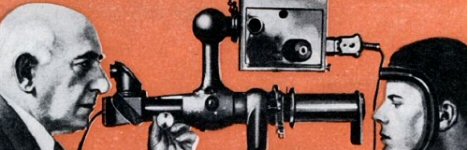
At the forefront of the city’s efforts to keep crime under control was a man named Carleton Simon. Simon trained as a psychiatrist, but his reach extended far beyond the therapist’s couch. He became a ‘drug czar’ six decades before the term was first used, spearheading New York’s war against drug sellers and addicts. He was a socialite and a celebrity, who made a minor contribution to early forensic science by devising new methods to identify criminals. He also tried to apply his knowledge to gain insights into the workings of the criminal brain, becoming, effectively, the first neurocriminologist.

The image above is a photo of Simon with a machine he invented to photograph the blood supply network in the back of the eye, following his discovery that the network of veins is as unique as a fingerprint.
 

Link to excellent Neurophilosophy profile of Carleton Simon.

2010-11-05 Spike activity

Quick links from the past week in mind and brain news:

The science of makeup. An excellent piece on the psychology of how cosmetics enhance allure over at Observations of a Nerd.

The New York Magazine has an excellent piece on how the psychology of narcissism affects politics. Widens from its initial focus on current US politics.

We’re more persuaded when we see similarities between ourselves and others, according to research covered by PsyBlog.

The Onion reports on a hot new relationship book that warns women: Wake Up! He’s A Shapeshifter.

A fascinating history of the “you can’t tell by looking” message in adverts about sexually transmitted infections – by Dr Petra.

Scientific American has another excellent instalment of Jess Bering’s Bering in Mind column on the evolution of obesity.

Retinal implant partially restores sight to blind. The cyber future is here and Not Exactly Rocket Science has an excellent piece on the science.

Wired on a call from US neurologists for strict sports-concussion guidelines after recent research showing long-term dangers.

Does how masculine or feminine a person is predict sexual orientation? asks Barking Up the Wrong Tree

The Lancet has a study on the effect of a recent UK ban on the stimulant mephedrone: still available and twice the price.

Does torture work? asks The Lay Scientist. Does it matter, is probably more to the point.

Science News reports on how the first stone tools in Africa may have been made perhaps 50,000 years earlier than previously thought.

Is there such a thing as a ‘culture of poverty‘? Neuroanthropology take a considered look at the concept.

The New York Times has a piece on how there is an increasing drive to diagnose autism in younger children to try and apply therapy to improve outcome.

What economists refer to as “anomalies” are actually what everyone else would call “real life”. Emorationality on how anomalies in traditional economic theory are actually normal psychology.

Seed Magazine discusses how what goes into placebo pills is barely documented in clinical trials, despite the fact that the ingredients might have an impact.

A new study on brain damage suggests cognition isn’t a localisable as we like to think. Oscillatory Thoughts covers his own study. I think we need more scientists blogging their own research. Good stuff.

Time covers new research finding a specific link between the CNTNAP2 gene and the extent of inter-cortical connections in the brain of people with autism.

There’s a great piece on new ‘designer drug’ mephedrone over at Addition Inbox.

CNN reports on the unusual case where a group of kids saw their dead schoolmate’s brain in a jar on a school trip to the medical examiner’s office.

The designer of the Psychology Today 1970’s ‘racism board game’ comments on our recent post about the product. Some fascinating context.

Gizmodo has some rough Facebook data that shows what time of year relationship breakups are more likely to occur.

The neurochemistry of mood and sleep changes are covered by the excellent Neuroskeptic. Also see his coverage on the ‘bionic eye’ news.

The Varsity has an excellent piece on the psychological management of the trapped Chilean miners.

Dan Ariely on his Irrationally Yours blog lists the ‘Seven Most Powerful New Economists’.

Wired Danger Room reports on how the US Air Force wants neuroweapons to overwhelm enemy minds.

A ‘koro’ penis shrinking panic strikes an Indian labour camp and Providentia has the write-up.

The Independent reports on new revelations on how modern art was used as CIA Cold War propaganda.