Just a quick note to say that the 5th Encephalon neuroscience writing carnival has been published at Developing Intelligence.
Head over there for the latest writing from online neuroscientists…
Just a quick note to say that the 5th Encephalon neuroscience writing carnival has been published at Developing Intelligence.
Head over there for the latest writing from online neuroscientists…
 The Hospital de la Caridad was founded in 1674 by Don Miguel de Mañara to care for physically and mentally ill of Seville who were too poor to afford treatment.
Don Miguel de Mañara was supposedly the inspiration for Byron´s Don Juan as he left a life of debauchery to found the hospital after having an intense religious vision in which he saw his own funeral procession.
He subsequently built the hospital and adjoining church and dedicated his life to charity and the religious order that runs the institution.
The church and hospital are still working, although it now focuses on caring for the elderly of Seville.
Link to Hospital de la Caridad website.
 I am off to deepest Seville for two weeks and I’m not sure how much internet access I will have. As a consequence, updates might be a little sporadic and I suspect will be without illustrations as I doubt I’ll have decent image editing software to hand.
In the mean time, here’s a few articles of interest for those curious about psychology and psychiatry in Spain.
* An article [pdf] about professional psychology in contemporary Spain.
* A piece from The Guardian about a bizarre chapter in the history of Spanish psychiatry where Franco’s psychiatrist tried to prove leftists were clinically mad.
* An abstract from a 1945 American Journal of Psychiatry paper on Spain as the ‘cradle of psychiatry’.
 PsyArt is an online journal dedicated the use of psychology in understanding the impact and meaning of art.
It’s a peer-reviewed journal which has been publishing quality analyses of the art-psychology borderlands for almost a decade now.
The full-text articles are freely available online, meaning you can pass on the links and read the full papers without a subscription.
Recent article include The Silence of Madness in ‘Signs and Symbols’ by Vladimir Nabokov [link] and Perspectivism ‚Äî A Powerful Cognitive Metaphor [link].
Link to PsyArt journal.
I’ve always been slightly suspicious about the Freudian tendency to read meaning into everything. You see hidden meanings and get paid for it and you’re an analyst, you do it for free and you’re psychotic.
I suspect this is why there’s so little psychoanalytic work on psychosis, the infinite regress of hidden meanings would probably cause a dimensional rift and the universe would collapse.
Quick links from the past week in mind and brain news:

Retrospectacle discusses the famous study on London cab drivers that won an IgNobel Award but has actually provided some important findings on adult brain regeneration.
American Scientist talks to psychologist Marc Hauser on the prospect of a moral instinct.
Research finds ‘unique brain gene’ – again.
A Blog Around The Clock asks should we rewrite the textbook on neuron regulation channels?
The ‘Hobbit’ debate rumbles on: New groups of researchers claim that Hobbit was a ‘disabled caveman‘.
A newspaper article in The Telegraph to accompany a recent TV series looks at the influence of biology and genetics on what makes us human.
How do we keep track of multiple objects? Cognitive Daily investigates the latest research.
Nature talks to Nick ‘we’re living in a computer simulation‘ Bostrom about human enhancement and virtue engineering.
A humorous list of logical fallacies in computational neuroscience are unearthed by OmniBrain.
Developing Intelligence looks at the latest research on the tricky problem of visual binding – the ability to combine different sources of sensory information into one conscious perception.
 While many people will get first aid training through school, college or work, few will be taught what to do when they encounter someone who is experiencing severe mental illness and needs help.
An Australian campaign is now trying to remedy the situation by running mental health first aid courses that teaches people the skills they need in an emergency situation with someone who is, for example, suicidal or suffering from severe psychosis.
The campaign also has a website with information and advice so you can educate yourself, wherever you live, so you can help people in crises.
The course manual is online as a pdf file and there’s also some brief advice which is suitable for all situations in which someone might have mental health difficulties.
Apparently, the campaign is going to be launched world-wide, so hopefully courses will be coming to a location near you.
Link to Mental Health First Aid website.
 There’s a curious letter in today’s New Scientist that takes issue with a recent criticism of V.S. Ramachandran’s theory of the neuroscience of art.
The criticism attacks Ramachandran’s theory on the basis that it fails to distinguish between images of big-breasted women such as Hindu statues of goddesses and actual big-breasted women such as Pamela Anderson.
In contrast, the letter to New Scientist says that the comparison is fair because Anderson’s image “is deliberately created using the specific techniques of plastic surgery, diet, exercise, make-up, clothing and photography”.
Hopefully, the world of neuroaesthetics will now be at peace over this particular issue.
Link to letter in New Scientist.
 Wired has a brief interview with Daniel Levitin, ex-rock music producer and current Professor of psychology who is researching the neuroscience of musicians and music perception.
Levitin has just written a book entitled This is Your Brain on Music that describes his own take on how the mind and brain understand music, both as listeners, and as composers and performers.
The book has a flash-heavy website that contains several excerpts and interactive examples as both a preview and an accompaniment.
Levitin’s book comes at a time when there’s a huge upsurge in interest in understanding the neuroscience of music.
For example, there are now labs focusing on music and neuroimaging and the neuropsychology of music.
There’s even a recent academic book on the subject: The Cognitive Neuroscience of Music.
Link to Wired interview with Professor Daniel Levitin.
Link to website for This is Your Brain on Music.
 ABC Radio’s All in the Mind recently hosted a debate for Australian National Science Week on the ‘nature of belief’ where a neuropsychologist, a minister and a science writer got together to discuss one of the most tricky problems in psychology.
Although we use the term belief in everyday life with little problems, it is actually incredibly hard to define with some schools of thought thinking it will eventually be discarded as useless, like other abandoned theories such the four humours theory of medicine.
This is an important issue, as researchers are now working on the neuropsychology of delusions, often described as pathological beliefs, that can occur as part of psychosis after mental illness or brain injury.
Professor Max Coltheart, one of the panel members in the debate, is trying to do exactly this as part of the Macquarie University belief formation research project.
The debate tackles what it means to believe something, as well as issue surrounding why we believe things, and what evidence justifies a belief.
When asked the now classic question “what do you believe is true even though you cannot prove it?” Coltheart gives the wry but accurate answer “everything”.
The show has a half hour edited version, but has also put the whole hour and 20 minutes debate online for those wanting the full story.
Link to All in the Mind webpage with audio downloads of debate.
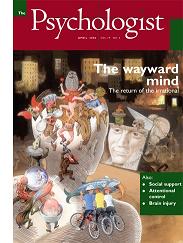 The latest news reports of The Psychologist magazine now appear online first, freely available for anyone to read.
Recent entries include a report on the Royal Institution debate: “What’s the worst ever idea on the mind?”; a discussion of whether increased rates of autism are all down to changes in diagnosis; and – is it the lack of psychologists that makes the Pacific island of Vanuatu the happiest place on earth?
Combined with all its full-length articles older than 6 months also being freely available to view, The Psychologist website now offers a veritable feast of material for anyone interested in psychology (BPS members have full access to all articles).
—
Link to The Psychologist magazine.
Disclaimer: I work for The Psychologist magazine.
 The Psychologist has just released an engaging open-access article on the psychology of celebrity worship [pdf] that attempts to explain why people spend time following the lives of celebrities and what benefits this attraction brings.
In adolescence, when celebrity fandom often peaks, research has suggested that celebrities might function as part of an extended social network.
In effect, these are pseudo-friendships that add to the existing social circle and provide opportunities for discussion, interest or intrigue.
However, there is now an increasing amount of research on people who take their fandom further than casual interest.
‘Celebrity worship’ is when someone spends a great deal of time thinking about a certain celebrity. Although not necessarily pathological, this level of intense interest has been correlated with a number of psychological disadvantages.
One finding is that people who worship celebrities for ‘intense-personal’ reasons (rather than just for the entertainment value) are likely to score badly on measures of cognitive flexibility – the ability to change strategy and switch ideas when problem solving.
It is unlikely that interest in Jessica Simpson affects your ability to reason (although sometimes I wonder), but perhaps those with poor cognitive flexibility are more likely to fixate on celebrities as a way of tackling minor difficulties with boredom or initiating social interaction.
It seems this interest can tip over into disorder for some people, leading to stalking or perhaps even de Clerambault’s syndrome – a psychotic disorder where the affected person has a delusion that the celebrity is in love with them.
The article is written by Drs David Giles and John Maltby, both of whom have conducted extensive research into ‘parasocial’ relationships with celebrities.
Although fascinating in itself, especially as we live in an increasingly celebrity-dominated media, this research has obvious implications understanding the psychology of obsession, stalking and related criminal behaviour.
pdf of article ‘Praying at the altar of the stars’.
I’m going to be in beautiful Seville, Spain, for two weeks from Monday 28th trying to improve my Spanish. If there are any local psychologists, psychiatrists, cognitive scientists or students of the mind and brain who want to meet and chat about psychology and neuroscience while I’m there, drop me a line.
 Mind and brain writing carnival Synapse has just released issue #5 and is hosted on this occasion by Shelley Batts’ Retrospectacle. There’s articles on everything from sleep disorders to moral development to keep you glued to the screen.
Also recently released is the new BPS Research Digest which tackles recent research on the effect of drugs on intuition and medically unexplained symptoms; as well as the psychology of love letters, sickies, cats and war.
 The Washington Post has a review and the first chapter of neuropsychiatrist Dr Louann Brizendine’s book ‘The Female Brain’ (ISBN 0767920090).
Brizendine is founder of the Women’s and Teen Girls’ Mood and Hormone Clinic in San Francisco and her book tackles how biological sex differences have a significant impact on thought and behaviour.
However, the psycholinguists over at Language Log were a bit suspicious about the book repeating a common claim that ‘a woman uses about 20,000 words per day while a man uses about 7,000’.
In a series of posts [one, two, three] Mark Liberman looked for the relevant scientific studies and found that, on average, men use slightly more words per day than women.
Link to Washington Post review of ‘The Female Brain’.
One, two, three links to Language Log analysis (thanks Mageriane!).
So this Flickr group just seems to consist of pictures of beautiful women wearing ‘I [brain] Cognitive Science’ t-shirts.
Why? Your guess is as good as mine…
 Mind Hacks