Virus linked to temporal lobe epilepsy

Open-access science journal PLoS Medicine published a recent study that suggests that infection with the herpes virus might cause temporal lobe epilepsy in some people.

The study found the virus in the brains of 11 out of 16 patients with temporal lobe epilepsy but not in those with other forms of epilepsy.

Studies that test brain tissue are often done post-mortem, on people who have died, because brain surgery is just too risky for the sake of removing samples for research.

This study is particularly impressive because it studied brain tissue from live patients.

In severe cases of epilepsy that don’t respond to medication, one option is to find which bit of the brain triggers the seizures (the ‘foci’) and surgically remove it.

This is particularly effective in people with mesial temporal lobe epilepsy, a type in which the foci is deep within the temporal lobes (mesial means ‘towards the midline’), usually stemming from disturbance in the hippocampus.

The team examined brain tissue removed in operations on 22 patients, and tested it for the presence of the human herpesvirus 6B (HHV-6B).

This type of herpes infection is incredibly common, more than 90% of the population have it. Normally, it’s completely harmless and just lies dormant in the body.

We don’t really know why, but in some people, it seems to reactivate, and is linked to neurological disorders like multiple sclerosis.

The researchers found that it was present in brain cells called astrocytes from 11 out of 16 patients with mesial temporal lobe epilepsy, but wasn’t present at all in patients with other types of epilepsy.

The image on the right is of a herpes infected astrocyte, the infection is visible due to a green marker.

They also studied one patient in more detail. He had four operations in a row, each of which reduced his seizures, until the final one left him seizure-free.

They found that the herpes virus was present most strongly in the temporal lobe tissue from the first operation, was weakly present in later operations, and wasn’t present in other brain areas.

They also found that infected brain tissue didn’t produce very much of a chemical that transports the key neurotransmitter glutamate across the brain.

If it doesn’t get transported properly, it ‘hangs around’, and because glutamate tends to make brain cells more active, too much could lead to overactivity and seizures.

To test the herpes – glutamate link, the team deliberately infected brain tissue taken from a patient without a previous infection.

In the lab, they discovered that herpes slowed the creation of the transporter chemical for glutamate, providing strong evidence for the link.

The evidence from the lab tests, the single case study, and the 22 patients, provides strong evidence that herpes infection could lead to temporal lobe epilepsy in some people.

This is an important finding because it suggests a cause for the disorder in some people, and provides a clear target which could lead to better treatments and prevention strategies.

What is still not clear is why this usually harmless infection might cause some people severe neurological problems, and remain dormant in others.

Link to PLoS Medicine paper.

2007-07-06 Spike activity

Quick links from the past week in mind and brain news:

The Times looks at the effects and treatment of childhood depression.

Sweet smells make pain more tolerable according to research covered by Mixing Memory.

The study that reported that older child had slightly higher IQ than younger children is examined and criticised by Slate.

Is synaesthesia more prevalent than previously thought? asks Cognitive Daily.

Texas prevented from executing (yet another) mentally ill prisoner by the US Supreme Court, reports the The New York Times. Most surprisingly, he was originally allowed to defend himself when obviously psychotic.

New Scientist reports that the current level of testosterone affects men’s judgments of fairness

Is there a specific electrical brain signal linked to face recognition? The Phineas Gage Fan Club investigates.

Yawning cools the brain say researchers in The New York Times.

OmniBrain finds some clay models of sensory and motor homunculi. If you don’t know what they are, have a look!

BBC News reports that contrary to popular belief, men and women speak roughly the same amount. If you follow Language Log, it’s old news of course.

Does your neighbourhood cause schizophrenia?

The results of two new studies suggest that the neighbourhood you live in affects your chance of developing schizophrenia. Surprisingly, neighbourhood seems to have no effect on your risk of bipolar disorder.

The received wisdom says that schizophrenia affects 1% of the population worldwide, with little variation between race, country and area.

The trouble is, the received wisdom is wrong. We now know that the prevalence (total amount of cases) and incidence (amount of new cases per year) varies globally, nationally and locally.

These two new studies, led by Dr James Kirkbride, investigated whether street-by-street differences also have an effect.

The research team examined every person who was treated by mental health services in South East London for a first episode of psychosis over a two-year period.

Psychosis involves delusions and hallucinations and most often leads to a diagnosis of schizophrenia or bipolar disorder, bipolar being most associated with mood problems such as soaring highs followed by crashing lows.

South East London is notable for many things, not all of them positive. It’s a high poverty, high crime, highly urbanised inner-city area.

We know that one of the single largest environmental risk factors for schizophrenia is living in an urban area, and, unsurprisingly, this corner of the UK’s captial has one of the highest rates of psychosis in the world.

The team looked at all the areas, and, controlling for the effects of age, sex and ethnicity, used statistics to test whether any differences between areas were likely to due to chance, or whether they varied enough to be confident that the critical influence was the neighbourhood.

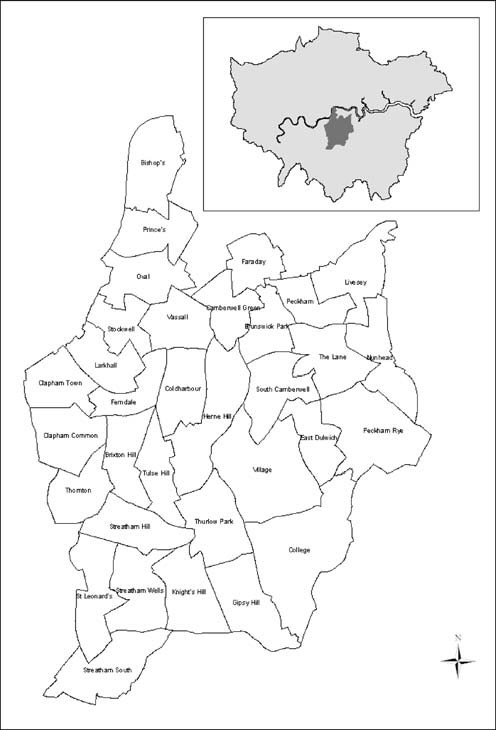
The map on the left shows the variation between neighbourhoods. If you know South East London, click on the map to see how it relates to specific areas.

You”ll notice that the toughest, poorest areas tend to have a higher rate of schizophrenia. In comparison, the rates for bipolar disorder were largely the same wherever the team looked.

Even if you don’t know the area at all, the amount of neighbourhood variation is quite startling. In some cases, moving just a few streets could dramatically affect your mental health.

In a second study, the team looked at characteristics of the area to try and see what risk was linked to.

Some main influences stood out: poverty, ethnic fragmentation, and, surprisingly, local election voter turnout.

In fact, a 1% increase in the number of voters in local elections was linked to a 5% reduction in new cases of schizophrenia.

Voter turnout itself is hardly likely to affect mental health, but the researchers suggest it might reflect the sense of community in the neighbourhood: the more you’re concerned about your neighbourhood the more likely you are to vote on issues affecting the area.

Ethnic fragmentation is a measure of how many people of your ethnic background live in your neighbourhood.

Immigrants are known to be at greater risk of schizophrenia than other people in the country, and South East London has a large immigrant population.

This might mean that contact with a community of people who share your cultural experiences may be protective against mental illness, perhaps again suggesting that ‘community spirit’ is key for mental health.

So why do all these things affect schizophrenia and not bipolar disorder? The researchers don’t discuss it in detail probably because it’s a bit puzzling.

The truth, of course, is just outside the front door.

Link to abstract of ‘Neighbourhood variation in the incidence of psychotic disorders in Southeast London’.

Link to abstract of ‘Neighbourhood-level effects on psychoses: re-examining the role of context’.

Striking perspective shift illusion

I’ve just stumbled across a remarkably simple yet fiendishly effective visual illusion that seems to give flat images the illusions of 3D depth. It works by quickly shifting between two images of the same scene taken from slightly different perspectives.

As we’ve noted when discussing other illusions, our brain generates the experience of seeing a 3D world by making the best it can out of the two fairly poor quality flat images that fall on the back of the retina.

Visual illusions usually have their effect by taking advantage of the brain’s processes for inferring visual features.

These processes are really nothing more than educated guesses, and illusions essentially give the brain red herrings, misleading it to guess in the wrong direction, so we experience one visual feature in a context where it wouldn’t normally appear.

In this case, the illusions give the misleading impression of depth in the context of an entirely flat image.

One clue the brain uses to infer depth is occlusion – things that are near the front of a visual scene will block those at the back. They just get in the way.

In fact, the lines in cartoons or diagrams are often just a representation of the occlusion contours – the edges of where one surface hide another.

However, although we can see that a cartoon drawing of a head is a 3D representation, we don’t experience it as actually having depth. It doesn’t seem to stand out from the page.

The perspective shift illusion flips between two images taken from slightly different perspectives and this seems to add a dynamic aspect – the illusion of movement.

Movement is often crucial for determing something’s depth. Have you ever moved your head side-to-side when you see a puzzling sculpture to try and better understand its shape?

This allows us to see the relative depth of each of the occlusion contours by experiencing how much the foreground moves in relation to the background. Things nearer the front seem to ‘move quicker’ – something known as motion parallax.

I’m guessing by adding an impression of movement – some motion parallax – to a detailed photograph that already has other depth cues from the natural environment, the perspective shift illusion produces an impression of real depth.

If you want to know more about the cognitive science of 3D shape perception, there’s a great review article by available Dr James Todd available online as a pdf file.

Otherwise, just spend a few minutes checking out the impressive visual effect.

Link to perspective shift visual illusion.

The REVERB project

reverblogo.jpgA.k.a part of my day job. I’ve written a short article introducing the project. The last line summarises it pretty well (I think!)


“The goal is to reverse-engineer the computational principles that the brain uses to multi-task”, says Dr Gurney, “and to show that they work in practice, not just in theory, by incorporating them in a robot. In a sense, we’re trying to work out the real-time operating system of our own minds.”

You can read more about REVERB here and the rest of my article here

Duped: Brain scan lie detection

There’s been quite a bit in the news recently about ‘brain scan lie detection’, but The New Yorker magazine have just published possibly the best article I’ve read so far on this intriguing but still-not-very-accurate technology.

It not only looks at the current technology, but also explores the dubious history of lie detection technology from times past.

The article is also remarkably well researched and level-headed, a balance that many stories about the technology sorely lack.

It points out some of the drawbacks of the technology, and some of frankly bizarre pitches being made by commercial companies.

One company recommends brain scans to help with “risk reduction in dating” and “trust issues in interpersonal relationships”!

Don’t get me wrong, people with brain scanners are sexy, but as with many things in life, it’s not what you have but what you do with it. Being shoved in a ‘fMRI lie detector’ by a potential lover would be a definite turn off.

The article is delightfully wide-ranging and talks to plenty of senior psychologists about their views on the technology and why we’re so attracted to brain scan evidence despite its drawbacks.

Really, an excellent piece. Well done New Yorker.

Link to New Yorker article ‘Duped: Can brain scans uncover lies?’.

Dreaming of the dead

The New York Times has an eye-opening article on research that has looked at how contents of dreams can be linked to emotional concerns – particularly when they relate to lost loved ones or turbulent life events.

‘Dream interpretation’ has got a bad name, partly due to the proliferation of books that claim to ‘decode’ dreams on a seemingly random basis (e.g. lemon = unrequited love), and partly because of its importance in the history of Freudian psychotherapy, which is now deeply unfashionable in some quarters.

Unfortunately, this has meant that research on the content of dreams has also fallen out of favour, despite the fact that it remains an interesting scientific topic and is still of clinical concern.

Modern psychotherapists will occasionally get into discussions about dreams, but, these days, will tend to avoid a strictly Freudian approach of trying to ‘interpret’ them.

Instead, they might use them as a point of discussion to make sense of real life concerns.

For example, if you’ve been particularly disturbed by a dream about work, it might be an opportunity to reflect on how you’ve been dealing with work-related stress, particularly if your reaction to the dream was quite a surprise in itself.

The NYT article looks research on the content of dreams, particularly ‘big dreams’: those of a more profound nature, often concerning deaths or other significant losses.

“Back to life” or “visitation” dreams, as they are known among dream specialists and psychologists, are vivid and memorable dreams of the dead. They are a particularly potent form of what Carl Jung called “big dreams,” the emotionally vibrant ones we remember for the rest of our lives.

Big dreams are once again on the minds of psychologists as part of a larger trend toward studying dreams as meaningful representations of our concerns and emotions. “Big dreams are transformative,” Roger Knudson, director of the Ph.D. program in clinical psychology at Miami University of Ohio, said in a telephone interview. The dreaming imagination does not just harvest images from remembered experience, he said. It has a “poetic creativity” that connects the dots and “deforms the given,” turning scattered memories and emotions into vivid, experiential vignettes that can help us to reflect on our lives.

Link to article ‘Winding Through ‚ÄòBig Dreams‚Äô Are the Threads of Our Lives’.

Best of the Brain

A book called Best of the Brain from Scientific American (ISBN 1932594221) turned up unannounced the other day, and so far, I’m very impressed with it.

It’s a collection of twenty one of the most notable mind and brain articles from past issues of SciAm collected in a single volume.

I feel a bit reticent about waxing lyrical about a free book I’ve been sent, but I have to admit, I quite a fan of SciAm and SciAmMind, not least because they always make two feature articles from every issue freely available online which allows you judge the quality for yourself.

In fact, several of the articles from the book have already been made available online:

The Addicted Brain

Unleashing Creativity

Decoding Schizophrenia

Treating Depression: Pills or Talk

Controlling Robots with the Mind

Thinking Out Loud

Unfortunately, it doesn’t seem if the book’s a table of contents is online, as you could get a better idea of the diversity of topics that are covered.

Essentially, if you’re a fan of SciAm psychology and neuroscience writing, you’ll probably like this book. It’s really a greatest hits collection.

As this is the first unsolicited book I’ve been sent, a couple of clarifications. Readers: I’ll always say if a book I mention has been sent to me for free. Publishers: I won’t mention your book just because you’ve sent it to me.

Link to more info on the book.

Drug reduces the impact of traumatic memories

BBC News has a story with the headline ‘scientists can erase bad memories’, which is, at best, nonsense. What has been found is still an important discovery: a drug given during the recall of a traumatic memory can reduce its long-term emotional impact.

The drug is propranolol, a ‘beta-blocker’ that dampens down the sympathetic nervous system.

One of the roles of this system is to prepare the body for ‘flight or flight’ during stressful situations, by, among other things, releasing adrenaline, increasing blood pressure, and upping anxiety.

The drug has been used for years to help people with high blood pressure and heart conditions, so when they get stressed, it doesn’t put such a strain on their heart.

It’s been known for a while that starting a course of propranolol shortly after a traumatic event reduces the chance of people developing post-traumatic stress disorder – a condition that involves intrusive traumatic memories and hyper-arousal.

This new study is important, because it recruited people who had been traumatised a long time ago – an average of ten years earlier.

The participants were asked to recall what happened. Half were given propranolol and half were given placebo.

A week later, the participants were asked to recall the same memory while the researchers measured heart rate, sweating and muscle tension in the face – all of which are measures of bodily stress.

The participants who had been given the propranolol showed significantly less arousal than those who were given the placebo, suggesting the emotional impact of the memories had been reduced.

The fact that this can have an effect ten years after the event, if used when the memory is recalled, is an interesting finding.

Memory is a reconstructive process – in other words, our brain recreates the best estimation of an event each time we recall it. This might be slightly different each time and, importantly, each time we recall something the ‘store’ of information is changed.

It would be like if a CD remembered the other sounds in the room each time it was played, and included some of them when you listened to it again.

Propranolol might work by reducing the stress associated with the memory by influencing the ‘rewriting’ process.

The study is only a clue though. What it didn’t show is that this selectively reduced the arousal associated with that memory (maybe it affected other traumatic memories which weren’t recalled) and there was no group who were only given the drug and weren’t asked to recall anything.

It’s unlikely that the drug can reduce traumatic memories if just given at any time, but its something that needs to be explored to be sure we know how the treatment is working.

UPDATE: The Beeb have changed their headline to the slightly more sensible ‘Drug can dampen down bad memories’.

Link to abstract of scientific paper.

Swarm intelligence and group synchronicity

National Geographic has just published an article on swarm behaviour in animals and how this is being applied to understanding human behaviour and improving complex systems.

The article looks at how whole groups of animals seem to have intelligence, while individually they only seem to be able to perform very simple actions.

One of the big discoveries in this area is that complex problem solving behaviours can emerge from a group of individuals who each follow simple rules.

The article also mentions Craig Reynolds, a computer scientist who has been working on computer simulations of flocking behaviour.

He has a fantastic page with animated demonstrations and explanations of his work if you want to see how it all fits together.

This technology was used to simulate flocks in Hollywood movies like Batman Begins but is also being used by everyone from the military to internet technology companies in an attempt to develop distributed but efficient problem solving systems.

Link to National Geographic article ‘Swarm theory’.
Link to Craig Reynolds ‘boids’ page.

Neuropsychology of hypnosis at Dublin science cafe

I shall be giving a talk at the Dublin science cafe on Thursday 12th July on the neuropsychology of hypnosis. Come along if you’re in the area and would like to join the discussion.

The talk will happen at The Mercantile on Dame Street. We’ll kick off at 7.45pm, it’s free to attend and everyone is welcome.

I’m relatively new to hypnosis research, having started working with a research team investigating the psychology and neuroscience of hypnotisability about a year ago, but am completely fascinated by this intriguing process.

Susceptibility to hypnosis differs between individuals, is stable across the lifespan, and is known to be partly inherited and has been linked to a specific dopamine modulating gene. In addition, structural and functional brain differences have also been found between people who differ in hypnotic suggestibility.

As well as discovering more about the intriguing process of hypnosis, this sort of research is helping us make sense of poorly understood disorders such as conversion disorder – where patients might experience paralysis despite having no detectable physical problems.

For example, one study found that similar brain areas are involved in paralysis linked to conversion disorder, and paralysis caused by hypnosis, perhaps indicating that suggestion plays a powerful role in conversion disorder syndromes.

Other studies have used hypnosis to investigate brain areas linked to experiences of external control in psychosis, pain relief and control of attention in healthy individuals.

I’ll be looking at some of these areas, and others, in the talk, but if you can’t make it, Dr Matt Whalley’s website on the science of hypnosis is probably the single best resource on the net.

Link to talk details.
Link to Dr Matt Whalley’s Hypnosis and Suggestion site.

Encephalon 26 – one year birthday

Issue 26 of psychology and neuroscience writing carnival Encephalon has just been published on the Neurophilosophy blog, returning to where it first started for its first anniversary.

It also coincides with the blog joining the ScienceBlogs fraternity and what better way to celebrate its new home.

A couple of my favourites include an 1880 article from The New York Times which claims that the right hemisphere of the brain is less developed than the left because babies tend to squash the brain by sleeping on their right sides, and one on the recent publication of the ‘cognitive health roadmap‘.

There’s a whole range of other articles, so check it out to see what else is on the menu.

Link to Encephalon 26.

Unconscious inspiration

I’ve just found an article from The Psychologist that examines historical accounts of sometimes world-changing ideas which have seemed to arrive during sleep or dreaming.

The article looks at inspirational slumber which has inspired everything from sewing machine designs to the theory of relativity.

The author, psychologist Josephine Ross, has discovered some great examples. My favourite being from horror writer Stephen King on how the plot for his novel Misery came to him when he fell asleep on a plane.

Ross notes that people’s own insight into whether the dream was genuinely the inspiration may not be entirely accurate.

They may just have been ‘incubating’ the idea (having it ‘at the back of the mind’) and because we sleep so often, it might be easy to attribute it to last night’s dreaming.

However, a study published in Nature in 2004 suggested that sleep might genuinely help in problem solving.

The researchers found that volunteers asked to complete maths problems were three times more likely than sleep-deprived participants to figure out a hidden rule for solving the problem if they had eight hours of sleep.

Link to Psychologist article ‘Sleep on a problem… it works like a dream’.

Psychologists accused of Geneva violations

Salon claims to have uncovered evidence that two psychologists have been involved in developing military and CIA interrogation techniques “which likely violated the Geneva Conventions on the treatment of prisoners”.

The online magazine has been investigating the role of psychologists in ‘war-on-terror’ interrogations for some time.

Last year they broke the story that the American Psychological Association endorsed the participation of psychologists in military interrogations when American medical associations had explicitly banned their members from taking part as they considered it against their ethical code.

The article caused a storm of controversy among psychologists, not least because the committee that drafted the guidelines had a majority of members with direct ties to the military.

Despite protests from members, the APA still fell short of bringing their code of conduct in line with their medical colleagues, although they did require their members to intervene and report abusive practices.

Now, Salon claim that two psychologists have been involved in a joint US military / CIA project to develop potentially abusive interrogation techniques by ‘reverse engineering’ a training programme to help special forces troops resist abusive interrogations.

There is growing evidence of high-level coordination between the Central Intelligence Agency and the U.S. military in developing abusive interrogation techniques used on terrorist suspects. After the Sept. 11 attacks, both turned to a small cadre of psychologists linked to the military’s secretive Survival, Evasion, Resistance and Escape program to “reverse-engineer” techniques originally designed to train U.S. soldiers to resist torture if captured, by exposing them to brutal treatment. The military’s use of SERE training for interrogations in the war on terror was revealed in detail in a recently declassified report. But the CIA’s use of such tactics — working in close coordination with the military — until now has remained largely unknown.

Furthermore, APA members have now written an open letter claiming that another psychologist has been involved in similar practices.

If the accusations turn out to be true, it makes for truly grim reading for a profession that usually prides itself on its ethical standards and robust code of conduct.

Link to Salon article ‘The CIA’s torture teachers’.

Shapes of thought

Neurofuture has picked up on a fantastic science-art project that is creating beautiful ‘thought images’ by visualising EEG readings in 3D.

The project is part of the Einstein’s Brain collaboration which involved two artists, Alan Dunning and Paul Woodrow, and medical researcher Morley Hollenberg.

The image on the left is the visualisation of anger. The image is described:

The shape of anger. Hypnotised participant’s thought form emerges as she recalls an incident in which she became uncontrollably angry. In this visualisation the elements are separated to show background of beta activity from 15 to 25 Hz from which emerges a dynamic form generated by wild swings between beta and alpha activity in the range 4 – 30 Hz, as she oscillated between meditative recall and consciousness.

Link to Neurofuture on the project.
Link to more ‘Shapes of Thought’.

The Brain That Wouldn’t Die!

The classic 1960’s B-movie The Brain That Wouldn’t Die has fallen into the public domain and is now available to download or to watch online.

It’s another classic story of boy meets girl, boy loses girl in terrible car crash, boy keeps girl’s head alive in neuroscience lab while looking for attractive new body.

Needless to say, it all ends in tears, but not before a journey that takes us from the lab, to a cat fight in a strip bar, and back again.

All in the best possible B-movie taste of course with some er… ‘unique’ dialogue that should give any experimental scientist cause for thought:

“The paths of experimentation twist and turn through mountains of miscalculations and often lose themselves in error and darkness!”

Wise words indeed.

Link to download from the Internet Archive.
Link to stream from Google Video.