Hypnosis redux

alert_eye.jpgThanks to everyone who came along to discuss the neuropsychology of hypnosis last night. For anyone who wants to investigate further, here’s more on the psychology and neuroscience of hypnotic states.

Scientific American has a fantastic article on ‘The Truth and the Hype of Hypnosis’ that tackles some of the myths and covers some of the key scientific research.

Psychologist and hypnosis researcher Dr Peter Naish did a great talk last year on the science of hypnosis for the Dana Centre which is available online as an archived video webcast.

WNYC’s RadioLab had a special on placebo and the power of suggestion, which, to be fair, is light on science and heavy on anecdote, although it does make for an interesting listen.

And finally, Dr Matt Whalley’s site is a great guide to science of hypnosis. I keep mentioning it, because, well, it’s excellent.

Terrorism fails because we don’t see its purpose

In an article for Wired, security guru Bruce Schneier suggests that the reason terrorism fails is because it falls foul of a cognitive bias in how we understand people’s intentions from their actions.

Schneier bases his conclusions on a recent paper [pdf] by Max Abrahms who applies correspondent inference theory to terrorism and the political objectives of terrorist groups.

‘Correspondent inference theory’ suggests that we try and understand people’s intentions and character based on the most salient effect of their actions.

This can often lead us astray, as demonstrated by a regular plot line in soap operas where someone’s good intentions accidentally misfire and the person on the receiving end assumes they’re being deliberately malicious.

As noted by Schneier and Abrahms, this also leads us to misunderstand the goal that motivates terrorist acts:

The theory posited here is that terrorist groups that target civilians are unable to coerce policy change because terrorism has an extremely high correspondence. Countries believe that their civilian populations are attacked not because the terrorist group is protesting unfavorable external conditions such as territorial occupation or poverty. Rather, target countries infer the short-term consequences of terrorism — the deaths of innocent civilians, mass fear, loss of confidence in the government to offer protection, economic contraction, and the inevitable erosion of civil liberties — (are) the objects of the terrorist groups. In short, target countries view the negative consequences of terrorist attacks on their societies and political systems as evidence that the terrorists want them destroyed. Target countries are understandably skeptical that making concessions will placate terrorist groups believed to be motivated by these maximalist objectives.

In his paper, Abrahms examines the political objectives of terrorist groups and looks at how successful terrorism has been in obtaining them. He reckons, with a generous estimate, that only 7% of the stated goals have been achieved.

But he also notes that the stated goals rarely gets through to the people being targeted and that the political rhetoric of the terrorists’ target is littered with misunderstandings of their intentions.

I’m personally interested in how and why terrorists are labelled ‘mad’. It’s in the terrorists’ interest to be seen as sane, as part of the goal is to force concessions.

There’s no point conceding to someone who you think is unbalanced, because an irrational group might not stop the violence once they’ve achieved their aims.

The fact that violent protestors are so often labelled as ‘mad’ suggests, as per correspondent inference theory, that we assume their is no coherent intention behind their actions, contrary to what they are trying to achieve.

Anyway, an interesting look at the motivations and perception of political violence.

Link to ‘The Evolutionary Brain Glitch That Makes Terrorism Fail’.
pdf of Max Abrahms’ paper ‘Why Terrorism Does Not Work’

Magnetic brain stimulation not proven to fight depression

At a recent American Psychiatric Association meeting, commercial companies were showing off custom made magnetic brain stimulators as a treatment for depression. A review article in the latest Nature Reviews Neuroscience looks at the technology and finds there’s still no convincing evidence that it’s an effective treatment.

The technology is based on transcranial magnetic stimulation (TMS), essentially a large electromagnetic which is activated near the scalp.

As you might remember from high school physics, a magnetic field that moves over a conductor causes a current. As your brain is a conductor, a current is formed in the neurons which cause them to briefly activate.

After an area of brain is magnetically activated, there are a few hundred milliseconds of inactive ‘silence’, effectively switching the area off, albeit safely and temporarily.

Depending on how quickly these pulses are applied, over a short period of time (typically a few minutes), the overall level of activity in the targeted brain area can be increased, or decreased. A technique known as repetitive or rTMS.

It has been known for a while that patients with depression have reduced activity in the left frontal lobe.

Researchers thought that TMS could be used to increase activity in this area and treat the depression, and so a long series of controlled trials were started to see how effective it could be.

It turns out, TMS does seem to reliably increase activation in the left frontal lobe, but the evidence on whether it actually improves depression in mixed, so mixed in fact, it’s not clear whether overall, it’s an effective treatment at all.

One of the difficulties is that there are so many variables to test out.

TMS can be applied to anywhere on the cortex, at varying strengths, at varying frequencies, at varying angles, with different wave forms and with different shaped coils, just to name a few of the possibilities that don’t include variation in the patients themselves.

Ridding and Rothwell, authors of the review paper, are not impressed with the results so far, but note some areas are promising but under-researched:

It is a sobering conclusion. A new treatment that might help some patients slightly more than placebo, but for which we do not know the most effective dose nor the best group of patients to target. Yet this is not the most worrying thing about the depression story. The main problem is that none of these trials has advanced our understanding of how rTMS may be having any action at all in depression. Trials currently underway are being conducted with almost the same rationale as the initial trials more than 10 years ago. The only changes are in variables such as the subset of patients being studied, or the intensity of the stimulus with respect to the distance of the patient’s brain from the scalp surface. In effect, the science has stood still.

In retrospect, depression was probably a poor choice of condition in which to begin trials of rTMS. It is phenotypically diverse with difficult diagnostic criteria and a subjective clinical evaluation that makes it highly susceptible to any placebo effects of rTMS. Diagnostically simpler conditions that have been studied more recently, such as auditory hallucinations in schizophrenia and tinnitus may prove more tractable. In both cases, rTMS of areas of the parietal or temporal cortices, respectively, have reduced symptoms, in some cases for several weeks after treatment. However, the number of studies done so far is small, and any firm conclusions about efficacy await much larger controlled trials.

This hasn’t stopped a number of companies producing ‘off-the-shelf’ TMS devices to make the technology more accessible to work-a-day psychiatrists, rather than clinical researchers.

There are currently some large scale trials being conducted to test further whether TMS for depression is a useful treatment, but so far, the evidence just isn’t there.

However, one promising avenue might be using TMS as a treatment for stroke – brain damage caused by bleeds and blockages in blood flow.

A different, but perhaps equally effective approach has been driven by a model in which recovery after stroke is suppressed in some patients by input from an ‘overactive’ non-stroke hemisphere. Reduction of the excitability of this hemisphere by low-frequency rTMS has also been reported to increase function, in this instance in a group of chronic patients whose stroke had occurred at least 1 year previously

It’s still early evidence, but it might be that using TMS to target specific symptoms and selective disorders may be more effective than trying to treat the diverse conditions that make up the common psychiatric diagnoses, such as depression, bipolar and schizophrenia.

Link to abstract of TMS review paper (sadly, not open-access).

Synaesthesia in one language only

New Scientist have recently published a fascinating exchange on synaesthesia which has highlighted that some bilingual people with the condition experience the effect in one language only.

A reader wrote in to suggest that the consistently found associations of certain colours with specific letters of the alphabet may be due to with the way the letters are represented in children’s ‘ABC’ books.

Psychologist Dr Julia Simner replied, noting that research shows this wasn’t the case, but most interestingly, her letter indicates that some bilingual people only experience synaesthesia in one language:

Slessenger’s proposal that synaesthetes’ colours stem simply from childhood ABC books is sensible, but has been tested, and rejected, elsewhere. Anina Rich and colleagues traced 136 ABC books published as far back as 1862 – of which, surprisingly, only 38 used colour in any prominent sense. However, only 1 in 150 of their synaesthetes experienced colours consistent with any alphabet book [pdf].

Additionally, although Slessenger’s account is plausible for the examples he provided (eg, “A is for (red) apple, it’s less tenable when the entirety of alphabetic colours are considered. Indeed if synaesthetes’ colours were indicative solely of ABC learning, this would imply they lived in a world of green elephants (E), red mothers (M), black and blue tigers (T) and yellow cats (C).

Instead, our research indicates a different cause: synaesthetes colour their alphabets with a sophisticated, unconscious rule-system, in which, for example, associations are mapped according to the frequency with which letters and colour terms are encountered in the English language. High-frequency letters such as A are significantly likely to pair with high-frequency colour terms such as “red”.

Finally, Slessenger suggests our synaesthetes should be given symbols from an unknown language to test whether associations are independent of experience. This approach has been investigated and proved unhelpful. Strangely, depth of familiarity is not a strong predictor of synaesthetic colouring since some bilingual people have colour in only one language – and some monolinguals have colour for languages they do not understand.

In original letter was in response to a May article on the condition and some of Simner’s research findings. Unfortunately, the main article is behind a pay wall, but the letters are fascinating in themselves.

Link to original letter.
Link to Dr Simner’s reply.

US psychologists to review gay ‘conversion therapy’

Time magazine reports that the American Psychological Association is conducting a review of their policy on treating gay clients, with a particular focus on reassessing guidelines around controversial therapies aimed at assisting gay clients to ‘go straight’.

The APA already have guidelines for working with gay, lesbian and bisexual clients that make it clear that homosexuality is not to be considered a mental illness.

However, a minority of therapists, usually linked to conservative Christian organisations, practice a type of therapy known as ‘reparative’ or ‘conversion therapy’ to assist gay clients who wish to be straight.

This practice is strongly opposed by gay rights groups, who suggest that it is at best futile and at worst harmful, and feel that it is the distress of discrimination that pushes people into starting such therapies.

Neither the current guidelines, nor the APA policy statement on lesbian and gay issues, makes any mention of this issue – something that the review panel is likely to consider in detail.

Gay rights advocates are hoping that the APA will denounce ‘reparative’ or ‘conversion’ therapies while conservative religious groups have written to the APA to defend their work with consenting clients.

As with many of these policy reviews, the arguments centre as much on who has been selected for the review panel as the debate itself:

Conservatives contend that the review’s outcome is preordained because the task force is dominated by gay-rights supporters. “We’re concerned,” said Carrie Gordon Earll of Focus on the Family. “The APA does not have a good track record of listening to other views.”

Joseph Nicolosi, a leading proponent of reparative therapy, predicted the task force would propose a ban of the practice — and he vowed to resist such a move. Nicolosi, who was rejected as a task force nominee, is president of the National Association for Research and Therapy of Homosexuality.

Clinton Anderson, director of the APA’s Lesbian, Gay and Bisexual Concerns Office, insisted the panel would base its findings on scientific research, not ideology. He defended the decision to reject certain conservative applicants to the task force. “We cannot take into account what are fundamentally negative religious perceptions of homosexuality ‚Äî they don’t fit into our world view,” Anderson said.

Link to Time article ‘Psychologists to Review Stance on Gays’.

The relative exposure of our respective arses

In 1980, the New York Review of Books published a heated exchange between psychologist and IQ researcher Hans Eysenck and biologist and IQ skeptic Stephen Jay Gould.

It remains a classic moment in the IQ debate, not least because of the entertaining mud slinging.

The exchange followed a review of Arthur Jensen’s book Bias in Mental Testing by Stephen Jay Gould in which he slams the concept of IQ and general intelligence – the idea that there is a core resource of psychological ability that most mental tasks draw upon.

In the first exchange, Hans Eysenck, one of the world’s most famous psychologists at the time, wrote to the magazine throwing doubt on pretty much everything Gould had to say.

Gould makes a valiant comeback, dismissing most the arguments as attacking him rather than his claims, but notes that one is “the only meat in a sandwich surrounded by too much very stale (if not moldy) bread”.

You can always tell a scientific argument has got interesting when it wanders off the original point and focuses on who can see whose arse.

Eysenck starts the second exchange with “It is always interesting to note the reactions of a critic who is caught with his pants down, and Stephen Jay Gould’s reply to my letter is no exception”.

Gould, unable to resist carrying the metaphor, replies: “I don’t wish to engage Mr. Eysenck in a protracted debate about the relative exposure of our respective arses; nonetheless, I can’t resist noting that his initial remark surprised me because I thought I had caught him in the same unenviable posture he ascribes to me.”

The debate was heated largely because of Eysenck’s controversial views on intelligence. He suggested that IQ was largely determined by genetics and that small but significant differences could be seen between races as a result.

He was accused of being racist, but he claimed he was simply reporting the data from his studies and noted, in his defence, that he found that Asian people typically came out with the highest IQ – hardly the views of a white supremacist.

Gould was shortly to publish The Mismeasure of Man, a book pouring scorn on the whole concept of IQ and arguing that the tests had serious cultural biases built into them so they were never going to be a fair comparison.

The exchange is worth reading in full both to get a flavour of the debate (essentially the same points are still being made today) and, of course, just for sheer entertainment value.

Link to original book review.
Link to round one.
Link to round two.

Edelman on neural darwinism and consciousness

Biologist Gerald Edelman is interviewed in Discover magazine about his views on the brain’s own internal ‘natural selection’ process and its possible role in the development of consciousness.

Edelman won the Nobel Prize in 1972 for his work on antibodies, but later turned to neuroscience and is keen to crack the problem of consciousness.

He argues that pathways in the brain are created by a process akin to ‘natural selection, where the most useful survive.

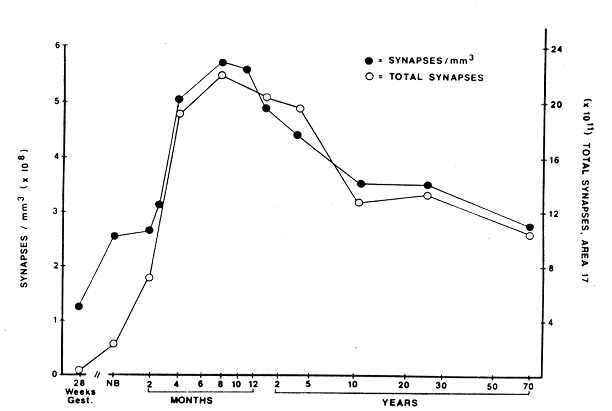
In the first few months of life, the neurons, on average, are more connected with each other than later in life.

If you click here you can see a graph of the number of synapses (inter-neuron connections) present in the human visual cortex by age.

According to the study that this graph is taken from, the peak time for synaptic connections is 6 months old. After that the number rapidly decreases.

This happens because connections that aren’t used disappear on a ‘use it or lose it’ basis, and the ones that are left form the more permanent connections in the brain.

In other words, from all the random variation, the weak connections die out and the strongest survive.

Edelman also argues that this principal applies to larger patterns of activity in the brain – with past and ongoing experience determining what can be considered useful.

Edelman talks about his theory and how he thinks it is crucial in understanding consciousness, and also how his research group is attempting to build robots based on the same principal.

Link to Edelman interview in Discover magazine.

John Nash speaks to American psychiatry

John Nash, Nobel prize winning mathematician and subject of the Oscar winning biopic A Beautiful Mind, delivered a speech to the American Psychiatric Association’s annual conference. In his talk, he suggested that mental illness may be the result of the otherwise healthy evolution of mental diversity.

Applying his specialized understanding of “game theory” to an analysis of mental illness and his own experience with psychosis, the 79-year-old Nobel Laureate suggested that severe mental illness exists in nature as a consequence of the diversification of species, and that it may serve the needs of adaptation by its not infrequent association with genius.

It is a line of thinking that has been followed by such renowned psychiatric researchers as Nancy Andreasen, M.D., and Kay Redfield Jamison, Ph.D.

At the same conference, model and actress Brooke Shields spoke to the conference about her own experience of post-partum depression – the depressive disorder that occurs after giving birth in about 1 out of every 10 women.

Link to Psychiatric News on Nash’s speech (via FuriousSeasons).
Link to Psychiatric News on Shield’s speech.

Neuropsychopharmacology: The Fifth Generation

The American College of Neuropsychopharmacology have made a huge text book freely available online that covers the cutting edge of pretty much everything we know about how drugs affect the mind and brain.

Psychopharmacology is the science of how drugs affect the mind. You can do this without a huge understanding of brain function. You can just see how different drugs affect people’s mental state.

This was pretty much how many of the early drug treatments in psychiatry were discovered.

For example, the first antipsychotic, chlorpromazine, was developed in the 1950s as an antiemetic, a drug to prevent vomiting.

However, the French doctor Henri Laborit noticed that it induced a sort of ‘indifference’ to the world, and wondered whether it might help calm patients with mental illness who were agitated.

It was discovered that this drug was the first effective treatment for psychosis, and for several decades, psychopharmacology research simply tested various derivatives without a good understanding of how they were affecting the brain.

Neuropsychopharmacology adds neuroscience into the mix, and attempts to explain how drugs have their effect by studying how they interact with the biology of the brain.

It’s an incredibly important science, not only for the purpose of developing new treatments, but also for understanding how any drug (be it aspirin, cocaine or caffeine) has its effect.

The online text book, entitled Neuropsychopharmacology: The Fifth Generation reviews a huge, and I mean HUGE, amount of research into this area.

It’s an academic text, so is very in-depth, but is a fantastic resource to have freely available on the net.

Link to Neuropsychopharmacology: The Fifth Generation.

Neurobiology of addiction in Time Magazine

Time magazine has an article that investigates the neuroscience of addiction and why some people find it so hard to give up drink and drugs.

The article takes an approach to addiction know as the ‘disease model’.

In its strongest form, this theory suggests that some people have a particular neurological weakness that makes them more likely to become addicted when they encounter certain substances.

Essentially, it suggests that the ‘disease’, often considered to be genetic in origin, exists before the problem behaviour.

The actual addiction is thought to be an interaction between the disease and the substance which leads to compulsive substance taking and seeking.

However, it’s also important to realise that many of the most addictive drugs directly affect a system that is also involved reward processing.

In other words, the thing that makes you feel good also affects the system that helps you judge how valuable things are.

This tends to affect your judgement of how bad you want something, and, over time, the system becomes more sensitive so it increases desire more easily,

This is known as the incentive-sensitization view and is one of the most influential neurobiological theories of addiction [pdf].

However, it has largely been developed on the basis of animal research and has been criticised for ignoring social factors.

For example, Jim Orford’s influential book Excessive Appetites (ISBN 0471499471) notes that heavy consumption of the same substance can have a very different impact depending on the cultural context.

Other than its (perhaps deliberately) narrow focus, the Time article is a competent look at the neurobiology of addiction.

UPDATE: Grabbed from the comments – a sharp-eyed observation from Resa:

I was reading this article the other day, and to my amusement, the pituitary gland had been incorrectly labeled as the amygdala in the illustration of the dopamine reward pathway. This little mishap is present in both online and print versions of the article.

You can see the offending diagram here.

Link to Time article ‘How We Get Addicted’.

Wellcome galleries of the mind and brain

Biomedical research charity the Wellcome Trust have made their image library available online. Searching for ‘brain’ or ‘psychology’ images produces hundreds of wonderful pictures from both the cutting edge of cognitive science and neurological investigations from times past.

All the images have been released under a Creative Commons licence, so you can use them without charge for non-commercial purposes.

It’s a really wonderful collection from both a scientific and artistic viewpoint and is enormously good fun to explore.

Link to front page of Wellcome Images (via BoingBoing).

Williams Syndrome and the genetics of sociability

The New York Times magazine has a great article on Williams Syndrome, the genetic disorder which leads to cognitive impairment, but with normal language and an outgoing and ‘chatty’ personality.

The article investigates the impact of this condition, but also explores what it tells us about the genetics of sociability.

Williams Syndrome results from the deletion of region q11.2 (section 11.2 of the ‘q’ or long arm) of chromosome 7. This causes 20 or so normally present genes to be missing.

The syndrome is associated with learning difficulties, slight facial differences and heart problems (not unlike several other genetic syndromes that affect the brain).

However, people with the syndrome are notable for their interest in language and conversation. They will often have a surprising vocabulary and delight in unusual words.

They also have what has been described as a ‘cocktail party personality’, meaning that they are outgoing, gregarious but often aren’t capable of dealing with deeper social issues because of their lower IQ.

The online article also has a video interview with someone with the syndrome who explains how it affects them and their family.

If you’re interested in hearing more about Williams Syndrome, NPR had an excellent radio show about it last year that’s well worth listening to.

Link to NYT article ‘The Gregarious Brain’.
Link to NPR programme ‘Williams Syndrome: It’s Not a Fairy Tale’.

SciAmMind – a slight return

Scientific American Mind usually make two of their feature articles freely available online. This issue, they seem to have substituted their articles at ‘half time’, as two new articles have become available from the June / July issue, while the two that were previously available have disappeared behind a pay wall.

One of the new articles is on how to recognise good quality advice and expertise in the cognitive, neuro and medical sciences.

The other is on the role of ‘mirror neurons’ in recovery and rehabilitation after brain injury and stroke.

I’ve got mixed feelings about this really. While its always good to have new quality mind and brain writing available, one of the attractions of SciAmMind is that freely available articles from past issues are always accessible.

Link to contents with links to freely available content (thanks Scott!)

The Cramps: Live at Napa State Mental Hospital

During a 1978 tour, psychobilly punk band The Cramps created one of the strangest moments in the history of both rock n’ roll and psychiatry when they played a gig inside Napa State Mental Hospital.

It’s hard to believe it actually happened. The story sounds more like an exaggerated rock legend than an account of a real concert, but no suspension of disbelief is needed. Someone filmed the gig.

We can only guess how the band got permission to play inside one of California’s biggest mental institutions, but play they did, to a few supporters and a fired-up crowd of psychiatric inpatients.

The footage is grainy, black and white, and chaotic, and we immediately see the band launch into a high-energy version of Mystery Plane.

The onlookers look bemused at first, a few start dancing, a few just wander.

As the first song fades, the lead singer, Lux Interior, addresses the crowd: “We’re The Cramps, and we’re from New York City and we drove 3,000 miles to play for you people.”

“Fuck you!” a patient yells back.

He cracks a smile. “And somebody told me you people are crazy! But I’m not so sure about that; you seem to be all right to me.”

The gig ascends into pure punk rock chaos.

Patients jump on stage and pogo like they were Saturday night regulars. Lux suddenly duets with a member of the crowd who grabs the mike and adds her own improvised lyrics to the mix.

One song finishes with the lead singer sprawled on the floor with two female members of the audience. One of them shouts “I got the Cramps!” Lux replies “That’s your problem, honey. I got ’em myself, and I can’t do anything with ’em, either.”

As with Johnny Cash’s landmark concert, played a decade earlier in Folsom Prison, it would be easy to assume that the onlookers are intended to be part of an ironic publicity stunt.

But one thing is striking from both of these shows: the audience wouldn’t have looked out of place at any other date on the tour.

Cash and The Cramps are unlikely bedfellows, but both took their music to the marginalised and hinted that we’re not so different from those we lock away.

OK, so The Cramps didn’t hint. Punk isn’t like that. But then again, the fans have hardly been known for their conformity either.

Link to YouTube clips of Live at Napa State Mental Hospital.