2008-07-18 Spike activity

Quick links from the past week in mind and brain news:

One I missed before – The New York Review of Books has an extended and thoughtful review of a stack of cognitive science books and Neurophilosophy has a great commentary.

The New York Times reports on the challenges of $600-a-session patients. Interesting to note it’s all described in terms of psychoanalysis – a therapy strangely ghettoed among the well-to-do.

TV producer creates a video documentary about his brain surgery for Parkinson’s disease.

Neuroanthropology discusses the best way of going about studying neuroanthropology and the problems you might face from other researchers worried about this crazy new mix of neuroscience and culture.

The history of the Wisconsin Card Sorting Test is covered by Advances in the History of Psychology.

Wired notes that victims of ‘mind control‘ are to gather in Connecticut for a annual conference.

Fluoxetine for Fido. The New York Times examines the growing trend for using psychiatric drugs on pets.

To the bunkers! Channel N has a video on neurorobotics.

The BPS Research Digest finds a video discussion between psychologist Jonathan Haidt and political scientist Will Wilkinson on the psychology of morality.

Research finding <a href="http://scienceblogs.com/notrocketscience/2008/07/infants_remember_more_by_chunking_groups.php
“>memory ‘chunking’ in infants is covered by the excellent Not Quite Rocket Science.

SharpBrains has one of its bi-weekly round-ups of its interviews and all that’s new in the world of cognitive enhancement.

More from The New York Times, this time on the commercial release of the Emotiv Systems ‘brain reading’ gamer’s headset.

Cognitive Daily report on how playing video games can improve visual acuity.

Wall-E and and the evolution of emotion expression is discussed by Frontal Cortex.

One step beyond

Neurophilosophy has found a fascinating black and white TV documentary on Mexican hallucinogenic mushrooms from 1961, where the presenter samples some of the psilocybin-containing fungus and reports the effects during the trip.

In the January 4th, 1961 episode of One Step Beyond, director and presenter John Newland ingests psilocybin under laboratory conditions, to investigate whether or not the hallucinogenic mushroom can enhance his abilities of extra-sensory perception.

The programme was apparently inspired by a 1959 book called The Sacred Mushroom, by parapsychologist Andrija Puharich, who is known for taking the spoon-bending fraudster Uri Geller to the United States for investigation.

As Neurophilosophy notes, this was before the dawn of the psychedelic age, and so it was unlikely that this would have been connected to drug culture as we might do today, but was likely to be viewed as a documentary on the strange ways of ‘them overseas’.

It has some interesting parallels to a 1955 BBC documentary on mescaline, where the Labour MP Christopher Mayhew took a fairly stiff dose and narrated the effects (“Tubby is disappearing in time…”).

The magic mushroom documentary also has some wonderfully stilted dialogue in places, and mentions that they could be used to treat mental disorder – an area which is being researched once more.

We’ll have some more on this research shortly, so look out for a forthcoming interview.

Link to Neurophilosopy with documentary video.

Audio rising high illusion

I’ve just found this fantastic auditory illusion after browsing through Tom’s blog. It’s a YouTube video but the visuals are just text, all you need to do is listen and replay.

It’s like the audio equivalent of a moving spiral. It always seems to be moving up but you realise after a while it can’t possibly be going anywhere. It’s remarkably compelling though.

I’m afraid I don’t know much about how it works, but I suspect it’s a form of Shepard tone.

The Shepard tone link above is a Wikipedia page, and if you scroll down through the page there’s a nice example of a continuous tone which seems to have the same effect.

The article also mentions that the effect has been used in the Muse song ‘Ruled by Secrecy’.

Link to rising tone illusion (via Idiolect).
Link to Wikipedia page on the Shepard tone.

Crumbling cuckoo’s nests

Time reports that Oregon State Hospital, the psychiatric hospital used to film the Oscar-winning movie One Flew Over the Cuckoo’s Nest, is being demolished.

It’s not the hospital that Kesey based his play on, but it’s interesting that even the demolition of the hospital which was the background for the movie makes big news.

The book, film and play have fascinated me for years, not least because they are still where most people get their mental images from when they think of a psychiatric hospital. Needless to say, the images are usually pretty stark.

The other image people seem to have, which I call the ’12 Monkeys’ scenario, is where lots of wacked out patients wearing pyjamas acts as if they’re in a world of their own, while a TV set shows old cartoons in the corner.

Needless to say, modern hospital care bears little resemblance to these stereotypes and tends to go from what I call ‘airport departure wards’ at the worst (full of bored people, sitting around, waiting to leave) to comfortable and relaxing environments with constructive activities available and a good medical team at the best.

However, there is generally a move away from monolithic psychiatric hospitals to having psychiatric wards as part of general hospitals.

As we noted earlier this year, the sometimes beautiful buildings of these older hospitals are rapidly disappearing, often because people are uncomfortable with either the troubled past of the hospital, or with the idea of madness in general.

On a similar note, ABC Radio National’s All in the Mind has just started a 3-part series, exploring the oral history of one of Australia’s biggest and oldest hospitals, built in 1865.

Link to Time article ‘Cuckoo’s Nest Hospital to be Torn Down’ (via BB).
Link to AITM on the history of Goodna Mental Hospital.

Tom Wolfe on a decade of neuroscience

I’ve just got round to watching the Seed Salon discussion between novelist Tom Wolfe and neuropsychologist Michael Gazzaniga where they debate free will, criminal responsibility and the similarities in the creative processes of writers and scientists.

Wolfe is best known as the author of ‘The Electric Kool-Aid Acid Test’ and ‘The Bonfire of the Vanities’, but wrote a highly influential 1996 article for Forbes magazine titled ‘Sorry, But Your Soul Just Died’.

The piece is worth re-reading now because its a look ahead to the forthcoming neuroscience revolution written 12 years ago, when the ‘Decade of the Brain’ initiative was only just past the half way point.

It’s revealing because it describes a society still quite resistant to what we consider relatively banal in 2008 – the fact that there may be neurobiological or genetic factors to behavioural differences.

It also fortells our concerns over widespread use of methylphenidate (Ritalin) in children and the interest in a psychology of happiness, but does have a curious paragraph about the ‘IQ Cap’ which could apparently predict IQ to within half a standard deviation based on an EEG reading.

As far as I know, it’s never been heard of since and seems to have been lost in history, presumably as it sounds a bit far fetched and probably never worked as advertised.

Link to Wolfe and Gazzaniga discussion.
Link to ‘Sorry, But Your Soul Just Died’.

The future is nonlinear

There have been some excellent articles recently on the psychology of time but one of the most fascinating is from Developing Intelligence who look at a new study that suggests our concept of time becomes nonlinear as we look into the future – in other words, not all futures are equal.

The research, led by psychologist Gal Zauberman, riffs on an effect called ‘hyperbolic discounting‘, where immediate rewards seem more valuable than rewards in the future.

Studies have offered people, for example, ¬£5 now, or more money in the future. Despite the fact that in economic terms they’re better off waiting even for a small amount more, people tend to want considerably more money in the future to make the wait ‘worth it’.

As the DevIntell article notes, this has largely been explained by impulsivity in the past, but a new study considers a radical alternative.

What if the effect is not because we’re impulsive, but because our concept of time is non-linear? In other words, we are reasoning rationally but not on the basis of how much additional time there actually is, but how much longer the wait seems.

These are quite different concepts – for example, we know logically that waiting four weeks is exactly four times as long as waiting a week, but it might not feel exactly four times as bad.

The study asked participants how much extra they’d have to be paid to receive a $75 gift voucher, either in 3 months, 1 year or 3 years. They also had to mark a line to indicate how long each wait seemed, from ‘Very Short’ at one end to ‘Very Long’ at the other.

When compared against the actual time, participants seemed to show hyperbolic discounting, but when compared against the subjective judgement the discounting effect disappeared.

The study goes on to test the effect in different ways, but also added another intriguing angle – when participants were asked to estimate the duration of how long various activities would take, essentially better calibrating their subjective time with actual time, the discounting effect was reduced.

I also really recommend another recent DevIntell post on time perception, discussing how cognitive science theories are attempting to explain how we can perceive something that doesn’t have any ‘sensation’ attached to it.

Any if you’re still hungry for more time, science writer Carl Zimmer has an article in Discover Magazine about how the brain keeps track of time.

Link to DevIntell on distortions in future time perception.
pdf of full-text of study.
Link to DevIntell on time perception and time ‘sensation’.
Link to Carl Zimmer’s article on neuroscience of time.

Neuroscience recordings

If the words Neuroscience Recordings make you think of depth electrodes, you may be surprised to hear its also the name of a record label specialising in techno and trance.

I am rather taken by this track, although even if techno isn’t your thing, they do have this rather catching range of t-shirts.

Now if only someone would name their record label ‘cognitive neuropsychology’ I’d have a great excuse for wearing a geeky cognitive science t-shirt without having to admit that I’m wearing a geeky cognitive science t-shirt.

No ladies, it’s not an anorak, it’s a light-weight sports jacket.

Link to Neuroscience Recordings.

Visual cliff hanger

Vimeo has some video of what looks like footage from Gibson and Walk’s original 1960 ‘visual cliff’ experiment where they tested whether infants had depth perception by attempting to get them to walk over glass plates suspended above a drop.

Unfortunately, the video doesn’t fully describe the experiment, which is a pity as it was a fantastic idea.

The researchers wanted to find out whether 6 to 14 month-old infants could perceive depth. Babies are not the best conversationalists, but they do have a natural sense of danger, so the experiment is based on the idea that the babies will avoid perceived danger, even if it’s completely safe.

The study put the infants, one at a time, in the middle of a table, with one side replaced by glass so you could see the ‘drop’.

Their mothers would try and tempt them over both sides, and if the kids had no depth perception, the glass ‘drop’ wouldn’t seem scary and they’d just walk straight over. Those who could see the ‘drop’ would avoid it.

Pretty much none of the infants wanted to walk across the ‘visual cliff’, suggesting that even kids of 6 months old could perceive depth.

Children younger than that generally can’t crawl though, so it makes it a bit harder finding out at what age depth perception develops.

In 1973, a study by psychologist Andrew Schwartz placed five and nine-month olds on each side of the ‘visual cliff’ and measured their heart rate.

When placed over the glass ‘drop’, the five month olds typically showed no increase in heart rate, suggesting there was no danger response. This suggests depth perception probably kicks in between about five and six months old.

More recent research has shown it’s a more complex picture than this, as depth perception has many parts which don’t all seem to develop at the same rate, but the ‘visual cliff’ experiment is still widely used in psychology.

Link to video of ‘visual cliff’ experiment.
Link to text of original study.

Bonkersfest! strikes this Saturday

Bonkersfest! South East London’s fantastic festival of mirth and madness, kicks off this Saturday with its biggest ever event. It’s also finally getting the recognition it deserves with a fantastic article in The Times and another in the New Statesman covering the upcoming celebrations.

In fact, it was also recently name dropped in a Guardian article and a story in The New York Times, although I can proudly say that we covered the mayhem back when it first started in 2006, when it was launched by the Mayor of Southwark firing a banana laden cannon.

From The Times:

So Dolly Sen, 37, an artist and writer, will spend the day trying to screw a light bulb into the sky because “the world is dark enough as it is”. There will also be a moving padded cell, a de-normalisation programme, and performance art by Bobby Baker featuring seven adults dressed as frozen peas.

Does it sound a bit crazy? Well, that’s the point. “There’s a history of many artists and writers being diagnosed with mental illness,” says Baker. “People who were unusual and different used to be more celebrated and accommodated, but now there’s a tremendous amount of fear. I feel people like me have a sensitivity and creativity that is very valuable, as well as an enormous sense of humour about the whole thing.”

The irreverent tone and celebration of all things outside the norm make it quite different from your average mental health event – even if the rock bands, circus performers and techno DJs are also a giveaway.

Bonkersfest! has just got better each time and always seems to be blessed by wonderful weather and great performers (although, I have to say, I did almost evaporate waiting for John Hegley to come on stage in a rather warm marquee last year).

It’s organised by Creative Routes, a grass roots arts association for people with mental health difficulties, who are one of the gems of South London.

It happens on Camberwell Green (not the site of the original Bedlam Hospital, as the NYT seemed to think) but still only two minutes walk from the Maudsley Hospital – the spiritual home of British psychiatry.

The Times article also features Liz Spikol, whose name I’m sure you’ll recognise if you’re a regular visitor to Mind Hacks.

Also, one of the organisers of Bonkersfest! changed her name by deed poll to Sarah Tonin, and you gotta respect that.

Link to Bonkersfest! website.
Link to article in The Times.
Link to article in the New Statesman.

Facebook ate my psychiatrist

Sometimes I just despair. I almost understand it when the media gets its knickers in a twist about ‘internet addiction’ and similar nonsense, because most outlets never been great at separating the wheat from the chaff. But it beggars beliefs why otherwise respectable professionals can spout similar drivel when they’re supposed to be trained to deal with the evidence.

Case in point. At the recent Annual Meeting of the Royal College of Psychiatrists Dr Himanshu Tyagi gave a widely reported talk where he said social networking sites like Facebook and MySpace could damage young people’s relationships and make them more susceptible to suicide, despite the evidence suggesting exactly the opposite.

On this occasion, the icing on the cake was provided by the Royal College, who for some reason decided to press release this scandalous scaremongering.

I shall reproduce the critical paragraph below, because it pushes so many media panic buttons you’d think it was from one of the UK tabloids:

‚ÄùThis is the age group involved with the Bridgend suicides and what many of these young people had in common was their use of Internet to communicate. It’s a world where everything moves fast and changes all the time, where relationships are quickly disposed at the click of a mouse, where you can delete your profile if you don’t like it and swap an unacceptable identity in the blink of an eye for one that is more acceptable,‚Äù said Dr Tyagi. ‚ÄúPeople used to the quick pace of online social networking may soon find the real world boring and unstimulating, potentially leading to more extreme behaviour to get that sense.

”It may be possible that young people who have no experience of a world without online societies put less value on their real world identities and can therefore be at risk in their real lives, perhaps more vulnerable to impulsive behaviour or even suicide. This is definitely a line of reasoning that warrants more investigation and research.”

So what evidence is there that Facebook damages social relationships? None. In fact, less than none because the little amount of existing research suggests it actually encourages social cohesion.

One recent study published in the Journal of Computer-Mediated Communication found exactly this and noted that “students reporting low satisfaction and low self-esteem appeared to gain in bridging social capital if they used Facebook more intensely”.

Another study found that students use Facebook to enhance relationships they already formed in real life. One study did find that using such sites could lower self-esteem, but only when (wait for it) users got negative feedback from others, it boosted self-esteem when they got positive feedback.

Furthermore, the fact that Tyagi and the Royal College are allowing a link to be made with a spate of suicides in Bridgend is in really bad taste.

Bridgend is a county in South Wales that has suffered a number of suicides of young people during the last year, and the UK tabloids initially ran scare stories about ‘internet suicide cults’ because almost all of them used social networking sites.

I’m sure you’ve already picked up on the flawed logic here, and, indeed, this theory was quickly dismissed by the authorities (presumably alongside the ‘eats crisps’ and ‘wears jeans’ suicide cult theories).

So goodness knows why the Royal College are promoting this tasteless insinuation alongside a load of evidence-free and frankly sensationalist drivel.

Oh, did I mention that Tyagi is a partner in a large online medical education website for doctors?

Link to Facebook study.

Psychiatrists’ association faces drug funding probe

After a number of investigations into the under-disclosure of drug industry earnings by top psychiatry researchers, The New York Times reports that US Senator Charles Grassley is aiming at the mothership of American psychiatry, the American Psychiatric Association.

Grassley is a Republican senator who has been pushing for transparency in the drug industry for some time and has particularly focused on drug payments to researchers and clinicians in recent months.

He’s been behind some recent high profile investigations which have indicated that some of America’s most influential psychiatrists have been receiving millions of dollars in undisclosed payments.

Grassley has recently focussed his attention on the APA itself, which, according to the NYT piece got about $20 million from the drug industry in 2006. These 2006 figures are the most recent, however, as the full details of the association’s funding are not made public.

The issue is not solely one about funding large organisations or the high flying opinion-leaders though.

Soft money is awash throughout the profession with drug company bonuses being routinely paid to individual psychiatrists who agree to talk on behalf of the company, while those that don’t take hard cash are likely to be taken out for expensive meals, given all expenses trips to plush conferences and given other barely-concealed incentives.

However, it is clear that this is not solely a problem with psychiatrists, as patient groups are often heavily funded by the drug industry, to the point where they’ve been described as being “perilously close to becoming extensions of pharmaceutical companies’ marketing departments”.

Link to NYT article on scrutiny of APA funding (via Furious Seasons).

Punk rock pogo robots

In early July, London’s Institute of Contemporary Arts hosted three nights of punk rock chaos with a difference, some of the audience were artificially intelligent robots designed to pogo when they recognised punk music being played.
The project was led by artist Fiddian Warman who created the headlining band, Neurotic and the PVC’s for the event, while collaborating on the robot design with computational biologist Peter McOwan and neurologist Barry Gibb.

Actually, this is not the first time we’ve had to resist making a Bee Gees joke about Dr Gibb, as we covered some of the media (over)excitement about a bit in his book The Rough Guide to the Brain last year.

The website for the project is fantastic and has lots of details about the project including a bit about the design of the neural network built and trained to recognise punk rock.

BBC News has some great video of the gigs, and the band even has its own MySpace page with some of the tracks ready for listening (which are actually pretty good).

Link to Neurotic and the pogoing robots website.
Link to BBC News story and video.
Link to Neurotic band MySpace page.

2008-07-11 Spike activity

Some slightly belated links from the past week in mind and brain news:

Ben Goldacre’s Bad Science follows up the piece on the ‘mobile network causes suicide’ nonsense, plus an interesting additional section on the plausibility effect.

Not Quite Rocket Science discusses the ‘Lady Macbeth effect’ and how physical cleanliness moral cleanliness are linked.

The recent study on mapping the brain’s white matter network is discussed in a short video by Scientific American.

The Boston Globe has an article about the recovery of child psychologist Seymour Papert, who suffered a serious brain injury 18 months ago.

My Mind on Books lists some forthcoming cognitive psychology books for 2008.

A career in forensic psychology is discussed by US psychologist Stephen Diamond.

The science of how melody and harmony combine to produce music is covered by Seed Magazine.

The New York Times reviews the debut novel of medic Rivka Galchen which seems to be about the Capgras delusion.

Better golfers see bigger holes according to research covered by PsyBlog.

Neuroanthropology looks at the work of anthropologist Felicitas Goodman on the connection between trance states and body posture which has some interesting parallels between work on hypnotisability and body posture.

Genes implicated in learning may also be linked to autism, reports Scientific American.

The Situationist has a video of Sam Gosling discussing his new book Snoop: What Your Stuff Says About You.

Call-Me-Kenneth prototype the Care-o-Bot is profiled by the AI and Robots blog.

The Neurocritic discovers the newly launched photoshopped ‘Journal of Speed Dating Studies’. No, really. No, not at all it seems!

United States of Analgesia

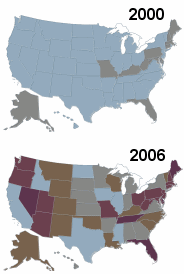
DrugMonkey has alerted to me an interactive map of the USA which displays rates of prescription drug abuse across all 50 states.

You can select the year up the top, the drug of abuse on the left-hand side, and point the mouse at a particular state to get the details.

It’s part of an investigation by the paper into why so many of these drugs are being used illicitly, and why Nevada, the state in which Las Vegas resides, seems to have one of the highest rates of abuse.

All the drugs are opioids and the maps on the right show the rates of consumption for oxycodone, a drug nicknamed ‘hillbilly heroin’.

You can see how the 2000 map clearly shows the highest rates of consumption in the ‘hillbilly’ areas across the Appalachian Mountains, although by 2006 the West Coast has caught up and most of the rest of the country seem to have got into the painkiller habit.

Link to interactive drug map.
Link to Las Vegas Sun series on prescription drug abuse.

Cat psychology (no, really)

I just found this curious empirical study, published last year in the academic journal Psychological Reports, on the personality structure of domestic cats.

The study analysed owner ratings and found four underlying components of cat personality.

Personality in domestic cats.

Psychol Rep. 2007 Feb;100(1):27-9.

Lee CM, Ryan JJ, Kreiner DS.

Personality ratings of 196 cats were made by their owners using a 5-point Likert scale anchored by 1: not at all and 5: a great deal with 12 items: timid, friendly, curious, sociable, obedient, clever, protective, active, independent, aggressive, bad-tempered, and emotional. A principal components analysis with varimax rotation identified three intepretable components. Component I had high loadings by active, clever, curious, and sociable. Component II had high loadings by emotional, friendly, and protective, Component III by aggressive and bad-tempered, and Component IV by timid. Sex was not associated with any component, but age showed a weak negative correlation with Component I. Older animals were rated less social and curious than younger animals.

How long before we start having ‘personality disorder‘ for domestic cats I wonder. Cat psychiatrists, start your engines.

Link to PubMed entry for paper.

Mental illness: in with the intron crowd

Today’s Nature has an excellent feature article on the heated scientific debates over why its so hard to link genes to specific mental illnesses.

Genetics is a complex business, but psychiatric genetics even more so, because it attempts to find links between two completely different levels of description.

Genes are defined on the neurobiological level, while psychiatric diagnoses are defined on the phenomenological level – in other words, verbal descriptions of behaviour, or verbal descriptions of what it is like to have certain mental states.

There is no guarantee, and in many people’s opinion, probably no likelihood, that these ‘what it is like’ descriptions actually clearly demarcate distinct processes at the biological level.

It’s a bit like classifying people as heavy metal fans if they have five or more heavy metal albums.

By definition, there’s a biological difference between people who like heavy metal and those who don’t, but it could be a whole number of distinct differences at the level of brain function which are all just recognised as ‘being a heavy metal fan’ in day-to-day life.

Actually, psychiatric diagnosis has an additional problem, in that for some diagnoses, the same classification can be made when the people don’t share any symptoms. For example, two people could be classified as having schizophrenia / being a heavy metal fan, when they have no symptoms / albums in common.

Some psychiatric geneticists just argue that we don’t have enough data yet, because it seems that when connecting genes to psychology each gene contributes very little and the effect is when the influence of many small effect genes add up and interact.

Others argue that we should look for effects on ‘endophenotypes‘ – the cognitive building blocks of more complex mental life. So instead of trying to connect genes to a collection of ‘what it is like’ experiences, we look at how genes influence neuropsychological processes – such as the mechanisms in the prefrontal cortex that control attention.

Increasingly, some researchers are starting to suggest that the genetic results show that existing psychiatric classifications are invalid, and that we should rethink them as new data comes in.

One thing psychiatry has traditionally been very bad at though, is refining diagnoses on the basis of lab studies.

Definitions are often revised to make them statistically more reliable (i.e. so people can reliably agree what is and what isn’t a particular diagnosis), but this is not the same as having something which is a good basis for scientific enquiry.

Unfortunately, psychiatry is (ironically) a bit too emotionally attached to the traditional diagnostic categories because diagnosis is such a core part of what psychiatrists do.

Anyway, the Nature piece is an excellent guide to the debate on whether we should be attempting to link genes to the neuropsychology of mental disorder.

Link to article ‘Psychiatric genetics: The brains of the family’.