 The Boston Globe has a fantastic article on the psychology of trustworthiness judgements and how they can be taken advantage of by con-men.
The article explores studies which have looked at various influences on our judgements of trust. One of the most interesting parts is where they cover research that has systematically altered pictures until the researchers generated faces that seem the least trustworthy (picture of the left) and most trustworthy (picture of the right).
According to recent work by Nikolaas Oosterhof and Alexander Todorov of Princeton’s psychology department, we form our first opinions of someone’s trustworthiness through a quick physiognomic snapshot. By studying people’s reactions to a range of artificially-generated faces, Oosterhof and Todorov were able to identify a set of features that seemed to engender trust. Working from those findings, they were able to create a continuum: faces with high inner eyebrows and pronounced cheekbones struck people as trustworthy, faces with low inner eyebrows and shallow cheekbones untrustworthy.
In a paper [pdf] published in June, they suggested that our unconscious bias is a byproduct of more adaptive instincts: the features that make a face strike us as trustworthy, if exaggerated, make a face look happy – with arching inner eyebrows and upturned mouths – and an exaggerated “untrustworthy” face looks angry – with a furrowed brow and frown. In this argument, people with “trustworthy” faces simply have, by the luck of the genetic draw, faces that look a little more cheerful to us.
Just as in other cognitive shorthands, we make these judgments quickly and unconsciously – and as a result, Oosterhof and Todorov point out, we can severely and immediately misjudge people. In reality, of course, cheekbone shape and eyebrow arc have no relationship with honesty.
There’s plenty more fascinating studies discussed in the article, including an amazing study found that people are more likely to take the advice of someone who has bought the same volume of paint as them compared with someone who buys a different volume of paint!
Link to Boston Globe article ‘Confidence game’.
pdf of study of facial structure and trustworthiness.
 The BPS Research Digest
  After some exploring of links, the ‘neurowar’ report we
  The
The  I just found this fascinating aside on Sherlock Holmes in a 1973
  Bad Science has an excellent
  Wired Science

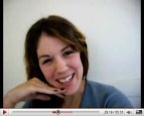 Anthropologist Michael Wesch gave a thoughtful and engaging talk on ‘An anthropological introduction to YouTube’ to the Library of Congress earlier this year and, rather appropriately, it’s available online as a
  Despite the American Psychological Association revising their ethics policy twice in the debate over American psychologists’ participation in war-on-terror interrogations, significant unrest still remains over the fact the APA has yet to actually enforce its reluctantly implemented ban.
 I’m currently reading the wonderful but very long
  Today’s Nature has got an interesting
 Each experiment involved a pale red disc that followed an ‘invisible track’ on a computer monitor. The sort of track is illustrated in the diagram of the left, although in the actual experiment the participants just saw the disc.
 Wired Science
 Mind Hacks