There is no shortage of misconceptions. The British public believes that for every £100 spent on benefits, £24 is claimed fraudulently (the actual figure is £0.70). We think that 31% of the population are immigrants (actually its 13%). One recent headline summed it up: “British Public wrong about nearly everything, and I’d bet good money that it isn’t just the British who are exceptionally misinformed.
This looks like a problem for democracy, which supposes a rational and informed public opinion. But perhaps it isn’t, at least according to a body of political science research neatly summarised by Will Jennings in his chapter of a new book “Sex, lies & the ballot box: 50 things you need to know about British elections“. The book is a collection of accessible essays by British political scientists, and has a far wider scope than the book subtitle implies: there are important morals here for anyone interested in collective human behaviour, not just those interested in elections.
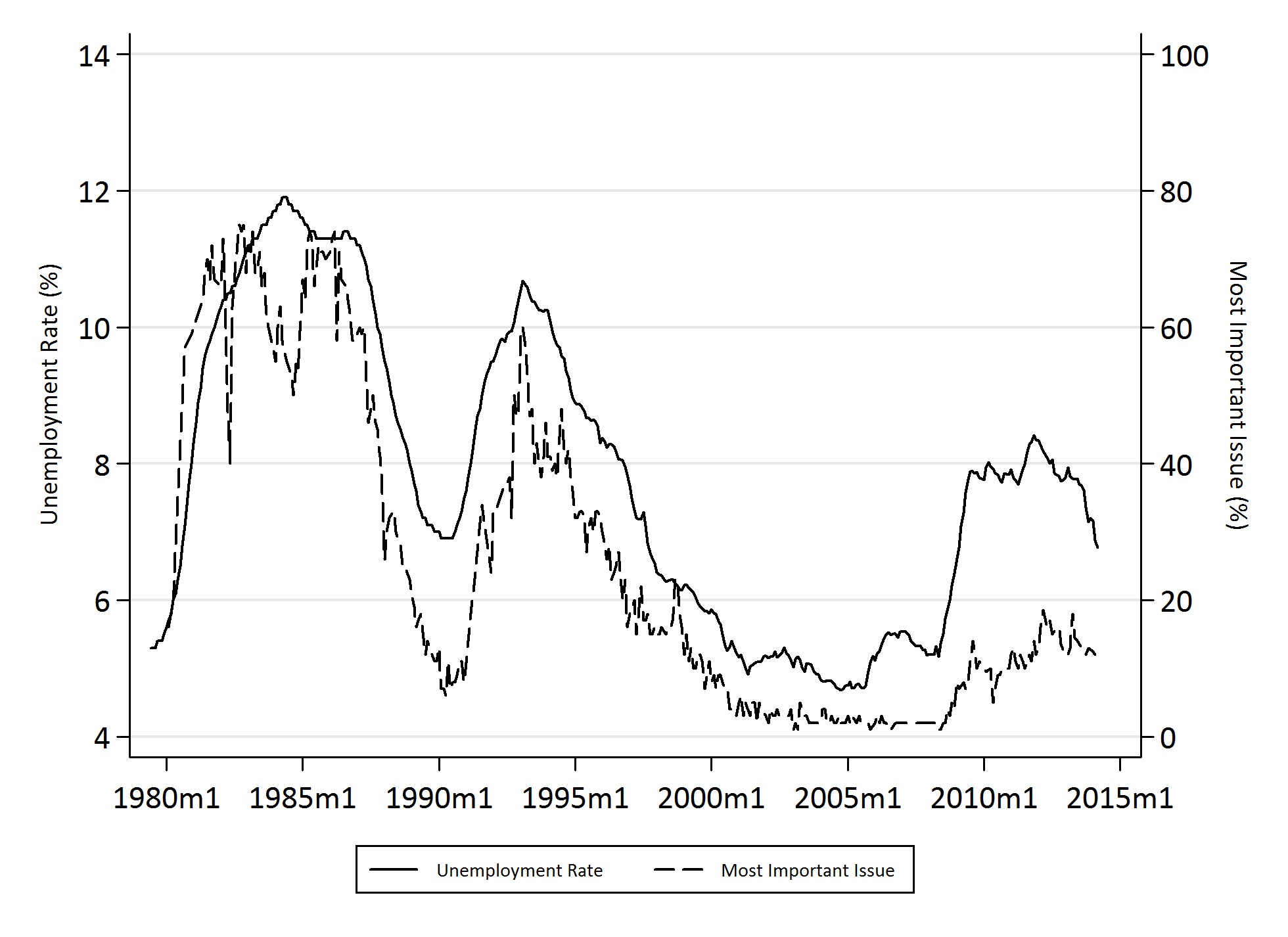
Will’s chapter discusses the “public opinion as thermostat” theory. This, briefly, is that the public can be misinformed about absolute statistics, but we can still change our strength of feeling in an appropriate way. So, for example, we may be misled about the absolute unemployment rate, but can still discern whether unemployment is getting better or worse. There’s evidence to support this view, and the chapter includes this striking graph (reproduced with permission), showing the percentage of people saying “unemployment” is the most important issue facing the country against the actual unemployment rate . As you can see public opinion tracks reality with remarkable accuracy:
The topic of how a biased and misinformed public can make rational collective decisions is a fascinating one, which has received attention from disciplines ranging from psychology to political science. I’m looking forward to reading the rest of the book to get more evidence based insights into how our psychological biases play out when decision making is at the collective level of elections.
Full disclosure: Will is a friend of mine and sent me a free copy of the book.
Link: “Sex, lies & the ballot box (Edited by Philip Cowley & Robert Ford).
Link: Guardian data blog Five things we can learn from Sex, Lies and the Ballot Box

 I’ve just found a curious
 Most ‘psy’ professionals are banned by their codes of conduct from conducting ‘celebrity analysis’ and commenting on the mental state of specific individuals in the media. This is a sensible guideline but I didn’t realise it was triggered by a specific event.
 In the latest edition of The Psychologist I’m involved in a debate with
  The US Government has just released its report on the CIA’s Detention and Interrogation Program, aptly branded the “torture report”, which is available online as a
  The journal contexts has an excellent
 Mind Hacks
