Against the high cult of retreat

Depending on who you ask Naomi Weisstein is a perceptual neuroscientist, a rock n roll musician, a social critic, a comedian, or a fuck the patriarchy radical feminist.

You stick Weisstein’s name into Google Scholar and her most cited paper is ‘Psychology Constructs the Female’ – a searing critique of how 60s psychology pictured the female psyche – while her second most cited is a study published in Science on visual detection of line segments.

Although the topics are different, the papers are more alike than you’d first imagine.

Her article ‘Psychology Constructs the Female’ was originally published in 1968 and became an instant classic.

She looked at the then current theories of female psychology, and at the evidence that supported them, and shows that the theories are pitiful – largely based on personal opinion and idiosyncratic interpretations of weak or non-existent evidence.

Moreover, she shows that all known differences at the time could be accounted for by social context and what was expected of the participants, rather than their sex.

It’s a masterpiece of evidence-based scientific thinking when feminist psychology was, and to a large extent, still is, heavily influenced by postmodernism and poststructuralism – theories that suggest that there is no objective reality and science is just another social narrative that has female oppression built into its knowledge base.

Weisstein, who also had a huge impact on perceptual science, had little time for what she considered to be ‘fog’ and ‘paralysis’:

I’m still wearing my beanie hat, aren’t I? I don’t think I can take it off… Science (as opposed to the scientific establishment) will entertain hypothesis generated in any way: mystical, intuitive, experiential. It only asks us to make sure that our observations and replicable and our theories have some reasonable relation to other things we know to be true about the subject under study, that is to objective reality…

Whether or not there is objective reality is a 4000-year-old philosophical stalemate. The last I heard was that, like God, you cannot prove there is one and you cannot prove there is not one. It comes down to a religious and / or political choice. I believe that the current feminist rejection of universal truth is a political choice. Radical and confrontational as the feminist challenge to science may appear, it is in fact, a deeply conservative retreat…

Poststructuralist feminism is a high cult of retreat. Sometimes I think that, when the fashion passes, we will find many bodies, drowned in their own wordy words, like the Druids in the bogs.

A recent academic article looked back at Weisstein’s legacy and noted that she has been a powerful force in a feminist movement that typically rejects science as a useful approach.

But she was also a pioneer in simply being a high-flying female scientist when they were actively discouraged from getting involved.
 

Link to full text of ‘Psychology Constructs the Female’.

The free will rebellion

A popular mantra of modern neuroscience tells us that free will is an illusion. An article in the New York Times makes a lucid challenge to the ‘death of free will’ idea and a prominent neuroscientist has come out to fight the same corner.

Neuroscientists began making preparations for the funeral of free will shortly after Benjamin Libet began publishing his experiments in the 1980s showing a consistent build-up of electrical activity from the brain’s motor cortex before participants were consciously aware of their desire to move.

Since then, many more neuroscience studies have shown that brain activity can precede conscious awareness of specific choices or actions – with the implication that our conscious experience of decision-making is nothing but a secondary effect that plays little role in our actions and reactions.

The idea that ‘free will is an illusion’ is now consistently touted by neuroscientists as an example of how brain science is revealing ‘what really drives us’ and how it explains ‘how we really work’. But philosophers, the conceptual engineers of new ideas, have started to find holes in this popular meme.

Probably the most lucid mainstream analysis of why neuroscience isn’t killing free will has just been published at The New York Times where philosopher of mind Eddy Nahmias takes the mourners to task using a narrow and largely irrelevant definition of free will.

So, does neuroscience mean the death of free will? Well, it could if it somehow demonstrated that conscious deliberation and rational self-control did not really exist or that they worked in a sheltered corner of the brain that has no influence on our actions. But neither of these possibilities is likely. True, the mind sciences will continue to show that consciousness does not work in just the ways we thought, and they already suggest significant limitations on the extent of our rationality, self-knowledge, and self-control. Such discoveries suggest that most of us possess less free will than we tend to think, and they may inform debates about our degrees of responsibility. But they do not show that free will is an illusion.

Nahmais makes the point that the ‘death of free will’ idea makes a fallacy he calls ‘bypassing’ that reduces our decisions to chemical reactions, implying that our conscious thinking is bypassed, and so we must lack free will.

He notes that this is like saying life doesn’t exist because every living thing is made up of non-living molecules, when, in reality, its impossible to understand life or free will without considering the system at the macro level – that is, the actions and interactions of the whole organism.

Interestingly, a similar point is made by legendary neuroscientist Michael Gazzaniga in an interview for Salon where he discusses his new book on free will. He also suggests it’s not possible to understand free will at the level of neurons without making the concept nonsensical.

These contrasting concepts about free will may yet be solved, however, as Nature recently reported on a new $4 million ‘Big Questions in Free Will’ project which brings together philosophers and cognitive scientists to work together to understand how we act in the world.
 

Link to NYT piece ‘Is Neuroscience the Death of Free Will?’
Link to Salon interview with Michael Gazzaniga.
Link to Nature piece ‘Taking Aim at Free Will’.

A theory of the bipolar economy

If you’re convinced that the current cycle of the boom and bust economy is due to the collapse of collateralised debt obligations secured on oversold mortgages that destablised the European market due to its reliance on cheap loans from an artificially inflated US market – think again!

A 1935 Psychological Review article proposed a ‘manic-depressive psychoses’ theory of economic highs and lows based on the idea that the market has a form of monetary bipolar disorder.

Manic-depressive psychoses of business

Psychological Review, Vol 42(1), Jan 1935, 91-107.

Morgan, J. J. B.

An analysis of the various theories offered to explain the business cycle of alternate booms and depressions shows that all these theories are based on a superficial study of symptoms, rather than on an analysis of the real causes, which the author believes are psychological in nature.

Business is compared to a patient suffering from a manic-depressive psychosis, in which the boom period parallels the manic phase and the subsequent slump parallels the depressive phase. It is argued that, in business as in the individual psychosis, the manic period is not a period of real optimism or even over-confidence, but is really a period of fear, for which the excessive speculative activity is a compensatory mechanism.

This fear is induced by a lack of confidence in the credit system and a desire to beat it. Two alternative solutions are offered: one is to strengthen the credit system by building up a group of heroic leaders; but this is utopian at present. The other is to discover a better defense mechanism and adopt it.

I suspect when Dr Morgan thought of a ‘better defense mechanism’ he wasn’t thinking of a bunch of unemployed people and students camping out in the local financial centre.

The article was apparently mentioned by economist Robert Shiller at a talk at the ongoing Society for Neuroscience conference.
 

Link to article summary (via @carlzimmer)

Invasion of the disembody snatchers

The latest edition of The Psychologist has a fantastic article on the psychology of horror, taking in everything from the popularity of cultural themes like zombies and vampires to research into the enjoyment of slasher films.

It’s a really comprehensive look at the both the psychological concept, the feeling of horror, and where its origins may lie in our evolutionary and cultural past, as well as numerous studies on how we react to fear and horror, both in real life and in entertainment.

This bit particularly caught my eye.

Related to this is the ‘snuggle theory’ – the idea that viewing horror films may be a rite of passage for young people, providing them with an opportunity to fulfil their traditional gender roles. A paper from the late 1980s by Dolf Zillmann, Norbert Mundorf and others found that male undergrads paired with a female partner (unbeknown to them, a research assistant), enjoyed a 14-minute clip from Friday the 13th Part III almost twice as much if she showed distress during the film. Female undergrads, by contrast, said they enjoyed the film more if their male companion appeared calm and unmoved. Moreover, men who were initially considered unattractive were later judged more appealing if they displayed courage during the film viewing.

Surely asking people to watch horror films with a companion who is secretly working with psychologists to study your reactions to fear is a fantastic plot for a horror film.

Yours for only $1 million Wes Craven.
 

Link to ‘The Lure of Horror’ in The Psychologist.
 

Declaration of interest: I’m an unpaid associate editor and occasional columnist for The Psychologist. I avoid exploring abandoned houses on the edge of town.

Steven Pinker: a life in brawls

There’s an excellent interview with Steven Pinker on the BBC Radio 4 programme The Life Scientific that takes a look back at his work and his involvement with a long list of enjoyable controversies.

For those over-saturated with discussion about his new book on the decline of violence, The Life Scientific interview is actually a refreshing retrospective that reviews his career as a whole.

It tackles everything from the cognitive science of word learning to brawls over the influence of genetics on human behaviour (bonus segment: Oliver James making a tit of himself in a live radio debate).

A thoroughly engrossing discussion although if you want the podcast you’ll have to download it from a separate page (linked below) because linking to the podcast is a bit too advanced for the BBC.
 

Link to BBC Pinker interview and streaming audio.
Link to podcasts of The Life Scientific interviews.

The hot hand smacks back

The idea of the ‘hot hand’, where a player who makes several successful shots has a higher chance of making some more, is popular with sports fans and team coaches, but has long been considered a classic example of a cognitive fallacy – an illusion of a ‘streak’ caused by our misinterpretation of naturally varying scoring patterns.

But a new study has hard data to show the hot hand really exists and may turn one of the most widely cited ‘cognitive illusions’ on its head.

A famous 1985 study by psychologist Thomas Gilovich and his colleagues looked at the ‘hot hand’ belief in basketball, finding that there was no evidence of any ‘scoring streak’ in thousands of basketball games beyond what you would expect from natural variation in play.

Think of it like tossing a weighted coin. Although the weighting, equivalent to the players skill, makes landing a ‘head’ more likely overall, every toss of the coin is independent. The last result doesn’t effect the next one.

Despite this, sometimes heads or tails will bunch together and this is what people erroneously interpret as the ‘hot hand’ or being on a roll, at least according to the theory. Due to the basketball research, that seemed to show the same effect, the ‘hot hand fallacy’ was born and the idea of ‘scoring streaks’ thought to be sports myth.

Some have suggested that while the ‘hot hand’ may be an illusion, in practical terms, in might be useful on the field.

Better players are more likely to have a higher overall scoring rate and so are more likely to have what seem like streaks. Passing to that guy works out, because the better players have the ball for longer.

But a new study led by Markus Raab suggests that the hot hand does indeed exist. Each shot is not independent and players that hit the mark may raise their chances of scoring the next time. They seem to draw inspiration from their successes.

Crucially, the researchers chose their sport carefully because one of the difficulties with basketball – from a numbers point of view – is that players on the opposing team react to success.

If someone scores, they may find themselves the subject of more defensive attention on the court, damping down any ‘hot hand’ effect if it did exist.

Because of this, the new study looked at volleyball where the players are separated by a net and play from different sides of the court. Additionally, players rotate position after every rally, meaning its more difficult to ‘clamp down’ on players from the opposing team if they seem to be doing well.

The research first established the belief in the ‘hot hand’ was common in volleyball players, coaches and fans, and then looked to see if scoring patterns support it – to see if scoring a point made a player more likely to score another.

It turns out that over half the players in Germany’s first-division volleyball league show the ‘hot hand’ effect – streaks of inspiration were common and points were not scored in an independent ‘coin toss’ manner.

What’s more, players were sensitive to who was on a roll and used the effect to the team’s advantage – more commonly passing to those on a scoring streak.

So it seems the ‘hot hand’ effect exists. But this opens up another, perhaps more interesting, question.

How does it work? Because if teams can understand the essence of on court inspiration, they’ve got a recipe for success.
 

Link to blocked study. Clearing a losing strategy.
Link to full text which has mysteriously appeared online.

A review of Pinker’s The Better Angels of Our Nature

I’ve written an in-depth review of Steven Pinker’s new book on the decline of violence for the latest Wilson Quarterly

I thought getting a free copy and working on a review would be great fun but was rather taken aback when the 848 page book landed on my doorstep. I shouldn’t have been because there isn’t a wasted page.

I go into the details of some of Pinker’s key arguments in the book, which you can read in more detail in the review, but as you can see from this part, the book is definitely worth reading.

Despite my concerns about how Pinker portrays individual psychology and neuroscience, The Better Angels of Our Nature is so comprehensive that these faults represent only a fraction of the book. Taken as a whole, it is powerful, mind changing, and important. Pinker does not shy away from the gritty detail and is not to be taken lightly—quite literally in fact, as at more than 800 pages his book could easily be used as a weapon if you remained unpersuaded by its arguments. But this avalanche of information serves to demonstrate convincingly and counterintuitively that violence is on the decline.

In many ways, violence is a disease of the emotions. While we should never ignore the victims, it can be managed and curbed so it affects as few people as possible and remains minimally contagious. Many illnesses that once felled multitudes are now largely vanquished through greater knowledge and simple preventive measures; a similar process has made us all less likely to be targets, and perpetrators, of brutality. As Pinker argues, this is an achievement we should take pride in.

You can read the full text of the review by clicking on the link below. Thanks to The Wilson Quarterly for making it available online.
 

Link to review of Pinker’s new book in The Wilson Quarterly.

Glitches in The Technology of Orgasm

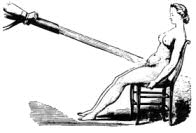
We’ve covered The Technology of Orgasm before, a hugely influential book arguing that 19th century doctors were using Victorian vibrators to cure ‘female hysteria’ through the induction of [serious look] ‘hysterical paroxysms’, but it seems that the main argument may not be as breathtaking as it first appears.

Cory Silverberg discusses how historians of sex have been less than impressed with the idea and the issue has now become a hot topic because the book, written by author Rachel Maines, has been made into a film starring Maggie Gyllenhaal.

The Technology of Orgasm is a somewhat controversial book. Controversial in that the thesis of the book has been almost universally accepted and embraced by the mainstream press and the sex toy industry, while at the same time being quite seriously critiqued by historians of sexuality. In her book Maines contends that the vibrator was regularly used by doctors to treat “hysteria” which they had previously been treating by manually stimulating women to orgasm. Included in this argument is the idea that the women didn’t know they were having orgasms and the doctors didn’t seem to worry about the professional boundaries involved in essentially masturbating their patients.

Silverberg also notes a comprehensive page by historian Lesley Hall who has detailed difficulties with the ‘Victorian vibrator cure’ idea.

The page also has loads of other fascinating information about 19th century sex.

Don’t be put off by the page’s dreadful green background – as the title suggests, it is full of wonderful ‘Victorian sex factoids’, including why it is unlikely that Queen Victoria ever used cannabis to help alleviate period pains.
 

Link to Cory Silverberg’s coverage of the new film (via @DrPetra).
Link to Lesley Hall’s page on ‘Victorian Sex Factoids’.

Outside the criminal mind

ABC Radio National’s All in the Mind recently had a fascinating programme on the science behind offender profiling and whether it lives up to its ‘inside the criminal mind’ image.

If you’re not familiar with the debates about criminal profiling you may be surprised to hear that a fair few forensic psychologists think it’s a waste of time.

Even while studies can show a statistical link between certain psychological characteristics and crime features, it’s not clear whether applying this to individual criminals gives us reliable enough results to guide police investigations.

This edition of All in the Mind explores the various types of criminal profiling and the evidence behind their accuracy.

Although it is somewhat annoyingly cut with scenes from Silence of the Lambs (which has about as much to say about criminal profiling as One Flew Over the Cuckoo’s Nest has to say about psychiatric nursing) it is still a fascinating and insightful look into a little understood practice.

And if this isn’t enough criminology for you, a recent Radio 4 documentary (podcast here) discussed the evidence behind ‘miracle’ crime and violence reduction schemes.
 

Link to All in the Mind on ‘Profiling the Criminal Profilers’.
Link to streamed BBC doco on ‘crime cutting miracles’.
Podcast for same because putting the mp3 on the same page is hard.

Shifting between the worlds of Carl Jung

The New Atlantis has a wonderful article giving an in-depth biography of Carl Jung, perhaps one of the most interesting, infuriating and brilliant thinkers in the history of psychology.

Variously a pioneering experimental psychologist, a depth-analyst, an asylum psychiatrist and a man submerged in his own psychosis, he had a massive influence on both our understanding of the mind and 20th century culture.

…Jung never slackened in his pursuit of the ultimate — both ultimate good and ultimate evil, which he tended to find inseparable. He was frequently off in the empyrean or down in the bowels of hell, consorting with gods and demons as ordinary men do with family and friends. Few persons conducted such conversations, and most of them were inmates of lunatic asylums. For a time the thought that he might be insane terrified him.

The fear dissipated, however, as he became convinced that his visions were genuinely revelatory and belonged to the primordial psychic reality that all men have in common: the collective unconscious, he called it. Poets and such may get away with beliefs like these, for their madness is pretty well taken for granted, but it was a most unorthodox way for an esteemed psychiatrist to think.

Jung is also probably one of the most misunderstood figures in psychology, largely owing to his tendency to swing between science, poetic genius and outright flakery.

The New Atlantis article is a fantastic exploration of the man and his ideas and one of the best short introductions you could find. Well, as short as you could get with Carl Jung.
 

Link to ‘Psychology’s Magician’.

Escaping from the past of disaster psychology

Scientific American has a useful piece on how the immediate treatment of psychological trauma has changed since 9/11. The issue is interesting because recent progress has turned lots of psychological concepts on their head to the point where many still can’t grasp the concepts.

The article notes that at the time of the Twin Towers disaster, the standard form of treatment was Critical Incident Stress Debriefing – also known as CISD or just ‘debriefing’ – a technique where psychologists would ask survivors, usually in groups, to describe what happened and ‘process’ all the associated emotions by talking about them.

This technique is now not recommended because we know it is at best useless and probably harmful – owing to the fact that it seems to increase trauma in the long-term.

Instead, we use an approach called psychological first aid, which, instead of encouraging people to talk about all their emotions, really just focuses on making sure people feel secure and connected.

Although the article implies that 9/11 was a major turning point for our knowledge of immediate post-trauma treatment, the story is actually far more complex.

Studies had been accumulating throughout the 90s showing that ‘debriefing’ caused harm in some, although it wasn’t until around the turn of the century that two meta-analyses sealed the deal.

Unfortunately, the practice of ‘debriefing’ by aid agencies and emergency psychologists was very hard to change for a number of interesting reasons.

A lot of aid agencies don’t deal directly with the scientific literature. Sometimes, they just don’t have the expertise but often it’s because they simply have no access to it – as most of it is locked behind paywalls.

However, probably most important was that even the possibility of ‘debriefing’ having the potential to do damage was very counter-intuitive.

The treatment was based on the then-accepted foundations of psychological theory that said that emotions always need to be expressed and can do damage if not ‘processed’.

On top of this, for the first time, many clinicians had to deal with the concept that a treatment could do damage even though the patients said it was helpful and were actually and genuinely getting better.

This is so difficult to grasp that many still continue with the old and potentially damaging practices, so here’s a quick run down of why this makes sense.

The theoretical part is a hang-over from Freudian psychology. Freud believed that neuronal energy was directly related to ‘mental energy’ and so psychology could be understood in thermodynamic terms.

Particularly important in this approach is the first law of thermodynamics that says that energy cannot be created or destroyed just turned into another form. Hence Freud’s idea that emotions need to be ‘expressed’ or ‘processed’ to transform them from a pathological form to something less harmful.

We now know this isn’t a particularly reliable guide to human psychology but it still remains hugely popular so it seemed natural that after trauma, people would need to ‘release’ their ‘pent up emotions’ by talking about them lest the ‘internal pressure’ led to damage further down the line.

And from the therapists’ point of view, the patients said the intervention was helpful and were genuinely getting better, so how could it be doing harm?

In reality, the psychologists would meet with heavily traumatised people, ‘debrief’ them, and in the following weeks and months, the survivors would improve.

But this will happen if you do absolutely nothing. Directly after a disaster or similarly horrible event people will perhaps be the most traumatised they will ever be in their life, and so will naturally move towards a less intense state.

Statistically this is known as regression to the mean and it will occur even if natural recovery is slowed by a damaging treatment that extends the risk period, which is exactly what happens with ‘debriefing’.

So while the treatment was actually impeding natural recovery you would only be able to see the effect if you compare two groups. From the perspective of the psychologists who only saw the post-trauma survivors it can look as if the treatment is ‘working’ when improvement, in reality, was being interfered with.

This effect was compounded by the fact that debriefing was single session. The psychologists didn’t even get to see the evolution of the patients afterwards to help compare with other cases from their own experience.

On top of all this, after the ‘debriefing’ sessions, patients actually reported the sessions were useful even when long-term damage was confirmed, because, to put it bluntly, patients are no better than seeing the future than professionals.

In one study, 80% of patients said the intervention was “useful” despite having more symptoms of mental illness in the long-term compared to disaster victims who had no treatment. In another, more than half said ‘debriefing’ was “definitely useful” despite having twice the rate of postraumatic stress disorder (PTSD) after a year.

Debriefing involves lots of psychological ‘techniques’, so the psychologists felt they were using their best tools, while the lack of outside perspective meant it was easy to mistake instant feedback and regression to the mean for actual benefit.

It’s worth saying that the same techniques that do damage directly after trauma are the single best psychological treatment when a powerful experience leads to chronic mental health problems. Revisiting and ‘working through’ the traumatic memories is an essential part of the treatment when PTSD has developed.

So it seemed to make sense to apply similar ideas to those in the acute stage of trauma, but probably because the chance of developing PTSD is related to the duration of arousal at the time of the event, ‘going over’ the events shortly after they’ve passed probably extends the emotional impact and the long-term risks.

But while the comparative studies should have put an end to the practice, it wasn’t until the World Health Organisation specifically recommended that ‘debriefing’ not be used in response to the 2004 tsunami [pdf] that many agencies actually changed how they went about managing disaster victims.

As well as turning disaster psychology on its head, this experience has dispelled the stereotype that ‘everyone needs to talk’ after difficult events and, in response, the new approach of psychological first aid was created.

Psychological first aid is actually remarkable for the fact that it contains so little psychology, as you can see from the just released psychological first aid manual from the World Health Organisation.

You don’t need to be a mental health professional to use the techniques and they largely consist of looking after the practical needs of the person plus working toward making them feel safe and comfortable.

No processing of emotions, no ‘disaster narratives’, no fancy psychology – really just being practical, gentle and kind.

We don’t actually know if psychological first aid makes people less likely to experience trauma, as it hasn’t been directly tested, although it is based on the best available evidence to avoid harm and stabilise extreme stress.

So while 9/11 certainly focussed people’s minds on psychological trauma and its treatment (especially in the USA which is a world leader in the field) it was really just another bitter waymarker in a series of world tragedies that has shaped disaster response psychology.

So unusually for a psychologist, I’ll be hoping we’ll have the chance to do less research in this particular area and have a more peaceful coming decade.
 

Link to SciAm piece on psychology and the aftermath of 9/11.

The spark of the cognitive revolution

Monitor on Psychology has a fascinating article on Otto Selz, a little known pioneer of the cognitive revolution who was decades ahead of the rest of psychology, before being captured and killed by the Nazis.

He was so little known, in fact, that the majority of people have never heard of him. In fact, this is the first time I’ve ever seen anything written about him, despite the fact he was a major influence on the key players who launched the concept of ‘mind as information processing metaphor’ in the 1950s.

Selz began to lay the foundation for cognitive research in a series of experiments he and his colleagues conducted from 1910 to 1915. They asked participants to explain their problem-solving thought processes out loud as they tried to complete a task, such as finding a word related to but more generic than “newspaper” or “farmer,” such as “publication” or “worker,” respectively. The participants would explain how they identified the features of those words, how the features fit into larger categories and how the categories led them to new words.

Based on these statements, Selz concluded that their minds were doing more than simply associating words and images they’d heard in conjunction before. To Selz, the participants were operating under what he called a “schema,” or an organizing mental principle, that guided their thoughts. Under this schema, the mind automatically orders relationships between ideas and can anticipate the connections among novel stimuli, serving as a basis for problem-solving. The existence of such an organized mental life would later become a cornerstone of the cognitive revolution.

Selz was actually captured twice by the Nazis. He was first sent to the Dachau concentration camp but was released after five weeks on the condition that he leave the country.

He went to Holland and continued working for two years but was captured again when the Nazi’s invaded. He died while been transported to Auschwitz.

The article has an incredibly poignant moment where it mentions “His last recorded correspondence was a postcard to his colleagues, telling them he planned to begin a lecture series for his fellow inmates.”
 

Link to APA Monitor article on Otto Selz.

Minding your own business

I’m just reading a review copy of Steven Pinker’s (excellent) new book The Better Angels of Our Nature: Why Violence Has Declined.

This section, on how moral motivation is over-rated as a control on violence, just made me laugh out loud.

The human moral sense can excuse any atrocity in the minds of those who commit them, and it furnishes them with motives for acts of violence that bring them no tangible benefit. The torture of heretics and conversos, the burning of witches, the imprisonment of homosexuals, and the honor killing of unchaste sisters and daughters are just a few examples. The incalculable suffering that has been visited on the world by people motivated by a moral cause is enough to make one sympathize with the comedian George Carlin when he said “I think motivation is overrated. You show me some lazy prick who’s lying around all day watching game shows and stroking his penis and I’ll show you someone who’s not causing any fucking trouble!


Link to more information on the book.

Ecstasy for war trauma: a flashback to earlier treatments

Mother Board has a completely fascinating article on the current ongoing trial testing whether MDMA or ‘ecstasy’ could be useful in treatment combat trauma.

The piece is interesting as much for what it doesn’t say, as for what it does, and for how it ties into the history of psychological treatments for posttraumatic stress disorder or PTSD.

The trial is testing whether MDMA can assist in psychological treatment for the condition, in which a traumatic event leads to a sense of current threat and intrusive sensory impressions that are maintained by a pattern of avoiding reminders.

The most effective tried-and-tested treatments for the condition are types of therapy that are ‘trauma-focused’ that involve, among other things, a mental revisiting of the traumatic memories to ‘take the sting out of their tail’.

But this is exactly what most people who arrive in psychologists’ offices don’t want to do. This makes sense from the perspective of someone who is troubled by these memories and wants to stop thinking about them, but the avoidance actually helps maintain the problem.

This is, in part, because the person never learns to adjust to the anxiety (they don’t habituate in technical terms) and the memories remain as fragmented impressions that don’t fit into a coherent narrative, making them more likely to intrude into the conscious mind.

In other words, most people with PTSD initially arrive for treatment wanting a better form of avoidance because their current methods simply aren’t working. The mental health professional has the unenviable task of explaining that treatment involves exactly the opposite and reliving the event and experiencing the anxiety will be key.

It is so key, in fact, that anti-anxiety drugs like benzodiazapines (e.g. vallium) may reduce the effectiveness of treatment because they dull the experience of stress that the person needs to adjust to.

The MDMA trial is interesting in this regard, because ecstasy is, for many, a remarkably effective anti-anxiety drug.

So how does the drug facilitate the psychotherapy? Here’s the description from the article:

MDMA’s effects typically manifest themselves 30-45 minutes after ingestion, so it doesn’t take long for rhythms to develop in Charleston. Sessions at the clinic oscillate between stretches of silent, inward focus, where the patient is left alone to process his trauma, and unfiltered dialogue with the co-therapists. “It’s a very non-directed approach,” Michael Mithoefer told me. This allows subjects to help steer the flow of their trip. They are as much the pilots of this therapy as their overseers. “Once they get the hang of it,” Mithoefer explained, “sometimes people will talk to us for a while and then say, ‘OK, time to go back inside. I’ll come report when I’m ready.’”

That said, patients understand that if no traumas emerge, the Mithoefer’s must coax them out. But they’ve never had to. The traumas always emerge, and by now there have been over 60 sessions between an initial, smaller Phase 2 study and the present trials. Horrors are bubbling up naturally, patient after patient.

This harks back to a more psychoanalytic or Freudian-inspired idea of trauma and treatment. The goal of the therapy is to understand the inner self while the drug is intended to help us overcome psychological defences that prevent us from seeing things as they really are. In fact, this is a central assumption of the therapy.

This approach is not new. ‘Narcoanalysis’ was used widely in mid-20th Century where a range of drugs, from ether to sodium pentathal, were applied to patients with ‘war neurosis’ for exactly this purpose. Unfortunately, it was unsuccessful and abandoned.

So this is why the MDMA treatment is a gamble. All known effective psychological treatments for PTSD involve not only confronting the memories of what happened to make sense of them, but also re-experiencing the associated anxiety. A treatment with a drug that removes anxiety will, by current predictions, have limited effectiveness.

But this is also why the approach is interesting, because if it is shown to be genuinely effective, we might have to rethink our ideas about PTSD and its treatment.
 

Link to Mother Board article on the MDMA PTSD trial.

Riot psychology

In the coming weeks we can expect to see politicians and pundits lining up to give us their smash-and-grab clichés for the recent urban riots in the UK.

They’ll undoubtedly give a warm welcome to our old friends economic decay, disengaged youth and opportunistic crime, and those of a more psychological persuasion might name-drop ‘deindividuation’ – the process where we supposedly lose self-awareness and responsibility in large crowds.

This belies the fact that crowd behaviour is a complex area that is surprisingly poorly researched.

But what we do know about is the interaction between large crowds and the police and you could do much worse than check out the work of psychologist Clifford Stott who researches how crowds react to policing and what triggers violence.

In his 2009 report on the scientific evidence behind ‘Crowd Psychology and Public Order Policing,’ commissioned by the UK constabulary, he summarises what we know about public disorder and how the authorities can best manage it (you can download it as a pdf).

He notes that the old ideas about the ‘mob mentality’, deindividuation and the loss of individual responsibility are still popular, but completely unsupported by what we know about how crowds react.

People don’t become irrational and they do keep thinking for themselves, but that doesn’t mean that the influence of the crowd has no effect.

In terms of policing, one of the clearest effects to emerge from studies of riots and crowd control is that an indiscriminate kicking from riot police can massively increase the number of people in the crowd who become violent.

This is probably because the social identity of people in a group is fluid and changes according to the relationship with other groups.

For those into academic jargon, this is known as the Elaborated Social Identity Model of crowd behaviour – a well-supported theory with an overly complicated name but which is surprisingly easy to understand.

Imagine you’ve just got on a bus. It’s full of people and you have to jam into an uncomfortable seat at the back. There are people going to work, some vacant students heading home after a night on the beers, some annoying teenagers playing dance music through their tinny mobile phone speakers and some old folks heading off to buy their groceries.

You’re late and you missed your train. You feel nothing in common with anyone on the bus and, to be honest, those teenagers are really pissing you off.

Suddenly, two of the windows smash and you realise that a group of people are attacking the bus and trying to steal bags through the broken windows.

Equally as quickly, you begin to feel like one of a group. A make-shift social identity is formed (‘the passengers’) and you all begin to work together to fend off the thieves and keep each other safe.

You didn’t lose your identity, you gained a new one in reaction to a threat.

The problem police face is that in most large threatening crowds only a minority of people are engaging in anti-social acts. Lots of people ‘go along for the ride’ but aren’t the hardcore that kick-off without provocation.

If the police wade in with batons indiscriminately, lots of these riot wannabes suddenly start to feel like they’re part of the bigger group and feel justified in ripping the place apart, mostly to throw at the coppers.

Suddenly, it’s ‘them’ against ‘us’ and a small policing problem just got much much bigger – like attacking a beehive because you just got stung.

The trick for the police is to make sure they’re perceived as a legitimate force. When they have to charge in, they’re doing so for a reason – to target specific criminals. The ‘them and us’ feeling doesn’t kick in because most individuals don’t feel that the police are targeting them. It’s the other idiots the police are after.

And herein lies the problem. The psychology of crowd control is largely based on the policing of demonstrations and sports events where the majority of people will give the police the benefit of the doubt and assume their status as a legitimate force.

Clifford Stott’s report has lots of advice for forces who want to establish and maintain this impression. The cops should start out in standard uniforms, should be scattered around the crowd and should make an effort to interact. If trouble looks like it’s brewing, non-violent folks should be allowed to leave and the police ‘have a word’ with the specific people involved. Force is only ramped up in proportion to the threat.

I’m no expert and I’ve been watching the UK riots from 5,000 miles away from the safety of Colombia (a sentence I never thought I’d write) but it strikes me that most of the rioters probably never thought of the police as a legitimate force to begin with.

This goes beyond establishing police legitimacy on the day and means many of the standard assumptions of behind crowd control probably don’t work as well.

But the fact that thousands of young people across the country don’t have faith in police is a much deeper social problem that can’t be solved through street tactics.

I have no easy answers and I suspect they don’t exist. Politicians, start your clichés.
 

Link to homepage of psychologist Clifford Stott.
pdf of ‘Crowd Psychology and Public Order Policing’.

Diagnostic dilemma, innit bruv

I’ve just been directed to a wonderful 2007 case study from the British Medical Journal that reports how middle aged doctors can mistake street slang for symptoms of schizophrenia.

Detailed and repeated assessment of [the patient’s] mental state found a normal affect, no delusions, hallucinations, or catatonia, and no cognitive dysfunction. His speech, however, was peppered with what seemed (to his middle class and older psychiatrist) to be an unusual use of words, although he said they were street slang.

It was thus unclear whether he was displaying subtle signs of formal thought disorder (manifest as disorganised speech, including the use of unusual words or phrases, and neologisms) or using a “street” argot. This was a crucial diagnostic distinction as thought disorder is a feature of psychotic illnesses and can indicate a diagnosis of schizophrenia.

We sought to verify his explanations using an online dictionary of slang (urbandictionary.com). To our surprise, many of the words he used were listed and the definitions accorded with those he gave.

The article also contains a brief test where doctors can test themselves to see if they can distinguish between slang and thought disorder symptoms.

It’s probably worth noting that traditional British and, particularly London slang, could easily seem like thought disorder to the uninitiated as it is heavily based on word play and substitution.

For example, “I was having having a ruby when I caught Susan having a butchers at my missus’ new barnet” probably makes perfect sense to lots of British people, but if you’re not familiar with cockney rhyming slang, it could be mistaken for a language impairment.

I have noted that British sarcasm can cause similar difficulties during discussions with Americans.
 

Link to ‘Street slang and schizophrenia’ (via @Matthew Broome)