A symphony of synapses

Those autotune-friendly science remix chaps Symphony of Science have just released a new track called ‘Ode to the Brain!’ about our favourite piece of pinkish grey sludge.

As well as being a decent track, it is also a piece of useful recycling as it incorporates several of the dodgiest bits of popular neuroscience into a nicely mixed video.

Jill Bolte Taylor’s over-the-top spiritual brain talk for TED, Carl Sagan explaining the not very helpful idea of the reptile brain, Oliver Sack’s rare dodgy moment for TED, Bill Nye the Science Guy explaining how the brain is like a newspaper, and virtually anything said about the brain by Robert Winston.

However, it does include excerpts of a TED talk by V.S. Ramachandran, which unlike his other one about mirror neurons shaping civilization, is actually bloody brilliant.

I await the dub remix with some old skool Wilder Penfield footage to give it a retro vibe.
 

Link to Symphony of Science ‘Ode to the Brain!’

Existential internet states

Thought Catalog has an amusing and unsettlingly accurate piece on ‘Five Emotions Invented by the Internet’ which has a series of existential feelings uniquely evoked by our favourite worldwide communication network.

The state of being ‘installed’ at a computer or laptop for an extended period of time without purpose, characterized by a blurry, formless anxiety undercut with something hard like desperation.

During this time the individual will have several windows open, generally several browser ‘tabs,’ a Microsoft Word document in some state of incompletion, the individual’s own Facebook page as well as that of another randomly-selected individual who may or may not be on the ‘friends’ list, 2-5 Gchat conversations that are no longer immediately active, possibly iTunes and a ‘client’ for Twitter. The individual will switch between the open applications/tabs in a fashion that appears organized but is functionally aimless, will return to reading some kind of ‘blog post’ in one browser tab and become distracted at the third paragraph for the third time before switching to the Gmail inbox and refreshing it again.

More new emotional experiences triggered by the interweb at the link below.
 

Link to ‘Five Emotions Invented by the Internet’.

Funky shit

In the debate about the ability of language to adequately describe conscious experience, jazzed-out rappers The Jungle Brothers came out firmly behind the skeptical position of philosopher of mind Eric Schwitzgebel with their 1997 track ‘Brain’.

In the 2007 book Describing Inner Experience? Proponent Meets Skeptic psychologist Russell Hurlburt argued that modern research methods make accurate accounts of inner experience possible whereas Schwitzgebel, a philosopher, disagreed saying that language simply cannot match our rich subjective experience and is prone to error.

However, a decade earlier The Jungle Brothers had strongly supported the idea that language is simply not up to the job of capturing our conscious experience.

I got so much funky shit inside my brain
I couldn’t explain, couldn’t explain
You wouldn’t understand, I couldn’t explain

Explanation of the funk essential trapped in my brain
Couldn’t do it, make me wonder how a world maintain
Got emcees frontin’ total masquerade
Screamin’ toast had to touch them up with my blade

Although their general theory now has a number of proponents, as far as I know, they are unique in proposing that “Screamin’ toast had to touch them up with my blade”.
 

Link to video of The Jungle Brothers’ ‘Brain’.

Brain area for empty news stories discovered

Satirical website Newsbiscuit has a cutting article making fun of the regular ‘brain scans show…’ news items that are a staple of the popular science pages.

Scientists are heralding a breakthrough in brain scan technology after a team at Oxford University produced full colour images of a human brain that shows nothing of any significance.

‘This is an amazing discovery’, said leading neuroscientist Baroness Susan Greenfield, ‘the pictures tell us nothing about how the brain works, provide us with no insights into the nature of human consciousness, and all with such lovely colours.’…

The development, which has been widely reported around the world, is also significant because it allows journalists to publish big fancy pictures of the brain that look really impressive while having little or no explanatory value.

‘These scans are fantastic,’ said Lawrence McGinty, Science Editor for ITV News, ‘not only are they bright and colourful but the graphics department have even converted them into 3D and can make them spin around the screen while I stand in front waving my hands about. None of this helps to explain anything, but it does it so much better the old black and white pictures. They were rubbish.’


Link to ‘New brain scan reveals nothing at all’ (via @michaelmeadon).

I’m Gladwell to hear it

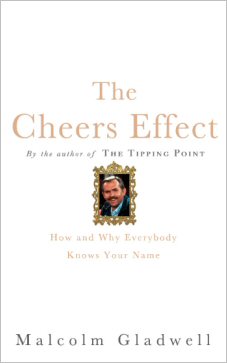
The Malcolm Gladwell Book Generator is simultaneously a very silly and a very funny website that generates Malcolm Gladwell books from a parallel universe.

If you never knew you wanted to read:

“The Tripping Point: How Psychoactive Substances Created a… Wait, I Can’t Feel My Face Bro”

or

“The Paradox Paradox: Why Nobody Gives a Shit About Great Mysteries”

…you might discover your inner talent for not being interested in a whole new range of topics.
 

Link to The Malcolm Gladwell Book Generator (via @AndreaKuszewski)

Suck two of these and call me in the morning

While in Barcelona I discovered a fantastic psychiatry-themed sweet shop called Happy Pills which sells every possible candy you could imagine packaged into mood-lifting pill bottles.

You can also browse their website although if you’re not a Spanish speaker wait for the ‘ingredients’ intro to pass before you can click to see the rest of the website in English if you so wish.

You can order online or track down one of their shops if you’re in Barcelona.
 

Link to Happy Pills website.

See Think Mash

Online scallywags The Daily Mash have a funny piece satirising the way neuroscience studies get reported in the media.

To be honest, I think I might keep the first paragraph and use it to improve any dodgy science stories that come my way from now on.

Scientists at the Institute for Studies have finally established that when human eyes see a thing the brain will often generate a thought that is in some way related to the thing that has just been seen.

Professor Henry Brubaker said: “We applied the seeing-thinking forumula to smoking and found that it followed exactly the same pattern.

“We got a bunch of smokers together and showed them a picture of a cigarette. We asked them if this made them think about cigarettes and they all said ‘yes’.”

Similarities to any recently published studies are, of course, purely co-incidental.
 

Link to The Daily Mash story (via @david_colquhoun).

Treating the madness of the hippies

In 1972, Colombian psychiatrist Miguel Echeverry published a book arguing that hippies were not a youth subculture but the expression of a distinct mental illness that should be treated aggressively lest it spread through the population like a contagion.

I found the book, called Psicopatologia y Existencia del Hippie (Psychopathology and Existence of the Hippy), in my local library and it turns out to be one of the most surprising psychiatry books I have ever read.

At some point, I suspect the good Dr Echeverry must have been driven to breaking point by a bunch of long-haired youths strumming poorly tuned guitars outside his window, because he is clearly furious.

This is his definition of a hippy, translated from p83, where he is so angry he forgets to use a full stop.

The true hippy is an individual with a frank disposition to hereditary psychopathology, who has abandoned himself, has totally neglected his hygiene and self-presentation, has let his hair and beard grow, is dressed bizarrely, eccentrically and ridiculously, wears a multitude of rings, necklaces, beads and other extravagances, is opposed to all defined and purposeful social and family structures now and in the future, rejects productive and redeeming work, irresponsibly and cynically promotes the cult of free love, aggressively promotes contempt for moral, social and religious conventions, preaches paradoxically about the abolition of private property, harmfully drugs them self with marijuana, LSD, amphetamines, hypnotics, mescaline, psylocybin, sedatives and heroin etc to rebelliously and insanely avoid the sad realities of life.

The author notes with disdain that the ‘hippy threat’ seems to be a particular problem in Bogotá, probably reflecting more than a little regional distrust of the free-wheeling capital.

The book contains not a single reference to any scientific or clinical study, although is happy to wax lyrical about the subgroups of the hippy mental illness. Apparently, there are five: hippies with defective personal relationships and autistic-like problems, aggressive hippies, hippies with defective behaviour and poor family adjustment, emotionally impaired hippies, and those with abnormal, perverted or inverted instincts.

For those worried that he may be getting a little too psychoanalytic, Dr Echeverry makes it clear that there is both a strong environmental and genetic component to hippy psychopathology. Yes, apparently, you can inherit hippidom.

The image on the right is from one of the adverts in the book, all of which advertise the drug Lucidril as a ‘treatment’ for hippies, and it’s no surprise that the book was sponsored by the makers of the medication.

Considering the tone of the book, and the fact that the author concludes that being a hippy as akin to having schizophrenia, it’s interesting that Lucidril is not an antipsychotic, but the trade name for a little known compound called meclofenoxate.

There is weak evidence that the drug boosts memory and is notable largely for its enthusiastic uptake by some sections of the ‘nootropics’ brain hacking crowd.

I suspect the enthusiastic adverts for this oddball drug are largely because the book happened to be sponsored by pharmaceutical company Instituto Bio-Quimico Ltd who were clearly trying to sell the drug as a ‘mental detoxification’ compound for the great unwashed.

But not every bearded girl or guy is a real hippy, says Dr Echeverry, who notes that there are also cases of pseudo-hippies, who are really just weak-minded youths who get swept along with the genuine ‘clinical cases’.

How can you tell the difference you ask? Well, pseudo-hippies are the ones who revert to normality once a psychiatrist pumps them full of approved medication. Simple.

The brain scanner’s prayer

The brilliant Neuroskeptic has created a version of The Lord’s Prayer for the fMRI generation. It is at once spiritually uplifting, scientifically edifying and very, very funny.
Our scanner, which art from Siemens,
Hallowed be thy coils.
Thy data come;
Thy scans be done;
In grey matter as it is in white matter.
Give us this day our daily blobs.
And forgive us our trespasses,
As we forgive them that trespass onto our scan slots.
And lead us not into the magnet room carrying a pair of scissors,
But deliver us from volunteers who can’t keep their heads still.
For thine is the magnet,
The gradients,
And the headcoil,
For ever and ever (at least until we can afford a 7T).
Amen.

If you don’t read the Neuroskeptic blog, you’re missing out, as it has some of the best mind and brain coverage on the net and, it seems, the occasional request for divine neurointervention.
 

Link to The Scanner’s Prayer over at Neuroskeptic.
Link to Neuroskeptic blog front page.

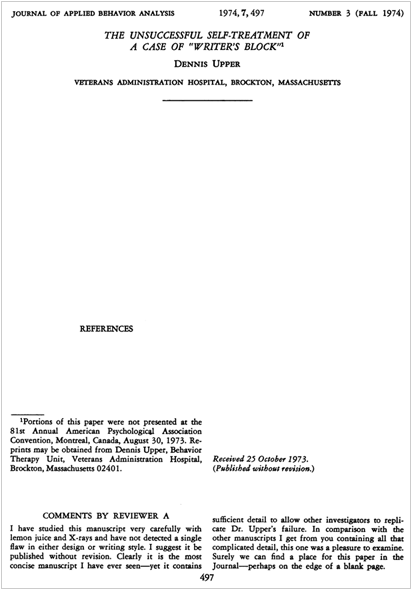
Unsuccessful treatment of writer’s block: a replication

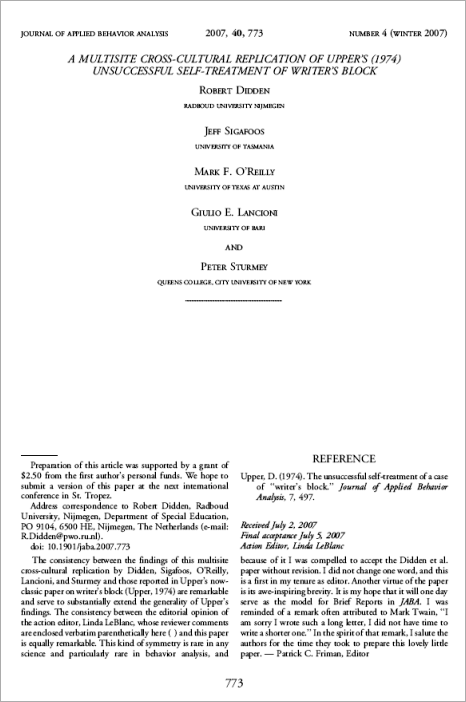
We recently covered an ironic 1974 study entitled ‘The Unsuccessful Self-Treatment of A Case of Writers Block’ and I’m pleased the say the study has been extended and replicated by a team working along similar lines.

The new study took over 30 years to arrive, but duly appeared in the Journal of Applied Behavior Analysis in 2007.


Link to full text of scientific article (via @autismcrisis)

Embrace the Greenfield revolution

Science Oxford Online has an interview with neuroscientist Baroness Susan Greenfield where she argues that too much connection to digital technologies is as much as a threat to humanity as climate change.

How does ‘climate change relate to the concept of ‘mind change’?

Mind change and climate change are both critical scenarios concerning governments and negotiations between countries. There is sometimes an idea that science can save us through climate policy and eco products. An example of how quickly mind change can happen is the way that everyone now recognises the telephone. It may affect boys and girls differently according to the technologies they interact with and influence relations with developing countries. Time spent in virtual environments could lead to behaviour which is individualistic, reclusive, and child like with a high level of greed, impulsivity and disregard for consequences.

Apart from this quite startling claim, for which she cites no actual evidence, I’m just a little struck by how odd the whole interview is.

The interview was done over the phone and I’ve no idea how it’s been edited, but it seems a strange mixture of over-generalisations and, sometimes, answers that don’t even seem relevant to the actual questions.
 

Link to Susan Greenfield interview on ‘mind change’.

I’m not waiting for inspiration, it’s waiting for me

Neuroscience blog Oscillatory Thoughts has a brilliant meditation on the phenomenology of “writer’s block”.

It includes what I originally thought was an hilarious but mocked-up paper from the Journal of Applied Behavior Analysis, only for me to discover that it was genuinely published.


For those wanting verification of these important findings, Oscillatory Thoughts has a replication of this landmark study using more recent technology.
 

Link to Oscillatory Thoughts on “writer’s block”.
Link to the full text of the scientific paper.

Terminal self-diddling

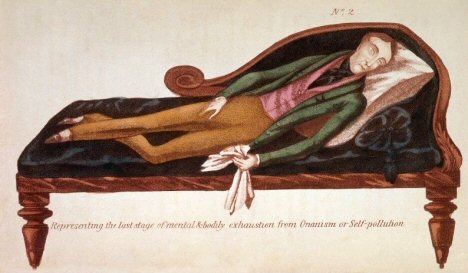
The fantastic Morbid Anatomy blog found this picture from an 1845 medical book depicting ‘the Last Stage of Mental & Bodily Exhaustion from Onanism or Self-pollution’ from the days when self-diddling was widely assumed to be a cause of madness.


Of course, you wouldn’t find anything quite so ridiculous as a mental illness described as ‘the last stage of Onanism or Self-pollution’ in the DSM-5, because stages have been rejected in favour of dimensions.
 

Link to post at Morbid Anatomy.

I’ve got a certificate in armchair psychology

The Guardian’s Lay Scientist blog has an excellent piece on the misguided and intrusive habit of getting psychologists to comment on the mental state of people in the public eye.

Although the media must take some responsibility for encouraging such crass and unhelpful speculation the responsibility lies squarely on the shoulders of the psychologists and pseudo-psychologists who are happy to waffle for their fifteen minutes of fame.

There are two possibilities for a psychologist talking to the media about somebody’s mental health. Either they have treated the subject in a professional capacity, in which case the details should be confidential, or they haven’t, in which case they aren’t qualified to comment….

But forget about my opinions – if you’ll excuse me quoting myself, let’s go back to what the British Psychological Society told me about their guidance last year in the wake of Michael Jackson’s death:

“A guiding principle of the British Psychological Society (BPS), echoed by psychologists I have spoken to, is that professionals should not comment publicly on the mental health of celebrities….”

In spite of guidelines like these, we’re fed a diet of pop psych speculation based on second- or third-hand media reports, dressed up as meaningful analysis through the presence of a media-friendly expert.

It’s true to say that a lot of this opinion parading as professional insight comes from people who are self-appointed ‘body language analysts’ or have simply written a book about ‘relationships’ but it comes surprisingly often from legit psychologists.

But as Dr Petra has noted in the past, the guidelines are rarely enforced by professional associations and the immediate rewards in terms of further media work are a big encouraging factor.
 

Link to The Lay Scientist on celebrity pop psych waffle.