A buried artefact

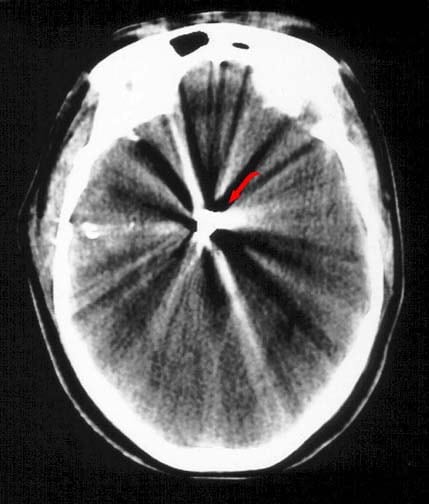
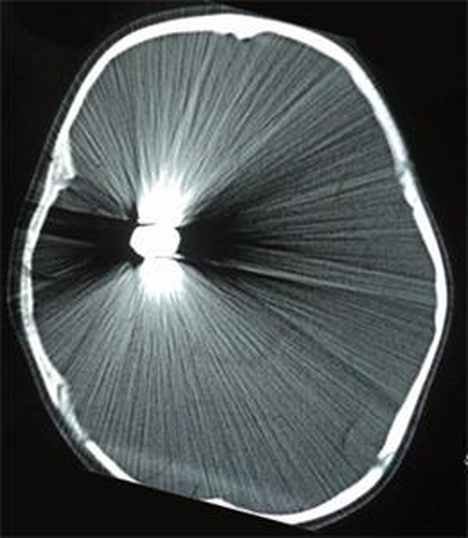
Sometimes there is an accidental beauty in the most macabre of events. Having a bullet lodged in your brain can produce beautiful CT scans due to the scanner’s difficulty with imaging metal objects.

The scan is from an 8-year-old girl who was hit by a bullet that was fired into the air in celebration. She was reportedly fine but this scan is from her hospital admission.

This pattern is an unintended consequence. It’s called a ‘streak’ or ‘star’ artefact and is caused by a combination of the CT scanner beam being over-absorbed by the dense metal object and the image construction software not being able to make sense of the incoming information correctly.

There’s various other images online if you want more unintended brain glitter.

Seeing synaesthetic stars during sex

A study in Frontiers in Psychology asked people who have emotional synaesthesia – they see colours when they have certain emotions – about what they experience during sex.

There is a particularly lovely table that illustrates these experiences through the different stages of the sexual response cycle:

Appentance phase
“This phase has an orange character”

Excitement phase
“it’s getting more intensive, starting with a few colours at the beginning and getting more and more intense”

Plateau phase
“The greater the excitement becomes the more thoughts are canalized” “The initial fog transforms into a wall”

Orgasmic phase
“In the moment of orgasm the wall bursts… ringlike structures… in bluish-violet tones”

Resolution phase
“The resolution phase varies between pink and yellow”

It’s worth bearing in mind that emotional synaesthesia isn’t the only thing that can turn sex into a slightly unreal experience.

Some people with epilepsy have seizures triggered by orgasm which can affect both males and females.

All cases reported in the medical literature are people who lose consciousness or have observable movements during the seizure, but this is probably because they are the ones most likely to go to the doctor.

People who have simple partial seizures during orgasm – where they just have unusual experiences but don’t lose consciousness – are probably more common than we think but are less likely to be aware they’re having seizures and so just assume it’s normal for them.
 

Link to study on synaesthesia and sexual experience (via @Neuro_Skeptic)

A radiant light and an aura of activity

Nature Medicine has a fascinating article about attempts to research the neuroscience of migraine and its aura – the perceptual changes that precede the onset of the splitting headache.

It turns out to be trickier than it seems. The idea is to trigger a migraine in people who seem to have clear conditions that start one off and then get them in a scanner as soon as possible.

Unfortunately, this doesn’t always work very reliably.

However, one notable success was someone who had migraines triggered by basketball:

Michael Moskowitz and his colleagues at the Massachusetts General Hospital Neuroscience Center in the Boston area described the most famous report of a controlled study involving a person experiencing aura in a lab in 2001. They identified a patient, named Patrick, who could reliably induce his aura by playing basketball. The researchers arranged for Patrick and his wife to shoot hoops next door to their research center at a YMCA gym. After about an hour of exercise, Patrick then jumped into a functional MRI machine at the clinic and waited for his aura to begin. In this way, Moskowitz and his team tracked changes in Patrick’s brain before, during and after self-described aura attacks on two separate occasions.

The article noted that it’s a mystery why basketball was a trigger for migraine but these very specific triggers are often also present in epilepsy.

Called ‘reflex epilepsy‘ it involves seizures that can be triggered by specific situations such as reading, eating, urination, being startled, hearing certain songs and pretty much anything else you can think of (including, believe it or not, thinking itself).

This is probably due to the activities setting up specific patterns of brain activity that interact with pre-existing weakness in neural networks leading to instability that triggers seizures.

Think of it as being like living in a city where the public transport only grinds to a halt when there’s a football match between two very specific teams – due to the influx of fans from specific directions affecting a key road junction which happens to be an important traffic hub.

These very specific triggers are rare, but interestingly, when they do occur tend to more commonly occur in epilepsy and migraine, probably telling us something about how both conditions are related to spreading patterns of activity across the brain.

Anyway, much more in the Nature Medicine piece which discusses the fascinating topic of migraine aura in more detail.
 

Link to ‘Aura of mystery’ from Nature Medicine.

Drugs for the circuit-based human

Image from Wikipedia. Click for source.In a recent article for The Observer I noted that almost all the major drug companies had closed down their neuroscience divisions as evidence for a move away from a ‘chemical-based’ to a ‘circuit-based’ approach to treatments.

So to my surprise, a new Nature News article has just appeared discussing the re-launch of pharmaceutical giant Novartis’s neuroscience section.

However, as I read the beginning of the article, it seems they are just banking on the fact that they can design drugs good enough to hit individual brain circuits.

In a sign that psychiatric-disease research is entering a new era, the pharmaceutical giant Novartis has hired an expert in neural circuitry, rather than pharmacology, to head its relaunched neuroscience division.

The appointment of 42-year-old Ricardo Dolmetsch, who has spent his entire career in academic research, signifies a radical policy shift for the company, as it moves away from conventional neurotransmitter research to concentrate on analysing the neural circuitry that causes brain diseases.

Well. Best of luck with that.

I may be wrong, but I suspect dousing the brain in a chemical which is supposed to affect only selected circuits may be folly.

Then again, maybe we need to think outside the pill box. Perhaps microinjections of drugs directly into the brain is the future.

Either way, it seems the big money is being increasingly invested in the idea that useful treatments will be tweaking brain circuits.
 

Link to ‘Novartis reboots brain division’ from Nature News.

It is mind control but not as we know it

The Headlines

The Independent: First ever human brain-to-brain interface successfully tested

BBC News: Are we close to making human ‘mind control’ a reality?

Visual News: Mind Control is Now a Reality: UW Researcher Controls Friend Via an Internet Connection

The story

Using the internet, one researcher remotely controls the finger of another, using it to play a simple video game.

What they actually did

University of Washington researcher Rajesh Rao watches a very simple video game, which involved firing a cannon at incoming rockets (and avoiding firing at incoming supply planes). Electrical signals from his scalp were recorded using a technology called EEG and processed by a computer. The resulting signal was sent over the internet, and across campus, to a lab where another researcher, Andrea Stocco, watches the same video game with his finger over the “fire” button.

Unlike Rao, Stocco wears a magnetic coil over his head. This is designed to invoke electrical activity, not record it. When Rao imagines pressing the fire button, the coil activates the area of Stocco’s brain that makes his finger twitch, thus firing the cannon and completing a startling demonstration of “brain to brain” mind control over the internet.

You can read more details in the University of Washington press release or on the “brain2brain” website where this work is published.

How plausible is this?

EEG recording is a very well established technology, and takes advantage of the fact that the cells of our brain operate by passing around electrochemical signals which can be read from the surface of the scalp with simple electrodes. Unfortunately, the intricate details of brain activity tend to get muffled by the scalp, and the fact that you are recording at one specific point in space, so the technology’s strength is more in telling us that brain activity has changed, rather than in saying how or exactly where brain activity has changed.

The magnetic coil which made the receiver’s finger twitch is also well established, and known in the business as Transcranial Magnetic Stimulation (TMS). An alternating magnetic field is used to alter brain activity underneath the coil. I’ve written about it here before.

The effect is relatively crude. You can’t make someone play the violin, for example, but activating the motor cortex in the right region can generate a finger twitch. So, in summary, the story is very plausible. The researchers are well respected in this area and open about the limitations of their research. Although the experiment wasn’t published in a peer-reviewed journal, we have every reason to believe what we’re being told here.

Tom’s take

This is a wonderful piece of “proof of concept” research, which is completely plausible given existing technology, but yet hints at the possibilities which might soon become available.

The real magic is in the signal processing done. The dizzying complexities of brain activity are compressed into an EEG signal which is still highly complex, and pretty opaque as to what it means – hardly mind reading.

The research team then managed to find a reliable change in the EEG signal which reflected when Rao was thinking about pressing the fire button. The signal – just a simple “go”, as far as I can tell – was then sent over the internet. This “go” signal then triggered the TMS, which is either on or off.

In information terms, this is close to as simple as it gets. Even producing a signal which said what to fire at, as well as when to fire, would be a step change in complexity and wasn’t attempted by the group. TMS is a pretty crude device. Even if the signal the device received was more complex, it wouldn’t be able to make you perform complex, fluid movements, such as those required to track a moving object, tie your shoelaces or pluck a guitar. But this is a real example of brain to brain communication.

As the field develops the thing to watch is not whether this kind of communication can be done (we would have predicted it could be), but exactly how much information is contained in the communication.

A similar moral holds for reports that researchers can read thoughts from brain scans. This is true, but misleading. Many people imagine that such thought-reading gives researchers a read out in full technicolour mentalese, something like “I would like peas for dinner”. The reality is that such experiments allow the researchers to take a guess at what you are thinking based on them having already specified a very limited set of things which you can think about (for example peas or chips, and no other options).

Real progress on this front will come as we identify with more and more precision the brain areas that underlie complex behaviours. Armed with this knowledge, brain interface researchers will be able to use simple signals to generate complex responses by targeting specific circuits.

Read more

The original research report: Direct Brain-to-Brain Communication in Humans: A Pilot Study

Previously at The Conversation, another column on TMS: Does brain stimulation make you better at maths?

Thinking about brain interfaces is helped by a bit of information theory. To read a bit more about that field I recommend James Gleik’s book The Information: A History, a Theory, a Flood

The Conversation

This article was originally published at The Conversation.
Read the original article.
The rise of the circuit-based human

Image from Sociedad Española de NeuroCienciasI’ve got a piece in The Observer about how we’re moving towards viewing the brain as a series of modifiable brain circuits each responsible for distinct aspects of experience and behaviour.

The ‘brain circuit’ aspect is not new but the fact that neuroscience and medicine, on the billion-dollar global level, are reorienting themselves to focus on identifying and, crucially, altering brain circuits is a significant change we’ve seen only recently.

What many people don’t realise, is the extent to which direct stimulation of brain circuits by implanted electrodes is already happening.

Perhaps more surprising for some is the explosion in deep brain stimulation procedures, where electrodes are implanted in the brains of patients to alter electronically the activity in specific neural circuits. Medtronic, just one of the manufacturers of these devices, claims that its stimulators have been used in more than 100,000 patients. Most of these involve well-tested and validated treatments for Parkinson’s disease, but increasingly they are being trialled for a wider range of problems. Recent studies have examined direct brain stimulation for treating pain, epilepsy, eating disorders, addiction, controlling aggression, enhancing memory and for intervening in a range of other behavioural problems.

More on how we are increasingly focussed on hacking our circuits in the rest of the article.
 

Link to ‘Changing brains: why neuroscience is ending the Prozac era’.

Drug addiction: The complex truth

We’re told studies have proven that drugs like heroin and cocaine instantly hook a user. But it isn’t that simple – little-known experiments over 30 years ago tell a very different tale.

Drugs are scary. The words “heroin” and “cocaine” make people flinch. It’s not just the associations with crime and harmful health effects, but also the notion that these substances can undermine the identities of those who take them. One try, we’re told, is enough to get us hooked. This, it would seem, is confirmed by animal experiments.

Many studies have shown rats and monkeys will neglect food and drink in favour of pressing levers to obtain morphine (the lab form of heroin). With the right experimental set up, some rats will self-administer drugs until they die. At first glance it looks like a simple case of the laboratory animals losing control of their actions to the drugs they need. It’s easy to see in this a frightening scientific fable about the power of these drugs to rob us of our free will.

But there is more to the real scientific story, even if it isn’t widely talked about. The results of a set of little-known experiments carried out more than 30 years ago paint a very different picture, and illustrate how easy it is for neuroscience to be twisted to pander to popular anxieties. The vital missing evidence is a series of studies carried out in the late 1970s in what has become known as “Rat Park”. Canadian psychologist Bruce Alexander, at the Simon Fraser University in British Columbia, Canada, suspected that the preference of rats to morphine over water in previous experiments might be affected by their housing conditions.

To test his hypothesis he built an enclosure measuring 95 square feet (8.8 square metres) for a colony of rats of both sexes. Not only was this around 200 times the area of standard rodent cages, but Rat Park had decorated walls, running wheels and nesting areas. Inhabitants had access to a plentiful supply of food, perhaps most importantly the rats lived in it together.

Rats are smart, social creatures. Living in a small cage on their own is a form of sensory deprivation. Rat Park was what neuroscientists would call an enriched environment, or – if you prefer to look at it this way – a non-deprived one. In Alexander’s tests, rats reared in cages drank as much as 20 times more morphine than those brought up in Rat Park. 

Inhabitants of Rat Park could be induced to drink more of the morphine if it was mixed with sugar, but a control experiment suggested that this was because they liked the sugar, rather than because the sugar allowed them to ignore the bitter taste of the morphine long enough to get addicted. When naloxone, which blocks the effects of morphine, was added to the morphine-sugar mix, the rats’ consumption didn’t drop. In fact, their consumption increased, suggesting they were actively trying to avoid the effects of morphine, but would put up with it in order to get sugar.

Woefully incomplete’

The results are catastrophic for the simplistic idea that one use of a drug inevitably hooks the user by rewiring their brain. When Alexander’s rats were given something better to do than sit in a bare cage they turned their noses up at morphine because they preferred playing with their friends and exploring their surroundings to getting high.

Further support for his emphasis on living conditions came from another set of tests his team carried out in which rats brought up in ordinary cages were forced to consume morphine for 57 days in a row. If anything should create the conditions for chemical rewiring of their brains, this should be it. But once these rats were moved to Rat Park they chose water over morphine when given the choice, although they did exhibit some minor withdrawal symptoms.

You can read more about Rat Park in the original scientific report. A good summary is in this comic by Stuart McMillen. The results aren’t widely cited in the scientific literature, and the studies were discontinued after a few years because they couldn’t attract funding. There have been criticisms of the study’s design and the few attempts that have been made to replicate the results have been mixed.

Nonetheless the research does demonstrate that the standard “exposure model” of addiction is woefully incomplete. It takes far more than the simple experience of a drug – even drugs as powerful as cocaine and heroin – to make you an addict. The alternatives you have to drug use, which will be influenced by your social and physical environment, play important roles as well as the brute pleasure delivered via the chemical assault on your reward circuits.

For a psychologist like me it suggests that even addictions can be thought of using the same theories we use to think about other choices, there isn’t a special exception for drug-related choices. Rat Park also suggests that when stories about the effects of drugs on the brain are promoted to the neglect of the discussion of the personal and social contexts of addiction, science is servicing our collective anxieties rather than informing us.

This is my BBC Future article from tuesday. The original is here. The Foddy article I link to in the last paragraph is great, read that. As is Stuart’s comic.

A furious infection but a fake fear of water

RadioLab has an excellent short episode on one of the most morbidly fascinating of brain infections – rabies.

Rabies is a virus that can very quickly infect the brain. When it does, it causes typical symptoms of encephalitis (brain inflammation) – headache, sore neck, fever, delirium and breathing problems – and it is almost always fatal.

It also has some curious behavioural effects. It can make people hyper-reactive and can lead to uncontrolled muscle spasms due to its effect on the action coordination systems in the brain. With the pain and distress, some people can become aggressive.

This is known as the ‘furious’ stage and when we describe some as ‘rabid with anger’ it is a metaphor drawn from exactly this.

Rabies can also cause what is misleadingly called ‘hydrophobia’ or fear of water. You can see this in various videos that have been uploaded to YouTube that show rabies-infected patients trying to swallow and reacting quite badly.

But rabies doesn’t actually instil a fear of water in the infected person but instead causes dysphagia – difficulty with swallowing – due to the same disruption to the brain’s action control systems.

We tend to take swallowing for granted but it is actually one of our most complex actions and requires about 50 muscles to complete successfully.

Problems swallowing are not uncommon after brain injury (particularly after stroke) and speech and language therapists can spend a lot of their time on neurorehabilitation wards training people to reuse and re-coordinate their swallow to stop them choking on food.

As we know from waterboarding, choking can induce panic, and it’s not so much that rabies creates a fear of water, but a difficulty swallowing and hence experiences of choking. This makes the person want to avoid trying to swallow liquids.

Bathing, for example, wouldn’t trigger this aversion and that’s why rabies doesn’t really cause a ‘fear of water’ but more a ‘fear of choking on liquids due to impaired swallowing’.

The RadioLab episode discusses the case that launched the controversial Milwaukee protocol – a technique for treating rabies that involves putting you into a drug-induced coma to protect your brain until your body has produced the anti-rabies antibodies.

It’s a fascinating and compelling episode so well worth checking out.

UPDATE: This old medical film on YouTube goes through the stages of rabies infection. Warning: it’s a bit gruesome and has a melodramatic soundtrack but it is quite informative.


Link to RadioLab episode ‘Rodney Versus Death’.

Peter Huttenlocher has left the building

The New York Times has an obituary for child neurologist Peter Huttenlocher, who surprised everyone by finding that the human brain loses connections as part of growing into adulthood.

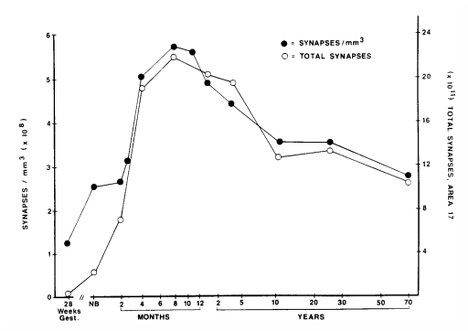
Huttenlocher counted synapses – the connections between neurons – and as a paediatric neurologist was particularly interested in how the number of synapses changed as we grow from children to adults.

Before Huttenlocher’s work we tended to think that our brain’s just got more connected as we got older, but what he showed was that we hit peak connectivity in the first year of life and much of brain development is actually removing the unneeded connections.

This is know as synpatic pruning and it was demonstrated with this graph from classic 1990 paper.

I love this graph for a couple of reasons. Firstly, it’s a bit wonky. It was hand-drawn and whenever it is reproduced, as it has been in many textbooks, it’s always a bit off-centre.

Secondly, it’s crystal clear. It’s a graph showing the density of synaptic connections in the visual cortex of the human brain and you can see it’s rapidly downhill from the first year of life until the late teens where things start to even out.

This is a good thing as the infant brain starts over-connected but loses anything that isn’t needed as we learn which skills are most important, and we are left with only the most efficient neural connections, through the experience of growing up.

One of Huttenlocher’s discoveries was that this process of synaptic pruning may go wrong in people who have neurodevelopmental disorders.
 

Link to NYT obituary for Peter Huttenlocher.

Super-recogniser officers policing Europe’s biggest party

The Guardian are reporting that the London Metropolitan Police have deployed ‘super recogniser’ officers to Notting Hill Carnival to pick out known criminals from the crowd.

This is curious because this is a verified ability that has only recently been reported in the scientific literature.

It has been long known that some people have severe difficulties recognising faces – something called prosopagnosia and sometimes inaccurately labelled ‘face blindness’.

But more recently, it was discovered that a tiny minority of people are ‘super recognisers’ – with exceptional face recognition abilities – meaning they can pick out a previously identified face from huge numbers of possibilities.

A more recent fMRI study found that super recognisers tend to show a greater level of activity in the fusiform gyrus.

This area is heavily associated with face recognition, although debates are ongoing whether it is face-dedicated or just specialised for learned fine-grained visual recognition of various sorts.

It’s not clear how the Met Police identified their ‘super recogniser’ officers but it seems it might be an interesting exercise in screening for key neuropsychological characteristics and deploying those officers to the appropriate task.

Needless to say, picking out a few dodgy faces from a street party that welcomes a million people every year would be exactly this sort of job.

More details from the The Guardian report:

…17 specialist officers will be holed up in a central control room several miles away in Earls Court monitoring live footage in an attempt to identify known offenders.

Chief superintendent Mick Johnson from the Metropolitan police said it was the first time the “recognisers” – who have been selected for their ability to remember hundreds of offenders’ faces – have been used to monitor a live event.

“This type of proactive operation is the first one we have done in earnest in real time so we are going to be looking at it very closely to see how effective it is and what we get out of it,” he said.

The Met has 180 so-called super recognisers – most of whom came to the fore in the aftermath of the London riots when they managed to identify more than a quarter of the suspects who were caught on CCTV footage…

One of the super recognisers on duty will be Patrick O’Riordan, who says he has had an ability to pick people out in a crowd and recall faces since he joined the Met 11 years ago.

“It is with me all the time. Often when I am on a day off or out with my girlfriend I will see someone and know straight away who they are and where they fit in,” said 45-year-old. “It could be their eyes or the shape of their forehead or their gait, but something usually sticks with me. It something that started from day one as a police officer – really it is just something that I took too naturally.”

 
Link to Guardian article on super recogniser officers at the Carnival.
Link to summary of study that identified ‘super recognisers’.
pdf of full-text of the same paper.

How Lariam can trigger psychosis

The New York Times has an article on how the anti-malaria drug mefloquine, better known as Lariam, can send you spiralling into madness.

Coincidentally, the link between mefloquine and madness was the subject of a recent review article in the Journal of the American Academy of Psychiatry and the Law which reads like a cross between an H.P Lovecraft short story and a neuroscience paper.

Case reports suggest that mefloquine intoxication may begin with a variable prodrome which may present with personality change, unease, anxiety, phobias, and a sense of impending doom and restlessness. These prodromal symptoms may progress to outright paranoia, delusions, magical thinking, persecutory mania, restlessness, aggression, and panic attacks…

Mefloquine psychosis frequently includes auditory or true visual hallucinations, frequently involving religious or morbid themes. Auditory hallucinations typically feature voices that may be incoherent or mumbling. Some individuals report a sense of the presence of a nearby nondescript figure. Olfactory hallucinations have also been reported. The often vivid and terrifying nature of the hallucinations produced by mefloquine are illustrated by an early unindexed case report, similar to at least one other published report, describing a man who jumped from his hotel room in the false belief that his room was on fire.

Of note, vivid dreams or horrific, terrifying nightmares, also frequently reported by users of mefloquine, are characterized as having “Technicolor clarity” and being “vividly remembered days later,” suggesting that these may also be prodromal to or inform later symptoms of psychosis.

The most likely explanation for why this happens is that mefloquine can trigger an encephalitis or inflammation of the limbic system – a deep brain area heavily involved in both memory and emotion.

Disturbance in this region is known to greatly raise the risk of psychosis. For example, people with temporal lobe epilepsy (which some of the limbic system is part of) have a greatly raised risk of psychosis.
 

Link to New York Times article Crazy Pills.
Link to open-access scientific article on mefloquine side-effects.

A half hour of hallucinations

I’m on the latest PLOS Mind the Brain podcast discussing the science of hallucinations with the inimitable Ruchir Shah.

We cover everything from the experience of ‘hearing voices’ and its relation to mental illness to how chemists are pioneering new variations of psychoactive substances to get around drugs laws.

In this podcast, we discuss one of Vaughan’s clinical research interests, which is hallucinations. What are they, and how are they diagnosed? We start by discussing some examples of hallucinations, and why auditory and visual hallucinations might be more common than other types, like taste or smell hallucinations. We then discuss the role that culture might play, and the interesting phenomenon that certain types of hallucinations are actually more common in specific countries.

When then move on to another of Vaughan’s academic interests, that of psychoactive drugs, and their potential relationship to hallucinations and psychosis. Finally, we end with a discussion about designer drugs, and how labs all over the world are synthesizing new psychoactive compounds much faster than governments could possibly ban then, effectively making the “war on drugs” irrelevant.

A thoroughly enjoyable discussion which you can download from the link below.
 

Link to hallucinations in Mind the Brain podcast Episode 3.

A concise, solid grounding in neuroscience

50IdeasHumanBrainI often get asked ‘how can I avoid common misunderstandings in neuroscience’ which I always think is a bit of an odd question because the answer is ‘learn a lot about neuroscience’.
This is easier than it sounds, of course, but if you want a solid introduction, a book by Mo Costandi called 50 Human Brain Ideas You Really Need to Know is an excellent starting point.

If you recognise the name Mo Costandi its because he has been writing the brilliant Neurophilosophy blog for the best part of the last decade as he’s moved from being a neurobiologist to a science journalist.

The book consists of 50 four page chapters each of which condenses a key area of neuroscience in a remarkably lucid way.

There is no pandering to the feint of heart in the selected topics (from free will to neural stem cells) but neither is there a glossing over of conflicting evidence or controversy.

You won’t get poorly researched hype here about ‘mirror neurons’ being ‘responsible for empathy’ or brain scans showing how the brain ‘lights up’ but you will get a concise, balanced and entertaining introduction to key concepts in neuroscience.

It’s worth noting that the book does not hand-hold you. It’s not a complete beginners guide. It’s aimed at a ‘smart high-school kid and up’ level but if that’s you, and you want to get to grips with the brain, this book is ideal.
 

Link to more details on 50 Human Brain Ideas You Really Need to Know.

Love is a cognitive enhancer

Aeon magazine has an excellent article about how a study on the adoption of Romanian orphans has helped us understand the importance of early-life affection for brain development.

It tracks the story of the Bucharest Early Intervention Project (BEIP), a US-based study that was inspired by seeing the appalling living conditions of orphans from the Ceausescu regime era.

Many were left with virtually no human interaction, were often poorly fed, in poor health and sometimes seemed to be cognitively impaired.

The Bucharest Early Intervention Project completed a randomised controlled trial to show that adoption not only improved physical health but also improved brain function – demonstrating the importance of human contact for healthy brain development.

It’s a moving article that really gets into the importance of early development but it gives an curious impression of what inspired the studies.

It suggests that in 1999, when the study was first launched, previous studies on the negative neurodevelopmental effects of depriving young animals of maternal affection provided the basis for thinking that this is what might be happening in the Romanian orphans.

This is certainly one line of thinking. The experiments of serial monkey abuser Harry Harlow often pop up in these discussions, despite the fact that the effect of early care and affection on healthy emotional development has been known since antiquity and was demonstrated by John Bowlby’s studies on World War II evacuee children years before.

But in the case of Romanian orphans, one of the most important sources of information was not animal studies, but studies already done on the effects of adoption on brain development in Romanian Orphans – of which the first study was published a year earlier, in 1998.

These studies were led by child psychiatrist Michael Rutter who had revisited Bowlby’s ideas and thought that while broadly accurate they were probably too strong in their predictions and that development could be improved for many.

When the Ceausescu regime fell and the plight of the orphanages became clear, many families from across Europe adopted orphans. Rutter compared children who had been taken up by UK families and compared them on what age they were adopted.

The studies found that the length of emotional deprivation was associated with smaller head size (reflecting brain development), lowered IQ, and increased mental heath problems, even when the effects of poor nutrition were controlled for.

One of the difficulties is that the results may not have been comparable to the effects of adoption by Romanian families – which, for example, remains a country with a more limited healthcare system.

The Bucharest Early Intervention Project were the first to run a randomised controlled trial of adoption – literally, an experiment to compare adopting children versus institutional care – to conclusively demonstrate the benefits.

Needless to say, it was an ethically charged project, and the Aeon article discusses the challenges that it raised.
 

Link to Aeon article ‘Detachment’.

What makes an extravert?

Why do some people prefer adventure and the company of others, while others favour being alone? It’s all to do with how the brain processes rewards.

Will you spend Saturday night in a crowded bar, or curled up with a good book? Is your ideal holiday adventure sports with a large group of mates and, or anywhere more sedate destination with a few good friends? Maybe your answers to these questions are clear – you’d love one option and hate another – or maybe you find yourself somewhere between the two extremes. Whatever your answers, the origin of your feelings may lie in how your brain responds to rewards.

We all exist somewhere on the spectrum between extroverts and introverts, and different circumstances can make us feel more one way or the other. Extraverts, a term popularised by psychologist Carl Jung at the beginning of the 20th Century, seem to dominate our world, either because they really are more common, or because they just make most of the noise. (The original spelling of “extravert” is now rarely used generally, but is still used in psychology.) This is so much the case that some have even written guides on how to care for introverts, and nurture their special talents.

A fundamental question remains – what makes an extrovert? Why are we all different in this respect, and what do extraverts have in common that makes them like they are? Now, with brain scans that can record activity from deep within the brain, and with genetic profiling that reveals the code behind the constructions of the chemical signalling system used by the brain, we can put some answers to these decades-old questions.

In the 1960s, psychologist Hans Eysenck made the influential proposal that extroverts were defined by having a chronically lower level of arousal. Arousal, in the physiological sense, is the extent to which our bodies and minds are alert and ready to respond to stimulation. This varies for us all throughout the day (for example, as I move from asleep to awake, usually via few cups of coffee) and in different circumstances (for example, cycling through the rush-hour keeps you on your toes, heightening arousal, whereas a particularly warm lecture theatre tends to lower your arousal). Eysenck’s theory was that extroverts have just a slightly lower basic rate of arousal. The effect is that they need to work a little harder to get themselves up to the level others find normal and pleasant without doing anything. Hence the need for company, seeking out novel experiences and risks. Conversely, highly introverted individuals find themselves overstimulated by things others might find merely pleasantly exciting or engaging. Hence they seek out quiet conversations about important topics, solitary pursuits and predictable environments.

Betting brains

More recently, this theory has been refined, linking extroversion to the function of dopamine, a chemical that plays an intimate role in the brain circuits which control reward, learning and responses to novelty. Could extroverts differ in how active their dopamine systems are? This would provide a neat explanation for the kinds of behaviours extroverts display, while connecting it to an aspect of brain function that we know quite a lot about for other reasons.

Researchers lead by Michael Cohen, now of the University of Amsterdam, were able to test these ideas in a paper published in 2005. They asked participants to perform a gambling task while in the brain scanner. Before they went in the scanner each participant filled out a personality profile and contributed a mouth swab for genetic analysis. Analysis of the imaging data showed how the brain activity differed between extroverted volunteers and introverted ones. When the gambles they took paid off, the more extroverted group showed a stronger response in two crucial brain regions: the amygdala and the nucleus accumbens. The amygdala is known for processing emotional stimuli, and the nucleus accumbens is a key part of the brain’s reward circuitry and part of the dopamine system. The results confirm the theory – extroverts process surprising rewards differently.

When Cohen’s group looked at the genetic profiles of the participants, they found another difference in reward-related brain activity. Those volunteers who had a gene known to increase the responsiveness of the dopamine system also showed increased activity when they won a gamble.

So here we see part of the puzzle of why we’re all different in this way. Extrovert’s brains respond more strongly when gambles pay off. Obviously they are going to enjoy adventure sports more, or social adventures like meeting new people more. Part of this difference is genetic, resulting from the way our genes shape and develop our brains. Other results confirm that dopamine function is key to this – so, for example, genes that control dopamine function predict personality differences in how much people enjoy the unfamiliar and actively seek out novelty. Other results show how extroverts learn differently, in keeping with a heighted sensitivity to rewards due to their reactive dopamine systems.

Our preferences are shaped by the way our brains respond to the world. Maybe this little bit of biological psychology can help us all, whether introverts or extroverts, by allowing us to appreciate how and why others might like different things from us.

This is my BBC Future column from last week. The original is here

Candidate neurotech for the billion dollar brain projects

NatureBrainNature has an article that discusses candidate neuro-mapping technologies that may form the basis of the billion dollar brain projects that are just kicking off on either side of the Atlantic.

Both Europe’s and Obama’s brain projects have set themselves the (possibly over-) ambitious goal of mapping the working brain on the neuron-by-neuron level.

This is off the back of new technologies that promise multiple-neuron fine-grained recording and systems to make sense of the date – but can only currently do it on a very small scale.

The Nature article looks at the most promising options and how they might scale to whole brain, or at least, ‘big chunk of brain’ level.

Attempting to take another leap farther, Jeff Lichtman at Harvard University in Cambridge, Massachusetts, and Winfried Denk of the Max Plank Institute for Neurobiology in Munich, Germany, are working with the German optics company Carl Zeiss on a new electron microscope that would image even thinner slices — 25 nanometres, or one-thousandth the thickness of an average cell. “Then you get to see every little damn thing in the brain, from every neuron to every subcellular organelle, from every synapse to every spine neck — everything,” says Lichtman.

It’s probably worth saying that the ‘mapping the whole brain as it’s working’ thing is spin. Considering there are about 100 billion or so neurons in the human brain that’s a lot of microchips you’d need mixing in with your brain.
 

Link to Nature article ‘Neuroscience: Solving the brain’