Bollocks to it

Teenagers love to swear. Says who? Says science you melon farmers. And what could be better than a top ten of teenage swearing compiled by science wielding psycholinguists? A US – UK show down. Let the cursing commence.

The book Trends in Teenage Talk: Corpus Compilation, Analysis and Findings was written to summarise the findings of research on the word use of teenagers in London.

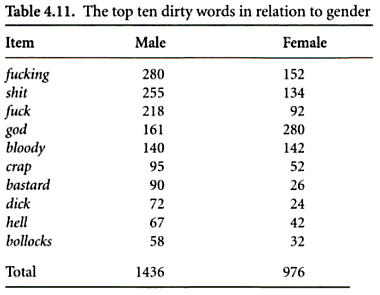
In Chapter 4, on slang and swearing, the authors compare the frequency of swear words in London teens to the same from an earlier study in East Coast American adolescents.

First the Londoners:

And now on to the East Coast Americans:

I would first like to express my disappointment that the word bollocks is being neglected by UK teenagers.

Unfortunately, a decline in social standards and a lack of respect for tradition is leading to a generation of fucking obsessed adolescents.

Indeed, one of the great pleasures of this eminently British tradition is the low level of recognition among Americans, meaning bollocks can be used openly in the States without causing offence.

However, the small sample size of the American data means it may not be the most reliable guide to the true population ranking.

I note, for example, that there are only 27 bitches and 24 asses which may mean that the true bitch – ass prevalence is being obscured by random variation in the sample.
 

Link to Trends in Teenage Talk on Google Books.

2011-03-19 Spike activity

Quick links from the past week in mind and brain news:

The Boston Globe has a fascinating piece on the psychological benefits of solitude. “What we do better without other people around.” No smirking now.

The colour of depression. Neuroskeptic investigates its association with the colours black and blue.

The New York Times has an obituary for Owsley Stanley – one of the most prolific and discerning producers of LSD the world has ever seen.

Can people tell whether abstract art is by a child or a chimp? Not Exactly Rocket Science has the surprising answer.

Science News has a piece on the latest developments in the science of wiring computer chips with nerve cells. I think we’re at the dodgy 16k RAM pack stage.

There’s an excellent interview on addiction and substance use with ex-addict and writer James Brown over at Addiction Inbox.

Slate has an great piece on why it could be counter-productive to start fact-based education too early by developmental psychologist Alison Gopnick.

V.S. Ramachandran is challenged about his mirror neurons and autism theory and gets a bit crotchety in an interview with Neurophilosophy.

NeuroPod hits the wires with a new edition on gender and PTSD, prion disease and pain.

How to Build Hallucinogenic Goggles. We Alone On Earth has the plans.

Wired Science covers a study finding that robot nurses are less weird when they don’t talk. Robot nurse bed baths yet to be studied.

There’s a wonderful piece on one of the most influential books in the history of psychiatry, Robert Burton’s The Anatomy of Melancholy, over at Providentia.

The Guardian reports on the US military’s new social-media-centred PsyOps and propaganda campaign. Think weaponised RickRolls.

The psychology of homework. A new field dawns and the sunrise is captured by The BPS Research Digest.

Science News covers a study finding that stock traders can stay in the black just by following the crowd.

Heavier men get paid more, heavier women get paid less. The BPS Occupational Digest on the weight salary link.

The New York Times has a brief but informative piece on the biological basis of left-handedness.

A fascinating piece on the amplifying effect of cities – except for their effect on pro-social behaviour – over at The Frontal Cortex.

Court in the cross-fire

There are not enough quality forensic psychology blogs in the world, which I suspect is not a thought that passes through the mind of anyone except Mind Hacks readers.

However, if you’re after a punchy fast paced look at the world of criminal and legal psychology you’d do far worse than checking out the website of psyDoctor8.

It dips into everything from the neuroscience of murder to the science of false confessions with an eye on both the media and the academic literature.

And if you do Twitter @PsyDoctor8 is also a great source of links in the same vein.

It makes a wonderful complement to the more in-depth In the News blog, which has consistently been one of the best forensic psychology sources on the net.

And that’s about it. Criminal really.

Yes your honour, I’ll stop with the puns.
 

Link to psyDoctor8 blog.
Link to In the News blog.

The brain behind the lion heart

I’ve just read a completely fascinating New York Times article on the neuropsychology of courage – a core human attribute that curiously seems to be largely ignored by cognitive science.

The piece looks at how we define courage, it’s relation to fear and the sometimes wonderfully innovative research that has tackled the area.

In pioneering work from 1970s and beyond, Stanley J. Rachman of the University of British Columbia and others studied the physiology and behavior of paratroopers as they prepared for their first parachute jump.

The work revealed three basic groups: the preternaturally fearless, who displayed scant signs of the racing heart, sweaty palms, spike in blood pressure and other fight-or-flight responses associated with ordinary fear, and who jumped without hesitation; the handwringers, whose powerful fear response at the critical moment kept them from jumping; and finally, the ones who reacted physiologically like the handwringers but who acted like the fearless leapers, and, down the hatch.

These last Dr. Rachman deemed courageous, defining courage as “behavioral approach in spite of the experience of fear.” By that expansive definition, courage becomes democratized and demilitarized, the property of any wallflower who manages to give the convention speech, or the math phobe who decides to take calculus.

It is also a wonderfully written article, by the way, so well worth making the leap for.
 

Link to NYT article ‘Searching for the Source of a Fountain of Courage’.

To catch a thief and fool a scientist

If you only listen to one radio programme this month, make it this one. The BBC Radio 4 programme Fingerprints on Trial explores how identifying people at crime scenes by their prints is subject to serious psychological biases and is not the exact science that we, and ironically, the forensic fingerprint community, like to believe.

It covers some spectacular high-profile cases, the science behind how prior knowledge can bias the supposedly objective identification of prints, and the baffling fingers-in-the-ears lalalala response of some fingerprint experts who just completely deny it’s a problem.

The programme riffs on the work of psychologist Itel Dror who has shown that changing the ‘backstory’ to a case can alter what fingerprint matches experts find.

So here’s how these biases could work in practice. Fingerprint examiners in this country [the UK] generally know the type of crime their working on. Any murder is high profile, so the chances are they’d know quite a bit about the case. They might see crime scene photographs and might even have heard snippets from detectives working on the case. And then when they start to check the fingerprints from the murder scene, evidence from cognitive psychology shows that what they know, or think they know, can influence what they then see in the prints.

Combines gripping sad-but-true whodunits, cutting edge cognitive science and a pressing issues for forensic science.

Excellent stuff.
 

Link to BBC streamed version and programme info.
mp3 of podcast from BBC.

The myths of ‘post-disaster counselling’

After almost any large scale disaster, you’ll hear reports that rescue workers, supplies and counsellors are being sent to the area – as if mental health professionals were as vital as food and shelter.

Time has an excellent interview with psychologist Scott Lilienfeld on how our ideas about ‘post-disaster counselling’ are rapidly moving away from the ‘everyone needs to talk’ cliché due to a better understanding of mental health and resilience in the face of tragedy.

Although everyone might be shaken up after a disaster, the vast majority – between about 70% and 80% – will not have mental health problems and will not need the help of psychologists or psychiatrists.

It was initially thought that legions of counsellors were needed to work with everyone affected by the devastation to give sessions of ‘critical incident stress debriefings’ – where people are asked to describe everything that happened to them and vent their emotions – supposedly to help prevent problems developing in the long term.

Instead, studies suggested that this was at best useless and instead probably made mental disorders more likely – probably because it raises or extends the level of stress in already very stressed people.

Perhaps unsurprisingly, most disaster victims are not that interested in exploring their emotions but want to get to a safe place, find out how there friends and family are, and solve immediate practical problems. This in itself tends to make people feel better.

Consequently, new strategies involve only working with people who specifically ask for help and – instead of getting people to ‘vent’ – the focus is on reducing emotional arousal, assuring physical safety and putting people in contact with loved ones.

This strategy is often known as psychological first aid and was specifically designed to avoid the debriefing approach.

Time interviewee Lilienfeld has been key in challenging the idea that ‘everyone needs counselling’ after tragic events and has been a leader in making our disaster response a lot more effective. Highly recommended.
 

Link to Time interview on post-disaster counselling.

Unweaving the weavers

The Guardian has an excellent ongoing series called ‘Untangling the Web’ that examines the social psychology of the internet and how it affects our lives.

Written by social psychologist Aleks Krotoski it’s looked at everything from what effect the internet has had on out sex lives to how it has affected hate campaigns.

Rarely predicable and always informative the series is well worth keeping an eye on, with the latest column on disability being particularly good.
 

Link to ‘Untangling the Web’.

Cognitive Transtormation

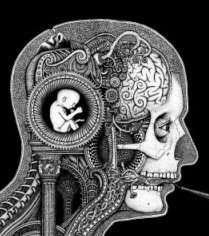
The picture is detail from a stunning picture called ‘Cognitive Transformation’ by artist Ben Tolman. Click to see the full version.

I just discovered Tolman’s website earlier today where you can see his wonderfully intricate and beautifully mind-bending images.

If you want some on your wall or shelf, he also has an online store.
 

Link to Ben Tolman’s website.

Relax, it’s just a reversible drug-induced coma

The New York Times has a fantastic interview with Emery Neal Brown, a neuroscientist and doctor who is trying to understand how anaesthesia works to better understand the brain and to build better drugs.

It’s a great interview because he address several of the common beliefs and myths about anaesthesia as well as the challenge of doing neuroscience on comatose people.

Q. Is anesthesia like a coma?

A. It’s a reversible drug-induced coma, to simplify. As with a coma that’s the result of a brain injury, the patient is unconscious, insensitive to pain, cannot move or remember. However, with anesthesia, once the drugs wear off, the coma wears off.

Q. Some years ago when I had an operation, I remember the anesthesiologist trying to soothe me by saying that she was going to put me “to sleep.” Was this right?

A. No. And I wish we’d refrain from saying that to patients. It’s inaccurate. It would be better if we explained exactly what the state of general anesthesia is and why it’s needed. Patients appreciate this intellectual honesty. Moreover, anesthesiologists should never say “put you to sleep” because it is exactly the expression used when speaking about euthanizing an animal!


Link to interview in New York Times.

From Both of Me to all 15 of You

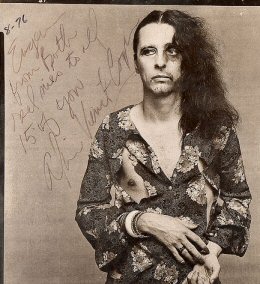
While browsing through Flickr I just found this amazing signed photo that rocker Alice Cooper dedicated to his psychologist Eugene Landy.

If you click on the image for the full version you can see the photo in all its Cooper-esque glory. It’s dated 1976, which is apparently shortly before Cooper was hospitalised to treat his alcohol problems.

Even with an enlarged image the writing remains quite hard to read but according to this autograph auction page the text reads:

A b&w 8″ x 10″ photo inscribed “Eugene from Both of Me to all 15 of You” and signed “Alice Vincent Cooper” in black ink by the original shock rocker. the date “8-76” is printed above the inscription. “Eugene” refers to psychologist Eugene Landy, with whom Cooper was a patient in the 1970s. (Lundy also treated Brian Wilson of the Beach Boys.)

To say Lundy ‘treated’ Brian Wilson is a bit like saying Napolean ‘toured’ Europe as he eventually lost his license after it was found out that he had taken over Wilson’s business affairs while supposedly working with him as a responsible clinician.

The situation lasted several years and has become a notorious episode in Wilson’s life.
 

Link to photo on Flickr.

A mental map of city street drugs

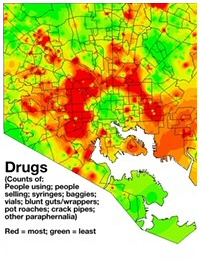
Urbanite has a fascinating article on researchers who are attempting to map drug users’ minds onto the city streets.

They are giving addicts GPS-enabled PDAs that ask the participants to rate their psychological state as they move around Baltimore.

By using pre-existing maps of the city that chart things like neighbourhood poverty and local drug availability it’s possible to see how the mental state of users changes as they move through the different physical and social environments of the city.

To make the patterns of movement meaningful, the researchers have to understand the various city “environments” that the drug users move through. This job fell to Craig, the biostatistician and a Baltimore native. To create maps of the urban landscape, Craig started with Census indices, which include race, income, and other socioeconomic metrics. To those he added a system developed by Dr. Debra Furr-Holden at the Johns Hopkins School of Public Health, who sent teams out to score city blocks based on physical characteristics (broken windows, shell casings, street memorials for recent killings) and on people’s behavior (clearly intoxicated adults, unsupervised children, and so on). “Her data are like nothing else I’ve ever seen,” says Epstein.

On these maps, Craig plots the paths of drug users as they move through the city, weaving in the information they’ve plugged into their PDAs. The result is a detailed rendering of how addiction is lived in space and time, opening a new window on the experience of tens of thousands of city residents. “Their work is novel,” says Yale University’s Rajita Sinha, professor of psychiatry and child study and director of the Yale Stress Center. This research “allows us to understand the social context in which drug use takes place and to evaluate that context,” says Sinha, who is internationally known for her pioneering research on the mechanisms linking stress to addiction.

The technique is called ‘ecological momentary assessment’ – although it is similar to a closely related method called ‘experience sampling’ that also involves giving participants an electronic device that requires they record their mental state at various points in their daily life.

These techniques have been around since the early 90s but the new aspect is the incorporation of GPS to map these responses into physical space.

One of the pioneers of this technique has been, not a scientist, but the artist Christian Nold, who has been making emotion maps of cities for many years to beautiful effect.

The Urbanite article covers how a team from the US National Institute on Drug Abuse are attempting perhaps the most ambitious and data-rich version of this approach to date which truly attempts to blend both inner and outer worlds.
 

Link to article ‘On the Trail of Addiction’.

Capturing waves of electricity

BBC Radio 4’s Case Notes has an excellent edition on epilepsy that covers everything from the changes in consciousness during seizures to the use of brain surgery to treat the condition.

It’s a pretty straightforward discussion but you’ll likely not find a better introduction to the neurological disorder, what it does and how it’s treated. Just well explained, no nonsense and comprehensive.

Great stuff.
 

Link to epilepsy edition page with streamed audio.
mp3 of podcast.

Infested by the Wizard of Oz

Jay Traver had begun to notice an uncomfortable crawling sensation under her skin. Scalp spots had bothered her for years but despite her best efforts – she was, after all, a renowned professor of zoology – she couldn’t identify the parasites.

Over the seasons the bugs had spread across her body and eventually invaded her eyes, ears and nostrils, raising her discomfort to fever pitch. Doctors seemed mystified but by the summer of 1950 she had made a breakthrough.

Strong caustic soaps seemed to help control the infestation and she had dug some of the bugs out of her skin with her nails to identify them as dermatophagoides – a mite never previously known to infect humans.

Although lacking a cure she wrote of her discovery and experiences as an article for the scientific journal Proceedings of the Entomological Society of Washington which later appeared in their February 1951 issue.

It is perhaps one of the most remarkable scientific papers ever published, not, as it turns out, because of the startling new discovery, but because the Professor had never been infected by parasites.

The bugs were hallucinated, the infestation a delusion and Travers was suffering from a mental illness.

Known as delusional parasitosis the condition consists of the usually focused delusion that the person is infected by parasites that crawl under the skin and which remain present in the surrounding environment.

Patients often turn up to doctors with small bugs in plastic bags which later turn out to be dust, irrelevant bugs or even just flakes of human skin.

Extensive damage is common as patients apply stronger and stronger solutions to the skin or use sharps objects to dig out what they assume are parasites below the surface of their body.

Professor Traver’s article reports these experiences in detail and even has photos of the supposed ‘dermatophagoides’ mites – which were identified by others as common house dust mites that only live on dry skin that has flaked off the body.

Tellingly, the article described how, after an admission to hospital where no parasites were found, Traver was referred to a neurologist for what was apparently labelled a “psychoneurotic condition”. Dismissing the diagnosis she quickly ducked the appointment.

The scientific paper has become a little-known classic for students of obscure psychiatric conditions. In a recent article on the condition, entomologist Nancy Hinkle hailed it as “one of the most astounding first-person accounts of Ekbom’s syndrome” available but the paper has a more profound point.

Hinkle notes that “her experience illustrates that even highly educated scientists accustomed to dealing with facts and evidence are not immune to delusions”.

We like to think that our convictions are based on reasoned conclusions and that all of our beliefs are subject to the searchlights of self-inquiry, but we are only experts as far as we are allowed by our own minds.

Like a Wizard of Oz that never got found out, we cannot see the man behind the curtains and even knowing he is there doesn’t let us detect him at work.

Professor Jay Traver lived with her delusions for 31 years, right up until her death.
 

pdf of Traver’s 1951 paper.
Link to annoyingly pay-gated Hinkle paper on delusional parasitosis.
2011-02-25 Spike activity

Quick links from the past week in mind and brain news:

Bad Science looks at how we can fool ourselves and others using security and detection technology.

Cell Phones Are Somehow Related To The Brain. Thank you Neuroskeptic for a decent look at the ‘mobile phones affect the brain’ story that made the headlines this week.

SoundCheck from WYNC radio had an excellent piece on music and the brain recently with musician and neuroscientist Dan Levitin.

How well can we communicate emotions purely through touch? The BPS Research Digest touches on a wonderful study.

Wired has a podcast about the battles of the upcoming revision to American psychiatry’s DSM diagnostic manual.

An excellent piece on Neuroanthropology covers new research challenging the idea of the recently evolved ‘modern‘ human.

The Guardian has a piece on motivations behind ‘designer vagina’ plastic surgery that starts with a sensationalist headline not supported by the article.

There’s a thoughtful but all-too-spiky response by The Last Psychiatrist to an important Jonah Lehrer article on the scientific ‘decline effect’ published recently in The New Yorker.

Time magazine asks whether the concept of sex addiction is a ‘real disease or a convenient excuse’.

A typically excellent piece on Providentia on Andre Bloch – mathematician in the asylum.

The Washington Post heralds another new movie based on the “drug-influenced, paranoid worldview” of Philip K. Dick.

Is romantic love a cultural illusion? A brilliant Neurocritic piece that examines the concept of love from cultural ideas to brain function.

Time magazine asks whether emergency bans on ‘legal highs’ can hinder legitimate drug development.

Does anger convey competence? asks Barking Up the Wrong Tree. Fortunately for lots of self-important bosses, it seems it does.

The Guardian reports that the UK government’s behavioural economics “Nudge Unit” hasn’t convinced anyone to use its ideas yet.

There’s a beautiful scanning electron close-up of the human cerebral cortex over at Neuro Images.

The New York Times discusses peak fertility in women and a curious new twist to the usual ‘most attractive time of the month’ story.

There’s a genuinely interesting consideration of Twitter and the psychology of private speech over at The Child in Time blog.

Emotional fluctuations in the lyrics of Bob Dylan

A 2008 study looked at the fluctuation in the use of emotional words in the lyrics of Bob Dylan in relation to the events in his life.

Emotional fluctuations in Bob Dylan’s lyrics measured by the dictionary of affect accompany events and phases in his life

Psychol Rep. 2008 Apr;102(2):469-83.

Whissell C

Lyrics for Bob Dylan’s songs between 1962 and 2001 (close to 100,000 words) were scored with the help of the Dictionary of Affect in Language (Whissell, 2006). Means for Pleasantness, Activation, and Imagery are reported for 22 Blocks characterizing this time span. Significant but weak differences across Blocks were found for all three measures at the level of individual words.

Emotional fluctuations in words included in Bob Dylan’s lyrics accompanied events and phases in his life, although they were not entirely dictated by these events. Dylan used more highly Imaged and more Active words at times when his work was critically acclaimed. More Passive word choices characterized times of prolonged stress, and more Pleasant choices times of experimentation. Dylan’s three popularity peaks were used to divide the singer’s career into three stages (rhetor, poet, sage) which differed in terms of pronouns used.

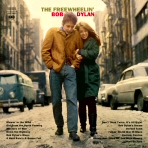
It turns out that Suze Rotolo, Dylan’s girlfriend and the girl on the front of his famous album The Freewheelin’ Bob Dylan has just passed away, which made me think of this curious piece of research.
 

Link to PubMed entry for study.

Faking tragedy and the pull of online sympathy

The Guardian has a fascinating article about the motivations of people who have faked terminal illnesses as their online companions have offered support and sympathy right until the supposed end.

Several cases have become notorious online where illnesses, and even deaths, have been faked much to the betrayal of community members.

Mandy is one of a growing number of people who pretend to suffer illness and trauma to get sympathy from online support groups. Think of Tyler Durden and Marla Singer in Fight Club, only these support groups are virtual, and the people deceived are real. From cancer forums to anorexia websites, LiveJournal to Mumsnet, trusting communities are falling victim to a new kind of online fraud, one in which people are scammed out of their time and emotion instead of their money. The fakers have nothing to gain from their lies – except attention.

These aren’t just people with a sick sense of humour. Jokers want a quicker payoff than this kind of hoax could ever provide. It requires months of sophisticated research to develop and sustain a convincing story, as well as a team of fictitious personas to back up the web of deceit. Psychiatrists say the lengths to which people like Mandy are prepared to go mean their behaviour is pathological, a disorder rather than simply an act of spite. The irony is these people might actually be classed as ill – just not in the way they claim to be.

This type of behaviour can be diagnosed as facticious disorder in the DSM with the idea that the motivation is to gain the psychological benefits of the ‘sick role’ – i.e. a caring response from other people.

It is considered a mental illness and is sometimes labelled Munchausen syndrome after the German Baron who was famous for his tall tales.

However, faking illness to get material benefits or to avoid responsibilities is classified as malingering is not considered a mental illness, although no justification is usually given for why one is considered an illness and the other just ‘bad behaviour’.

To complicate matters further, it seems some people can experience serious medical problems (e.g. paralysis, blindness) with nothing seeming to be wrong with them – but crucially – they are not doing so consciously.

In other words, they are not ‘faking’ in the normal sense of the word and these conditions are typically diagnosed as conversion disorder.

If they sound exotic, about 10-20% of all neurology examinations turn up no damage that could explain the symptoms.

Considering we have all faked or exaggerated illness to some degree, and the fact that our unconscious mind has a powerful effect on the experience of symptoms – regardless of their physical basis, we can consider terminal illness fakers as one end of a behaviour spectrum on which we all live.

The Guardian article looks at the increasingly recognised online expression of this behaviour (with the inevitable unnecessary suggestion of an online specific diagnosis) and some fascinating individual cases.

 
Link to article ‘Faking illness online’.