The Times on art, neuroscience and self-harm

razor_blade.jpgToday’s Times has two short but interesting articles in its ‘body and soul’ section, both of which are available online: one on the neuroscience of art and another on self-harm.

Mark Lythgoe is a neuroscientist at University College London who has been involved in art / science projects for over a decade. He discusses the possible neural basis for why Dan Flavin’s minimalist light-based artwork has such appeal.

The article on self-harm is inspired by a new book by Carolyn Smith, based on her own experiences of self-harm and recovery. It discusses the phenomenon, its emotional impact, and includes advice if you find out someone you know has self-harmed.

Link to article ‘The light fantastic’.
Link to article ‘Unkindest cut of all’.

Explore your brain

psychpop_image.jpgA new online service called ‘PsychPop‘ has been launched by the Institute of Psychiatry in London. It allows members of the public to volunteer to help in research that aims to combat brain injury, neurological disease and mental illness.

Often, one of the difficulties in conducting research is not recruiting people affected by medical conditions, but members of the public.

General public participants are essential allies in research, needed to determine which aspects of mind and brain functioning might be different when compared to people with a specific condition.

The service at the Institute of Psychiatry has been set up by neuropsychologist and wikipedian Paul Wicks, initially out of frustration when trying to recruit members of the public in his own research on motor neurone disease.

Taking part in research can also be a fascinating experience. If you don’t live in London, most universities will conduct research into the mind and brain so it’s worth getting in touch and asking how to volunteer.

Crucially, find out exactly what’s involved, make sure the study has ethical approval (it has been judged by an ethics committee to be safe and well conducted) and ask any questions you have before starting.

Other than that, enjoy the experience! You usually get your travel expenses reimbursed and can often get a copy of the results – including a picture of your brain if you take part in a neuroimaging study.

Cognitive scientists: If your department has an online sign-up form for participants, why not add a link in the comments page of this entry?

Link to PsychPop.

2006-02-03 Spike activity

Quick links from the past week in mind and brain news:

spike.jpg

A new blog ‘On The Spectrum‘ collects and discusses development in the science of the autism spectrum.

Mixing Memory discusses the psychology of intellectual of insight

ABC Radio’s All in the Mind discusses the effect of petrol sniffing on the brain.

Scientific brain linked to autism – with the appropriate number of caveats and qualifications.

Brain Waves previews an upcoming book on the female brain.

Epilepsy Action launches Mothers in Mind campaign.

RadioLab’s science programme discusses the psychology and neuroscience of stress.

A report on a person who experiences near permanent deja-vu.

An engaging article from Cognitive Daily tackles research on the how children understand the concept of death.

Wired chart the use of transcranial magnetic stimulation for the treatment of depression.

NewSci on robots and chronobiology

newsci_20060202.jpgToday’s New Scientist is a special on robots, particularly focusing on robots that mimic or model certain aspects of human behaviour.

The issue also has an additional article on whether it is possible to regulate the brain’s ‘time keeper’ to change the conscious perception of time – a skill which could be used to allow for more conscious control of difficult tasks.

The article does suffer from a few points of frank weirdness (e.g. “Schizophrenics have too much dopamine activity in the brain so their clock is so fast that it feels like the whole world is crazy” – wtf?) but is otherwise an interesting look at chronobiology – the science of biological time perception.

For those wanting to know more about the area, you could do far worse than go to the insightful and informative blog Circadiana, for which chronobiology is a focus of interest.

Otherwise, your local library should have a copy of New Scientist if your newsagent doesn’t, as unfortunately, the main feature articles aren’t available online.

Link to table of contents for this week’s New Scientist.
Link to Circadiana.

Parallel universe Mind Hacks

mindhacks_org.jpgI’ve just discovered mindhacks.org. I think it’s a version of this site from a parallel universe.

It’s a seemingly dormant blog that has a mixture of posts on everything from the science of spirituality to the plainly cosmic…

Dr. William A. Tiller’s studies and experiments have proven that human consciousness “changes space.” And he explains how this works in a way that’s easy for us to follow and understand.

But further – and of importance to the subject matter of our current issue – he demonstrates not only that Zero Point Energy is, for all practical purposes, absolutely limitless, but that in it lies our future potential.

Zero Point Energy sounds suspiciously like a good dose of caffeine to me, but I suspect Dr. Tiller might have something slightly different in mind.

Link to mindhacks.org

Neurobiological optimisation

better_humans.jpgAn article in The Guardian discusses the possibilities of using new developments in biotechnology to enhance the human mind and brain.

The article is somewhat breathless to say the least, but does contain an interesting overview of the current schools of thought on the possible impact of the technology on society.

The author also notes that there are a number of upcoming events which will discuss the implications of a world where cognitive enhancement technology is widely available.

One such event, entitled ‘Better Humans?‘, is being run by the London-based think-tank Demos in Feburary and aims to mark the launch of a series of essays on the topic.

A further event, entitled ‘Tomorrow’s People‘, is being run by Oxford University in March and aims “to explore the promises of technology for life enhancement and extension in different parts of the world”.

Link to ‘There is no stop button in the race for human re-engineering’.

Cajal and the history of the synapse

Cajal.jpgAmerican Scientist reviews two new books on the scientific history of the synapse and the early work on neural communication, particularly focusing on the life and work of pioneering Spanish neuroscientist Santiago Ramón y Cajal.

In his Nobel Prize winning work, Cajal discovered the synapse and first argued that the neuron was the fundamental unit of the nervous system. Although this is now accepted as fact, at the time it was highly controversial.

The review is more than simply an opinion on the two books, but is actually a fantastic summary of his life and times, and the scientific discoveries which changed the world.

Link to review entitled ‘A Lot of Nerve’.

Revolutionary child brain database launches

child_mri.jpg

A database of MRI scans of normally developing children has been launched that could revolutionalise the understanding of childhood brain function, injury and disease. It includes brain scans of 500 children from 7 days to 18 years-old and aims to be representative of the population at large.

The understanding of child brain function is still a grey area, despite the fact that the young brain can show remarkable properties.

For example, a 2001 book by Antonio Battro (sample chapter: pdf) describes a three year old boy named ‘Nico’ who had the whole of his right hemisphere removed to control life-threatening epilepsy.

Nevertheless, he has developed with very little impairment and has turned out to be a bright and engaging child, despite the fact that a similar operation in adults would be profoundly disabling.

One difficulty with many current studies of brain development in children is there is no precise reference for what constitutes ‘normal’ development.

The database will provide a wealth of data for clinicians and researchers to make accurate comparisons, rather than relying on detecting the presence of abnormalities by eye, or by comparison with small or ad-hoc control groups.

The journal NeuroImage just published a early-release copy of the article describing the development and potential uses of the data. The project has been realised by a huge list of individuals, listed as the ‘Brain Development Cooperative Group’, and by neuroscientist Alan Evans.

Link to NeuroImage abstract ‘The NIH MRI study of normal brain development’.
Link to summary from NIH.

Imagination as torch bearer

Byron.jpg

“It is singular how soon we lose the impression of what ceases to be constantly before us. A year impairs, a luster obliterates. There is little distinct left without an effort of memory, then indeed the lights are rekindled for a moment – but who can be sure that the Imagination is not the torch-bearer?”

Lord Byron in the Ravenna Journal, 1821-22.

Cracking the neural code

phrenology_head.jpgThere’s a piece in this month’s Adbusters magazine on ‘cracking the neural code‘ as part of a feature on ‘Big Ideas of 2006’:

Chances are you have never heard of the neural code. And yet, from both a practical and philosophical perspective, the neural code is the most important remaining scientific mystery. Analogous to the machine code of a digital computer, the neural code is the software, set of rules, syntax, that transforms electrical pulses in the brain into perceptions, memories, decisions. A solution to the neural code could – in principle – give us almost unlimited power over our psyches, because we could monitor and manipulate brain cells with exquisite precision by speaking to them in their own private language.

The article is full of sci-fi speculation, but notes that it is grounded in current scientific developments and particularly the developing field of neuroprosthetics.

Link to ‘We’re Cracking the Neural Code, the Brain’s Secret Language’.

Zero wings

red_bull_can.jpgA recent news story has noted the consequences of drinking popular energy drink Red Bull in excess as a UK driver was booked for dangerous driving after drinking 20 cans (20 cans!) of the product.

Interestingly, the Canadian Journal of Psychiatry published a case report in 2001 suggesting that excessive intake triggered a manic episode in a gentleman with bipolar disorder.

Red Bull has had several papers published on it in scientific journals. It is often not referred to by brand, but often by the euphamism of ‘energy drink [with taurine and caffeine]’ or ‘functional energy drink’.

Despite the marketing hype, it has been genuinely shown to improve mental performance for a short duration, and particularly usefully, to counteract dangerous driver sleepiness during tests with a driving simulator.

…when taken in sensible doses, of course.

2006-01-27 Spike activity

Quick links from the past week in mind and brain news:

spike.jpg

Researchers find gene linked to the chance of being diagnosed with bipolar disorder.

The Telegraph talk up psychology and neuroscience, arguing that ‘The Future is All in Your Head‘.

The evolution and function of laughter is discussed in Seed Magazine.

Brainscan Blog hails the opening of a new fMRI lab to study the neuroscience of sign language.

Behind every great genius – is another great genuis, claim Live Science.

Philosopher Daniel Dennett in a fairly content-free interview in the New York Times discusses his forthcoming book on the biology of religious belief.

Members of a remote Amazon tribe can solve basic problems in geometry, despite never having seen a math book, suggesting geometric ability may be innate.

The New York Times article ‘This Is Your Brain on Schadenfreude‘ discusses the neural response to others’ displeasure.

“None of the circuits involved in conscious reasoning were particularly engaged”. No big surprises from studies of the neuropsychology of political affiliation.

A gene which regulates the enzyme CYP2A6 – known to be involved in the metabolism of nicotine – may be key to understanding the genetics of cigarette addiction.

With our thoughts, we make our world

monk_eeg.jpgWired magazine examines the recent interest in the neural basis of meditation and the political storm caused by the Dalai Lama’s speech at the last Society for Neuroscience conference, in a recently published online article.
The Tibetan Buddhist leader’s presentation was the subject of much protest and counter-protest even before it began, which guaranteed that it would be one of the hottest tickets at SfN 2005.

One accusation levelled at some of the scientists involved in this research is that they are being unduly influenced by the religious aspects of Buddhism and are losing their scientific objectivity.

The Wired article looks at both the research on meditation and the Dalai Lama’s enthusiam for science and considers whether the science is indeed being affected.

Link to ‘Buddha on the Brain’.

Is that a brain charm in your pocket?

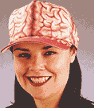
brain_cap.jpgI’ve just discovered Brain Mart, an online shop for everything (and I mean everything) brain-related. They sell a great deal of educational material as well as a range of ‘brain novelties’.

These stretch from the classic (a phrenonology bust) to the anatomically correct ‘brain cap’ (“Flip up the brim and expose the words, Think, think, think…”) to the slightly worrying ‘Brain Charms’, for adding to a necklace or bracelet.

Link to Brain Mart.

Gallagher on action, body image and psychosis

Gallagher_strip.jpg

Philosopher and cognitive scientist Shaun Gallagher sits in the hot seat and is interviewed by Science and Consciousness Review who quiz him about how the body and its actions shape our thoughts, and how this can break down to produce bizarre experiences of being controlled by outside forces.

Gallagher draws on the neuroscience of action and the philosophy of consciousness in his interview, in line with much of his previous work.

I think these experiences of ownership and agency [of actions] are manifested at the level of the level of first-order, pre-reflective, phenomenal consciousness. That is, I don’t need to reflect on what I’m doing to generate these experiences. Rather, they are part of and implicit in what my movement feels like.

Link to ‘An Interview with Shaun Gallagher’.
Link to Shaun Gallagher’s homepage.

Foxtrot on ad hoc psychological testing

foxtrot_panel.jpgA recent edition of Bill Amend’s FoxTrot comic strip has a nice twist on the notional glass half-full / glass half-empty psychological ‘test’. The test also features in a Gary Larson Far Side strip entitled ‘The Four Basic Personality Types‘ that adorns the doors of hundreds of psychologists across the globe.

(Thanks Nathan!)