US Military PsyOps video appears online

A US Military PsyOps video has found its way onto the YouTubes and gives a interesting but clunky guide to ’90s psychological operations.

It’s called The Invisible Sword and it’s a bit like watching a cable TV infomercial for psychological warfare complete with cheesy easy listening background music and stilted dialogue.

“It all gets put together when the chips are down somewhere in the world and it gets put together from the top down”. Thanks General.

The video is also a curious bit of history as it discusses operations that bridge over the time when the US military was transitioning from intervention in the Balkans and proxy wars in Latin America to large scale campaigns in the middle east.

It’s a pre-Human Terrain System view of social intervention that was less focused on managing the relatively small-scale social networks that mediated allegiances between the complex militias intertwined in the ‘war on terror’ and more on larger-scale propaganda.
 

Link to The Invisible Sword on YouTubes (via @psywarorg)

A radiant light and an aura of activity

Nature Medicine has a fascinating article about attempts to research the neuroscience of migraine and its aura – the perceptual changes that precede the onset of the splitting headache.

It turns out to be trickier than it seems. The idea is to trigger a migraine in people who seem to have clear conditions that start one off and then get them in a scanner as soon as possible.

Unfortunately, this doesn’t always work very reliably.

However, one notable success was someone who had migraines triggered by basketball:

Michael Moskowitz and his colleagues at the Massachusetts General Hospital Neuroscience Center in the Boston area described the most famous report of a controlled study involving a person experiencing aura in a lab in 2001. They identified a patient, named Patrick, who could reliably induce his aura by playing basketball. The researchers arranged for Patrick and his wife to shoot hoops next door to their research center at a YMCA gym. After about an hour of exercise, Patrick then jumped into a functional MRI machine at the clinic and waited for his aura to begin. In this way, Moskowitz and his team tracked changes in Patrick’s brain before, during and after self-described aura attacks on two separate occasions.

The article noted that it’s a mystery why basketball was a trigger for migraine but these very specific triggers are often also present in epilepsy.

Called ‘reflex epilepsy‘ it involves seizures that can be triggered by specific situations such as reading, eating, urination, being startled, hearing certain songs and pretty much anything else you can think of (including, believe it or not, thinking itself).

This is probably due to the activities setting up specific patterns of brain activity that interact with pre-existing weakness in neural networks leading to instability that triggers seizures.

Think of it as being like living in a city where the public transport only grinds to a halt when there’s a football match between two very specific teams – due to the influx of fans from specific directions affecting a key road junction which happens to be an important traffic hub.

These very specific triggers are rare, but interestingly, when they do occur tend to more commonly occur in epilepsy and migraine, probably telling us something about how both conditions are related to spreading patterns of activity across the brain.

Anyway, much more in the Nature Medicine piece which discusses the fascinating topic of migraine aura in more detail.
 

Link to ‘Aura of mystery’ from Nature Medicine.

2013-10-11 Spike activity

Quick links from the past week in mind and brain news:

New series of BBC Radio 4’s excellent internet and society programme The Digital Human started this week.

Scientific American cover surprising sex differences in migraine which seem to be almost ‘different diseases’ in men and women.

Post-traumatic stress reactions in survivors of the 2011 massacre on Utøya Island, Norway. Forthcoming study for British Journal of Psychiatry hits the wires.

ESPN have a fascinating piece on boxer Timothy Bradley whose the first fighter to admit to lasting neurocognitive problems after a fight.

Reading fiction can make you a better mind-reader said a widely hyped study. Not so fast says Language Log.

USA Today reports that the US Army has deployed software to predict suicides as way of preventing them.

Despite promising results in controlling neuronal activity, leaders in brain research still struggle turning their work into treatments reports MIT Technology Review.

Breaking – psychologist has opinion: “Men quote from films to bond with each other without having to ask any intimate questions” reports The Telegraph. No, you can’t have those two minutes of your life back.

Drugs for the circuit-based human

Image from Wikipedia. Click for source.In a recent article for The Observer I noted that almost all the major drug companies had closed down their neuroscience divisions as evidence for a move away from a ‘chemical-based’ to a ‘circuit-based’ approach to treatments.

So to my surprise, a new Nature News article has just appeared discussing the re-launch of pharmaceutical giant Novartis’s neuroscience section.

However, as I read the beginning of the article, it seems they are just banking on the fact that they can design drugs good enough to hit individual brain circuits.

In a sign that psychiatric-disease research is entering a new era, the pharmaceutical giant Novartis has hired an expert in neural circuitry, rather than pharmacology, to head its relaunched neuroscience division.

The appointment of 42-year-old Ricardo Dolmetsch, who has spent his entire career in academic research, signifies a radical policy shift for the company, as it moves away from conventional neurotransmitter research to concentrate on analysing the neural circuitry that causes brain diseases.

Well. Best of luck with that.

I may be wrong, but I suspect dousing the brain in a chemical which is supposed to affect only selected circuits may be folly.

Then again, maybe we need to think outside the pill box. Perhaps microinjections of drugs directly into the brain is the future.

Either way, it seems the big money is being increasingly invested in the idea that useful treatments will be tweaking brain circuits.
 

Link to ‘Novartis reboots brain division’ from Nature News.

A tour through isolation

Photo from Wikipedia. Click for source.The BBC World Service just broadcast an amazing radio documentary on the experience of isolation – talking to people who have experienced intense remoteness from other humans including polar base residents, astronauts, prisoners and people who completed the Mars-500 simulated mission.

Firstly, it’s just beautiful. If there’s such a thing as an ambient documentary, this comes sublimely close to achieving it at times.

But the programme is also a fascinating look at the subjective psychology of separation.

A doctor explains how it feels to see the last plane leaving an Antarctic research base for nine months of separation from the rest of the world.

A British drug smuggler explains what it was like to be sent to an Argentine prison when he spoke no Spanish – unable to communicate with anyone.

Astronaut Al Worden has been the most isolated human in history, during his time on a Apollo mission, and explains the experience of ultimate remoteness.

The programme reminded me of another form of modern isolation the 21st century hermits who hide themselves away due to fear of the effects of modern technology – like the mythical ‘health damaging effects of WiFi’.

An article in the Journal of the Royal Society of Medicine made the comparison between these modern day hermits with their ancient brethren.

The World Service documentary is wonderful, however. As is normal with the internet-impaired BBC Radio pages, you have to get the podcast from a completely different page but you’re probably better off downloading the mp3 directly.
 

Link to BBC World Service documentary Isolation.
mp3 of the same.

Jazz no longer corrupting young people

A study published in the journal Pediatrics looked at the link between music preferences at age 12 and adolescent delinquency – finding that an early liking for ‘rebellious’ music predicted small scale anti-social behaviour like shoplifting, petty theft and vandalism.

Rebellious music turns out to be defined as variations of rock, hip-hop and electronica. But one of the interesting findings was that kids who liked jazz music were slightly less likely to be antisocial:

Although some music preferences were positively associated with delinquency, liking jazz at age 12 correlated negatively with delinquency (r = –0.12), but did not relate to age 16 delinquency.

Historically, this is interesting because jazz, at the height of its popularity, was widely linked to delinquency, drug-taking, insanity and sexual promiscuity:

Dig this:

The human organism responds to musical vibrations. This fact is universally recognized. What instincts then are aroused by jazz? Certainly not deeds of valor or martial courage, for all marches and patriotic hymns are of regular rhythm and simple harmony; decidedly not contentment or serenity, for the songs of home and the love of native land are all of the simplest melody and harmony with noticeably regular rhythm. Jazz disorganizes all regular laws and order; it stimulates to extreme deeds, to a breaking away from all rules and conventions; it is harmful and dangerous, and its influence is wholly bad.

That’s from the August 1921 edition of the Ladies Home Journal, one of the most widely read magazines of the time.

You’ll notice a lot of racism around the ‘jazz is bad’ vibe. This was picked up at the time as it happens.

However, I would guess that 50’s jazz, like modern rebellious music, could have had a statistical link to minor delinquency, but like today, it was probably not causal. Rebellious people gravitate toward rebellious music.

Jazz, however, aint no longer rebellious. In the popular imagination, it’s a soundtrack for beard-strokers, and the days of banging up a quarter gram of snow and downing a couple of bennies before losing it in a sweaty jazz joint are long gone.

In fact, it’s so no-longer-rebellious that it was the only type of music to predict lower delinquency.

One thing hasn’t changed though. The slightly awkward tone that sounds like your dad lamenting the death of proper music. With a tune. And lyrics. You know, proper lyrics, that tell a story.

The opening sentence of the Pediatrics study:

During the 1980s and 1990s, the loudest and most rebellious forms of rock (eg, heavy metal, gothic), African American music (hip-hop, particularly gangstarap), and electronic dance music (house, techno, hardhouse) were labeled by adults as “problem” music and perceived as promoting violence, substance use, promiscuous sex, blasphemy, and depression

Can I get a nice cup of tea from the massive tonight?
 

Link to study ‘Early Adolescent Music Preferences and Minor Delinquency’.

Madness and hallucination in The Shining

Roger Ebert’s 2006 review of Stanley Kubrick’s The Shining turns out to be a brilliant exploration of hallucination, madness and unreliable witnessing in a film he describes as “not about ghosts but about madness and the energies it sets loose”.

Kubrick is telling a story with ghosts (the two girls, the former caretaker and a bartender), but it isn’t a “ghost story,” because the ghosts may not be present in any sense at all except as visions experienced by Jack or Danny.

The movie is not about ghosts but about madness and the energies it sets loose in an isolated situation primed to magnify them. Jack is an alcoholic and child abuser who has reportedly not had a drink for five months but is anything but a “recovering alcoholic.” When he imagines he drinks with the imaginary bartender, he is as drunk as if he were really drinking, and the imaginary booze triggers all his alcoholic demons, including an erotic vision that turns into a nightmare. We believe Hallorann when he senses Danny has psychic powers, but it’s clear Danny is not their master; as he picks up his father’s madness and the story of the murdered girls, he conflates it into his fears of another attack by Jack. Wendy, who is terrified by her enraged husband, perhaps also receives versions of this psychic output. They all lose reality together.

A psychologically insightful piece on one of the classics of psychological horror.
 

Link to Roger Ebert’s 2006 review of The Shining.

18 minutes of trauma

I’ve just found one of the best discussions on the importance and limits of the concept of post-traumatic stress disorder on a programme from the Why Factor on BBC World Service.

It’s a brief programme, only 18 minutes long, but packs in a remarkably incisive look at PTSD that tackles its causes, its cultural limits and its increasing use as an all-purpose folk description for painful reactions to difficult events.

Both compassionate and critical, it’s one of the best discussions of post-trauma and its diagnosis I have heard for a while.

As is typical for the internet-impaired BBC radio pages, the podcast is on an entirely different page, so you might want to download the mp3 directly.
 

Link to programme page and streamed audio.
mp3 of programme audio.

A war of biases

Here’s an interesting take on terrorism as a fundamentally audience-focused activity that relies on causing fear to achieve political ends and whether citizen-led community monitoring schemes actually serve to amplify the effects rather than make us feel safer.

It’s from an article just published in Journal of Police and Criminal Psychology by political scientist Alex Braithwaite:

A long-held premise in the literature on terrorism is that the provocation of a sense of fear within a mass population is the mechanism linking motivations for the use of violence with the anticipated outcome of policy change. This assumption is the pivot point upon and around which most theories of terrorism rest and revolve. Martha Crenshaw, for instance, claims, the ‘political effectiveness of terrorism is importantly determined by the psychological effects of violence on audiences’…

Terrorists prioritize communication of an exaggerated sense of their ability to do harm. They do this by attempting to convince the population that their government is unable to protect them. It follows, then, that any attempt at improving security policy ought to center upon gaining a better understanding of the factors that affect public perceptions of security.

States with at least minimal historical experience of terrorism typically implore their citizens to participate actively in the task of monitoring streets, buildings, transportation, and task them with reporting suspicious activities and behaviors… I argue that if there is evidence to suggest that such approaches meaningfully improve state security this evidence is not widely available and that, moreover, such approaches are likely to exacerbate rather than alleviate public fear.

In the article, Braithwaite presents evidence that terrorist attacks genuinely do exaggerate our fear of danger by examining opinion polls close to terrorist attacks.

For example, after 9/11 a Gallup poll found that 66% of Americans reported believing that “further acts of terrorism are somewhat or very likely in the coming weeks” while 56% “worried that they or a member of their family will become victim of a terrorist attack”.

With regard to community monitoring and reporting schemes (‘Call us if you see anything suspicious in your neighbourhood’) Braithwaite notes that there is no solid evidence that they make us physically safer. But unfortunately, there isn’t any hard evidence to suggest that they make us more fearful either.

In fact, you could just as easily argue that even if they are useless, they might build confidence due to the illusion of control where we feel like we are having an effect on external events simply because we are participating.

It may be, of course, that authorities don’t publish the effectiveness figures for community monitoring schemes because even if they do genuinely make a difference, terrorists might have the same difficulty as the public and over-estimate their effectiveness.

Perhaps the war on terror is being fought with cognitive biases.
 

Link to locked academic article on fear and terrorism.

The rise of the circuit-based human

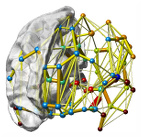
Image from Sociedad Española de NeuroCienciasI’ve got a piece in The Observer about how we’re moving towards viewing the brain as a series of modifiable brain circuits each responsible for distinct aspects of experience and behaviour.

The ‘brain circuit’ aspect is not new but the fact that neuroscience and medicine, on the billion-dollar global level, are reorienting themselves to focus on identifying and, crucially, altering brain circuits is a significant change we’ve seen only recently.

What many people don’t realise, is the extent to which direct stimulation of brain circuits by implanted electrodes is already happening.

Perhaps more surprising for some is the explosion in deep brain stimulation procedures, where electrodes are implanted in the brains of patients to alter electronically the activity in specific neural circuits. Medtronic, just one of the manufacturers of these devices, claims that its stimulators have been used in more than 100,000 patients. Most of these involve well-tested and validated treatments for Parkinson’s disease, but increasingly they are being trialled for a wider range of problems. Recent studies have examined direct brain stimulation for treating pain, epilepsy, eating disorders, addiction, controlling aggression, enhancing memory and for intervening in a range of other behavioural problems.

More on how we are increasingly focussed on hacking our circuits in the rest of the article.
 

Link to ‘Changing brains: why neuroscience is ending the Prozac era’.

This complex and tragic event supports my own view

As shots rang out across the courtyard, I ducked behind my desk, my adrenaline pumping. Enraged by the inexplicable violence of this complex and multi-faceted attack, I promised the public I would use this opportunity to push my own pet theory of mass shootings.

Only a few days have passed since this terrible tragedy and I want to start by paying lip service to the need for respectful remembrance and careful evidence-gathering before launching into my half-cocked ideas.

The cause was simple. It was whatever my prejudices suggested would cause a mass shooting and this is being widely ignored by the people who have the power to implement my prejudices as public policy.

I want to give you some examples of how ignoring my prejudices directly led to the mass shooting.

The gunman grew up in an American town and had a series of experiences, some common to millions of American people, some unique to him. But it wasn’t until he started to involve himself in the one thing that I particularly object to, that he started on the path to mass murder.

The signs were clear to everyone but they were ignored because other people haven’t listened to the same point-of-view I expressed on the previous occasion the opportunity arose.

Research on the risk factors for mass shootings has suggested that there are a number of characteristics that have an uncertain statistical link to these tragic events but none that allow us to definitively predict a future mass shooting.

But I want to use the benefit of hindsight to underline one factor I most agree with and describe it as if it can be clearly used to prevent future incidents.

I am going to try and convince you of this in two ways. I am going to selectively discuss research which supports my position and I’m going to quote an expert to demonstrate that someone with a respected public position agrees with me.

Several scientific papers in a complex and unsettled debate about this topic could be taken to support my position. A government report also has a particular statistic which I like to quote.

Highlighting these findings may make it seem like my position is the most probable explanation despite no clear overall conclusion but a single quote from one of the experts will seal the issue in my favour.

“Mass shootings” writes forensic psychiatrist Anand Pandya, an Associate Clinical Professor in the Department of Psychiatry and Behavioral Neurosciences at the UCLA School of Medicine, Los Angeles, “have repeatedly led to political discourse”. But I take from his work that my own ideas, to quote Professor Pandya, “may be useful after future gun violence”.

Be warned. People who don’t share my biases are pushing their own evidence-free theories in the media, but without hesitation, I can definitely say they are wrong and, moreover, biased.

It is clear that the main cause of this shooting was the thing I disliked before the mass shooting happened. I want to disingenuously imply that if my ideas were more widely accepted, this tragedy could have been averted.

Do we want more young people to die because other people don’t agree with me?

UPDATE: Due to the huge negative reaction this article has received, I would like to make some minor concession to my critics while accusing them of dishonesty and implying that they are to blame for innocent deaths. Clearly, we should be united by in the face of such terrible events and I am going to appeal to your emotions to emphasise that not standing behind my ideas suggests that you are against us as a country and a community.

A comic repeat with video games and violence

An article in the Guardian Headquarters blog discusses the not very clear evidence for the link between computer games and violence and makes a comparison to the panic over ‘horror comics’ in the 1950s.

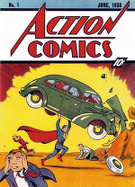
The Fifties campaign against comics was driven by a psychiatrist called Fredric Wertham and his book The Seduction of the Innocent.

We’ve discussed before on Mind Hacks how Wertham has been misunderstood. He wasn’t out to ban comics, just keep adult themes out of kids magazines.

However, his idea of what ‘adult themes’ might be were certainly pretty odd. This is Wertham’s testimony to a hearing in the US Senate.

I would like to point out to you one other crime comic book which we have found to be particularly injurious to the ethical development of children and those are the Superman comic books. They arose in children’s fantasies of sadistic joy in seeing other people punished over and over again, while you yourself remain immune. We have called it the “Superman complex.” In these comic books, the crime is always real and Superman’s triumph over [evil] is unreal. Moreover, these books like any other, teach complete contempt of the police…

I may say here on this subject there is practically no controversy… as long as the crime comic books industry exists in its present form, there are no secure homes. …crime comic books, as I define them, are the overwhelming majority of all comic books… There is an endless stream of brutality… I can only say that, in my opinion, this is a public-health problem.

The ‘Superman causes sadism’ part aside, this is a remarkably similar argument to the one used about violent video games. It’s not a matter of taste or decency, it’s a public health problem.

In fact, an article in the Mayo Clinic Proceedings had a neat comparison between arguments about 1950s comic books and modern day video games which turn out to be very similar.

Moral of the story: wait for sixty years when the debate about violent holograms kicks off and they’ll leave you to play your video games in peace.
 

Link to ‘What is the link between violent video games and aggression?’
Link to article on video games and comic panics in Mayo Clinic Proceedings.

A coming revolution walks a fine line

The Chronicle of Higher Education has an excellent in-depth article on the most likely candidate for a revolution in mental health research: the National Institute of Mental Health’s RDoC or Research Domain Criteria project.

The article is probably the best description of the project this side of the scientific literature and considering that the RDoC is likely to fundamentally change how mental illness is understood, and eventually, treated, it is essential reading.

It is also interesting for the fact that the leaders of the RDoC project continue to hammer the reputation of the long-standing psychiatric diagnosis manual – the DSM.

First though, it’s worth knowing a little about what the RDoC actually is. Essentially, it’s a catalogue of well-defined neural circuits that are associated with specific cognitive functions or emotional responses.

If you look at the RDoC matrix you can see how everything has been divided. For example, stress regulation is associated with the raphe nuclei circuits and serotonin system.

The idea is that mental illnesses would be better understood as dysfunctions in various of these core components of behaviour rather than the traditional collections of symptoms that have been rather haphazardly formed into diagnoses.

Conceptually, it’s like a sort of neuropsychological Lego that should allow researchers to focus on agreed components of the brain and see how they map on to genes, behaviour, experience and so on.

It’s meant to be updated over time so ‘bricks’ can be modified or added as they become confirmed. An advantage is that is may allow a more accessible structure to understanding the brain for those not trained in neuroscience but there is a danger that it will over-simplify the components of experience and behaviour in some people’s minds (and, of course, research).

The RDoC has been around for several years but it recently hit the headlines when NIMH director Thomas Insel wrote a blog post promoting it two weeks before the launch of the American Psychiatric Association’s diagnostic manual, the DSM-5, saying that the DSM ‘lacks validity’ and that “patients with mental disorders deserve better”.

After a media storm, Insel wrote another piece jointly with the president of the American Psychiatric Association that involved some furious backpeddling where the DSM was described as a “key resource for delivering the best available care” and “complementary” to the RDoC approach.

But in the Chronicle article, head of the RDoC project, Bruce Cuthbert, makes no bones about the DSM’s faults:

“If you think about it the way I think about it, actually the DSM is sloppy in both counts. There’s no particular biological test in it, but the psychology is also very weak psychology. It’s folk psychology without any quantification involved.”

The DSM will not, of course, suddenly disappear. “As flawed as the DSM is, we have no substitute for the clinical realm for insurance reimbursement,” ex-NIMH Director Steven Hyman says in the article.

It’s worth noting that this is not actually true. In the US, diagnosis is usually made according to DSM definitions but insurance reimbursement is charged by codes from the ICD-10 – the free diagnostic manual from the World Health Organisation.

But the fact that the most senior psychiatric researchers in the US are now openly and persistently highlighting that the DSM is not fit for the purpose of advancing science and psychiatric treatment is a damning condemnation of the manual – no matter how they try and sugar-coat it.

The fact is, the NIMH have to walk a fine line. They need to both condemn the DSM for being a mess while trying not to shatter confidence in a system used to treat millions of patients every year.

Best of luck with that.
 

Link to Chronicle article ‘A Revolution in Mental Health’.

A furious infection but a fake fear of water

RadioLab has an excellent short episode on one of the most morbidly fascinating of brain infections – rabies.

Rabies is a virus that can very quickly infect the brain. When it does, it causes typical symptoms of encephalitis (brain inflammation) – headache, sore neck, fever, delirium and breathing problems – and it is almost always fatal.

It also has some curious behavioural effects. It can make people hyper-reactive and can lead to uncontrolled muscle spasms due to its effect on the action coordination systems in the brain. With the pain and distress, some people can become aggressive.

This is known as the ‘furious’ stage and when we describe some as ‘rabid with anger’ it is a metaphor drawn from exactly this.

Rabies can also cause what is misleadingly called ‘hydrophobia’ or fear of water. You can see this in various videos that have been uploaded to YouTube that show rabies-infected patients trying to swallow and reacting quite badly.

But rabies doesn’t actually instil a fear of water in the infected person but instead causes dysphagia – difficulty with swallowing – due to the same disruption to the brain’s action control systems.

We tend to take swallowing for granted but it is actually one of our most complex actions and requires about 50 muscles to complete successfully.

Problems swallowing are not uncommon after brain injury (particularly after stroke) and speech and language therapists can spend a lot of their time on neurorehabilitation wards training people to reuse and re-coordinate their swallow to stop them choking on food.

As we know from waterboarding, choking can induce panic, and it’s not so much that rabies creates a fear of water, but a difficulty swallowing and hence experiences of choking. This makes the person want to avoid trying to swallow liquids.

Bathing, for example, wouldn’t trigger this aversion and that’s why rabies doesn’t really cause a ‘fear of water’ but more a ‘fear of choking on liquids due to impaired swallowing’.

The RadioLab episode discusses the case that launched the controversial Milwaukee protocol – a technique for treating rabies that involves putting you into a drug-induced coma to protect your brain until your body has produced the anti-rabies antibodies.

It’s a fascinating and compelling episode so well worth checking out.

UPDATE: This old medical film on YouTube goes through the stages of rabies infection. Warning: it’s a bit gruesome and has a melodramatic soundtrack but it is quite informative.


Link to RadioLab episode ‘Rodney Versus Death’.

Peter Huttenlocher has left the building

The New York Times has an obituary for child neurologist Peter Huttenlocher, who surprised everyone by finding that the human brain loses connections as part of growing into adulthood.

Huttenlocher counted synapses – the connections between neurons – and as a paediatric neurologist was particularly interested in how the number of synapses changed as we grow from children to adults.

Before Huttenlocher’s work we tended to think that our brain’s just got more connected as we got older, but what he showed was that we hit peak connectivity in the first year of life and much of brain development is actually removing the unneeded connections.

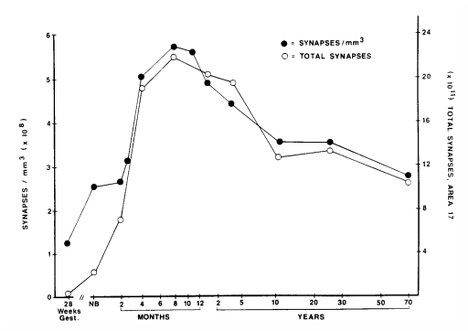
This is know as synpatic pruning and it was demonstrated with this graph from classic 1990 paper.

I love this graph for a couple of reasons. Firstly, it’s a bit wonky. It was hand-drawn and whenever it is reproduced, as it has been in many textbooks, it’s always a bit off-centre.

Secondly, it’s crystal clear. It’s a graph showing the density of synaptic connections in the visual cortex of the human brain and you can see it’s rapidly downhill from the first year of life until the late teens where things start to even out.

This is a good thing as the infant brain starts over-connected but loses anything that isn’t needed as we learn which skills are most important, and we are left with only the most efficient neural connections, through the experience of growing up.

One of Huttenlocher’s discoveries was that this process of synaptic pruning may go wrong in people who have neurodevelopmental disorders.
 

Link to NYT obituary for Peter Huttenlocher.

A detangler for the net

I’ve just finished reading the new book Untangling the Web by social psychologist Aleks Krotoski. It turns out to be one of the best discussions I’ve yet read on how the fabric of society is meshing with the internet.

Regular readers know I’ve been a massive fan of the Digital Human, the BBC Radio 4 series that Krotoski writes and presents, that covers similar territory.

Untangling the Web takes a slightly more analytical angle, focusing more on scientific studies of online social interaction and theories of online psychology, but it is all the richer for it.

It covers almost the entire range psychological debates: friendships, how kids are using the net, debates over whether the net can ‘damage the brain’, online remembrance and mourning, propaganda and persuasion, sex, dating and politics. You get the idea. It’s impressively comprehensive.

It’s not an academic book but, unsurprisingly, given Krotoski’s background as both a social psychologist and a tech journalist, is very well informed.

I picked up a couple of minor errors. It suggests internet addiction was recognised as a diagnosis in the DSM-IV, when the nearest things to an internet addiction diagnosis was only discussed (and eventually relegated to the Appendix), in the DSM-5.

It also mentions me briefly, in the discussion of public anxieties that the internet could ‘rewire the brain,’ but suggests I’m based at University College London (apparently a college to the north of the River Thames) when really I’m from King’s College London.

But that was about the best I could do when trying to find fault with the book. It’s a hugely enjoyable, balanced treatment of an often inflammatory subject, that may well be one of the best guides to how we relate over the net that you’re likely to read for a long time.
 

Link to more details about Untangling the Web.