Parental advisory: teenage kicks in progress

New York Magazine has an excellent piece on whether adolescence is really a time of turmoil for young people or whether it is actually the parents that find their kids’ teenage years the most challenging.

The article is a brilliant alternative take on adolescence and looks into a range of studies on how teens develop and how it affects the changing parent-teen relationship.

Laurence Steinberg, a psychologist at Temple University and one of the country’s foremost authorities on puberty, thinks there’s a strong case to be made for this idea. “It doesn’t seem to me like adolescence is a difficult time for the kids,” he says. “Most adolescents seem to be going through life in a very pleasant haze.” Which isn’t to say that most adolescents don’t suffer occasionally, or that some don’t struggle terribly. They do. But they also go through other intense experiences: crushes, flirtations with risk, experiments with personal identity. It’s the parents who are left to absorb these changes and to adjust as their children pull away from them. “It’s when I talk to the parents that I notice something,” says Steinberg. “If you look at the narrative, it’s ‘My teenager who’s driving me crazy.’ ”

In the 2014 edition of his best-known textbook, Adolescence, Steinberg debunks the myth of the querulous teen with even more vigor. “The hormonal changes of puberty,” he writes, “have only a modest direct effect on adolescent behavior; rebellion during adolescence is atypical, not normal.”

A fascinating and very well-written piece.
 

Link to NYMag article ‘The Collateral Damage of a Teenager’

Ghost psychiatry

The Australian Journal of Parapsychology has an article about post-traumatic stress disorder in people who have been murdered.

I suspect diagnosing mental disorder in those who have passed onto another plane of existence isn’t the easiest form of mental health assessment but it seems this gentleman is determined to give it a go.

Psychological phenomena in dead people: Post- traumatic stress disorder in murdered people and its consequences to public health

Australian Journal of Parapsychology, Volume 13 Issue 1 (Jun 2013)

Wasney de Almeida Ferreira

The aims of this paper are to narrate and analyze some psychological phenomena that I have perceived in dead people, including evidence of post-traumatic stress disorder (PTSD) in murdered people. The methodology adopted was “projection of consciousness” (i.e., a non-ordinary state of consciousness), which allowed me to observe, interact, and interview dead people directly as a social psychologist. This investigation was based on Cartesian skepticism, which allowed me a more critical analysis of my experiences during projection of consciousness. There is strong evidence that a dead person: (i) continues living, thinking, behaving after death as if he/she still has his/her body because consciousness continues in an embodied state as ‘postmortem embodied experiences’; (ii) may not realize for a considerable time that he/she is already dead since consciousness continues to be embodied after death (i.e., ‘postmortem perturbation’ – the duration of this perturbation can vary from person to person, in principle according to the type of death, and the level of conformation), and (iii) does not like to talk, remember, and/or explain things related to his/her own death because there is evidence that many events related to death are repressed in his/her unconscious (‘postmortem cognitive repression’). In addition, there is evidence that dying can be very traumatic to consciousness, especially to the murdered, and PTSD may even develop.

It is worth noting that the concept of post-mortem PTSD was largely invented by Big Parlour as a way of selling seances, when what spirits really need is someone to help them understand their experiences.
 

Link to abstract for article (via @WiringTheBrain)

Put your hands up and move away from the therapy

An editorial in Molecular Psychiatry has been titled “Launching the War on Mental Illness” – which, considering the effects of war on mental health, must surely win a prize for the most inappropriate metaphor in psychiatry.

But it also contains a curious Freudian slip. Five times in the article, the project is described as the ‘War on Mental Health’, which is another thing entirely.

…how can we then proceed to successfully launch a ‘War on Mental Health’? Our vision for that is summarized in Figure 3 and Table 1.

Sadly, Figure 3 and Table 1 don’t contain a description of a world with continuous traffic jams, rude waiters and teenagers constantly playing R&B through their mobile phone speakers.
 

Link to Launching the ‘War on Mental Illness’ (thanks @1boringyoungman)

2014-01-10 Spike activity

Quick links from the past week in mind and brain news:

Not-So-Sweet Home: The Persistence of Domestic Violence. Important piece from Nautilus.

The Lancet discusses whether, once again, psychiatry is being used for political repression in Russia.

Are we too keen to turn crime into a mental health issues? asks Spiked Online.

Nature has an excellent piece on the new generation of influential ‘deep learning‘ AI algorithms.

What’s it like to hear voices that aren’t there? Interesting review of the common features of hallucinated voices from the BPS Research Digest.

The New York Times has an amazing piece by a man losing his memory who eloquently describes the experience.

Keyboard dyspraxia: do neuropsychological syndromes need updating in light of modern life? asks the Cortex Unfolded blog.

An antipsychotic drug may banish hallucinations and delusions by prompting neurons to churn out proteins that reshape the cells report Science News.

Neuroskeptic continues the excellent coverage on fMRI with The Reliability of fMRI Revisited.

The pull for lobotomy

The Psychologist has a fascinating article by historian Mical Raz on what patients and families thought about the effects of lobotomy.

Raz looks at the letters sent between arch-lobotomist Walter Freeman and the many families he affected through his use of the procedure.

Contrary to the image of the ‘evil surgeon who didn’t care about the harm he was doing’ many patients and families gave warm and favourable feedback on the effects of the operation.

Even some very worrying details about the post-operative results are recounted in glowing terms. Freeman had every reason to suspend his disbelief.

What it does illustrate is how a damaging and useless treatment could be perceived as helpful and compassionate by Freeman and, presumably, other doctors because of how docility and, in some cases, genuine reduced distress were valued above the person’s self-integrity and autonomy.

An interesting and challenging article.
 

Link to ‘Interpreting lobotomy – the patients’ stories’.

2014-01-04 Spike activity

Quick links from the past week in mind and brain news:

So Happy 2014 and all that.

Let’s get on with it.

Brain Watch has an excellent piece on 10 Surprising Links Between Hollywood and Neuroscience.

Talking of Hollywood, The Brain That Wouldn’t Die, inspiration for one of the great pulp movie posters of all time, is available on YouTube.

Lots of crappy ‘Psychology of New Year’s Resolutions’ articles kicking around but Dan Ariely has some elegant suggestions based on behavioural economics. Where can’t I get a personal behavioural economics coach? It’s the 21st century right?

Quantum Theory Won’t Save The Soul says Neuroskeptic. Awesome when you’re stoned though isn’t it?

The BPS Research Digest covers a good study on the diversity of sexual arousal in bisexual men. Another reminder of how sexual behaviour doesn’t fit into those neat categories we all like.

Writing for The New Yorker, psychologist Gary Marcus brings the brakes to the AI hype.

The Atlantic has an excellent piece on the dark side of emotional intelligence.

Fascinating study about the layout of mental time lines, brain injury and future confusion, covered by New Scientist.

A multitude of phantoms

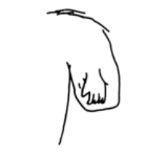
A fascinating paper in the neuroscience journal Brain looks at artistic depictions of phantom limbs – the feeling of the physical presence of a limb after it has been damaged or removed – and gives a wonderful insight how the brain perceives non-functioning or non-existent body parts.

In fact, most people who have a limb amputated will experience a phantom limb, although they often fade over time.

However, the feeling is usually not an exact representation of how the actual limb felt before it was removed, but can involve curious and sometimes painful ‘distortions’ in its perceived physical size, shape or location.

The Brain article looks at the diversity of phantom limb ‘shapes’ through their visual depictions.

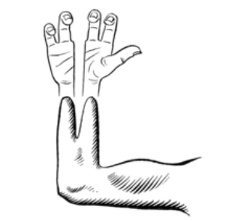
The image on the left is from a 1952 case report where an amputation involved a ‘Krukenberg procedure‘.

This operation is rarely performed in the modern world but it involves the surgeon splitting the stump to allow pincer movements – and in this case it left the patient with the feeling of divided phantom hand.

In other cases, without any out-of-the-ordinary surgical procedure, patients can be left with a phantom that feels like the middle parts of their limb are missing while they still experience sensations in phantom extremities.

The drawing on the right was completed by a patient in a medical case study to illustrate their experience of a post-arm-amputation phantom limb.

In this case, the person experienced the feeling of a phantom hand on their shoulder stump, but had no experience of an intervening phantom arm.

While phantom limbs are usually associated with amputations, the phenomenon is actually caused by the mismatch between the lack of sensory input from the limb and the fact that the brain’s somatosensory map of the body is still intact and trying to generation sensations.

This means that any sensory disconnection, perhaps through nerve or spinal damage, can cause the experience of a phantom limb, even if the actual limbs are still there.

In the drawing on the left, a patient who suffered spinal damage that caused a loss of sensation in their limbs, illustrated how their phantom legs felt.

Although their own legs were completely ‘numb’ the phantom legs felt like they were bent at the knee, regardless of where their actual legs were positioned.

Normally, feedback from real world actions and sensations keeps the somatosensory map tied to the genuine size and shape of the body, but these sensations can begin to generate distorted sensations when this connection is broken through damage.

However, the stability of our experience of body size, shape and position is remarkably flexible in everyone as the rubber hand illusion shows.
 

Link to locked Brain article on depictions of phantom limbs.

The most accurate psychopaths in cinema

The most accurately depicted psychopaths in cinema have been identified by a study that has just been published in the Journal of Forensic Sciences.

The study specifically excluded films that weren’t intended to be realistic (involving magical powers, fantasy settings and so on) but still examined 126 characters from 20th and 21st century movies.

It’s worth noting that the clinical definition of psychopathy is not what most people think – it’s not necessarily someone who is a knife wielding maniac – but suggests someone who has poor empathy, little remorse, and is impulsive and manipulative.

Needless to say, psychopathy is more common in people who are persistently violent, but you don’t need to be violent to be a psychopath.

After conducting the analysis the authors note which films they feel have most accurately captured the characteristics of the psychopath.

Among the most interesting recent and most realistic idiopathic psychopathic characters is Anton Chigurh in the 2007 Coen brothers’ film, No Country for Old Men. Anton Chigurh is a well-designed prototypical idiopathic / primary psychopath. We lack information concerning his childhood, but there are sufficient arguments and detailed information about his behavior in the film to obtain a diagnosis of active, primary, idiopathic psychopathy, incapacity for love, absence of shame or remorse, lack of psychological insight, inability to learn from past experience, cold-blooded attitude, ruthlessness, total determination, and lack of empathy. He seems to be affectively invulnerable and resistant to any form of emotion or humanity. Having read and studied [serial killer] Richard Kuklinski’s case, Chigurh and Kuklinski have several traits in common. In the case of Chigurh, the description is extreme, but we could realistically almost talk about “an anti-human personality disorder”.

Another realistic interesting example is Henry (inspired from [real life serial killer] Henry Lee Lucas) (Henry-Portrait of a Serial Killer, 1991). In this film, the main, interesting theme is the chaos and instability in the life of the psychopath, Henry’s lack of insight, a powerful lack of empathy, emotional poverty, and a well-illustrated failure to plan ahead. George Harvey is another different and interesting character found in The Lovely Bones, 2009. Harvey is more ‘adapted’ than Chigurh and Henry. He has a house, is socially competent and seems like ‘the average man on the street’. Through the film, we learn that he is in fact an organized paraphilic SVP [sexually violent predator]. Here, the false self is well illustrated.

In terms of a ‘successful psychopath’, Gordon Gekko from Wall Street (1987) is probably one of the most interesting, manipulative, psychopathic fictional characters to date. Manipulative psychopathic characters are increasingly appearing in films and series. Again, we observe the same process, as observed and explained before, with antisocial psychopaths. For the past few years, with the world economic crises and some high-profile trials (such as the Bernard Madoff trial), the attention of the clinicians is more focused on ‘successful psychopaths’, also called corporate psychopaths by Babiak et al. Films and series presenting characters such as brokers, dishonest traders, vicious lawyers, and those engaged in corporate espionage are emerging (e.g., Mad Men, The Wire) and are generally related to the global economy and international business. Again, we see a strong parallelism between what happens in our society and what happens in film.

The paper also has a short section on the how the movies portray psychopathatic mental health professionals, which were apparently more common in cinema from the 1980s.

It describes how psychiatrist Hannibal Lecter is an ‘extraordinarily astute clinician’ who can diagnose Agent Starling’s psychological conflicts by identifying her perfume and assessing her shoes and clothing, while also being invulnerable.

They authors dryly note that these seem to be abilities “that are not generally found in everyday clinical practice”.
 

Link to locked study in Journal of Forensic Sciences.

2013-12-27 Spike activity

Quick links from the past week in mind and brain news:

Mother Jones reports on a new study finding that political beliefs interfere with logical reasoning.

Space in the brain: how the hippocampal formation supports spatial cognition. Excellent video introduction to Royal Society special edition.

The New York Times discusses the science of depression and what we still need to acheive.

The Inaccuracy of National Character Stereotypes. Neuroskeptic covers a wonderful study. British people apparently not universally humorous, dashingly good looking and modest.

The Brain Bank blog collects the best neuroscience images of 2013 for your viewing pleasure.

Remember that neurosurgeon who had a near death experience and claimed he had proved the existence of heaven? OK, Mind Hacks readers probably don’t but lots of other folks will. Esquire has an in-depth expose on him. That heaven thing was apparently unlikely.

Cracking the Enigma discusses the latest research on autism and asks whether ‘autistic brains’ are under- or over-connected.

The mysterious nodding syndrome – a crack of light

Two years ago we discussed a puzzling, sometimes fatal, ‘nodding syndrome‘ that has been affecting children in Uganda and South Sudan. We now know a little more, with epilepsy being confirmed as part of the disorder, although the cause still remains a mystery.

The condition affects children between 5 and 15 years old, who have episodes where they begin nodding or lolling their heads, often in response to cold. A typical but not exclusive pattern is that over time they become cognitively impaired to the point of needing help with simple tasks like feeding. Stunted growth is common.

Global Health News have a video on the condition if you want to see how it affects people.

In terms of our medical understanding, a review article just published in Emerging Infectious Diseases collates what we now know about the condition.

Firstly, it is now clear that epilepsy is part of the picture and the nodding is caused by recurrent seizures in the brain. This is a bit curious because this type of very specific ‘nodding’ behaviour has not been seen as a common effect of epilepsy before.

Also, knowing that it is caused by a seizure just pushes the need for explanation further down the causal chain. Seizures can occur through many different forms of brain disruption, so the question becomes – what is causing this epidemic form of seizure that seems to have a very selective effect?

With this in mind, a lot of the most obvious candidates have been ruled out. The following is from the review article, but if you’re not up on your medical terms, essentially, tests for a lot of poisons or infections have come up negative:

Testing has failed to demonstrate associations with trypanosomiasis, cysticercosis, loiasis, lymphatic filariasis, cerebral malaria, measles, prion disease, or novel pathogens; or deficiencies of folate, cobalamin, pyridoxine, retinol, or zinc; or toxicity from mercury, copper, or homocysteine.

Brain scans have been inconclusive with some showing minor abnormalities while others seem to show no detectable damage.

There have been some curious but not conclusive associations, however. Children with the nodding syndrome are more likely to have signs of infection by the river blindness parasite. But huge swathes of Africa have endemic river blindness and no nodding syndrome, and some children with nodding syndrome have no signs of infection.

Furthermore, the parasite is not thought to invade the nervous system and no trace of it has been found in the cerebrospinal fluid from any of the people with the syndrome. The authors of the review speculate that a new or similar parasite could be involved but hard data is still lacking and the typical signs of infection are missing.

A form of vitamin B6 deficiency is known to cause neural problems and has been found in affected people but it has also been found in just as many people untouched by the mystery illness. One possibility is this could be a risk factor, making people more vulnerable to the condition, rather than a sole cause.

One idea as to why it is so specific relates to the increasing recognition that some neurological conditions are caused by the body’s immune system erroneously attacking very specific parts of the brain.

For example, in Sydenham’s chorea antibodies for the common sore throat bacteria end up attacking the basal ganglia, while in limbic encephalitis the immune system attacks the limbic system.

This sort of autoimmune problem is a reasonable suggestion given the symptoms, but in the end, it is another hypothesis that is awaiting hard data.

Perhaps most mysterious, however, is its most marked feature – the fact that it only seems to affect children. At the current time, we seem no closer to understanding why. Similarly, the fact that it is epidemic and seems to spread also remains unexplained.

If you’re used to scientific articles, do check out the Emerging Infectious Diseases paper because it reads like a as-yet-unsolved detective story.

Either way, keep tabs on the story as it is something that needs to be cracked, not least because the number of cases seems to be slowly increasing.
 

Link to update paper in Emerging Infectious Diseases.

Whatever happened to Hans Eysenck?

Psychologist Hans Eysenck was once one of the most cited and controversial scientists on the planet and a major force in the development of psychology but he now barely merits a mention. Whatever happened to Hans Eysenck?

To start off, it’s probably worth noting that Eysenck did a lot to ensure his legacy would be difficult to maintain. He specifically discouraged an ‘Eysenck school’ of psychology and encouraged people to question all his ideas – an important and humble move considering that history favours the arrogant.

But he also argued for a lot of rubbish and that is what he’s become most remembered for.

He did a lot of work on IQ but took a hard line of its significance. Rather than thinking of it as simply a broad-based psychological test that is useful as a clinical measure of outcome, he persistently championed it as a measure of ‘intelligence’ – a fuzzy social idea that implies someone’s value.

Without any insight into the cultural specificity of these tests Eysenck argued for racial differences in IQ as likely based in genetics, and signed the notorious ‘Mainstream Science on Intelligence’ statement which reads like your drunk grandpa trying to justify why there are no black Nobel science winners.

Eysenck was apparently not racist himself, but believing that science was ‘value free’ he was also incredibly politically naive and took money from clearly racist organisations or published in their journals, thinking that the data would speak for itself.

He also doubted that smoking caused lung cancer and took money from tobacco giant Philip Morris to try and show that the link was mediated by personality, and at one point started espousing that there was some statistical basis behind astrology.

Some of his other main interests have not been rejected, but have just become less popular – not least the psychology of personality and personality tests.

This area is still important but has become a minority sport in contemporary psychology, whereas previously it was central to a field that was still battling fairytale Freudian theories as a way of understanding personal tendencies.

But perhaps his most important contributions to psychology are now so widely accepted that no-one really thinks about their origin.

When he was asked to create the UK’s first training course for clinical psychology he created a scientifically informed approach to understanding which treatments work but extended this philosophy to focus on a hypothesis-testing approach to work with individuals. This is now a core aspect of practice across the world.

His belief that psychologists should consistently look to make links between thoughts, experience, behaviour and biology is something that has been widely taken up by researchers, even if clinical psychologists remain a little neurophobic as a profession.

Because Eysenck loved an academic dust-up, he is most remembered for the IQ debate, on which he took a rigid position which history has, justifiably, not looked kindly on. But as someone who influenced the practice of psychology, his legacy remains important, if largely unappreciated.

A sticking plaster for a shattered world

The last paragraph of this article from the American Journal of Psychiatry on people displaced by the Syrian conflict essentially sums up the entire practice of conflict-related mental health.

Looking at this endless list of horrible stories from a psychiatrist’s perspective, I see only patients suffering from what my profession calls posttraumatic stress disorder. It is a disorder with well-described symptoms and therapeutic options. Looking at this same list from a human being’s perspective, I only see in the looks and attitudes of those patients—as I empathically explain to them their disorder, prescribe a few pills, and orient them to psychotherapy—something that is beyond what contemporary evidence-based medicine can describe scientifically.

In every one of these patients, I see intense, irreversible mistrust and a lack of belief in every principle or rule that is supposed to control our relationships with each other. I see question marks regarding the meaning of their whole existence as well as the meanings behind the most important concepts that seemed unquestionable to them in the past, such as religion, politics, work, family, and finally, last but not least, health. These patients manifest symptoms that justify the wide array of treatment modalities I offer to them, but I am left with a terrible feeling that this management is somehow wanting. All that has been shattered in these patients’ lives cannot be mended by the small treatment that we can offer.

It’s written by Lebanese psychiatrist Rami Bou Khalil, who mentions this little told but often learnt lesson about the effects of war.
 

Link to ‘Where All and Nothing Is About Mental Health’

2013-12-20 Spike activity

Quick links from the past week in mind and brain news:

The New York Times reports that information overlords Google acquire creature-inspired military robot outfit Boston Dynamics. Honestly. It’s like humanity is attached to a big angry dog and someone keeps yanking the chain.

There’s an excellent and extensive MIT Tech Review piece on the development of neuromorphic chips.

Over 60% of people diagnosed with depression do not actually meet the diagnostic criteria, according to an American study covered in The Atlantic.

The New York Times has an interesting piece on how peak violence is in your first few years of life and how persistent adult violence may be a ‘missing dropoff’ from these period.

Long neglected, severe cases of autism get some attention. Excellent piece from the Simons Foundation.

Nature reports that narcolepsy is all but confirmed as an auto-immune disease. Big news.

Hi Kids, I’m Neuro The Clown! Genius comic strip from Saturday Morning Breakfast Cereal.

Sifting The Evidence takes a careful look at dubious claims that aspirin could treat aggression.

There’s an interesting piece over at Nautilus on how your brain twists together emotion and place.

Neurocritic covers a curious case study: When Waking Up Becomes the Nightmare: Hypnopompic Hallucinatory Pain.

Year Four of the Blue Brain documentary

Film-maker Noah Hutton has just released the ‘Year Four’ film of the decade-long series of films about Henry Markram’s massive Blue Brain neuroscience project.

It’s been an interesting year for Markram’s project with additional billion euro funding won to extend and expand on earlier efforts and the USA’s BRAIN Initiative having also made it’s well-funded but currently direction-less debut.

Hutton also tackles Markram on the ‘we’re going to simulate the brain in 10 years’ nonsense he relied on earlier in the project’s PR push although, his answer, it must be said, is somewhat evasive.

Although more of an update on the politics of Big Neuroscience than a piece about new developments in the science of the brain, the latest installation of the Blue Brain documentary series captures how 2013 will define how we make sense of the brain for years to come.
 

Link to ‘Bluebrain: Year Four’ on Vimeo.
Link to the Bluebrain Film website.

Is school performance less heritable in the USA?

CC licensed photo by flickr user Pollbarba. Click for source.A recent twin study looked at educational achievement in the UK and found that genetic factors contribute more than half to the difference in how students perform in their age 16 exams. But this may not apply to other countries.

Twin studies look at the balance between environmental and genetic factors for a given population and a given environment.

They are based on comparing identical and non-identical twins. Identical twins share 100% of their DNA, non-identical twins 50%. They also share a common environment (for example, the family home) and some unique experiences.

By knowing that differences in what you’re measuring in identical twins is likely to be ‘twice as genetic’ or ‘twice as heritable’ in non-identical twins you can work out the likely effect of environment using something called the ACE model.

This relies on various assumptions, for example, that identical twins and non-identical twins will not systematically attract different sorts of experiences, which are not watertight. But as a broad estimate, twin studies work out.

Here’s what the latest study concluded:

In a national twin sample of 11,117 16-year-olds, heritability was substantial for overall GCSE performance for compulsory core subjects (58%) as well as for each of them individually: English (52%), mathematics (55%) and science (58%). In contrast, the overall effects of shared environment, which includes all family and school influences shared by members of twin pairs growing up in the same family and attending the same school, accounts for about 36% of the variance of mean GCSE scores. The significance of these findings is that individual differences in educational achievement at the end of compulsory education are not primarily an index of the quality of teachers or schools: much more of the variance of GCSE scores can be attributed to genetics than to school or family environment.

In other words, the study concluded that over half of the difference in exam results was down to genetic factors.

The most important thing to consider, however, is how well the conclusions apply outside the population and environment being tested.

Because the results give an estimate of the balance between environment and genetic heritability that contribute to the final outcome, the more fixed the environment, the more any differences will be due to genetics and vice versa.

If that’s a bit difficult to get your head round try this example: ask yourself – is difference in height mostly due to genetics or the environment? Most people say genetics – tall parents tend to have tall offspring – but that only applies where everybody has adequate nutrition (i.e. the environmental contribution is fixed to maximum benefit).

In situations where malnutrition is a problem, difference in height is mostly explained by the environment. People who have adequate nutrition during childhood are taller than people who suffered malnutrition. In this situation, genetic factors are a minor player in terms of explaining height differences.

So let’s go back to our education example and think about how genetic and environmental factors balance out.

One of the interesting things about the UK is that it has a National Curriculum where schools have to teach set subjects in a set way.

In other words, the government has fixed part of the environment meaning that differences in exam performance in the UK are that bit more likely to be due to genetic heritability than places where there is no set education programme.

In fact, the same research group speculated in 2007 in a research monograph (pdf, p116) in a similar analysis, that school performance would be less genetically heritable in the USA, because the school environment is more variable.

The U.K. National Curriculum provides similar curricula to all students, thus diminishing a potentially important source of environmental variation across schools, to the extent that the curriculum actually provides a potent source of environmental variation.

In contrast, the educational system in the United States is one of the most decentralized national systems in the world. To the extent that these differences in educational policy affect children’s academic performance, we would expect greater heritability and lower shared environment in the United Kingdom than in the United States.

In other words, all other things being equal, greater equality in educational opportunity should lead to greater heritability.

School performance may be less influenced by genetic heritability in the USA because the educational environment is more variable and therefore accounts for more difference.

Whereas in the UK, the educational environment is more fixed so a greater proportion of the difference in performance is down to genetic heritability.

It’s worth noting that this hasn’t, to my knowledge, been confirmed yet, but it’s a reasonable assumption and demonstrates exactly the question we need to bear in mind when considering studies that estimate heritability – for whom and in what environment?
 

Link to twin study on school performance in PLOS One.
pdf of research monograph on learning and genetics.

The best graphic and gratuitious displays

Forget your end of year run-downs and best of 2013 photo specials, it doesn’t get much better than this: ‘The 15 Best Behavioural Science Graphs of 2010-13’ from the Stirling Behavioural Science Blog.

As to be expected, some are a little better than others (well, Rolling Stone chose a Miley Cyrus video as one of their best of 2013, so, you know, no-one’s perfect) but there are still plenty of classics.

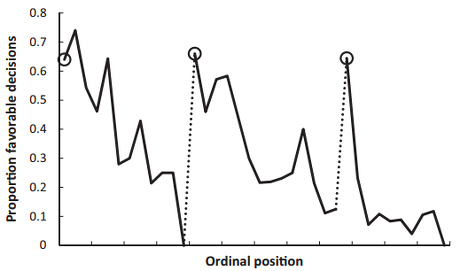
This one, from a study on parole rulings by judges based on the order of cases and when food breaks occur is particularly eye-opening.

This paper examined 1,112 judicial rulings over a 10 month period by eight judges in Israel. These judges presided over 2 parole boards for four major prisons, processing around 40% of all parole requests in the country. They considered 14-35 cases per day for an average of six minutes and they took two daily food breaks (a late morning snack and lunch), dividing the day into three sessions.

The graph looks at the proportion of rulings in favor of parole by ordinal position (so 1st case of the day, then 2nd, then 3rd, etc). The circled points are the first decision in each of the three decision sessions, the tick marks on the x-axis denote every third case and the dotted line denotes a food break. The probability of the judges granting parole falls steadily from around 65% to nearly zero just before the break, before jumping back up again after they return to work.

Moral of the story: don’t get banged up, make sure your judge has been recently fed, or bring snacks to court.

Anyway, plenty more fascinating behavioural science graphs to check out and no Miley Cyrus. At least, until she jumps on that bandwagon.
 

Link to ‘The 15 Best Behavioural Science Graphs of 2010-13’