The anatomy of fashion

T-shirt fashionistas Alphanumeric have created an anatomically labelled brain t-shirt, so you never have to decide between wearing a t-shirt or taking your neuroanatomy textbook with you.

Of course, if ever you were in a situation where you needed to choose between clothes or a neuroanatomy book, you might have more to worry about than the accurate labelling of brain parts.

Needless to say, while naked neuroanatomy might be the way forward, this t-shirt might suffice in the mean time.

Link to Alphanumeric brain t-shirt (via HYA).

Mapping emotions onto the city streets

Christian Nold maps cities. But instead of mapping their physical layout, he maps their emotional geography.

He uses a technique he invented called biomapping where participants walk the area connected to a system that measures galvanic skin response – a measure of the electrical resistance of the skin which is known to give a rating of arousal and stress.

The system is also connected to a GPS device, so the stress response of each person is physically mapped onto the landscape.

His maps describe an area in terms of how stressful it is, and so far, he’s mapped Greenwich in London, San Francisco and Stockport.

He’s also done a project that maps the sensory experiences of Newham.

I had the pleasure of meeting Christian the other night and one of the best things is is that he’s persuaded Ordinance Survey, the UK’s mapping agency, to print the maps!

I have a copy of the Greenwich map and so far everyone I’ve showed it to has been blown away.

You can buy paper copies of the maps, but also view them in full detail online.

Link to Emotion Map.
Link to Christian Nold’s website.

Higher price makes cheap wine taste better

A new brain scanning study has supported what we’ve suspected all along, more expensive wine tastes better partly because we expect it to.

Neuroscientist Hilke Plassman led a brain-scanning study [pdf], shortly to be published in the Proceedings of the National Academy of Sciences, where volunteers were asked to taste and rate five different wines, each individually priced.

What the volunteers didn’t know was that there were only three different wines, and two of them were tasted twice. One one occasion it was described as costing $90 a bottle, on another as costing $10 a bottle.

The volunteers rated the ‘more expensive’ wine as significantly more likeable despite being identical to the ‘cheaper’ wine.

In addition, the brain scans showed when the volunteers tasted the wine they thought was more expensive, their brains showed increased activity in the medial orbitofrontal cortex (mOFC) and its surrounding area, the rostral anterior cingulate cortex (rACC), both areas of the frontal lobes.

The orbitofrontal cortex is known to be involved in the regulation of emotions and encoding the ‘value’ of experiences. Unsurprisingly, it has been identified as a key area in studies of gambling.

However, it has also been previously found to correlate with ratings of pleasantness of smells, tastes and even music.

Interestingly, there was no difference in the brain areas directly related to experiencing taste, and the researchers suggest that the belief that the wine is more expensive probably doesn’t directly change our sensory experience, but leads us to think that the experience is more ‘valuable’.

The results echo behavioural studies which have found that the same wine is rated differently when served in different quality bottles.

pdf of full-text paper.
Link to write-up from The Times.

The psychology of the moral instinct

The New York Times has a fantastic in-depth article by Steven Pinker on the origins of morality and the psychology of moral reasoning.

It’s a comprehensive and enjoyable review of most of the main areas of the recently invigorated ‘moral psychology’ field.

As well as discussing how lab-based studies are helping us to understand the cognitive neuroscience of moral reasoning, it also contains a number of examples and thought experiments that bring the anomalies in our moral cognition into sharp relief.

Pinker argues that we have a specific reasoning framework for moral situations and that when we deem a situation to have moral implications, this comes into play.

The starting point for appreciating that there is a distinctive part of our psychology for morality is seeing how moral judgments differ from other kinds of opinions we have on how people ought to behave. Moralization is a psychological state that can be turned on and off like a switch, and when it is on, a distinctive mind-set commandeers our thinking. This is the mind-set that makes us deem actions immoral (“killing is wrong”), rather than merely disagreeable (“I hate brussels sprouts”), unfashionable (“bell-bottoms are out”) or imprudent (“don’t scratch mosquito bites”).

Pinker suggests that this process can easily be seen at work, as some things that were previously thought to be an personal difference have now become a moral issue (e.g. smoking) whereas other things that were previously thought to be a moral issue have now become a personal difference (e.g. atheism).

He also covers the development of morality in children, the role of genetics, and the anthropology of morality – how the hypothesised universal moral principles express themselves differently across different cultures.

Highly recommended if you want a guide to this burgeoning area of research.

Link to NYT article ‘The Moral Instinct’.

Nature NeuroPod visits SfN megaconference

Nature Neuroscience’s NeuroPod podcast has a special on the recent Society for Neuroscience annual megaconference that picks up on some of the more interesting new developments.

There’s loads of fascinating new findings in there, but don’t miss the last few minutes of the podcast where Prof Eleanor Maguire talks about ongoing work with London Taxi drivers.

Maguire’s team famously discovered in 2000 that London Taxi drivers have bigger than average hippocampi, a brain structure known to be heavily involved in learning routes and spatial representations.

The study found that the size of the hippocampus correlated with the length of time being a taxi driver, suggesting that the extensive training and navigational experience may change and develop the hippocampus.

The study won an Ig Nobel Prize in 2003 for research “that cannot, or should not, be reproduced” but was actually one of the first studies to show likely experience-related changes to the structure of the human brain.

In the podcast Maguire discusses a new study which updates the findings and suggests that the taxi drivers’ pumped hippocampi come at a cost.

While their navigational abilities were increased, their ability to learn new associations between things (another function of the hippocampus) was poor, and the size of the anterior hippocampi (a more forward area) was actually smaller.

This suggests that overdevelopment in one area of the hippocampus may actually reduce development in another.

mp3 of NeuroPod special at SfN 2007 conference.
Link to NeuroPod index page.
pdf of Eleanor Maguire’s Taxi driver update study.

Fighting over inner experience

Salon has an entertaining review of the new book Describing Inner Experience which is sort of a combination of an argument and a self-consciousness showdown between philosopher Eric Schwitzgebel and psychologist Russell Hurlburt.

Schwitzgebel is sceptical that we can accurately describe our inner thoughts and experiences, while Hurlburt feels that we are capable of doing so, when properly directed.

If you think that it’s obvious we can describe our inner mental states, start by reading the review and you’ll get a flavour of what the problem is.

At the beginning of the book’s central section, Hurlburt and Schwitzgebel meet their volunteer. Her pseudonym is Melanie. She is in her 20s, and she has an interest in psychology but no experience in these debates. Hurlburt explains the rules to her: She will simply tell them what was on her mind just before each beep, and they will try to figure out if her reports are accurate.

Hurlburt handles the direct questioning, then turns her over to Schwitzgebel for cross-examination. They have six sessions, each about an hour long. And over the course of these sessions, something unexpected happens, a novelistic twist that is subtle, hilarious and hard to describe. A battle for interpretive credibility emerges, as the doubt Schwitzgebel casts upon Melanie’s self-understanding rebounds upon himself.

The preface and first chapter of the book are freely available online if you want to learn more, and the book itself has just been published.

Link to Salon review.
Link to details of book and sample preface and chapter.

The art of first impressions

Frontal Cortex has found an absolutely fantastic video art piece that explores the psychology of first impressions.

It really brings home the fact that first impressions vary so much between individuals and can be vastly wide of the mark as character judgements.

The piece is by film-makers Lenka Clayton and James Price.

The pair also created the fantastic short film People in Order, another very simple premise which is a perceptive look at how people change as they age, and New Love Order, which briefly introduces us to couples arranged in the order of the length of their relationship.

All insightful pieces that are alternately, challenging, poignant, funny and original.

2008-01-11 Spike activity

Quick links from the past week in mind and brain news:

A neuroimaging study on ESP! The Neurocritic looks at a recent study that investigated parapsychology using brain scanners.

Drug companies approximately spend $30 billion dollars promoting drugs in the US – twice as much as they spend on research and development, according to a new study in PLoS Medicine.

Scientific American reviews the year in robots. To the bunkers!

Sociologist Laura Maria Agustin argues that double standards in how we think about rich and poor people who cross borders is clouding the debate on ‘sex trafficking‘ in Reason magazine.

Harvard Magazine has an article on the genetics of autism and why the condition is being increasingly thought of a spectrum of traits rather than a cut-and-dry diagnosis.

Mirror Neurons – Rock Stars or Backup Singers? Neuroscientist Gregory Hickok argues against the mirror neuron hype on SciAm’s Mind Matters blog.

Professor of Robert Sylwester is interviewed on Sharp Brains on the cognitive science of learning.

Could a computers have a conscience? The Buffalo News ponders the possibilities.

PBS has a full programme and website on the debate over the increasing trend for medicating children with psychiatric drugs.

An article in Wired argues that the next victim of climate change will be our minds.

New hope for tinnitus sufferers as BBC News article discusses some new treatments in the pipeline.

Intelligence and working memory may be the key to identifying the genes for schizophrenia, suggests new research.

Furious Seasons has a careful analysis of one of the most important studies of treating depression yet completed.

How do we know we’re not dreaming? Eric Schwitzgebel looks at the possibilities.

Cognitive Daily has a fascinating article on whether your name affects your performance and preferences (something known as nominative determinism).

Cary Grant on LSD

Film star Cary Grant talks about his experiences with LSD in an excerpt from his autobiography.

Grant was one of the few people who were medically treated with LSD-assisted psychotherapy when it was still legal in 1960s America, and he claimed he benefited greatly from it.

The feeling is that of an unmarshaling of the thoughts as you’ve customarily associated them. The lessening of conscious control, similar to the mental process which takes place when we dream. For example, when you’re asleep and your mind no longer concerned with matters and activities of the day, your subconscious often brings itself to your attention by dreaming. With conscious controls relaxed, those thoughts buried deep inside begin to come to the surface in the form of dreams. These dreams, since they appear to us in symbolic guise, are fantasies and, if you will accept the reasoning, could be classified as hallucinations. Such fantasies, or hallucinations, are inside every one of us, waiting to be released, aired and understood. Dreams are really the emotions that we find ourselves reluctant to examine, think about, or meditate upon, while conscious.

Under the effect of LSD 25, these dreams or hallucinations, if you wish, are speeded up, and interpreted, when properly conducted ba a psychiatrically orientated doctor who sits quietly by, awaiting whatever communication one cares to make — the revealing of a hidden memory seen again from an older, more mature viewpoint, or the dawning of new enlightenment. Then, if the doctor is as skilled as mine was, he carefully proffers a word or key, that can lead to the next release, the next step toward fuller understanding.

Link to Grant on LSD, from his autobiography (via MeFi).

The psychology of the politics of fear

Newsweek has a fantastic article on the psychology and neuroscience behind the politics of fear which draws directly on examples from the current and past US elections.

American politics in particular it seems, has, in recent years, used fear as a way of trying to motivate voters and support particular candidates.

The Newsweek article looks at why fear is such a potent force in decision-making and what psychology research has shown us about how invoking concepts of death or threat actually affects our reasoning and desires.

“When we’re insecure, we want our leaders to have what’s called an ‘unconflicted personality’,” says political psychologist Jeff Greenberg of the University of Arizona. “Bush was very clear in his beliefs and had no doubts, but Kerry was painted as a flip-flopper…

That real-world observation has been replicated in lab studies. In one experiment Greenberg and colleagues ran during the 2004 campaign, volunteers who completed a questionnaire that reminded them about their own inevitable death (how thoughts of their own death made them feel and what they thought would happen to them physically after they died) expressed greater support for Bush than voters of similar leanings who were not reminded of mortality. The researchers also found that subliminal reminders of death increased support for Bush (and decreased support for Kerry) even among liberals. It’s not clear if such responses in the lab would endure in an actual voting booth. So perhaps one should not be too cynical about the decision by the Department of Homeland Security to raise the terror-threat level on Election Day 2004. “Political use of fear is not something new,” says NYU’s LeDoux. “But certainly the ante has been upped. We’ve gone from ‘vote for me or you’ll end up poor’ to ‘vote for me or you’ll end up dead’.”

Documentary maker Adam Curtis argued in his three-part series The Power of Nightmares (video: parts one, two, three) that since the cold war politicians across the globe have been attempting to promote the idea of foreign threats so they can then promise to deliver us from them.

Curtis is by no means a neutral commentator, but as he’s demonstrated with a number of his documentaries, his analysis of politics as an essentially psychological process is an interesting take on world affairs.

My only reservation about the Newsweek piece is that it takes the somewhat simplistic line that the amygdala equals fear in the brain.

The amygdala must have the worst PR of all of the brain structures, but to set the record straight, there’s more to the amygdala than fear, and more to fear than the amygdala.

Neurophilosophy has a guide to the neurobiology of fear if you want an overview of the wider fear circuits in the brain, and Current Biology has a freely available article which is a primer on the amygdala.

You may be interested to know that this almond shaped brain area is also involved in a range of positive emotional states, so it’s not all doom and gloom.

Link to Newsweek article ‘The Roots of Fear’ (via Schneier).

Opinion leaders impotent in ideas economy

Science News has a remarkably clear and concise article on a study that looked at how ideas spread through social networks. It found that under most circumstances a critical mass of more easily influenced people, not ‘opinion leaders’, are key to making ideas popular.

One of the major theories in marketing is that new ideas are taken up by the wider population because they are adopted by ‘opinion leaders’ – respected individuals who others listen to.

The theory goes that when opinion leaders adopt an idea, lots of other people quickly follow. Sort of like a ‘leader of the pack’ theory.

Researchers Duncan Watts and Peter Dodds wondered whether this was really the case, or whether instead, large numbers of people would embrace a particular idea when a certain number of their more easily influenced peers started to champion it. More of a ‘birds of a feather’ theory.

Watts and Dodds research how the mathematics of networks can tell us about how social systems work, and so they created various simulated social networks, set up some rules, and then ran the experiments to see how easily ideas would spread.

They simulated individual differences in the model by making each person more likely to adopt an idea if a certain percentage of their social network already believed it.

As some people are more easily influenced than others, the ‘people’ in the network varied in what percentage of their peers were needed to influence them – in effect, a mathematical simulation of individual scepticism.

The researchers compared how far an idea would spread depending on whether it started with a random individual or with an influential individual who was connected to a lot of other individuals. They found that highly influential individuals usually spread ideas more widely, but not very much more widely. For example, if an individual had three times as many connections as the average person, ideas espoused by that individual almost always spread substantially less than three times as far as the ideas of an average individual. Sometimes, the researchers found, the difference wasn’t even measurable…

More important than the influencers, the researchers found, were the influenced. Once an idea spread to a critical mass of easily influenced individuals, it took hold and continued to spread to other easily influenced individuals. In some networks, it was far easier to get an idea established this way than in others. The entire structure of the network mattered, not just the few influential people.

The full-text of Watts and Dodds’ paper is available online as a pdf if you want to read the study in more detail, but the Science News article is a great summary.

Link to Science News on ‘The Power of Being Influenced’.
pdf of study ‘Influentials, Networks, and Public Opinion Formation’.

‘Stress’: from buildings to the battlefield

Sometimes we don’t realise how much the vocabulary of psychology has become part of everyday language.

I was surprised to learn that the use of the term ‘stress’ to mean psychological tension, rather than just physical pressure, has only been with us since the mid-1930s and was popularised by the major wars of the 20th century.

And it turns out, the person who coined the new usage did it by accident, owing to a mistaken translation.

Akin to ‘distress’, ‘stress’ meant ‘a strain upon endurance’, but it was also used in a more specialist way by engineers to denote the external pressures on a structure – the effects of ‘stress’ within the structure became known as ‘strain’.

Then in 1935 the Czech-Candian physiologist Hans Selye began to promote ‘stress’ as a medical term, denoting the body’s response to external pressures (he later admitted that, new to the English language, he had picked the wrong word; ‘strain’ was what he had meant).

Academic physiologists regarded the concept of stress as too vague to be scientifically useful, but Selye’s determined self-promotion, coupled with the upheaval and distress brought by the [Second World] war to many millions of ordinary people, popularised the term.

By the time of Vietnam, ‘stress’ had become a well-established part of military medicine, thought to be a valuble tool in reducing ‘wastage’. In the military context, it was an extension of the work done at the end of the First World War on the long-term effects of fear and other emotions on the human system…

‘Stress’, writes the historian Russell Viner, ‘was pictured as a weapon, to be used in the waging of psychological warfare against the enemy, and Stress research as a sheild or vaccination against the contagious germ of fear.’

From p349 of A War of Nerves, a book on the history of military psychiatry, which we covered previously.

A phobia of bridges

The New York Times has a short but interesting piece on people with gephyrophobia, a morbid fear of bridges.

Phobias are often described as an irrational fear, but most have a reasonable basis to them, as reflected in the fact that phobias most commonly concern things that have an element of danger or risk – such as heights, dogs, spiders or water.

However, the fear gets exaggerated so the perceived danger vastly outweighs the actual danger.

Often the disabling aspect is not the fear itself, but how people begin to restrict their lives to avoid the fear. In a sense, people can become driven by a fear of fear.

Mrs. Steers, 47, suffered from a little-known disorder called gephyrophobia, a fear of bridges. And she had the misfortune of living in a region with 26 major bridges, whose heights and spans could turn an afternoon car ride into a rolling trip through a haunted house.

Some people go miles out of their way to avoid crossing the George Washington Bridge — for example, driving to Upper Manhattan from Teaneck, N.J., by way of the Lincoln Tunnel, a detour that can stretch a 19-minute jog into a three-quarter-hour ordeal. Other bridge phobics recite baby names or play the radio loudly as they ease onto a nerve-jangling span — anything to focus the mind. Still others take a mild tranquilizer an hour before buckling up to cross a bridge.

Link to NYT article ‘To Gephyrophobiacs, Bridges Are a Terror’.

Composing, by brain waves

Mick Grierson has been hacking some applications for a brain-computer interface that uses EEG to convert the brain’s electrical signals into a thought-driven synthesizer control mechanism.

The kit is just in a test stage at the moment, but there’s a YouTube video of him being able to trigger specific notes from his EEG signals.

OK. So I‚Äôve had my EEG for about a month now. Within a few days, I‚Äôd successfully run a project that allowed me to spell words with my thoughts. This took some practice, and the algorithms are really elementary at the moment. However, it‚Äôs nice to be on the edge of what is possible. I‚Äôve just spent a few days integrating a fairly obvious matching algorithm – basically an algorithm that detects unconscious responses to stimuli on a simple level – into a synthesiser built in max/msp. This took quite a lot of effort. Anyhow, this system is a variation of those which you may have been hearing about on and off‚Ķ.my system now allows me (with a bit of work) to control the pitch of the synthesiser with my thoughts in real-time. This reliably allows me to play tunes – slowly. I often ‚Äòhit‚Äô wrong notes, but it sort of works. Has anyone else done this yet?

Can’t wait to see how the project advances. The first jam session will be quite a sight (and sound!), I’m sure.

Link to video of BCI synthesiser (via DevIntel).
Link to Grierson’s blog.

Knock, knock, room service

NPR has a short piece on a fascinating study where the researchers informed hotel maids that their normal work counted as exercise, which had the effect of making them more physically fit, despite them not seeming to change their activity levels.

Unfortunately, the NPR segment seems to suggest that the study ‘challenges the placebo effect’, based on the faulty assumption that the placebo effect only alters ‘subjective perception’.

In fact, placebos are known to affect outcome in a range of physical illnesses (and even produce placebo ‘side-effects – known as the nocebo effect), and they have been shown to directly stimulate the same brain circuit when they are used to replace a drug to treat Parkinson’s disease.

Furthermore, the study itself [pdf] claims to demonstrate the placebo effect in a new domain.

Despite this, it’s a fascinating study and raises a number of intriguing questions, such as whether the placebo effect is directly affecting body metabolism, or whether the information given to the maids just made them behave differently, and actually do their work in a way to give more health benefits.

Link to NPR piece on the study.
pdf of full-text of study.

Buy your own brain surgery tools, online

I’ve just found a page with some beautiful pictures of antique neurosurgery tools, including these trephining or trepanning tools for cutting holes in the skull. Can you imagine the elbow work needed to get the job done?

After a bit of a search I discovered that there’s a healthy market in neurosurgical tools on the net, old and new.

Advances in the History of Psychology discovered an antique trepanning brace that’s currently for sale for a cool $1900.

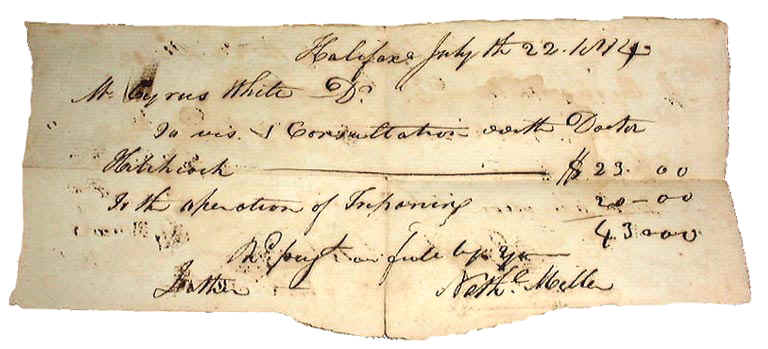
One antique dealer even has a receipt for a trepanning operation from 1814. It turns out you could get your head drilled for $20 in early 19th century Massachusetts.

If you’re after some more modern kit, it turns out you can pick up quite a few contemporary surgical tools on eBay.

Including this VectorVision2 BrainLab system, a snip (excuse the pun) at $15,000.

The VectorVision2 is an ‘augmented reality’ image guidance system (sometimes called frameless stereotaxy) that allows the surgeon to see where his tools are in relation to both the patient and a matched brain scan image – while the operation is in progress.

While the tools can be bought and sold online, most of the anaesthetics are, of course, controlled drugs.

So while you may be able to get the latest high-tech kit on eBay, you’re still going to have to resort to those traditional 19th century surgical painkillers: brandy, and a stiff upper lip.

Link to pictures of antique neurosurgery tools.
Link to VectorVision2 for sale on eBay.