Avalance of new SciAmMind articles

The new edition of Scientific American Mind has just appeared with a whole host of new freely-available articles available online covering the psychology of storytelling, gifted children, genius, animal intelligence, scent, smell and learning through error.

My favourite is the article on the psychology of storytelling and narrative, and why it could intricately bound up in the cognitive abilities we’ve developed to navigate the social world.

The article is quite wide ranging, dipping into anthropology, cognitive and evolutionary psychology to explore why stories are so central to cultures across the world.

Perhaps because theory of mind is so vital to social living, once we possess it we tend to imagine minds everywhere, making stories out of everything. A classic 1944 study by Fritz Heider and Mary-Ann Simmel, then at Smith College, elegantly demonstrated this tendency. The psychologists showed people an animation of a pair of triangles and a circle moving around a square and asked the participants what was happening. The subjects described the scene as if the shapes had intentions and motivations—for example, “The circle is chasing the triangles.” Many studies since then have confirmed the human predilection to make characters and narratives out of whatever we see in the world around us.

But what could be the evolutionary advantage of being so prone to fantasy? “One might have expected natural selection to have weeded out any inclination to engage in imaginary worlds rather than the real one,” writes Steven Pinker, a Harvard University evolutionary psychologist, in the April 2007 issue of Philosophy and Literature. Pinker goes on to argue against this claim, positing that stories are an important tool for learning and for developing relationships with others in one’s social group. And most scientists are starting to agree: stories have such a powerful and universal appeal that the neurological roots of both telling tales and enjoying them are probably tied to crucial parts of our social cognition.

Link to August 2008 SciAmMind.

Cognitive restructuring and the fist bump terrorists

The recently satirical New Yorker cover depicting Obama and his wife as fist-bumping Islamic terrorists comes under fire in an article for The Chronicle by psychologist Mahzarin Banaji who argues that it irresponsibly creates an implicit association between “Obama and Osama”. Banaji is almost certainly right, but neglects higher levels of cognition which can make this ineffectual.

Banaji is most known for her extensive work on the implicit association test (IAT), which we discussed only the other day. What this and other work has shown is that despite our conscious thoughts (“hair colour has no association with intelligence”) we still might have an unconscious bias that associates certain concepts (‘blonde’ and ‘dim’).

Along these lines, Banaji suggests that the artist, Barry Blitt, who created the picture has harmed the political debate by unintentionally strengthening an inappropriate link:

The brain, Blitt would be advised to understand, is a complex machine whose operating principles we know something about. When presented with A and B in close spatial or temporal proximity, the mind naturally and effortlessly associates the two. Obama=Osama is an easy association to produce via simple transmogrification. Flag burning=unpatriotic=un-American=un-Christian=Muslim is child’s play for the cortex. Learning by association is so basic a mechanism that living beings are jam-packed with it ‚Äî ask any dog the next time you see it salivating to a tone of a bell. There is no getting around the fact that the very association Blitt helplessly confessed he didn’t intend to create was made indelibly for us, by him.

It is not unreasonable, given the inquiring minds that read The New Yorker, to expect that an obvious caricature would be viewed as such. In fact, our conscious minds can, in theory, accomplish such a feat. But that doesn’t mean that the manifest association (Obama=Osama lover) doesn’t do its share of the work. To some part of the cognitive apparatus, that association is for real. Once made, it has a life of its own because of a simple rule of much ordinary thinking: Seeing is believing. Based on the research of my colleague, the psychologist Daniel Gilbert, on mental systems, one might say that the mind first believes, and only if it is relaxing in an Adirondack chair doing nothing better, does it question and refute. There is a power to all things we see and hear ‚Äî exactly as they are presented to us.

It strikes me that Banaji is perhaps being a little disingenuous here. Certainly the advert does strengthen that unconscious association, but, as as the intention of most satire, it attempts to include another association into the mix – that of absurdity.

In other words, the idea of the cartoon is presumably to trigger the association Obama = terrorist, but also include another so it becomes Obama = terrorist = absurd. It’s the humourists equivalent of the reductio ad absurdum argument.

Of course, this can rely as much on the same implicit associations as Banaji mentions, but it can be also seen to work very effectively through a process of reinterpretation that alters the impact of automatic connections through changing their meaning.

In fact, this process so can be so powerful that it is used to treat psychiatric problems.

In clinical work it is called ‘cognitive restructuring’. For example, in panic disorder, people begin to interpret normal bodily reactions (increased heart rate, temperature etc) as a sign of impending heart attack or other danger, which leads to more anxiety, further interpretations and a spiral of terrifying anxiety.

Cognitive restructuring teaches people that these bodily changes and worried thoughts aren’t signs of an impending heart attack, they’re normal reactions, and the spiral of anxiety is not a risk to your health, just a pattern you’ve got into. In other words, they begin to believe something different about the significance of the link.

Humour also relies on a process of reinterpretation. Most theories of humour stress that it usually requires the reframing of a previously held association.

However, the key to good satire is that this reframing should be obvious and we might speculate that the reframing effect should be more powerful than the effect of simply reviving the old association.

We can perhaps wonder then, whether the controversy over the New Yorker cover is not that it made an association between Obama and terrorism, but that it was not effective enough in making it obviously absurd.

I suspect one of the difficulties is that the cartoon was actually attempting to satirise not Obama, but the media discussion of him. This is always a risky strategy because it requires so much cognitive abstraction that the automatic association is far more apparent.

Link to Banaji’s article in The Chronicle.

2008-08-01 Spike activity

Quick links from the past week in mind and brain news:

Awesome Developing Intelligence post gives a remarkably concise review of cognitive science and discusses what this tells us about the best targets for cognitive enhancement.

BookForum looks at two memoirs that recount the psychological and physical intricacies of illness of the body and brain.

The mighty Language Log has a great analysis looking at the fallacies of yet another popular piece on sex differences in mind and brain.

The Economist has an article on the science of cognitive nutrition.

The ideas behind ‘critical neuroscience‘ are discussed by Neuroanthropology.

Eric Schwitzgebel on the Wittgensteinian puzzle of whether philosophy solves problems with language or problems with the world.

ABC Radio National’s The Philosopher’s Zone has an interesting discussion on the philosophy of moral dilemmas.

While we’re on the subject of morality the NYT Freakanomics blog has two guest posts on moral hypocrisy.

Sharp Brains has a special on mind and brain haikus.

ABC Radio National’s In Conversation looks at the anthropology of sisters, mothering and motherhood across the world’s cultures.

Dr Petra has the most sensible post you’ll read about the recent news reports on Viagra supposedly increasing sexual function in women who take antidepressants.

Advances in object recognition around age 2 may herald symbolic thought, reports Science News.

Pure Pedantry has an interesting commentary on the merits of postponing your alcoholism.

Perpetually falling woman learns to balance with her tongue. The Telegraph has a story about a woman who has lost her sense of balance owing to brain injury.

The Primary Visual Cortex is an excellent new blog on vision science and perception.

A robot that “resembles the love child of a monkey and an iMac”. The Times has an excellent piece on robots designed to emotionally interface with humans.

Not Quite Rocket Science looks at a new study on language evolution in the lab and Wired Science has some further in-depth analysis.

A new book called ‘Brain Research for Policy Wonks’ is reviewed by Nature Reviews Neuroscience.

New Scientist has a special article and video report on the somewhat recursively titled ‘Seven Reasons Why People Hate Reason‘.

The psychology of motivation – when passionate interest becomes a business – is discussed by The Washington Post.

The New York times examines the methods and motivations of web trolls.

An eye-tracking study that compared how individuals with Williams syndrome (“hyper social”) and autism (“hypo social”) view pictures of social scenes is covered by The Neurocritic.

It is scientists who seek to get heaven in their heads

The wonderful image is an original drawing by the artist Masonic Boom, aka Kate St.Claire, as part of her series of psychological self portraits.

The quote in the image is from the author and philosopher G.K. Chesterton.

He was once asked by The Times to write an article on ‘What is wrong with the world?’ and send the following piece:

Dear Sirs,

I am.

Sincerely yours,
G. K. Chesterton

Thanks to Katie for allowing us to feature the image and it’s really worth seeing full size at the link below.

Link to full size image on Flickr.
Link to Masonic Boom collection.

The theatre of hysteria

I’m currently reading Elaine Showalter’s book Hystories, a cultural history of the concept of ‘hysteria‘, a term which has variously described the supposed effects of a ‘wandering womb’, unexplained neurological symptoms, panic, nervousness or just ‘making a fuss’.

She describes where medicine and media have collided, and highlights how popular interest in the condition has driven a long-standing tradition of fictional interpretations that have developed alongside medical understanding.

Showalter has a feminist angle although is generally even handed with the evidence and is not shy in highlighting the excesses of some past feminist writing on the subject.

One particularly interesting part is where she discusses how theatre interpreted the work of 19th century French neurologist Jean-Martin Charcot as it was happening.

Charcot is perhaps most famous for his work on hysteria and held regular Tuesday lectures at the Salp√™tri√®re hospital in Paris where he would theatrically demonstrate the symptoms of hysteria in favourite female patients who apparently ‘performed’ with an equal flourish.

As we mentioned previously, one of the reasons Charcot’s work was so widely known is because he used the newly developed technology of photography to create striking and sometimes pseudo-erotic portraits documenting the bodily contortions of his (largely) female patients. The picture on the right is of Augustine, one of his ‘star patients’.

These have been the inspiration for numerous contemporary plays, ballets, exhibitions and novels.

What I didn’t know was that these are not a modern phenomena, shows based on Charcot’s work work were popular since Charcot first began publishing his work and giving lectures (from p100):

As Charcot’s clinic achieved celebrity in the 1890s, images of hysteria cross over to theatre and cabaret. At the Chat Noir and Folies Berg√®re, performers, singers, and mimes who called themselves the “Harengs Saurs √âpileptiques” (The Epileptic Sour Herrings) or “Hydropathes” mimicked the jerky, zigzag movements of the hysterical seizure…

The poses of grande hyst√©rie enacted at the Friday spectacles of the Salp√™tri√®re closely resembled the stylized movements of French classical acting. Indeed, hysterical women at the clinic and fallen women in melodrama were virtually indistinguishable; the theatre critic Elin Diamond comments that both displayed “eye rolling, facial grimaces, gnashing teeth, heavy sighs, fainting, shrieking and choking; ‘hysterical laughter’ was a frequent stage direction as well as a common occurrence in medical asylums”…

Arthur Symons regarded the Moulin Rouge dancer Jane Avril as the embodiment of the age’s “pathological choreography.” These resemblances were not coincidental: writers, actresses cabaret performers and dancers like Avril attended Charcot’s matinees and then worked the Salp√™tri√®re style into their own performances.

An interesting twist is that Avril was actually treated by Charcot as a young girl after she ran away from an abusive mother and was admitted to the Salp√™tri√®re for ‘insanity’.

Link to details of Showalter’s book Hystories.
Link to first chapter.

The Maudsley cat

The not very good photo is of Coco, the Maudsley Hospital cat and one in a long line of felines who reside in psychiatric hospitals. Not all psychiatric hospitals have cats, but they’re not uncommon and exist as a sort of informal tradition of live-in feline therapy.

They’re very popular with both staff and patients, but their presence tends to drive managers up the wall, which just makes them all the more endearing. I’ve worked in three hospitals that have cats and almost invariably they live in the older adults ward, keeping the older folks company (and vice versa, of course).

The older adults ward at the Maudsley is called the Felix Post unit, after the distinguished psychiatrist of the same name. Coco’s predecessor was naturally called Felix, leading to occasional confusion where people assumed the ward was named after the cat.

As I hadn’t seen Coco all summer I enquired and it turns out he’s “gone to Liverpool”, which I’m assured isn’t a euphemism to protect those of fragile mood, but a genuine change in his location as the ward manager moved with Coco in tow. So for the first time in decades, the Maudsley is without a hospital cat.

Promising Alzheimer’s drug announced

The results of a moderate sized trial on a new Alzheimer’s drug have just been announced and the results, if reliable, may suggest that the treatment is one of the most important medical breakthroughs of the century.
Alzheimer’s disease is a type of dementia, a degenerative disorder of where the brain starts to degrade more quickly than would be expected through normal ageing.

One of the common features of Alzheimer’s disease is the accumulation of neurofibrillary tangles in the brain. These are clumps of tau protein that accumulate inside dying neurons. There have been debates about whether these cause the problems or are just the result, but most researchers are now coming round to the idea that tau protein tangles are the main problem.

The drug has been given the tradename ‘remben’ and was initially thought to be useful as it dissolved tangles in the test tube. It has just been tested in a Phase II trial which have been announced at an Alzheimer’s research conference.

The results of the first announced trial has not been published but there are details on the conference press release which I’ve included below the fold.

What’s most impressive from the preliminary details, is that the drug seemed to both slow or even stop cognitive decline in some cases, as well as eliminating the decline in blood flow in the areas usually most affected by the disease suggesting that it is halting the spread of tangles.

Interestingly, the company behind the drug, TauRx, have just launched their website today to catch the wave of publicity.

However, I’m wondering whether there’s more to it than meets the eye because, if I’ve got it right, the drug isn’t actually new.

Its chemical name is methylthioninium chloride but it’s also known as methylene blue and was synthesised way back in 1876. It was shown to be active against malaria by Paul Ehrlich in 1891 and later as a useful antibacterial drug (have a look at this fascinating NYT article from 1910).

In the late 1980s it was tried as a treatment for manic-depressive disorder and found to be useful.

Is this seems surprising, you may be interested to know that methylene blue was the basic compound from which the first antipsychotic drug chlorpromazine or Thorazine was made (in case you’re wondering, this family of antipsychotics can also work as anti-bacterial drugs, but have not been used due to other drugs having less side-effects).

If this is really just methylene blue, what this means in financial terms is that the drug can’t be patented.

In other words, anyone can make the drug which means its much harder to make money on it as pricing becomes competitive. In contrast, a patent gives you a time-limited monopoly – albeit one that can earn billions.

A widely available cheap generic drug that treats a major disease is actually a fantastic thing for society, but developing them is not typical behaviour for pharmaceutical companies who tend to shun unpatentable drugs.

Also, it’s probably true to say that the history of drug development shows a typical three stage process:

1. We’ve found a miracle cure!
2. We’ve found a miracle cure, but it can kill people.
3. It’s not a miracle cure, it can kill people, but it’s worth the risk in many cases.

So, time will tell how useful it is in the real world, but pretty much everyone has their fingers crossed that it will work out as a useful treatment.

Link to write-up from The Telegraph.

Continue reading “Promising Alzheimer’s drug announced”

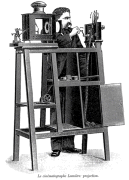
Is the cinematograph making us stupid?

I’ve just found an eye-opening 2003 article in the Journal of the American Medical Association on the work on 19th century neurologists George Beard and Silas Weir Mitchell, who thought the pace of life and the effect of new technology was harming the mind and brain of citizens in 1800s America – echoing similar concerns we still hear today.

The two physicians were influential in pushing the idea that these effects resulted in ‘neurasthenia‘, a kind of fuzzy catch-all diagnosis for mental or emotional malaise.

What’s interesting is we’re experiencing something almost identical over 100 years later.

As we’ve noted several times, leading scientists or commentators can make international headlines by simply suggesting that new technology is harming the mind, brain and relationships of the modern citizen, despite a general lack of evidence or flat out evidence to the contrary.

The JAMA article notes how neurasthenia was associated with the cultural concerns of the time:

Families migrated from the countryside to the city, men left traditional jobs as tradesmen and farmers to join the growing ranks of businessmen and office workers, women went from being mothers and daughters to also being university students and physicians, and technological developments such as telegraphs, telephones, and railroads became increasingly common parts of everyday life. As a diagnosis, neurasthenia commanded an intuitive legitimacy because it incorporated the anxieties that arose from these changes into the way people thought of their health. It could attribute a bank manager’s headaches to his hectic schedule and the obsession for detail his job demanded.

Similarly, a young woman’s depression could be understood as neurasthenia brought on by the mental drain of attending a newly founded coeducational university, where she competed for grades. In many cases, diagnoses of neurasthenia attached themselves to traditional ideals, such as the restorative virtues of farming vis-√†-vis the fast-paced stress of modern business or the Victorian belief in women’s disposition for motherhood rather than scholarship. For Beard and Mitchell, neurasthenic patients were casualties of modern society whose bodies and minds simply could not keep up with the seemingly accelerated lifestyles of men and women in the latter part of the 19th century.

It’s a lovely illustration of the fact that since the dawn of popular medicine, our cultural concerns about changes in society are likely to be expressed in the language of illness and disease.

The article also notes that then, like now, the concerns are accompanied by an encouragement to return to the traditional ways of doing things (in this day and age – encouraging kids to ‘play proper games’ or have ‘genuine relationships’) rather than highlighting ways of healthy adaptation to the new technology.

This is not to say that all fears about new technologies are unfounded, but its clear that they are quickly medicalised and get far more prominence than the evidence supports, both in the 19th century and in the 21st.

Link to JAMA article ‘Neurasthenia and a Modernizing America’.

A party game that goes down like a red balloon

I just found this clever advert for The Economist which has an immediate impact but kinda becomes a bit awkward if you think about it for too long.

Presumably, it’s meant to convey the idea that the magazine is ‘mind expanding’. But as we mentioned in an earlier post, we tend to ascribe different sorts of properties to the mind and brain.

One key difference is that we don’t ascribe physical properties to the mind, which is a bit of a pain when you’re trying to create a visual advert. So the designers went for a brain.

But ‘brain expanding’ is just kind of awkward. It makes me think of hydrocephalus – a condition where faulty fluid drainage causes internal pressure which literally balloons the brain.

In young children with soft skulls this causes skull deformation, in adults it just tends to squash the brain against the side of the skull. Either way, it usually needs surgical intervention to insert a shunt valve to treat the drainage problem, else brain damage and death follow in a high proportion of cases.

Nevertheless, if you can get your hands on any of these balloons you’ve instantly got yourself a neurosurgery party game for kids. The first kid to fashion a shunt out of a drinking straw gets a special John Holter prize.

Yes, I know I should get out more.

Link to Economist advert.

Juggling can change brain structure within 7 days

A new study just published in PLoS One reports that learning to juggle alters the structure of motion detection areas in the brain within as little as 7 days.

Led by neuroscientist Joenna Driemeyer, the study builds on a previous research that also found juggling could alter brain structure, although this previous study waited three months before the brain was checked for alterations using high resolution structural MRI scans.

This new study also took 20 non-jugglers and asked them to learn to juggle, but scanned them after 7, 14 and 35 days.

After only 7 days, a motion specialised part of the occipital lobe known as V5 had increased in density. In both studies, the changes were maintained over the subsequent weeks of practice, but these areas returned to their pre-learning state after several weeks without juggling.

This is an interesting example of rapid ‘neuroplasticity‘, the ability of the brain to adapt structurally to new situations.

However, the authors are careful to note that they can’t tell whether the brains of the participants had generated more neurons, or whether existing cells grew in size, or additional glial cells were developed, or maybe there were just changes in how much blood or other brain fluids packed the area.

Also, the fact that changes seemed to occur at the beginning of the learning cycle but that further practice maintained but didn’t cause additional changes led the researchers to speculate that learning a variety of new things, rather than simply practising old skills, may be most effective in terms of brain structure alterations.

Link to ‘Changes in Gray Matter Induced by Learning ‚Äî Revisited’.
Link to PubMed entry for paper.

Full disclosure: I’m an unpaid member of the PLoS One editorial board.

Detecting suicidal intent in the unconscious mind

The Situationist has just alerted me to a fantastic article in the Boston Globe on the development a cognitive test for suicidal thoughts that doesn’t rely solely on the conscious mind.

The test is a variant of the Implicit Association Test (IAT) that has been used to look at our automatic associations between different concepts, based on how quickly we can categorise them.

We’ve discussed in it more detail previously but it essentially relies on the fact that if you have an pre-existing association between two concepts, say, the concepts ‘blonde’ and ‘stupid’, making similar associations will be faster than associating ‘blonde’ and ‘clever’ because you’re going to be quicker doing whichever classification best matches associations you already have.

Most of the research has been done on implicit social biases, finding that even people who have no explicit prejudices against blondes, foreigners, men or whomever, might find they automatically associate certain negative concepts with these groups.

However, as the test purely measures associations between concepts, it can be used to look for other implicit biases. In fact, the researchers featured in the Globe piece have used it to test for implicit associations between the concept of self and suicide.

Most suicidal patients will admit they are at risk of harming themselves. Contrary to popular belief, suicidal patients don’t necessarily want to die, they just want the pain to stop and will be upfront if they think professionals can help.

Some, however, may have decided that death is the only relief, or they may be unable to see clear alternatives owing to the effects of mental illness on thinking.

Suicide risk is assessed on the basis of people’s actions and what they say, so a completely determined person can talk their way through a risk assessment.

This new research is testing the IAT as a way of assessing suicide risk, even if the person is denying they are suicidal.

The study, led by Dr. Matthew Nock, an associate professor in the psychology department at Harvard University, is called the Suicide Implicit Association Test…

But critics question whether the test is actually practical, and up until now no one has tried to apply it to suicide prevention. As part of his training, Nock worked extensively with adolescent self-injurers – self-injury, such as cutting and burning, is an important coping method for those who engage in it, though they are often unlikely to acknowledge it. Nock thought that the IAT could serve as a behavioral measure of who is a self-injurer and whether such a person was in danger of continuing the behavior, even after treatment.

In their first major study, Nock and Banaji asserted that the IAT could be adapted to show who was inclined to be self-injurious and who was not. And more important, they said, the test could reveal who was in danger of future self-injury.

It’s an interesting idea and the early results look intriguing, although as the article notes, the proof will be how well it actually works in practice.

One difficulty with risk assessment in psychiatry is its almost impossible to do ‘ideal’ outcome studies because of the ethical implications.

For example, lets say your new risk measure predicts someone will kill themselves. From a statistical point of view, you’d want to wait and see if they do, so you can compare these positive predictions with the negative predictions and get an accuracy measure.

But from a purely humane point of view, you’re going to intervene and try and help the person, meaning risk assessments are not always based on ‘ideal’ statistical information.

The article has an excellent discussion of some of the wider ethical and practical issues involved, drawing on the writers own experience of his brother’s suicide.

Link to Boston Globe article ‘On the Edge’ (via The Situationist).

Waterfalls, adaptation and light

Firstly, you’ll have to excuse the somewhat ‘in house’ nature of this post, as it’s me writing about Christian writing about Tom. It’s an account of Tom giving an address to the Association for the Teaching of Psychology where he conducted a fantastic demonstration of how you can test out whether your brain adapts to certain visual conditions ‘locally’ on an eye-by-eye basis, or ‘centrally’ in eye independent perceptual brain areas.

Moments into the keynote talk, the teachers and I found ourselves blinded by darkness. As our eyes adjusted, we were told to cover one eye with our hands before the lights were raised again. A little wait for our open eyes to become light-adjusted and then the lights re-dimmed. What would happen to our vision this time? The answer depends on whether adaptation to light levels occurs centrally, in the brain, or locally in each eye. The audience tested this, looking through each eye one at a time and discovering the strange experience of having one eye adapted to the light and one to the dark, thus showing that light adaptation occurs locally. Both eyes open led to a strange, grey, grainy, effect. ‚ÄúWhoever said psychology isn’t useful is wrong,‚Äù Stafford said. ‚ÄúYou now have the perfect strategy for visiting the toilet in the night and finding your way back to your bed in the dark.‚Äù

Light adaptation may well occur locally, but what about adaptation to motion? A huge video of a waterfall filled the screen. After a minute staring at the cascading water, the video was stopped and the audience experienced the well-known illusion of the water appearing to flow upwards. But what if the flowing water was watched with just one eye (with the other covered), with the paused video then observed through the previously covered eye? The illusion was still experienced, thus showing that in this case, adaptation to motion had occurred centrally, in the brain.

If you don’t have a waterfall handy, you may be interested to know it’s a form of ‘motion after effect‘ illusion and there’s a similar demonstration online that you can try. If you go to that link, click ‘detach’ and resize the window to get a bigger version.

You’ll need to supply the room and light yourself though. The hall full of teachers is optional.

Link to BPSRD on visual adaptation.
Link to motion after effect example.

Silence, but for the clouds moving across the sky

Lee Tracy is an artist who creates poems out of brain scans.

The image is from a 2006 exhibition called Negative to Positive that was shown in the International Museum of Surgical Science in Chicago.

Each image is an CT scan of the artist’s brain, mounted in a light box and etched with a statement of the profound to the whimsical.

If you’re a neuroscientist and your lab needs more poetry or you’re an artist and your studio needs more neuroscience, you can purchase the pieces from the artist through Etsy.

Link to Lee Tracy’s poetic CT scans on Etsy (thanks Sandra!).
Link to Time Out review of ‘Negative to Positive’.

Whatever happened to symptom substitution?

Symptom substitution is at the core of Freudian psychology but according to a new article in Clinical Psychology Review there is virtually no evidence for its existence and the concept should be abandoned.

The idea is that if you treat a symptom, say a phobia of social situations, without addressing the underlying conflict, another symptom will just appear because the core problem is unchanged. It is based on the Freudian theory that all symptoms of mental illness are simply a reflection of an underlying unconscious conflict.

Freud was inspired by the first law of thermodynamics that says that energy cannot be created or destroyed just turned into another form. His psychology, and much Freudian-inspired psychodynamic psychotherapy that follows, applies a similar idea to emotions.

In this model, a conflict is caused by a forbidden unconscious impulse being held back by our conscious ego. Supposedly, we want to banish them from our conscious mind to maintain a positive self-image, so we repress them into our unconscious. But because they can’t just disappear they are expressed in other ways – i.e. as neurotic symptoms.

However, this model also plays an important symbolic role in the politics of mental health. It suggests that psychoanalysis is the only truly effective treatment, because it supposedly deals with the ‘root cause’, while drugs, behaviour therapy and CBT just alleviate symptoms and leave the patient open to further suffering.

Rather unusually for a Freudian idea, it leads to a directly testable hypothesis. Psychoanalytic treatment should lead to a better long-term prognosis, whereas we should see other other symptoms appear after treatment with other approaches.

Psychologist Warren Tryon decided to look at the medical literature to see whether other approaches were more likely to result in the appearance of other symptoms, and found no evidence from relevant empirical studies.

In fact, Tryon found only two cases studies that claimed to provide direct evidence for symptom substitution and one of them didn’t even fulfil the definition, it just reported that the same symptoms came back – therefore describing a relapse rather than a substitution.

Despite their being a lack of evidence so far, he does note that not many studies have directly addressed the issue, but proposes a direct test:

The following experimental design could identify genuine psychoanalytic symptoms. Form two groups of demographically matched patients displaying a hypothesized symptom. Provide psychoanalytic treatment to one group and symptomatic treatment to the other group. The hypothesized symptom can be considered to be a bone fide psychoanalytic symptom if patients receiving psychoanalytic therapy get better and symptom substitution occurs in patients receiving symptom oriented therapy. Helping these patients to get better by providing psychoanalytic therapy would provide additional supportive evidence and be ethically responsible. The literature review reported above indicates that the presence of bona fide psychoanalytic symptoms has yet to be demonstrated.

Link to ‘Whatever happened to symptom substitution?’ (thanks Karel!).
Link to PubMed entry for article.

Strippers for taxation reform

Frontal Cortex has an excellent post on the near futility of election coverage and why people tend to vote with what they feel, rather than what they know.

The piece reviews a whole range of studies that have highlighted possible non-issue influences on people’s voting preferences, from the weather to the facial expressions of news presenters.

One other line of research has found that facial structure can predict leadership, allowing people to reliably pick out business leaders or political winners just from a photo of their face.

Advertisers have long known that marketing products on the basis of facts is a lot less effective than marketing on the basis of appeals to emotion, desire and self-image.

While this is often labelled ‘sex sells’, ‘you-can-be-sexy sells’ is just as widely used.

Traditionally, this avenue has not been open to political candidates since it leaves the candidate open to the emotional counter-attack of accusations of impropriety.

After seeing the popularity of the ‘Obama Girl’ video, it struck me that the internet opens up this avenue, as supporters not officially associated with a candidate can now make their own wide-coverage sex sells promotions without ‘sullying’ the name of the official party machine.

As Frontal Cortex notes:

The problem, as political scientist Larry Bartels notes, is that people aren’t rational: we’re rationalizers. Our brain prefers a certain candidate or party for a really complicated set of subterranean reasons and then, after the preference has been unconsciously established, we invent rational sounding reasons to justify our preferences.

Link to Frontal Cortex on ‘Rational Voters?’.