The scan says we add fries and call it a special

Photo from Flickr user Daniel Go. Click for source.Marketing magazine has an interview with the marketing director of KFC who explains why he thinks neuroscience holds the key to selling deep-fried junk food.

“Marketing as a whole is undergoing transformation,” he says. “We now know through neuroscience how people’s brains work and what affects their decision-making. So what we’re trying to do is take the new knowledge and say – this is how we put it together, this is how a brain actually works – and this is how we should be marketing.”

Somebody, please, find me a pizza.
 

Link to Marketing interview.

Excellent NPR Invisibilia finally hits the wires

A sublime new radio show on mind, brain and behaviour has launched today. It’s called Invisibilia and is both profound and brilliant.

It’s produced by ex-Radiolab alumni Lulu Miller and radio journalist Alix Spiegel – responsible for some of the best mind and brain material on the radio in the last decade.

The first episode is excellent and I’ve had a sneak preview of some other material for future broadcast which is equally as good.

It’s on weekly, and you can download or stream from the link below, and you can follow the show on the Twitter @nprinvisibilia.

Recommended.
 
Link to NPR Invisibilia.

Bringing us closer to the blueprints of the brain

I’ve got a piece in today’s Observer about the amazing science of doing functional brain imaging and behavioural studies with babies while they are still in the womb to see the earliest stages of neurocognitive development.

Brain development during pregnancy is key for future health, which is why it gets checked so thoroughly during prenatal examinations. But neuroscientists have become increasingly interested in how the activity of the brain becomes progressively integrated and synchronised during development to support human experience, something developmental neuroscientist Moriah Thomason calls “bringing us closer to the blueprints of the brain”.

It’s difficult to state how remarkable this is, both technically and scientifically, as researchers have managed to measure the unborn brain in action as it responds to the outside world through the womb.

The article looks at how this science is developing and what it’s telling us about the earliest stages of the developing brain.

Exciting stuff.
 

Link to ‘Prenatal blueprints give an early glimpse of a baby’s developing brain’

A new year with an old friend

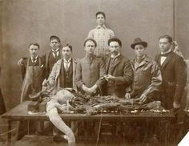
I’ve just found a curious article in the scientific journal Clinical Anatomy which reprints a Victorian story called ‘Celebrating new year in Bart’s dissecting room’ where the corpses come to life. It finishes with some interesting observations about the psychological impact of dissecting a dead body as a rite of passage for medical students.

The story is of “a somewhat desultory student” who has been treating the body on which he has been working disrespectfully and is reminded of its humanity as it comes to life. “As a result, he resolves to behave differently in the future”.

The authors of the article, which reprints the story, discuss its modern day relevance for young medical students faced with a dead body they have to cut up.

In some dissecting rooms, even into the twentieth century, the dead were still being treated with irreverence and levity (Smith, 1984).

Today, it is understood that some of these behaviors may result from unresolved tensions. Recent studies by Hafferty (1991), Horne et al. (1990), and Gustavson (1988), have shown that first reactions to the dissecting room and to dissection itself may include faintness, physical symptoms of unease, even flight. Anxiety may be expressed as embarrassment, levity, or bravado.

Coping mechanisms include the bestowal by students of fictitious names or speculative personalities or life stories upon the dead. A curious sort of bond can develop between the student and the “person” of the dead body. The emotional experience contrasts with and supplements students’ efforts to internalize anatomical knowledge. There may evolve a sense of familiarity, contact and intimacy, mixed perhaps with a sense of transgression or guilt, and of obligation.

For those not from the UK, ‘Barts’ refers to St Bartholomew’s Hospital which is the oldest working hospital in Europe and probably best known for being associated with Sherlock Holmes.

The article is open, so you can read it online in full.
 

Link to ‘Celebrating new year in Bart’s dissecting room’.

Spike activity 19-12-2014

Quick links from the past week in mind and brain news:

MIT Tech Review has an interesting piece about ‘troll hunters’ – a new wave of internet abuse vigilantes.

ABC All in the Mind has a good edition asking whether mirror neurons have been oversold. Spoiler alert: yes, they have.

The New York Magazine’s Science of Us section has an interesting piece on whether terrorists can be rehabilitated.

The LSE has an excellent interview with Nikolas Rose on the social implications of the Human Brain Project.

A new study covered by Neuroskeptic finds that head motion biases yet another area of neuroimaging – this time voxel-based morphometry.

Science magazine has an interesting piece on how ideas flow between languages.

There are some excellent extended video interviews with psychologist Gary Marcus on the ‘future of the brain’ over at Live Science.

Foreign Policy magazine has an extended article which perfectly captures the ‘global mental health’ approach to extending mental health services. Please note: other approaches are available.

There’s an extended post on the Skype site that explains the AI tech behind their real-time language translator software.

Economics against sexual violence

PBS has an article on ‘How economic theory can help stop sexual assault’ which despite its unappealing title is actually a genuinely thought-provoking piece on how game theory and social norms marketing could help prosecute and prevent sexual violence.

Both approaches look at how people’s behaviour is shaped by their perception of other people’s beliefs and behaviour.

People are less likely to report rape when they think they’re going to have to do it alone and people are more likely to intervene to prevent violence if they believe other people will also intervene.

The article discusses two existing interventions to tackle sexual violence based on game theory and social norms marketing and the article is also a great guide to the theories themselves.
 

Link to PBS article on approaches to preventing sexual assault.

The celebrity analysis that killed celebrity analysis

Most ‘psy’ professionals are banned by their codes of conduct from conducting ‘celebrity analysis’ and commenting on the mental state of specific individuals in the media. This is a sensible guideline but I didn’t realise it was triggered by a specific event.

Publicly commenting on a celebrity’s psychological state is bad form. If you’ve worked with them professionally, you’re likely bound by confidentiality, if you’ve not, you probably don’t know what you’re talking about and doing so in the media is likely to do them harm.

Despite this, it happens surprisingly often, usually by ‘celebrity psychologists’ in gossip columns and third-rate TV. Sadly, I don’t know of a single case where a professional organisation has tried to discipline the professional for doing so – although it must be said that mostly it’s done by self-appointed ‘experts’ rather than actual psychologists.

A new article in Journal of the American Academy of Psychiatry and the Law traced the history of how this form of ‘celebrity analysis’ first got banned in the US under the ‘Goldwater Rule’.

The Goldwater Rule stemmed from a scandal surrounding a 1964 publication in Fact magazine that included anonymous psychiatric opinions commenting on Senator Barry Goldwater‘s psychological fitness to be President of the United States. Fact, a short-lived magazine published in the 1960s, carried opinionated articles that covered a broad range of controversial topics. In the 1964 September/October issue entitled, “The Unconscious of a Conservative: A Special Issue on the Mind of Barry Goldwater,” the opinions of over 1,800 psychiatrists commenting on Goldwater’s psychological fitness were published…

Of the 2,417 respondents, 571 deferred from providing comments, 657 responded that Goldwater was fit to be president, and 1,189 responded that he was not fit. None of the psychiatrists whose comments were published had examined Goldwater, however, and none had permission from him to issue their comments publicly. In the article, Goldwater was described with comments including “lack of maturity”, “impulsive”, “unstable”, “megalomaniac”, “very dangerous man”, “obsessive-compulsive neurosis”, and “suffering a chronic psychosis”… Much was made of two nervous breakdowns allegedly suffered by Goldwater, and there was commentary warning that he might launch a nuclear attack if placed under a critical amount of stress as president.

Goldwater responded by bringing libel action against Ralph Ginzburg, Warren Boroson, and Fact… The United States District Court for the Southern District of New York returned a verdict in favor of the senator… The AMA and APA immediately condemned the remarks made in the Fact article after its publication. Individual psychiatrists also spoke out against the ethics of the published comments.

Most people who are subject to ‘celebrity analysis’ don’t have the luxury of bringing libel suits to defend themselves but it’s probably worth remembering that if someone is seeming to give a professional opinion on someone’s psychological state whom they’ve never met, they’re probably talking rubbish.
 

Link to article on ‘Psychiatrists Who Interact With the Media’

Towards a nuanced view of mental distress

In the latest edition of The Psychologist I’m involved in a debate with John Cromby about whether our understanding of mental illness is mired in the past.

He thinks it is, I think it isn’t, and we kick off from there.

The article is readable online with a free registration but I’ve put the unrestricted version online as a pdf if you want to read it straight away.

Much of the debate is over the role of biological explanations in understanding mental distress which I think is widely understood by many.

Hopefully, amid the knockabout, the debate gets to clarify some of that.

Either way, I hope it raises a few useful reflections.
 

Link to ‘Are understandings of mental illness mired in the past?’ (free reg).
pdf of full debate.

Spike activity 12-12-2014

Quick links from the past week in mind and brain news:

The new trailer for upcoming Pixar movie Inside Out is very funny and has a remarkably accurate depiction of brain function.

Neurocritic covers hipster neuroscience.

Is the ‘bilingual advantage’ in cognitive performance a result of publication bias? Maybe, suggests the Science of Us.

The Economist asks whether behavioural economics could be a tool to tackle global poverty.

Why do friendly people usually lead happier lives? asks BPS Research Digest.

Fastcompany has an interesting piece on the curious results from an online lingerie company who use extensive A/B testing of model photos to see underwear.

The science of why torture makes for useless interrogation – in New Scientist.

Snake oil salesmen selling torture

The US Government has just released its report on the CIA’s Detention and Interrogation Program, aptly branded the “torture report”, which is available online as a pdf.

It makes for appalling reading but sheds light on the role of two psychologists in the creation and running of what turned out to be genuinely counter-productive ‘enhanced interrogations’ that were used in preference to already productive non-abusive interrogations.

In the report the psychologists are given the codenames Grayson SWIGERT and Hammond DUNBAR but these refer to James Mitchell and Bruce Jessen who have been widely identified by other sources in the preceding years.

Mitchell and Jessen were both contractors, who, according to the new report, arrived at detention centres to direct CIA interrogations, despite having no interrogation experience, and in face of sometimes severe reservations of regular CIA staff.

Later, Mitchell and Jessen formed a company, Mitchell Jessen and Associates – given the codename ‘Company Y’ in the report – which was contracted to the tune of $81 million to perform the interrogations. By interrogations here, of course, we mean torture that include waterboarding, unnecessary feeding through the anus, sleep deprivation, violence, threats, confinement to coffin shaped boxes for days on end, and painful stress positions.

Mitchell and Jessen’s approach was flawed from the start because it was based on a fundamental misunderstanding of the theory they based their approach on.

They are frequently described in the report as saying that their interrogation method aimed to induce a state of ‘learned helplessness’.

This was a concept first developed by the psychologist Martin Seligman who noted that if you prevented animals from escaping when they were given electric shocks some eventually stopped trying and just fell into a state of passivity as they were repeatedly shocked.

Seligman argued that this might explain depression: people who experience multiple uncontrollable tragedies simply lose motivation and give up trying to make things better.

It’s not a great theory of depression but it does describe the loss of coherent self-helping behaviour that appears in some people who have no control over their abusive situations.

Mitchell and Jessen wanted to induce this state in detainees, thinking that it would make them more likely to co-operate.

This, to be frank, is just bizarre. The theory predicts the opposite would happen and this is, rather grimly, exactly what occurred.

Detainee Abu Zubaydah, the report notes, became “completely unresponsive, with bubbles rising through his open, full mouth” after repeated waterboarding. Ramzi bin al-Shibh started to exhibit “visions, paranoia, insomnia, and attempts at self-harm.”

One CIA staff member understood exactly the counter-productive psychology of these techniques when he noted that “we believe employing enhanced measures will accomplish nothing except show [al-Nashiri] that he will be punished whether he cooperates or not, thus eroding any remaining desire to continue cooperating”. This is learned helplessness in action.

It’s not as if the entirely nonsensical basis of Mitchell and Jessen’s ‘learned helplessness’ approach was a complex or subtle theoretical distinction – it’s undergraduate level psychology. Even for the uninitiated, the clue is in the name.

Perhaps one of the biggest questions is why Mitchell and Jessen were given such a central and powerful role to carry out these useless torture sessions in light of their lack of experience, the incoherent basis of their ideas, lack of results, abusive methods and and massive conflict of interest.

On this last point, the report notes that CIA staff members on the ground expressed concerns that Mitchell and Jessen were responsible for assessing detainees’ suitability for ‘enhanced interrogation’, directing the sessions, evaluating their own performance, and profiting from participation.

If it couldn’t get any worse, the report mentions in several places that established CIA psychologists repeatedly expressed concerns about what was happening but were overruled.

The episode is both a monumental fuck-up on the level of the organisation’s ability to detect psychological snake oil and a vast human tragedy.
 

pdf of full report from Senate Select Committee on Intelligence.

You won’t find the data in my pants

The journal contexts has an excellent article on the long history of exploring the sex lives of sex researchers as a veiled attempt to discredit their work.

…these stories suggest a troubling pattern: they tend to focus on researchers’ alleged sexual proclivities, spinning them as deviant motivations which compromise the research.

For example, James Miller’s biography of Michel Foucault links Foucault’s work to unconventional sexual activities like sadomasochism. Thomas Maier begins his biography with Virginia Johnson losing her virginity, portrays her as a sexually conniving secretary, and delights in exposing complicated aspects of the researchers’ sex life together. And historian James Jones depicts Kinsey as deeply twisted.

The problem is not simply that sexuality research remains stigmatized. It is that, in many circumstances, sex itself remains stubbornly discrediting. Sexuality’s cultural meanings are paradoxical—it is simultaneously repulsive and attractive, taboo yet vital to our happiness. It is difficult to write sexual stories without reproducing what Michael Warner calls “the ordinary power of sexual shame.” Moreover, stories that examine sex research through the prism of the researcher’s sex life rely on the simplistic notion that there is a specific connection between one’s sexual experiences and research.

A fascinating piece which covers the sort of leering interest sex research continually attracts despite it being one of the most important and under-investigated aspects of human health and behaviour.
 

Link to ‘The Sex Lives of Sex Researchers’ in contexts.

Madness, murder and mental healing

London’s innovative biomedical centre, the Wellcome Collection, have created a fascinating interactive story on how ‘mesmerism’ and hypnosis played an important role in the history of mind and madness.

It’s written by the fantastic Mike Jay, who has penned many excellent books on the high-strangeness of the early science of the mind in the 1800s, and has been wonderfully realised as an interactive web site.

It’s called ‘Mindcraft: a story of madness, murder and mental healing’ and rather curiously, but also rather usefully, it has its own trailer.

After you’ve gone to the website, you just need to keep scrolling down to work through the story and you’ll be diverted into video, narrative and text along the way.
 

Link to Mindcraft.

Spike activity 05-12-2014

Quick links from the past week in mind and brain news:

There’s a picture gallery from the abandoned Talgarth and Denbigh asylums at Wales Online.

The Guardian has a piece on psychologist William Marston, polyamory, feminism and the genesis of Wonder Woman. Doesn’t mention he also invented the polygraph.

The saga of the lost, maybe found, and probably destroyed lost brains of Texas University is covered by the New York Times.

Pacific Standard has an interesting piece on what sociologists can tell us about serial killing.

End of the Road for “Endophenotypes”? Neuroskeptic covers a provocative but not particularly well powered study on the highly cited psychiatric Lego blocks of the mind.

BBC News has an investigative piece on the ‘world’s most dangerous’ psychiatric hospital. Very disturbing indeed.

Excellent piece in BBC Future on common myths about PTSD.

For decades, the idea of a language instinct has dominated linguistics. It is simple, powerful and completely wrong, argues linguist Vyvyan Evans over at Aeon

3652 days

CC Licensed Photo by Flickr user Earl. Click for source.Mind Hacks is exactly 10 years old today. Here’s the first post where Matt announced that the book had started shipping.

This is the 4950th post and Mind Hacks has been going for 3652 days which means we’ve published an average of 1.4 posts a day, every day, for the last 10 years.

Apart from the blog posts there were two memorable occasions when we were featured in the mainstream press. Both were fittingly, slightly unusual.

Tom was featured on the front page of the Wall Street Journal for leading a cognitive science safari through the streets of Berlin. A reporter accompanied him through the urban jungle and reported back from the pioneering trip through unexplored cognitive territory.

On a slightly different tack, an article in The New York Times featured my psychosis research. Curiously, it was put in the Fashion and Style section, which was most likely a mistake, although sometimes I catch a look at my well cut corduroy slacks and think maybe it was really due to my daring autumn look and stylistic joie de vivre.

Apart from those moments, we’ve mainly spent the rest of the decade at our laptops alternately flicking between PubMed and Google News, grumbling about people not linking to the original study and tapping out diatribes when people make unjustified inferences from neuroanatomical findings or limited behavioural data.

I suspect the next ten years might be somewhat similar.

Spike activity 28-11-2014

Quick links from the past week in mind and brain news:

The Pentagon publishes their plan for future war and they seem to have ripped off the plot from 1980s Rogue Trooper story lines.

The Scientist has a basic guide to imaging white matter with diffusion MRI. Next week in The Scientist: Collar up or collar down? We explore the latest lab coat trends.

Neurons light up Times Square for Midnight Moment – and they look amazing. Photo in New Scientist.

xkcd wins the internet with this cartoon simply entitled fMRI. Don’t miss the mouseover.

US regulators move on thought-controlled prosthetics, reports Nature – as soon as they can relax enough move the cursor. Mind Hacks – your number one source for brain-computer interface gags. Don’t miss our Christmas selection.

Mosaic Science asks whether hospital design can affect our recovery. With some fascinating answers.

Retroreport has a good video report on Sybil and the multiple-personality disorder hysteria that swept America in the 1970s.

A group of historians are identifying and memorialising unmarked graves of patients from an abandoned asylum in the States. Touching article and video report from The New York Times.

Wankers and prankers on the suicide hotline

CC Licensed Photo by Flickr user kev-shine. Click for source.The New York Magazine‘s new Science of Us section has an interesting review of a new documentary on hotlines – whether they be for suicide support or phone sex.

I was initially annoyed at the fact that the documentary puts both of these in the same category but it’s based on the interesting premise that hotlines – whether for mental health, sex or supporting members of a particular marginalised community – often involve the common component of lonely people reaching out to connect with a stranger, briefly, through conversation.

I don’t know how good the documentary is, I haven’t seen it, but interestingly the review was by an writer who himself had worked on a mental health support lines.

As a result the piece has some wonderfully insightful points about the emotional experience of working as a telephone support counsellor. I was really struck by this section:

Hotline mentions the masturbators, at least — cretins who call up and simply breathe heavily into their phones as they do their thing (at Samaritans, I never had to deal with them because they’d hang up and call back until a female picked up the phone). But the film doesn’t delve into other common experiences volunteers go through, such as how it feels to listen to and empathize with a desperate-sounding 12-year-old girl for seven devastating minutes, only to hear her — and the friends who have apparently been in the room with her the whole time — crack up with laughter, revealing her whole soul-crushing story of sexual abuse to have been a prank.

The problem is, after you’ve hung up angrily on the masturbator or the slumber-party pranksters, your phone is inevitably going to ring in another minute or five, and you have to somehow return to that place of empathy and openness, because the next person who calls may really need your help. It’s a strange sort of emotional bombardment, and Hotline missed an opportunity to unpack it a bit.

In the support hotline world, these callers are known as ‘wankers and prankers’ and they are surprisingly common. You probably wouldn’t imagine that people phone up suicide hotlines to whack off or wind people up, but it is common enough that most services have specific procedures to deal with these nuisance callers.

Many of these lines have a policy where the hotline attender doesn’t hang up on the caller, because people with the most disordered ways of accessing the services might be the ones who need it most.

To deal with this, some services have a specific person each shift whose job it is to listen to persistent masturbators. When they call they can just ask for ‘Julie’, or some other code name, and be passed on to the designated nuisance call monitor, who listens out for any signs that the person has something relevant they want to discuss.

This reduces the number of times people in the front line have the emotionally jarring experience of going from distressed suicidal people to ‘wankers and prankers’, meaning they’re better able to be open and empathetic for people who need it, and are less emotionally drained themselves.

It’s a strange corner of the mental health support world which has to overcome the foibles and dysfunction of social behaviour for which it was never designed to address.
 

Link to review of Hotline documentary.