BBC Future column: Does the internet rewire your brain?

My column for BBC Future from a few days ago. The original is here. Mindhacks.com readers will have heard most of this before, thanks to Vaughan’s coverage of the Baroness and her fellow travellers.

Being online does change your brain, but so does making a cup of tea. A better question to ask is what parts of the brain are regular internet users using.

This modern age has brought with it a new set of worries. As well as watching our weight and worrying about our souls, we now have to worry about our brain fitness too – if you believe the headlines. Is instant messaging eroding the attention centres of our brains? Are Facebook, Twitter and other social media tools preventing you from forming normal human bonds? And don’t forget email – apparently it releases the same addictive neurochemicals as crack cocaine!

Plenty of folk have been quick to capitalise on this neuro-anxiety. Amazon’s virtual shelves groan with brain-training books and games. (I confess I am not entirely innocent myself). You can fight the cognitive flab, these games promise, if you work that grey matter like a muscle.

But is this true? Are sudoku puzzles the only thing stopping the species turning into a horde of attention-deficient, socially-dysfunctional, email addicts – part human, part smartphone?

Fear not, there is some good news from neuroscience. But first, it is my duty to tell you the bad news. You may want to put down your phone and take note, this is the important bit.

The truth is that everything you do changes your brain. Everything. Every little thought or experience plays a role in the constant wiring and rewiring of your neural networks. So there is no escape. Yes, the internet is rewiring your brain. But so is watching television. And having a cup of tea. Or not having a cup of tea. Or thinking about the washing on Tuesdays. Your life, however you live it, leaves traces in the brain.

Brain workout


Worrying about the internet is just the latest in a long line of fears society has had about the changes technologies might bring. People worried about books when they first became popularly available. In Ancient Greece, Socrates worried about the effect of writing, saying it would erode young people’s ability to remember. The same thing happened with television and telephones. These technologies did change us, and the way we live our lives, but nothing like the doom-mongers predicted would stem from them.

But is the internet affecting our brains in a different, more extraordinary way? There is little evidence to suggest harm. Here we are, millions of us, including me and you, right now, using the internet, and we seem okay. Some people worry that, even though we cannot see any ill-effects of the internet on our minds, there might be something hidden going on. I am not so worried about this, and I’ll tell you why

We regularly do things that have a profound effect on our brains – such as reading or competitive sports – with little thought for our brain fitness. When scientists look at people who have spent thousands of hours on an activity they often see changes in the brain. Taxi drivers, famously, have a larger hippocampus, a part of the brain recruited for navigation. Musicians’ brains devote more neural territory to brain regions needed for playing their instruments. So much so, in fact, that if you look at the motor cortex of string players you see bulges on one side (because the fine motor control for playing a violin, for example, is only on one hand), whereas the motor cortex of keyboard players bulges on both sides (because piano playing requires fine control of both hands).

So practice definitely can change our brains. By accepting this notion, though, we replace a vague worry about the internet with a specific worry: if we use the internet regularly, what are we practicing?


Get a life


In the absence of any substantial evidence, I would hazard a guess that the majority of internet use is either information search or communication, using email and social media. If this is so, using the internet should affect our brains so that we are better at these things. Probably this is already happening, part of a general cultural change which involves us getting better and better at dealing with abstract information.

Internet use would only be a worry if it was getting in the way of us practicing some other life skill. If Facebook stopped people seeing their friends face to face that could have a harmful effect. But the evidence suggests this is not the case. If anything, people with more active internet lives have more active “meat-space” lives. Most of us are using the internet as a complement to other ways of communicating, not as a substitute.

So there is no magic extra risk from the internet. Like TV before it, and reading before that, it gives us a way of practicing certain things. Practice will change our brains, just like any habit. The important thing is that we are part of this process, it is not just something that happens to us. You can decide how much time you want to put into finding pictures of funny cats, bantering on Facebook or fitting your thoughts into 140 characters. There will be no sudden damage done to your brain, or great surprises for your brain fitness. You would be a fool to think that the internet will provide all the exercise your brain needs, but you would also be a fool to pass up the opportunities it offers. And those pictures of funny cats.
BBC Future column: earworms

From a couple of weeks ago, my column from BBC Future, about everyday brain quirks (as I’ve mentioned previously). Thanks to Maria Panagiotidi for help with this one.

“Earworms”, some people call them. Songs that get stuck in your head and go round and round, sometimes for days, sometimes for months. For no apparent reason you cannot help yourself from humming or singing a tune by Lady Gaga or Coldplay, or horror upon horrors, the latest American Idol reject.

To a psychologist – or at least to this psychologist – the most interesting thing about earworms is that they show a part of our mind that is clearly outside of our control. Earworms arrive without permission and refuse to leave when we tell them to. They are parasites, living in a part of our minds that rehearses sounds.

We all get these musical memories, and people appear to have different ones, according to a team at Goldsmiths University in London, who collected a database of over 5,000 earworms. True, the songs that we get stuck with tend to be simple and repetitive, but it seems we are not all singing the same number one song at the same time.

Lost in music

Neurologist Oliver Sacks wrote in his book Musicophilia that earworms are a clear sign of “the overwhelming, and at times, helpless, sensitivity of our brains to music”. Music is defined by repetition, just like earworms, and this might make earworms so hard to shake – they are musical memories that loop, say a particular verse or a hook, forever repeating rather than running to completion. Some people report that singing an earworm to the end can help get rid of it (others report in frustration that this does not work at all).

As well as containing repetition, music is also unusual among the things we regularly encounter for being so similar each time we hear it. Fences are visually repetitive, for example, but each time you see the same fence you will look at it from a different angle, or in different light. Put a song on your stereo and the sound comes out virtually identical each time. Remembering is powerfully affected by repetition, so maybe the similarity of music engraves deep grooves in our mind. Grooves in which earworms can thrive.

Another fact about earworms is that they often seem to have something interesting or usual about them. Although they will often be simple and repetitive bits of music, tunes that become earworms have a little twist or peculiarity, something that makes them “catchy”, and perhaps this is a clue as to why they can take hold in our memory system. If there was nothing unique about them they would be swamped by all the other memories that sound similar too.

Slave to the rhythm

If you have got a particularly persistent earworm you can suffer an attack of it merely by someone mentioning the tune, without having to hear it. This proves that earworms are a phenomenon of long-term memory, rather than merely being a temporary “after-image” in sound.

But this is not the whole story. Human memory researchers have identified so called “slave systems” in our short-term memory, components of the mind which capture sights and sounds, keeping them alive for a short time while we focus on them.

One slave system is the “mind’s eye”, capturing visual information, another is the “inner ear”, the part we use for remembering phone numbers, for instance. It is this second part that seems to get infected with earworms. Rather than rehearse our plans for the day, idle thoughts, or lists of things to remember, the inner ear gets stuck on a few short bars of music or a couple of phrases from a song. A part of us that we normally do not have to think about, that should just do what we ask, has been turned against us, tormenting us with a jukebox request that we never asked for.

That our minds are not a unity is one of the basic insights of modern psychology – it is the story Dr Freud was telling, and, although it differs on many of the details, modern cognitive neuroscience says a similar thing. The sense of our selves is not the only thing going on in our minds, psychology says. The mind is an inner world which we do not have complete knowledge of, or have control over.

Mind games

Fortunately psychology can provide some vital intelligence on how to deal with an unruly mind. Consider the famous “don’t think of a white bear” problem, which as it implies involves trying not to think about white bears. Try this yourself, or you can set it as a challenge for a loved one you would like to torment. This problem is a paradox: by trying not to think of a thing you constantly have to be checking if you are still thinking of it – re-invoking precisely the thing you are trying not to think of.

The general solution for the white bear problem is to do something else, to avoid both thinking of the white bear and not thinking of the white bear. For earworms, the solution may be the same. Our inner ear, a vital part of our cognitive machinery for remembering and rehearsing sounds, has become infected with an earworm. This is a part of ourselves which is not under our control, so just sending in instructions to “shut up” is unlikely to be of much help (and has been shown to make it worse). Much better is to employ the inner ear in another task, preferably something incompatible with rehearsing the earworm.

If earworms survive because of their peculiarity, the hook that makes them catch, then my prediction for ridding yourself of an earworm is to sing songs that are similar. If your mind is poisoned by Brittany Spears’ Toxic, for instance, then try singing Kylie Minogue’s appropriately titled Can’t Get You Out Of My Head. By my theory this will erode the uniqueness of the memory habitat that lets the earworm survive. Let me know if it works!

Link: My columns at BBC Future
Link: UK readers – you’ll have to try it via here

BBC Future column: Personal superstitions

I’m writing a fortnightly column for BBC Future, about everyday brain quirks (as I’ve mentioned previously). My marvellous editor has told me I can repost the columns here, with a three day delay. There’s a bit of a backlog, including Why can smells unlock memories?, Why you’re bad at names and good at faces, and Why we need to sleep?, but you’ll have to visit the site for them. The column from a month ago was on personal superstitions. And without further ado, here it is:

Legendary Dutch footballer Johan Cruyff used to slap his goalkeeper in the stomach before each match. Tennis ace Serena Williams always bounces her ball five times before her first serve. Jennifer Aniston, it is reported, touches the outside of any plane she flies in with her right foot before boarding.

From touching wood for good luck, to walking around ladders to avoid bad luck, we all have little routines or superstitions, which make little sense when you stop to think about them. And they are not always done to bring us luck. I wait until just after the kettle has boiled to pour the water for a cup of tea, rather than pouring just before it boils. I do not know why I feel the need to do this, I am sure it cannot make a difference to the drink.

So, why do I and others repeat these curious habits? Behind the seemingly irrational acts of kettle boiling, ball bouncing or stomach slapping lies something that tells us about what makes animals succeed in their continuing evolutionary struggles.

Repeat behaviour

We refer to something that we do without thinking as being a habit. This is precisely why habits are useful – they do not take up mental effort. Our brains have mechanisms for acquiring new routines, and part of what makes us, and other creatures successful is the ability to create these habits.

Even pigeons can develop superstitious habits, as psychologist B. F. Skinner famously showed in an experiment. Skinner would begin a lecture by placing a pigeon in a cage with an automatic feeder that delivered a food pellet every 15 seconds. At the start of the lecture Skinner would let the audience observe the ordinary, passive behaviour of the pigeon, before covering the box. After fifty minutes he would uncover the box and show that different pigeons developed different behaviours. One bird would be turning counter clockwise three times before looking in the food basket, another would be thrusting its head into the top left corner. In other words, all pigeons struck upon some particular ritual that they would do over and over again.

Skinner’s explanation for this strange behaviour is as straightforward as it is ingenious. Although we know the food is delivered regardless of the pigeon’s behaviour, the pigeon doesn’t know this. So imagine yourself in the position of the pigeon; your brain knows very little about the world of men, or cages, or automatic food dispensers. You strut around your cage for a while, you decide to turn counter clockwise three times, and right at that moment some food appears. What should you do to make that happen again? The obvious answer is that you should repeat what you have just been doing. You repeat that action and – lo! – it works, food arrives.

From this seed, argued Skinner, superstition develops. Superstitions take over behaviour because our brains try and repeat whatever actions precede success, even if we cannot see how they have had their influence. Faced with the choice of figuring out how the world works and calculating the best outcome (which is the sensible rational thing to do), or repeating whatever you did last time before something good happened, we are far more likely to choose the latter. Or to put it another way: “if it ain’t broke, don’t fix it”, regardless of the cause.

Habit forming

University of Cambridge psychologist Tony Dickinson has taken the investigation of habits one step further. Dickinson trains rats to press a lever for food and perform another action (usually pulling a chain) for water. The animals can now decide which reward they would like most. If you give them water before the experiment they press the lever for food, if you give them food beforehand they pull the chain for water.

But something strange happens if the animals keep practising these actions beyond the point at which they have effectively learnt them – they seem to “forget” about the specific effects of each action. After this “overtraining”, you feed the animal food before the experiment and they keep on pressing the lever to produce food, regardless of the fact that they have just been fed. The rat has developed a habit, something it does just because it the opportunity is there, without thinking about the outcome.

Sound like anyone we know? To a psychologist, lots of human rituals look a lot like the automatic behaviours developed by Skinner’s pigeons or Dickinson’s rats. Chunks of behaviour that do not truly have an effect on the world, but which get stuck in our repertoire of actions.

And when the stakes are high – such as with sports – there is even more pressure on our brains to “capture” whatever behaviours might be important for success. Some rituals can help a sportsperson to relax and get “in the zone” as part of a well-established routine before and during a big game. But some of the habits you see put my kettle boiling routine to shame. Tiger Woods always wears red the last day of a golf tournament, because he says it is his “power colour”. In baseball, Wade Boggs claimed he hit better if he ate chicken the night before. Soccer’s Kolo Toure once missed the start of the second half because refused to come out – superstition dictated he had to be the last player to re-emerge from the dressing room, but on that occasion he was stuck there waiting for a stricken teammate to finish treatment.

We cling to these habits because we – or ancient animal parts of our brains – do not want to risk finding out what happens if we change. The rituals survive despite seeming irrational because they are coded in parts of our brains, which are designed by evolution not to think about reasons. They just repeat what seemed to work last time. This explains why having personal rituals is a normal part of being human. It is part of our inheritance as intelligent animals, a strategy that works in the long-term, even though it clearly does not make sense for every individual act.

Link: My columns at BBC Future
Link: UK readers – you’ll have to try it via here

Neurohacks column at BBC Future

The quite lovely BBC Future has launched (‘the home of new trends in the worlds of Science, Technology, Environment and Health’) and yours truly has a column there: Neurohacks (‘Neuroscience and the psychology of the everyday’). You can find it in the ‘Brain‘ section.

At this point any UK-based surfers who have followed the above links will be staring in frustration at a corporate holding page. BBC Future is only visible outside of the UK, due to it being funded by advertisements rather than our licence fee. Non-UK readers – hello! UK readers – despair not, there are workarounds.

At BBC Future I’ll be recruiting neuroscience and experimental psychology to help us understand conundrums and curiosities of everyday life. Things such as Why recalling names is so vexing (UK readers, try here) and questions like Do we all see the same colours?’ (UK readers).

Those are the topics of my first two columns, at least. I do take requests, incidentally, so if there is some phenomenon that has always bugged, or that you think neuroscience or psychology should be able to help with, get in touch (by email or twitter – see the right bar for details). I may be able to provide you with an entertaining and evidence-based answer.

Link: Neurohacks column at BBC Future

Check out the rest of BBC Future while you’re there. It’s a great clear site with a stellar cast of columnists.

Dressing psychologists as wizards in court

From overlawyered.com we hear that in 1995, New Mexico state senator Duncan Scott introduced a legislative ammendment providing that

When a psychologist or psychiatrist testifies during a defendant’s competency hearing, the psychologist or psychiatrist shall wear a cone-shaped hat that is not less than two feet tall. The surface of the hat shall be imprinted with stars and lightning bolts. Additionally, a psychologist or psychiatrist shall be required to don a white beard that is not less than 18 inches in length, and shall punctuate crucial elements of his testimony by stabbing the air with a wand. Whenever a psychologist or psychiatrist provides expert testimony regarding a defendant’s competency, the bailiff shall contemporaneously dim the courtroom lights and administer two strikes to a Chinese gong…

The amendment, which was intended satirically, was passed unanimously but removed removed from the bill before it became law.

Link: Original post at Overlawyered
Thanks Pamela for the tip!

A treasure hunt for the mysteries of mind and brain

I’ve published a couple of free ebooks recently: Explore your blind spot shows you how to reveal the gap we all have in our visual experience of the world, and discusses what it means about consciousness that this gap is kept hidden from us most of the time. Control Your Dreams, co-written with Cathryn Bardsley and illustrated beautifully by Harriet Cameron, tells you how to have lucid dreams, those dreams where you realise you are dreaming and can take control over reality.

Both books are written as treasure hunts – travel guides, but for exploring inner space. When you start reading you will be told about the journey ahead, what you’ll need and how long it will take. Next we tell you about the treasure – some surprising or interesting feature of the mind and brain which is the core experience of the book. We tell you how to generate this experience for yourself, and the things to look out for, and what that experience might mean for our understanding of ourselves. We finish with “travellers’ tales”, which are reports from others who’ve experimented with the phenomenon and links to the scientific literature on the topic.

The core of psychology is experiences. Psychologists think about those experiences, turn them into theories, and try to settle arguments between themselves by generating new experiences – in the form of experiments. But the joy of psychological science is that everybody has access to the raw material. The books are a way of sharing that, an attempt to give away the raw material of psychological science, packaged as experiences for the reader.

The books are creative commons licensed, which means you download them, copy them, even modify them if you want to produced an improved version, and both are fully referenced so you can check up on any claims made in them. Science is naturally an open-source phenomenon, so it feels good to be doing some open source science writing.

Link: Explore Your Blindspot by Tom Stafford
Link: Control Your Dreams by Tom Stafford & Cathryn Bardsley, Illustrated by Harriet Cameron

Update 22 Jan: It looks like people are having problems downloading Control Your Dreams. This is something to do with the Smashwords site. Hopefully the issue will be fixed soon

Update 24 Jan: Fixed

Control your dreams (ebook)

Anyone can learn to have lucid dreams, and this ebook tells you how. Lucid dreams are those dreams where you become aware you are dreaming, and can even begin to control the reality of the dream. Adventure, problem-solving and consequence-free indulgence await! And for those interested in the mind, lucid dreams are a great place to explore the nature of their own consciousness. The ebook is written as a sort of travel guide, telling you what you need to take on your journey and what to expect when you start to lucid dream. It finishes off with a quick review of the scientific literature on lucid dreaming and links and references for further reading if you want to continue your exploration of lucid dreaming.

I wrote this with friend, and lucid dreamer, Cat Bardsley. My wife Harriet Cameron provided some beautiful illustrations which you can find throughout the book (and on the cover you can see here). The book is Creative Commons licensed so you can copy it and share it as you will, and even modify and improve (as long as you keep the CC licensing). It’s available on smashwords on a pay-what-you-want-basis (and that includes nothing, so it is yours for free if you’d like).

“Control your dreams” is my second self-published ebook. You can also get “Explore your blindspot” from smashwords (which is completely free, and also CC licensed). The wonderful folk at 40k books published my essay The Narrative Escape last year (and after doing all the formatting and admin associated with these two new ebooks I am more and more in awe of what they did).

Sweet Dreams!

Explore your blind spot (free ebook)

I’ve written an ebook called ‘Explore your blind spot’. It’s about, er, exploring your blind spot! In the best tradition of Mind Hacks I take you from the raw experience to the cutting edge of scientific theory. The blind spot is a simple phenomenon of our visual processing, but one we don’t notice day to day. In the ebook I talk about how it provides a great example of the way consciousness is constructed despite ‘missing’ information. Like the ebook subtitle says, the blind spot gives us an insight into the mind hides its own tracks.

The ebook is available in all major formats here and is creative commons licensed. That means it is free, not just to download but also to share. You can even edit it and pass on modified versions, as long as you keep it CC licensed.

I’ve written this book as an experiment in ebook publishing, and as a test-bed for what I think could be a good format for presenting open-source guides to the myriad interesting phenomena of psychology. If you’ve got feedback let me know.

Link to Explore your blind spot, a free ebook by Tom Stafford

Make study more effective, the easy way

Decades old research into how memory works should have revolutionised University teaching. It didn’t.

If you’re a student, what I’m about to tell you will let you change how you study so that it is more effective, more enjoyable and easier. If you work at a University, you – like me – should hang your head in shame that we’ve known this for decades but still teach the way we do.

There’s a dangerous idea in education that students are receptacles, and teachers are responsible for providing content that fills them up. This model encourages us to test students by the amount of content they can regurgitate, to focus overly on statements rather than skills in assessment and on syllabuses rather than values in teaching. It also encourages us to believe that we should try and learn things by trying to remember them. Sounds plausible, perhaps, but there’s a problem. Research into the psychology of memory shows that intention to remember is a very minor factor in whether you remember something or not. Far more important than whether you want to remember something is how you think about the material when you encounter it.

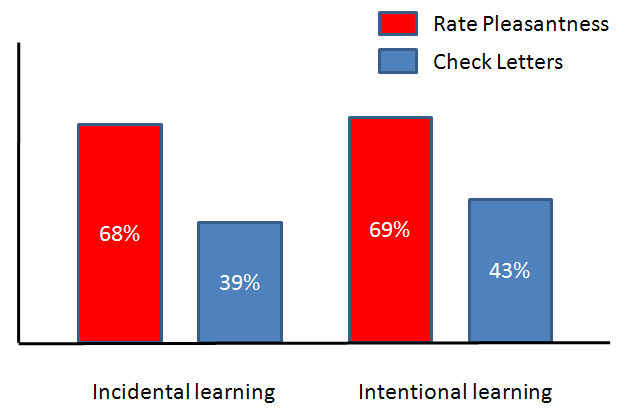
A classic experiment by Hyde and Jenkins (1973) illustrates this. These researchers gave participants lists of words, which they later tested recall of, as their memory items. To affect their thinking about the words, half the participants were told to rate the pleasantness of each word, and half were told to check if the word contained the letters ‘e’ or ‘g’. This manipulation was designed to affect ‘depth of processing’. The participants in the rating-pleasantness condition had to think about what the word meant, and relate it to themselves (how they felt about it) – “deep processing”. Participants in the letter-checking condition just had to look at the shape of the letters, they didn’t even have to read the word if they didn’t want to – “shallow processing”. The second, independent, manipulation concerned whether participants knew that they would be tested later on the words. Half of each group were told this – the “intentional learning” condition – and half weren’t told, the test would come as a surprise – the “incidental learning” condition.

I’ve made a graph so you can see the effects of these two manipulations

As you can see, there isn’t much difference between the intentional and incidental learning conditions. Whether or not a participant wanted to remember the words didn’t affect how many words they remembered. Instead, the major effect is due to how participants thought about the words when they encountered them. Participants who thought deeply about the words remembered nearly twice as many as participants who only thought shallowly about the words, regardless of whether they intended to remember them or not.

The implications for how we teach and learn should be clear. Wanting to remember, or telling people to remember, isn’t effective. If you want to remember something you need to think about it deeply. This means you need to think about what you are trying to remember means, both in relationship to other material you are trying to learn, and to yourself. Other research in memory has shown the importance of schema – memory patterns and structures – for recall. As teachers, we try and organise our course material for the convenience of students, to best help them understand it. Unfortunately, this organisation – the schema – for the material then becomes part of the assessment and something which students try to remember. What this research suggests is that, merely in terms of remembering, it would be more effective for students to come up with their own organisation for course material.

If you are a student the implication of this study and those like it is clear : don’t stress yourself with revision where you read and re-read textbooks and course notes. You’ll remember better (and understand much better) if you try and re-organise the material you’ve been given in your own way.

If you are a teacher, like me, then this research raises some disturbing questions. At a University the main form of teaching we do is the lecture, which puts the student in a passive role and, essentially, asks them to “remember this” – an instruction we know to be ineffective. Instead, we should be thinking hard, always, about how to create teaching experiences in which students are more active, and about creating courses in which students are permitted and encouraged to come up with their own organisation of material, rather than just forced to regurgitate ours.

Reference: Hyde, T. S., & Jenkins, J. J. (1973). Recall for words as a function of semantic, graphic, and syntactic orienting tasks. Journal of Verbal Learning and Verbal Behavior, 12(5), 471–480.

Now available in Italian Insegnare ed apprendere in modo efficace (thanks Giuliana!)

Games of Invention

I’ve been collecting card decks. First I got the Oblique Strategies, Brian Eno’s deck of worthwhile dilemmas. When I’m stuck with something I’m working on I sit completely still for a few moments, holding the problem in mind. Then I take a breath, draw a card and apply what’s written to my problem.

Trying this now I get:
“Make something implied more definite (reinforce, duplicate)”

Other cards say things such as “Remove elements in decreasing order of importance”, “Honour thy error as a hidden intention” or simply “Water”

Often as not this process frees me from the rut I’m in. I don’t always get the answer in a flash, but mentally I get moving again.

The Oblique Strategies work because they use our talent for justification to stimulate invention. Justification is the mental skill of tracing causes to understand a situation. It is closely related to deductive reasoning. Most of us get a lot of practice at justification and deduction. We’re used to tracing causation and necessity down the loops and chicanes of “if-then” rules, used to figuring out what is allowed, forbidden and required. These are useful skills for understanding laws, code and the bureaucracies of advanced industrial society, but it is a mental set for reducing possibility, not for increasing it.

Edward de Bono, the guy who invented the term “lateral thinking”, talks about how this talent we all cultivate for deduction and justification can be hijacked in the service of creativity and invention. Rather than ask of ourselves, with our highly cultivated deduction machinery, “what is the next best move?”, we instead make a blind move in the space of possibilities. We force ourselves, for example, to remove the most important element in our design, or to apply the idea of water. This blind move whatever it is shifts us to asking “how could the world get this way?” We can then use our deduction machinery to build a bridge back from the move we’ve forced ourselves to make, finding reasons why or how this could be the next best move. The results can be so inventive they feel like they come from outside ourselves, but they are really just our ordinary logical machinery thrown into reverse by the need to justify a blind move.

The next deck of cards I bought were Stephen Anderson’s Mental Notes, a set of 50 insights from psychology designed as prompts for web designers. The insights are grouped under categories such as “Persuasion” or “Attention” and each card gives has a short description of a psychological phenomenon and notes on how to create or encourage it.

What I love about the cards is that they capture a huge amount of information from the field of Psychology, but in a completely different way from the ways psychologist usually try and present the information. Experts write textbooks laboriously cataloguing phenomena, enumerating arguments for and against their nuances. The Mental Notes don’t do this – brevity is the soul of their wit. The other thing academic psychologists do, is try and reduce phenomena to their essences, sifting the real and eternal from the incidental, the ephemeral and secondary. The Mental Notes could have done this, but they don’t. To ask why there are separate cards “Scarcity”, “Limited Choice”, “Limited Duration” and “Limited Access” when these are describing essentially the same thing would be to miss the point. The way the cards are they present the information in a form which means it can immediately be taken and thought about in a concrete way and applied to the design problem you are dealing with. Reduction to essences would be counter-productive here.

The third set of cards I’ve bought are Dan Lockton‘s “Design with Intent” toolkit. These cards are an attempt to catalogue patterns in design which influence behaviour, things like “prominence”, “decoys” or “threat of injury”. What’s nice about these cards is that they recognise explicitly that the cards are prompts. The main text of each card is a question: “Can you direct users’ attention to what you want, by making it more prominent, obvious or exaggerated?”, “Can you add ‘decoy’ choices, making the others (which you want people to pick) look better in comparison?”

Collecting information like this in cards recognises that the creative process needs an element of randomness, that making thoughts physical makes it easier for us to play games of invention with ourselves, and that too much organisation can sometimes restrict what we know – the information might be all there in a textbook, but the ends are all tied off, stopping our current state of mind latching onto what is needed. Invention comes naturally from inside ourselves, but sometimes we need a spark to set it off. We need external prompts which ask us questions we didn’t think to ask of ourselves alone, which lift us into seeing more of ourselves than we would on our own.

Links

Oblique Strategies
Anderson’s Mental Notes
Dan Lockton’s website

This is the text of an article I originally wrote for the boys at Rattle, and their newspaper the Rattle Review. It is republished here with their permission

A profession with “no” at its core

I’ve just finished Randy Olson’s “Don’t be Such a Scientist: Talking Substance in an age of style” (after loving his article in New Scientist, “Top five tips for communicating science “). Olson is a marine biologist turned filmmaker, so knows the world of science from the inside, and from the outside perspective.

This book is 75% solid gold – absolutely essential perspective for scientists who want to communicate outside of their specialism. But it is also 25% misleading and elitistic simplification. At heart, Randy Olson’s message as a populariser ends up pandering to a mistaken belief in scientific exceptionalism – that what scientists do and who scientists are is so beyond the ken of the rest of the population that it cannot be conveyed to them, that we have to use a pound of silly songs and fart jokes to make the public to swallow an ounce of important information. Sorry, Randy, but when you underestimate the public taste you end up demeaning it.

Part of the 75% I loved is Olson’s perspective on the value of acting and improv classes for science communicators. This something close to my heart, after I had my own mind-blowing experience of improv training. An essential – some would say the essential – of improv is to avoid negating your fellow improvisers suggestions. Whatever happens, improvisers are taught to accept and build – using a “yes and” mindset instead of a “no but” one. This lends itself to humour and creativity. Science, on the other hand, tends to downplay “yes and” at the favour of “no but”, lending itself to rigour and certainty, at the risk of cynicism and myopia. Olson puts this particularly well in the following passage:

The entire profession of science has at its core a single word, and that word is “no”. Science is a process not of affirming ideas but of attempting to falsify ideas in the search for truth. This is what a hypothesis is – an idea that can be tested and possibly falsified and rejected.
When you give a scientist a paper, he or she reads it with the assumption that the writer is guilty of being wrong until proven innocent. The writers proves his or her innocence by either presenting data or citing sources. With each statement made in the paper, the scientist reading it says “I’m not sure I believe this.” As the author presents graphs and tables of data and cites sources, the good critical scientist attempts to falsify what is being said.
Eventually, after the scientist has examined the data, looked up the cited sources and found that in fact, despite considerable effort, the hypothesis presented cannot be falsfied – only then does the scientist finally start to relax and a bit and say, “Well, okay, I think I can probably live with this.”
Tough buisness. It really is. As I waded through my first decade of rejection in Hollywood as a filmmaker, people would ask me whether I found the rejection hurtful or depressing. And I would respond, “Are you shitting me? Do you have any idea what it’s like to deal with the rejection of scientists? Hollywood folks reject things on the basis of the idea that ‘it just didn’t grab me,’ and they can’t even articulate the reason for their decision. When scientists reject you they hit you with a stack of data and sources that are the basis for it. That’s the sort of specific, substantive rejection that truly hurts (p128-129)

Link to page for Randy Olson’s “Don’t be such a scientist”

I wrote about improv for Prospect magazine, here

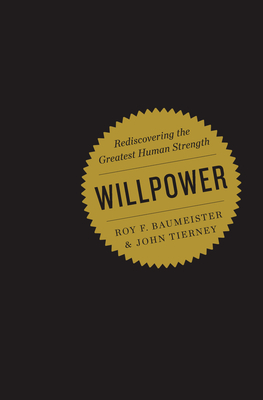
Book review: Willpower by Baumeister & Tierney

“Willpower: Rediscovering the greatest human strength”, Roy Baumeister & John Tierney, 2011


I’ve just finished this book, and yet I still couldn’t tell you what it was trying to claim. It’s a grab-bag of research on willpower, nearly all of it done by social psychologist Baumeister and colleagues, and including his celebrated experiments on ego-depletion. The ego-depletion experiments appear to show that willpower is a limited resource dependent on blood sugar. Using it to control your impulses diminishes it in the short-term, but can build it up – like a muscle – in the long term. Ultimately, however, this book presents this set of findings with little to offer in terms of coherent insight. The advice given for our daily lives is glib and unhelpful. The reader is told, for example, that to avoid smirking at an idiotic boss in a meeting, we should avoid strenuous mental work beforehand (p27). As if we all have the liberty of avoiding strenuous mental work whenever we want! Being told not to be tired sort of begs the question, in my opinion, and in self-help terms is about as useful as being told to “be clever” or “have great ideas”.

The case studies which pepper the book are brief and unsatisfying, obviously intended to give the ideas the appearances of flavour, rather than add any real depth whatever argument is being made. In general, the writing is adequate to poor, with an over reliance on a set of cheap journalistic tricks to sustain momentum. Journalistic tricks such as the one I use in the next paragraph…

…Annoying isn’t it? The references to events and celebrities who have temporarily floated to the surface of the toilet bowl of American popular culture will make this book date very badly in the next few years (and already meant that this, admittedly sheltered, British reader had to use wikipedia to work out who was being talked about in some chapters). I’m guessing that science journalist Tierney wrote this book, with advice from Baumeister (an impression fostered by the authors’ insistence on talking about themselves in the third person, which is disorienting). Even so, some of the psychological clangers are inexcusable and would shame an undergraduate (for example, squirrels burying nuts for later are dismissed as following “programmed behaviours, not conscious saving plans” (p15). To make this assertion gives the impression that we know both what a squirrel is thinking and what the nature of a conscious saving plan is (we don’t). To arbitrarily dismiss the highly flexible and foresightful behaviour of the squirrel as merely “programmed” prevents you, at one stroke, from understanding properly the role of automatic mental processes in our own future-orientated behaviour). The examples of sexism, on the other hand, are at least so blatant that they can be enjoyed for the full force of their anachronistic misogyny. (p56 tells us “most women cope quite well with PMS at work”, which has a lovely quality of being superficially positive, whilst implying that actually we should expect many women not to be able to cope, especially at work, and even those who do only manage to do it “quite well”.). The references to the literature are patchy, making it frustrating if you want to check the source for some of the authors’ most interesting claims.

Overall this book is a great disappointment. Roy Baumeister is one of the most exciting social psychologists, managing to do experimental work which addresses fundamental issues of what it means to be human. This book, on the other hand, is an example of how sterile experimental psychology can be when faced with the complexities of a core human dilemma, such as that of self-control. Although it is written in a breezy style, it never really grips the attention like the books of Malcolm Gladwell (which it obviously aspires to emulate). Because the treatment of the psychological evidence is superficial, and it never gives a full account of exactly what theoretical position they are trying to argue for or against, the book is scientifically unsatisfying. The other flaws I’ve discussed above make it, overall, an annoying book to read.

If you want a self-help book with an appreciation of the psychology of willpower, read Dave Allen’s Getting Things Done. If you want an entertaining and accessible account of the science of volition read Dan Wegner’s The Illusion of Conscious Will. If you want an account of self-control with a genuine appreciation of the nuances of the human condition try George Ainslie’s Breakdown of Will. This book will satisfy none of these needs.

Full disclosure: I’m reviewing this book because I was asked to by the publisher, who sent me a free copy. I’m glad I didn’t pay for it

UPDATE: So apparently quite means “very” in American English, while it means “fairly” in British English. This changes the sense of the PMS line I quote slightly, perhaps making it less insulting, but I would argue that the whole is still patronising and sexist (as are other lines in the book). Thanks Chris for the tip-off

When explaining becomes a sin

As the cacophony of politicians and commentators replaces that of the police sirens, look out for the particularly shrill voice of those who condemn as evil anyone with an alternative explanation for the looting than theirs. For an example, take the Daily Mail headline for Tuesday, which reads “To blame the cuts is immoral and cynical. This is criminality pure and simple”

If I’ve got them right, this means that when considering what factors contributed to the looting, identifying government spending cuts is not just incorrect, but actively harmful. For the Mail, the issue of explanations for the looting is of such urgency that they are comfortable condemning anyone who seeks an explanation beyond that of the looting being “criminality pure and simple”. What could be motivating this?

Research into moral psychology provides a lead. One of my favourite papers is “Thinking the unthinkable: sacred values and taboo cognitions” by Philip Tetlock (2003). In this paper he talks about how our notion of the sacred affect our thinking. The argument he makes is that in all cultures some values are sacred and we are motivated to not just to punish people who offend against these values, but also to punish people who even think about offending these values. The key experiment, from Tetlock et al, 2000, concerns a vignette about a sick child and hospital manager, who must decided if the hospital budget can afford an expensive treatment for the sick child. After reading about the manager’s decision, participants in the experiment are given the option to say how they felt about the manager, and to answer questions about such things as whether they think he should be removed from his job, and whether, if he were a friend of theirs, they would end their friendship with him. Unsurprisingly, if the vignette concludes by revealing that the manager decided the treatment was too expensive, participants are more keen to punish the manager than if he decided that the hospital could afford to treat the child. The explanation in terms of sacred values is straightforward: life, especially the life of a child, is a sacred value; money is not and so should not be weighed against the sacred value of life. But the most interesting contrast in the experiment is between participants who read vignettes in which the manager took a long time to make his decision and those in which he didn’t. Regardless of whether he decided for or against paying for the treatment, reading that the manager thought for a long time before making a decision provoked participants to want to punish the manager more. Tetlock argues that we are motivated to punish not just those who offend against sacred values, but also those who appear to be thinking about offending against sacred values – by weighing them against non-sacred values. In an added twist, Tetlock and colleagues also offered participants the opportunity to engage in ‘moral cleansing’ by subscribing to an organ donation scheme. Those participants who read about the manager who chose to save the money over saving the child, and those who read about the manager who took a long time to make his decision, regardless of what it was, were most motivated to donate their organs. This shows, Tetlock argues, that it is merely enough for the idea of breaking a taboo to flicker across your consciousness to provoke feelings of disgust at ourselves (which provoke the need for moral cleansing).

Tetlock’s papers are a full and nuanced treatment of how sacred values and taboo cognitions affect our thinking. I have only presented a snapshot here, and can but recommend that you read the full papers yourself, but I’d like to break from the science to draw some fairly obviously conclusions.

The Daily Mail editors feel they are in a moral community in which society is threatened by the looters and by those who give them succour, ‘the handwringing apologists on the Left’ who ‘blame the violence on poverty, social deprivation and a disaffected…youth’ (to quote from the rest of Tuesday’s editorial). For some, the looting is an immoral act of such a threatening nature that to think about it too hard, to react with anything other than a vociferous condemnation, is itself worthy of condemnation.

The sad thing about adopting this stance is that it prevents media commentators from thinking about how they themselves might have contributed to the looting. The footage on TV and in newspapers such as the Daily Mail has been vivid and hysterical. Television has shown the most dramatic footage of the looting, while headlines have screamed about the police losing control and anarchy on the streets. You don’t have to be a scholar of psychology to realise that this kind of media environment might play a role in encouraging the copycat looting sprees that sprung up outside of London (although if you were, you would be aware of the literature on how newspaper headlines and TV footage, can provoke immitation in the wider population).

Some, like the Daily Mail, see any attempt at explaining the looting as excusing the looting. The looting, like so much for them, is a moral issue of such virulence that they see people who understand society differently as part of the same threat to society as the looters. Research in moral psychology provides some clues about their style of thinking. It doesn’t, as far as I know, provide much of a clue about how to alter it.

REFS

Tetlock, P. E. (2003). Thinking the unthinkable: Sacred values and taboo cognitions. Trends in Cognitive Sciences, 7(7), 320–324.

Tetlock, P.E. et al. (2000) The psychology of the unthinkable: taboo trade-offs, forbidden base rates, and heretical counterfactuals. J. Pers. Soc. Psychol. 78, 853– 870

See also Vaughan’s Riot Psychology

They’re Made Out of Meat!

“They’re Made Out of Meat” is a short story by Terry Bisson. It’s a great riff on the improbability of the human situation, and particularly relevant to psychologists (e.g. “So … what does the thinking?”) The full text is here. The story has its own wikipedia page, and there’s a YouTube film here. Now, for your listening delight Erin Revell and Geraint Edwards, at my request, have recorded the story so I can play parts of it during a lecture. The result was too good not to share, so with Terry Bisson’s permission, here’s a link for the whole thing:

Terry Bisson’s “They’re Made Out of Meat”

(Cross posted at idiolect.org.uk)