2008-02-15 Spike activity

Quick links from the past week in mind and brain news:

Psychiatrists and the fashion for corduroy suitsFronter Psychiatrist says don’t do it kids!

Sharp Brains looks at the benefits of teaching kids mindfulness meditation in schools.

Language Log has found the headline of the year. Genius!

Campaigners want to put health warnings about cannabis on Rizla papers. Presumably, we should also put health warnings about crack on Coke cans.

The New York Times on an interesting study that found that girls’ self-perception of popularity predicted later weight gain.

An article in the The New York Times discusses the art of persuasion and the psychological research behind it.

Some thoughts really do require language. Cognitive Daily covers a study that tackles the controversial issue of whether thought and language are dependent upon each other.

Yes darling, you’re unique. Just like everyone else. Another article on the psychology and speed dating suggests it’s a maverick scientific approach when it’s already been used many times. This week, Nature joins the list of suitors.

If you’re still waiting for PBS’s The Lobotomist to appear online, it’s become available as a torrent for the impatient.

Deric Bownd’s examines a study that developed a computer-based face recognition system with 100% accuracy.

New study attempts to answer why orgasms are better when you love your lover.

More in orgasm news: Frontal Cortex looks at a real-life orgasmatron.

The wonderful Felice Frankel thinks about how to represent ideas visually in American Scientist.

Acceptance, not distraction, is the way to deal with pain. The BPS Research Digest has a fantastic complement to Lehrer’s article on the psychology and neuroscience of pain.

Eric Schwitzgebel has more reflections on his fantastic project that asks why don’t ethics professors behave better?

Psychoanalysts on love. Treatment Online captures some of their insights.

Neurology podcasts – the shocking truth

The American Academy of Neurology are now doing fortnightly super-geeky podcasts that feature discussions about studies published in their journal.

If you’re not familiar with the arcane language of neurology – tough luck, as they make no effort to explain anything to the uninitiated.

They’re not quite as bad as the American Journal of Psychiatry podcasts (which I previously described as an ‘excessively thorough lecture given by a voice synthesiser’ although I’m actually finding the fembot voice rather sexy – is that wrong?) and include some discussion rather than just spoken summaries.

Occasionally, they throw a curve ball and include poetry, or a quick hint or tip for the clinician, but mainly they’re neurologists doing what neurologists do best – talking about brain disorders in lots and lots of detail.

Also, I challenge you not to shout out “Space. The Final Frontier!” when you hear the opening fanfare.

I keep mentioning them, but the Royal College of Psychiatrist’s podcasts are excellent – dealing with the nitty gritty of the science but also explaining the concepts and debating the controversial points. They really should be a model for others to follow.

And as an aside, Nature’s NeuroPod seems to be missing in action again.

Mind Hacks. The Perez Hilton of academic neuroscience podcast gossip.

The operation of the skulls: a trepanation video

Neurophilosophy has found a gory but completely astonishing film of a Kisi medicine man in Tanzania performing a trepanation operation. A young lady endures the seven hour procedure that puts a hole in her skull without any anaesthetic.

Mo has been doing some fantastic work on the history of trepanation and his illustrated article on the topic is a must read if you want an overview of this ancient procedure.

This film emphasises the importance of the operation in some cultures and highlights quite what a remarkable, if not, somewhat hazardous procedure trepanation really is.

And by the way, if you saw our recent rather whimsical post on ‘brain hats’, the end of the video gives a whole new meaning to the phrase.

Link to video of Kisi trepanation.
Link to illustrated history of trepanation.

Love blossoms in the lab

Love is the most exalted and sublime of human emotions. It has inspired breathtaking works of art, journeys through continents and even the tragedies of war. Given its powerful hold on humanity it’s surprising that it’s been traditionally neglected by the brain sciences. In spite of this, a new dawn in romance research has begun to bud in recent years, and love has finally blossomed in the lab.

While romantic love has always been an obsession of the psychoanalysts, they were often creating little more than a new poetry of emotion, often beautiful, often bizarre, but rarely explaining more than their own metaphors.

Always a little late to the game, it wasn’t until the end of the 1990s that neuroscience fell head over heals for love. The first to become inspired by this new passion was, as if we needed to ask, an Italian.

Psychiatrist Donatella Marazziti and her colleagues measured levels of a protein that transports the neurotransmitter serotonin in the blood of 20 people who had recently fallen madly in love, 20 people with obsessive compulsive disorder (OCD) and 20 healthy comparison participants.

People with OCD experience intrusive, obsessive thoughts and are often described as having an ‘over-valued idea’ – an almost semi-delusional state where a particular thought becomes the focus of attention.

Marazziti, already an established OCD researcher, knew that serotonin had previously been linked both to obsessional thoughts and to sexual attraction, and wondered whether something similar might be going on in the early stages of romance.

She found that the group of patients with OCD and the recently love-struck were no different in terms of the serotonin transporter protein, suggesting the brain began to function markedly differently as love blossomed.

Although measuring the blood is a fairly crude way of looking at how the brain works, the researchers were struck by the similarities between these two states:

This aspect we believe underlies the obsessive pre-occupation so characteristic of the early stage of love (which, in rare instances, might persist for a lifetime of abstract idealization that leads to poetry and music dedicated to the love object). As far as we are aware, this is the first report of changes in the 5-HT [serotonin] transporter during a physiological state; it would suggest that being in love literally induces a state which is not normal – as indeed suggested by a variety of colloquial expressions used throughout the ages in different countries, all of which refer generally to falling ‘insanely’ in love or to being ‘lovesick’

Since this initial flirtation, love has become a hot topic in the neurosciences, with whole conferences dedicated to it and numerous scientific studies being published every year.

Perhaps unsurprisingly, the traditional connection between love and madness has not been dispelled by these recent studies.

In fact, a 2007 study that looked at new love in adolescents found so many striking similarities between the intensity of teenage romance and hypomania, a symptom of manic-depression, that the authors warned researchers to look out for the love-struck when conducting research with young people, so as not to bias their results.

Link to abstract of study of the serotonin transporter and romantic love.
Link to abstract of study on hypomania and adolescent love.

Faking a labour of love

I’ve just found an interesting page on Wikipedia that discusses the concept of ‘emotional labour‘: where employees are expected to regulate their outward emotional reactions so they are consistent with the company’s goals, regardless of their internal feelings.

A classic ’emotional labour’ worker would be a shop assistant or a waitress, where the employee has to control their emotions and maintain a pleasant demeanour even when customers are being difficult, annoying or even abusive.

This concept was apparently first devised by the sociologist Arlie Hochschild in the book The Managed Heart.

However, a distinction is made between ‘surface acting’, where the display doesn’t need to match internal feelings at all (as when waitressing), and ‘deep acting’ where the employee is expected to genuinely feel the emotions (like in nursing).

Apparently, ‘surface acting’ jobs are associated with stress, feeling inauthentic and depression, while ‘deep acting’ jobs are associated with increased job satisfaction.

How well this is supported by empirical evidence is anyone’s guess, but it’s an interesting concept.

Link to Wikipedia page on ’emotional labour’.

Will the PTSD diagnosis disappear?

Psychiatrist Gerald Rosen argues that the diagnosis of post-traumatic stress disorder (PTSD) should be abandoned because it just re-describes emotional reactions that would otherwise be diagnosed as depression or anxiety, and is increasingly used where there was never any clear trauma in the first place.

He’s made his case in an editorial for the British Journal of Psychiatry and debates his ideas in an engaging discussion in a BJP podcast.

PTSD is the only psychiatric diagnosis where a clear cause forms part of the diagnosis. The person must have experienced a life-threatening event to themself or others, and must have experienced intense fear, helplessness, or horror at the time.

If this is followed by intrusive memories of the event, increased arousal (feeling ‘on edge’), avoidance of any reminders and these are long-lasting and they interfere with everyday life, the disorder can be diagnosed.

The trouble is, all of these can be found in people who have not experienced classical ‘trauma’. Some people, including Rosen, are arguing that many of the normal reactions to negative events are now being described in terms of mental illness and the concept of PTSD is becoming meaningless:

Peer-reviewed articles have even discussed the possibility of developing PTSD from watching traumatic events on television. It has been suggested that rude comments heard in the workplace can lead to PTSD because a victim might worry about future boundary transgressions: the conceptual equivalent of pre-traumatic stress disorder. New diagnostic categories modeled on PTSD have been proposed, including prolonged duress stress disorder, post-traumatic grief disorder, post-traumatic relationship syndrome, post-traumatic dental care anxiety, and post-traumatic abortion syndrome. Most recently, a new disorder appeared in the professional literature to diagnose individuals impaired by insulting or humiliating events ‚Äì post-traumatic embitterment disorder. Even expected and understandable reactions after extreme events, such as anxiety and anger, are now referred to as ‘symptoms’.

This does not mean that anyone who becomes disturbed after a negative experience shouldn’t be helped, just that PTSD is not a useful way of guiding the treatment. Critics argue that the existing categories of depression and anxiety are more than adequate.

In the podcast, Rosen discusses the possibility that PTSD may be ‘popular’ as a diagnosis because it’s perfectly suited to the legal system.

It defines a cause and an effect, a compensation lawyer’s dream. This is more important for the American health care system where mental health treatment is often only reimbursed by the insurance companies if a doctor can make a diagnosis.

PTSD might be the only way for a doctor to get insurance companies to pay for treating someone who is having difficulty adjusting to a bad experience.

Interestingly, the diagnosis of PTSD was largely accepted into the diagnostic manuals due to pressure from campaigners wanting the US government to treat Vietnam veterans’ mental health needs on their return from the conflict.

A recent study checked the service records of Vietnam veterans who were being treated for PTSD and found only 41% had been exposed to combat, despite their being no difference in the symptoms between ‘combat’ and ‘no combat’ troops.

This isn’t to suggest that some veterans were ‘faking’, just that there isn’t always a clear connection between a traumatic event and the symptoms of PTSD.

With these points in mind, Rosen makes for an interesting guest on a diagnosis that we now tend to take for granted.

Link to BJP podcast ‘Problems with the PTSD diagnosis’.
Link to PubMed entry for editorial.

Better living through caffeine

Developing Intelligence has a fantastic post on what pharmacology and neuropsychology has told us about getting optimally wired on caffeine.

In small amounts, caffeine boosts mental function, and the article looks at scientific studies that have told us which are the optimal doses, which psychological abilities are most affected and what you can take with caffeine to modulate its effect.

Obviously, caffeine has its health risks. Psychologically speaking, even everyday doses run the risk of withdrawal symptoms and have the tendency to increase anxiety, so as with any drug, it’s important to educate yourself so you can judge the risks for yourself.

The Wikipedia page on caffeine is wonderful, so it’s a great complement to the fantastic round-up of stimulation-related tips from Developing Intelligence.

Link to article ‘A User’s Guide to Getting Optimally Wired’ (via BadScience).
Link to Wikipedia page on caffeine.

Hats off to you sir

It’s not often you find yourself thinking ‘you know, I really need a brain hat, but I just can’t decide which one to buy’.

The pictured head piece is undoubtedly for the discerning customer, revealing a large section of the upper cortex with added plastic blood. Nice.

However, there’s also an alien brain hat for babies, a brain cap for keeping the sun out of your eyes, or even a high fashion wooly brain hat by a top designer.

Importantly though, friends don’t let friends wear brain golf visors.

Implicit associations

You might have prejudices you won’t admit to, or, don’t even know about. The Implicit Attribution Test claims to measure these hidden associations and it’s been one of the most important psychological developments during the last decade.

Edge has a video interview with two of its creators, psychologists Mahzarin Banaji and Anthony Greenwald, and an online version of the IAT which allows you to test your unconscious associations in relation to the US presidential candidates.

The IAT is a computer task that measures the strength of automatic, implicit or unconscious associations between concepts.

Let’s say we’re interested in whether black or white faces are more linked to positive or negative associations.

Faces of black or white people, and either pleasant or unpleasant words are flashed up on screen, one at a time. Participants are asked to press one key if the face is black or the word is pleasant, and other if the face is white or the word is unpleasant.

In other words, you’re asked to classify both black faces and pleasant words using the same response, and white faces and unpleasant words using the same response.

Next, you’re asked to do the same thing, but with the reverse associations: so you’re asked to classify black faces and unpleasant words together, and white faces and pleasant words together.

The idea is that you’re going to be quicker doing whichever classification best matches associations you already have.

So, if you already have unconscious associations between white and pleasant, and black and unpleasant, you’re going to be quicker when these two responses are grouped.

Importantly, the idea is that these associations are different from our conscious attitudes. Someone who is definitely not racist might still have negative associations with black people, perhaps because of exposure to social stereotypes.

Most studies have more than just the two conditions, to control for order, practice and other effects and if you’re interested, you can take part in this exact experiment online.

It was originally thought that the test could uncover people’s implicit or hidden attitudes (indeed, it was originally called the Implicit Attitude Test) but it’s now generally thought of just in terms of associations, because, in effect, it measures how closely two things are linked, and implicit attitude sounds more like a sort of evaluation or stance on something.

The value in this sort of test is not only in that it can pick out associations we might have but don’t admit to or aren’t aware of, but it can also map out how various things influence the unconscious structure of meanings in the mind and brain.

Needless to say, it’s been researched intensively since it was first uncovered, with research suggesting it can even pick up on hidden violent associations in psychopathic murderers.

Link to video interview and presidential IAT at Edge.
Link to previous WashPost article on the IAT.

Orgasm and the brain: body, soul and sensory nerves

How does the brain generate orgasm? It’s one of the most under-investigated human experiences but two articles, one in the LA Times and another in The Psychologist, discuss some of the key developments of recent years.
The LA Times article is a good description of some of the most interesting neuroscience studies in this developing field, but is a little uncritical in places.

Apparently “About 43% of women and 31% of men in the U.S. between ages 18 and 60 meet criteria for sexual dysfunctions, according to a 1999 report on the sexual behavior of more than 3,000 U.S. adults”.

This report was a research study published in the Journal of the American Medical Association that classified sexual dysfunction as reporting any one of the following during the last 12 months:

(1) lacking desire for sex; (2) arousal difficulties (ie, erection problems in men, lubrication difficulties in women); (3) inability achieving climax or ejaculation; (4) anxiety about sexual performance; (5) climaxing or ejaculating too rapidly; (6) physical pain during intercourse; and (7) not finding sex pleasurable

Almost all of which fall within the normal range of a year’s worth of regular sexual experiences, which probably explains why a third to almost half of people surveyed experienced at least one – but hardly a marker of a serious medical problem in itself.

There’s a much better article on orgasm in this month’s The Psychologist by Barry Komisaruk, Carlos Beyer and Beverly Whipple, authors of a recent book on ‘The Science of Orgasm’.

It looks at the research on the roles of neurotransmitters in orgasm, as well as what the brain scanning literature tells us about brain activity during sexual arousal and release.

Most interestingly, it has a good discussion of non-genital orgasm:

As reviewed in Komisaruk et al. (2006), there are published reports of orgasms elicited by stimulation also of lips, hand, knee and anus occurring during dreaming sleep, of phantom limbs, from electrical or chemical stimulation of the septum, amygdala or thalamus of the brain and of the spinal cord.

Orgasms have also been described by men and women when they suffer epileptic seizures that are triggered by specific activity (e.g. brushing the teeth: Chuang et al., 2004), or that occur spontaneously. While these epileptic orgasms are in some cases described as ‘unwelcome’ (Reading & Will, 1997), others describe them as pleasurable, one woman refusing anti-epileptic medication for that reason (Janszky et al., 2004)

We have measured autonomic and brain activity during orgasms that women have produced by thought alone. During the thought orgasms, the magnitude of the increases in heart rate, blood pressure, pain threshold, pupil diameter, and brain regions are similar to those that we observe during vaginal or cervical self-stimulation-induced orgasms (Whipple et al., 1992). It is not surprising that in those cases of thought-induced orgasms, the specific genital sensory thalamic and cortical, and specific limb-motoric regions, are not activated.

The article notes that a number of different nerve pathways may serve to communicate sensual stimulation to the brain, which may account for why different sites of stimulation can produce orgasm.

Link to LA Times article ‘Science of the orgasm’
Link the The Psychologist article on orgasm.

Full discloser: I’m an unpaid associate editor of The Psychologist.

Tieing knots with booze

An excerpt from Knots, a book of poetry by the radical psychiatrist R.D. Laing, that attempted to capture some of the traps, maladaptive thinking patterns and emotional bonds that we find ourselves in, usually in relationships with others.

Some of the poems describe simple but powerful vicious circles, others are complex and almost algorithmic labyrinths of self-justification and denial.

She has started to drink
  As a way to cope
  that makes her less able to cope

the more she drinks
the more frightened she is of becoming a drunkard

the more drunk
the less frightened of being drunk

Apparently, the book was made into a film, although I know very little else about the screen version. Luckily though, most of the poems are now available online.

Perhaps some of Laing’s insight was due to the fact that he was not without his own troubles. He suffered from depression and drinking problems during his life – infamously appearing on Ireland’s Late Late Show drunk and incoherent.

Link to poems from Knots by R.D. Laing.

Psychological torture: a CIA history

Advances in the History of Psychology has alerted me to a gripping video lecture on the development of CIA psychological torture techniques from the Cold War to War on Terror.

It was an invited lecture at the University of California by historian Prof Alfred McCoy who has long specialised in the history of the US secret services.

He argues that the results of CIA research into psychological torture can be clearly seen in both the treatment of prisoners in Guantanamo bay and images of the Abu Ghraib scandal.

By contrast when I looked at those photos, I did not see snapshots of simple brutality or a breakdown in military discipline. For example, that most iconic photo of a hooded Iraqi with fake electrical wires hanging from his extended arms shows not the sadism of a few ‘creeps’, but instead, the two key trademarks of the CIA’s psychological torture: the hood was for sensory disorientation and the arms extended for self-inflicted pain.

McCoy discusses how these techniques were researched and developed by some of the most distinguished cognitive scientists of the time and were reflected in now uncovered CIA documents, including the 1961 ‘Manipulation of Human Behavior’ research summary, the 1963 KUBARK interrogation manual, and the 1983 ‘Human Resource Exploitation Training Manual‘.

He notes that these techniques have been developed and legitimised by a legal framework that was deliberately designed not to outlaw existing techniques, despite the fact there is no strong basis for their effectiveness and evidence suggests that psychological torture has a similar long-term impact to physical torture.

Interestingly, he suggests that Guantanamo is both being used as a centre for gathering intelligence, as well as a sort of ‘lab’ for testing and developing new methods.

McCoy is the author of the recent book ‘A Question of Torture: CIA Interrogation from the Cold War to the War on Terror’ on which this talk is based, in which he also argues that the work on Donald Hebb and Stanley Milgram were partly funded by the CIA to help understand how to break through people’s psychological defences.

The lecture has a long introduction by one of the University’s dignitaries, so you can skip to 11:30 when it really starts in earnest.

Advances in the History of psychology has also been keeping track of recent discussion about the book and recent findings about the role of the CIA in funding American psychology research in the 50s and 60s.

Link to YouTube video of McCoy lecture.

Sealed with a reminisce

The Neuroscience for Kids website has created an online exhibition of neuroscience-themed stamps that depict everything from drugs to brain scans.
They also include the wonderful Swedish set displayed on the left that include a series of impossible shapes.

Unfortunately, the stamps aren’t dated. Rather surprisingly, Portugal put Egas Moniz, inventor of the frontal lobotomy, on their stamps, and it would be interesting to know when they were in circulation.

To be fair, he did win the Nobel Prize, although these days the mention of his award tends to make people shuffle their feet and mutter things like “well, of course, it wouldn’t happen in this day and age…”

Link to neuroscience stamp exhibition.

Researching the sublime

Jonah Lehrer, author of Proust was a Neuroscientist, is a guest on this week’s All in the Mind, where he discusses why he thinks the arts are an essential complement to the sciences in the attempt to understand human experience.

Lehrer argues that some artists aim to explore, capture or communicate aspects of our subjective experience that are otherwise indefinable.

Perhaps most controversially, he suggests that through these explorations some artists have glimpsed the functional organisation of the brain – even though we’ve only come to realise this in more recent lab work.

Nevertheless, Lehrer argues that art is more than just a reconnaissance mission for science.

Although some of its ‘discoveries’ can stimulate research or be validated by experiments, it also communicates what science cannot, and so is essential as part of the wider attempt to understand ourselves.

It struck me while listening to the programme that Lehrer talks about art in the same way many clinical scientists talk about working with patients.

In neuropsychology and neuropsychiatry particularly, clinicians will constantly be trying to integrate the empirical research and objective medical tests with the patient’s subjective account of their experience.

The patient’s narrative (soliloquy perhaps?) also helps direct a scientific approach to their individual problems, and raises broader scientific questions about the course of the disorder or the function of the normal system, now gone awry.

While clinicians are trained to draw these reflections from their patients with careful questioning, artists are like evangelists for the subjective – making their first-person experience available to all.

Moreover, these experiences often come in such fine and exquisite detail that not even the most skilled clinician could provoke such insights.

Link to AITM with Jonah Lehrer.

2008-02-08 Spike activity

Quick links from the past week in mind and brain news:

Is V1agra spam getting you down? Fear not, get more sex with V1tamin C!

OmniBrain discovers a long lost film on ‘Frightening Diseases of the Mind’.

How good is Neurofeedback for treating attention deficits? Sharp Brains has a great review of the evidence.

The fantastic Furious Seasons hosts a pdf of a recent academic article on the increasing overdiagnosis of child bipolar disorder.

The New York Times has the shocking news that brilliant discoveries typically need years of hard word.

Subliminal images of drug paraphernalia can trigger cravings in addicts, according to a new study reported by Treatment Online.

Pregnancy ‘does cause memory loss’ according to a new study covered by The Guardian.

Discover Magazine asks if Osama’s only 6 degrees away, why can’t we find him? I’ve asked a similar question about Shakira myself.

10 reasons people lie to their psychotherapists. World of Psychology rounds up an informal survey.

The ‘Google generation’ a myth according to a new study. Susan Greenfield and chums take note.

A Blog Around the Clock interviews psychologist Vanessa Woods, who goes into the jungle to observe the behaviour of bonobos.

“Colin Blakemore: An organ so complex we may never fully understand it”. A poorly worded headline unintentionally describes the head of the Medical Research Council as an organ.

More headline innuendo pleasure from The New York Times: “Drop Down and Give Me More Than She‚Äôs Doing”. Sadly, about the psychology of exercise.

Metapsychology reviews a book that documents medical complicity in torture during the war on terror. So truly awful that words fail to describe it adequately.

More from The New York Times with an article and audio reading from an upcoming book on obsessive-compulsive disorder.

PsyBlog looks at the limits of cognitive dissonance, one of the most important theories in social psychology.

Don’t breath the pig brains. Sound advice from Neurophilosophy.

Developing Intelligence looks at how gestures during speech affect what we communicate.

School of Everything! Want to learn something or have something to share. Fine out who can teach you in your local area.

How to Study. The BPS Research Digest has a guest feature looking at the psychology of optimum learning.

Deric Bownds discusses how blindsight has been created in people without brain damage, using TMS.

The he-haw boys and the eye-drillers

A 61 year-old lady was admitted to a Florida hospital with florid hallucinations after suffering a stroke to her thalamus. She saw curious strangers and visitors with odd clothes, but rather unusually, the ones on the right always seemed pleasant and happy, whereas the ones on the left always seemed fearful and unsettling.

The case was reported in the journal Cognitive Neuropsychiatry and is of interest because the emotional content of the hallucinations seem to match the dominant emotion of the corresponding hemisphere of the brain.

[The patient] described the right visual hallucinations as consisting of “college age boys in colourful Hawaiian shirts” that “are too happy, talk too much”, and that are somewhat “too energetic”. The patient called them the “he-haw boys,” and reported that she could hear them talking.

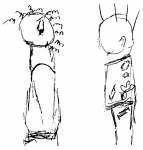
The left visual hallucinations were described as “men in black religious clothes that make no noises.” The patient called them “the eye drillers”, and stated that “they look a hole right through you”. The patient provided vivid drawings of the hallucinations that accentuated the positive and negative associations she had with each hallucination. The patient provided vivid drawings of the hallucinations that accentuated the positive and negative associations she had with each hallucination.

This is not the first time that hallucinations have been reported to be differing in emotional tone depending on which side of space they appear.

This is likely due to the way emotion is processed in the brain.

Perception of negative emotions often relies largely on the right hemisphere, where positive emotions are processed by both the right and the left hemispheres. In fact, this pattern of brain response has been found in children as young as 10 months old.

The woman in this case report didn’t suffer damage to the hemispheres directly, but to the thalamus. This area is often called the brain’s relay station as it is extensively connected to hemispheres, so damage in this area can often mimic damage to the cortex.

Link to PubMed abstract of case report.