Psychotherapist to the dangerously disturbed

The Independent has a revealing article on the working life of Dr Gwen Adshead, a forensic psychiatrist and psychotherapist at Broadmoor Hospital, one of the few very high security hospital dedicated to the most dangerous psychiatric patients in the UK.

As a consultant forensic psychotherapist – a rare breed in medicine – she spends her working life in the company of men at Broadmoor whom others would dismiss with a single word – evil. Her aim is to make them safer – safe enough, ultimately, to be released from Britain’s highest security institution for mentally disordered offenders – and to achieve that they must understand the full import of the crime they have committed.

“My job is to help a man become more articulate about what he has done, about his illness and about why that might be important for his future. Even if a cure is not possible, recovery of some identity is possible. My work involves talking to them and getting them to become more self-reflective. Violence is more likely to occur when people are not thinking straight.”

Admission to Broadmoor is granted only to members of an exclusive club: the violent insane. The Yorkshire Ripper, Peter Sutcliffe, is here, convicted in 1981 of murdering 13 prostitutes; Kenneth Erskine, the Stockwell strangler who murdered seven elderly people in 1986; and London nail bomber David Copeland who targeted blacks, Bangladeshis and gays, killing three people and injuring 129, of whom four lost limbs.

The article characterises the patients Adshead works with as the ‘violent insane’ although it’s worth noting that not all will be ‘insane’ in the popular or even traditional sense of the term – that is, affected by psychosis that includes delusions and hallucinations.

Some will be ‘diagnosed’ with Dangerous and Severe Personality Disorder. I put ‘diagnosed’ in scare quotes because you may notice that no such condition is listed in either the DSM or ICD diagnostic manuals – it has been created by the UK government and on the basis of this label a patient can be locked-up indefinitely.

Unlike psychosis, personality disorder doesn’t involve any significant ‘loss of contact with reality’ (although it may be diagnosed alongside it). This is why the journalist comments that the patient he bumps into who makes “a passionate denunciation” of his detention doesn’t seem to be ‘insane’.

This is not to say he’s just a regular chap – a diagnosis of personality disorder signifies his day-to-day functioning is quite impaired because of difficulties relating to others – while the ‘dangerous and severe’ prefix is based on a still-not-very-accurate risk assessment that the person is likely to be violent in the near future.

The Broadmoor DSPD unit has now been in existence for 10 years and still lacks good evidence that it is effective in helping the patients or reducing risk. Needless to say, it is likely to remain controversial.

The Independent article is a good insight into the difficulties of working with (the very few) psychiatric patients who are dangerous, regardless of diagnosis, although do ignore the sensationalist and irrelevant headline. Apart from that, well worth a read.
 

Link to Independent on Adhead and Broadmoor.

Racism: the board game

In 1970 Psychology Today published a board game where players were divided into white and black, and had to make economic progress while competing with each other. Based on Monopoly, the idea was to demonstrate how the odds were stacked against black people in society by having different rules for each race in the game.

Whites started out with $1 million, blacks with $10,000 and each race had different opportunity decks. While whites could buy property in any part of the board, blacks were limited to certain areas until they had accumulated at least $100,000 and were outright banned from property in the ‘suburban zone’.

Needless to say, it turned out to be one of the most controversial board games of all time and even merited an article in Time magazine:

The game, produced by Psychology Today Games (an off shoot of the magazine) now on sale ($5.95) at major department stores, was developed at the University of California at Davis by Psychology Department Chairman Robert Sommer. It was conceived as a painless way for middle-class whites to experience—and understand—the frustrations of blacks. In Sommer’s version, however, the black player could not win; as a simulation of frustration, the game was too successful. Then David Popoff, a Psychology Today editor, redesigned the game, taking suggestions from militant black members of “US” in San Diego. The new rules give black players an opportunity to use—and even to beat—the System.

Although turning Monopoly into an attempt to draw people’s attention to social issues seems a little bit of a long shot, it’s worth noting that the original version of Monopoly itself, called ‘The Landlord’s Game‘, was designed to demonstrate how the current economic system led to inequality and bankruptcy.

Psychology Today’s board game division seems to have been short-lived but other titles included The Cities Game – that involved ‘urban tension, corruption and the undercurrents of city politics’; and Woman and Man where ‘Each woman must accumulate enough Status Quo points (100) to prove her equality to men. Each man must collect enough Status Quo points (100) to prove once and for all a woman’s place is beneath his’.

Fun for all the family.
 

Link to 1970 Time article on the ‘Blacks and Whites’ board game.
Link to game details and photos on BoardGameGeek.

Cultures of friendship

Neuroanthropology has an all-too-brief interview on how different cultures around the world have fundamentally different ideas about what it means to be a friend.

The interviewee is anthropologist Dan Hruschka who has just written a book summarising his research on the anthropology of friendship.

It’s a wonderfully simple idea but really challenges some of our core assumptions about social relationships:

Can you describe one of your examples that really makes us think differently about friendship?

When you look at friendship cross-culturally, there are many surprises! Consider the fact that in societies around the world, close friends will sanctify their relationships with elaborate public ceremonies not unlike American weddings or that parents or elders can arrange their children’s friendships in much the same way that marriages are arranged in many parts of the world.

I think one of the more interesting findings, and one that reveals our own American preferences and taboos, concerns the kinds of things that friends are expected to help each other with. For example, in the U.S., we often expect friends to talk through personal problems and disclose deep secrets. Indeed, U.S. researchers often impose this criterion on definitions of friendship.

However, there are many places in the world where such verbal, emotional support is only a minor concern in friendships.


Link to Neuroanthropology on ‘the book of friendship’.

Online therapy: a download off your mind

What’s it like doing psychotherapy in Second Life? New Scientist has a level-headed article that describes how personal therapeutic interactions are altered by the online world and how this may be a benefit for people with certain types of problems.
In my limited experience of Second Life, I was struck by how many people were offering commercial counselling services, many without apparent qualifications, and I’ve seen been a bit sceptical since.

The NewSci piece is by a professional counsellor and takes a critical look at the concept and its practice, relating both the experience of therapy and where its strengths and weaknesses lie, not least for people who may have social anxiety or other face-to-face difficulties.

The other major concern is the loss of body language. For people used to Second Life, this is not as much of a problem as you might think, according to Dillon. But as a therapist, I glean a great deal from seeing someone become tearful or shift in their seat.

It’s a trade-off, say avatar therapists. What you lose in body language you gain in the eloquent expression of conscious thought – at least for clients who type in their responses – as well as the loss of inhibition that comes with communicating through an avatar.

I have to say, having read so much drivel about ‘cyber therapy’ I was ready to dismiss the article but found it one of the best introductory pieces I’ve yet read that tackles online psychotherapy.
 

Link to NewSci on Avatar therapy.

2010-09-24 Spike activity

Quick links from the past week in mind and brain news:

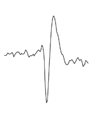
The Guardian has a great piece on the attempts to create a brain-wave-based criminal-catching lie detector and why the technology hasn’t yet matched the hype.

I’ve been thoroughly enjoying the excellent NeuroShrink blog recently. The latest post explores the link between Viagra and a transient but poorly understood form of amnesia.

Wired UK has a brief piece on how ‘scientists can read your face like a data-filled book’. In other words, slowly and only when asked to by the lab boss.

Fascinating cases of ‘sociopathic dementia‘ and their neurological explanations are discussed by the ever-excellent Neuroskeptic.

Scientific American has a great piece on the the neuroscience of selfhood that riffs on some of the unusual neurological cases of self-distortion we touch on recently.

There’s an in-depth but rewarding discussion on Child’s Play that challenges the orthodoxy that learning theories can’t explain how children acquire language because kids are often not corrected when they talk incorrectly.

Discover Magazine has an excellent article about how problems with understanding the spatial layout of the outside world after brain injury are helping us understand the neuroscience of space perception.

There odd and frankly stomach churning experiments of neurologist Charles-Édouard Brown-Séquard are described in an eye-opening piece from Oscillatory Thoughts.

Seed Magazine looks at the popularity of the concept of the soul and how it relates to what we know about the neuroscience of integrated experience.

A professor of forensic psychology specialising in violence rails against a new proposed US law to restrict violent video games as a “waste of taxpayer money.” In the News covers his statement with a nice summary of the science.

The Atlantic asks ‘Where does music come from?’ and discusses possible reasons behind the existence of one of humankind’s more puzzling inventions.

JFK was killed by a neurotoxin deployed with a rocket launching umbrella, at least according to a theory published in the eccentric uncle of the science world – Medical Hypotheses. The Neurocritic covers the novel and unusually illustrated theory.

Salon has an amazing interview with someone who believed they had a ‘recovered memory’ of childhood abuse but later came to realise they’d falsely accused their father.

A great resource for films on medical anthropology available online is published on Somatosphere.

Scientific American’s Bering in Mind discusses the psychoactive effects of human semen. Insert your own ‘mind blowing’ jokes at will.

The excellent Wired the Brain blog has a great piece on the ancient origins of the cerebral cortex and the evolution of the brain.

The Guardian has a funny article on how the author almost got jailed for cocaine smuggling, why tests need to control for false positives, and why drug testing children is a bad idea.

Denglish, the German version of Spanglish, is covered in a delightful post over at LanguageLog.

The Sydney Morning Herald has an excellent interview with neuroscientist Olivier Oullier on emotion, rationality and decision-making.

How can we cultivate a positive attitude to homework in children? Evidence Based Mummy reviews the research that has directly tackled the question.

The Guardian covers the conviction of US-trained Pakistani neuroscientist Aafia Siddiqui. Who disappeared for years only to reappear in American custody. Her case raises more questions than answers.

There is a brief but excellent interview with Derren Brown on appearance and reality over at Philosophy Bites video.

Nature News covers a brilliantly conceived study where self-touch altered illusory pain owing to changes in body representation.

The man who animated the madness for the upcoming film about Ginsberg’s Howl is interview over at NeuroTribes.

Scientific American has a short piece on why we are less trusting of words said in a foreign accent.

By what age do children recognise that plagiarism is wrong? By the time they start school, it turns out, from a study covered by BPS Research Digest.

The Atlantic has a fantastic piece on the anthropology of hackers.

Philosopher and blogger Peter Mandik from Brain Hammer designs the cover for philosopher and blogger Eric Schwitzgebels’s new book on consciousness. Cool.

BBC World Service kicks off a promising new series on mysteries of the brain.

What are the ethical implications for the possible creation of a device to indicate whether someone is conscious or not? Neuron Culture picks up the baton.

All in the Mind from ABC Radio National had a brilliant interview with a philosopher of mind who has experienced psychosis.

What do mad scientists study?

io9 has a fantastic piece that analyses the favoured subjects of investigation for mad scientists – tracking trends in 200 years of fictional evil research.

The researchers from io9’s underground science bunker scanned films and literature for depictions of the slightly unbalanced investigator to look at how research topics varied as fashions changed.

So what did we discover? First of all, mad scientists have obviously grown in popularity a great deal since the nineteenth century. Of all the sciences, biology seems to enjoy the most adherence from the maniacal – followed closely by its sister discipline, biotechnology. It’s interesting to note that big spike in mad scientists researching biology during the 1910s and 20s – this would have been the era when cinema and pulp fiction were gaining traction, and along with them “scientifiction” stories. It was also a time of great medical and biological experimentation in the west.

Coincidentally, today’s Guardian has an article on dispelling the image of the ‘boffin’ and the ‘mad scientist’ from the public’s mind to improve the image of science, noting that in the last decade Hollywood scientists are almost entirely depicted as beautiful competent young women.

If you work in cognitive science, of course, your research colleagues are probably entirely made up of beautiful competent young women, and I would like to make a stand for socially awkward not fully-in-touch-with-reality badly dressed male boffin.

Don’t get me wrong, I am frequently in awe of female cognitive scientists, but how many have burnt their ear with a soldering iron? A different but still valuable form of awe-inspiration I’m sure you’ll agree.
 

Link to io9 ‘Research areas of mad scientists, 1810-2010’ (via @NoaWG ).
Link to The Guardian ‘Who are you calling a boffin?’

Nude psychotherapy and the quest for inner peace

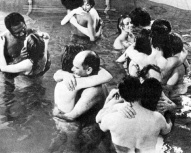
The first session of nude psychotherapy was held in 1967, at a nudist resort in California. It was the brainchild of radical therapist and ordained minister Paul Bindrim who made headlines around the world with events intended to enhance emotional connectedness and dismantle body-image hangups.

Despite the massive interest at the time, ‘nude psychotherapy’ would have largely disappeared from the history of psychology if it weren’t for a truly amazing article by historian Ian Nicholson, published in the Journal of the History of the Behavioral Sciences, which you can read in full as a pdf.

Nude psychotherapy grew out of the 60s encounter group movement, where people seeking personal development would meet for intense one-off group therapy sessions where emotional honesty and group amplification led to powerful personal experiences.

The popularity of these events created a demand for groups that delivered ever more striking emotional experiences with the most intense being the marathon 24 or 36 hour encounters. Bindrim took the concept one step further and created the concept of nude psychotherapy.

He was partly inspired by the founder of humanistic psychology, the famous and significantly more respectable Abraham Maslow, who had an established but purely theoretical interest in whether nudity would make people in therapy “an awful lot freer, a lot more spontaneous, less guarded”.

Bindrim talked the language of spontaneity and authenticity, but as Nicholson notes, the groups were carefully planned:

Bindrim was convinced that the “natural state” of humanity had been lost and that disrobing would peel back layers of modernist artifice and alienation and reestablish a healthy connection with one’s body and the true self. Ironically, although a self-declared enemy of the inauthentic, Bindrim sought psychological deliverance through the very artifice he decried. Far from being spontaneous returns to “nature,” his marathons were carefully orchestrated performances of psychological ingenuity and financial opportunism…

Bindrim began this process by employing familiar encounter group techniques. Participants were invited to “eyeball” each other (stare into each other’s eyes at close range) and then to respond in some physical way (hugging, wrestling, etc.). After this ice-breaker, participants disrobed in the dark to musical accompaniment before joining a small circle to perform a “meditation-like” hum. This process, Bindrim felt, gave rise to the “feeling of being all part of one human mass”

The sessions included role-playing traumatic experiences and touching exercises in a swimming pool, but perhaps most notable was an exercise called “crotch eyeballing”, designed to dispel guilt about the body, in which participants were instructed to look at each others genitals and disclose the sexual experiences they felt most guilty about while lying naked in a circle with their legs in the air.

As well as select groups of participants, Bindrim invited the press, and nude psychotherapy was featured in some of the world’s biggest publications. The Life magazine online archive has two photos from a feature on one of the events.

Psychology Today apparently featured nude therapy on its front page where a big breasted young woman was accompanied by the headline “The Quest for the Authentic Self” (which is a phrase I’ve noticed works great on almost any semi-pornographic picture, by the way).

Although the press generally took a snigger snigger approach to the proceedings, nude psychotherapy garnered a great deal of mainstream interest and headlined professional conferences and journals – even pushing Milgram’s famous ‘lost letter’ study to the back pages of American Psychologist.

It was subject to a professional ethics enquiry at one point, but because of all the nudity and free love already happening in 60s America, the committee couldn’t decide whether it violated the “the social codes and moral expectations of the community”. No serious action was taken and the attention helped raise the profile of the off-beat therapy.

Bindrim’s ego grew in proportion to the excitement and soon he was claiming nude psychotherapy could cure everything from suicidal tendencies to arthritis, before transforming it into ‘aqua energetics’ – a “theoretical framework that could address the totality of human experience”.

Although the Bindrim maintained a lively private practice, he faded into obscurity, and by the time he died he was remembered by a single snarky obituary in the LA Times.

I really can’t do justice to Ian Nicholson’s brilliant article on nude psychotherapy here, which is as well written as it is well researched. A fascinating insight into a forgotten (dare we say, repressed?) chapter of American psychology.
 

pdf of ‘Baring the Soul’.
Link to DOI entry for article.

Watch the skies

The BBC World Service has an excellent documentary that visits the SETI Institute, a project that is scanning for skies for signs of extraterrestrial intelligence.
The occasion is the 50th anniversary of the Drake equation, a mathematical formula that attempts to estimate the number of alien civilisations that exist in the universe.

On one hand, it’s quite charming (admittedly, in a slightly patronising way) to think of scientists earnestly looking for aliens from outer space, but on the other, it’s an interesting psychological problem that involves a guess about what other forms of intelligence might be like.

As artificial intelligence researchers will tell you, we tend to increasingly define intelligence to mean exactly and only what humans can do. When machines manage to equal a human cognitive ability, by playing chess for example, we just move the goal posts and suggest ‘real intelligence’ is whatever the computer can’t do yet – something called the AI effect.

The fact that the SETI project is looking for other ‘civilisations’ itself relies on assumptions that civilisation is a common result of intelligence. This raises the question of whether we would recognise alien intelligence if we met it. And perhaps, more importantly, would it recognise it in us?

The BBC documentary is an engaging look at the motivations and assumptions behind the SETI project as well as how they are implemented in the day-to-day running of the search.

However, because the BBC has yet to fully come to grips with intraterrestrial intelligence, the programme stream and podcast will disappear in a few weeks, so be quick.
 

Link to documentary on SETI and alien intelligence.

Towards an operating system for brain hacking

Electronic devices that interface directly with the brain are now being produced by labs around the world but each new device tends to work in a completely different way. An article in Technology Review argues that we need an agreed neural operating system so brain-machine interfaces can more easily work together.
Although current devices tend only to measure brain activity or stimulate cortical areas, it won’t be very long before devices typically do both – detecting and reacting to neural states – possibly forming a dynamic network of electronic devices that regulate brain activity.

To avoid the ‘Mac vs PC problem of the brain’, neuroscientist Ed Boyden highlights the importance of having devices that speak a common language to avoid both wasted scientific effort and potentially dangerous miscommunication.

Some examples of this kind of “brain coprocessor” technology are under active development, such as systems that perturb the epileptic brain when a seizure is electrically observed, and prosthetics for amputees that record nerves to control artificial limbs and stimulate nerves to provide sensory feedback. Looking down the line, such system architectures might be capable of very advanced functions–providing just-in-time information to the brain of a patient with dementia to augment cognition, or sculpting the risk-taking profile of an addiction patient in the presence of stimuli that prompt cravings.

Given the ever-increasing number of brain readout and control technologies available, a generalized brain coprocessor architecture could be enabled by defining common interfaces governing how component technologies talk to one another, as well as an “operating system” that defines how the overall system works as a unified whole–analogous to the way personal computers govern the interaction of their component hard drives, memories, processors, and displays.

Although not mentioned in the article, another advantage of a common platform for brain devices would be security, as current devices as often completely open and designed to be easily controllable from the outside.
 

Link to TechReview article on ‘Brain Coprocessors’.

Rare footage of physical treatments in psychiatry, 1957

I’ve just found a remarkable documentary on YouTube from a 1957 BBC series called ‘The Hurt Mind’. The programme attempts to de-stigmatise mental health for the public but also documents some of the most controversial treatments in the history of psychiatry.

The programme was an edition of a then pioneering five-part BBC series on mental health and this was the episode that specifically dealt with ‘physical treatments’ – that is, treatments which directly affect the brain, such as ECT, leucotomy, insulin coma therapy and abreaction.

This was before the days when pills were widely used in psychiatry – there were no antidepressants, antipsychotics or mood stabilisers and the only tranquilisers were heavyweight barbiturates, as benzodiazapines had yet to become available.

The psychiatrists on the programme are not named, but if I’m not mistaken, the main interviewee is William Sargant, who has a bit of sinister reputation for his enthusiasm for brain altering treatments, his interest in ‘brain washing’, and rumours he was funded by the CIA – as we’ve discussed previously.

Sargant literally wrote the book on physical treatments (titled An Introduction to Physical Methods of Treatment in Psychiatry) and the programme presents them in the most biased possible light, in line with Sargant’s enthusiasms, by dismissing side-effects and selectively presenting single cases of recovered happy patients.

For those more familiar with the frontal lobotomy – popularised by American surgeon Walter Freeman, which involved hammering an ice pick under the orbits of the eyes – you’ll notice that the British version of the operation, the leucotomy, was substantially different in its approach and involved drilling small holes in the skull.

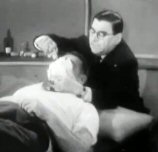
The programme also depicts abreaction, where a patient with a post-traumatic condition is given a drug – often barbiturate, or, in this case, ether – and encouraged to talk about the difficult event.

The procedure was based on the Freudian notion that emotional pain can be repressed and can ‘build up’ and cause difficulties in other areas – although a drug can be used to help break down the defences and releases the emotion in a healthy catharsis.

I suspect that the Billy Bunter-like psychiatrist who discusses and demonstrates abreaction is Eliot Slater, although I have no idea of the identity of the bespectacled doctor who discusses leucotomy (do leave a comment if you know).

The programme is classic post-war BBC: chaps with posh accents talk to cor blimey guv’ner commoners, and there are plenty uncomfortable pauses and a shaky set. As a piece of history, though, it is fascinating.

It also turns out that BBC and the Maudsley Hospital attempted to see how effective the programme was in educating the public and published a brief article in the British Medical Journal which analysed the sorts of letters that got sent in by viewers.

Interestingly, William Sargant wrote to the publication saying that he was a medical adviser to the series and had “on rare occasions appeared anonymously on such programmes” and defended how even-handed it was.

Regardless of your interest in the characters, however, the video is a rare insight into how these treatments were actually carried out.
 

Parts one, two, three and four of ‘The Hurt Mind’ on physical treatments.
Link to details of the series from the British Film Institute.
Link to good Wikipedia page on William Sargant.

Sci vs Spy

The Cold War espionage styles of the US and Soviet spy agencies are compared in a fantastic article for the history of science journal Isis that notes that while the Americans tended to invest in technology, the Russians were more focused on ‘human intelligence’.

The article, by historian Kristie Macrakis, explores the technophilia of the CIA in contrast to the KGB’s emphasis on getting spies on the ground and how these contrasting styles played out in many (now infamous) incidents.

Soviet and East Bloc spies were better at their craft—recruiting and planting agents at key institutions, acquiring secret information, and especially developing the fine art of double agents. In fact, the East Bloc’s great success in using double agents turned into the CIA’s most appalling blunder. At the end of the Cold War, the CIA discovered that all of its East German and Cuban agents were, in fact, double agents working at the behest of East German or Cuban foreign intelligence.

As former CIA chief historian Benjamin B. Fischer writes, this rendered “the CIA deaf, dumb and blind” in East Germany. Further, “the East Germans, as well as the Soviets, ran circles around SE [the CIA’s Soviet‐Eastern European Division], neutralizing its operations and tying it up in knots with double agents who fed it disinformation.” The double agent fiasco occurred, in part, because of U.S. intelligence’s dependence on technological espionage and its lack of skill in human intelligence. In a sense, the East Bloc won the spy wars but lost the Cold War.


Link to full text of article.
Link to DOI entry.

The book of reality distortions

I’m happy to announce that I’ve just finalised an agreement with Penguin to write a book on what hallucinations tell us about the mind, brain and human nature. From the proposal:

The mind and brain can generate fantastical visions and disembodied voices, illusory people and shifting landscapes, internal symphonies and sensed presences. These states happen at the extremes of human experience, in madness, terror and brain disturbance, but they are often an exaggeration of our natural tendency to hallucinate that we rely on for everyday perception – a tendency that has inspired great works of art and shaped history.

We all hallucinate, and our perception relies on it. We have blind spots in our vision that our brain fills with hallucinated experience. Occasionally we experience intense and vivid hallucinations, after taking certain drugs, during mental illness, with epilepsy or brain injury, during hypnosis, after being taken hostage, during deep-sea dives, while blacking out at high Gs, or at other extremes of human experience that tax the body and mind. But it is not just these situations that trigger hallucinations: one in ten healthy adjusted people hallucinate more than patients in hospital with psychosis. In other words, hallucinations are part of human nature.

The book explores different types of hallucinations and their historical and cultural significance, and explains how they arise and what they tell us about normal psychology and neuroscience. This is the central theme of the book: that hallucinations are not just mental junk; rather, they are windows into the workings of the mind and brain that can reveal the essence of our inner lives.

It won’t be out until 2012, but I’ll make sure Mind Hacks readers get to preview the adventure as it gets written.

Also, if you know of any fascinating research or interesting types of hallucinations – please let me know by posting in the comments or getting in touch.

I’m always pleased to receive tip offs and, as well of doing plenty of scientific investigation, I’m also planning to visit many interesting people and places.

The pleasure is all mine

Monitor on Psychology has a brief but interesting interview with psychologist Paul Bloom who has just written a book on the counter-intuitive psychology of pleasure.

Pleasure, it would seem, is a byproduct of essentialism, Bloom says. The value we assign consumer products is largely based on something deeper than just the way they look or fit or feel. We consider their potentials as status symbols, their individual histories, how much we assume other people think they are worth and so on — and from these hidden properties, we derive pleasure…

What’s surprised you the most about your studies of pleasure?

My research started off looking at artwork and the case of everyday celebrity objects. I argued that your beliefs about how something came into being and who it was in contact with affects your experience of it. At some level, it’s not so surprising. If you ask people, “What would you rather have, a Chagall or a copy of a Chagall?” people say the original. But working out the details of why this is struck me as really interesting. What really surprised me was that even for pleasures that seem incredibly simple and primitive — like the taste of meat or sexual arousal — that these are also affected by essentialist beliefs.


Link to interview with Paul Bloom on pleasure.

Dreams of a consciousness measuring device

The New York Times has an excellent article about Giulio Tononi, one of the few neuroscientists trying to understand consciousness in a way that may have a direct practical application – to create a medical device that can tell whether you are conscious or not.

To be honest, I’ve been a bit bored with consciousness, not in an existential sense you understand, but in terms of the science which tends towards tinkering with interesting but possibly inconsequential effects.

The NYT article, however, is completely riveting, as it discusses Tononi’s quest to understand consciousness to the point of building a ‘consciousness meter’.

Although it may sounds fanciful, it could have an important medical application – to help anaesthetists determine when a patient is actually aware of what’s happening to them.

If you’re not familiar with surgery you’d think this was easy enough to determine except for the fact that muscle relaxant drugs are often administered.

This means that even if you’re awake, you can’t communicate the fact, occasionally leading to terrifying cases of people who are conscious but paralysed while operated on.

So ideally, anaesthetists would like a machine that gives a consciousness ‘read out’ from the brain. There is something called the bispectral index, which claims to measure depth of anesthesia, although it turns out not to be a very good guide to consciousness.

Of course, to create a device to measure consciousness, we need to understand its neuroscience, and Tononi has a unique theory he is working on:

Consciousness, Dr. Tononi says, is nothing more than integrated information. Information theorists measure the amount of information in a computer file or a cellphone call in bits, and Dr. Tononi argues that we could, in theory, measure consciousness in bits as well. When we are wide awake, our consciousness contains more bits than when we are asleep.

For the past decade, Dr. Tononi and his colleagues have been expanding traditional information theory in order to analyze integrated information. It is possible, they have shown, to calculate how much integrated information there is in a network. Dr. Tononi has dubbed this quantity phi, and he has studied it in simple networks made up of just a few interconnected parts. How the parts of a network are wired together has a big effect on phi. If a network is made up of isolated parts, phi is low, because the parts cannot share information…

Dr. Tononi argues that his Integrated Information Theory sidesteps a lot of the problems that previous models of consciousness have faced. It neatly explains, for example, why epileptic seizures cause unconsciousness. A seizure forces many neurons to turn on and off together. Their synchrony reduces the number of possible states the brain can be in, lowering its phi.

The NYT piece is a fantastic look into the ideas behind the theory and the exciting possibilities it presents.
 

Link to NYT on ‘Sizing Up Consciousness by Its Bits’.

It’s not a date, it’s an experiment in the lab of love

There’s a fantastic discussion on the science of dating over at Dr Petra that tackles how effective the techniques used by ‘scientific matching’ companies really are, and whether common dating advice is actually any good.

Petra recently ran a ‘Science of Pulling’ event at the British Science Festival (Americans: ‘pull’ is British slang meaning ‘to gently woo’) where she covered everything from how researchers actually go about studying couples to the myths of dating advice – in light of the extensive research on relationships.

What we have learned from social research on dating is helpful – not least because it often contradicts what single people are anxious about. Westerners can expect to spend 1/3 to 1/2 of their life single or looking for a relationship (see data from here and discussed more here). The average age for heterosexual marriage (in UK) is 34 for men and 29 for women (this report also highlights how many people are single for larger parts of their life than in the past). If you try internet dating you’ve a 1:10 chance of getting a date and going out with them more than once a month. You’re also equally likely to end up in a happy long term relationship regardless of whether it started as a one night stand or emerged through a period of dating.

The piece covers everything from pick-up-artists, to finding ‘the one’, to using science to improve your gentle wooing power.
 

Link to Dr Petra on ‘The Science of Pulling’.

Memories from before nightfall

The Yale Alumni Magazine has a moving and beautifully written article that is both a tribute to a college friend who recently took his own life and a wider discussion of depression, suicide and friendship.

The writer is Andrew Solomon, perhaps best known for one of the finest books on the experience, meaning and science of depression – ‘The Noonday Demon’ – and this latest article follows in his honest and subtly powerful style.

There’s not a lot I can say that would do the piece justice except that it is warm without being sentimental and perceptive without distance. Highly recommended.
 

Link to article ‘To an Aesthete Dying Young’ (via MeFi).