Wikileaks: Psychological warfare in Iraq

The Wikileaks Iraq war documents give an insight into the use of ‘psychological warfare‘ by the United States military, illustrating how the PSYOP response evolved through the conflict.

If you want to pull out the raw reports, you can search the Wikileaks Iraq war archive by using the term ‘PSYOP’ or by clicking here.

Although it’s not clear how comprehensively the logs cover the day-to-day operation of US Psychological Operations, they do give a snapshot of the sort of challenges the units faced.

Out of the leaked reports, 84 mention PSYOP, although not all are directly about the unit (for example, in one, a mention is purely because some of their leaflets were found in a car).

However, out of the reports that are directly about the units themselves, perhaps most striking is how many reports of attacks there are.

I counted at least nine reports of attacks by improvised explosive devices (eg), two by rocket propelled grenades (eg) and units were also on the receiving end of shootings while handing out toys to children, conducting a billboard assessment and carrying out ‘atmospheric sampling’.

‘Atmospheric sampling’ is a phrase that turns up a lot in the reports, and I’m not entirely clear what it means, but this essay [pdf] from the Small Wars Journal seems to suggest its a sort of military market research:

The atmospheric report is filed in a database along with reports from a multitude of other organizations and planners must pull the information if (and it’s a big if) the report is ever referenced. PSYOP units glean atmospherics for two primary reasons; first to drive an understanding of the target audience and second to assess whether or not proposed or previously disseminated product has any effect.

This is one of the seemingly ongoing activities, along with delivering leaflets (eg), preparing statements for the media (eg), making radio broadcasts to the local people (eg), and accompanying general forces on everything from raids of mosques to investigating explosions.

However, it’s clear that when the logs start, in 2004, the units were used as more as a general purpose communication service to allow the military to communicate with the local populace, often after things got heated.

For example, they might be warning people to stay out of the streets for their own safety, or attempting to calm a crowd after they were angered when a car crash killed two civilians, or broadcasting radio messages in support of voting.

As the conflict develops, the reports start to discuss more detailed PSYOP responses that have specific points of information that the military wants to get across and the strategies they apply for doing so.

For example, this report from 26th January 2009 describes the PSYOP response to an explosion from a Vehicle Borne Improvised Explosive Device in Mosul (the blank spaces are where identifying information was removed):

IO [Information Operations] Recommendations and talking points:

___.To allow these criminals to conduct such attacks ___ to hurt the innocent people of Mosul and increase the likelihood of more attacks.

___.IP [Iraqi police] and IA [Iraqi army] are valiant guardians of your ___ security. These cowardly acts are to hurt you, you must protect them. (Protect the Protector Theme)

___.Prevent attacks like these by informing officials if you have any information of knowledge of these types of activities. Your information can prevent the death of those that protect you and your family.

___.Your efforts to secure your country must continue; you have chosen the right path. (Choose Campaign)

PSYOP: Should the /___ commander approve, ___ has products supporting the above campaigns for dissemination.

KEY Leader Engagements: Recommended /___ Commander to follow up with the Police Chief
___: Monitor for Media Feedback

Recommend sending ___-approved radio message (___-VBIED [Vehicle Borne Improvised Explosive Device] and Protect Your Security Forces) to ___ and ___

I was particularly interested by the fact that some of the later reports mention specific themes or templates for messages (in this case the ‘Protect the Protector Theme’) that have presumably been developed to be deployed widely and ensure certain ideas are reinforced consistently.

It may be that the reports just contain more comprehensive descriptions of information operations that the earlier reports lacked, but the leaked logs do give the impression that the PSYOP response matures as the conflict develops, to convey more information in more complex and targeted ways .
 

Link to PSYOP records on Wikileaks Iraq war archive.
Link to excellent Wikipedia page on US PSYOP.
Impaled by comparison

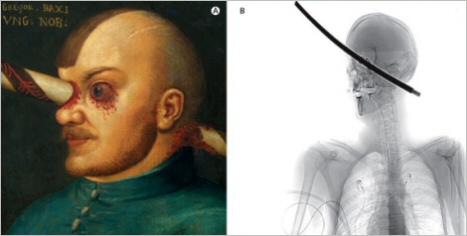
The picture on the left is a famous 1550 portrait of the Hungarian nobleman Gregor Baci who was impaled through the head by a lance.

It was never known whether the picture had been exaggerated. Recently, a medical team from Austria reported a remarkably similar case in The Lancet where the patient survived and recovered with no ill effects. The CT scan of this modern-day Gregor Baci is visible on the right.
 

Although case reports of trauma describe single events only, they can contain very useful scientific information for applied surgery. The portrait of Gregor Baci from the collection of Archduke Ferdinand II of Austria (figure A) provokes the question: is the legend that Baci survived a piercing injury with a lance only a myth, or does medical fact indicate that such severe impalement of the head and neck can be survived? We were able to provide the answer, when a similar case of impalement presented to us.

The patient, a craftsman, was injured when a metal bar fell from the ceiling of a church with an altitude of about 14 m, impaling his head in an anterior-posterior direction (figure B)…

The patient had to undergo surgical treatment twice, and had a year of episodes with headache and moderate diplopia, but now, about 5 years after the accident, the patient does not show any related clinical symptoms…


Link to DOI entry for brief Lancet case report.

The outer limits of psychiatric genetics

The Wiring the Brain blog has a fantastic piece on the how whole genome sequencing is already showing us the limits of how we understand the genetics of mental illness.
Whole genome sequencing allows the entire length of someone’s DNA to be read and, when data from enough people has been collected, it’s possible to look for reliable links between genetic information and human traits.

The advantage of this technique is that it allows genetic links to be detected without needing a specific idea about what should link with what beforehand.

It’s often been cited as the ‘new hope’ for psychiatric genetics which attempts to understand the genetics of mental illness.

However, one difficulty with looking for genetic links with mental illness is that people diagnosed with conditions like schizophrenia or bipolar are unlikely to have exactly the same thing while the specific components are not perfectly measurable (there is no cut and dry way of classifying intrusive thoughts for example).

In addition, most genetic studies to date have found that changes in single genes can explain only a tiny fraction of the risk of developing a mental illness and are often present, although less frequently, in healthy people.

Owing to the fact that the heritability of mental illness can be quite high, the current thinking is that the risk is likely transmitted through lots of genes that, although individually have a small effect, can greatly increase the risk if transmitted together.

The Wiring the Brain post does a brilliant job of exploring why picking out these genes and genetic patterns may not just be a problem with not having enough data – but with the techniques themselves.

However, we will still likely be left with a situation where the statistical evidence we can get from considering the spectrum of mutations in single genes will run into mathematical limits. At some point it will be necessary to look for other types of evidence from outside the system. One type of evidence will come from analysing the biochemical pathways of the implicated genes – it is already becoming apparent that many such genes encode proteins that interact with each other…

The point about mathematical limits is an interesting one, as it may be that there are genes or genetic patterns which are important but have such a small effect that you would need a sample size so big (millions and millions of people perhaps) that your study would simply be impossible.

As the post indicates, this may kill the idea that the genetics of mental illness can be studied without any existing theories and just by looking at which links turn up.

It’s a bit like trying to work out how riots start by counting the different types of people in crowds and seeing which types of people are more likely to be present when a fight breaks out.

Without knowing about the roles of different people, you could easily conclude that the police are the ones responsible for the riot because they are always there in big numbers, while the firebrand orator demanding death to the government is irrelevant because there’s only one of him.

The Wiring the Brain piece covers this and several other issues and is one of the most interesting articles on psychiatric genetics I have read in a while. The blog, by the way, is consistently excellent, so definitely one to keep tabs on.
 

Link to Wiring the Brain on ‘Searching for a needle in a needle-stack’.

Erotic asphyxia and the limits of the brain

A guy who enjoyed whacking off while trying to strangle himself has provided important evidence that an outward sign considered to indicate severe irreversible brain damage can be present without any lasting effects.

It was long thought that a body response called decerebrate rigidity – where the body becomes stiff with the toes pointing and the wrists bending forward – was a sign of irreversible damage to the midbrain.

This sign is widely used in medical assessments to infer severe brain damage and has been observed in videos of people being executed by hanging.

A new study in The American Journal of Forensic Medicine and Pathology provides striking evidence that it is possible to recover from decerebrate rigidity owing to self-taped videos of a man who would strangle himself with a pair of pyjama pants suspended from the shower while masturbating.

The practice is known as autoerotic asphyxia and is based on the idea that restricted oxygen can enhance sexual pleasure – although is not recommended, not least because the medical literature is awash with cases of people who have died while attempting it.

Indeed, the gentleman described in the study did eventually die while hanging himself and when the forensic team investigated his house they found videos where he had filmed himself undertaking the risky sexual practice.

The three videos show him hanging himself while masturbating to the point where he lost consciousness and had the equivalent of an epileptic tonic-clonic seizure as he crashed to the ground. Each time, he regains consciousness and has no noticeable lasting effects.

In one of the videos, 20 seconds of decerebrate rigidity are clearly present. This was previously thought to be a sign of severe permanent brain damage – and yet he comes round, picks himself up and seems unaffected.

The study makes the interesting point that we still know very little about the effects of oxygen starvation on the brain.

For example, the widely quoted figure about brain cells dying after three to five minutes without oxygen is based entirely on animal studies and we don’t actually know the limit for humans.

As the authors note “There is no study to document this threshold of 3 to 5 minutes of ischemia [oxygen deprivation] to cause irreversible brain damage in human beings. Nevertheless, data obtained from animal studies were applied to human beings and the source of the threshold was later forgotten and assumed to be reliable.”
 

Link to PubMed entry for study.

The power of loss

The Frontal Cortex blog has a fantastic piece on ‘loss aversion’ – the cognitive bias where try to we avoid losses more than we try to obtain gains – and its origin in the Allais Paradox.

The crucial thing about loss aversion is it is not about just losing things – it’s also about the perception that we might be losing something, regardless of the actual impact on our resources.

For example, people tend to be less keen to undergo surgery when it is described as having a 20% death rate than when described as having a 80% survival rate, even though both mean exactly the same thing.

The post over at the Frontal Cortex does a great job of weaving together the psychology of the effect, the story of how it was discovered, and it’s impact on our lives, in an excellent brief article.
 

Link to Frontal Cortex on the the Allais Paradox and loss aversion.

2010-10-22 Spike activity

Quick links from the past week in mind and brain news:

Scientific American Mind’s Bering in Mind has two unmissable pieces on the psychology of suicide – the first taking a critical look at the idea that suicide might be adaptive in some cases, the second looking at the individual psychology of the suicidal person.

Why shaking someone’s beliefs turns them into stronger advocates. Not Exactly Rocket Science covers a new study on the endlessly fascinating effects of cognitive dissonance.

The Lancet has an excellent open essay on neuroethics and brain science.

Speakers with a foreign accent are perceived as less credible – and not just because of prejudice. The BPS Research Digest reports on some disappointing data to follow last weeks news about reduced libido in foreign countries.

New Scientist has a good series on the science of morality which has some paywalled pieces which, annoyingly, aren’t well marked.

Journalist Carl Zimmer is interviewed about his new neuroscience e-book, Brain Cuttings, and the electronic future of science writing over at Neurotribes.

The New York Times has an interactive feature on how psychology is being applied to school cafeteria design to encourage healthy eating

To the bunkers! Popular Science reports on the first fully automated robot surgery to removed a prostate. Today, a prostate, tomorrow your frontal lobes.

Seed Magazine has a short but through-provoking piece wondering whether vaccine quackery in autism is partly supported by cognitive biases that under-value ‘sins of omission’ in causal explanations.

Light swearing at the start or end of a persuasive speech can help influence an audience according to a new piece from PsyBlog. Welcome, new dawn of evidence-based swearing.

CNN reports on the 20-year-old female criminology student whose just been made police chief in a dangerous Mexican town shortly after the mayor was murdered.

Emos rejoice! Feeling sad makes us more creative, according to research covered by a great Frontal Cortex piece. OK, stop rejoicing, you’ll lose that artistic edge.

Science News covers an intriguing new study finding that we value potential purchases more highly and are more likely to buy if they’re physically present.

A study covered by Barking Up the Wrong Tree reports that you have a 6% chance of shagging someone you meet at a speed-dating event. What’s the standard deviation you ask? Doesn’t say but my guess is spanking.

Wired Danger Room takes a critical look at the US Army’s ‘breakthrough’ blood test for brain injury and notes that there’s more than a little hype in its announcement.

Contrary to the researchers’ expectations people with autism were more susceptible to magic tricks than neurotypical folks. Great write up on the Cracking the Enigma blog.

BBC News has pictures of the Mexican authorities burning 105 tons of marijuana. Think 50 Cent gig without the baseball caps.

There’s an excellent piece on how the concept of risk became central to psychiatry over the Frontier Psychiatrist.

RadioLab has an excellent short podcast on communication patterns embedded in animal calls.

[Honestly dear], receiving a massage increases trust and co-operation in a financial game. Dan Ariely’s excellent Irrationally Yours blog covers an interesting study that also works as a good excuse for executives.

The Economist argues that the Mexican drug war could be curtailed with better police in Mexico, stricter gun laws in America and legal pot in California. Best of luck with that.

Got a solution? Well, have we got a problem to sell you. Pharmalot interviews author of new book ‘Sex, Lies & Pharmaceuticals’ on the invention of female Hypoactive Sexual Desire Disorder and the new pills that are supposed to treat it.

The British Psychological Society are looking for a freelance blogger to write about occupational and business psychology. Interested?

On the controversy that ripped anthropology asunder – the trashing of Margaret Mead. Great coverage of a new book by Savage Minds.

NPR Science has a piece on a fascinating anthropological study of Japanese teens finding that most electronic messages they send have no ‘news’ – they’re just signalling their social connectedness.

A history of psychology post-doc is blogging her tour of US asylums past and present over at Asylum Notes.

There’s a great interview with broad thinking perceptual psychologist Mark Changizi over at Neuroanthropology.

GQ has a compelling, tragic and enraging feature article on the man shortly to stand trial accused of encouraging suicidal people to kill themselves online by pretending to enter into suicide pacts. Great journalism on a dreadful case.

Sensory blending

The BBC’s science series Horizon just broadcast a fantastic edition on perception, illusions and how the senses combine with each other to the point of allowing us to integrate artificial new senses.
If you’ve got a healthy interest in psychology, the first half of the programme discusses several important but well-known effects like the rubber hand illusion, colour context changes and the McGurk effect, in light of what they reveal about the perceptual system.

Even if you’re familiar with these concepts, its worth watching as they’re so well presented, but its the second half of the programme which really stands out.

It has several brilliant examples of where people have begun to integrate new information into their sensory world: a blind mountain biker who has learnt to echolocate by making clicks with his mouth, helicopter pilots flying purely by spatial information conveyed to them by vibrations, a belt that allows the wearer to feel where magnetic north is at all times, and so on.

Some of the programme is clearly inspired by an excellent book on unusual sensory and perceptual integration that I’m reading at the moment called See What I’m Saying. It’s by psychologist Lawerence Rosenblum whose name you may recognise as we’ve featured some great pieces from his Sensory Superpowers blog before on Mind Hacks.

If you’re in the UK, you can use the BBC’s iPlayer website to watch the programme online, although rumour has it that there’s a working torrent over at the Pirate Bay.
 

Link to Horizon edition on BBC iPlayer.
Link to index page of programme on the Pirate Bay.

The Narrative Escape

Please excuse me if I interrupt Vaughan’s normal programming to blow my own trumpet: My ebook “The Narrative Escape” was published yesterday by 40k books. ‘The Narrative Escape’ is a long essay about morality, psychology and stories and is availble in Kindle format. From the ebook blurb:

We instinctively tell stories about our experiences, and get lost in stories told by other people. This is an essay about our story-telling minds. It is about the psychological power of stories, and about what the ability to enjoy stories tells us about the fundamental nature of mind.

My argument in ‘The Narrative Escape’ begins by exploring Stanley Milgram’s famous experiments on obedience, looking at them as an example of moral decision making – particularly for that minority that choose to disobey in the experiment. A fascinating thing about these experiments is that although they tell us a lot about what makes people obey authority, they leave mysterious that quality that makes people resist tyrannical authority. I then go on to contrast this moral disobedience, with conventional psychological investigations of morality (for example the work of Lawrence Kohlberg). In using descriptions of moral dilemmas to ask people about their moral reasoning this research, I argue, misses something essential about real-world moral choices. This element is the ability to realise that you are acting according to someone else’s version of what is right and wrong, and to step outside of their definition of the situation. This is the “narrative escape” of the title. The essay also talks about dreams, stories and story-telling and other topics which I hope will be of interest to Mind Hacks readers.

The essay is also available in Italian as “La Fuga Narrativa
Amazon.com Link for the English edition.
…And coming soon in Portuguese, I’m told!

Mexican waves across the currents of life

The New York Times has an excellent collection of essays by writers from four Mexican cities, each affected by the ongoing drug war.

The pieces give a fleeting but thoughtful impression of how life in each town has been changed by the upsurge in violence.

I was particularly struck by the piece on Sinaloa, the town forever associated with the cartel that shares its name, which reflects on a dark cultural history and the uncomfortable ambivalence it causes in the residents.

The Mexican drug industry was established in the 1940s by a group of Sinaloans and Americans trafficking in heroin. It is part of our culture: we know all the legends, folk songs and movies about the drug world, including its patron saint, Jesús Malverde, a Robin Hood-like bandit who was hanged in 1909.

There are days when we feel deeply ashamed that the trade is at the heart of Sinaloa’s identity, and wish our history were different. Our ancestors were fearless and proud people, and it is their memory that gives us the will to try to control our own fear and the sobs of the widows and mothers who have lost loved ones.

All four pieces quietly but powerfully portray how the currents of everyday life continue to move beneath the surface of the conflict.
 

Link to NYT collection ‘In Mexico, Scenes From Life in a Drug War’.

Searching for the off switch

The complex interplay between suicidal people in online chat rooms is discussed in an excellent edition of BBC Radio 4’s The Report which you can listen to online or download as a podcast.

Despite the programme being a carefully researched and nuanced exploration of the issues, let me just note that it is sold on a stupid premise, namely “Is the internet encouraging vulnerable people to kill themselves?”

People in passing cars have apparently been known to shout “jump!” to suicidal people on the Golden Gate Bridge but you would never see an article entitled “Is the transport system encouraging vulnerable people to kill themselves?”

Sadly, people’s anxieties about new technology means you can get away with such meaningless generalisation when talking about how people interact online.

Needless to say, I was expecting 30 minutes of badly-researched shock-horror radio but instead found a carefully constructed documentary that takes a comprehensive look at whether suicide chat rooms and online groups that provide self-harm instructions actually increase the risk of ending it all.

The documentary talks to families who have lost loved ones after they participated in online groups, police who have investigated such deaths and a suicide chat-room administrator.

It also covers the case of William Melchert-Dinkel who is accused of encouraging people to take their own lives by pretending to agree to online suicide pacts, and discusses recent studies on how participation in such groups affects suicidal thinking (with preliminary research suggesting a reduction).

The knee-jerk response to such groups is usually for government organisations to suggest they should be ‘banned’ (apparently unaware that this is neither possible nor effective) although the documentary covers some more interesting suggestions – including outreach workers who offer support when an at-risk individual seems to be seeking methods to self-harm.

The one line premise is the only bad thing about this documentary and it’s possibly one of the best discussions you’ll hear about the internet and mental health for a long time. It doesn’t look for, or rely on, easy answers and manages some insightful coverage of a delicate issue.
 

Link to streamed audio of The Report on suicide chat rooms.
Link to podcast of the same.

The origin of the ‘nervous breakdown’

I often get asked what ‘nervous breakdown’ means, as if it was a technical term defined by psychology.
In fact, it’s really just an everyday term used to describe when someone can’t carry on because of psychological problems, although it turns out to have quite technological origin, as this brief article from the American Journal of Psychiatry describes.

The Cambridge academic German Berrios (personal communication) informed me that “breakdown” is a 19th century construction, initially used to refer to breakages and fractures in machinery and leading to the need for “breakdown gangs” (i.e., teams of navvies whose job involved addressing the mechanical disruptions to the functioning of railways). Metaphorical uses of the term followed, particularly in reference to failure in personal intentions and plans.

Berrios suggested that it was only in the second half of the 19th century that its metaphorical connotations were extended to the brain—and later to the mind. Its initial association was not to depression, anxiety, or psychosis but to symptoms associated with mental and physical exhaustion and relating to 19th century constructs such as “neurasthenia,” “the vapors,” “spinal irritation,” and “nervous prostration.” Because neurasthenia (in Greek meaning “lack of nerve strength”) imputes a physical basis (in the nerves) rather than psychological weakness, it was an intrinsically less stigmatizing phrase than “mental illness,”


Link to AJP piece on the ‘nervous breakdown’.

Video of the ‘Lazarus sign’

I’ve just found a video that has footage of the ‘Lazarus sign‘ – a complex reflex movement that can occur in brain dead patients where the arms are raised to the chest and often fall crossed onto the body.

We’ve covered this reflex before, noting that despite its complexity it is generated by the spine, which is why it can still appear after brain death.

However, I didn’t realise there a video of it was available online where you can see the unnerving post-mortem movement triggered by doctors as they move the head.

If you’re uncomfortable about seeing dead bodies this isn’t the video for you, particularly as it shows what seems to be quite a young lad who presumably just very recently passed away.

It’s titled and narrated in Portuguese by (I’m guessing) a Brazilian medical team to demonstrate the reflex.

I noticed there’s also a video with a sequence of stills of the Lazarus sign in English which also explains the concept of a spinal reflex arc, although you’ll need to login to YouTube to see it.
 

Link to video of Lazarus sign in Portuguese.
Link to short presentation on spinal reflex arc and Lazarus sign.

A previously unseen species of hallucinated moth

I’ve discovered H.G. Wells’ amazing short story The Moth about a scientific feud between two leading entymologists that ends with one’s premature death and the other being driven insane by an hallucinated moth.

It’s a deftly written piece because it captures the method of scientific grudge matches – devastating and savage critiques in scholarly journals – and is peppered with references to illusory scientific papers.

Pawkins, the target of the academic demolition job dies shortly after, only for Hapley, the scientific aggressor, to see a moth that is completely new to science but which seems strangely difficult to capture.

That night Hapley found the moth crawling over his counterpane. He sat on the edge of the bed in his shirt sleeves and reasoned with himself. Was it pure hallucination? He knew he was slipping, and he battled for his sanity with the same silent energy he had formerly displayed against Pawkins. So persistent is mental habit, that he felt as if it were still a struggle with Pawkins. He was well versed in psychology. He knew that such visual illusions do come as a result of mental strain. But the point was, he did not only _see_ the moth, he had heard it when it touched the edge of the lampshade, and afterwards when it hit against the wall, and he had felt it strike his face in the dark.


Link to full text of The Moth.

Arrow in the head

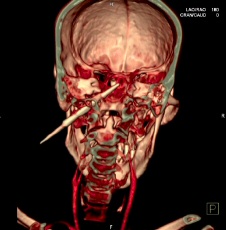
The image is a 3D CT scan of someone who was shot in the head with an arrow which penetrated their brainstem.
It’s taken from a recent case study that notes that these injuries have virtually disappeared from the West although are more common in other parts of the world, including from some tribal areas of India, from where this injury occurred.

The case is reported in the Journal of Emergencies, Trauma and Shock and is of a 35-year-old man who was admitted to hospital conscious, in severe pain, with partial facial paralysis, unable to open his jaw, and with an arrow sticking out of the back of his head.

The report notes that the patient made a full recovery although stresses the importance of not pulling out arrows without surgery because they can cause life threatening damage to blood vessels if removed without careful monitoring.

As far as I can tell, this is the only report in the medical literature of an arrow stuck in the brain after being fired in anger, as all the others are either from sporting accidents or suicide attempts.
 

Link to Journal of Emergencies, Trauma and Shock case study.

Fifteen brain encounters

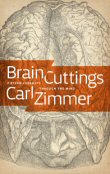
I’ve just finished Carl Zimmer’s new e-book Brain Cuttings that collects fifteen of his previous long-form mind and brain articles and, I have to say, I thoroughly enjoyed it.

I was kindly sent an advanced copy of the book which is only available as a pdf for your Kindle or other electronic reader. As I don’t own one, I took the file to the local copy shop and got it printed out (a paper version of the ‘iPad’ known as the ‘Pad’).

I was particularly impressed by the sheer range of the pieces that cover everything from the neurobiology of astrocytes (in a chapter entitled The Brain’s Dark Matter) to an account of a trip the Singularity Summit, a conference of techno-utopians who are working towards augmented immortality for the human race.

The piece on the Singularity is probably the stand-out section of the book as it takes a level-headed look at the movement’s claims for brain enhancement and super-intelligence without engaging in literary eye-rolling or ever losing a sense of wonder for the genuine scientific advances incorporated into the ideas.

In terms of the science, the book is absolutely faultless, which is sadly not something your average reader can take for granted when it comes to neuroscience or psychology journalism, and Zimmer writes in a remarkably clear style that makes absorbing even some of the most technical aspects seem as natural as breathing.

At times, I yearned for a little more exploration of the characters we encounter on the journeys, but the length of the pieces means they tend to focus more on the ideas than the scenes.

I’m not familiar with the e-book market but $11 for a 100 page book struck me as a little steep. However, I note that the book is an experiment in itself and is only available electronically, something of a first from such as well-established author.

Whether you are an enthusiast, a professional psychologist or neuroscientist, or a combination, you will probably learn much from the book due to its breadth of vision. Regardless of who you are you are sure to enjoy the engaging immersions in some of the most interesting ideas in contemporary science.
 

Link to Brain Cuttings page.
Link to Zimmer’s blog post about the new book.

A history of the phantom penis

After amputation, many people feel ‘phantom limb‘ sensations that seem to come from the missing body part. Although typically associated with missing arms or legs, these phantom sensations can arise from almost anywhere and a new study in the Journal of the History of the Neurosciences looks at how the ‘phantom penis’ has enjoyed a surprisingly long history in the medical literature.

The first case of a phantom penis was mentioned in passing by the ‘father’ of phantom limbs, Silas Weir Mitchell, and there has been an assumption that these sensations are rare or unusual.

In fact, a 1999 case report of a phantom penis after amputation noted only a few previous mentions of the experience, some of which have become quite well-known.

Among the most cited publications is one by Boston surgeon A. Price Heusner (1950) containing two case studies. His first case was an elderly man whose penis was “accidently traumatized and amputated,” and who “was intermittently aware of a painless but always erect penile ghost whose appearances were neither provoked nor provokable by sexual phantasies” (Heusner, 1950, p. 129). This man had to look under his clothes to be sure that his penis was, in fact, absent. Heusner’s second case was a middle-aged, perineal cancer patient. Because his malignancy had spread and was causing intense burning pains in his groin, he opted to undergo penile amputation. Thereafter, he continued to have painful sensations “suggesting the continuing presence of the penis,” until he underwent spinal surgery

This new historical study shows that there were actually many reports of phantom penises in the 18th Century medical literature that have previously been overlooked.

These include reports from some of the most important doctors of the time, and indeed, some of the most important in history.

This included the Scottish surgeon and anatomist John Hunter who reported on what can only be described as phantom wanking:

A serjeant of marines who had lost the glans, and the greater body of the penis, upon being asked, if he ever felt those sensations which are peculiar to the glans, declared, that upon rubbing the end of the stump, it gave him exactly the sensation which friction upon the glans produced, and was followed by an emission of the semen.

Hunter’s case highlights an interesting aspect of the phantom penis sensation which seems to differentiate it from most other forms of phantom limb sensations – they tend to be pleasurable rather than painful.

Phantom limbs are often associated with the feeling that the missing body part is stuck in an awkward position, such as the ‘fingers digging into the palm’, something which the mirror box treatment attempts to correct.

Although some painful phantom penises have been reported they seem more likely to appear as pleasurable sensations and phantom erections.

This may have some interesting implications for neuroscience. Phantom limbs are thought to arise when activity in the brain maps that represent the limbs no longer have a constant flow of sensory feedback that keep them tied to their task.

The boundaries of the maps become blurry and information from other body areas starts to cause activity in the map for the missing limb, leading to the phantom sensations.

However, in contrast to the penis, arms and legs involve much more of a feedback loop, because fine action control signals are being sent and modified on the basis of the sensations from the limb.

As the penis has less need for such fine action control, it’s probably less likely that misfiring of the signals can make it seem as if it is in an awkward or painful position, possibly reducing the chance of an uncomfortable phantom pecker.
 

Link to DOI entry for the locked article (via AITHOP).