A proto-anthropology of the rock n’ roll groupie scene

The Groupies is a remarkable record. The 1969 LP features nothing but interviews with ‘super groupies’ who discuss the culture of sleeping around the 60’s rock n’ roll scene.

It was made by, and featured, an 18 year-old version of the future Dr Cleo Odzer who shows her early interest in both sex and culture – both of which she’d study in her career as an anthropologist.

The girls talk about taking drugs, hanging out with bands, getting the clap and ‘making piggies’ – which is quite possibly both the cutest and oddest euphemism I’ve ever heard for having sex.

By the time she made The Groupies she had already been featured in Time magazine and broken off an engagement to Keith Emerson – of Emerson, Lake & Palmer fame. That’s them together on the left, by the way.

Odzer went on to become a journalist, then a drug runner, then an addict, then an ex-addict, and then, an anthropologist – eventually completing her PhD in the subject at the New School for Social Research in New York by studying prostitution in Thailand.

This was the first of Odzer’s areas of interest as an anthropologist. The second was the hippy scene in Goa, India, and the third was on sexual activity on the internet – then rather boldly called ‘cybersex’.

It’s worth saying that Odzer was never the most objective of investigators, tending to get overly involved in most things she researched. Or at least, that’s how it seemed. It’s just as possible she decided to research the things that she was already overly-involved with.

You can see this in her work. While her academic work included a more cutting analysis, her published books tended to be as much about her as the culture.

Her 1997 ‘cybersex’ book Virtual Spaces: Sex and the Cyber Citizen was largely thought a curiosity but, looking back, it was quite revolutionary.

While the academic world had just discovered this weird new phenomenon, and mostly viewed it with eyes-over-spectacles disproving glances, Odzer wrote what amounted to a cross between a Lonely Planet travel guide and the Joy of Sex – but for the newly connected internet user.

Odzer died at the age of 50, in Goa, after returning there from New York. Accounts vary. Possibly she died peacefully in her adopted home, possibly she finally succumbed to a lonely death with AIDS.

But when you listen to The Groupies LP, and the full audio is online, you can see the beginnings of a common thread that ran through her work.

It touches on a genuinely interesting social area which most people would have dismissed as seedy but which has a clear culture emerging from it. The analysis is slightly chaotic but genuinely insightful in places. It captures the excitement but in retrospect, it took something from her.
 

Link to page with audio of The Groupies.
Link to Wikipedia page on Cleo Odzer.
Candidate neurotech for the billion dollar brain projects

NatureBrainNature has an article that discusses candidate neuro-mapping technologies that may form the basis of the billion dollar brain projects that are just kicking off on either side of the Atlantic.

Both Europe’s and Obama’s brain projects have set themselves the (possibly over-) ambitious goal of mapping the working brain on the neuron-by-neuron level.

This is off the back of new technologies that promise multiple-neuron fine-grained recording and systems to make sense of the date – but can only currently do it on a very small scale.

The Nature article looks at the most promising options and how they might scale to whole brain, or at least, ‘big chunk of brain’ level.

Attempting to take another leap farther, Jeff Lichtman at Harvard University in Cambridge, Massachusetts, and Winfried Denk of the Max Plank Institute for Neurobiology in Munich, Germany, are working with the German optics company Carl Zeiss on a new electron microscope that would image even thinner slices — 25 nanometres, or one-thousandth the thickness of an average cell. “Then you get to see every little damn thing in the brain, from every neuron to every subcellular organelle, from every synapse to every spine neck — everything,” says Lichtman.

It’s probably worth saying that the ‘mapping the whole brain as it’s working’ thing is spin. Considering there are about 100 billion or so neurons in the human brain that’s a lot of microchips you’d need mixing in with your brain.
 

Link to Nature article ‘Neuroscience: Solving the brain’

Like a kid in a brain candy store

Photo by Flickr user Max. Click for source.Slate has got a great article that takes on the newly fashionable field of ‘neuromarketing’ and calls it out as an empty promise.

The piece is written by neuroscientist Matt Wall who notes the upsurge in consumer EEG ‘brain wave’ technology has fuelled a boom in neuromarketing companies who claim that measuring the brain is the shining path to selling your product.

Because neuromarketing companies don’t provide the key details of the analysis techniques they use, it’s hard to evaluate them objectively. However, they seem to take a highly automated approach, essentially plugging the raw data into a black box of algorithms that spits out a neatly processed answer at the other end. Such an approach must involve making a large number of assumptions and some fancy-analysis footwork to make something coherent out of the poor-quality data.

In general the same applies to getting information out of a data set as to getting information out of a human: If you torture it long enough, it’ll tell you everything you want to know, but information extracted under torture is highly unreliable.

In addition, marketing-related studies are not well-suited to the kind of repetition that’s required to boost the useful signal and reduce noise; the same product or TV commercial can be presented only a few times before the participant becomes very bored indeed and therefore ceases to have any kind of meaningful reaction.

The article discusses why the current fad of EEG-based neuromarketing is scientifically unsound but despite the technical difficulties and theoretical incoherence of the field, it would all become irrelevant with one simple demonstration: a measure of the brain that could predict buyer preference better than behavioural or psychological measures.

Until now, no-one has shown this. In other words, no-one, nowhere, has shown that a ‘neuromarketing’ approach adds anything to what can be done by a standard marketing approach.

I’m all for neuromarketing research but until you can come up with the goods as a commercial product, you’re selling hot air.

There is one area that neuromarketing companies excel at though – marketing themselves. Considering a complete lack of data for their benefits, they pull in millions of dollars a year from advertising contracts.

Now that is effective marketing.
 

Link to Slate article ‘What Are Neuromarketers Really Selling?’

Why you think your phone is vibrating when it is not

Most of us experience false alarms with phones, and as Tom Stafford explains this happens because it is a common and unavoidable part of healthy brain function.

Sensing phantom phone vibrations is a strangely common experience. Around 80% of us have imagined a phone vibrating in our pockets when it’s actually completely still. Almost 30% of us have also heard non-existent ringing. Are these hallucinations ominous signs of impending madness caused by digital culture?

Not at all. In fact, phantom vibrations and ringing illustrate a fundamental principle in psychology.

You are an example of a perceptual system, just like a fire alarm, an automatic door, or a daffodil bulb that must decide when spring has truly started. Your brain has to make a perceptual judgment about whether the phone in your pocket is really vibrating. And, analogous to a daffodil bulb on a warm February morning, it has to decide whether the incoming signals from the skin near your pocket indicate a true change in the world.

Psychologists use a concept called Signal Detection Theory to guide their thinking about the problem of perceptual judgments. Working though the example of phone vibrations, we can see how this theory explains why they are a common and unavoidable part of healthy mental function.

When your phone is in your pocket, the world is in one of two possible states: the phone is either ringing or not. You also have two possible states of mind: the judgment that the phone is ringing, or the judgment that it isn’t. Obviously you’d like to match these states in the correct way. True vibrations should go with “it’s ringing”, and no vibrations should go with “it’s not ringing”. Signal detection theory calls these faithful matches a “hit” and a “correct rejection”, respectively.

But there are two other possible combinations: you could mismatch true vibrations with “it’s not ringing” (a “miss”); or mismatch the absence of vibrations with “it’s ringing” (a “false alarm”). This second kind of mismatch is what’s going on when you imagine a phantom phone vibration.

For situations where easy judgments can be made, such as deciding if someone says your name in a quiet room, you will probably make perfect matches every time. But when judgments are more difficult – if you have to decide whether someone says your name in a noisy room, or have to evaluate something you’re not skilled at – mismatches will occasionally happen. And these mistakes will be either misses or false alarms.

Alarm ring

Signal detection theory tells us that there are two ways of changing the rate of mismatches. The best way is to alter your sensitivity to the thing you are trying to detect. This would mean setting your phone to a stronger vibration, or maybe placing your phone next to a more sensitive part of your body. (Don’t do both or people will look at you funny.) The second option is to shift your bias so that you are more or less likely to conclude “it’s ringing”, regardless of whether it really is.

Of course, there’s a trade-off to be made. If you don’t mind making more false alarms, you can avoid making so many misses. In other words, you can make sure that you always notice when your phone is ringing, but only at the cost of experiencing more phantom vibrations.

These two features of a perceiving system – sensitivity and bias – are always present and independent of each other. The more sensitive a system is the better, because it is more able to discriminate between true states of the world. But bias doesn’t have an obvious optimum. The appropriate level of bias depends on the relative costs and benefits of different matches and mismatches.

What does that mean in terms of your phone? We can assume that people like to notice when their phone is ringing, and that most people hate missing a call. This means their perceptual systems have adjusted their bias to a level that makes misses unlikely. The unavoidable cost is a raised likelihood of false alarms – of phantom phone vibrations. Sure enough, the same study that reported phantom phone vibrations among nearly 80% of the population also found that these types of mismatches were particularly common among people who scored highest on a novelty-seeking personality test. These people place the highest cost on missing an exciting call.

The trade-off between false alarms and misses also explains why we all have to put up with fire alarms going off when there isn’t a fire. It isn’t that the alarms are badly designed, but rather that they are very sensitive to smoke and heat – and biased to avoid missing a real fire at all costs. The outcome is a rise in the number of false alarms. These are inconvenient, but nowhere near as inconvenient as burning to death in your bed or office. The alarms are designed to err on the side of caution.

All perception is made up of information from the world and biases we have adjusted from experience. Feeling a phantom phone vibration isn’t some kind of pathological hallucination. It simply reflects our near-perfect perceptual systems trying their best in an uncertain and noisy world.

This article was originally published on BBC Future. The original is here.

Double matrix

This is quite possibly the least comprehensible abstract of a psychology article I have ever read. It starts off dense and wordy and ends up feeling like you’re huffing butane.

The psychologization of humanitarian aid: skimming the battlefield and the disaster zone

Hist Human Sci. 2011;24(3):103-22.

De Vos J.

Humanitarian aid’s psycho-therapeutic turn in the 1990s was mirrored by the increasing emotionalization and subjectivation of fund-raising campaigns. In order to grasp the depth of this interconnectedness, this article argues that in both cases what we see is the post-Fordist production paradigm at work; namely, as Hardt and Negri put it, the direct production of subjectivity and social relations. To explore this, the therapeutic and mental health approach in humanitarian aid is juxtaposed with the more general phenomenon of psychologization.

This allows us to see that the psychologized production of subjectivity has a problematic waste-product as it reduces the human to ‘Homo sacer’, to use Giorgi Agamben’s term. Drawing out a double matrix of a de-psychologizing psychologization connected to a politicizing de-politicization, it will further become possible to understand psycho-therapeutic humanitarianism as a case of how, in these times of globalization, psychology, subjectivity and money are all interrelated.

Hey. I think the walls are melting.
 

Link to PubMed abstract.

I’m experiencing a lot of automaticity right now

Funny or Die is supposedly a comedy site but they seem to have a brief video tutorial on how to undertake neurally informed domestic negotiations.

The credits of the video give special thanks to Dr Dan Siegel – founder of ‘the exciting field of interpersonal neurobiology’.

I think that might be a joke though as the video seemed relatively free of flowery neurojargon.

Life of a Neuro Pope

The late Pope John Paul II is to be made a saint by the Catholic church after having two miracles confirmed – both of which allegedly involved curing neurological disorders.
As Popes go, John Paul was particularly interested in neuroscience and seems to have continued his interest in the, er, afterlife.

His post-mortem miracles have allegedly involved, on one occasion, curing a woman of a ‘brain aneurysm’, and on another, curing a nun of Parkinson’s disease.

The neurosurgeon involved in the latter cases was recently interviewed about the case to explain why he thinks it was a miracle – rather than, for example, a misdiagnosis.

However, this was not the first time it was claimed that the late Pope miraculously aided a neuroscientist. He beatified 17th Century neuroscientist Nicolas Steno who became the first brain specialist to start his journey toward sainthood.

Pope John Paul II also commented on neuroscientific issues. He defended dualism – the belief that the mind and brain are separate entities in a 1996 address, saying:

Consequently, theories of evolution which, in accordance with the philosophies inspiring them, consider the mind as emerging from the forces of living matter, or as a mere epiphenomenon of this matter, are incompatible with the truth about man. Nor are they able to ground the dignity of the person.

But perhaps paradoxically he also supported the medical consensus on death being ‘brain death’ rather than respiratory failure – noting in the year 2000 that the “complete and irreversible cessation of all brain activity” was an acceptable definition.

However, this issue clearly troubled him for some time after, because in 2006 he convened a conference of medics and neuroscientists to debate exactly this issue, producing the famous ‘Signs of Death’ publication from the Vatican.

He also commented on cases of people in coma-like persistent vegetative states, saying that even without their ‘higher functions’ that may have been affected by brain damage, they should be always be treated to keep them alive.

John Paul’s interest in the brain may have had a personal aspect. He developed Parkinson’s disease himself which was not made public for many years.

Nevertheless, he was not the first Pope to have a neurological disorder. Pope Pius IX had epilepsy – something else which was barely mentioned by the Vatican during his time as the head of the Catholic Church.

In fact, even now they only describe his condition as “a disease not well diagnosed, which some called epilepsy” – possibly because it is still associated with possession by cultures across the world.

‘digital dementia’ lowdown – from The Conversation

The Headlines

The Telegraph: Surge in ‘digital dementia’

The Daily Mail: ‘Digital dementia’ on the rise as young people increasingly rely on technology instead of their brain

Fox News: Is ‘digital dementia’ plaguing teenagers?

The Story

South Korea has the highest proportion of people with smartphones, 67%. Nearly 1 in 5 use their phone for more than 7 hours in a day, it is reported. Now a doctor in Seoul reports that teenagers are reporting with symptoms more normally found in those with head injury or psychiatric illness. He claims excessive smartphone use is leading to asymmetrical brain development, emotional stunting and could “in as many as 15 per cent of cases lead to the early onset of dementia”.

What they actually did

Details from the news stories are sketchy. Dr Byun Gi-won, in Seoul, provided the quotes, but it doesn’t seem as if he has published any systematic research. Perhaps the comments are based on personal observation?

The Daily Mail quotes an article which reported that 14% of young people felt that their memory was poor. The Mail also contains the choice quote that “[Doctors] say that teenagers have become so reliant on digital technology they are no longer able to remember everyday details such as their phone numbers.”

How plausible is this?

It is extremely plausible that people should worry about their memories, or that doctors should find teenagers uncooperative, forgetful and inattentive. The key question is whether our memories, or teenagers’ cognitive skills, are worse than they ever have been – and if smart phones are to blame for this. The context for this story is a recurring moral panic about young people, new forms of technology and social organisation.

For a long time it was TV, before that it was compulsory schooling (“taking kids out of their natural environment”). When the newspaper became common people complained about the death of conversation. Plato even complained that writing augured the death of memory and understanding). The story also draws on the old left brain-right brain myth, which – despite being demonstrably wrong – will probably never die.

Tom’s take

Of course, it is possible that smartphones (or the internet, or TV, or newspapers, or writing) could damage our thinking abilities. But all the evidence suggest the opposite, with year by year and generation-by-generation rises found in IQ scores. One of the few revealing pieces of research in this area showed that people really are more forgetful of information they know can be easily retrieved, but actually better able to remember where to find that information again.

This isn’t dementia, but a completely normally process of relying on our environment to store information for us. You can see the moral panic driving these stories reflected in the use of that quote about teenagers not being able to remember phone numbers. So what! I can’t remember phone numbers any more – because I don’t need to. The only evidence for dementia in these stories is the lack of critical thought from the journalists reporting them.

Read more

Vaughan Bell on a media history of information scares.

Christian Jarret on Why the Left-Brain Right-Brain Myth Will Probably Never Die

The Conversation

This article was originally published at The Conversation.
Read the original article.

The Connected Brain: Edinburgh

From Flickr, click for link

I’m giving at talk at the Edinburgh festival on August 9th, called The Connected Brain. It will be at Summerhall (Fringe Venue 26 during the festival), cost £3, and here is the blurb:

Headlines often ask if facebook is making us shallow, or google eroding our memories. In this talk we will look “under the hood” of research on how digital technology is affecting us. We will try and chart a course between moral panic and techno-utopianism to reveal the real risks of technology and show how we can cement the great opportunities that it presents for the human mind.

The talk will be similar to the one I did in London recently at the School of Life. Ben Martynoga wrote up some details of that talk, which you can find here. The ideas in the talk involve using some examples from the Mind Hacks book to illustrate some principles of how the mind works, looking at the extended mind hypothesis and reminding ourselves of some of the history of moral panics around information technologies, which Vaughan has written so engagingly and often about (thanks Vaughan!). The place I get to, which is where I’m at with my thinking and where I hope to start a discussion with the audience, is that, rather than panic about technology making us dumb, distracted and alone, we need to identify the principles which will help us design technology which makes use smart, able to concentrate and empathetic.

So that’s, me + Edinburgh + August the 9th. Link for tickets : The Connected Brain

Taking emotions at face value

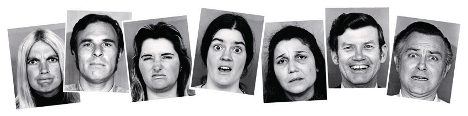
Boston Magazine has a fascinating article on the work of psychologist Lisa Feldman Barrett who has been leading the charge against the idea that we recognise the same facial expression of emotion across the world.

This was first suggested by Paul Ekman whose work suggested that humans can universally recognise six emotions: anger, disgust, fear, happiness, sadness, and surprise.

His research involved showing people from different cultures pictures of faces and asking them to label each expression from a choice of emotional words.

But Barrett has found a simple flaw in the procedure:

She returned to those famous cross-cultural studies that had launched Ekman’s career—and found that they were less than watertight. The problem was the options that Ekman had given his subjects when asking them to identify the emotions shown on the faces they were presented with. Those options, Barrett discovered, had limited the ways in which people allowed themselves to think.

Barrett explained the problem to me this way: “I can break that experiment really easily, just by removing the words. I can just show you a face and ask how this person feels. Or I can show you two faces, two scowling faces, and I can say, ‘Do these people feel the same thing?’ And agreement drops into the toilet.”

The article is on much more than this controversy in cognitive science and also tracks how research on emotion and facial expression is playing an increasing role in law enforcement – with not all of it well supported by evidence.

And if you want links to some of the scientific papers, the always interesting Neuroanthropology blog has more at the bottom of this post.
 

Link to Boston Magazine article ‘About Face’.

Great cure but we lost the patient

The Journal of Neuroscience has a surprising case report of a patient who was treated with an implanted brain stimulator to treat severe movement side-effects from an extended period of taking antipsychotic drugs for behavioural problems.

This is the background to the case:

A 27-year-old woman with developmental delay and severe behavioural disturbance was treated with risperidone 6 mg/day from age 14. At age 20, she developed facial twitching, blinks, and truncal extension spasms, which persisted during both sitting and lying supine. By age 21, she was no longer able to walk due to the spasms. She became housebound and was forced to ambulate by crawling, to the extent that she developed post-traumatic cysts over both knees. She was unable to sit in a chair. She was forced to eat from a plate on the floor while kneeling because the extension spasms were too severe in other positions.

The movement problems were due to tardive dystonia – a problem where the brain’s automatic control of muscle tone stops working.

When you move, some muscles need to contract while others need to relax. This happens automatically but turns out to be a complex brain process that is mediated by important dopamine pathways in a deep brain area called the basal ganglia.

Antipsychotic medication was first widely used to treat the delusions and hallucinations of psychosis but is increasingly being used to treat ‘behavioural disturbance’ (normally meaning aggression) as it can be slightly sedating and reduces anxiety.

This medication works by blocking dopamine receptors but in high doses it can lead to temporary and, occasionally, permanent movement problems due to its effects on the dopamine-mediated movement pathways in the brain.

This most typically appears as tic-like movements called tardive dyskinesia, Parkinson’s-disease like stiffness, a form of restlessness called akithisia, or movement problems that affect muscle tone – which is what this patient had.

These severe symptoms were treated in similar way to one option for Parkinson’s disease – a deep brain stimulation device was inserted into the brain to send electrical pulses directly into the basal ganglia to help regulate the movement circuits.

It turns out that many studies have reported the results of putting brain implants in people to treat movement side effects from antipsychotic drugs.

It’s probably true to say that some people have been left with permanent movement problems from the days when large doses of antipsychotics were prescribed and the side-effects were poorly understood.

These days, one of a psychiatrist’s most important jobs is to avoid these unwanted effects.

From one perspective, no matter how the situation arose, patients deserve the best possible treatments, of which deep brain stimulation is certainly one.

But still, you can’t help thinking it’s kind of a bleak situation where brain implants are needed to treat medication side-effects.

When used appropriately, antipsychotics can be a genuinely useful form of treatment but cases like these serve to remind us how far we have to go in developing safer psychiatric medications.
 

Link to locked Journal of Neuroscience case report.

Workout music and your supplementary motor cortex

Why do we like to listen to tunes when we exercise? Psychologist Tom Stafford searches for answers within our brains, not the muscles we are exercising.

Perhaps you have a favourite playlist for going to the gym or the park. Even if you haven’t, you’re certain to have seen joggers running along with headphones in their ears. Lots of us love to exercise to music, feeling like it helps to reduce effort and increase endurance. As a psychologist, the interesting thing for me is not just whether music helps when exercising, but how it helps.

One thing is certain, the answer lies within our brains, not the muscles we are exercising. A clue comes from an ingenious study, which managed to separate the benefits of practicing a movement from the benefits of training the muscle that does the movement. If you think that sounds peculiar, several studies have shown that the act of imagining making a movement produces significant strength gains. The benefit isn’t a big as if you practiced making the movement for real, but still the benefit of thinking about the movement can account for over half of the benefit of practice. So asking people to carry out an imaginary practice task allows us to see the benefit of just thinking about a movement, and separates this from the benefit of making it.

Imaginary practice helps because it increases the strength of the signal sent from the movement areas of the brain to the muscles. Using electrodes you can record the size of this signal, and demonstrate that after imaginary practice people are able to send a stronger, more coherent signal to the muscles.

The signals to move the muscles start in an area of the brain called, unsurprisingly, the motor cortex. It’s in the middle near the top. Part of this motor area is known as the supplementary motor cortex. Originally thought to be involved in more complex movements, this area has since been shown to be particularly active at the point we’re planning to make a movement, and especially crucial for the timing of these actions. So, this specific part of the brain does a very important job during exercise, it is responsible for deciding exactly when to act. Once you’ve realised that a vital part of most sporting performance is not just how fast or how strong you can move, but the effort of deciding when to move, then you can begin to appreciate why music might be so helpful.

The benefits of music are largest for self-paced exercise – in other words those sports where some of the work involved is in deciding when to act, as well as how to act. This means all paced exercises, like rowing or running, rather than un-paced exercises like judo or football. My speculation is that music helps us perform by taking over a vital piece of the task of moving, the rhythm travels in through our ears and down our auditory pathways to the supplementary motor area. There it joins forces with brain activity that is signalling when to move, helping us to keep pace by providing an external timing signal. Or to use a sporting metaphor, it not only helps us out of the starting blocks but it helps to keep us going until we reach the line.

Of course there are lots of other reasons we might exercise to music. For example, a friend of mine who jogs told me: “I started running to music so I didn’t have to listen to my own laboured breathing.” He might well have started for that reason, but now I’ll bet the rhythm of the music he listens to helps him keep pace through his run. As one song might have put it, music lets us get physical.

This is my BBC Future column from last week. The original had the much more accessible title of “The Psychology of Workout music“, but mindhacks.com is our site (dammit) and I can re-title how I want.

What is it like being nerve gassed?

I’ve just found an interesting article in the Journal of Pharmacy Practice that discusses the medical management of chemical weapons injuries.

It has a particularly attention-grabbing section that describes the effects of being nerve gassed. I’ve pasted it below, but as it was dense with medical jargon, I’ve added explanations in square brackets.

The nerve agents prevent the breakdown of [neurotransmitter] acetylcholine resulting in a cholinergic crisis. Muscarinic effects from nerve agents include miosis [constriction of the pupils of the eyes], bradycardia [slowed heartbeat], diarrhea, nausea and vomiting, diaphoresis [excessive sweating], bronchial secretions [fluid in the lungs], and bronchial constriction [lung tightening]. A dimming of vision occurs with the miosis.

Nicotinic effects include tachycardia [fast heartbeat] and muscle twitching which progresses to muscle paralysis. The toxidrome [poisoning syndrome] depends of the route of absorption. When dermally absorbed [through the skin] muscle twitching occurs first. With inhalation exposure, breathing difficulties are seen first.

The onset of symptoms with inhalation exposure is within 5 minutes. With dermal exposure, it can last up to several hours. The seizures due to nerve agents may be from blocking [neurotransmitter] γ-aminobutyric acid (GABA).

The article also discusses other types of chemical weapons: blister agents, choking agents, incapacitating agents, riot control agents, blood agents, and toxic industrial chemicals. All of which sound very unpleasant.

However, ‘incapacitating agents’ can also mean substances that have psychotropic effects. These can be anything which drug the person to a state where they are less able to resist.

In theory, these could be anything, but the article particularly notes opioid-based gasses (think vaporised synthetic heroin – like the fentanyl derivative used in the 2002 Moscow theatre siege by Russian special forces) or the hallucinogenic drug BZ which has featured in many favourite conspiracy theories.
 

Link to locked article on chemical weapons medicine.

A taxonomy of ayahuasca hallucinations

A wonderful list categorising hallucinations experienced by the Cashinahua people of Peru after drinking the hallucinogenic brew ayahuasca.

1. Brightly colored, large snakes
2. Jaguars and ocelots
3. Spirits, both of ayahuasca and others
4. Large trees, often falling trees
5. Lakes, frequently filled with anacondas and alligators
6. Cashinahua villages and those of other Indians
7. Traders and their goods
8. Gardens

It was reported by the anthropologist Ken Kensinger in a chapter in the book Hallucinogens and Shamanism.

It reminded me of writer Jorge Luis Borges’ whimsical classification system for animals.

Is social psychology really in crisis?

My latest ‘behind the headlines’ column for The Conversation. Probably all old news for you wised-up mindhacks.com readers, but here you go:

The headlines

Disputed results a fresh blow for social psychology

Replication studies: Bad copy

The story

Controversy is simmering in the world of psychology research over claims that many famous effects reported in the literature aren’t reliable, or may even not exist at all.

The latest headlines follow the publication of experiments which failed to replicate a landmark study by Dutch psychologist Ap Dijksterhuis. These experiments are examples of what psychologists call “social priming”, which is a phenomenon where people who are exposed to ideas unconsciously incorporate them into their behaviour. So people who are reminded of old age are reported to walk slower, and people asked to think about university professors do better on a trivial pursuit knowledge test.

What they actually did

The first of Dijksterhuis’ original experiments asked people to think about the typical university professor and list on paper their appearance, lifestyle and behaviours. After this they answered 42 questions taken from Trivial Pursuit.

The experiment found that people who had thought about professors scored 10% higher than people who hadn’t been primed in this way. In this latest report, David Shanks, Head of the Division of Psychology and Language Sciences at University College London and colleagues tried to replicate this effect in nine separate experiments. They didn’t find the effect in any of their experiments, which they suggest calls into question the validity of the original research.

How plausible is it

It’s extremely plausible that people are influenced by recent activities and thoughts – the concept of priming is beyond question, having been supported by decades of research.

What’s less established is whether these effects are really “unconscious” (whatever that means) and whether sophisticated concepts like intelligence can really worm their way into our behaviour in such a profound way.

Tom’s take

The headline reporting of this spat is misleading – there’s nothing worrying about disputed results for social psychology. The process of affirming, disputing and denying results is part of the normal part of science. What is worrying is that this failed replication comes on top of other failed replications of famous social priming results and after the discovery of some high profile frauds in psychology, such as Diederik Stapel.

This has led some to talk of a crisis in experimental social psychology, centring on whether standards of research in the area have slipped enough to allow false results to become easily accepted.

The whole situation is a wonderful opportunity to see “under the hood” of science and see how it really works (rather than how we’re taught it should work). Everything is in the mix: fundamental conceptual disagreements (about the nature of unconscious processing), disciplinary tribalism (between cognitive psychologists and social psychologists), big dog personalities and emotions running high, academic fashion creating a scientific “bubble” (this is that bubble bursting) and soul-searching questions about whether our methods as researchers are fit for purpose.

My guess is that, when the dust settles, we’ll find out that priming effects can work – but they aren’t as strong or common as reported. I have faith that most effects reported in the literature will turn out to true in some form – the vast majority of psychologists are honest and methodical – but we also know for sure than some effects will turn out to have been chimeras, we just can’t say for sure in advance which.

The really interesting aspects to the debate, from my point of view, is going to be clarifying exactly how unconscious these effects are. My prejudice is that social psychologists have been overly casual about using that word, using it in circumstances which would contradict the way most people use it, whether they’re psychologists or not.

Read more

Shanks, D. R., Newell, B. R., Lee, E. H., Balakrishnan, D., Ekelund, L., Cenac, Z., Fragkiski, K. & Moore, C. (2013). Priming Intelligent Behavior: An Elusive Phenomenon, PloS one, 8(4), e56515.

Ed Yong on Bargh’s response to another failure to replicate

Rolf Zwaan on the theory of social priming

Rolf Zwaan on replication done right

Tom Stafford does not work for, consult to, own shares in or receive funding from any company or organisation that would benefit from this article, and has no relevant affiliations.

The Conversation

This article was originally published at The Conversation.
Read the original article.

An unrecognised revolution in street drug design

I’ve got an article in The Observer about the ongoing but little recognised revolution in street drug design being pushed forward by the ‘legal high’ market.

Since 2008 we’ve seen the first genuine wave of ‘designer drugs’ that are being produced by science-savvy professional labs that are deliberately producing substances to avoid drug laws.

New substances are appearing at a rate of more than one-a-week and some are completely new to science.

The article looks at how the clandestine labs are creating these new highs and what this almost impossible to regulate situation means for the ‘war on drugs’ approach to recreational drug use.
 

Link to article in The Observer.