Classic R.D. Laing documentary online

Ronald_D._Laing.jpgAsylum, a 1972 documentary filmed in the therapeutic community established by radical psychiatrist R.D. Laing, is available for download via this bittorrent tracker.

Laing wanted to establish a community for helping those who were experiencing mental distress without recourse to the uneven power balances present in mainstream psychiatry, where patients can be forcibly detained or drugged.

The result was the Archway Community, where residents were free to come and go and lived together with psychiatrists.

The film is largely without a narrative structure and simply captures some of the people and situations that occur during a seven week period.

The first thing that struck me was how bleak, chaotic and depressing it looked, far from the utopian vision of its founder. The residents are treated with respect, however, and are genuinely listened to, although the surroundings can hardly be described as luxurious.

The film is quite difficult to get hold of, so finding it online is a rare treat.

It isn’t necessarily an easy film to watch, although it gives a fascinating insight into one of the most influential and misunderstood people and projects from the heyday of radical psychiatry.

The film shouldn’t be confused with the other 1972 Asylum which was a low budget horror flick starring Peter Cushing and Britt Ekland.

Link to webpage with torrent of movie.
Link to information about the film.
Link to Wikipedia page on Bittorrent.
Can science explain religion?

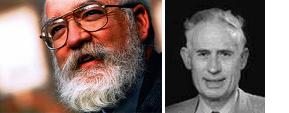
religion debate.JPG Daniel Dennett’s been at it again, this time in a juicy online Prospect debate with Richard Swinburne (pictured right), Emeritus Nolloth professor of the Philosophy of the Christian religion at the University of Oxford. In the debate Swinburne suggests science can’t begin to study religion without first acknowledging that God exists. Dennett argues that religions might well be a nice way of explaining what’s happened so far, but they’re not useful for furthering our understanding of the natural world because they don’t make any meaningful, testable predictions. But according to Swinburne that’s not what science is all about. Hmm…

A few excerpts:

Swinburne: ‚ÄúSo why are the most general laws of the multiverse as they are? Why do all particles behave in exactly the same way as each other, so as together ultimately to produce human life? This enormous coincidence in particle behaviour requires explaining. I’ve got a good theory which explains it [God]; you haven’t‚Äù.

Dennett: ‚ÄúFrom my perspective, your imaginative attempt at an inference to the best explanation is telling for the one thing it lacks: a single striking prediction. That’s why it can’t be taken seriously as a contender against a purely secular and materialist theory of cosmic and biological and cultural evolution‚Äù.

Swinburne: ‚ÄúI don’t think that it is in any way important that science should make predictions‚Äù.

Link to earlier post about science explaining religion.
Link to earlier post about Prospect debate on whether science can explain mental illness.
Link to event at At-Bristol Imax next Weds, where Dennett, Swinburne and others will be debating science and religion.
Make a real day of it and check out their Your Amazing Brain exhibition while you’re there.

Women in mind

women_statue.jpgToday is International Women’s Day, where the achievements of women are celebrated, which seems particularly appropriate in the cognitive sciences as there is a strong tradition of female participation.

In fact, the majority of cognitive scientists are women and most males will find themselves outnumbered on psychology and neuroscience courses.

This is, perhaps, because there are some strong female role models who have made a huge impact on the understanding of human thought and behaviour.

One of my many female heroes is neuropsychologist Professor Elizabeth Warrington, who published her first paper in 1962, and, although now officially retired, is still heavily involved in research and is publishing regularly.

Warrington was one of the most influential figures in the development of cognitive neuropsychology and helped define the field during its emergence in the 1970s and 1980s.

Many of the standard clinical assessments of cognitive function were created by her, which are now crucial components of clinical assessment after brain injury.

Link to Royal Society Fellowship Citation for Elizabeth Warrington.
Link to PubMed entries for Elizabeth Warrington.

Is ‘theory of mind’ impaired in autism?

sean_ballpool.jpgThe claim that people with autism have an impaired ‘theory of mind‘ (that is, they are supposedly not able to imagine what other people are thinking) is one of the most commonly repeated ‘facts’ about the condition.

This typically infuriates people with autism, especially when it gets translated into the more everyday, and, perhaps, even less accurate claim, that autism involves a ‘lack of empathy’.

It is now being challenged by researchers, such as Professor Morton Gernsbacher, who are comparing the performance of participants with autism on experimental tests of ‘theory of mind’ with individuals who do not have autism but do have similar problems in understanding language.

Gernsbacher is interviewed in a short section on BBC Radio 4’s science programme Leading Edge (starts 15 minutes into the realaudio stream) where she explains that apparent ‘theory of mind’ problems may be due to participants with autism not always understanding the complexity of the verbal instructions in tests such as the ‘Sally-Anne’ task.

Gernsbacher claims that in ‘theory of mind’ tests that use drawing, rather than verbal interaction, autistic children actually do better than non-autistic children.

This echoes findings from studies on non-autistic deaf children (pdf) who seem to show ‘theory of mind’ impairments if they suffer problems with language development, but not if they become fluent in sign-language.

Link to description of ‘theory of mind’.
Link to Leading Edge webpage for 23rd Feb edition (via Autism Diva).
Realaudio of programme (section starts 15 minutes in).
Link to flash heavy website of Morton Gernsbacher’s lab.
PDF of ‘Insights into theory of mind from autism and deafness’ by Peterson and Siegal.

Marketing anxiety

worry_image.jpgI recently went to a talk by Professor Nikolas Rose where he noted that for ¬£8,000 you can buy a report entitled ‘Anxiety Disorders: More Than Just a Comorbidity‘ from an online business intelligence company.

The report will apparently allow you to “assess the size of the drug-treated population”, “target physicians more effectively” and “identify commercial opportunities”.

An excerpt:

Anxiety disorders are considered the most prevalent of psychiatric disorders. However, poor diagnosis rates and treatment outcomes mean that there is still considerable scope for manufacturers to move into the anxiety market.

Yes, you read that right, it genuinely uses the phrase “anxiety market”.

It even promotes investment in ‘awareness campaigns’ (i.e. astroturfing) as a way of ‘maximising revenues’ in the drugs market.

Psychiatric drugs are a useful option for treating mental distress, although many professionals consider them over-used and over-promoted, particularly in light of the fact that the treatment with the longest duration of effect for anxiety disorders is cognitive behavioural therapy rather than medication (see pdf of NICE guidelines).

Unfortunately, the business intelligence report mentioned above reflects exactly the sort of approach to healthcare that makes people cynical of the mental health system.

Link to NICE review on treatment of anxiety disorders.
Link to report summary ‘Anxiety Disorders: More Than Just a Comorbidity’.

Neurology of headache

head_movement_blur.jpgBBC Radio 4’s medical programme Check Up just had a special on the most common neurological symptom – headache.

Neurologist Professor Peter Goadsby joins the programme to explain the current science and treatments. One particular focus is cluster headaches which are a particularly severe form that are notorious for beginning without warning.

As well as tackling the neuroscience of the various conditions, Professor Goadsby also passes on straightforward advice for managing and preventing headache in those who are susceptible.

Link to Check Up webpage on Headaches edition.
Realaudio of programme.

A Darwinian tiff

This had me in stitches. Apparently Darwinian philosopher Daniel Dennett (who’s out and about promoting his new book) has fallen out with fellow Darwinian, British-Born philosopher Michael Ruse. Ruse warns against taking evolutionary theory too far, so that it becomes an argument for atheism. Anyway, during the tiff (see here for detail) Dennett emailed Ruse suggesting he was being enlisted by the dark side. So Ruse replied:

“I am a full professor with tenure at a university known chiefly for its prowess on the football field, living out my retirement years in the sunshine ‚Äì I have no reputation to preserve, and frankly can say and do whatever the fuck I want to without sinking further‚Äù.

‚ÄúI am a hardline Darwinian and always have been very publicly‚Ķ in fact I am more hardline than you are, because I don‚Äôt buy into this meme bullshit but put everything‚Ķin the language of genes”.

Reflecting on the fall out, Ruse apparently had this to say:

“I think he [Dan Dennett] finds it very difficult when people don’t say to him ‘you were fantastic. Can I warm the bog seat for you before you take a crap?’”.

Link to Guardian article where I read about this.
Link to William Dembski’s blog – he’s an Intelligent Design Creationist who first made the saga public.

Thinking with a damaged brain

lost_brain.jpgJournalist Floyd Skoot has written an insightful article for Lost Magazine about his experiences of virus-induced brain damage and the curious effects it has had on his speech, movement and mathematical ability.

Skoot interlaces personal experience with his wide reading in the cognitive sciences to bring alive the generalities and clinical detachment typically found in neurological textbooks.

In their fascinating study, Brain Repair, an international trio of neuroscientists ‚Äî Donald G. Stein from America, Simon Brailowsky from Mexico, and Bruno Will from France ‚Äî report that after injury “both cortical and subcortical structures undergo dramatic changes in the pattern of blood flow and neural activity, even those structures that do not appear to be directly or primarily connected with the zone of injury.” From this observation, they conclude that “the entire brain ‚Äî not just the region around the area of damage ‚Äî reorganizes in response to brain injury.” The implications of this are staggering; my entire brain, the organ by which my very consciousness is controlled, was reorganized one day ten years ago. I went to sleep here and woke up there; the place looked the same but nothing in it worked the way it used to.

It’s rare to find such a carefully considered and well-informed account of brain damage from someone who has suffered the consequences.

One other source, however, is a book called Injured Brains of Medical Minds where medical people, including some neuroscientists and psychologists, discuss their own experience of brain injury. The book covers 120 years of accounts, with some only attributed to ‘anonymous’.

Link to article ‘Thinking with a damaged brain’.
Link to information on book ‘Injured Brains of Medical Minds’.

the endowment effect & marketing

The endowment effect is that we value more highly what we already have. It’s a variation on the status quo bias that we talk about in Mind Hacks (Hack #74). This cognitive bias is of particular interest to economists, because it has implications for how eonomies work. If it is strongly in effect then people will trade less than is required to bring about the optimal resource allocation that free market’s are theoretically capable of. The most famous demonstration of the endowment effect directly addresses the operation of the endowment effect in a market trading situation [1] – showing that even though preferences for a small arbitrary item (a coffee mug) are randomly distributed, if you give half of the group one and allow them to trade less trading happens than you would predict. In other words more people want to hold on to their mug now they’ve got one, than people without a mug want to get hold of one. The preferences of the group have been realigned according to initial resource distribution.

This is all relevant to marketing, as well as economics of course. You can see why car-salespeople are keen for you to take a test-drive before you purchase, or why shops are happy to offer a money-back-with-no-questions-asked option. You figure the money-back option into your cost-benefit calculation about whether to take something home, but once you’ve got it home your preferences realign – that item is now “yours”, so you’re far less likely to take it back to the shop, even if it doesn’t turn out to be as good as you thought when you bought it.

Refs and Links:

[1] Kahneman, D., J.L. Knetsch and R.H. Thaler (1990). Experimental Tests of the Endowment Effect and the Coase Theorem. Journal of Political Economy. link
Wikipedia: The Endowment effect: : link
Experienced traders can overcome the endowment effect : Economist article
References at behaviouralfinance.net

[Cross-posted at idiolect.org.uk]

Excellent All in the Mind on epilepsy

blue_epilepsy.jpgLast week’s edition of ABC Radio National’s All in the Mind was an excellent programme on the science, experience and treatment of epilepsy.

The programme talks to several neurologists about what causes the curious condition and how it is being treated.

Also featured on the programmme is Gail Williams, a 16 year old girl who had epilepsy since the age of 4, an experience which included seeing unusual hallucinations before she lost consciousness.

Gail’s epilepsy was particularly serious, and was eventually given brain surgery which has since stopped her seizures. She describes the experience of the surgery and life before and after epilepsy.

This is one of the most comprehensive and engaging programmes I’ve yet heard on the condition. Half an hour well spent.

mp3 or realaudio of programme.
Link to transcript.
Link to Epilepsy Action information pages.

A quick and miscellaneous list of advertising links

Metafiler: “Why do companies advertise?”

Stayfree’s media literacy curriculum

Vaughan on Mindhacks.com does some smackdown on neuromarketing

Guardian special report on loyalty cards

A brief guide to the concept of ‘priming’

Three from the BPS research digest:
When sex doesn’t sell (either because it distracts or provokes negative associations)

Experimental confirmation that music affects the power of (political adverts)

looking for the best option, rather than a good enough option can make you unhappy

Pledgebank: art not ads

Icarus Diving on my decoding advertisements post

Experienced traders seem to overcome the endowement effect (a common cogntiive bias)

Consciousness exists to make itself unnecessary

While we’re thinking about the nature of free conscious choice, this is extremely relevant. John Bargh, in this chapter – Bypassing the Will: Towards Demystifying the Nonconscious Control of Social Behavior [1] – takes evidence from several different subdisciplines and argues that consciousness – that thing which gives us our experience of deliberate control – exists exactly to make automatic, ‘unwilled’, behaviours possible.

Bargh talks about cases where the individual’s behavior is being “controlled” by external stimuli, not by his or her own consciously-accessible intentions or acts of will. and they are not aware of the true causes of their behavior. These exist, he says, not despite conscious control, but because of it


In a very real sense, then, the purpose of consciousness — why it evolved — may be for the assemblage of complex nonconscious skills. In harmony with the general plasticity of human brain development, people have the capability of building ever more complex automatic ‚Äúdemons‚Äù that fit their own idiosyncratic environment, needs, and purposes. As William James (1890) argued, consciousness drops out of those processes where it is no longer needed, freeing itself for where it is…Intriguingly, then, one of the primary objectives of conscious processing may be to eliminate the need for itself in the future by making learned skills as automatic as possible. It would be ironic indeed if, given the current juxtaposition of automatic and conscious mental processes in the field of psychology, the evolved purpose of consciousness turns out to be the creation of ever more complex nonconscious processes.

[1] Bypassing the Will: Towards Demystifying the Nonconscious Control of Social Behavior by John Bargh (2004), in The New Unconscious; ed. R. Hassin, J. Uleman, & J. Bargh. Oxford University Press.

Amedeo puts bounty on free medical textbooks

bsk_logo.gifOpen-access medicine promoter Bernd Sebastian Kamps, has launched Amedeo Challenge – a project that offers bounties for authors to write high-quality medical textbooks that will be freely distributed over the internet.

Amedeo has already released free medical textbooks books on HIV and influenza, and now 12,500 euros are being offered for the authors of a book on tuberculosis.

Kamps has put this money up himself, but he’s also asking for sponsors to donate bounties for textbooks on a range of other medical conditons and specialities.

Of interest to readers here will be proposed books on Alzheimer’s Disease, Anaesthesiology, Genetics, Multiple Sclerosis, Neurology, Pain Medicine, Parkinson’s Disease and Psychiatry.

Unfortunately, it seems like only large sponsors are being gathered, but I’ve emailed Kamps to suggest a small donations system for individuals to donate towards a ‘running bounty’ for any book of their choice.

I’d happily donate 50 euros knowing that it would contribute towards the development of a high-quality, open-access psychiatry, neurology or neuropsychology textbook.

If you’d like the opportunity to do something similar, contact the project and suggest the same. It seems like many small donations could create large bounties in a relatively small amount of time.

UPDATE: Good news! I just got the following back from Bernd Sebastian Kamps:

Thank you for your suggestion: Your idea is brilliant (I had never thought of asking for small contributions).

We’ll open the PayPal account next week and by the end of the month, everything should be in place. I’ll keep you informed.

My ideas are rarely described as brilliant (my mum will be proud at least), but more importantly, we’ll post here when the Amedeo Challenge small donations system is in place.

Link to Amedeo Challenge.

2006-03-03 Spike activity

Quick links from the past week in mind and brain news:

spike.jpg

Measure of serotonin receptors in hippocampus found to be an early predictor of Alzheimer’s in some people.

Institute of Electrical and Electronics Engineers magazine Spectrum discusses the use of magnetic stimulation in the treatment of psychiatric disorder.

An explanation of a curious touch illusion called the “cutaneous rabbit” is offered after a recent brain-imaging study on the effect.

Electrical activity in the brain can predict which items will be remembered before they are encountered.

Babies as young as 18 months show willingness to help others, reports USA Today.

PsyBlog looks at the psychology of attributions in depressive thinking.

Cognitive Daily discusses an ingenious experiment that suggests that young babies have an understanding of others people’s goals.

Does advertising erode free will

Ah…now here’s the nub of the argument: advertisements erode free will, they are manipulations designed to subvert conscious judgement (I paraphrase Clay Shirky at Edge.org). Shirky mentions one particular judgement bias, that of super-sizing, but the general form of bias should be familiar to anyone who has been reading Mind Hacks, and/or my recent posts about advertising (like this one). Quoting Shirky


Consider the phenomenon of ‘super-sizing’, where a restaurant patron is offered the chance to increase the portion size of their meal for some small amount of money. This presents a curious problem for the concept of free will ‚Äî the patron has already made a calculation about the amount of money they are willing to pay in return for a particular amount of food. However, when the question is re-asked, ‚Äî not “Would you pay $5.79 for this total amount of food?” but “Would you pay an additional 30 cents for more french fries?” ‚Äî patrons often say yes, despite having answered “No” moments before to an economically identical question. Super-sizing is expressly designed to subvert conscious judgment, and it works.

Shirky believes this is much more serious than just unfair advertising.

Our legal, political, and economic systems, the mechanisms that run modern society, all assume that people are uniformly capable of consciously modulating their behaviors…[These] days are now ending, and everyone from advertisers to political consultants increasingly understands, in voluminous biological detail, how to manipulate consciousness in ways that weaken our notion of free will.

In the coming decades, our concept of free will, based as it is on ignorance of its actual mechanisms, will be destroyed by what we learn about the actual workings of the brain

Previously I argued that creating changes in people’s behaviour didn’t necessarily mean that people were being coerced, or that their will was being taken away from them. The demonstration of influences on behaviour doesn’t knock down any strong version of free will – the kind of free will which is entirely unaffected by anything else doesn’t seem like a variety of free will worth wanting.

People faced a similar dilemma in the nineteenth century when statistics were first compiled of suicides. If we can predict from census records that the number of suicides in a parish in a year will be around seven, where does that leave the free will of those who ‘choose’ to kill themselves that year? Are you taking away the freedom of the seven people who now have to die to fulfil your prediction? (Philip Ball discusses the science and philosophy of this in his book, Critical Mass). Most people, now, would probably be happy to say that just calculating the statistic doesn’t effect anything. But with the case of interventions – either marketing strategies or psychology experiments – which have the explicit purpose of changing behaviour, it isn’t so clear that we can happily say that individual freedom isn’t being unfairly manipulated. Cialdini’s point about suicide contagion makes me worry that there is no clear line between persuasion and coercion, between biasing people’s judgements in small ways, over unimportant decisions, and fundamentally changing the way people make decisions about some of the most important things in life.

I’m happy to throw my hands up at this point and say I’ve no idea what the right way to resolve this is. Free will seems to dissolve as you draw away from it – as an individual I don’t feel manipulated, but when i look at other people – especially groups of other people, it seems like I can see manipulation going on. Has anyone got any useful conceptual structures I can borrow to see me through this?

Neuroscience books reviewed by Washington Post

white_book.jpgThe Washington Post has a brief review of three recently released neuroscience books: ‘The Three Pound Enigma’ by Shannon Moffett, ‘The Creating Brain’ by Nancy Andreasen and ‘The Mature Mind’ by Gene Cohen.

Consider the issue of creativity, which is central to Andreasen’s book and rates a chapter in Cohen’s. No one would doubt that the brain processes the thoughts and actions that later will be called “creative.” But how do creative thoughts differ from ordinary ones? The coincidence between what we label “mental disease” and “creativity” that so puzzled the Italian criminologist Cesare Lombroso more than a century ago is still a rather embarrassing finding. How can mental processes that we hold to be among the highest achievements of humankind be so uncomfortably close to those we consider defective or aberrant? And how come Einstein had such poor grooming habits, as Andreasen notes?

Link to review from Washington Post (via BrainBlog).