Not tonight honey…?

blue_headache_image.jpgAlthough headaches are a traditional turn-off for amorous couples, new research published in the journal Headache suggests that people susceptible to migraines actually report greater levels of sexual desire.

The authors suggest that the link may be levels of the neurotransmitter serotonin – which are linked to libido and have also been found to increase during migraine onset.

Luckily, greater levels of sexual desire tend to be a general trait in those susceptible to migraine, rather than being linked to the experience of headache itself.

Link to study abstract.

2006-06-16 Spike activity

Quick links from the past week in mind and brain news:

spike.jpg

The Boston Globe has a review of Walter Benjamin’s collected writings on drugs and intoxication.

Study finds Prozac worse than placebo at treating anorexia (via AADT)

South America’s indigenous Aymara people have a ‘reverse concept’ of time.

The Phineas Gage Group apply behavioural science to legal education.

Older people do mellow with age – they’re quicker to perceive happiness, slower to perceive fear.

World of Psychology report that child abuse may be a causal factor in schizophrenia.

Psychologist Dana Leighton is recording and podcasting her general psychology lectures.

Developing Intelligence looks at recent research which is trying to determine the main alogorithms of the prefrontal cortex.

One I missed in a previous post… Chronobiology blog Coturnix has now moved to A Blog Around the Clock.

Shy children more sensitive to life’s subtleties

science_shy_study.jpgScience have an interesting snippet on a study that shows that shy children may not only be more sensitive to unpleasant things, and also to pleasurable and rewarding experiences as well.

A brain scanning study led by Dr Amanda Guyer showed that areas of the brain sensitive to both anxiety and reward were more strongly activated in shy children than other children.

The study subjects – who were classified as either shy or outgoing based on psychological testing – were instructed to press a button as quickly as possible after being shown a signal. If they pressed the button in time, they won money, or at least prevented themselves from losing it.

Both groups performed similarly, and there was no difference in the activity of their amygdalas – the brain region that governs fear. Shy children, however, showed two to three times more activity in their striatum, which is associated with reward, than outgoing children, the team reports in the 14 June issue of the Journal of Neuroscience. “Up until now, people thought that [shyness] was mostly related to avoidance of social situations,” says co-author and child psychiatrist Monique Ernst. “Here we showed that shy children have increased activity in the reward system of the brain as well.”

Link to article ‘The Rewards of Being Shy’.
Link to study abstract.

Sexy images engage the female brain fast

erotics_images_eeg_map.jpgA recent study examining how the brain reacts to different types of image has found that women show a quicker reaction to erotic images than other image types. This is the first time that a difference in brain activity for erotic images has been found in women.

The research was led by neuroscientist Andrey Anokhin and used a technique that measures electrical activity from the brain by recording event-related potentials or ERP.

ERP is not very good at detecting which exact areas activity comes from, but can detect changes over very short periods of time (less than a millisecond). This makes it very good for determining differences in when the brain reacts.

Previous studies have found that men tend to show a stronger physiological response to erotic images than other images, as well as having larger areas of brain active when viewing such images.

Until now, no difference between erotic and non-erotic images had been found in women.

The study found that erotic images differently activated the mid part of the female prefrontal cortex (the red area in the image on the left) when compared to other images, within 185ms. Interestingly, this was regardless of how arousing or emotionally strong the images were.

185ms is an incredibly short time for the brain to differentiate between image types, and is almost certainly an automatic response. The prefrontal cortex is known to be involved in attention, and the authors suggest this activity reflects a vigiliance for socially relevant visual scenes.

When taken with the other research in the area, these findings suggests that men and women show differences in both where and when brain activity occurs when viewing erotic images.

However, it is still not clear what these differences might mean, and more extensive studies will need to be conducted to better understand this response.

It is also interesting that Anokhin and colleagues didn’t ask the female participants about sexual activity, orientation or a number of other things (such as stage in the menstrual cycle) that might affect reaction to erotic images.

It may be that these might have their own unique effect upon the new form of response reported in this study.

Link to study abstract.
Link to write-up from Live Science.

Home transcranial magnetic stimulation

blue_magnet.jpgTranscranial magnetic stimulation (TMS) is a technique whereby magnetic fields are used to temporarily alter the function of the brain by inducing an electrical current in the brain tissue.

In neuroscience research, TMS usually refers to the use of powerful magnetic fields (about 1.5 tesla or 40,000 times the earth’s magnetic field) focused on approximately 1x1cm areas of the cortex.

Repetitive TMS (rTMS) can be used either to make the area more active or less active over a specific time period (often 30 minutes or so), while single pulse TMS is used to harmlessly ‘knock out’ an area for approximately 100ms.

Much weaker magnetic fields (about the strength of a loudspeaker) but much more complex in form, have also been used to induce unusual experiences by stimulating the temporal lobes, most notably by neuroscientist Dr Michael Persinger.

A new project called Open-rTMS aims to develop this latter type of system (actually, generally not referred to as TMS in the neuroscience literature) and publish the plans and software online.

They’re currently looking for people to sign up to the mailing list and kick the project off, so if you’re looking for a way to alter your state of consciousness with magnets, this might be your chance.

The project is similar in approach to the OpenEEG project, which aims to provide software and plans for a home EEG system, so you can read the brain’s electrical activity.

Link to Science News article on high-strength TMS.
Link to low-strength Open-rTMS project page.

Imitating the sacred disease

Fractal_Brain.jpgNew Scientist reports on a recent study that looks at the differences between epilepsy and psychogenic non-epileptic seizures – a mysterious condition that looks like a standard epileptic seizure (e.g. falling to the floor, limb shaking and unconsciousness) but does not seem to involve any disturbance in brain activity and instead is linked to underlying emotional issues and psychological distress.

It has been suggested that patients with psychogenic non-epileptic seizures consciously fake their attacks, but it now seems that although not related to a disturbance in brain function, the attacks are not under conscious control and seem to be related to conversion hysteria, where psychological stress leads to otherwise unexplained medical symptoms.

There’s more on these type of seizures in a previous post on Mind Hacks, for those that are interested.

A recent study by Dr Steve Chung and his colleagues attempted to distinguish between epileptic and non-epileptic seizures by carefully watching videos of people when they have a seizure.

They noticed that in genuine generalised epileptic seizures, the patients had their eyes open during the attack, whereas those with non-epileptic seizures had their eyes closed.

This can be seen in their video of a genuine epileptic seizure (WMV file) when compared to a non-epileptic seizure (WMA file).

The head and eye turning that occurs at the start of the genuine seizure is typical in some forms of epilepsy, and usually indicates that the seizure starts in the side of the brain opposite to the side of turning.

The ability to easily distinguish between seizure types is important, as genuine seizures are best treated with anti-epileptic drugs, whereas non-epileptic seizures can be treated with psychological therapy.

Link to New Scientist story.
Link to abstract of study from Neurology.
Link to previous Mind Hacks post on non-epileptic seizures.

Being subjected

tv_face.jpgFox TV have just started a new reality TV show called ‘Solitary‘ where contestants are put into solitary confinement and stressed until their physical or mental health can’t take any more.

According to the website, “a test may include repetitive cycles of number games, conducted while being subjected to loud sirens and during times of sporadic sleep deprivation”.

When did psychological abuse become entertainment?

Link to Solitary website (via World of Psychology).

Remembering Kitty Genovese

KittyGenovese.jpgKitty Genovese was murdered outside her apartment block in 1964 by a stranger. The story of her death had a massive influence on psychology, leading to the description of the bystander effect – where people are less likely to intervene in an emergency when they’re in groups as when they are alone.

This arose from the reports that Kitty was killed in sight of 38 of her neighbours, who all assumed that someone else would help or phone the police while she was being fatally stabbed. In the event, she died shortly after.

Like several other founding myths in psychology (such as the stories of Phineas Gage and Little Albert) the truth of Kitty’s murder is not as clear-cut as the textbooks make out.

The ‘bystander effect’ itself is considered to be real. With additional people comes a ‘diffusion of responsibility’ that makes it less likely that individuals feel a personal responsibility to take action.

Nevertheless, the popular story of the the murder is likely to have been muddied.

Joe De May, a current resident of the same apartment block that Kitty lived in, has pieced together a careful account of the murder from news reports and court documents.

It turns out that it is unlikely that Kitty’s murder was witnessed by nearly 40 people who did not act. In fact, only two clear witnesses to the attack were ever found. There are many more details which seem to have made their way into the media, and then into psychological myth, that probably never occurred.

A recent twist saw Kitty’s story told by her girlfriend and lover, Mary Ann Zielonko, in a recent radio interview. Mary Ann describes the Kitty Genovese that is missing from the textbooks, and how her death affected those left behind.

Sadly, Kitty’s death is no less tragic for this historical debunking, and it is no less tragic that the ‘bystander effect’ occurs all too often when people are in trouble.

Link to audio of radio programme ‘Remembering Kitty Genovese’.
Link to Joe De May’s investigation into the case (via MeFi).
Link to Wikipedia page on Kitty Genovese.

Science of Happiness on the air

happy_shadow.jpgThe Canadian science radio show Quirks and Quarks had a recent special on the Science of Happiness – an area that has seen an upsurge of interest in recent years.

The show interviews some of the leading psychologists in the field and discusses the sometimes counter-intuitive findings about how our happiness is affected by our experience of the world.

We mentioned work by Professor Daniel Gilbert, one of the show’s contributors, previously on Mind Hacks.

Link to show webpage.
mp3 or ogg of programme audio.

Scienceblogs ‘Brain and Behavior’ channel

ScienceBlogsLogo.pngScienceBlogs has just welcomed a slew of new writers in the fold and now has enough to justify a Brain and Behavior Channel which gathers all the posts from the cognitive and neuroscience sites.
The new members include neuroscientists Shelly Batts, Jake Young and, er, The Evil Monkey.

Also part of the collective are Jonah Lehrer, a staff writer for Seed Magazine with an interest in cognitive science, and a site called Corpus Callosum, written by a community psychiatrist from the US.

You may also recognise Mixing Memory and Carl Zimmer’s The Loom , both of which have now moved to the expanded science blogging site.

Link to ScienceBlogs brain and behavior channel.

From Freud to cognitive therapy

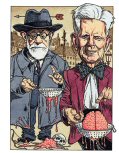
Linklater_essay_image.jpgProspect Magazine has an in-depth article about the development of cognitive behaviour therapy (CBT) – one of the most researched and effective forms of modern psychotherapy.

The article tracks how Aaron Beck discovered the principles of CBT after initially starting off as a Freudian therapist himself.

The therapy is now one of the most widely recommended non-drug treatments for mental disorder, as well as a number of other situations where psychological function can be altered to increase quality of life, such as in chronic pain.

The article is one of the best descriptions of CBT I’ve yet seen in a mainstream publication and does a great job of outlining the history of the practice.

Link to article ‘After Freud’.

Suicide itself now an act of war

A motivation not yet mentioned in the extensive scientific literature on suicide was offered by the US Government for why three inmates killed themselves in Guantanamo Bay – apparently, it was a well-planned “act of asymmetric warfare“.

Perhaps, someone could email the organisors of the US Department of Defense 2006 Military Suicide Prevention Conference and let them know that their opening talk on the Theoretical Considerations of Suicide by Dr. David Jobes (powerpoint slides here) obviously missed out this important explanation in an otherwise comprehensive coverage of the medical literature?

UPDATE: Six hours after the first story, the suicides are now being explained as a ‘PR move‘. Doesn’t science move fast.

Link to BBC News Story (via MeFi).
Link to 2006 Military Suicide Prevention Conference homepage and slides.

Cognitive science podcasts from Science and the City

bw_headphones.jpgNew York Academy of Sciences webzine Science in the City has a been archiving a series of interviews, conversations, and lectures by noted scientists and authors, including some of the brightest and best in cognitive science.

Some of the recent events have been:

* Mind Versus Soul panel discussion [mp3]
* Eric Kandel on In Search of Memory [mp3]
* V.S. Ramachandran on Synesthesia and Art [QT]
* How Human Minds Make Human Kinds [mp3]
* The Chemical Roots of Romance [mp3]
* How Trauma Changes Us [mp3]
* Facts, Ethics, and Policy Guiding Neuroscience [mp3]
* Ethics in the Age of Neuroscience [mp3]

The QT link for the Ramachandran talk is an ‘enhanced podcast’ that displays relevant links and images as the talk progresses if played in Quicktime.

Link to Science in the City podcasts (thanks Ben!).

SciAmMind on mental workouts and bitter pills

SciAmMind_June2006.jpgIt’s that time again when a new edition of Scientific American Mind has hit the shelves with the customary freely available feature articles available online.

One of the online articles examines the recent trend for mental workout computer games deliberately designed to keep the grey cells ticking over and the mind sharp.

It particularly examines the science behind the Nintendo game Brain Age and whether there is actually hard evidence that these sort of games help maintain mental function into old age.

The other freely available article reminds me of a discussion sparked by a previous Mind Hacks post about whether there are taste or smell illusions, analogous to visual illusions.

Some of the comments on this post were fascinating and one contributor mentioned the properties of miraculin, a glycoprotein from the Miracle Fruit that fools the tongue into tasting sour things as sweet.

The SciAmMind article looks at ongoing research on how food company scientists are developing chemicals to change the taste perception of bitter compounds. It seems it needs an understanding of both the genetic effects of taste perception and the chemical interactions of our sense organs.

The full issue also contains articles on the psychology of burnout, the latest on neuronal communication, savant abilities, controlling epilepsy, getting new generations of drugs into the brain and one reporter’s experience of dating Hiroshi Ishiguro’s life-like female android.

Link to contents of new Scientific American Mind.
Link to article ‘Circuit Training’.
Link to article ‘Bitter Could Taste Better’.

2006-06-09 Spike activity

Quick links from the past week in mind and brain news:

spike.jpg

The Nobel Prize website has an online game to illustrate Roger Sperry’s work on split-brain patients – with Mr Split-Brainy!

Brian Ethics has a cutting-edge update on the science of genetic influences on mind and brain.

American Scientist talks to neuroscientist Eric Kandel about his current reads and favourite books.

The synaesthesia-like links between taste and smell are investigated by Cognitive Daily’s faultless account of a recent scientific study.

New campaign video for wonder drug Panexa hits the net.

Ultra-sensitive material may pave the way for remote human touch technology.

The increasingly compulsive Developing Intelligence tags up a series of recent posts on neuroscience and transhumanism.

The brain’s left caudate may mediate the switch between language in bilingual speakers, reports Science.