Being subjected

tv_face.jpgFox TV have just started a new reality TV show called ‘Solitary‘ where contestants are put into solitary confinement and stressed until their physical or mental health can’t take any more.

According to the website, “a test may include repetitive cycles of number games, conducted while being subjected to loud sirens and during times of sporadic sleep deprivation”.

When did psychological abuse become entertainment?

Link to Solitary website (via World of Psychology).

Remembering Kitty Genovese

KittyGenovese.jpgKitty Genovese was murdered outside her apartment block in 1964 by a stranger. The story of her death had a massive influence on psychology, leading to the description of the bystander effect – where people are less likely to intervene in an emergency when they’re in groups as when they are alone.

This arose from the reports that Kitty was killed in sight of 38 of her neighbours, who all assumed that someone else would help or phone the police while she was being fatally stabbed. In the event, she died shortly after.

Like several other founding myths in psychology (such as the stories of Phineas Gage and Little Albert) the truth of Kitty’s murder is not as clear-cut as the textbooks make out.

The ‘bystander effect’ itself is considered to be real. With additional people comes a ‘diffusion of responsibility’ that makes it less likely that individuals feel a personal responsibility to take action.

Nevertheless, the popular story of the the murder is likely to have been muddied.

Joe De May, a current resident of the same apartment block that Kitty lived in, has pieced together a careful account of the murder from news reports and court documents.

It turns out that it is unlikely that Kitty’s murder was witnessed by nearly 40 people who did not act. In fact, only two clear witnesses to the attack were ever found. There are many more details which seem to have made their way into the media, and then into psychological myth, that probably never occurred.

A recent twist saw Kitty’s story told by her girlfriend and lover, Mary Ann Zielonko, in a recent radio interview. Mary Ann describes the Kitty Genovese that is missing from the textbooks, and how her death affected those left behind.

Sadly, Kitty’s death is no less tragic for this historical debunking, and it is no less tragic that the ‘bystander effect’ occurs all too often when people are in trouble.

Link to audio of radio programme ‘Remembering Kitty Genovese’.
Link to Joe De May’s investigation into the case (via MeFi).
Link to Wikipedia page on Kitty Genovese.

Science of Happiness on the air

happy_shadow.jpgThe Canadian science radio show Quirks and Quarks had a recent special on the Science of Happiness – an area that has seen an upsurge of interest in recent years.

The show interviews some of the leading psychologists in the field and discusses the sometimes counter-intuitive findings about how our happiness is affected by our experience of the world.

We mentioned work by Professor Daniel Gilbert, one of the show’s contributors, previously on Mind Hacks.

Link to show webpage.
mp3 or ogg of programme audio.

Scienceblogs ‘Brain and Behavior’ channel

ScienceBlogsLogo.pngScienceBlogs has just welcomed a slew of new writers in the fold and now has enough to justify a Brain and Behavior Channel which gathers all the posts from the cognitive and neuroscience sites.
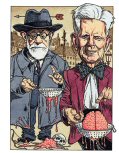
The new members include neuroscientists Shelly Batts, Jake Young and, er, The Evil Monkey.

Also part of the collective are Jonah Lehrer, a staff writer for Seed Magazine with an interest in cognitive science, and a site called Corpus Callosum, written by a community psychiatrist from the US.

You may also recognise Mixing Memory and Carl Zimmer’s The Loom , both of which have now moved to the expanded science blogging site.

Link to ScienceBlogs brain and behavior channel.

From Freud to cognitive therapy

Linklater_essay_image.jpgProspect Magazine has an in-depth article about the development of cognitive behaviour therapy (CBT) – one of the most researched and effective forms of modern psychotherapy.

The article tracks how Aaron Beck discovered the principles of CBT after initially starting off as a Freudian therapist himself.

The therapy is now one of the most widely recommended non-drug treatments for mental disorder, as well as a number of other situations where psychological function can be altered to increase quality of life, such as in chronic pain.

The article is one of the best descriptions of CBT I’ve yet seen in a mainstream publication and does a great job of outlining the history of the practice.

Link to article ‘After Freud’.

Suicide itself now an act of war

A motivation not yet mentioned in the extensive scientific literature on suicide was offered by the US Government for why three inmates killed themselves in Guantanamo Bay – apparently, it was a well-planned “act of asymmetric warfare“.

Perhaps, someone could email the organisors of the US Department of Defense 2006 Military Suicide Prevention Conference and let them know that their opening talk on the Theoretical Considerations of Suicide by Dr. David Jobes (powerpoint slides here) obviously missed out this important explanation in an otherwise comprehensive coverage of the medical literature?

UPDATE: Six hours after the first story, the suicides are now being explained as a ‘PR move‘. Doesn’t science move fast.

Link to BBC News Story (via MeFi).
Link to 2006 Military Suicide Prevention Conference homepage and slides.

Cognitive science podcasts from Science and the City

bw_headphones.jpgNew York Academy of Sciences webzine Science in the City has a been archiving a series of interviews, conversations, and lectures by noted scientists and authors, including some of the brightest and best in cognitive science.

Some of the recent events have been:

* Mind Versus Soul panel discussion [mp3]
* Eric Kandel on In Search of Memory [mp3]
* V.S. Ramachandran on Synesthesia and Art [QT]
* How Human Minds Make Human Kinds [mp3]
* The Chemical Roots of Romance [mp3]
* How Trauma Changes Us [mp3]
* Facts, Ethics, and Policy Guiding Neuroscience [mp3]
* Ethics in the Age of Neuroscience [mp3]

The QT link for the Ramachandran talk is an ‘enhanced podcast’ that displays relevant links and images as the talk progresses if played in Quicktime.

Link to Science in the City podcasts (thanks Ben!).

SciAmMind on mental workouts and bitter pills

SciAmMind_June2006.jpgIt’s that time again when a new edition of Scientific American Mind has hit the shelves with the customary freely available feature articles available online.

One of the online articles examines the recent trend for mental workout computer games deliberately designed to keep the grey cells ticking over and the mind sharp.

It particularly examines the science behind the Nintendo game Brain Age and whether there is actually hard evidence that these sort of games help maintain mental function into old age.

The other freely available article reminds me of a discussion sparked by a previous Mind Hacks post about whether there are taste or smell illusions, analogous to visual illusions.

Some of the comments on this post were fascinating and one contributor mentioned the properties of miraculin, a glycoprotein from the Miracle Fruit that fools the tongue into tasting sour things as sweet.

The SciAmMind article looks at ongoing research on how food company scientists are developing chemicals to change the taste perception of bitter compounds. It seems it needs an understanding of both the genetic effects of taste perception and the chemical interactions of our sense organs.

The full issue also contains articles on the psychology of burnout, the latest on neuronal communication, savant abilities, controlling epilepsy, getting new generations of drugs into the brain and one reporter’s experience of dating Hiroshi Ishiguro’s life-like female android.

Link to contents of new Scientific American Mind.
Link to article ‘Circuit Training’.
Link to article ‘Bitter Could Taste Better’.

2006-06-09 Spike activity

Quick links from the past week in mind and brain news:

spike.jpg

The Nobel Prize website has an online game to illustrate Roger Sperry’s work on split-brain patients – with Mr Split-Brainy!

Brian Ethics has a cutting-edge update on the science of genetic influences on mind and brain.

American Scientist talks to neuroscientist Eric Kandel about his current reads and favourite books.

The synaesthesia-like links between taste and smell are investigated by Cognitive Daily’s faultless account of a recent scientific study.

New campaign video for wonder drug Panexa hits the net.

Ultra-sensitive material may pave the way for remote human touch technology.

The increasingly compulsive Developing Intelligence tags up a series of recent posts on neuroscience and transhumanism.

The brain’s left caudate may mediate the switch between language in bilingual speakers, reports Science.

Caffeine makes people more open to persuasion

cappuccino_cup.jpgDosing someone with coffee or another strongly caffeinated drink may make them more susceptible to persuasion, according to a recent study, reported in New Scientist.

Previous studies have show that consuming caffeine can improve one’s attention and enhance cognitive performance, with 200 milligrams (equivalent to two cups of coffee) being the optimal dose.

Moderate doses of caffeine can also make you more easily convinced by arguments that go against your beliefs, say Pearl Martin of the University of Queensland in Brisbane, Australia, and her colleagues.

In 2005, her team published a paper suggesting that the compound primes people to agree with statements that go against their typical views because it improves their ability to understand the reasoning behind the statements.

After a bit of a search, it seems the full paper is freely available online.

Link to news story from New Scientist.
Link to page with full-text paper.

Implanting magnets for a sixth sense

quinn_surgery.jpgWired magazine has an article about reporter Quinn Norton’s experience of implanting a magnet in her fingertip to add a magnetic touch sense to her sensory repertoire.

Matt reported on this practice previously on Mind Hacks, where those with the implants say they can detect magnetic fields from electrical devices.

Because of the sensitivity of the finger, different types of electrical current can supposedly be felt as different textures in the air.

The operation is not available from qualified practictioners, so involves risk of infection or the magnet breaking up – both of which Norton experienced after her implant.

Link to Wired article ‘A Sixth Sense for a Wired World’ (via BB).
Link to previous report on Mind Hacks.

Anger is an energy – and a mental illness, apparently

broken_mirror.jpgHaving ‘uncontrollable’ angry outbursts meets the criteria for “intermittent explosive disorder” – a diagnosable mental illness. According to a recent study, 7.3% of Americans could be diagnosable within their lifetime – that’s 1 in 14 people.

The diagnosis just seems to describe people who have occasional and extreme angry outbursts that are out of proportion to the stresses they experience.

No wonder diagnostic manuals get a bad name when behaviour within the normal spectrum (even if it is only displayed by a minority of people) is pathologised as a ‘mental illness’.

I suspect this reflects an increasing attitude than unless something is defined as a ‘mental illness’ people can’t be offered help for their problem, or perhaps, won’t be willing to seek assistance.

Link to write-up from New Scientist.
Link to abstract of scientific study.

Electric blues stimulation

vagusns_image.jpgThe Economist has a short but interesting piece on the use of vagus nerve stimulation to treat depression.

The technique involves implanting a pacemaker-like device into the body that stimulates the vagus nerve (in the neck) at regular intervals.

The technology was originally developed as a treatment for epilepsy, but it was discovered that some patients felt better after the device had been implanted, even if it didn’t help control their seizures.

I’m not quite sure of The Economist’s claim that the treatment “builds on” deep-brain stimulation, which is newer and more advanced in many respects and directly stimulates areas of the brain with an implanted electrode.

Nevertheless, the article is an engaging look at the increasing interest in this technology, and notes that no-one is really sure how it works – either in treating epilepsy or depression.

Link to Economist article.

Beautiful webcasts of Dana debates

exposed_brain.jpgThe UK’s Dana Centre regularly hosts free science events for the public and has been webcasting them live. They’ve now put the archives online and there’s a fantastic selection of high-quality programmes for mind and brain enthusiasts.

It’s now quite common for video of lectures or science events to be put online, but they tend to be filmed by a camera vaguely pointed at the speaker with the audio taken from the PA – making the whole thing quite difficult to watch.

In contrast, I was impressed by the fact that the Dana Centre webcasts are produced like a TV show, meaning you can actually see and hear what’s going on.

They’ve had events touching on eclectic range of mind and brain issues, including:

* Van Gogh: Method in his madness?
* Deep Brain Stimulation
* Creating Brains: the science of genius
* The Origins of Magical Beliefs
* Drugs and the Brain: Pills to make you normal
* Drugs and the Brain: Recreation or Therapy?
* The Ethical Brain
* Is It You or I Who Should Be in the Asylum?

All these events were streamed live before they were archived, and the website has details of whatever the next live webcast will be. The events often take questions via email from people watching over the internet.

A thoroughly impressive use of the internet and video technology. Well done Dana.