Couples’ faces grow more alike as they age

PsyBlog has picked up on a neat study from way back in ’87 that found that couples faces look more alike the longer they stay together, and the researchers suggest that empathy might play a part.

The study asked a group of participants to judge how similar pairs of photographs were. Some of the photos were taken after 25 years of marriage, some on the wedding day.

Couples were more likely to be judged as looking similar at the 25 year mark than when first married.

Couples were then asked to complete a questionnaire about how satisfied they were with their partnership. The study found that the couples who grew more alike were more likely to report being happy, share worries or concerns with each other, and perceive themselves to have similar attitudes.

The researchers suggest that empathy might play a part in the increased facial similarity.

Interestingly, now we know that more empathetic people tend to mimic other people’s facial emotional expressions more readily.

So after 25 years, the effect of more frequently copying another person’s face, might mean it would it would take on similar features.

There’s other explanations and some caveats, of course, and PsyBlog considers some of them as it looks at the study in more detail.

Link to PsyBlog on ‘Empathy Causes Facial Similarity Between Couples to Increase Over Time’.

War causes trauma, death, satire

This week’s edition of satirical newspaper The Onion has a cutting ‘news’ story on both the Iraq war and psychology, highlighting the absurdity that arises from trying to quantify the bleedin’ obvious and discussing the shortcomings of the study in the press.

The story supposedly concerns a study investigating the psychological impact of the Iraq war on civillians.

“Almost all the Iraqis we interviewed said the war had ruined their lives because of the incalculable loss of friends and family,” Pryztal said. “But to be totally honest, these types of studies can be skewed rather easily by participant exaggeration.”

Psychologists and anthropologists have thus far largely discounted the study, claiming it has the same bias as a 1971 Stanford University study that concluded that many Vietnamese showed signs of psychological trauma from nearly a quarter century of continuous war in southeast Asia.

“We are, in truth, still a long way from determining if Iraqis are exhibiting actual, U.S.-grade sadness,” Mayo Clinic neuropsychologist Norman Blum said. “At present, we see no reason for the popular press to report on Iraqi emotions as if they are real.”

Pryztal said that his research group would next examine whether children in Sudan prefer playing with toys or serving as guerrilla fighters and killing innocent civilians.

The Onion has a long and proud history of satirising psychology and psychologists, inspiring stories that are often as funny as they are painful.

Link to story ‘Iraqis May Experience Sadness When Friends, Relatives Die’.

40 years on: Experiences of ‘gay conversion therapy’

This Saturday marks the 40th anniversary of the first major decriminalisation of male-male sexual acts in the UK. Dr Petra Boynton looks back at how the change came about and has dug up some fascinating articles on the experience of <a href="http://www.bmj.com/cgi/content/full/328/7437/427
“>patients and professionals who took part in ‘gay conversion therapy’ in the 60s and 70s.

At one time, homosexuality was considered both a criminal act and a mental disorder.

It was decriminalised in both the US and the UK before it was removed from the diagnostic manuals, and treatments to change homosexuals into heterosexuals peaked in the 1960s and early 1970s.

Two articles were published in the British Medical Journal in 2004 that highlighted the experiences of patients and professionals who were involved in ‘conversion therapy’ either voluntarily or because of a court order.

One paper describes some of the methods:

In electric shock aversion therapy, electrodes were attached to the wrist or lower leg and shocks were administered while the patient watched photographs of men and women in various stages of undress. The aim was to encourage avoidance of the shock by moving to photographs of the opposite sex. It was hoped that arousal to same sex photographs would reduce, while relief arising from shock avoidance would increase, interest in opposite sex images. Some patients reported undergoing detailed examination before treatment, while others were assessed more perfunctorily.

Patients would recline on a bed or sit in a chair in a darkened room, either alone or with the professional behind a screen. Each treatment lasted about 30 minutes, with some participants given portable electric shock boxes to use at home while they induced sexual fantasies. Patients receiving apomorphine were often admitted to hospital due to side effects of nausea and dehydration and the need for repeated doses, while those receiving electric shock aversion therapy attended as outpatients for weeks or in some cases up to two years.

Oestrogen treatment to reduce libido (two participants in the 1950s), psychoanalysis (three private participants and one NHS participant in the 1970s), and religious counselling (two participants in the 1990s) were also reported. Other forms of treatment were electroconvulsive therapy [ECT], discussion of the evils of homosexuality, desensitisation of an assumed phobia of the opposite sex, hypnosis, psychodrama, and abreaction. Dating skills were sometimes taught, and occasionally men were encouraged to find a prostitute or female friend with whom to try sexual intercourse.

The professionals interviewed in the study present mixed views, but “most doubted the treatment’s efficacy, however, and came to question whether they were acting in patients’ best interests. They began to think that treatment was underpinning questionable social values and that patients might say anything to convince them that it had worked to avoid yet more treatment or further legal repercussions.”

As we reported earlier this month, this is currently a hot topic for the American Psychological Association, who are currently re-assessing their guidelines on whether they should explicitly denounce ‘conversion therapy’.

If you want to know more about how homosexuality was de-listed as a mental illness, there’s a fantastic radio programme online which looks at how the campaign was intricately tied up with one woman’s remarkable family history.

Link to Dr Petra on 40 years of decriminalisation.
Link to BMJ article on patients’ experience of ‘conversion therapy’.
Link to BMJ article on professionals’ experience of ‘conversion therapy’.
Link to radio programme ’81 words’.

Albert Ellis has left the building

Albert Ellis, one of the co-founders of cognitive therapy, died yesterday at his home in New York. The Boston Herald has an obituary that captures some of his work and eccentric spirit.

Ellis created ‘rational emotive behavior therapy’ (REBT) that stressed a rational approach to dealing with distressing cognitive distortions – a significant break from the largely Freudian therapy he was trained in.

It was an early version of cognitive behaviour therapy (CBT), now one of the most extensively tested, empirically validated and widely used psychological treatments for mental disorder.

Ellis was a prolific writer, producing a small library of books, papers and articles, did weekly seminars for most of his life and founded the Albert Ellis Institute.

Apart from his extensive writing he was known for his boundless energy and his approach to therapy and teaching which was variously described as no nonsense / assertive / confrontational (take your pick).

He was voted sixth in Psychotherapy Networker’s list of ‘top ten’ influential therapists of all time earlier this year.

Link to Boston Herald obituary for Albert Ellis.
Link to Psychotherapy Networker on Ellis.

Epilepsy: fighting myths and saving lives

BBC News reports on a recently published study that found that myths about epilepsy and its treatment are still widely believed, possibly putting people at risk. This post will tell you how to help someone having a seizure.

The research project, led by Dr Sallie Baxendale, used the internet to survey over 4,500 people concerning their knowledge of the effects of epilepsy, and what to do if someone has a seizure.

The study found that myths about the effects are widespread, many people still believe that epilepsy commonly causes ‘foaming at the mouth’ and is strongly linked to violence, neither of which are the case.

More worringly, a third of people thought they should put something in the mouth of a person having a seizure to stop them ‘swallowing their tongue’ and two-thirds would always call an ambulance.

Never put anything in the mouth of someone having a seizure (they could choke) and you only need to call an ambulance if it’s the person’s first seizure, if the seizure has been going on for more than five minutes, if they don’t regain consciousness between seizures, or if they’re physically injured.

This is the advice from Epilepsy Action about how to help someone who is having a tonic-clonic seizure.

These are what are sometimes called ‘fits’ and used to be called ‘grand-mal’ seizures. ‘Grand mal’ literally means ‘great evil’, and so understandably, isn’t used by the medical profession, although it still is used in day-to-day language by some people not familiar with the proper name.

Tonic-Clonic seizures

The person loses consciousness, the body stiffens, then falls to the ground. This is followed by jerking movements. A blue tinge around the mouth is likely. This is due to irregular breathing. Loss of bladder and/or bowel control may occur. After a minute or two the jerking movements should stop and consciousness may slowly return.

Do…
* Protect the person from injury – (remove harmful objects from nearby)
* Cushion their head
* Look for an epilepsy identity card or identity jewellery
* Aid breathing by gently placing them in the recovery position [pictured] once the seizure has finished
* Be calmly reassuring
* Stay with the person until recovery is complete

Don’t…
* Restrain the person
* Put anything in the person’s mouth
* Try to move the person unless they are in danger
* Give the person anything to eat or drink until they are fully recovered
* Attempt to bring them round

Call for an ambulance if…
* You know it is the person’s first seizure
* The seizure continues for more than five minutes
* One tonic-clonic seizure follows another without the person regaining consciousness between seizures
* The person is injured during the seizure
* You believe the person needs urgent medical attention

Obviously, if no-one knows whether it’s the person’s first seizure and they are unable to tell you, or no-one knows when the seizure started, call an ambulance.

Also, some people who have seizures will have strong emotional reactions when they come round owing to the brain disturbance.

The person might regain consciousness and seem terrified, traumatised, confused or very anxious (not always the case, some people feel elated).

This may cause onlookers to get equally anxious and panicky. Stay calm and just reassure the person (and everyone else if necessary!), gently letting them know what’s happened.

The Epilepsy Action first aid page also has information on dealing with other types of seizure.

Take the opportunity to read through the information – the next five minutes of your life could save someone else’s.

Link to Epilepsy Action first aid information.
Link to BBC News story ‘Many ‘believe myths’ on epilepsy’.
Link to abstract of research report.

Cognitive reserves and staying sharp

SharpBrains has a great interview with neuropsychologist Prof Yaakov Stern who discusses his research on maintaining a healthy brain and gives plenty of great advice for keeping your edge throughout life.

Stern talks about the cognitive and neural ‘reserve theories’ which argue that the mind and brain have a certain tolerance to decline and damage before they go into the freefall of dementia.

It’s sort of a threshold theory, suggesting that if the strain on the brain reaches past a certain point, the system starts to break down rapidly.

The amount of ‘reserve’ or the threshold varies between individuals, so some people are more likely to get dementia than others.

We know that genetics is one component, but what Stern’s research has also shown is that we can play an active part in boosting our reserve and raising our dementia threshold.

In other words, by changing our lifestyle we can maintain our mental sharpness for longer and reduce the chances of getting a degenerative brain disease.

Healthy diet, exercise and nutrition are key, but education, keeping mentally active and having a varied social life might also be important.

AF: Can you give us some examples of those leisure activities that seem to have the most positive effects?

YS: For our 2001 study we evaluated the effect of 13 activities, combining intellectual, physical, and social elements. Some of the activities with the most effect were reading, visiting friends or relatives, going to movies or restaurants, and walking for pleasure or going on an excursion. As you can see, a variety. We saw that the group with high level of leisure activities presented 38% less risk (controlling for other factors) of developing Alzheimer’s symptoms. And that, for each additional type of activity, the risk got reduced by 8%.

There is an additional element that we are starting to see more clearly. Physical exercise, by itself, also has a very beneficial impact on cognition. Only a few months ago researchers were able to show for the first time how physical activity promotes neurogenesis in the human brain. So, we need both mental and physical exercise. The not-so-good news is that, as of today, there no clear recipe for success. More research is needed before we prepare a systematic set of interventions that can help maximize our protection.

The interview also has plenty more practical advice, links to the original scientific papers, and a video, which I can’t watch because it’s blocked at work. Grrrr!

Link to SharpBrains interview with Prof Yaakov Stern.

Renaissance advice on mind and mood

A couple of quotes from the 16th and 17th centuries that still hold true today. The first from Leonardo da Vinci’s Notebooks, dated 1508:

Irons rusts from disuse, stagnant water loses its purity and in cold weather becomes frozen; even so does inaction sap the vigor of the mind.

Which reminded me of Robert Burton’s advice for combating depression, given in his landmark 17th century book, The Anatomy of Melancholy:

Observe this short precept — Be not solitary; be not idle.

Both sets of advice hold true today. Modern studies have shown that exercise boosts mood and prevents cognitive decline.

Are attention and consciousness the same thing?

Psychologists have often wondered whether attention and consciousness are the same thing. Can we only be conscious of things we pay attention to? And can we attend to things we’re not conscious of?

A paper [pdf] published last year suggests that they are, in fact, separate mental processes.

William James, one of the founder of modern psychology, wrote that “everyone knows what attention is” when trying to define it.

Similarly, as neuroscientist Susan Greenfield has pointed out, scientists often rely on a ‘we all know what we’re talking about, don’t we?’ definition of consciousness.

It turns out that attention is easier to define that consciousness, and in psychology it generally refers to the preferential processing of one source of information over another.

This can be measured experimentally because it’s possible to see how experience of one thing affects performance on another task, even if the person isn’t aware of experiencing anything in the first place.

We described an example of this last week, in a study that found that people could make accurate beauty judgements for faces presented so quickly they didn’t consciously recognise them.

This study, and many others on ‘implicit’ or ‘subliminal’ perception, demonstrate that people can attend to something without being conscious of it.

Being conscious of something we haven’t attended to, and where attention is nearly absent, is a bit more tricky.

The paper, by cognitive scientists Christof Koch and Naotsugu Tsuchiya, suggests that getting ‘gist’ impressions might be one example.

Experiments show that when photographs are unexpectedly flashed up in front of participants for no more than 30ms, they don’t have time to focus on any part of it, but can report a general gist or summary of the image.

Consciousness and attention have also been shown to have opposite effects in some instances.

When participants try to find two embedded images within a rapidly flashed stream of pictures, they often fail to see the second image – an effect known as ‘attentional blink‘.

However, one study [pdf] found that distracting people during this task, actually made them better at it, they were more likely to consciously detect the second image.

Reducing their attention to the task seemed to increase their conscious awareness.

The Koch and Tsuchiya paper has many more examples if you’re interested in trying to untangle these closely related processes.

pdf of ‘Attention and Consciousness: Two Distinct Brain Processes’ (via SciCon).

Autism, honesty and the capacity to deceive

Online magazine InCharacter has an article on what autism can tell us about honesty and deception, by autism researcher Prof Simon Baron-Cohen.

People with autism or related conditions are often poor at both deception and recognising deception in others. It’s not always the case, but it’s quite a common attribute.

Baron-Cohen’s article explores what we know about some of the differences in autistic thinking, and what might be so different that an effective understanding of deception becomes almost impossible.

He argues that a key skill is ‘meta-representation’, the ability to think about other thoughts, imaginary scenarios or abstract principles in yourself or others.

The key is that it’s not just thinking or imagining, it’s being able to think about thinking or imagining.

When this specifically involves thinking about what other people are thinking, understanding their perspective, it is often called ‘theory of mind‘.

You can see why this is a key skill in deception. You need to have a theory or understanding of what the other person is thinking or is likely to think, to work out how to hide the real state of the world from them.

As people with autism often perform poorly on tasks that test ‘theory of mind’ (despite some debate about whether the experiments are suitable) it has been suggested that a poor understanding of deception is a result of this difficulty.

Baron-Cohen’s article examines some of the research behind these ideas, but also looks at why the human race might have generally evolved to be good deceivers, with some notable exceptions in people who are nowadays likely to be diagnosed with autism.

In other autism news, Bad Science has been doing a fantastic job of tackling dodgy news stories that regularly hit the press, particularly a recent front-page Observer article that seemed to have little trouble deceiving people about autism research.

Link to InCharacter autism and deception article.
Link to Bad Science on another type of autism and deception story.

Lying on the Couch with Masud Khan

I’m currently reading Irvin Yalom’s novel about psychoanalysts, Lying on the Couch (ISBN 0060928514), and have noticed that a key character bears a striking resemblance to one of the most controversial people in the history of psychoanalysis, Masud Khan.

Psychoanalysis is both the talking therapy and the set of theories about the human mind that were originally created by Freud. Both have a colourful history owing to the controversial ideas and the eccentric people involved.

In Yalom’s book, Seth Pande is introduced as a senior Indian psychoanalyst who is dying of lung cancer and is being censured by the psychoanalytic society for bringing the profession into disrepute, owing to unethical conduct such as sleeping with patients, financial irregularities and, worst of all, writing about what he does!

Perhaps the real-life inspiration for Pande, Masud Khan, is discussed in an eye-opening article from the Boston Review that looks at his life and also gives an insight into the turbulent world of 20th century psychoanalysis.

Initially a student when he came to the UK, he ended up training with some of the leading psychoanalysts of the time, notably being analysed by Donald Winnicott.

Khan was known for his brilliant writing, but also slept with his patients, insulted them and largely lacked ‘therapeutic boundaries’ (i.e. a responsible doctor-patient relationship) even with those patients whom he didn’t so obviously abuse.

Later in his life, Khan wrote a book called The Long Wait which detailed his anti-Semitic views and outrageous behaviour with a number of patients.

Although it has been suggested that the case studies in his book are fake, it is now well established that Khan was regularly drunk and abusive with his patients, and was kicked out of the British Psycho-Analytical Society. He later died of lung cancer.

A famous 2001 article and subsequent letters published in the London Review of Books ‘outed’ Khan to the general public, who were mostly unaware of his previous misdeeds.

Interestingly, both the fictional Pande and the real-life Khan inspired considerable devotion in some of their patients and trainees. It’s been noted in recent biographies that Khan seemed to behave more responsibly with some people, whom he reportedly genuinely helped.

One of the most interesting things about both Yalom’s enormously fun novel and the Boston Review article is that they give a fascinating insight into the world of psychoanalysis past and present.

One of the great ironies is that for a profession that prides itself in resolving conflicts, psychoanalysts have a long history of stabbing each other in the back.

Link to great Boston Review article on Masud Khan.
Link to (closed access) LRB article on Khan by former patient.
Link to LRB post-article letters page.

Prototype of new brain scanning technology

Technology Review has an article on a prototype MRI scanner that could vastly improve our ability to measure brain function. It uses a lattice of small coils positioned around the head rather than large coils you lie inside.

MRI uses very strong magnets that align the spin of the atoms in your body. It then sends a radio pulse which knocks the atoms out of alignment.

After the knock, the atoms return to their previous alignment but the time taken will differ, depending on the body tissue. As they return, they send off their own pulse, this is picked up by the coils, and these are computed into a ‘map’ of the tissue.

The coil is essentially tube shaped. It might be big enough for your entire body, or just big enough for your head to fit inside, as this image shows.

The new protype scanner, developed by Siemens, instead has an overlapping series of small circular coils positioned around the head, as you can see in the picture.

The idea is that they will be more sensitive and only focus on a small area of brain, and the information from each will be combined into a complete data set.

One major hope is that the scans will have even more detail than conventional MRI, which divides the brain up into chunks that are approximately 3mm across in all direction.

Although this is quite small, it’s still too big to pick up the brain’s fine detail.

The device is likely to have important applications in functional magnetic resonance imaging (fMRI), a variation of standard MRI that tracks blood flow in the brain as an indirect measure of activity. The technique is often used to locate the parts of the brain that control specific functions, such as speech and movement. The first clinical application for the device will likely be fMRI for neurosurgery planning, says [Siemens MR vice president] Bundy. “Surgeons want to know where speech and motor areas are when they take a tumor out–the more precise, the better.”

The instrument could also impact our basic understanding of the brain. “The spatial resolution of fMRI is somewhat limited,” says Gabrieli. “We’ve hit the wall on a lot of scientific questions.” With higher-resolution images, scientists could try to determine neurological basis of various aspects of cognitive function. Gabrieli, for example, says that he’d like to figure out if different parts of the amygdala–a small structure deep in the brain that plays a key role in emotion–regulate different emotions, such as fear and joy.

One restrictive aspect of current fMRI is that the person has to be lying down and is inside a tube. This make many types of experiments (e.g. on limb movement) virtually impossible to conduct.

If, like other brain scanning technologies PET and MEG, the person could be sitting up, it would mean a far more diverse range of studies could be done in fMRI.

Sometimes the most important effects are the simplest, even if they need to be enabled by advances in high-technology.

Link to TechReview article ‘A Better Brain Scanner’.

Spinning silhouette illusion

I’ve just found this ‘spinning silhouette‘ visual illusion which took ages to take effect but when it did it was so striking I thought at first it was faked.

The idea is that you keep looking and the woman suddenly ‘flips’ and seems to spin in the opposite direction. It’s very impressive when it happens, but it seemed to happen so randomly that I wondered whether it had been programmed to randomly reverse.

However, I’ve found that if you cover image apart from the shadow of the feet and concentrate on seeing them rotate in the opposite direction, when you uncover the image, it too will seem to be in a reverse spin.

I’m guessing it works because our brain is making the best guess of a 3D shape from a 2D image. The silhouette from a real 3D rotating shape would look identical no matter what way it rotated.

Think about a rotating coin. No matter which way it turns, the silhouette would be the same – it would seem as if a disc was being progressively ‘squashed’ into a line and then back to a disc again.

As with all visual perception, our brain ‘fills in the gaps’ with best guesses, in this case to make it seem like a rotating 3D shape.

However, there’s actually no information about which way its rotating, so it can suddenly ‘flip’ when our perception of the direction becomes unstable and another interpretation takes effect.

It’s like a motion-based necker cube effect.

Link to Spinning Silhouette illusion.

The necessity of the brain: a slight return

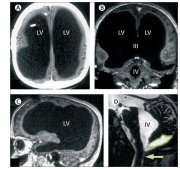
This week’s edition of medical journal The Lancet has a brief case report of a 44-year-old man who was discovered to have a severely distorted brain, due to it being displaced by a build-up of fluid.

The man’s MRI scans are shown on the right and you can clearly see that huge sections of the brain are seemingly absent.

In this case, it was due to hydrocephalus, a condition where the cerebrospinal fluid (CSF) isn’t properly drained.

This fluid bathes and protects the brain. It is produced in the ventricles and circulates around before being removed into the blood supply.

If this draining doesn’t happen properly, the fluid builds up and dangerously increases the pressure inside the skull. This can lead to the brain being malformed, particularly if it occurs in childhood.

The young brain is remarkably good at adapting to obstacles. Children who have had half their brain removed can grow up with few obvious effects.

This seems to also occur in some cases of hydrocephalus. While it is usually associated with quite profound neurological problems, in some cases, it goes undetected because the people seem relatively unaffected.

The late neurologist John Lorber studied case of hydrocephalus and reported one particularly famous case.

A CT scan suggested that the patient had a largely fluid-filled skull with less than a few millimetres of grey matter, but with a IQ of 126 and a first class maths degree. Lorber had many other cases that he said illustrated similar effects.

Lorber provocatively titled his article ‘Is the brain really necessary?’.

His finding was quite astonishing and, despite some criticisms (CT scans probably exaggerate the damage and the patients undoubtedly had some mental difficulties), he highlighted the fact that the brain can adapt to quite severe setbacks in some exceptional cases.

However, the title of his article annoyed quite a few people and it has been cited as one of the origins of the ridiculous but curiously persistent myth that we only use 10% of our brains.

In comparison to Lorber’s case, the Lancet is a man described as having ‘normal social functioning’ and an IQ of 75, on the borderline of having a mild intellectual disability, but nothing so severe you wouldn’t find it as part of normal human variation.

Nevertheless, considering the extent of distortion in the brain, it’s still quite remarkable.

‘Distortion’ is likely to be the key is these cases, as the key brain areas are likely to be ‘smeared’ around the inside of the skull, rather than missing completely.

However, we shouldn’t be too complacent in our explanations of how some people can have such severe brain distortions while functioning really quite well. Our understanding of how this occurs is still quite poor. Plenty of mystery still accompanies these cases.

Link to (closed access) Lancet case report.
Link to write-up from Nature (via Neurophilosopher).
Link to excellent SciCon article on Lorber’s cases and the 10% myth.

Schizophrenia in 15th century Islamic medicine

There’s an interesting exchange in this month’s American Journal of Psychiatry where two researchers note that there is no mention of any condition that resembles schizophrenia in the key 15th century Islamic medical text Cerrahiyyetu‚Äôl-Haniyye (Imperial Surgery).

A reply highlights the fact that it may be because medicine was only practicised on people who volunteered for treatment, which is unlikely to include people who are floridly psychotic.

The exchange contains lots of historical information about how psychosis was understood in centuries past both socially, and by doctors of the time.

Islam has been incredibly important in the history of medicine and Islamic medical texts are rich sources for historians interested in the development of medical care.

Link to AJP letter ‘Absence of Schizophrenia in a 15th-Century Islamic Medical Textbook’.
Link to reply and commentary.

Brain haemorrhage inspires creativity

The Times has an interesting account of a man who experienced a massive surge in creativity after suffering a brain haemorrhage.

Walking into a neat red-brick semi on a housing estate in Birkenhead I am faced with a glittering-eyed tiger. His stare is mercifully benign and his swirling surroundings cover the whole of the inside front door. The room beyond is a cornucopia of shape and colour; every square foot of wall and ceiling a mass of abstract designs, animals and faces. The paintings continue into the kitchen and up the stairs. There are carvings, sculptures, reliefs and smaller pictures propped or hung against larger ones.

This is the home of Tommy McHugh, 57, until six years ago a Liverpool builder, with a rough past as a street fighter, and no apparent artistic inclination. Now he is a man with a passion, full of emotion, driven to create. “My mind is like a volcano exploding with bubbles,” he says in a gentle Scouse accent, “and each bubble contains a million other bubbles, and then another million bubbles of unstoppable creative ideas.” He spends his days ‚Äì and most of his nights ‚Äì painting, sculpting and carving. So what happened six years ago to bring about this transformation? The extraordinary answer is: a brain haemorrhage.

Similar cases have been reported in the medical literature. In one case, the onset of dementia improved the technique of an already established artist and there have been several cases of people who seem to have found previously unused artist talents as their brain disease progresses.

Link to Times article ‘Painting? I can‚Äôt turn it off’.
Link to neurology article on creativity ‘sparked’ by dementia.

2007-07-20 Spike activity

Quick links from the past week in mind and brain news:

NPR has a special radio programme on an Iraqi psychiatrist, now resident in the USA, looking back to his work in the war-torn state.

OmniBrain gathers together a whole list of neuroscience sites for kids. Yay!

New Scientist reports on how a new brain scanning study gives clues to how we suppress traumatic memories.

Neurophilosophy looks at the psychology of Hitchcock’s movies.

New research study suggests there may be two distinct brain networks affected by Parkinson’s disease and a Science News article investigates why smokers are less likely to develop the condition.

Cognitive Daily looks at research on how children perceive motion.

New Scientist investigates how people from different cultures might differ in their ability to take others’ perspective.

I’m not as slim as that girl: The Neurocritic looks at a recent review on the effect of viewing thin models on body image concerns in women.

A Stroke Association survey find that only 33% of people are aware that stroke causes immediate brain damage (in fact, it is immediate brain damage).

Why are people more likely to fight when they’re drunk? Pure Pedantry investigates.

Language Log finds some Chomsky-themed breakfast cereal.