Vengeance and the recycle of violence

Two recently published articles on inter-group violence highlight the how the cycle of vengeance is remarkably similar across two different cultures: one in tribal peoples from New Guinea, the other in street gangs from Chicago.

In an article for The New Yorker Jared Diamond writes about the cycles and social customs surrounding vengeance in New Guinea by examining how one Handa tribesmen sought to exact revenge on another tribe for the death of his uncle.

The social customs about what counts as vengeance, how and whom it may be exacted upon are complex, but it’s interesting that Diamond concludes that the desire for vengeance is a powerful motivation (ranking alongside love, anger, grief, and fear) which feeds the cycle of retribution even past the point where the original cause of the conflict has been lost in the sands of time.

A similar theme is echoed in an article published in today’s New York Times on gang violence in Chicago. It focuses on a project called CeaseFire started by epidemiologist Gary Slutkin.

The project uses an interesting method which thinks of violence like a disease which can be transmitted through vengeance, and so applies an approach taken from disease prevention models to try and stop the spread of shootings.

Slutkin employs mostly ex-members of the Chicago underground who know both the streets and the players to intervene and mediate disputes when violence has flared on when the situation seems ready to explode.

The idea, just like in clinical epidemiology, is to target the most ‘infected’ members to reduce transmission – in this case, by engaging those causing the most violence and cooling the need for vengeance.

After a quick search, there seems to be remarkably little research on the role of vengeance in violence (although almost all supports its role).

This tends to parallel the research into violence in general. As one of the biggest killers in the world, I’m always struck by how little attention it gets.

Link to Jared Diamond article ‘Vengeance is Ours’.
Link to NYT article ‘Blocking the Transmission of Violence’.

Sexual PsyOps

We’ve covered some of the historical archives of propaganda material before on Mind Hacks, but ex-US PsyOps Sergeant Major Herbert Friedman has created an archive of historical propaganda that was specifically themed to target sexual insecurities.

The page is not the easiest to read owing to the rather rough and ready formatting, but it has a fascinating archive of 20th century wartime propaganda that used sexual images to rally the civilian population or lower moral in enemy troops.

The images are NSFW but are most are not particularly pornographic by today’s standards, although a few are obviously designed to be particularly offensive.

Most images aimed at civilians use the theme that the enemy are sexual deviants who will defile the country’s women if they’re not defeated, while most aimed at enemy soldiers suggest that their girlfriends and wives will be unfaithful while they’re away – or simply highlight the contrast between staying and fighting or, for example, returning home to drink cocktails with topless women.

Some of the leaflets are quite complex for the time, using see-through covers to make them visually more appealing, while they were often specifically designed to take advantage of the specific insecurities of allied forces.

For example, this section discusses German sexual propaganda leaflets dropped to allied soldiers in World War II:

There are two major differences between the leaflets aimed at the Americans and those aimed at the French. The American leaflets are much cruder and the pictures not nearly as well drawn. The second difference is that while the leaflet to the French showed British soldiers with the women, thus attacking an ally, the leaflet aimed at the GIs showed American civilians with the wives and girlfriends, so the propaganda theme might be considered more “anti-slacker” or “anti-draft-dodger”.

A fascinating collection, and if you’re interested in a browsing through probably the most comprehensive archive of propaganda leaflets on the net (including examples from as recent as last year), I notice the PsyWar website is back online.

UPDATE: The original page seems to be a bit unreliable, but thanks to Will for posting a link to a mirror of the page which you can read here.

Link to NSFW Sex and Psychological Operations archive.
Link to PsyWar archive.

Uncanny valley of the dolls

Human-computer interaction scientist Karl MacDorman has produced a fantastically illustrated video lecture on the psychology of the ‘uncanny valley‘ – the effect where androids become creepy when they’re almost human.

It comes in seven 3-4 minute sections, each of which is packed with some completely fascinating science and some wonderful examples of humanoid androids in action and how people react to them.

It’s a bit hard to navigate the YouTube links between sections, so I’ve collected the links to all the parts of the talk, entitled ‘Charting the Uncanny Valley’, below:

1. Introduction
2. Form Dynamics Contingency
3. Human Perception
4. Do Looks Matter?
5. Android Science
6. Explanations
7. What makes a robot uncanny?

While reviewing the whole area of android – human interaction, MacDorman seems to have done some fascinating research himself, often taking paradigms from existing psychology studies and seeing how androids alter the experience.

For example, in one study [pdf] he morphed android faces with human ones (using Philip K Dick as the human face!) and measured how the images trigger differing feelings of familiarity, eeriness and the like.

A very well spent 20 minutes and a great introduction to a fascinating area.

pdf of MacDorman’s paper on the Uncanny Valley.
Link to MeFi post which alerted me to the lecture.

Man, controller of the neuroverse

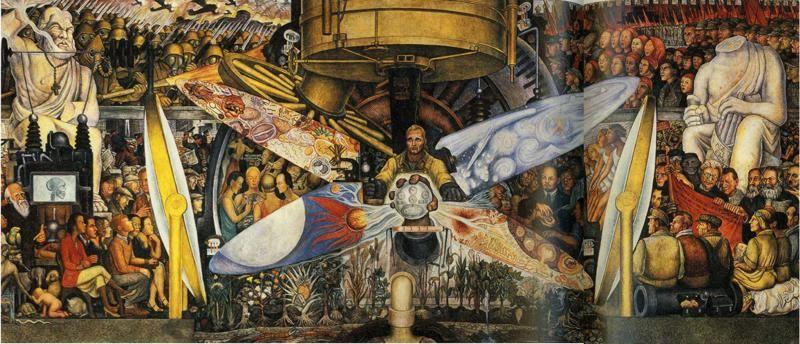
The medical journal Neurosurgery is celebrating its 30 year anniversary and I’ve just noticed that their February edition had this wonderful cover.

It’s the detail from a painting by Mexican artist Diego Rivera called Man, Controller of the Universe. A beautiful image, although never let it be said that our neurosurgical friends miss an opportunity to express their grandiosity.

Nevertheless, the edition contains a large number of wonderful Rivera prints in between article such as ‘Ballistics for the Neurosurgeon’, ‘A New Multipurpose Ventriculoscope’ and ‘Enchanced Tumor Growth Elicited by L-Type Amino Acid Transporter 1 in Human Malignant Glioma Cells’.

It makes for slightly surreal but completely delightful read.

The journal has a tradition of having an article by a neurosurgeon commenting on the cover image, which is often a great article in itself and is usually has nothing directly to do with neuroscience.

Sadly, the journal is closed access, but their free sample issue has an excellent ‘Cover Comment’ article [pdf] on Herman Melville and his classic novel Moby Dick.

Link to image of entire painting.
pdf of Neurosurgery article on Moby Dick.

2008-05-02 Spike activity

Quick links from the past week in mind and brain news:

Interesting Scientific American article looks at the how infections can increase risk for mental illness but suffers from some rather irresponsible and sensational statements in the summaries.

A classic study on how children learn the world isn’t flat, covered by PsyBlog.

Science Daily reports on research suggesting that the key language areas of the brain ‘shift’ as we age.

Some wonderful examples of 19th century Japanese brain art are discovered by In Two Minds.

Neuroscientifically Challenged has an excellent short piece on a brain scanning study on social hierarchy in humans.

The excellent Dana magazine Cerebrum has an article on the link between the heart and brain function. Healthy heart, healthy brain.

The Neuroethics and Law Blog rounds up some recent reviews of neuroethics books.

BBC News has a remarkably good article on ‘sex addiction‘ and why it’s not an addiction, even if it’s a problem.

A coooool visual illusion is discovered by Cognitive Daily.

Booze reduces the brain response to fearful faces finds study reported by Science News who seem to have had a few when they wrote the first rather over-generalised sentence.

The Frontal Cortex has a thoughtful piece on madness and creativity.

Female voices sound sexier when they’re at the peak of fertility in the menstrual cycle, reports New Scientist.

The latest research on deep brain stimulation for treatment resistant depression is covered by PsychCentral.

Scientific American has an article on whether age-related cognitive decline may be caused by a breakdown in connections between different brain systems.

The anthropology of Grand Theft Auto! A thinly veiled excuse to play video games at work leads to an interesting article on why Liberty City is such as success.

Furious Seasons on why new data reveals that the famously corrupt Paxil Study 329 is actually worse than we thought. Hard as that is to believe.

McGill University has some funky neuroscience images (thanks Sandra!).

Unix, Lacanian psychoanalysis, anarchy, David Cronenberg, the unconscious and Stanislaw Lem – together at last!

BPS Research Digest covers a curious debate over whether psychotherapy is over-hyped where a frankly delusional psychopharmacologist ignores evidence and seemingly makes up figures about levels of therapist abuse. He references his own paper, which quotes a different figure.

Bringing sexy back (side)

Last week, we featured a sexy serotonin tattoo, and this week, thanks to the work of the same diligent correspondent (thanks Sandra!), we feature a new brain tattoo that has a markedly different effect, despite the fact it resides in the same location.

You really need to click on the image and go to the full size picture to get the maximum effect.

Interestingly, the discussion in the comments note that it might be part of a recent trend for parents to have their children’s pictures as tattoos (although this is a bit too direct if you ask me).

Either way, I’d be sitting the child down and having some serious words about the relative sizes of cortical and subcortical structures in the normal adult brain before letting them them loose on my tattoo design.

Link to arse residing brain tattoo from another dimension.

A rattle around Harvard’s baby brain lab

The Telegraph has an article and video on the Harvard ‘baby brain lab’ and some of its recent discoveries which are helping us understand how the mind and brain develops through the earliest months of life.

The research team is otherwise known as the Laboratory for Developmental Studies and is headed up by developmental psychologist Elizabeth Spelke who’s interviewed on the video.

You would think babies are difficult to test with behavioural experiments because they are can’t even stick to simple procedures, so developmental psychologists have created a task that takes advantage of the fact that infants stare at things when they’re new or interesting, but get bored and stop looking at the things they’ve seen before.

Let’s say you wanted to test whether newborn babies can tell the difference between familiar and unfamiliar people when they see their faces from different angles.

You show a picture of a person’s face, facing directly forward, until the infant becomes bored and starts looking away.

Then you flash up two new pictures both taken at the same angle, one of the original person and one of a new person. You then measure how long the infant looks at each face.

Because infants look at new or different things for longer, they would spend more time looking at the unfamiliar face if they can genuinely tell the difference. If they both seem the same to the infant, they should look at both equally, on average.

In fact, this was a recent study done on 1 and 2-day old babies, and it turns out they can tell the difference between a familiar face and a new face when the change in viewing angle isn’t too great.

Variations on this simple procedure have taught us a great deal about what babies can perceive, understand or expect, as well as how their brains function when they’re doing these tasks.

What is often most surprising is what babies can do within their first few days or birth – such as recognise faces, as in the study above – but the debate about how much these sorts of skills are due to innate knowledge, or innate rapid learning mechanisms, are still raging:

Newborns have no idea what they look like, yet they enter the world equipped with a basic understand of what a face is. They know that the pink blob in the middle of a face is a tongue, and that they can poke out their own tiny tongue in just the same way. This was crucial ammunition for an intellectual war that still rages over whether we emerge from the womb as general-purpose learning machines that soak up details of our environments, or, as Spelke believes, born ‘precocious’, so we can immediately do things that are key to survival (just as newly-hatched chicks and fish can immediately do things such as navigate, or find and recognise food).
advertisement

Spelke has crossed swords with Professor Mark Johnson of Birkbeck’s Centre for Brain and Cognitive Development in London, whose studies of infant brains stretch back nearly two decades. He points out that the four and six month olds at Spelkeland have hundreds of hours of experience in categorising the world, which challenges Spelke’s ‘core knowledge’ theory. He believes that we enter the world with ‘soft biases to attend to different aspects of the environment, and to learn about the world in particular ways’.

His colleague, Prof Annette Karmiloff-Smith, who once worked with Piaget, praises some of the Spelkeland work (‘Liz has done some great behavioural experiments’) but adds, ‘Paradoxically, although she studies babies, in my view she doesn’t raise questions about infants’ capacity for learning, which may account for their extraordinary abilities without the need for them to be born with pre-specified knowledge.’

Link to article ‘Harvard’s baby brain research lab’ (via 3QD).
Link to video of Spelke interview.

Solar powered EEG headset

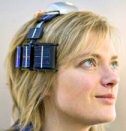
The New Scientist Tech Blog has an interesting article on a new prototype EEG machine that, like all others, is designed to read electrical activity from the brain. The novelty is that it is totally enclosed in an earphones-like headset and is solar-powered. Apparently, it also generates power from the body’s own heat.

The new headset can generate at least 1 milliWatt of power in most circumstances. That is more than the 0.8mW needed to detect electrical activity observed in the brain, and transmit it over wifi to a computer.

“Using both power sources, you get twice as much power, so it’s roughly half the size,” say Chris van Hoof, also of IMEC, comparing the new headset to the previous device.

Van Hoof says small, preclinical trials show the headset collects data identical to those of EEGs used in hospitals. The portable headset should provide a look at the brain in environments it has not been studied in before.

This looks like it builds on research that has been going on at Imperial College in London on low power technology for ‘wearable cognition systems’.

The ‘cognition’ bit is only likely to be very approximate to what psychologists think of as cognitive processes (as we discussed previously), but I suspect the trick will be developing new applications for the technology, rather than using the technology to try and replace the precision of already existing systems.

A paper on the technology was recently published by the Imperial team. Unfortunately, I can’t find the full-text online but the summary itself is well-worth a read.

Link to article on NewSciTechBlog (via Neurophilosophy).
Link to summary of low power tech for wearable cognition paper.

Doctor Who Hears Voices torrent online

The recent UK TV docudrama, The Doctor Who Hears Voices, that we discussed previously has appeared on torrent servers and seems available for download. I’ve not yet seen the programme or fully downloaded it myself yet, but I’m assuming it works OK.

Clinical psychologist Rufus May plays himself. An interesting choice because he was diagnosed with schizophrenia at the age of 18 and later trained as a clinical psychologist. As an aside, he’s also recently launched his own blog to try and encourage debate around mental health.

May works in Bradford, which has turned out to be a bit of a UK centre for radical ideas in mental health.

Bradford is also the home to psychiatrists Patrick Bracken and Philip Thomas, who wrote a thought-provoking article for the British Medical Journal in 2001 on ‘post-psychiatry‘ that has proven to be one of the cornerstones of progressive mental health philosophy.

The groups tends to be treated with suspicion by mainstream psychiatrists, who can be quite a defensive bunch at times, but it’s interesting that some of the ideas that the Bradford group pioneered, such as treating people in their own homes, are now accepted as mainstream practice.

Link to torrent of docudrama on mininova.
Link to BMJ article on ‘post-psychiatry’.

Does economics make you selfish?

Philosopher Eric Schwitzgebel has been investigating whether ethics professors are more moral than other people, and it turns out, they’re possibly less. He’s now turned his attention to economics and wonders whether too much exposure to ‘rational choice theory‘ – that says it’s always rational to maximise profit – makes people more selfish.

Surprisingly, there have been several studies on exactly this topic, several which seem to suggest that economics students are more selfish than other students, but these all seem to be flawed in quite important ways.

They either use exactly the same sorts of tasks that students study in class to demonstrate that ‘selfish’ actions are the most economically rational strategy, or they rely on self-report – something also potentially biased by the association between ‘selfishness’ and irrationality.

Apparently, only three studies have looked at the link between studying economics and real-world selfishness, and none provide good evidence for the link.

Schwitzgebel has a bigger issue in mind than simply investigating the personal habits of economists, however.

This is part of his project to question the utility of certain types of theory. For example, if studying ethics makes people no more ethical and studying economics makes people no more economically rational, how useful are they?

Link to post ‘Does Studying Economics Make You Selfish?’.

Hofmann gone to the great Lucy in the Sky with Diamonds

At 9 am this morning, Albert Hofmann, chemist and creator of LSD, died in his home in Switzerland.

Hofmann died at the grand old age of 102 and saw the psychedelic drug he called his “problem child” spark the interest of psychologists and psychiatrists, inspire a generation of 1960s flower children, and earn the ire of the authorities across the world who banned it as a prohibited drug.

What he didn’t see (at least at the time) was that the CIA dedicated millions (billions?) of dollars in funding to investigate the chemical as a possible ‘mind control’ drug in a huge and often vastly unethical research project known as MKULTRA.

LSD had an impact on music, culture, politics, science and psychology and Hofmann remained committed to LSD research right until the end, supporting the first clinical trial of LSD for 30 years which started recently in Switzerland.

I suspect they’ll be some extensive obituaries published when the press get wind of Hofmann’s death which will hopefully do justice to his life and work, so we’ll keep you posted.

UPDATE: A couple of good obituaries from The New York Times here and The Washington Post here. This on the Hofmann’s first experience of the drug, the first ever LSD trip, from the WashPost:

He wrote in a journal about this first known encounter: “At home I lay down and sank into a not unpleasant intoxicated-like condition, characterized by an extremely stimulated imagination.

“In a dreamlike state, with eyes closed (I found the daylight to be unpleasantly glaring), I perceived an uninterrupted stream of fantastic pictures, extraordinary shapes with intense, kaleidoscopic play of colors. After some two hours this condition faded away.”

Three days later, April 19, he bicycled home after consuming 250 micrograms of LSD in a now-famous “trip” that has become known as Bicycle Day. The route he took home was later named in his honor.

Link to tribute on MAPS homepage (via BB).
Link to The New York Times obituary.
Link to The Washington Post obituary.

Encephalon 44 wants you!

The 44th edition of the psychology and neuroscience writing carnival Encephalon has just been released by the ever-excellent Cognitive Daily.

What with the flurry of recent interest in neuroscience studies predicting the imminent death of our concept of free will, this edition has a slyly satirical slant on your ability to resist.

A couple of my favourites include a post by Cognitive Daily on a remarkable study that found that priming students to believe that free will doesn’t exist increases levels of cheating (!), and a provocative article from The Mouse Trap on whether God is just the result of humans making a Type I error – i.e. detecting a false positive.

Of course, another alternative is that God is significant but just has a very small effect size. Epicurus is that you?

Link to Encephalon 44.

Evolution of the troubled mind

I just listened to a recent edition of ABC Radio National’s All in the Mind on evolutionary approaches to mental illness. While the topic isn’t new, it’s interesting that the two clinicians try to directly apply some of the ideas to their work treating patients with mental disorders.

Almost all evolutionary accounts of mental illness attempt to explain why we still have mental illness when it so markedly reduces the chances of reproductive success.

Most theories, and indeed the ones discussed on the programme, argue that in small doses the genes that raise risk for mental illness are useful in promoting creativity (e.g. psychosis / mania), maternal withdrawal (e.g. in post-pregnancy depression), self-preservation (e.g. anxiety) or some other presumably adaptive behaviour in specific situations.

I’m fairly tolerant of these theories, on the basis that they’re hard to demonstrate but plausible, but I have less time for Paul McClean’s ‘triune brain’ theory which one of the interviewers seems to favour.

In fact, everytime I hear the phrase ‘reptilian brain’, I reach for my spear.

This is often invoked in discussions about evolutionary psychology as a seemingly more sensible alternative to Freudian theories.

What makes me chuckle is that they are remarkably similar. Freud argued that we are a subject to evolutionary ancient drives of the Id that must be controlled by the Ego, McLean suggested that we are a subject to evolutionary ancient drives of the reptilian brain that must be controlled by the neocortex.

For an updated and significantly more sophisticated version of these arguments, neuroscientist Jaak Panksepp’s 2002 article [pdf] on the weakness of evolutionary psychology without neuroscience is well worth a read.

While we’re on the subject, distinguished biologist and sufferer of depression Lewis Wolpert recently published an open-access article on ‘Depression in an evolutionary context’ which is well worth a look.

Link on AITM on evolutionary approaches to psychiatry.
pdf of Panksepp’s article on ‘neurevolutionary psychology’.
Link to Wolpert’s article on evolution and depression.

Dr Mezmer’s Dictionary of Bad Psychology

The Devil’s Dictionary was a famously satirical book by Ambrose Bierce where he lampooned almost everything, in alphabetical order. He famously defined the brain as “an apparatus with which we think we think”, but now, a similarly cutting dictionary has been dedicated to psychology.

Dr Mezmer’s Dictionary of Bad Psychology contains a wealth of useful definitions, covering the everything from the hard edge of cognitive science to the fluffy gloss of pop psychology.

Behaviorism: A psychological movement, now extinct, that is built on the premise that you are what you do, and you do because of what you have done. Replaced by humanistic psychology (you are what you feel), cognitive science (you are what you think), Dr. Atkins (you are what you eat) and modern advertising (you are what we say).

Link to Dr Mezmer’s Dictionary of Bad Psychology.

Viktor Frankl and Man’s Search for Meaning

I’ve just finished reading the wonderful Man’s Search for Meaning, a 1946 book written by psychiatrist and neurologist Viktor E. Frankl, where he discusses his experiences and observations as a Nazi concentration camp inmate.

The book comes in two parts, the first recounts Frankl’s experience as an inmate in two concentration camps; the second discusses the ideas behind the form of psychotherapy he developed, called logotherapy.

Unlike narrative accounts of concentration camp life, such as Primo Levi’s If This is a Man, Frankl describes scenes rather than a story and uses them to explore the psychology of both the oppressed and the oppressors in the camp.

The book is particularly outstanding in that it explores the social complexities of the concentration camps with remarkable subtlety, noting when the failings of the inmates and the humanity of the guards were present. He highlights that these seemingly out-of-place responses had the most impact amid the brutality of camp life.

It is apparent that the mere knowledge that a man was either a camp guard or a prisoner tells us almost nothing. Human kindness can be found in all groups, even those which as a whole it would be easy to condemn. The boundaries between groups overlapped and we must not try to simplify matters by saying that these men were angels and those were devils. Certainly, it was a considerable achievement for a guard or foreman to be kind to the prisoners in spite of all the camp’s influences, and, on the other hand, the baseness of a prisoner who treated his own companions badly was exceptionally contemptible. Obviously the prisoners found the lack of character in such men especially upsetting, while they were profoundly moved by the smallest kindness received from any of the guards. [p93]

In a sense, Zimbardo’s Stanford prison experiment just re-iterated what Frankl was saying years before – that coercive systems breed their own conformity and that average people need extraordinary courage to step outside the norm.

Frankl’s form of psychotherapy is influenced partly by his wartime experiences and draws on the fact that some concentration camp inmates could still find purpose in their lives despite the hellish conditions.

The therapy attempts to help people who are experiencing inescapable suffering to cope better, by looking at ways in which they can find meaning in their lives.

Paradoxically, suggests Frankl, for some the experience of suffering is the one thing that inspired a discovery of meaning in a previously superficial existence. Accepting that all life involves some suffering allows us to use the experience to better understand ourselves and others.

Frankl was not the only mind doctor in the concentration camps, indeed he was among a long list of professionals who were interred.

Psychologist Bruno Bettleheim famously wrote the article ‘Individual and Mass Behavior in Extreme Situations’ after his experiences.

Bettleheim, best known for his work on child psychology, was a complex character whose reputation has fluctuated greatly since his death.

Even the story of his article on concentration camp psychology is fascinatingly complex, as recounted in a 1997 article [pdf] by Christian Fleck and Albert Müller.

Link to Wikipedia article on ‘Man’s Search for Meaning’ (thanks Ceny!)
pdf of article ‘Bettleheim and the Concentration Camps’.