 Psychologist Jesse Bering has written a witty and informative post on the science of homophobia, evolutionary theories of homosexuality and why some hypotheses just don’t work without large quantities of strong gin.
Bering notes he’s both gay and an evolutionary psychologist, and some people find it surprising that a homosexual male works in a field that might suggest he’s a biological anomaly.
Needless to say, his whistle-stop tour through the field is both informative and funny. The final bit summarises evolutionary theories of homosexuality and the last paragraph made me laugh out loud:
‚Ä¢ E.O. Wilson’s kin altruism theory states that homosexuality was a rare but functional alternative to traditional routes of increasing inclusive fitness because gay people in the ancestral past, who weren’t burdened with their own kids, helped to raise, care for, and provide resources to their other genetic relatives, such as nieces and nephews. (This one doesn’t quite gel, especially when you consider that a gay person’s resources are usually funneled to their same-sex partners. Also, for most people, being gay doesn’t exactly endear you to your relatives.)
‚Ä¢ Evolutionary psychologist Frank Muscarella’s alliance formation theory proposes that, in the ancestral past, homoerotic behaviours by young men with high status older men would have been an effective strategy for climbing up the social ladder. (Think Ancient Greece, or maybe Mark Foley?)
‚Ä¢ John Maynard Smith is often credited with what is colloquially called the “sneaky f*cker theory,” which argues that gay men in the ancestral past had unique access to the reproductive niche because females let their guards down around them and other males didn’t view them as sexual competitors. (I rather like this one: remember, we’re not infertile, we’re just gay. Although in my case, it’d take a lot of gin to work.)
</blockquoteTo do it in style, presumably you’d be drinking pink gin.
Bering is one of the most inventive researchers working in evolutionary psychology, and his work on our everyday theories of souls, ghosts and the supernatural is fascinating.
One of my favourites is his study [pdf] finding that simply telling people the lab is haunted improves their honesty in a computer task, whereas another creative study [pdf] investigated which mind and brain functions children think continue after death and how this differs by age and religious schooling.
Link to ‘The Sneaky F*cker Theory (and Other Gay Ideas)’.
 An interesting
  Dream researchers in the 1950s concluded that people typically dreamed in black and white whereas modern dream research reports most people dream in colour. Philosopher
 Cato Unbound has a thought-provoking
  Neuroscience and fabric of reality play
 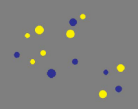 The ability to intuitively estimate the number objects you can see is known as automatic number sense and has been widely studied in the scientific literature, but is usually thought to be separate from the formal and precise maths abilities we learn at school.
 This month’s British Journal of Psychiatry has a fascinating
  KQED’s science programme Quest has put some completely fascinating audio and video segments online on the science of emotion and how neurological disorders can lead to almost instant laughing and crying that are not always accompanied by the strong emotions we normally associate with them.
 If you listen carefully you can hear a distant rumble from over the horizon. It’s the sound of sociologists advancing slowly towards our online data trail, about to release the mother of all data analysis campaigns that will rain from the internet like a storm from above.
 ABC Radio National’s All in the Mind recently broadcast a gripping
 My new favourite typo: if you’re fed up with the sound of electric rock n’ roll perhaps you’d prefer some autistic guitar.
 The BPS Research Digest has
  Psychologist Petra Boyton has written a fantastic
  Mind Hacks