Complex beginnings

The term ‘complex’, used to refer to a mental illness or psychological hang-up, has become so common as to have entered everyday language (e.g. ‘he has an inferiority complex’) but I only just recently found out about the origin of the concept.

The following is from the epic and endlessly fascinating book The Discovery of the Unconscious by Henri Ellenberger, where he discusses the use of the ‘word association test’ in early 1900s psychiatry.

The story takes us through some of the most important figures in the history of 19th and 20th century mind science. From p691:

The test consisted of enunciating to a subject a succession of carefully chosen words; to each of them the subject had to respond with the first word that occurred to him; the reaction time was exactly measured…

It was invented by Galton, who showed how it could be used to explore the hidden recesses of the mind. It was taken over and perfected by Wundt, who attempted to experimentally establish the laws of the association of ideas.

Then Aschaffenberg and Kraepelin introduced the distinction of inner and outer associations; the former are associations according to meaning, the latter according to forms of speech and sound; they could also be called semantic and verbal associations.

Kraepelin showed that fatigue caused a gradual shift toward a greater proportion of verbal associations. Similar effects were observed in fever and alcoholic intoxication. The same authors compared the results of the word association test in various mental conditions.

Then a new path was opened by Ziehen who found that the reaction time was was longer when the stimulus word was to something unpleasant to the subject. Sometimes, by picking out several delayed responses, one could relate them to a common underlying representation that Ziehen called gefühlsbetonter Vorstellungskomplex (emotionally charged complex of representations), or simply a complex.

Carl Jung later used the test extensively as a more rigorous alternative to Freudian free association and found some interesting results.

In women, erotic complexes were in the foreground with complexes related to the family and dwelling, pregnancy, children and marital situation; in older women he detected complexes showing regrets about former lovers. In men, complexes of ambition, money and striving to succeed came before erotic complexes.

The description comes from a chapter about Carl Jung, who was originally a psychoanalyst but broke away from Freud’s system and developed his own.

Freud’s theories, with only a few exceptions, just seem to get loopier the more you read them. Jung is interesting because on the surface his ideas seem quite barmy but are often remarkably sensible when you understand them in more detail.

Despite his interest in everything from ghosts to UFOs, he always maintained these were essentially psychological phenomena that reflected important aspects of our collective culture and subconcious mind.

For example, I always thought his concept of the ‘collective unconscious’ was supposed to be some sort of semi-mystical psychic connection, but in fact, he was just describing much of what is now a premise of evolutionary psychology.

Namely, that by nature of being human, we may share some inherited psychological structures, common symbols or ideas – such as what ‘motherhood’ entails – that can be seen in both common behaviours and in myths and stories throughout history.

Irrational reading

Science writer Jonah Lehrer has a short but useful piece in the Wall Street Journal where he recommends five must-read books on irrational decision-making.

Lehrer is well placed to be making recommendations as he’s recently been completely immersed in the science of decision-making to write his newly released book How We Decide.

The five books he recommends are:

Extraordinary Popular Delusions and the Madness of Crowds by Charles Mackay.

Judgment Under Uncertainty by Daniel Kahneman, Paul Slovic and Amos Tversky

How We Know What Isn’t So by Thomas Gilovich

The Winner’s Curse by Richard H. Thaler

Predictably Irrational by Dan Ariely

All of which I can also heartily recommend, except The Winner’s Curse, but simply because I’m not familiar with it.

By the way, the first book that Lehrer recommends was published in 1841 and is freely available online.

Link to ‘Books on Irrational Decision-Making’ from the WSJ (via FC).

Electricity, let it wash all over me

I’ve just found a fantastic article that discusses the representation of epilepsy in contemporary rock and hip hop. It was published last year in the neurology journal Epilepsy and Behaviour and is both fascinating and funny owing to the contrast between the stuffy academic journal style and the lyrics drawn from the street.

For example, where else are you likely to read anything like the following:

In “Ballad of Worms,” Cage, a New York rap artist with a troubled psychiatric past, rails against God for giving his girlfriend (previously “the hottest bitch”) meningitis.

It’s a fascinating review, not least because most of the songs that mention epilepsy are from death metal bands, lyrical singer-song writers or hip hop artists.

I was a bit confused at first because it misses out some obvious tracks, but I quickly realised it’s just sampling from lyrics about epilepsy, rather than trying to give a complete overview.

For example, we mentioned a Beastie Boys track where Adrock gives props to his own epilepsy back in 2007. Beck also gives a nod to his epilepsy in his 2006 track Elevator Music:

I shake a leg on the ground
Like an epileptic battery man
I’m making my move

Joy Division frontman Ian Curtis famously developed epilepsy and had several seizures on stage. Their pulsing 1979 track She’s Lost Control, although not explicitly about his own experiences, vividly describes a girl having a seizure in the street.

There are many more examples, and after doing a search I was surprised at quite how often epilepsy and seizures are referenced in rock n’ roll.

The review notes that epilepsy is often linked to the historical themes of madness and cognitive impairment, but interestingly contemporary music also uses it as a metaphor for all consuming love and sexual desire, as well as wild abandon in dancing – which are not traditional themes.

The paper is by clinical neuropsychologist Sallie Baxendale, who does some compelling and diverse research into epilepsy, including a recent article on the representation of epilepsy in movies.

Link to ‘The representation of epilepsy in popular music’.
Link to PubMed entry for same.

Corseting female sexuality

The New York Times has an interesting and in-depth article on research into female sexuality that looks at the work of some of the most prominent female researchers in the field.

It does a great job of discussing the often surprising results of recent scientific studies but a commentary on Neuroanthropology really nails why it misses the mark.

The whole article is pitched to support that old tired clich√© of sexuality that ‘women are complicated, men are simple’ and it uses the differences in research findings to suggest women are enigmatic, complex, they don’t know what they want, or are torn by competing sexual desires.

But this is largely because the scientific studies have looked at specific research questions that don’t relate to ‘what do women want?’ line, as if this is a question that could actually be answered.

Neuroanthropology uses a great analogy that demonstrates why this is just bad spin:

One can imagine an article with the title, ‘What do diners want?’, which bemoaned the fickleness and impenetrable complexity of culinary preferences: Sometimes they want steak, and sometimes just a salad. Sometimes they put extra salt on the meal, and sometimes they ask for ketchup. One orders fish, another chicken, another ham and eggs.

One day a guy ordered tuna fish salad on rye, and the next, the same guy ordered a tandoori chicken wrap, hold the onions! My God, man, they’re insane! Who can ever come up with a unified theory of food preferences?! Food preferences are a giant forest, too complex for comprehension. What do diners want?!

You get my drift. The line of questioning is rhetorically time-tested (can we say clichéd even?) but objectively and empirically nonsensical. So many of these experiments seem to be testing a series of different, related, but ultimately distinct questions.

Can they all be glossed as, ‘What do women want?’ Yeah, sort of, but you’re going to get a hopeless answer.

Rather ironically, the NYT article celebrates the complexity of female sexuality but ultimately suggests that it’s the one-dimensional question that’s important when this is nothing but a caricature of human nature.

It’s worth reading for the coverage of the research, but the whole premise of the article is slightly askew. The Neuroanthropology piece is an excellent way of getting a broader vista.

Link to NYT article ‘What Do Women Want?’.
Link to excellent Neuroanthropology commentary.

I don’t like Mondays

Photo by stock.xchng user Simeon. Click for sourceThe defenders of Bullshit Blue Monday tend to suggest that even if the formula is nonsense, it promotes awareness of mental health at a time of the year when people are feeling particularly low. In light of this, today’s Bad Science column discusses the research on mood and time of year and finds there’s no reliable link between season and depression.

The piece looks at studies of suicides, depression, prescriptions of antidepressants, mood changes and hospital admissions – and none show a reliable connection.

Goldacre concludes:

And worst of all, we know that lots of things really are associated with depression, like social isolation, stressful life events, neighbourhood social disorder, poverty, child abuse, and the rest. Get those in the news, I dare you. Suicide is the third biggest cause of life years lost. Anything real you could do to study the causes, and possible preventive measures, or effective interventions, would be cracking. Making stupid stuff up about the most depressing day of the year, on the other hand, doesn’t help anyone, because bullshit presented as fact is simply disempowering.

By the way, during previous Bullshit Blue Monday posts, I alluded to a researcher who was threatened with legal action by Cliff Arnall for criticising the formula.

As it happens, it was psychologist Petra Boyton and you can now read her account of being subject to below-the-belt nastiness.

To lighten the tone a little, I must point out my highlight of the whole media debacle: an article in The Scotsman who gave the date of Blue Monday as the 23rd 21st of January – a Wednesday.

Link to Bad Science on season, mood and Bullshit Blue Monday.
Link to Petra Boyton on formulas, science reporting and legal threats.

2009-01-23 Spike activity

Quick links from the past week in mind and brain news:

New Scientist has an interesting piece on progress in human-like interaction by machines. Check the impressive video.

UK psychologist Oliver James discusses his polemic book on the psychological effects of materialism on BBC Radio 4’s Bookclub. See programme page and sidebar for listen again.

Discover Magazine has a Carl Zimmer article on the extended mind hypothesis and technology entitled ‘How Google Is Making Us Smarter’.

Do you believe in free will? asks PsyBlog.

BPS Research Digest reports on research suggesting it’s the quality, not just the length, of sleep that is important for learning.

Articles related to topics and themes in the book Understanding Psychology are collected by Time magazine. Not sure why, but a good collection nonetheless.

The Boston Globe has an article on CBT pioneer Aaron Beck and how the therapy for depression is being updated to include the role of genetics and neurobiology.

The neuroscience of the emotional instability of <a href="
http://sciencenews.org/view/generic/id/40028/title/Neural_paths_for_borderline_personality_disorder”>borderline personality disorder is discussed by Science News.

BBC News has an excellent article on mental health in Afghanistan.

On-the-ball science writer Jonah Lehrer’s new book on decision-making, called How We Decide is out now!

PhysOrg has an article on recent research looking at differences in default network activity in schizophrenia.

Research showing differences between men and women in the ability to control hunger is covered by Time magazine.

The Wall Street Journal discusses the emerging role of neuroscience and brain imaging evidence in the legal system.

Psychopaths ‘manipulate’ their way out of jail, reports New Scientist although the study shows no evidence of ‘manipulation’, just the fact they get parole more often. Careful with the labelling.

Neurophilosophy has an excellent write-up of a somewhat pedestrian review paper on the neuroscience of delusions after brain injury that concludes with a ‘new’ theory that already exists.

Dog On Anti-Depressants Mauls Former French President. That, is why Furious Seasons is so good. See David Dobbs’ excellent piece for several other good reasons.

Simulating hysteria for fun and profit

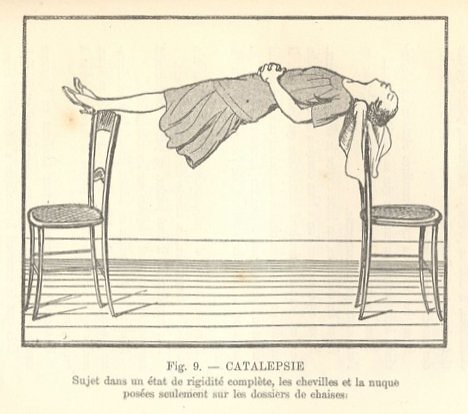
I’ve just found pages from a 1941 French hypnotism manual on the (tastefully NSFW) Au carrefour √©trange blog that has some wonderful illustrations of hypnotism ‘in action’.

A few are particularly curious because they seem to be directly mimicking famous images of hysteria from the 1800s.

Hysteria is the presence of neurological symptoms without any detectable neurological damage that could account for it (see previous) and the top image on the right is taken from a late 1800s book ‘Lectures on the Diseases of the Nervous System’ by Jean-Martin Charcot who argued that patients with hysterical epilepsy can show this type of body posture he called the ‘Grande Hysterie Full Arch’.

It’s an iconic image and can be seen to the left of the famous painting entitled ‘A Clinical Lesson with Doctor Charcot at the Salp√™tri√®re’ by Andr√© Brouillet that Freud had hung above his couch. You can still see it there in fact, in Freud’s old house, now the Freud Museum in London.

The image below is taken from the 1941 French hypnotism manual. In fact, all the images of the woman mimic Charcot’s famous photos or drawings of hysterical patients.

For example, here’s the Charcot original of a woman between two chairs, and here’s the image from the manuel d’hypnotisme.

Unfortunately, the Au carrefour √©trange website doesn’t have text from the book, but the images suggest that it is encouraging practitioners to simulate these famous poses.

Interestingly, Charcot was the first to suggest that hypnotism and hysteria may rely on similar neurological and psychological processes owing to the fact that it is possible to temporarily simulate hysteria with hypnosis.

Over 100 years later, there is growing evidence that this is the case, as neuroimaging studies have shown that hysterial paralysis and hypnotically-induced paralysis activate remarkably similar brain areas.

However, his classifications of the different body postures of hysteria are now thought to useless, and likely caused by Charcot’s own suggestions to his patients.

The pages from the hypnotism book are on a site with tasteful but NSFW images, so be cautious at work, or be ready with your excuse about a historical interest in Charcot.

UPDATE: The same blog has images from another French hypnotism book called Nouveau cours pratique d’hypnotisme et de suggestion from 1929. Dig that cover!

Link to pages of ‘Manuel pratique d’hypnotisme’ (via MorbidAnatomy).

The cutting edge of robotics

Singularity Hub has reviewed the best commercial and research lab robots from 2008 and has videos of each and every one.

It’s a fantastic collection that has everything from exoskeletons, to violin playing humanoids, to ultra-lightweight robots that fly by flapping gossamer-thin wings.

The most curious is probably the robot self-reassembling chair or maybe the robo-shapes from the ISI Polymorphic Robotics Laboratory.

Anyway, a fascinating collection and great to see how AI and mechanical engineering are being applied to create the latest in cutting-edge robotics.

Link to ‘A Review of the Best Robots of 2008’ videos.

The shock of the few

Monsters existed in the 1800s. They were not mythical creatures, but children born with birth defects who were widely discussed in the medical literature and sometimes cruelly paraded in the travelling freak shows of the time. Curiously, one of the most popular explanations for these congenital deformities concerned the psychology of the expectant mother.

If you had asked a 19th century doctor why some children were born with unusual bodies, or even fairly common birthmarks, you might have been told that they were caused by a frightening incident experienced by the mother during pregnancy.

The theory, known as ‘maternal impression‘, suggested the trauma could symbolically imprint itself on the foetus. The 1896 book Anomalies and Curiosities of Medicine described many such cases in their chapter on obstetric anomalies, and this is a fairly typical example:

Parvin mentions an instance of the influence of maternal impression in the causation of a large, vivid, red mark or splotch on the face: “When the mother was in Ireland she was badly frightened by a fire in which some cattle were burned. Again, during the early months of her pregnancy she was frightened by seeing another woman suddenly light the fire with kerosene, and at that time became firmly impressed with the idea that her child would be marked.’

In another case history, a child with hydrocephalus with a “small and rabbit-shaped” face and deformed eyes is explained by the fact that a rabbit jumped at its mother during pregnancy where she was frightened by its ‘glare’.

Perhaps one of the most curious cases was published in 1817 and concerned a recalcitrant father who denied being responsible for an unwanted pregnancy, causing the mother a great deal of distress. The child was later born, reportedly with the name of date of birth of his father clearly visible in his eyes.

This is a curious mirror of the first, probably mythical, case of maternal impression, where Hippocrates reportedly saved the honour of an adulterous princess by explaining her dark skinned child as due to her having a portrait of a ‘negro’ in her room.

Although the theory enjoyed a long and colourful life, it peacefully passed away in the late 19th century when it became clear that the mind of the mother had no influence on birthmarks or congenital deformities.

For many years the psychological state of the expectant mother was thought to have virtually no effect on the developing child.

But then the Soviet Union invaded Finland in 1939, and that all began to change.

The quickly assembled Finnish force was vastly outnumbered and ominously outgunned but, unlike their Soviet counterparts, they were quick and comfortable in the Artic conditions and made swift and deadly attacks.

In one of history’s great military victories, they defeated the Russians but suffered heavy losses. Many of the dead were young men, and many of the grieving were young pregnant women.

Nearly 40 years later, two Finnish psychiatrists decided to look at the mental health of the children who grew up without fathers. They compared children born to women who grieved during pregnancy, to those born to women who lost their husbands after the child had been born.

Their study, published in 1978, found that mothers who had lost their husbands during pregnancy were much more likely to have children who later developed schizophrenia.

Many similar studies have found that severe maternal stress during pregnancy affects the developing brain of the child, increasing the risk of cognitive or psychiatric problems later in life, possibly due to the effect of the hormonal response of the hypothalamo-pituitary-adrenal (HPA) system.

Thankfully, we no longer think of people as monsters, whatever their size, shape or mental state, and we have long banished the monstrous myths of ‘maternal impression’.

But we do know that the mind of the mother is connected to the development of the unborn baby, and that maternal experiences can still echo through the life of the child.

Cocaine nights, moral relativism, orgasms and gangs

BBC Radio 4’s wonderfully eclectic and vastly under-rated social science programme Thinking Allowed has had some fascinating programmes lately, covering the concern of ‘cocaine girls’ in 1915 London, the history of the orgasm, moral relativism, gang culture, the social meaning of scents and the culture of detectives, to mention just a few of the topics.

The programme is a mixture of social history and the latest in sociology research on contemporary issues that looks at the most amazingly diverse range of issues.

Although there are no mp3 downloads, you can listen to all of the programmes online as streamed audio.

Some of my recent favourites have included an exploration of the social panic about the cocaine scene in 1915 London, evidence for the existence of ‘gang culture’ in the UK and the psychology of the police interviews but you’ll find discussions on pretty much anything you can think of (and probably plenty you’d never have thought about before) in the archive.

Some of the most interesting points relate to how our concerns of ‘new threats’ to society, for example the influence of popular culture or new technology, are old acquaintances but are presented as new by every generation.

Other interesting programmes often reveal a new angle to something I’d never considered. The programme on the sociology of smell discusses the ‘language’ of scents and perfumes. It asks why we think some scents are ‘feminine’ or ‘masculine’ and how have we come to associate certain smells with specific social meanings.

Link to Thinking Allowed website and archive.

Encephalon 62 – the straight dope

The 62nd edition of the Encephalon psychology and neuroscience writing carnival has just appeared on The Mouse Trap as a remarkably well-written guide to the latest in the last fortnight’s online mind and brain discussions.

A couple of my favourites include a nuanced look at the neurobiology and culture of addiction from Neurophilosophy and a look at a recent study on the psychological effects of the first human face transplant from Brain Blogger.

There are plenty of other great articles in this latest edition, all enthusiastically presented by Sandy’s engaging write-up.

Link to Encephalon 62.

The mind has a distorted reflection

Image by Flickr user dearoot. Click for sourceOur perception of how mentally sharp we are has more to do with how we’re feeling emotionally than how our cognitive functions are actually working.

In other words when someone says, ‘I think my memory has become much worse recently’, research suggests that this tells us almost nothing about how their memory is working, but reliably indicates that their mood has been low.

It’s quite amazing to think that we have such poor insight into the functioning of our own minds that we ‘mistake’ low mood for a bad memory, poor concentration or impaired problem solving but it’s a finding that has been widely replicated in healthy people, both young and old, in psychiatric patients, and most recently in patients with epilepsy – to mention but a few of the studies.

Anosognosia is a condition that can occur after serious brain injury where the patient is unaware of their disability.

In the most striking cases, a patient may be paralysed, amnesic or even blind, but be completely unaware of the fact.

In these cases, we think that the brain damage has impaired our ability to have insight into our own mental functioning, but these studies suggest that we’re actually not very good at this to start with.

Link to one of the many studies in the area.

Learning Should Be Fun

jogger.jpg

Learning can and should be fun. This is not just a moral position, but a scientific one too.

When you learn a new thing, or get a surprise, there is a shot of a chemical messenger in your brain called dopamine. Dopamine is famous among neuroscientists for its involvement in the reward and motivation systems of the brain.

You won’t be surprised to learn that the reason addictive drugs are addictive is that they hack the reward circuitry that dopamine is intimately involved in. Perhaps the most addictive drug, cocaine, directly increases the amount of dopamine at work in your brain.

Learning something new triggers a chemical release of the same kind as cocaine, albeit in a much more subtle manner. As methods of getting your kicks you can perhaps compare it to the difference between walking up a hill yourself or being strapped to a rocket and blasted up — slower, harder work, but a lot more sustainable and you’re in a better state to enjoy the view when you get there!

The reason for this electro-chemical connection between learning and drugs of reward is that our brains have obviously been designed to find learning fun.

One of the many negative things about the misconception that education is about transmitting content is the idea that any fun you have is taking time away from proper learning, and that ‘proper learning’ shouldn’t be fun.

Rather than fun being a relief from learning, or a distraction from it, for most of our history, before school, learning had to be its own motivation. Brains that learnt well had more offspring, and so learning evolved to be rewarding.

In lots of teaching situations we focus on the right and wrong answers to things, which is a venerable paradigm for learning, but not the only one. There is a less structured, curiosity-driven, paradigm which focusses not on what is absolutely right or wrong, but instead on what is surprising. A problem with rights and wrongs is that, for some people, the pressure of being correct gets in the way of experiencing what actually is.

You can try this for yourself, either in any teaching you do, or any learning. Often we will get blocked at a particular stage in our learning. A normal response is to try harder, and to focus more on what we’re doing right, and what we’re doing wrong. Sometimes this helps, but sometimes it just digs us further into our rut. The way out of the rut is to re-focus on experiencing again.

I’ll give you an example from one of the two things I know best about teaching — aikido, the japanese martial art. Aikido involves some quite intricate throws and grappling moves. Often a student is so intent on getting through the move, and on trying hard to get it right, that they become completely stuck, repeatedly doing something that doesn’t work, and usually too fast. Even if you say or show explicitly the correct movement, they can’t seem to get it. In this situation, one teaching technique I use, inspired by the ‘Inner Game’ writings of Timothy Gallway, is to tell the student to stop trying to do the move correctly, and instead do it deliberately wrong. “Try pushing over this way to the left”, I’ll say, “Now try the opposite over to the right. Now try high, or low. Which is easiest?”. By removing the obligation to get the move correct I hope to give permission to the student to just experience the effect they are having on their partner’s balance. Once they can tune into this they can figure out for themselves what the right thing to do is, without me having to tell them.

However you do it, if you can get out of the rut of right and wrong you free up a natural capacity for experience-led, curiosity-driven learning. Soon you’ll be flying along again, experiencing the learning equivalent of the jogger’s high, and all thanks to that chemical messenger dopamine and a brain that’s evolved to find things out for itself, and feel good while doing it.

Part of a series. #1 Learning Makes Itself Invisible

Cross-posted at schoolofeverything.com

Image: jogging on the beach by Naama

Bullshit Blue Monday is here

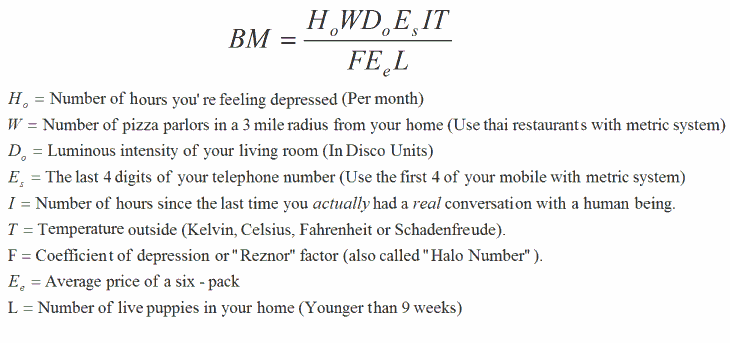
Happy Bullshit Blue Monday! Yes, today is the day where everyone feels down and gloomy about the fact that we’re assaulted with lots of completely made up news stories masquerading as psychology and misinforming everyone about science.

Methods suggested for relieving the nonexistent tosh have included everything from petting a pig to knowing that Al-Qaeda’s terrorists are being struck down by the bubonic plague.

Useful mental health coverage = precisely zero.

And on to our competition, which has been won by Kathe, who emailed in the following:

For every thing there is a season, and someone hoping to make a buck.

B=(S+H)T

What they hope the equation means:

T= thing
S= someone
H= hope
B= buck

What the equation really means:

T= Time spent making stupid equations
S= Amount of pseudoscience Spouted during the making of stupid equations
H= Hours of Help received from Googling ‘equations’
B= Amount of Bullshit produced

Kathe wins a £20 Kiva.org voucher, which I will send on shortly.

Although, we must say thanks to everyone for your entries, if you either added them as comments or mailed them. There are some great entries on our original competition page and an honourable mention must go to Camilo whose entry managed to not only include a New Order lyric but also used ‘disco units’.

You can see it as a pop-up if you want to experience it in all its glory.

Lycanthropy in Babylon

An interesting case series from the Babylon region of Iraq, reporting eight patients who had clinical lycanthropy where they had the delusional belief that they had changed into an animal. Seven believed they had changed into dogs, one believed he had changed into a cow.

Lycanthropy alive in Babylon: the existence of archetype.

Acta Psychiatr Scand. 2009 Feb;119(2):161-4; discussion 164-5. Epub 2008

Younis AA, Moselhy HF.

OBJECTIVE: Lycanthropy is the belief in the capacity of human metamorphosis into animal form. It has been recorded in many cultures. Apart from historic description of lycanthropy, there has been several case reports described in the medical literature over the past 30 years. METHOD: We identified eight cases of lycanthropy in 20 years, mainly in the area of Babylon, Iraq. RESULTS: The most commonly reported diagnosis was severe depressive disorder with psychotic symptoms. The type of animal that the patients changed into were mainly dogs (seven cases) and only one case changed into a cow for the first time to report. CONCLUSION: Lycanthropy delusion is a rare delusion but appears to have survived into modern times with possible archetypal existence.

Link to PubMed entry for ‘Lycanthropy alive in Babylon’.

Caffeine, hallucinations and an odd ghost obsession

A recent study hit the headlines reporting a link between caffeine intake and susceptibility to hallucinations. I’ve just read the paper and it’s an interesting well-conducted correlational study, but what struck me was the wackiness of the headlines it generated.

The study, led by researcher Simon Jones, was inspired by previous scientific work that has found a link between the stress-related hormone cortisol and psychosis.

Caffeine is known to interact with stress to increase cortisol levels further, so the researchers wondered whether there would be a direct link between caffeine intake and psychosis-type changes in thoughts and perception in people without a mental illness.

They asked 219 students to fill in well-validated standardised questionnaires relating to caffeine intake, stress, persecutory thoughts and hallucinatory experience and found that caffeine intake was associated with a small but reliable increase in susceptibility to hallucinations.

Actually, stress accounted for more hallucination susceptibility than caffeine, but as the first study to show an association between perceptual distortion and the world’s most popular stimulant in healthy people, it’s useful research.

I will now recount some of the headlines:

Coffee addicts see dead people

Caffeine, Responsible For Hallucinations

Did You See That Pink Elephant?

Too Much Coffee Can Cause You To Freak Out, Man

Coffee may make you see ghosts

Coffee linked to ‘visions’

‘Coffeeholics wake the dead’

If you think I’m cherry picking, these are actually fairly typical.

The news stories are a strange mix between an obsession with ghosts, which came from God knows where, and a profound confusion between correlation and causation.

UPDATE: I notice Bad Science has just picked up on the same study, and the same media obsession with ghosts, but also looks at a common element of the stories claiming that 7 cups of coffee a day ‘triples’ the risk of hallucinations – which didn’t appear in the paper but was apparently sourced from a bit of ad-hoc jiggery pokery for the press-release.

Link to DOI entry and study summary.
Link to sensible write-up from Science Daily.