Travelling at the speed of thought

Discover Magazine has an excellent Carl Zimmer piece discussing efforts to understand the speed of the human nerves – a quest that has lasted for well over one hundred years.

Although our experience of the world seems instantaneous, different nerves in the body work at different speeds and, of course, cover different distances – to the point where taller people experience a slight sensory lag compared to shorter people owing to the greater length of some of the nerve pathways.

Speed is not necessarily of the essence, however, and as with dancing, it is timing and co-ordination that seems key:

Sometimes our brains actually need to slow down, however. In the retina, the neurons near the center are much shorter than the ones at the edges, and yet somehow all of the signals manage to reach the next layer of neurons in the retina at the same time. One way the body may do this is by holding back certain nerve signals—for instance, by putting less myelin on the relevant axons. Another possible way to make nerve impulses travel more slowly involves growing longer axons, so that signals have a greater distance to travel.

In fact, reducing the speed of thought in just the right places is crucial to the fundamentals of consciousness. Our moment-to-moment awareness of our inner selves and the outer world depends on the thalamus, a region near the core of the brain, which sends out pacemaker-like signals to the brain’s outer layers. Even though some of the axons reaching out from the thalamus are short and some are long, their signals arrive throughout all parts of the brain at the same time—a good thing, since otherwise we would not be able to think straight.

Link to Discover article ‘What Is the Speed of Thought?’

On the soul of robots

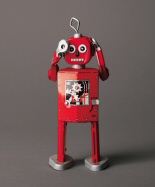
Image by Flickr user FlySi. Click for sourceNew Scientist has an interesting article discussing research on how we attribute personality traits to robots. This is not just the human-like android from research labs, it’s the robots that are already in widespread use in the workplace and home like the floor-cleaning Roomba.

This is a fantastic snippet about a study on the commercially available Aethon TUG robot, used to deliver supplies on hospital wards, and what staff made of the machine:

TUG, which is made by Aethon, can navigate a building’s corridors and elevators on its own and tell humans it has arrived with a delivery…

The lack of any social awareness led interviewees to complain that they felt “disrespected” by the robot. “It doesn’t have the manners we teach our children,” said one, “I find it insulting that I stand out of the way for patients… but it just barrels right on.”

Luckily for TUG, its unvarying, one-size-fits-all social skills happened to be a natural fit in the relaxed atmosphere of the post-natal ward, says Mutlu. But the same default settings were interpreted as demanding and attention-seeking on the oncology ward, which is a more stressful and busy place to work. “If you are going to design robots with human-like capabilities you have to design the appropriate social behaviour that goes along with it,” Mutlu says.

This reminds me of perhaps the only study that has evaluated what personality traits people attribute to the synthetic speech on a voice mail system, rating it as practical, intelligent, courteous, efficient, straight-forward, sophisticated, methodical, progressive and alert.

Link to NewSci article ‘Learning to love to hate robots’.

Understanding witchcraft

YouTube has a fantastic documentary about the work of the pioneering anthropologist E. E. Evans-Pritchard who was one of the first researchers to try and understanding the psychology of people he was studying.

He is most well known for his 1937 book Witchcraft, Oracles and Magic among the Azande where he studied the role of magic and prophecy in the lives of the Sudanese Azande people from their perspective.

This was one of the first times that an anthropologist had attempted to understand other cultural beliefs as a coherent system, rather than simply listing the ‘odd’ or ‘irrational’ practices from a Western perspective.

One of his main conclusions was that the Azande were making rational decisions based on different assumptions, in contrast to the general colonial opinion that the people of Africa were somehow ‘backward’.

Evans-Pritchard became one of the founders of social anthropology and was influential in a change of perspective in understanding other cultures.

He was also a keen photographer and there is a fantastic collection of his photos that attempted to record the people he met at the Oxford University Pitt Rivers museum.

The documentary is a great overview of both the man and his work with the Azande and Nuer people in Africa.

Link to documentary ‘Strange Beliefs: Sir Edward Evans-Pritchard’.

The psychiatric bible: the state of play

New Scientist has a good piece which outlines the current state of play in the contentious and recently delayed revision of the forthcoming psychiatric diagnostic manual, the DSM 5.

If you’ve been following the bad-tempered tussling among the psychiatric community over the re-writing of the manual, you probably won’t find much new in the main piece but it is a great summary and is accompanied by some examples of contentious disorders that are being considered for the new version.

These include complicated grief, a form of extended and unresolved grieving; changes to ‘gender identity disorder’, which currently describes the state of feeling like you’re a different gender; and hebephilia, a sexual interest in pubescent children.

The NewSci article is also accompanied by an interesting editorial that argues that the American Psychiatric Association should ditch the book and move to a database format where individual diagnoses could be updated when necessary as new evidence requires.

Link to NewSci article ‘Psychiatry’s civil war’.
Link to editorial ‘Psychiatry’s bible: Its time has passed’.

A great write-up of Project HM

Neurophilosophy has an excellent write-up of Project HM, the ongoing mission to thinly slice and digitise the brain of Henry Molaison, famous as amnesic Patient HM, who died last year.

Molaison was only one of a very few patients who had a radical operation that removed inner sections of both temporal lobes to cure otherwise untreatable temporal lobe epilepsy.

At the time, it wasn’t known that removing the hippocampus on both sides of the brain would lead to a profound amnesia that left the patient with the inability to create new ‘declarative’ memories – ones that can be recalled into the conscious mind.

The procedure was only carried out on a handful of patients before the profound effects became clear. The neurosurgeon William Scoville later campaigned against its use.

The rest, as they say, is history and owing to Molaison’s cheerful participation in numerous memory experiments we know a great deal more about the neural basis of memory. Hopefully the new high resolution digitised brain slices will allow a fine detail look at the relationship between HM’s brain and his abilities.

You’ll not find a better account of the project, so do head over and check out the Neurophilosophy piece.

My only slight addendum would be that the distinction between short and long-term memory was not initially drawn from HM. This distinction was originally made by ‘father of psychology’ William James who described it as ‘primary’ and ‘secondary’ memory in his 1890 book Principles of Psychology.

However, because HM had intact short-term memory (for example, he could repeat telephone numbers back to himself) but was not able to store anything effectively in long-term memory, he gave the first clues that this distinction was reflected in the structure of the brain.

This was all but confirmed in 1970 when neuropsychologists Tim Shallice and Elizabeth Warrington reported on Patient KF who had the reverse pattern of impairment – no short term memory, but with with normal long-term memory.

This showed that each of the two forms of memory could be independently impaired after brain damage and so almost certainly depend on distinguishable brain systems.

Link to Neurophilosophy on ‘Project H.M. Phase I’.
Link to Project HM website.

Ad Nauseum

adnauseam.jpgI am reading Ad Nauseam: A Survivor’s Guide to American Consumer Culture, edited by Carrie McLaren and Jason Torchinsky. The book is a funny, smart and sometimes shocking collection of articles from Stay Free Magazine and blog. I first came across Stay Free when I was researching the psychology of advertising and was impressed by their sophisticated take on how adverts affect consumers’ decision making. They discuss in Ad Nauseam how advertising is often misunderstood, with people relying on an intuitive ‘Advertising doesn’t effect me’ view or swinging to the opposite extreme of the ‘Sinister Advertisers Manipulate Consumers with their Mind Control Tricks’ position. Both positions distract from the very real, but not magical, power of advertising.

The book has a great discussion of Wilson Bryan Key’s Subliminal Seduction, the book that launched the idea that subliminal, and often sexual, figures are embedded in random features of adverts such as in ice cube shadows. The idea of these ’embeds’ is nonsense, of course, but great fun to look for and a great distraction from the real persuasive content of the advert. The book also has a chapter on the origins of modern advertising practice in 19th century pharmaceutical advertising (the manufacturing of ailments for which ready made ‘cures’ can be sold has been covered by Vaughan on mindhacks.com before, in relation to the mental health). Packed with critical analysis of the advertising industry, more informative history and some shocking examples of how consumerism has worked its way into many aspects of our daily lives, this book is essential intellectual self-defense, managing to be critical and aware without ever being sanctimonious or hysterical.

Cross-posted at idiolect.org.uk

Psychology in the New York Times Year in Ideas

I really recommend the 2009 Year in Ideas review from The New York Times as it is packed full of developments in the world of psychology and social science.

If you’re a regular Mind Hacks reader you’ll recognise some of the ideas from experiments and studies we’ve covered during 2009, but there are many more curiosities that make for compulsive reading.

Probably the majority of the articles will be of interest to mind and brain enthusiasts but I particularly enjoyed Literary Alzheimer’s, Lithium in the Water Supply, Treating P.T.S.D. With Tetris, Cognitive Illiberalism, The Counterfeit Self, Drunken Ultimatums and to be fair, pretty much all the others too.

My only complaint is the short pieces don’t link to the original sources (suggestion for Year in Ideas 2010: inline links!) but otherwise if you like the sort of stuff we post on Mind Hacks there’s plenty to keep you occupied here as well.

Link to NYT Year In Ideas 2009.

2009-12-11 Spike activity

Quick links from the past week in mind and brain news:

<img align="left" src="http://mindhacks-legacy.s3.amazonaws.com/2005/01/spike.jpg&quot; width="102" height="120"

New Scientist has an excellent piece on homosexuality throughout the animal kingdom.

Action video games “induce a general speeding of perceptual reaction times without decreases in accuracy of performance” according to a scientific review article in Current Directions in Psychological Science. To be widely publicised by Susan Greenfield. Oh no, my mistake.

Wired Science covers an interesting archaeological study finding possible signs of mass cannibalism from 7,000 years ago.

There’s well written, competent although slightly behind the curve article in Science News on the difficulties with functional brain scan cognitive neuroscience.

Dr Petra has more on the ‘in preparation’ and not very effective sex drug for women, flibanserin.

Well lookie here. The Economist uncovers UK government refusal to release its own report on the effectiveness of its anti-drugs strategy because it might ‘confuse the public’.

Not Exactly Rocket Science covers a fantastic study that found that testosterone made people more selfish, but only if they knew they were taking it.

You can find a working torrent of the recent and excellent BBC Horizon documentary ‘Why Do We Talk?’ on the psychology and neuroscience of speech and language here.

The New York Times reports on research finding that fathers can also experience post-partum (post-birth of child) depression.

There’s a fantastic article on the cognitive benefits of travel by Jonah Lehrer over at his blog Frontal Cortex.

Forbes magazine may be the first mainstream publication to get past the hype of commercial neuromarketing companies with an appropriately skeptical article.

“To a psychologist, climate change looks as if it was designed to be ignored”. Interesting article from The Washington Post.

Neuron Culture announces that if you liked the recent Atlantic ‘Orchid and the Dandelion’ article on how risk genes may really be sensitivity genes, science writer David Dobbs has agreed a deal to write a book riffing on the idea.

Brain structure and circuitry offer clues to consciousness in non-mammals, says an interesting cross-species article in Science News.

New Scientist has a piece on how the gaze of a computer generated disembodied head is being used to study the ability to follow eye direction and create shared or joint attention – a key social skill.

If you’ve not heard the latest RadioLab do so. A beautiful programme on numbers with plenty of psychology material.

Not Exactly Rocket Science has another great piece on a study finding fear memory associations can be reduced if a reminder of the feared thing is briefly presented a short while before an ‘extinction trial’ – a string of other reminders.

A blog at The Economist reports that the reported inmate suicides at Guantanamo Bay are <a href="Death at Guant√°namo
http://www.economist.com/blogs/democracyinamerica/2009/12/death_at_guantanamo”>unlikely to have been suicides.

Neuroworld is a new and promising looking brain science blog over at recently launched True/Slant network.

The lack of a fully formed prefrontal cortex may help young kids accumulate knowledge rapidly, according to research covered by the LA Times.

The Splintered Mind has news that Eric Schwitzgebel’s brilliant study on whether ethicists steal more books has appeared in the journal Philosophical Psychology.

A wonderfully contrarian review of a new book on art and evolution called The Play’s the Thing appears in American Scientist

Science Daily reports that a hidden sensory system discovered in the skin.

Antidepressants linked to personality changes, particularly a reduction in neuroticism, according to new study covered by the LA Times. Which, if you’re familiar with Eyesenck’s concept of neuroticism is a pretty unsurprising finding.

Science Now reports on study finding that first-borns are less co-operative in an economic bargaining game.

There’s a profile of psychologist and Deputy Director of the US Office of National Drug Control Policy who has faced numerous addiction problems in the family in The New York Times.

Metafiler picks up on an interesting new survey on ‘what philosophers believe‘ – tracking everything from political orientation to their take on hot philosophical issues.

My day with the mental health professionals. The Guardian has a life in the day of a community psychiatric team in a tough bit of North London.

New Scientist has a piece on a new brain imaging study looking at the neural correlates of not fulfilling a promise in an investment game. Daft headline, but it turns out the hubris is from the original badly titled original study.

The psychology of social status is discussed in an excellent piece for Scientific American’s Mind Matters blog.

Fan violence: take a swing when you’re winning

Popular sporting occasions have long been associated with violence and it was long assumed that assaults were more likely to be initiated by losing fans taking out their frustration. This has been contradicted by recent research that suggests it is fans of the winning team whom are more likely to be violent.

These studies are from the Violence and Society Research Group at Cardiff University who have an interesting history. The group was started by Jonathan Shepherd who is not a psychologist, sociologist or criminologist but a facial and dental surgeon.

He noticed that many of the injuries that he was treating were due to attacks, as the face is a common target of attack, and wondered if he could go about reducing facial injuries by reducing violent incidents.

The medical school is near Cardiff’s Millenium Stadium, one of the biggest sporting venues in the country, and so the group had the opportunity to study the effect of sporting events on assault and aggression.

In an initial study they found that violent incidents rose when the home team, Wales, won, rather than lost, regardless of the sport being played. A subsequent study evaluated fans on measures of aggressiveness, happiness and intention to drink alcohol before and after the match.

It turned out that aggressiveness was increased in winning fans but not losing fans. A win did not increase happiness but losing or drawing decreased it and intention to drink was not affected by the match result.

This concurs with the results of a somewhat disturbing study on domestic violence that found that assaults against women in the Washington area specifically increased when the Washington Redskins American football team won.

This is interesting in light of one of the main theories of violence, proposed by James Gilligan in his influential book Violence: Reflections on a National Epidemic, that says violence is typically a response to humiliation and serves to restore a perceived loss of status.

We don’t really have a good analysis of what triggers these specific violent incidents and it could be that winning sports fans are more sensitive to self-perceived humiliation, in line with the theory, but these sports violence studies could equally be evidence against this idea – with the rather unpleasant possibility that assaults are partly the result of a form of post-win triumphalism.

Link to Pubmed entry for study on effect of winning on assaults.
Link to Pubmed entry for study on effect of winning on aggression.

Publication of new DSM diagnostic manual put back

The American Psychiatric Association has announced that it has put back the publication of the forthcoming ‘DSM 5’ revision of the influential diagnostic manual of mental disorders back one year to May 2013.

The press release, available online as a pdf, notes:

“Extending the timeline will allow more time for public review, field trials and revisions,” said APA President Alan Schatzberg, M.D. “The APA is committed to developing a manual that is based on the best science available and useful to clinicians and researchers.”

Which could equally well be code for ‘owing to the recent shitstorm over our behind-closed-doors policy and strident criticism from past committee members about the scientific quality of our review process, we’ve decided we need a bit of breathing space’.

As long as the time is genuinely used to get a better scientific footing for the project it could be genuinely beneficial, although to be fair, it’s hardly likely that any new revision of the controversial manual will be greeted with universal approval.

pdf of APA press release on DSM 5 delay (via @DrDavidBallard).

Mystery shoppers for mental hospitals

The New York Times has an article on an interesting scheme by a Dutch hospital where three ‘mystery shopper’ psychiatric nurses were admitted onto the psychiatric ward pretending to be patients in an attempt to evaluate the care.

The article mentions a similarly to the famous experiment where psychologist David Rosenhan asked several volunteers to report to a psychiatrist that they heard a hallucinated voice say “empty”, “hollow” and “thud”. When admitted to hospital, all the ‘pseudopatients’ acted normally but none were suspected as faking. In a subsequent study, staff ‘detected’ a range of genuine patients as ‘fakers’.

The similarity with the mystery shopper scheme is only cursory, however, as in this case the diagnostic systems are quite different, the ‘mystery shoppers’ extensively trained, and the staff were warned but were not deliberately looking out for the ‘impostors’.

The article finishes with an interesting commentary by psychologist Richard Bentall on why the scheme is using ‘mystery shoppers’ at all and what this says about how we regard patients’ own opinions:

“Having covert observation is going to provide you with information you probably wouldn’t get in any other way,” he said.

But Dr. Bentall also sees some irony in using proxy mental patients to illuminate the experiences of real ones. “Their stories are neglected,” he said, “and their understanding of how they got to be in the hospital is not considered important.”

Link to NYT article on mystery shopper patients (via AITHoS).

Can’t get you out of my head

Photo by Flickr user _ES. Click for sourceSometimes songs get ‘stuck in our head’. In German, this experience is known as having an ‘earworm‘ and a new study shortly to be published in the British Journal of Psychology surveyed the typical features of this common phenomenon.

What particularly struck me was that “the length of both the earworm and the earworm experience frequently exceed standard estimates of auditory memory capacity”.

What is meant by auditory memory here is our ability to consciously remember a short piece of sound or to ‘repeat something back to ourselves’ – often called the ‘phonological loop’ in a popular model of working memory.

This tells us that ‘earworms’ are probably not something getting stuck in our very short-term memory but the reason why such tunes keeping buzzing around our conscious mind is still a mystery.

However, it’s interesting seeing a study address what the experience typically consists of:

Earworms (‘stuck song syndrome’): Towards a natural history of intrusive thoughts

British Journal of Psychology,

C. Philip Beaman and Tim I. Williams

Two studies examine the experience of ‚Äòearworms‚Äô, unwanted catchy tunes that repeat. Survey data show that the experience is widespread but earworms are not generally considered problematic, although those who consider music to be important to them report earworms as longer, and harder to control, than those who consider music as less important. The tunes which produce these experiences vary considerably between individuals but are always familiar to those who experience them. A diary study confirms these findings and also indicates that, although earworm recurrence is relatively uncommon and unlikely to persist for longer than 24 h, the length of both the earworm and the earworm experience frequently exceed standard estimates of auditory memory capacity. Active attempts to block or eliminate the earworm are less successful than passive acceptance, consistent with Wegner’s theory of ironic mental control.

The reference to ‘Wegner’s theory of ironic mental control’ is just the fact that when you deliberately try not to think of something (sometimes called thought suppression) you tend to think about it more often.

Link to study summary.

The persuasive power of false confessions

The APS Observer magazine has a fantastic article on the power of false confessions to warp our perception of other evidence in a criminal case to the point where expert witnesses will change their judgements of unrelated evidence to make it fit the false admission of guilt.

We tend to think that no-one would confess to a crime that they didn’t commit but there are numerous high profile cases where this has happened and the article notes that “because of advances in DNA evidence, the Innocence Project has been able to exonerate more than 200 people who had been wrongly convicted, 49 of whom had confessed to the crime we now know they didn’t commit.”

As a result of some of the early discoveries of false confessions, there is now a growing amount of research on what personal and situational factors trigger false confessions.

The classic book on the topic is forensic psychologist Gisli Gudjonsson’s The Psychology Of Interrogations And Confessions. It reviews the scientific evidence but also covers numerous legal cases where false confessions have played a part.

It turns out, people falsely confess to crimes for a wide array of reasons. Some are voluntary confessions where the person might want to gain notoriety, annoy the police or might genuinely believe they’ve committed the crime due to a delusion in the context of a psychotic mental illness like schizophrenia.

In other cases, a false confession can be triggered by pressure from the police or investigators. Sometimes this happens even when the person doesn’t genuinely believe their confession, because they just want to escape the high-pressure situation. In other cases, the psychological pressure leads the person to start doubting their own memories and they come to believe they have committed the crime.

There is now a great deal of research showing that highly suggestible people and people with learning disabilities or mental illnes are much more likely to make a false confession under pressure and police interview guidelines are being changed as a result.

However, the APS article takes a different tack. It looks at the psychology of how other people involved in deciding whether the person is guilty or not are influenced by confessions.

Imagine if an accused but innocent person falsely confesses and the other evidence doesn’t suggest that they have committed the crime. In this situation, it turns out that both lay people and experts tend to change their evaluation of the other evidence and perceive it as being stronger evidence against the accused.

Some of the studies cited in the article just blew me away:

In a 1997 study, Kassin and colleague Katherine Neumann gave subjects case files with weak circumstantial evidence plus either a confession, an eyewitness account, a character witness, or no other evidence. Across the board, prospective jurors were more likely to vote guilty if a confession was included in the trial, even when they were told that the defendant was incoherent at the time of the confession and immediately recanted what he said… Other studies have shown that conviction rates rise even when jurors see confessions as coerced and even when they say that the confession played no role in their judgment…

Kassin recently teamed up with psychologist Lisa Hasel to test the effect of confessions on eyewitnesses. They brought subjects in for what was supposed to be a study about persuasion techniques. The experimenter briefly left the room and, during that time, someone came in and stole a laptop off the desk. The subjects were then shown a lineup of six suspects, none of whom was the actual criminal, and they were asked to pick out which member of the lineup, if any, committed the crime. Two days later, the witnesses were brought back for more questioning… Of the people who had identified a subject from the original lineup, 60 percent changed their identification when told that someone else had confessed. Plus, 44 percent of the people who originally determined that none of the suspects in the lineup committed the crime changed their mind when told that someone had confessed (and 50 percent changed when told that a specific person had confessed). When asked about their decision, ‚Äúabout half of the people seemed to say, “Well, the investigator told me there was a confession, so that must be true.”…

In 2006, University College London psychologist Itiel Dror took a group of six fingerprint experts and showed them samples that they themselves had, years before, determined either to be matches or non-matches (though they weren’t told they had already seen these fingerprints). The experts were now given some context: either that the fingerprints came from a suspect who confessed or that they came from a suspect who was known to be in police custody at the time the crime was committed. In 17 percent of the non-control tests, experimenters changed assessments that they had previously made correctly.

The APS Observer has plenty more examples and demonstrates that false confessions are psychological sink holes that pull in both the accused and the legal process.

Link to ‘The Psychology and Power of False Confessions’.

John Nash, A Beautiful Mind, interviewed

There’s a video interview with Nobel prize winning mathematician John Nash, the subject of the Oscar-winning film A Beautiful Mind, over at 3QuarksDaily where he talks about his life, work and mental illness.

The film is a quite heavily fictionalised account of Nash’s life and he clearly has some disagreements with Sylvia Nasar’s award winning biography of the same name, so it’s interesting to get his own perspective.

Nash rarely gives interviews so this 20 minute discussion is quite comprehensive. In parts he discusses how he managed his work as a mathematician throughout his difficulties and even touches on some of his past delusions.

It’s fascinating, if not a little awkward in places, but a rare opportunity to hear Nash in person.

Link to video interview on 3QuarksDaily.

Optimal starting prices for negotiations and auctions

An article in the latest edition of Current Directions in Psychological Science reviews studies on the best starting points to increase the final price in either negotiations or auctions. In general, start high in negotiations, start low in auctions.

It turns out that negotiations, where several parties are invited to discuss a price, and auctions, where people can include themselves by jumping in when they want, are quite different psychologically.

The article, by business psychologist Adam Gilinsky and colleagues, notes that starting prices are a form of ‘anchor‘ – a piece of information which is known to affect subsequent decisions. As the authors note, anchoring has a powerful influence on our reasoning:

An anchor is a numeric value that influences subsequent numeric estimates and outcomes. When people make judgments, their final estimates are often assimilated to—that is, become more similar to—the initial anchor value (Tversky & Kahneman, 1974).

For example, in one of the best-known anchoring studies (Tversky & Kahneman, 1974), participants were exposed to an arbitrary number between 0 and 100 from the spin of a roulette wheel and then asked to estimate the percentage of African nations in the United Nations: Participants whose roulette wheel landed on a relatively high number gave higher absolute estimates than did participants whose wheel landed on a lower number.

Even outside of trivia questions, few psychological phenomena are as robust as the anchoring effect; it influences public policy assessments, judicial verdicts, economic transactions, and a variety of psychological phenomena.

The evidence suggests that in negotiations, a high starting price most often leads to a high final price, as the anchoring effect seems to work in a relatively undiluted way (with the caveat that completely ridiculous starting prices could prevent any deal being reached).

There’s an interesting aside in the article, mentioning that you can protect yourself from high anchor points from other people by focusing on your own ideal price or your opponents weaknesses, as found by a 2001 study, or by considering why the suggested price might be inaccurate, as found by another study published in the same year.

It also turns out that, contrary to conventional wisdom, making the first offer is also a good strategy:

Many negotiation books recommend waiting for the other side to offer first. However, existing empirical research contradicts this conventional wisdom: The final outcome in single and multi-issue negotiations, both in the United States and Thailand, often depends on whether the buyer or the seller makes the first offer. Indeed, the final price tends to be higher when a seller (who wants a higher price and thus sets a high first offer) makes the first offer than when the buyer (who offers a low first offer to achieve a low final price) goes first.

In contrast, for auctions, starting with a low price is generally more likely to lead to a higher final price. The researchers note this is likely due to three factors: price rise in auctions seems to be driven by social competition and so starting with a low entry point encourages more people to join in; once someone has bid, they have made a commitment which is likely to encourage them to continue; and finally, more bids leads us to infer that the item has a higher value.

It’s not a huge article so is worth reading in full if you’re interested in economic reasoning. Luckily, the full text is available as a pdf pre-print if you don’t have access to the journal.

Link to DOI entry for study.
pdf of full text.

Does squinting really improve vision?

Photo by Flickr user massdistraction. Click for sourceScience radio show Quirks and Quarks had a fascinating segment on its most recent programme asking whether squinting really does help you see more clearly. It turns out, it does.

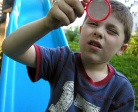
The programme talks to ophthalmologist Stephanie Baxter from Queen’s University in Kingston who notes that squinting focuses the incoming light onto the fovea – a central point on the retina responsible for sharp central vision – and cuts out light from other directions.

The short segment on squinting is at the bottom of the page.

Link to December 5th edition of Quirks and Quarks.