Brain scan diagnoses misunderstanding of diagnosis

There have been a lot of media stories in the past week about a study from the US military supposedly showing that a new form of brain scan can diagnose post-traumatic stress disorder (PTSD) in army veterans. Although interesting, the study doesn’t show any such thing and this is an example of a common misconception that regularly appears as a form of ‘new biological test diagnoses mental disorder’ story.

The study used a form of brain scan called MEG, essentially a high-tech form of EEG that picks up magnetic fluctuations from the brain’s electrical activity rather than the electrical signals themselves, and found that the coherence of signals across the resting brain was reliably different in vets diagnosed with PTSD by interview, compared to healthy people without mental illness.

Crucially, the scan didn’t pick out cases of PTSD among people with a range of mental illnesses, it just found a difference between people with PTSD and healthy people. But this is not a diagnosis, it’s just a difference.

If you’re not clear on this distinction, imagine that I claimed I found a new way of diagnosing malaria in under 2 seconds – I just measure body temperature and if the person has a fever, I decide they have malaria.

I hope you would point out that this is ridiculous, because people with flu can have fever, as can people with typhoid, mumps, dengue and so on.

My test would genuinely distinguish between people with malaria and healthy people, but in no way is it a diagnosis.

And this is the same situation with this new PTSD study. The difference could be due to levels of anxiety, common in many mental disorders, or to people who’ve experienced life threatening situations, regardless of whether they have PTSD or not, or any other factor I’ve not accounted for.

In other words, like with my fever example, it could be common to many different problems and not specific to the diagnosis I’m studying and I would need to make sure my method made a differential diagnosis – i.e. specifically ‘picked out’ the disorder among many – to be a useful diagnostic tool.

However, this latest PTSD story follows a common format in mental health news. I’ve lost count over how many reports I’ve read on how a ‘new test’ could diagnose schizophrenia based entirely on the fact that a study has found a difference between people with schizophrenia and people who don’t have it.

From reading these stories, I suspect it’s often the researchers who are at fault in describing their research.

When asked about to publicly justify their work, I suspect researchers often go for the easy “it could help diagnose the disorder”, which sounds immediately useful, as compared to the more truthful “it’s a small piece of knowledge in a very large area and we won’t know if it is reliable until it is replicated and if so, we may not fully understand its significance for many years to come. However, these small incremental advances are all useful even if they prove to be dead ends as they help us understand the problem from all angles”.

In this case, the researchers wrongly suggest in their scientific article that their findings “can be used for differential diagnosis” and so we can hardly blame the media for picking up on the hype.

So the next time you read a ‘new test diagnoses mental illness’ story, check to see whether it is genuinely picking out the problem among many others, or whether it’s just reporting a non-diagnostic difference.

Link to PubMed entry for new study.
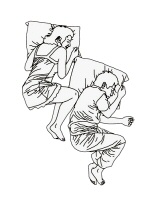
The soporific boogaloo

The Guardian has a short piece and gallery on what couple’s sleeping positions say about their relationship. The article is based on a humorous book called The Secret Language Of Sleep and it’s not quite clear that the writer has picked up on the fact its not meant to be taken too seriously.

The idea that sleep position is linked to personality is surprisingly popular but largely untested. Only poorly controlled study has ever tried to investigate the issue. It chose only 6 out of 14 sleep position recorded from 51 females and concluded that “Sleep positions, particularly the full fetal position, appear to be related to CPI [California Psychological Inventory] variables of Sociability, Sense of Well Being, Achievement by Conformance, Femininity, and Social Maturity”.

The general idea, however, has quite an interesting history. It was originally suggested in passing by the early psychoanalysts and fits well into Freud’s theory of dreaming.

He suggested that when we sleep we are left alone with our unconscious which may contain lots of unpleasant or unwanted desires we don’t want to think about. If we did, we might become so emotionally disturbed as to wake up, therefore, according to Freud, dreams serve to hide our unconscious desires from us by presenting them to us in a more acceptable symbolic form.

From this perspective, dreams serve to keep us asleep and Freud’s big idea was that we can analyse the dream’s ‘manifest’ or obvious content to give us an insight into the ‘latent’ or unconscious meaning. This is why Freud famously wrote that dreams are a “royal road to the unconscious”.

According to Freudian theory, our personalities are largely a reflection of how we manage and ‘defend’ against out our unconscious desires. As our dreaming life occasionally breaks through into movement or speech when we sleep, it’s not a big leap to link sleep position with personality.

This link was made explicitly in a 1979 book called Sleep Positions: The Night Language of the Body by the psychoanalytically inclined psychiatrist Samuel Dunkell. In the book, Dunkell readily admits there is no research to back up his ideas but links personality with sleep position on the basis of individual cases and anecdotes from his own practice, as psychoanalysts have a tendency to do.

Despite being based almost entirely on one man’s opinion, the book has been remarkably influential in pop culture and there has been a steady trickle of media interest ever since that has repeated the main ideas.

In fact, the Huffington Post, which has become an unintentional champion of dodgy science, ran a piece only last week that claimed to explain ‘What Your Sleep Position Says About You’ based almost entirely on Dunkell’s book.

There was a brief media splash in 2003 when sleep psychologist Chris Idzikowski claimed almost exactly the same based on a ‘new study’ but it never appeared and was presumably a PR piece for the private sleep clinic he worked for.

So we don’t really know if sleep position is linked to personality, and certain can’t ‘read’ anything about you from your night-time body position.

But the theory is so popular that even a satirical book can apparently be misinterpreted as supporting the idea.

Link to Guardian piece ‘The politics of sharing a bed’.

2010-01-22 Spike activity

Quick links from the past week in mind and brain news:

Drug Monkey covers a fascinating study finding that mental health workers judge patients differently depending on whether they’re described as being a ‘substance abuser’ or as having ‘a substance use disorder’. We covered a similar study on personality disorder previously.

To the bunkers! The robots are coming but are we ready for them? asks Silicon.com. Remember: see a twitch? Check for a switch. Species security is everyone’s responsibility.

NPR has a fascinating segment on the relationship between lies and wishful thinking.

To the bunkers! The age of the killer robot is no longer a sci-fi fantasy, says an article in The Independent. Remember: a disabled robot can be rebuilt, leave no component in working order. Clunk, clip, every chip.

Normal face recognition abilities are influenced by genetics finds new twin study reported by Wired Science.

To the bunkers! The Daily Express reports on the unveiling of robot planes hailed as ‘the future of warfare’. Remember: robot soldiers have no souls – make a dent, don’t repent.

The Neurocritic asks ‘Is this aspirin playful or serious?’ and covers a curious neuromarketing study that looked at the personalities of products.

To the bunkers! H+ Magazine reports on a nanotechnology robot arm that places atoms and molecules with 100% accuracy. Remember: he may look clean, but have you scanned? Even live humans may have robot parasites.

Neuronarrative reports that making a constant public commitment to lose weight improves dieting success.

To the bunkers! Popular Science reports on a robot that takes surer steps due to ‘chaos control’. Remember: see a wire? Open fire. Humans always fight for liberty.

PsyBlog lists the the 7 psychological principles of scams.

To the bunkers! CNET reports that Korean scientists have created a robot housemaid. Remember: Stepford Wives – check the eyes.

Wiley Science puts the first issue of its new Interdisciplinary Reviews: Cognitive Science magazine online with an impressive list of academic articles freely available to download.

To the bunkers! Toyota predicts robot nurses will care for the frail elderly, according to a story in Wired Gadget Lab. Remember: a family with a robot is a massacre in the making. Take care of the robots, before they take care of you.

BBC News reports on a study finding that video game success is related to brain structure size: nucleus accumbens size predicts initial success, basal ganglia long-term success.

To the bunkers! TG Daily reports on Roxxxy, an AI sex robot that “has personality, and can even answer back”. Remember: nothing compares to human sex, don’t let the robots get you by the balls.

The Guardian has an excellent eight part summary of Heidegger’s ‘Being and Time’.

To the bunkers! New Scientist reports on a study finding that exposure to robots in the movies and television could affect our ability to empathise with synthetic beings. Remember: detect a bug? Pull the plug. Even loved ones can be androids.

New Scientist reports on a new study finding a link between symmetry of activity in the brain’s hemispheres and susceptibility to hypnosis.

To the bunkers! The New York Times reports that a new generation of ear bud headphones have built in artificial intelligence-based signal processing. Remember: your ears are a backdoor into the brain, don’t let the robots in – keep neural tissue pure.

The BPS Research Digest reports on a study finding that early risers are more proactive than evening people. Shortly to be the basis of a new diagnosis and licensing application for modafinil.

To the bunkers! An article in Popular Mechanics argues against the concept of the ‘uncanny valley‘, although neglects to mention a couple of relevant studies that support the concept. Remember: if it’s too good to be true, it’s robot through and through. Your intuition is the best defence against the robot menace.

The Psychiatric Times blog notes that families of US soldiers who commit suicide do not get condolence notes from the government like other military casualties.

To the bunkers! Geeky Gadgets sells an awesome Google / SkyNet t-shirt. Remember: humans, biology is our heritage. Metabolism pride!

The Telegraph reports that even the founder has given up on the idea of bullshit Blue Monday. Thankfully, we were relatively unafflicted this year although Dr Petra had a good antidote for any remaining infections.

To the bunkers! The Engineer reports on the development of a fire fighting robot. Remember: heat tolerance is a robot trait. No sweat, no soul.

Neuroworld takes apart the ‘blonde women get angry’ news that was completely made up from a barely related study.

To the bunkers! Entertainment Weekly reports that the next Spike Jonez film is a robot love story. Remember: to a robot, your heart is just a machine. Don’t let them capture it.

New Scientist covers and interesting study that mathematically modelled the social effects of monogamy and polygamy.

To the bunkers! USA Today reports on the unveiling of a new anti-terrorism robot at Boston’s Logan Airport. Remember: only humans feel fear, anti-terrorism is anti-humanism, fight the robot overlords.

Skeptical Inquirer magazine has an excellent piece on highlights of mass delusions and hysteria from the last millennium.

To the bunkers! The Guardian has an article looking at the history of robots in sport. Remember: sport strengthens human relationships, don’t let robots infiltrate your team.

The Economist covers an intriguing study find that power corrupts, but it corrupts only those who think they are entitled to take advantage of the situation.

To Bedlam and Part Way Back

BBC Radio 4 has a fantastic documentary on one of then 20th century’s great poets, Anne Sexton, who struggled with mental illness throughout her adult life and eventually committed suicide at the age of 46.

Uniquely, tapes of Sexton’s psychotherapy sessions with psychiatrist Martin Orne were found after her death giving an alternative insight into her mental life.

The programme dramatises excerpts from the tapes and talks to members of her family about her life, writing and frequent hospitalisations.

Sexton is typically classified as one of the ‘confessional’ poets, although, regardless of the label, her work is certainly very personal and reveals an articulate if not fragile look at many key relationships in her life.

Because of the BBC’s archive of doom, you only have three days to listen to it before it disappears for good into the abyss, although it is well worth catching if you get the chance.

Link to BBC Radio 4 documentary ‘Consorting with Angels’.

Two drugs show best treatment possibility for MS

In massive news for neurology, The New England Journal of Medicine has published three important studies reporting that two new drugs for multiple sclerosis are more effective than existing treatments and can be taken in pill form.

Multiple sclerosis is a bitch. It’s a neurological disorder where the immune system starts attacking myelin – the protective covering of nerves in the brain and spinal cord – leading to unpredictable attacks that typically leave the person a little more disabled each time.

Problems can include movement difficulties, chronic pain, fatigue, cognitive problems, mood instability and impairments to the body’s automatic processes like digestion, bladder and bowel control.

One problem with the the current treatments that try and slow down the disease itself, rather than just manage the effects, is that they all require regular injections or infusions via a drip.

These new studies report on two drugs: one is cladribine which is already widely used in leukaemia, and the other is fingolimod, which is not yet available commercially. Crucially, both can be taken as pills without the need for injections.

The studies that investigated these drugs were very impressive. They had large numbers of patients in many countries; they were conducted with the co-operation of drug companies but were led by independent researchers; they continued for about two years; they were compared against placebo and, in the case of fingolimod, against the current best available treatment – beta interferon; and they looked at both chances of relapse and at changes in brain structure.

The studies did not include the most disabled people with MS are all were able to walk, although patients with mild and moderate disability were included.

The results suggest that the drugs are not only easier to take but are better than the current best available treatments and reduced the chances of the patient having a relapse of MS as well as the damage to the white matter in the brain.

The drugs work quite differently from current treatments – which largely reduce inflammation directly – by changing the balance of how the immune system releases T cells so more antiinflammatory ‘helper’ T cells are available.

Unfortunately, the drugs are not without side effects, and although these effects were rare, altering the immune system led to more herpes infections and an increase in the development of cancer.

Herpes infections can take the form of the annoying but relatively benign, like in local infections such as cold sores, shingles and genital herpes, but when it gets into the whole body or brain it can cause serious damage or even lead to death, which happen to two patients in the trial, although in this case it was out of more than 1,100 people in total. The people with cancer generally recovered well – there was one death but it isn’t entirely clear it was linked to the treatment.

Although these drugs are not cures, they only slow the disease down, this is still massive news and a major development in neurology.

One of the practical big issues will be how the drugs are priced by the pharmaceutical companies and you can be sure they’re not going to be cheap.

However, one small hope is that the two compounds are owned by rival companies and as they seem to have broadly equivalent effects it will be hoped that competition will drive the price down.

Link to good write-up from The Times.
Link to good technical summary in the NEJM, sadly paywalled.

A Brilliant Madness online

I’ve just discovered that the excellent PBS documentary A Brilliant Madness that looks at the life of Nobel-prize winning mathematician, John Nash, is available online either as streamed video or as a torrent.

Nash was famously the subject of the Oscar-winning film, A Beautiful Mind, although the while the main plot elements are true – he both won the Nobel prize and experienced decades of psychosis – his life was heavily fictionalised to the point of being schmaltzy.

The PBS documentary is a more honest, but no less inspirational, look at Nash, and is based on the Pulitzer Prize winning biography by Silvia Nasar.

Nash himself gives an articulate account of his own illness and how society deals with those who experience other realities, while the documentary traces Nash’s sometimes less-than-flattering earlier life story to his later years where he is widely considered to be an altogether more gentle and humane individual.

If you want to know the real story behind A Beautiful Mind or more about Nash it is essential viewing.

Link to information on the documentary from PBS.
Link to flash streamed version.
Link to torrent.

Cognitive Daily has left the bulding

Cognitive Daily, one of the most established and respected psychology blogs on the internet, has just announced it has come to an end on the five year anniversary of its first post.

We’ve been fans of CD since, well, since they started as they kicked off only a few months after we did.

However, all is not lost, as both Dave and Greta will continue with their many online projects and there is a mysterious ‘new project’ soon to be announced (greatest hits? musical? concept album?)

What will we do with all that time we’ve freed up? Greta plans to continue her work as Professor of Psychology at Davidson College, teaching and mentoring students, conducting research, and sharing her love of music, literature, and art. Dave will continue as editor of ResearchBlogging.org and weekly columnist for SEEDMAGAZINE.COM, and he’ll maintain his personal blog, Word Munger and his obsessively-updated Twitter account. In addition, Dave’s planning a new project, to be unveiled within the next few weeks. Look for more information about it on Twitter and Word Munger.

Many thanks to you both for five years of fantastic psychology coverage on Cognitive Daily and we wish you all the best for future projects.

Link to Cognitive Daily announcement.

Lost in frustration

Photo by Flickr user honikum. Click for sourceNew Scientist has a piece on culture and psychological distress by Ethan Watters, the same chap who wrote the recent and widely discussed New York Times article on the ‘globalisation of mental illness’. This new article looks at similar territory but also pulls out some examples of where concepts and symptoms don’t translate well between different societies.

The meaning matters as much as the event,” says Ken Miller, a psychologist at Pomona College, Claremont, California, who studied in Afghanistan and elsewhere the reactions to war trauma.

He found many psychological reactions that were not on any western PTSD symptom list, and a few with no ready translation into English. In Afghanistan, for example, there was asabi, a type of nervous anger, and fishar-e-bala, the sensation of agitation or pressure.

Giathra Fernando, a psychologist at California State University, Los Angeles, also found culturally distinct psychological reactions to trauma in post-tsunami Sri Lanka. By and large, Sri Lankans didn’t report pathological reactions in line with the internal states making up most of the west’s PTSD checklist (hyperarousal, emotional numbing and the like). Rather, they tended to see the negative consequences of tragic events in terms of damage to social relationships. Fernando’s research showed the people who continued to suffer were those who had become isolated from their social network or who were not fulfilling their role in kinship groups. Thus Sri Lankans conceived the tsunami damage as occurring not inside their minds but outside, in the social environment.

It’s probably worth mentioning that this goes both ways and there are many everyday psychological concepts in English and Western society that don’t translate well into other languages.

Some of these become obvious when you read studies that have attempted to translate questionnaires originally in English into other languages.

For example, here’s an excerpt from a study that translated a mental health questionnaire from the World Health Organisation into Urdu:

This item [“Do you have trouble thinking clearly?”] presented considerable problems in translation. It measures the disturbance in concentration and cognition associated with depressive disorders. We could not find an exact substitute for the term, “clear thinking” in colloquial Urdu, and the nearest semantic and technically equivalent term that was acceptable in back translation was “wazay soch bichar”

Unfortunately, it doesn’t say what ‘wazay soch bichar’ is in English, so if you’re an Urdu speaker do get in touch as I’d love to find out.

It’s also often the case that words such as ‘anxiety’ may have a related word in another language but the sensations associated with it are not the same.

The New Scientist piece, taken from a forthcoming book by Watters, argues that Western concepts are now being exported around the world and local people are increasingly describing mental and social distress in terms of Western, and particularly, American, diagnoses.

UPDATE: Many thanks to Mind Hacks reader Matt for getting in touch with the translation:

i have a translation of ‘wazay soch bichar’ for you. my colleague nasir says the literal translation of it is ‘obvious thinking’ and agrees there is no direct translation of ‘thinking clearly’ in urdu and that ‘wasay….’ is the best available.

Link to ‘How the US exports its mental illnesses’.

Leave my soul alone

I’m re-reading the excellent book Into the Silent Land by neuropsychologist Paul Broks and was reminded of a part where he recounts an eerie poem about a 1938 operation to remove a brain tumour.

The poem is by Welsh poet and doctor Dannie Abse and, looking it up on the internet, I discovered that the poetry archive has a wonderful entry for the piece online that not only includes the text but also a recording of Abse introducing and reading the poem.

The uncanny incident, probably caused by stimulation of the cortical surface, was witnessed by Abse’s brother, also a doctor, when observing an operation by the famous neurosurgeon Lambert Rogers.

In the Theatre
by Dannie Abse

(A true incident)

Sister saying—‘Soon you’ll be back in the ward,’
sister thinking—‘Only two more on the list,’
the patient saying—‘Thank you, I feel fine’;
small voices, small lies, nothing untoward,
though, soon, he would blink again and again
because of the fingers of Lambert Rogers,
rash as a blind man’s, inside his soft brain.

If items of horror can make a man laugh
then laugh at this: one hour later, the growth
still undiscovered, ticking its own wild time;
more brain mashed because of the probe’s braille path;
Lambert Rogers desperate, fingering still;
his dresser thinking, ‘Christ! Two more on the list,
a cisternal puncture and a neural cyst.’

Then, suddenly, the cracked record in the brain,
a ventriloquist voice that cried, ‘You sod,
leave my soul alone, leave my soul alone,’—
the patient’s dummy lips moving to that refrain,
the patient’s eyes too wide. And, shocked,
Lambert Rogers drawing out the probe
with nurses, students, sister, petrified.

‘Leave my soul alone, leave my soul alone,’
that voice so arctic and that cry so odd
had nowhere else to go—till the antique
gramophone wound down and the words began
to blur and slow, ‘ … leave … my … soul … alone … ’
to cease at last when something other died.
And silence matched the silence under snow.

Link to poetry archive entry for ‘In the Theatre’.

The dream life of children

Photo by Flickr user Grace. Click for sourceWhile we may have an elaborate dream life as adults, it seems we develop the ability to have rich and vivid dreams as we grow – children start off having relatively simple dreams that become more complex throughout childhood.

Below is an excerpt from a scientific review article on ‘dreaming and the brain’, shortly to be published in Trends in Cognitive Sciences, that addresses how our dream life changes and develops during our early years.

One of the criticisms of these findings might be that dreams seem less complex in younger children because their language isn’t rich enough to describe them fully. However, there is good evidence against this idea – the complexity of dreams is not strongly related to verbal ability, although it is to the vividness of the child’s mental imagery.

When do children start dreaming, and what kind of dreams do they have? Given that children often show signs of emotion in sleep, many assume that they dream a great deal. However, a series of studies by David Foulkes showed that children under the age of 7 reported dreaming only 20% of the time when awakened from REM sleep, compared with 80–90% in adults.

Preschoolers’ dreams are often static and plain, such as seeing an animal or thinking about eating. There are no characters that move, no social interactions, little feeling, and they do not include the dreamer as an active character. There are also no autobiographic, episodic memories, perhaps because children have trouble with conscious episodic recollection in general, as suggested by the phenomenon of infantile amnesia.

Preschoolers do not report fear in dreams, and there are few aggressions, misfortunes and negative emotions. Children who have night terrors, in which they awaken early during the night from SWS [slow-wave sleep] and display intense fear and agitation, are probably terrorized by disorientation owing to incomplete awakening rather than by a dream. Thus, although children of age 2–5 years can see and speak of everyday people, objects and events, they apparently cannot dream of them.

Between the ages of 5‚Äì7 years, dream reports become longer, although they are still infrequent. Dreams might contain sequences of events in which characters move about and interact, but narratives are not well developed. At around 7 years of age, dream reports become longer and more frequent, contain thoughts and feelings, the child’s self becomes an actual participant in the dream, and dreams begin to acquire a narrative structure and to reflect autobiographic, episodic memories.

It could be argued that perhaps all children dream, but some do not yet realize that they are dreaming, do not remember their dreams, or cannot report them because of poor verbal skills. Contrary to these intuitive suggestions, dream recall was found to correlate best with abilities of mental imagery rather than with language proficiency… Put simply, it is children with the most developed mental imagery and visuo-spatial skills (rather than verbal or memory capabilities) that report the most dreams, suggesting a real difference in dream experience.

I’ve removed the numeric references for ease of reading, but you can find the full research sources in the original article.

Link to PubMed entry for article.
Link to DOI entry for same.

Hard as nails

Tom alerted me to this fantastic brief case published in the British Medical Journal where a builder is admitted to hospital in great pain after a nail penetrated all the way through his boot. But it turned out that the pain was entirely psychological, as the nail had missed his foot by sliding between his toes.

A builder aged 29 came to the accident and emergency department having jumped down on to a 15 cm nail. As the smallest movement of the nail was painful he was sedated with fentanyl and midazolam. The nail was then pulled out from below. When his boot was removed a miraculous cure appeared to have taken place. Despite entering proximal to the steel toecap the nail had penetrated between the toes: the foot was entirely uninjured.

As Tom mentioned “One of the things I love about it is that the builder had no incentive to ‘fake’. He knew he should have acted tough so we know that the pain he felt wasn’t over-acting. It was imaginary pain, but it was real imaginary pain!”

This isn’t really the nocebo effect, where ‘side-effects’ appear after having taken nothing but a placebo, but more similar to what doctors might describe in its persistent form as somatisation disorder where physical symptoms appear that aren’t explained by tissue damage.

However, both are similar in that real pain arises from beliefs, expectations and perceptions. We now know that all pain has a significant mental component and, consequently, psychological therapy is an effective treatment for chronic pain.

It’s no coincidence that Tom picked up this snippet in a talk by psychologist Stuart Derbyshire who has done some fantastic studies on the neural basis of psychologically controlled and induced pain by using hypnosis in fMRI scanners.

Link to brief piece in the BMJ.

You’ve got mail…

A curious case of a woman who believed she was receiving email directly into her body near to where a diamond teddy bear was residing, published in the International Journal of Geriatric Psychiatry:

We report the case of an elderly lady with no experience of using a personal computer or internet technology, whose delusional experiences included the direct personal receipt of email. Ms T, an 84-year old female with a 40-year history of schizoaffective disorder, presented with a delusional belief that something precious and of value ‘for all people’ had been inserted into her body by a doctor in Germany in the 1950s.

She had sought medical help because she believed that an abdominal operative procedure would be necessary to remove a ‘‘rat and a teddy bear made of diamonds’’ that she believed had grown within her. Following admission, she remained highly guarded, distressed and preoccupied with the need of urgent surgery, which she demanded every time she met her medical team.

When asked about the origins of this belief and her desire for surgery, she said that she had gained knowledge about this from a friend, whom she had seen last in 1945. She explained that she received emails from this friend. These arrived in her mind, exactly like electronic mail, but were managed without a computer. Rather than receiving messages in text form, she received what she described as ‘an impression in my mind’, which conveyed an unequivocal meaning to her.

She also believed that her friend had some valuable information for the medical team and that he would be able to contact the senior physician by a similar mechanism. Following 4 weeks of treatment with risperidone 1.0 mg bd her mental state improved to the point where she stopped receiving the emails, gained insight into her primary belief and told us that she was satisfied that surgery was no longer needed.

Link to PubMed entry for case study.

Chasing the digital dragon

Wired has an excellent report on abuses in China’s ‘internet addiction’ boot camps in the wake of the death of a young man from a beating only hours after he was admitted to one of the facilities.

As we reported last August, after years of promoting the ‘psychiatric dangers’ of the internet, the Chinese government has started to rein in its own clinics after criticisms of its treatments (that included electroshock) and has begun to crack down on the numerous private clinics after reports of widespread abuses.

The Wired piece follows the story of Deng Senshan, the young man who was beaten to death in one of the camps, and explores how the rise of the treatment clinics have followed the increase in anxiety about young people using the internet.

The article also pulls out some of the cultural factors that drive the concept of internet addiction in China, which are quite different from those that are common in the United States.

In fact, this was discussed in a study by anthropologists Alex Golub and Kate Lingley, who noted that in America, parents typically take their children to internet addiction clinics because they don’t spend any time outside or don’t socialise, whereas in China, people take their children to Internet addiction clinics because their children are playing basketball, dating, and playing video games instead of studying.

Link to Wired article ‘Obsessed With the Internet: A Tale From China’.
Link to our previous report on China’s ‘net addiction’ clinics.
Link to study on cultural factors behind Chinese ‘net addiction’.

Patients with no skull are a window on brain activity

I’ve just clocked a stunning experiment, shortly to be published in the Journal of Cognitive Neuroscience, that recorded brain activity from patients who had part of their skull surgically removed for several months and had only flaps of skin between their brain and the outside world.

The operation is called a hemicraniectomy and is often used when the brain swells or the pressure builds up inside the skull to the point where it is damaging the brain.

Neurosurgeons will sometimes remove a portion of the skull (see the scans on the left) and just leave the scalp protecting the brain until the swelling subsides, before replacing the skull flap some months later.

As an aside, sometimes the surgeons will surgically insert the piece of skull into the abdomen so the bone marrow doesn’t die and it can be replaced ‘alive’ when the time comes. There’s a great description of this here.

The patients normally wear helmets, for obvious reasons, but they are unique in having such a thin covering of the brain.

A team of researchers, led neuroscientist Bradley Voytek, realised this provided a unique opportunity to examine the exactly how the skull affects EEG, one of the most common techniques for measuring the electrical activity of the brain.

EEG records brain activity from electrodes on the skull, but the signal gets ‘smeared’ as the electrical charge passes through the bone and so the source of the activity can’t be located very precisely to specific brain areas.

By working with the hemicraniectomy patients, the researchers could compare electrical activity on one side of the brain – recorded through just the skin, and the other, where recordings were made normally – through electrodes on the skull.

The researchers found that the non-skull signals were richer, were less subject to interference, were more closely tied to specific tasks and could be better linked to specific brain areas.

On the right is a comparison of the signal coming from a listening task, where participants are suddenly presented with an ‘oddball’ noise in the midst of a bunch of otherwise identical sounds. The brain reacts strongly to the change and this is reliably reflected in a positive spike in the electrical activity at about 50 milliseconds (consequently, the wave is called the ‘P50’ signal).

You can see that the activity on the craniectomy side is much stronger, tighter and cleaner whereas on the skull side it is quite indistinct. The team found similar results in several other tasks.

This not only helps us better understand EEG results on people with intact skulls, but it also meshes with brain activity recordings that are taken from electrodes implanted directly in the brains of patients undergoing neurosurgery.

Link to PubMed entry for study.
pdf of scientific article.
Link to Bradley Voytek’s blog post about his work.

2010-01-15 Spike activity

Quick links from the past week in mind and brain news:

Herbert Spiegel, legendary pioneer of hypnosis research, has left the building. The New York Times has an obituary.

Corpus Callosum covers a possible new non-addictive anti-anxiety drug. We have a long history of new ‘non-addictive’ anti-anxiety drugs turning out to be addictive. Fingers crossed for this one.

Jenny McCarthy dismisses a recent scientific study on autism and demands more anecdotal data, according to a report by Discovery News.

The Smithsonian Magazine has an article on ‘Phineas Gage: Neuroscience’s Most Famous Patient’.

There’s an excellent piece about the history of child bipolar disorder, a culture-bound syndrome specific to American psychiatry if ever there was one, over at Neuroskeptic.

Vox Project is a BBC Radio 4 documentary on the neuroscience of speech and language. Shortly to evaporate into the black hole that is the time-limited BBC archive, so catch it while you can.

There are some beautiful cut-away illustrations of MRI, PET and CT scanners here.

BBC News reports on the second biggest danger associated with taking cocaine, after acting like a cock.

Viewing headless bodies causes changes in how we perceive faces, according to an intriguing study covered by Neurophilosophy.

The New York Times reviews the new movie documentary on the life of Nobel-winning neuroscientist Eric Kandel.

The top ten most popular posts on the excellent Addiction Inbox blog are listed for your perusal.

The Splintered Mind notes philosopher of mind Eric Schwitzgebel is doing a UK tour. T-shirts presumably available at the venues.

Jewellery and make-up suggest neanderthals were smart, according to archaeologists who have clearly never been down Watford High Street on a Saturday night. Wired UK covers the story.

Scientific American has an excellent article on online social networks and mental health which is locked behind their newly imposed paywall. Science!

The effect of stereotypes and how the unconsciously influence our behaviour is covered in a great piece on PsyBlog.

The New York Times covers new concerns about human rights abuses in China’s drug rehab centres.

An awesome looking book on the history of prion brain disease kuru is reviewed by The Neuro Times.

American Scholar magazine has a quirky A-Z narrative journey through brain science that shouldn’t work, but does.

There’s a great piece on the history of giving beef flavoured Prozac to dogs for ‘canine separation anxiety’ over at Frontier Psychiatrist.

The LA Times covers the debate over cognitive behavioural therapy vs traditional psychological treatments that continues to rumble on. I assumed it was all dolphin therapy in LA.

The US Navy wants troops wearing brain-scanners and doing cognitive assessments in the war zone, according to a report by Wired Danger Room.

Neuroethics at the Core has some excellent coverage of the state-of-play with the ‘next generation’ ampakine cognitive enhancers.

Post-shit-hitting-the-fan morphine cuts combat PTSD rates in half, according to a new study discovered and discussed by Neuron Culture.

The New York Times reports that AI pioneer, Ray Solomonoff, has left the building and has an obituary.

The uncanny valley and the digital Beatles are discussed by the Sensory Superpowers blog.

BBC News reports on a new study finding that angiotensin receptor blocker drugs cut dementia rates.

The latest Brain Science Podcast is an interview with pioneering emotion neuroscientist Jaak Panksepp.

Charlie Rose has part three of his brain series where a cluster of high profile neuroscientists discuss action and the brain.

In a rather timely post, The Frontal Cortex covers a recent imaging study on the neuroscience of charitable giving.

The New York Times has an interesting account of how a judge has tried to reconfigure the court system for low-level drug offenders to promote behavioural change.

A British law automatically sacking MPs who need more than six months out for mental health problems when no such rule exists for physical health problems is being challenged, reports BBC News.

The San Francisco Chronicle reports on how Yahoo! is tooling up with social scientists.

The dying art of Braille reading and how the blind community is using technology is covered by an interesting piece in The New York Times.

New Scientist has an interesting piece on ‘Five emotions you never knew you had’ that tackles various feelings recently classified by psychologists.

An elegant study that helps explain why light makes migraines worse is covered by Science News.

In The Pipeline covers an interesting example of the nocebo effect: residents complain that a new cell phone tower making them ill, company reveals it wasn’t switched on.

Beyond crossed senses in synaesthesia

Cognitive Daily covers a super-elegant study that helps us understand whether synaesthesia is really just a case of ‘crossed senses’ or whether the perceptual blending effect requires the person to have processed some of the meaning of the triggering experience.

The traditional explanation of most types of synaesthesia is that the brain’s sensory areas are overly connected, so activation of one sense triggers activity in another area which causes the experience. However, there has been some recent evidence that synaesthesia doesn’t work purely at this basic sensory level.

For example, a recent study by neuropsychologist Jamie Ward and colleagues reported that letter-colour synaesthetes needed to be concentrating on the letters to trigger colours – seeing them ‘out of the corner of the eye’ didn’t work – suggesting there must be some involvement of focus and concentration and not just a reliance on incoming sensory information.

To test the idea further, it would be ideal to be able to separate out experiences where we process just sensory information and experiences where we also understand meaning but as we tend to deal with both at once, this is not easy to do.

But this new study managed to do exactly this in people with colour-speech synaesthesia, where affected people experience colours when they hear specific words, using a perceptual illusion called the McGurk effect.

It’s an intriguing effect that you can see in action on the Cognitive Daily page, but essentially, it shows that seeing someone mouth a word affects what we hear, so if we are played the syllable ‘gah’, but see someone mouthing ‘bah’, the brain makes a compromise and we experience hearing the syllable ‘dah’.

So the effect is a perfect tool to separate out sensory information and meaning, because the researchers can play exactly the same sound but change what word the participants hear simply by showing clips of people mouthing different words.

If colour-speech synaesthesia works only through crossed-senses then the McGurk effect should make no difference to the colours because the exact same sound is played each time, but if this form of synaesthesia is triggered by meaning, the colours should differ because the McGurk effect changes which words are perceived and understood, despite the identical sound.

This is exactly what the researchers found, providing additional evidence that synaesthesia is not just a sensory confusion, it is based in how the brain understands meaning.

It’s an incredibly elegant study and the Cognitive Daily piece covers it equally as elegantly.

Link to CogDaily on ‘Synesthesia and the McGurk effect’.
Link to PubMed entry for study.
pdf of study full text.